Modern Artists Show How the Ancient Greeks & Romans Made Coins, Vases & Artisanal Glass
Sometimes the old ways work best. That assumption, or at least the assumption that the most centuries-tested techniques can still produce interesting results, underpins many of the Art Institute of Chicago’s Launchpad videos. The series, designed to give visitors context for the artifacts they see there, reveals the process behind the product, and some new products may come out of some very old processes indeed. In the case of the video at the top, we see the creation of an ancient Greek vase — or, rather, a new vase, created as the ancient Greeks did — from the clay purification to the kneading to the shaping to the illustration to the firing.
Just above, you can watch the ancient “free-blown technique” of glassmaking in action. Invented around 40 B.C., glass-blowing gave the glassmakers of the day a faster, cheaper, more controllable way to work, which enabled them to produce for a larger market than ever before. If you’d like to learn more about the method it displaced, the Art Institute also has a video demonstrating the older “core-formed” glassmaking technique. Pottery and glassware have an appealing practicality, and first-rate artisans of those forms could no doubt make a good deal of money, but how did the money itself come into being? The Launchpad video on coin production in Ancient Greece, below, sheds light on minting in antiquity. Serious artistically inclined numismatists will, of course, want to follow it up with its companion piece on coin production in the Roman world.
via Metafilter
Related Content:
How a Baltimore Hairdresser Became a World-Renowned “Hair Archaeologist” of Ancient Rome
Rome Reborn – An Amazing Digital Model of Ancient Rome
Learning Ancient History for Free
Colin Marshall hosts and produces Notebook on Cities and Culture and writes essays on literature, film, cities, Asia, and aesthetics. He’s at work on a book about Los Angeles, A Los Angeles Primer. Follow him on Twitter at @colinmarshall.
Read More...Daniel Dennett Presents Seven Tools For Critical Thinking
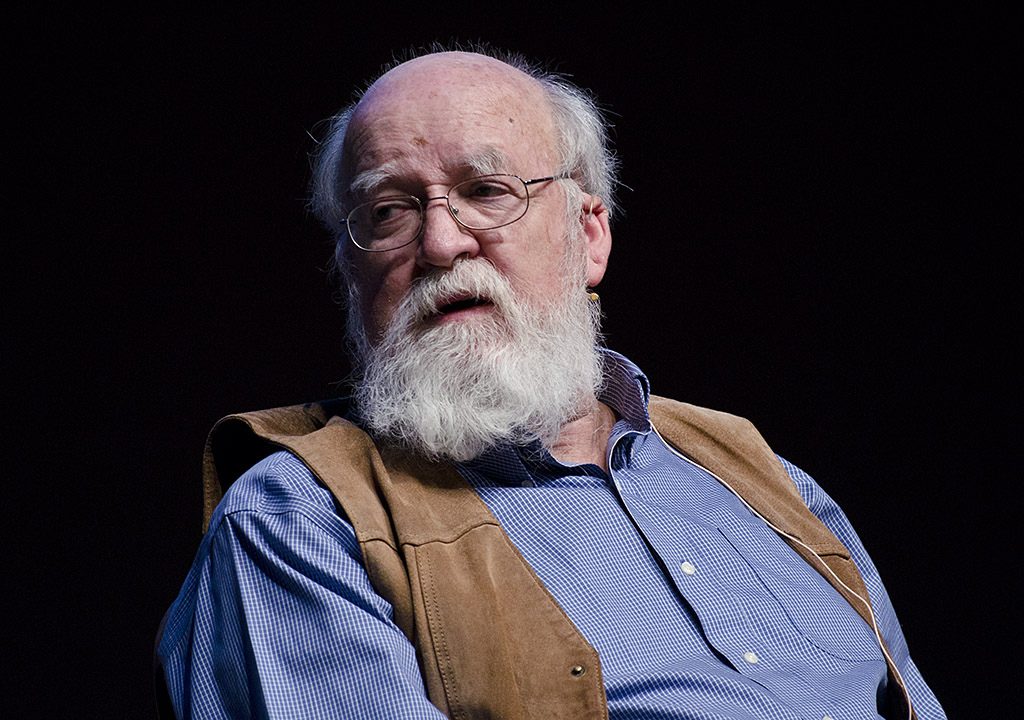
Love him or hate him, many of our readers may know enough about Daniel C. Dennett to have formed some opinion of his work. While Dennett can be a soft-spoken, jovial presence, he doesn’t suffer fuzzy thinking or banal platitudes— what he calls “deepities”—lightly. Whether he’s explaining (or explaining away) consciousness, religion, or free will, Dennett’s materialist philosophy leaves little-to-no room for mystical speculation or sentimentalism. So it should come as no surprise that his latest book, Intuition Pumps And Other Tools for Thinking, is a hard-headed how-to for cutting through common cognitive biases and logical fallacies.
In a recent Guardian article, Dennett excerpts seven tools for thinking from the new book. Having taught critical thinking and argumentation to undergraduates for years, I can say that his advice is pretty much standard fare of critical reasoning. But Dennett’s formulations are uniquely—and bluntly—his own. Below is a brief summary of his seven tools.
1. Use Your Mistakes
Dennett’s first tool recommends rigorous intellectual honesty, self-scrutiny, and trial and error. In typical fashion, he puts it this way: “when you make a mistake, you should learn to take a deep breath, grit your teeth and then examine your own recollections of the mistake as ruthlessly and as dispassionately as you can manage.” This tool is a close relative of the scientific method, in which every error offers an opportunity to learn, rather than a chance to mope and grumble.
2. Respect Your Opponent
Often known as reading in “good faith” or “being charitable,” this second point is as much a rhetorical as a logical tool, since the essence of persuasion involves getting people to actually listen to you. And they won’t if you’re overly nitpicky, pedantic, mean-spirited, hasty, or unfair. As Dennett puts it, “your targets will be a receptive audience for your criticism: you have already shown that you understand their positions as well as they do, and have demonstrated good judgment.”
3. The “Surely” Klaxon
A “Klaxon” is a loud, electric horn—such as a car horn—an urgent warning. In this point, Dennett asks us to treat the word “surely” as a rhetorical warning sign that an author of an argumentative essay has stated an “ill-examined ‘truism’” without offering sufficient reason or evidence, hoping the reader will quickly agree and move on. While this is not always the case, writes Dennett, such verbiage often signals a weak point in an argument, since these words would not be necessary if the author, and reader, really could be “sure.”
4. Answer Rhetorical Questions
Like the use of “surely,” a rhetorical question can be a substitute for thinking. While rhetorical questions depend on the sense that “the answer is so obvious that you’d be embarrassed to answer it,” Dennett recommends doing so anyway. He illustrates the point with a Peanuts cartoon: “Charlie Brown had just asked, rhetorically: ‘Who’s to say what is right and wrong here?’ and Lucy responded, in the next panel: ‘I will.’” Lucy’s answer “surely” caught Charlie Brown off-guard. And if he were engaged in genuine philosophical debate, it would force him to re-examine his assumptions.
5. Employ Occam’s Razor
The 14th-century English philosopher William of Occam lent his name to this principle, which previously went by the name of lex parsimonious, or the law of parsimony. Dennett summarizes it this way: “The idea is straightforward: don’t concoct a complicated, extravagant theory if you’ve got a simpler one (containing fewer ingredients, fewer entities) that handles the phenomenon just as well.”
6. Don’t Waste Your Time on Rubbish
Displaying characteristic gruffness in his summary, Dennett’s sixth point expounds “Sturgeon’s law,” which states that roughly “90% of everything is crap.” While he concedes this may be an exaggeration, the point is that there’s no point in wasting your time on arguments that simply aren’t any good, even, or especially, for the sake of ideological axe-grinding.
7. Beware of Deepities
Dennett saves for last one of his favorite boogeymen, the “deepity,” a term he takes from computer scientist Joseph Weizenbaum. A deepity is “a proposition that seems both important and true—and profound—but that achieves this effect by being ambiguous.” Here is where Dennett’s devotion to clarity at all costs tends to split his readers into two camps. Some think his drive for precision is an admirable analytic ethic; some think he manifests an unfair bias against the language of metaphysicians, mystics, theologians, continental and post-modern philosophers, and maybe even poets. Who am I to decide? (Don’t answer that).
You’ll have to make up your own mind about whether Dennett’s last rule applies in all cases, but his first six can’t be beat when it comes to critically vetting the myriad claims routinely vying for our attention and agreement.
via Mefi
Related Content:
Daniel Dennett and Cornel West Decode the Philosophy of The Matrix in 2004 Film
Daniel Dennett (a la Jeff Foxworthy) Does the Routine, “You Might be an Atheist If…”
90 Free Online Philosophy Courses
Josh Jones is a writer and musician based in Washington, DC. Follow him @jdmagness
Read More...Doors Keyboardist Ray Manzarek Tells the Story of the Classic Song, ‘Riders on the Storm’
Ray Manzarek of the Doors died Monday of cancer. He was 74. Manzarek’s jazz-inflected, classically influenced keyboard playing, woven together with Jim Morrison’s baritone vocals, helped define the sound of the 1960s.
Manzarek and Morrison were both recent graduates of the UCLA film school in 1965 when they had a chance encounter on Venice Beach. Morrison sang a few songs for Manzarek, and the two decided right then and there to start a band. Drummer John Densmore and guitarist Robby Krieger soon joined, and the Doors were born.
From the beginning, the classically trained Manzarek played musical foil to Morrison’s poetic wildman persona. “We just combined the Apollonian and the Dionysian,” Manzarek said of the band in 1997. “The Dionysian side is the blues, and the Apollonian side is classical music. The proper artist combines Apollonian rigor and correctness with Dionysian frenzy, passion and excitement. You blend those two together, and you have the complete, whole artist.”
For a fascinating look at just how beautifully things blended together with the Doors, watch above as Manzarek tells the story of the band’s classic 1971 single, “Riders on the Storm.” The scene is from the 2011 documentary Mr. Mojo Risin’: The Story of L.A. Woman, which chronicles the making of the Doors’ sixth and final studio album. The band recorded “Riders on the Storm” in December of 1970. By the time L.A. Woman was released in April of 1971, Morrison had already moved to Paris, where he died a few months later. “Riders on the Storm” reached number 14 on the Billboard charts in America. You can hear the finished recording below.
Related Content:
A Young, Clean Cut Jim Morrison Appears in a 1962 Florida State University Promo Film
Animations Revive Lost Interviews with David Foster Wallace, Jim Morrison & Dave Brubeck
Read More...Watch Picasso Create Entire Paintings in Magnificent Time-Lapse Film (1956)
How did Pablo Picasso do it? Art historians have spent much time and many words answering that question, but in the video above, you can watch the painter in the act of creation — or, rather, you can watch a series of his paintings as they come into being, evolving from spare but evocative collections of marker strokes into complete images, alive with color. We see Picasso’s visual ideas emerge, and then we see him refine and revise them, sometimes toward a surprising result. All of this happens in under two minutes, since filmmaker Henri-Georges Clouzot shot the artist working with time-lapse photography, compressing each creative process into mere seconds.
This particular sequence became the trailer of Clouzot’s 1956 documentary The Mystery of Picasso. The paintings in it, we read at the end, “cannot be seen anywhere else. They were destroyed upon completion of the film.” Though word on the street has it that one or two of them may actually survive somewhere today, the idea of Picasso paintings existing only on film does capture the imagination, and it moved the French government to officially declare The Mystery of Picasso a national treasure. Picasso had, of course, painted on film before, as you might recall from seeing us feature Paul Haesaerts’ 1950 Visite à Picasso.
If you would like to support the mission of Open Culture, consider making a donation to our site. It’s hard to rely 100% on ads, and your contributions will help us continue providing the best free cultural and educational materials to learners everywhere. You can contribute through PayPal, Patreon, and Venmo (@openculture). Thanks!
Related Content:
Colin Marshall hosts and produces Notebook on Cities and Culture and writes essays on literature, film, cities, Asia, and aesthetics. He’s at work on a book about Los Angeles, A Los Angeles Primer. Follow him on Twitter at @colinmarshall.
Read More...Keith Moon’s Last Interview, 1978
Here’s a sad little piece of rock and roll history: the last television interview of Keith Moon, mercurial drummer for The Who. It was broadcast live on the morning of August 7, 1978, exactly one month before Moon’s death from a drug overdose at the age of 32.
Moon and guitarist Pete Townshend had flown into New York the previous day to promote The Who’s eighth studio album, Who Are You. In addition to a couple of radio interviews, Moon and Townshend stopped by the studios of Good Morning America for a TV interview with a stiff and humorless David Hartman. Moon appears bloated and unhealthy. At one point he makes a joke about not being in control of his life.
“Are you in control of your life at all?” Hartman asks.
“On certain days,” says Moon.
“Certain days.”
“Yeah.”
“What are you like the other days?”
“Quite out of control. Amazingly…ah…drunk.”
Moon’s various addictions had caught up with him by 1978. “Musically,” writes Townshend in Who I Am: A Memoir, “his drumming was getting so uneven that recording was almost impossible, so much so that work on the Who Are You album had ground to a halt.…[The Who] had just about enough tracks for a record, with very little additional material to spare. ‘Music Must Change’ was completed with footsteps replacing drums.”
On the night of September 6, 1978, Moon and his girlfriend Annette Walter-Lax attended a party in London, hosted by Paul McCartney. During the party, and at the midnight premier of The Buddy Holly Story that followed, Moon took Clomethiazole, a sedative prescribed to help him cope with alcohol withdrawal. When he got home, he took more. Walter-Lax found his lifeless body when she checked on him on the afternoon of September 7. An autopsy showed that Moon had taken 32 tablets of Clomethiazole. His doctor had told him not to exceed three per day.
In a public statement following Moon’s death, Townshend wrote: “We have lost our great comedian, our supreme melodramatist, the man, who apart from being the most unpredictable and spontaneous drummer in rock, would have set himself alight if he thought it would make the audience laugh or jump out of its seats. We have lost our drummer but also our alter-ego. He drove us hard many times but his love of every one of us always ultimately came through.… We loved him and he’s gone.”
For something to help us remember Moon’s contribution to The Who–both his musicianship and his personality–here is a video featuring his isolated drum track from “Who Are You,” the title track on Moon’s final album:
Related Content:
Keith Moon’s Final Performance with The Who (1978)
Keith Moon, Drummer of The Who, Passes Out at 1973 Concert; 19-Year-Old Fan Takes Over
Goodnight Keith Moon: “The Most Inappropriate Bedtime Story Ever”
Read More...Allen Ginsberg’s “Celestial Homework”: A Reading List for His Class “Literary History of the Beats”

Click for larger image
“Argh, you’re all amateurs in a professional universe!” roared Allen Ginsberg to a young class of aspiring poets in 1977 at the Jack Kerouac School of Disembodied Poetics. Their offense? Most of the students had failed to register for meditation instruction. The story comes to us from Steve Silberman, who was then a 19-year-old student in that classroom and a recipient of Ginsberg’s genius that summer.
Only three years earlier, in 1974, Ginsberg and poet Anne Waldman launched the Jack Kerouac School at Naropa Institute (now Naropa University), in Boulder, Colorado. The Institute—founded by Tibetan teacher Chögyam Trungpa Rinpoche—was modeled on ancient Buddhist learning centers in India and described by Waldman and poet Andrew Schelling as “part monastery, part college, part convention hall or alchemist’s lab.”
Ginsberg taught at Naropa until his death in 1997. The class in which he had his outburst was called “Literary History of the Beats,” at the start of which he handed his students a list called “Celestial Homework” (first page above, second and third pages here and here). Silberman describes the list thus (quoting from Ginsberg’s description):
This “celestial homework” is the reading list that Ginsberg handed out on the first day of his course as “suggestions for a quick check-out & taste of antient scriveners whose works were reflected in Beat literary style as well as specific beat pages to dig into.”
It’s a particularly Ginsberg-ian list, with a healthy mix of genres and periods, most of it poetry—by Ginsberg’s fellow beats, to be sure, but also by Melville, Dickinson, Yeats, Milton, Shelley, and several more. Sadly, it’s too late to sit at Ginsberg’s feet, but one can still find guidance from his “Celestial Homework,” and you can even listen to audio recordings from the class online too.
Silberman has done us all the great service of compiling as many free online versions of Ginsberg’s recommended texts as he could. You’ll find them all here, with author bios linked to each photo. Unfortunately, some of the links have gone dead, but with a little bit of searching, you can work your way through most of Ginsberg’s list. Silberman reports another Ginsberg epigram from his 1977 class: “Poetry is the realization of the magnificence of the actual.” The works on the “Celestial Homework,” Silberman comments, “are gates to that magnificence.”
Related Content:
Allen Ginsberg Reads His Famously Censored Beat Poem, Howl
Allen Ginsberg Recordings Brought to the Digital Age. Listen to Eight Full Tracks for Free
Josh Jones is a writer and musician based in Washington, DC. Follow him @jdmagness
Read More...Watch 5 Filmmakers Recall Their Most Cringeworthy Moments at the Movies with Mom & Dad
In sixth grade, my friend Amy Osborn’s parents took us to a screening of Annie Hall. The bedroom scenes with Carol Kane, Janet Margolin and Diane Keaton were chaste by today’s standards. The repartee was so beyond my frame of reference, it caused but little discomfort. What did me in was the two-line exchange between a cartoon Woody Allen and Snow White’s Wicked Queen concerning her period (or lack thereof). Are You There God? It’s Me, Margaret was our sacred text, but its most sensational subject matter—menstruation—was deeply taboo outside of my 1970’s Indiana tribe. I could have died, knowing Mr. Osborn was sitting right there. The one consolation was that my own parents weren’t.
These awkward encounters can be defining, which explains why the Tribeca Film Festival sought to ferret them out as part of its One Question series. It’s impressive that the four directors and one producer featured above decided to pursue careers in film after inadvertently sharing with their parents such tender moments as a masturbating Philip Seymour Hoffman in Todd Solondz’s seminal (pardon the pun) Happiness or the relentless defloration scene at the top of Larry Clark’s Kids.
Perhaps you can relate. If so, please spill the gory details below. Provided you’re strong enough to revisit the trauma, what was your most cringe-inducing moment at the movies with your mom or dad, or—let’s not be ageist here—your kids?
Related Content:
The Story Of Menstruation: Watch Walt Disney’s Sex Ed Film from 1946
Dustin Hoffman Talks Sex from the Comfort of His Own Bed (1968)
Ayun Halliday grows less ashamed with every passing year. Follow her @AyunHalliday
Read More...Photographer Revisits Abandoned Movie Sets for Star Wars and Other Classic Films in North Africa
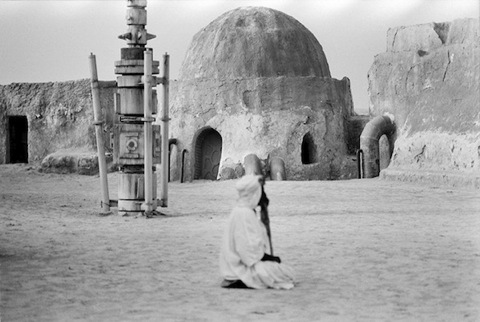
Making a movie? Need to shoot some large-scale desert scenes? You might consider taking your production to North Africa, where you’ll find not only a great many acres of sand, but will follow in the footsteps of some of the twentieth century’s highest-profile filmmakers. Just above, you see a picture of one of the many Star Wars sets still standing in Tozeur, Tunisia, 36 years after the shoot. New York photographer Rä di Martino has taken it upon herself to determine the locations and collect images of these cinematic ruins in the projects “No More Stars” and “Every World’s a Stage.” Given the surprisingly sound condition of some of these sets — that dry air must have something to do with it — I foresee an entrepreneurial opportunity in the vein of all those New Zealand Lord of the Rings fan tours.
Even if Star Wars doesn’t get you excited enough to book a trip to Tunisia, a visit to Morocco may still interest you. Di Martino’s short Petite histoire des plateaux abandonnès (Short History of Abandoned Sets) seeks out more such long-silent fake towns, fortresses, and gas stations around Ouarzazate, originally used for everything from cheap horror movies to Lawrence of Arabia. There, a group of kids recites, deadpan, scenes from the various productions that swung through town well before they were born. These surviving chunks of artifice, meant only for the camera, have found the camera again — or, rather, the camera has found them — with results that now look more interesting than many of the major films that commissioned them.
Related Content:
The Making of The Empire Strikes Back Showcased on Long-Lost Dutch TV Documentary
Hundreds of Fans Collectively Remade Star Wars; Now They Remake The Empire Strikes Back
Colin Marshall hosts and produces Notebook on Cities and Culture and writes essays on literature, film, cities, Asia, and aesthetics. He’s at work on a book about Los Angeles, A Los Angeles Primer. Follow him on Twitter at @colinmarshall.
Read More...1927 London Shown in Moving Color
Back during the 1920s, Claude Friese-Greene, an early British pioneer of film, shot The Open Road, “a series of ten-minute travelogues of Britain,” which were meant “to be shown before the main feature in cinema programmes,” according to the British Film Institute. Clips from that series have appeared for years on the BFI’s YouTube Channel. But, in recent days, the hive mind of the internet has focused on these five minutes of footage showing 1920s London in rare moving color. What draws us to this footage? Perhaps one Vimeo commenter put it best, saying: “Profoundly moving somehow. All those ghosts on film, foreshadowing our footsteps through the same city. Parts of London remain startlingly unchanged. The megalopolis was less corporate then, more imperial, certainly less suspicious of the camera. But, those pastel shades of people are shown dodging the traffic in the same way as we do, perhaps showing us a way through the labyrinth.” It’s hard not to stop and take notice when the past seems distant, yet so close and familiar.
via Kottke
Related Content:
Early Experiments in Color Film (1895–1935)
The Normandy Invasion Captured on 16 mm Kodachrome Film (1944)
Rare Color Footage of the 1939 World Series: Yankees v. Reds
Read More...Ernest Hemingway to F. Scott Fitzgerald: “Kiss My Ass”
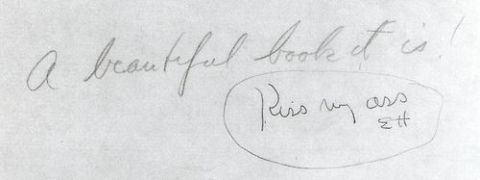
So everyone knows Hemingway was a bruiser. Some of the best stories of his macho posturing involve fellow writers. There was, of course, that time he and Wallace Stevens slugged it out in Key West. I’ve been told Stevens asked for it, drunkenly telling Hemingway’s sister Ursula that her brother wrote like a little boy. I don’t know whose version of the story this comes from, but by all accounts, Hemingway knocked the bear of a poet down several times. The two made up soon after. Then there’s the story of Hemingway and James Joyce; the diminutive Irish writer apparently hid behind his pugnacious friend when trouble loomed.
There are many other such yarns, I’m sure, but one I’ve just learned of shows us a much more passive-aggressive side of Papa H. As the John F. Kennedy Presidential Library blog informs us, Hemingway once sent F. Scott Fitzgerald a typescript of A Farewell to Arms. Fitzgerald sent back ten pages of edits and comments, signing off with “A beautiful book it is!” You can see Hemingway’s first reaction above (signed EH). In later drafts, it seems, he took some of Fitzgerald’s advice to heart.
via @matthiasrascher
Related Content:
Seven Tips From Ernest Hemingway on How to Write Fiction
F. Scott Fitzgerald in Drag (1916)
James Joyce in Paris: “Deal With Him, Hemingway!”
Josh Jones is a writer and musician based in Washington, DC. Follow him @jdmagness
Read More...Support Us
We're hoping to rely on loyal readers, rather than erratic ads. Please click the Donate button and support Open Culture. You can use Paypal, Venmo, Patreon, even Crypto! We thank you!

About Us

Open Culture scours the web for the best educational media. We find the free courses and audio books you need, the language lessons & educational videos you want, and plenty of enlightenment in between.
Advertise With Us

FREE UPDATES!
GET OUR DAILY EMAIL
Get the best cultural and educational resources on the web curated for you in a daily email. We never spam. Unsubscribe at any time.
FOLLOW ON SOCIAL MEDIA

Open Culture editor Dan Colman scours the web for the best educational media. He finds the free courses and audio books you need, the language lessons & movies you want, and plenty of enlightenment in between.
Advertise With Us


