Watch Isabella Rossellini Embody the Animal Kingdom’s Most Shocking Maternal Instincts in Mammas
Mother’s Day can elicit complicated emotions in the human animal. Not so Mother Hamster. While you were out to brunch, she was matter-of-factly devouring the runtiest of her litter. And not because he failed to present her with a bouquet and flowery card. “It’s a good morsel to recoup some of the vitamins and protein that are lost during childbirth,” she explains with a shrug.
This heartwarming vignette is but one of the revelations in Mammas, the latest web series from the inquisitive and extremely game Isabella Rossellini. Having embodied a variety of insects, arachnids, and marine life in the science-based Green Porno and its follow-up Seduce Me, the mother of two is currently suiting up to play some of the Animal Kingdom’s most notorious mothers, from the opportunistic Cuckoo to the self-sacrificing Australian subsocial crab spider (Diaea ergandros).
The comically inventive costumes are an added bonus, particularly for any human mother (or father) with an aversion to dressing their animal-loving offspring in store bought disguises, come Halloween. Catch the complete series here.
Related Content:
The Wild Kingdom: Brought to You by Mutual of Omaha (and YouTube)
Filming a Sprinting Cheetah at 1,200 Frames Per Second
Rainn Wilson Talks About Life’s Big Questions in His Web Series Metaphysical Milkshake
Ayun Halliday thinks Isabella Rossellini is the bee’s knees, especially when her glass legs are filled with beer. Follow her @AyunHalliday
Read More...Record-a-Poem for Mother’s Day
Mother’s Day is tomorrow, and you haven’t gotten Mom a present yet. No worries, head over to poetryfoundation.org, where you can find a selection of Mother’s Day poems — or search for your own. You can even follow the directions here to join the Record-a-Poem group on Soundcloud and then share your poem with Mom. It’ll be better than any Hallmark card, that’s for sure.
Kristin Gecan is the media associate at the Poetry Foundation, which is the publisher of Poetry magazine and an independent literary organization committed to a vigorous presence for poetry in our culture.
How Brewster Kahle and the Internet Archive Will Preserve the Infinite Information on the Web
Brewster Kahle is an unassuming man. But as an internet pioneer and digital librarian, he may rightly be called a founding father of the Open Culture ethos. In 1996, Kahle began work on the Internet Archive, a tremendously important project that acts as a safety net for the memory hole problem of Internet publishing. Kahle developed technology that finds and aggregates as much of the internet as it is able in his massive digital library.
Along with the archive, which Open Culture has drawn from many a time, comes Kahle’s “Wayback Machine,” named for the time-traveling device in a Rocky and Bullwinkle segment featuring the genius dog Mr. Peabody and his pet boy Sherman (the cartoon spelled it as an acronym: WABAC). The “Wayback Machine,” as you probably know, logs previous versions of websites, holding on to the web’s past like classic paper libraries hold on to an author’s papers. (Here’s what we looked like in 2006.)
In the animated adventures of Peabody and Sherman, the Wayback Machine was a monstrous contraption that occupied half of Peabody’s den. And while we often think of Internet space as limitless and disembodied, Kahle’s Internet Archive is also physically housed, in a former Christian Science church now lined with towering servers that store digitized books, music, film and other media for free access. It’s an impressive space for an impressive project that will likely expand past its physical boundaries. As Kahle says above, “it turns out there is no end; the web is, in fact, infinite.”
Kahle is deeply invested in data. The challenges of maintaining the Internet Archive are immense, including translating old, unplayable formats to new ones. But what Kahle calls the greatest challenge is the perennial threat to all libraries: “they burn.” And he’s committed to designing for that eventuality by making copies of the archive and distributing them around the world. If you’re interested in what motivates Kahle, you should watch his 2007 TED talk above. He frames the business of archiving the internet as one of making available “the best we have to offer” to successive generations. “If we don’t do that,” Kahle warns, “we’re going to get the generation we deserve.” It’s a warning worth heeding, I think.
If you would like to support the mission of Open Culture, consider making a donation to our site. It’s hard to rely 100% on ads, and your contributions will help us continue providing the best free cultural and educational materials to learners everywhere. You can contribute through PayPal, Patreon, and Venmo (@openculture). Thanks!
Related Content:
10 Classic Films from the Internet Archive
8,976 Free Grateful Dead Concert Recordings in the Internet Archive, Explored by the New Yorker
Kids (and Less Savvy Marketers) Imagine the Internet in 1995
Josh Jones is a writer and musician based in Washington, DC. Follow him @jdmagness
Read More...Listen to The John Bonham Story, a Radio Show Hosted by Dave Grohl
Rock and roll bands do have a tendency to burn through drummers. The phenomenon has been so noticeable over the years that Spinal Tap did a memorable parody of it. But when Led Zeppelin’s powerhouse of a drummer John Bonham died unexpectedly at the age of 32 on September 25, 1980, there would be no replacing him. Bonham’s distinctive playing was such an integral part of the Led Zeppelin sound that it was hard to imagine anyone else filling his shoes. A few months after his death, the drummer’s grief-stricken bandmates issued a statement announcing the break-up of the group. Without Bonham, they said, “we could not continue as we were.”
The John Bonham Story, first broadcast on BBC radio in 2010, is an engaging one-hour program hosted by Foo Fighters frontman Dave Grohl, former drummer of Nirvana and a lifelong fan of Bonham. The show (above, in its entirety) includes musical performances, many of them rare, along with interviews of the surviving members of Led Zeppelin–Jimmy Page, Robert Plant and John Paul Jones–and others who knew Bonham well, like Vanilla Fudge drummer Carmine Appice, Bad Company singer Paul Rodgers, Bonham’s younger sister Deborah and his son Jason. The John Bonham Story is a nicely produced program, a fascinating look at the life and music of the man who is widely thought of as the quintessential rock and roll drummer.
Related content:
John Bonham’s Isolated Drum Track For Led Zeppelin’s ‘Fool in the Rain’
‘Stairway to Heaven’: Watch a Moving Tribute to Led Zeppelin at The Kennedy Center
Jimmy Page Tells the Story of “Kashmir”
Read More...Steven Soderbergh Writes Twitter Novella After His Retirement From Filmmaking
How does one read Twitter literature? Your thoughts are as good as mine. I suppose I’ll have to learn or end up in the ash heap of old-timey turners of pages. Because Twit Lit is upon us, manifested by Jennifer Egan and now, under the twitter handle “Bitchuation,” by mercurial filmmaker Steven Soderbergh. Having announced his retirement from filmmaking in 2011, Soderbergh made another announcement at the San Francisco Film Festival on the State of Cinema (video above, transcript here). The following day, Soderbergh’s Twitter novella Glue began with the laconic April 28 tweet “I will now attempt to tweet a novella called GLUE.”
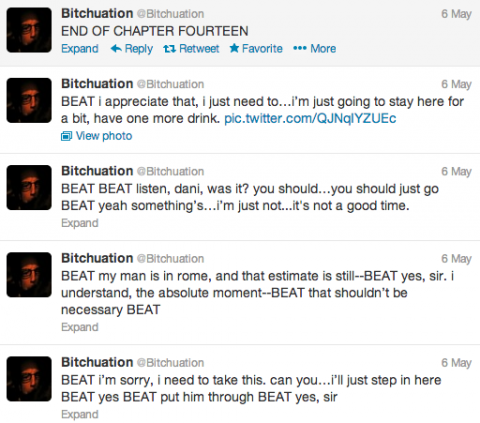
Some unique features of Twit Lit: Soderbergh can twitpic an establishing shot—which he does, of Amsterdam—along with pics of other locations (or just vaguely suggestive images). The individual tweets often read like Horse ebooks absurdities. He’s up to Chapter Fourteen now. The later tweets replicate screenplay dialogue, with copious insertions of BEAT to signify dramatic pauses. Taken together, I suppose there’s coherence, though as I admitted above, I have not mastered the ability to pull tweets together into longer text in my mind, Twitter being where I go when my attention span is spent.
I leave it to savvier, more patient readers to judge the success of Soderbergh’s attempt. It may suffice to say that his pessimism about the state of film does not apply to Twitter Lit. Or maybe he’s just passing time before he makes movies again.
Related Content:
Read, Hear, and See Tweeted Four Stories by Jennifer Egan, Author of A Visit from the Goon Squad
Josh Jones is a writer and musician based in Washington, DC. Follow him @jdmagness
Read More...Revisit Martin Scorsese’s Hand-Drawn Storyboards for Taxi Driver
Anyone who’s watched Martin Scorsese’s Taxi Driver surely remembers, or has remained haunted by, many images from the film, most of which — if not all— began as humble pencil drawings. Like many major motion pictures, Taxi Driver began not just as a script but also as a storyboard, the piece of comic book-like sequential art filmmakers use to plan shots, camera movements, and character placements. Some directors, like Ridley Scott, spend time crafting detailed storyboards, while others, like the thoroughly improvisational Werner Herzog, don’t use them at all. Scorsese falls somewhere in between, sketching out storyboard panels that feel more like brief notes to himself and his closest collaborators. You can see them alongside the Taxi Driver scenes they produced in the video above.
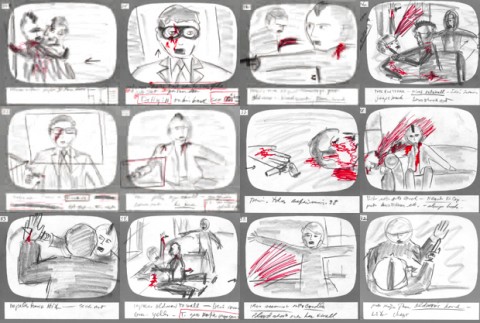
“Storyboards express what I want to communicate,” Scorsese told Phaidon in 2011 for an article on the exhibition “Between Film and Art: Storyboards from Hitchcock to Spielberg.” “They show how I would imagine a scene and how it should move to the next.” And the effect on his process of using as seemingly flimsy a tool as a pencil? “The pencil line leaves little impression on the paper, so if the storyboard is photocopied it loses something. I refer back to my original drawings in order for me to conjure up the idea I had when I saw the pencil line made.” Every filmmaker has their own way of doing things, and as you can see when the video lines up these pencil drawings with (millions of dollars later) the finished sequences, Scorsese’s method gets results. “These storyboards are not the only means of communication for what I imagine,” the director adds at the article’s end, “but they are the point where I begin.”
Related content:
Martin Scorsese’s Very First Films: Three Imaginative Short Works
Martin Scorsese Presents The Blues: A Film Tribute to America’s Great Musical Tradition
Martin Scorsese Brings “Lost” Hitchcock Film to Screen in Short Faux Documentary
Colin Marshall hosts and produces Notebook on Cities and Culture and writes essays on literature, film, cities, Asia, and aesthetics. He’s at work on a book about Los Angeles, A Los Angeles Primer. Follow him on Twitter at @colinmarshall.
Read More...Listen to Recordings of Allen Ginsberg & Other Poets on Phone-a-Poem, the 1970s Poetry Hotline
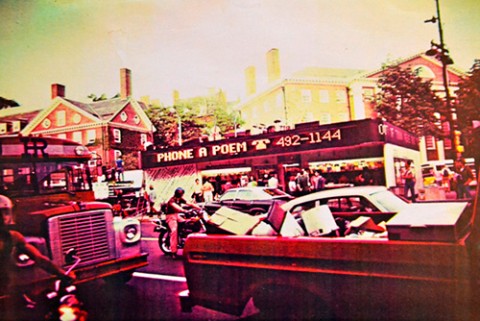 Much of what we once used the telephone for, we now use the internet for. Conversely, some tasks to which the internet now seems perfectly suited were once performed, imperfectly, through the phone. Take the case of hearing poetry read aloud. Today, online poetry resources are readily available; you can hear a variety of poets reading their work with a few well-directed clicks of the mouse (see our list below). But in 1976, you’d have had to rely on Phone-a-Poem. Operated out of Cambridge, Massachusetts by poet Peter Payack, the hotline offered readings by his well-known colleagues, including Allen Ginsberg, Denise Levertov, Donald Hall, Charles Bernstein, Forrest Gander, and Anne Waldman.
Payack mailed these famous poets blank cassettes to fill with poems and then return; into Payack’s answering machine the tapes would go for eager dialers to hear automatically played back. “I gave the average person a chance to hear a poem, and if they didn’t like it, they could just hang up,” Payack said to the Harvard Gazette’s Colin Manning. “Usually, if you wanted to hear the poet’s voice you had to go to poetry readings, which can be intimidating. But this allowed people to hear the poet’s voice in their own home, so it wouldn’t be intimidating.” Phone-a-Poem went out of commission in 2001, but after a recent exhibition of Payack’s cassettes at Harvard University, you can still hear its poems toll free on, yes, the internet, through the playlist embedded above.
H/T via @kirstinbutler; image via Harvard Gazette
Related Content:
Allen Ginsberg Reads His Famously Censored Beat Poem, Howl
Rare 1930s Audio: W.B. Yeats Reads Four of His Poems
“PoemTalk” Podcast, Where Impresario Al Filreis Hosts Lively Chats on Modern Poetry
Colin Marshall hosts and produces Notebook on Cities and Culture and writes essays on literature, film, cities, Asia, and aesthetics. He’s at work on a book about Los Angeles, A Los Angeles Primer. Follow him on Twitter at @colinmarshall.
Read More...John Cage Plays Amplified Cacti and Plant Materials with a Feather (1984)
On January 1, 1984, 25 million viewers tuned in to watch Good Morning, Mr. Orwell!, a live satellite program created by the Korean-born video artist, Nam June Paik. According to reports in The New York Times, Paik created the program with the hope of proving that television could be “an instrument for international understanding rather than an ominous means of thought control,” as George Orwell warned in 1984. And Paik made his pitch with the help of names you’ll recognize from the 1980s cultural scene (assuming your memory goes back that far) — Peter Gabriel, Laurie Anderson, George Plimpton, Oingo Boingo, Philip Glass, the Thompson Twins, Merce Cunningham and Allen Ginsberg.
Above, we’re featuring one memorable performance from Good Morning, Mr. Orwell!, which aired on PBS stations across the US: the avant-garde composer John Cage playing amplified cacti and plant materials with nothing but a feather. Joined on stage by fellow composer Takehisa Kosugi, Cage performs an improvisation that could have accompanied a Merce Cunningham dance. Meanwhile, George Plimpton, a founder of The Paris Review and the host of Good Morning, Mr. Orwell!, provides some narration.
Follow Open Culture on Facebook and Twitter and share intelligent media with your friends. Or better yet, sign up for our daily email and get a daily dose of Open Culture in your inbox. And if you want to make sure that our posts definitely appear in your Facebook newsfeed, just follow these simple steps.
Related Content:
John Cage Unbound: A New Digital Archive Presented by The New York Public Library
John Cage Performs Water Walk on “I’ve Got a Secret” (1960)
Read More...The Finland Wartime Photo Archive: 160,000 Images From World War II Now Online

From the The Finnish Defence Forces comes the Finnish Wartime Photograph Archive, a collection of 160,000 photographs taken during World War II when Finland fought to free itself from Nazi Germany and the Soviet Union. Preserved in their original state, the pictures “portray life on the home front, ruins from bombings, the war industry and events that happened behind the front lines.” As you can imagine, some of the photos can be disturbing.
On a brighter note, let me add this. You can download each and every photo, and use them for educational purposes. The archive only asks that you give proper attribution by mentioning “SA-kuva” as the source. And, indeed, “SA-kuva” should be given credit for the image above.
You can enter the complete archive here.
via Petapixel
Read More...Steven Spielberg’s Obama, Starring Daniel Day Lewis as the President
Sarah Palin didn’t like the 2013 White House Correspondents’ Dinner. In a cranky tweet, she wrote: “That #WHCD was pathetic. The rest of America is out there working our asses off while these DC assclowns throw themselves a #nerdprom.” But I have to disagree with America’s most distinguished half-term governor. Somewhere in Washington, a hard-working writer imagined Barack Obama playing Daniel Day Lewis playing Barack Obama and had the gumption to follow the joke entirely through. Whoever’s responsible for realizing that comic moment, we salute you.
Spielberg’s Obama aired during the Correspondents’ Dinner. You can watch Conan O’Brien’s full comedy routine at the WHCD here.
Related Content:
Steven Spielberg on the Genius of Stanley Kubrick
Watch Steven Spielberg’s Debut: Two Films He Directed as a Teenager
525 Free Movies Online: Great Classics, Indies, Noir, Westerns, etc.
Inside Breaking Bad: Watch Conan O’Brien’s Extended Interview with the Show’s Cast and Creator
Read More...Support Us
We're hoping to rely on loyal readers, rather than erratic ads. Please click the Donate button and support Open Culture. You can use Paypal, Venmo, Patreon, even Crypto! We thank you!

About Us

Open Culture scours the web for the best educational media. We find the free courses and audio books you need, the language lessons & educational videos you want, and plenty of enlightenment in between.
Advertise With Us

FREE UPDATES!
GET OUR DAILY EMAIL
Get the best cultural and educational resources on the web curated for you in a daily email. We never spam. Unsubscribe at any time.
FOLLOW ON SOCIAL MEDIA

Open Culture editor Dan Colman scours the web for the best educational media. He finds the free courses and audio books you need, the language lessons & movies you want, and plenty of enlightenment in between.
Advertise With Us

