A Short Animated History of the GIF
In 1987, Compuserve begatteth Image Format 87A.
Image Format 87A begatteth Graphics Interchange Format or GIF (rhymes with a certain brand of peanut butter, the video history above helpfully points out).
The proliferations of free online GIF generators begatteth the countless annoying, smarmy, boneheaded animated loops you’ve seen junking up emails, profile pictures, and MySpace pages.
Of course, some of them are also pretty cool, which is why they’re being celebrated with a festival at the Brooklyn Academy of Music. No tickets necessary. Moving the Still: A GIF Festival will be screening through June on the outdoor electronic billboard meant to promote upcoming and current attractions. Conceivably, viewers with wheels and time to spare could take it in on an endless loop of their own, by circling up Flatbush to Lafayette, then moving up when the light changes, battling traffic from the nearby Barclays Center on the return leg.
What do we stand to see in this festival? The video history leads us to believe that anything is possible, though certain things—accidental happenings, laser cats, colorful barfing (…wait, colorful barfing?)—have a built in appeal.
Related Content:
A Gallery of Stanley Kubrick Cinemagraphs: Iconic Moments Briefly Animated
Kids (and Less Savvy Marketers) Imagine the Internet in 1995
Ayun Halliday gravitates toward the paper GIFs known as flip books. Follow her @AyunHalliday
Read More...No Women Need Apply: A Disheartening 1938 Rejection Letter from Disney Animation
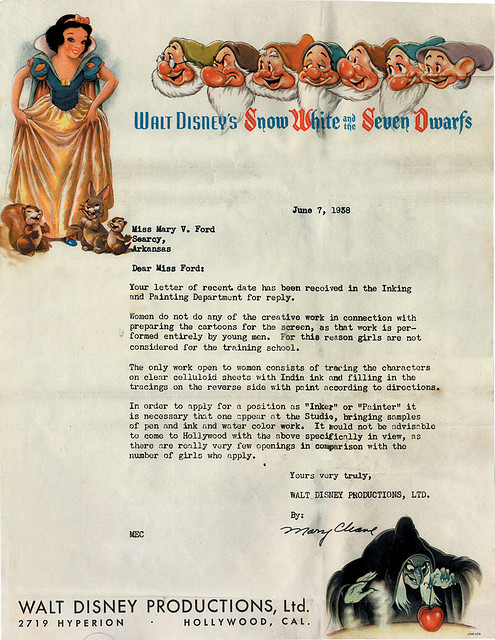
Put yourself in the mind of an artistic young woman who goes to see Disney’s Snow White and the Seven Dwarfs when it first opens in 1937. Captivated by the film’s groundbreaking cel-based cinematic animation, understanding that it represents the future of the art form, you feel you should pursue a career with a studio yourself. Alas, in response to the letter of inquiry you send Disney’s way, you receive the terse rejection letter above. “Women do not do any of the creative work in connection with preparing the cartoons for the screen,” it flatly states, “as that work is performed entirely by young men. For this reason girls are not considered for the training school.” Your only remaining hope? To aim lower on the totem pole and become an “Inker” or “Painter,” but “it would not be advisable to come to Hollywood with the above specifically in view, as there are really very few openings in comparison with the number of girls who apply.”
Times have changed; women now create animation. But to catch a glimpse of the industry in decidedly pre-changed times, revisit the 1939 promotional documentary short How Walt Disney Cartoons Are Made. In it, you’ll see these very young men hard at work, as well as those “pretty girls” hired to do inking and color. Prewar Disney turned out some masterpieces, no doubt, but by today’s standards their attitudes toward gender may leave something to be desired. “This letter originally belonged to my grandmother,” writes the user who discovered the note above. “After she passed away we discovered it and were surprised at how well it was preserved for being nearly 70 years old.” Young women like her, aspiring to high places in animation, found themselves forced to find alternate routes in, although after receiving that rejection letter on that stationery — emblazoned with Snow White herself, adding insult to injury — I wouldn’t blame them for looking into other fields entirely.
via Sociological Images & Mefi
Related content:
How Walt Disney Cartoons Are Made
Donald Duck Wants You to Pay Your Taxes (1943)
Walt Disney Presents the Super Cartoon Camera (1957)
Colin Marshall hosts and produces Notebook on Cities and Culture and writes essays on literature, film, cities, Asia, and aesthetics. He’s at work on a book about Los Angeles, A Los Angeles Primer. Follow him on Twitter at @colinmarshall.
Read More...Tilda Swinton and Barry White Lead 1500 People in Dance-Along to Honor Roger Ebert
The relationship of movie star to critic isn’t always as parasitic and fraught as you might imagine. Witness Tilda Swinton bouncing around the Virginia Theater in Champaign Illinois, urging audience members to get up and dance in honor of the late Roger Ebert. (He gave high praise to Swinton’s 2009 film Julia, one of the offerings in this year’s Ebertfest.)
Prior to leaping into the audience to the strains of Barry White’s “You’re the First, the Last, My Everything”, the actress decreed participation was mandatory, no voyeurism allowed. With Ebert’s widow, Chaz, busting some serious moves in support, most of the 1500 attendees seemed content to split the difference, cheerfully clapping along in their seats (though check out the grim “how long ’til we’re released from this hell” faces of the couple in the balcony at the 4:10 mark).
Remember White Men Can’t Jump? One is tempted to tack on “or dance,” watching the few game souls who truly threw themselves into the spirit of the thing. No shame in that. It was, in Swinton’s words, a “spiritual service”, not a talent contest. Surely the biggest winners are the ones beaming breathlessly from the stage at song’s end. (Honorable mention to anyone who’s inspired to never again let a fear of embarrassment lead to inaction.)
Life is beautiful. Life is short.
- Ayun Halliday wishes she had been there, for sure. Follow her @AyunHalliday
Read More...Mark Rothko is Toast … and More Edible Art from SFMOMA
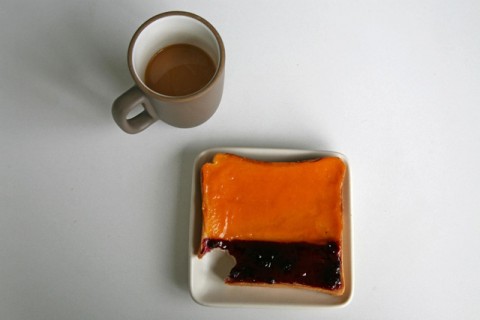
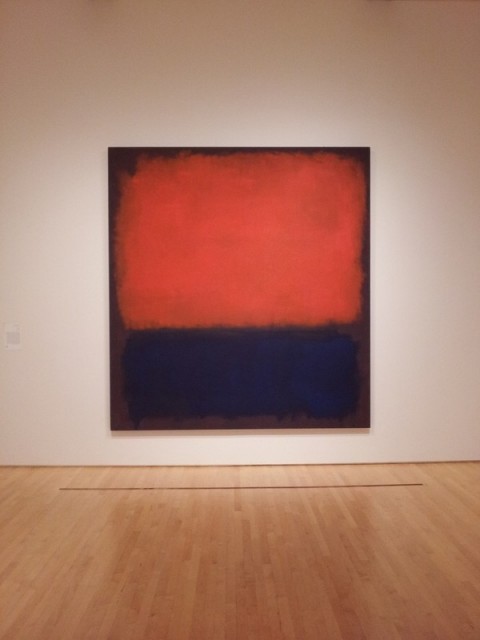
If you head to SFMOMA’s café on Third Street in San Francisco, you can order up some Damien Hirst “Amylamine” lemon velvet cake, Donald Judd tomato soup, and Mark Rothko Toast. The Rothko Toast comes painted with apricot butter along the top, and wild blueberry jam along the bottom, creating an edible imitation of Rothko’s painting known as “No. 14, 1960.” The painting (see below) hangs at SFMOMA, the West Coast’s first museum devoted to 20th century art.
via BoingBoing & sfist
Read More...A Middle-Eastern Version of Radiohead’s 1997 Hit “Karma Police”
We’ve shown you Pakistani musicians playing an amazing version of Dave Brubeck’s Jazz Classic, “Take Five”; also Jimi Hendrix’s ‘Voodoo Chile’ performed on a Gayageum (a traditional Korean instrument); and then the Talking Heads’ “This Must Be the Place (Naive Melody)” played with traditional Chinese instruments. There’s nothing better than these felicitous meetings of east and west. So, today we present a Middle-Eastern flavored version of Radiohead’s 1997 hit “Karma Police,” which originally appeared on the album OK Computer. The video above features Tel Aviv-based singer Rotem Shefy on vocals, Leat Sabbah on cello, Yaniv Taichman on the oud, and Ori Dekel on percussion. This video emerged from a Kickstarter campaign that was successfully funded at the end of 2012.
If you would like to support the mission of Open Culture, consider making a donation to our site. It’s hard to rely 100% on ads, and your contributions will help us continue providing the best free cultural and educational materials to learners everywhere. You can contribute through PayPal, Patreon, and Venmo (@openculture). Thanks!
Related Content:
Radiohead-Approved, Fan-Made Film of the Band at Roseland for 2011′s The King of Limbs Tour
Radiohead’s Thom Yorke Gives Teenage Girls Endearing Advice About Boys (And Much More)
Read More...Led Zeppelin Plays One of Its Earliest Concerts (Danish TV, 1969)
Here’s a great record of what Led Zeppelin looked and sounded like in the first year of the band’s existence. The date was March 17, 1969. The group’s debut album, Led Zeppelin, had been out in America for almost three months but would not be released in the UK for a couple more weeks. Led Zeppelin was on a tour of the UK and Scandinavia when they stopped by the TV-Byen studios in Gladsaxe, Denmark, a suburb of Copenhagen, to play four songs from the new album:
- “Communication Breakdown”
- “Dazed and Confused”
- “Babe I’m Gonna Leave You”
- “How Many More Times”
Zeppelin had only been together a little more than half a year when the TV show was recorded (the band’s first gig, on September 7, 1968, also happened to have been in Gladsaxe) but they sound tight. Some of the band’s trademark theatrics are already in place, including Jimmy Page’s ethereal violin-bow guitar solo. Page is playing his classic 1959 Fender Telecaster, a gift from Jeff Beck that Page had painted a dragon on and used as his main guitar during his days with the Yardbirds. Only a month before this broadcast, during Zeppelin’s kickoff tour of America, Joe Walsh had given Page a Gibson Les Paul. By the time Led Zeppelin II was finished, Page had switched to the Les Paul and basically retired the Telecaster, though he played it on his famous 1971 solo in “Stairway to Heaven.”
Related Content:
Jimmy Page, 13, Plays Guitar on BBC Talent Show (1957)
‘Stairway to Heaven’: Watch a Moving Tribute to Led Zeppelin at The Kennedy Center
John Bonham’s Isolated Drum Track For Led Zeppelin’s ‘Fool in the Rain’
Jimmy Page Tells the Story of Kashmir
Read More...Inside Breaking Bad: Watch Conan O’Brien’s Extended Interview with the Show’s Cast and Creator
“The Mad Men collection at Banana Republic is okay,” joked a comedy-writer friend of mine, “but the Breaking Bad collection at TJ Maxx is to die for.” A fantastic line, for sure — though I would argue that Banana Republic’s Mad Men collection is not, in fact, okay — and one that highlights just how wide a spectrum of sensibility and setting this new wave of critically acclaimed cable television offers us. Over the past half-decade, these two dramas, Mad Men set in the early sixties’ high-flying advertising industry and Breaking Bad set on the contemporary New Mexican meth-cooking scene, have together drawn the lion’s share of this acclaim. What’s more, they’ve both done it on AMC, the channel whose previous service consisted primarily of Audrey Hepburn movies, served to your great aunt. Sure, maybe you’d expect from them a period series something like Mad Men. But the grittier, more troubling Breaking Bad? How did all involved pull it off?
In the hour-long video above, the astute investigator known as Conan O’Brien leads a panel discussion about the show featuring, among several others, creator Vince Gilligan and star Bryan Cranston. From his web series Serious Jibber-Jabber, on which he’s held in-depth conversations with the likes of historian Edmund Morris and statistician Nate Silver, we’ve learned that Conan can do long-form interviews and get answers to the important questions. Here we have the important question — not least, naturally, to AMC itself — of how Breaking Bad became, in the words of various critics, a “taut exercise in withheld disaster,” a “feel-good show about feeling really bad,” a “superlatively fresh metaphor for a middle-age crisis” and a “combination of staggering and transfixing weirdness” that “elevates the artistic achievements of the medium,” ultimately becoming “one of television’s finest dramatic accomplishments.” If these words strike you as hyperbolic, watch the compilation just above that profiles the long-term transformation of Bryan Cranston’s protagonist Walter White. Then you’ll want to watch the series, which ends this summer, and add some words of your own.
Colin Marshall hosts and produces Notebook on Cities and Culture and writes essays on literature, film, cities, Asia, and aesthetics. He’s at work on a book about Los Angeles, A Los Angeles Primer. Follow him on Twitter at @colinmarshall.
Read More...Amazing Flipbook Animation Shows Off the Skills of Ronaldinho
Ronaldo de Assis Moreira, otherwise simply known as Ronaldinho, plays football/soccer for Atlético Mineiro and currently captains the Brazilian national team. And the artist ‘Etoilec1,’ whose real name remains obscure to us, creates some amazing flipbooks, including this one that animates Ronaldinho’s finest moments on the pitch. You can watch real highlights of Ronaldinho’s footwork here, and find more carefully wrought flipbooks by Etoilec1 here.
via mefi
Find us on Facebook, Twitter and Google Plus and we’ll make it easy to share intelligent media with your friends!
Read More...Read the First Page of Thomas Pynchon’s New Novel, Bleeding Edge

Click the image for a larger view. And if it doesn’t get large enough, click it again…
Pynchon. What to say? An all-night marathon reading of Gravity’s Rainbow changed my brain chemistry. A couple days locked in a room with V altered my reality forever. I read the first chapter of Mason & Dixon. Bought and forgot a copy of Against the Day. Scanned a review of Inherent Vice.
So maybe the later Pynchon hasn’t grabbed me, or my leisure reading time has just evaporated. Or both. I’m sure I’m not alone in this. But now we’ve got another chance to gape at the reclusive paranoiac’s labyrinthine prose, since his new novel Bleeding Edge comes out September 17th. And publisher Penguin has thrown us a morsel—you can read the first page of Bleeding Edge (above), from Penguin’s Fall 2013 catalog.
Described as a “historical romance on New York in the early days of the internet,” Bleeding Edge takes place in a pre-lapserian 2001, “in the lull between the collapse of the dot-com boom and the terrible events of September 11th.” The novel promises plenty of intrigue, dark humor, layers of occult foreboding, “lamentations about the ’60s counterculture,” and “shady fascistic organizations with futuristic names.”
Read the full description of Bleeding Edge at Gothamist.
Josh Jones is a writer and musician based in Washington, DC. Follow him @jdmagness
Read More...Ira Glass on the Art and Craft of Telling Great Radio Stories
As television news continues its pathetic slide into the abyss of celebrity worship, political partisanship and 24-hour punditry, its encouraging to note that in one area of traditional broadcasting there is actually something of a renaissance going on. Public radio is bucking the trend with programs like Radiolab and This American life, shows that do nothing to confirm our biases, but instead engage our curiosity and teach us something new.
In this funny and thought-provoking talk from the 2007 Gel Conference, Ira Glass, host of This American Life, explains a little of what goes into a good radio story. “Narrative,” he says, “is basically a machine that’s raising questions and answering them.” Glass’s talk is very much like his radio show. In exchange for a little patience, you will be rewarded with a good story and perhaps an insight or two.
Related Content:
Ken Burns on the Art of Storytelling: “It’s Lying Twenty-Four Times a Second”
The Moth Now Streams its Brilliant & Quietly Addictive Stories on the Web
Ira Glass on Why Creative Excellence Takes Time
Read More...Support Us
We're hoping to rely on loyal readers, rather than erratic ads. Please click the Donate button and support Open Culture. You can use Paypal, Venmo, Patreon, even Crypto! We thank you!

About Us

Open Culture scours the web for the best educational media. We find the free courses and audio books you need, the language lessons & educational videos you want, and plenty of enlightenment in between.
Advertise With Us

FREE UPDATES!
GET OUR DAILY EMAIL
Get the best cultural and educational resources on the web curated for you in a daily email. We never spam. Unsubscribe at any time.
FOLLOW ON SOCIAL MEDIA

Open Culture editor Dan Colman scours the web for the best educational media. He finds the free courses and audio books you need, the language lessons & movies you want, and plenty of enlightenment in between.
Advertise With Us

