Friedrich Nietzsche & Existentialism Explained to Five-Year-Olds (in Comical Video by Reddit)
Who’s ready for a lesson on “Eggsalentlalism?” How about “Exatentalum?” Sound like fun? Great! Pull up a tiny chair, grab a toy, and get ready to have Nietzsche explained like you’re five with “Explain Like I’m Five: Existentialism and Friederich Nietzsche.” A web series inspired by a subreddit, “Explain Like I’m Five” has explained other complicated subjects to five year-olds, including the crisis in Syria and the volatility of the stock market. In this episode, our two presenters prime their students for a discussion on slave morality with the question “who here thinks they’re a good boy or a good girl?”
All the kids eagerly raise their hands, and after some Socratic dialogue are told that Existentialism means “there is no universal morality that governs all of us.” I’ll leave it to the philosophers out there to assess this definition. The kids don’t respond well. They hate Nietzsche. One vociferous young critic proposes tossing him on the street and stepping on him. Like good 19th century German burghers, they can’t imagine a world without rules. I imagine these kids’ parents would also like to toss Nietzsche in the street when their angels come home paraphrasing Beyond Good and Evil.
Some of the popular responses to Nietzsche among adults can also be overly emotional. First there is fear: of the supposed nihilist who proclaimed the death of God and who—thanks to the machinations of his unscrupulous and anti-Semitic sister—became erroneously associated with Nazi ideology after his death. Then there’s the enthusiastic embrace of Nietzsche’s work by unsophisticated readers who see him only as an antiestablishment romantic rebel, hellbent on undermining all authority. Some of these impressions are valid as far as they go, but they tend to stop with the style and leave out the substance.
What people tend to miss are Nietzsche’s sustained defense of a pragmatic naturalism and his tragic embrace of individual human freedom, which is not won without great personal cost. The unusual thing about Existentialism is that it’s a philosophy so broad, or so generous, it can include the anti-Christian Nietzsche, radically Christian Kierkegaard, and the Marxist Sartre. A more serious treatment of the subject—1999 three-part BBC documentary series “Human All Too Human”—also includes Martin Heidegger, who actually did truck with Nazi ideology. The series, which profiles Nietzsche, Heidegger, and Sartre, begins with the Nietzsche doc below (this one with Portuguese subtitles).
If you’re new to Nietzsche, and not actually a five-year-old, it’s worth an hour of your time. Then maybe head on over to our collection of venerable Princeton professor Walter Kaufmann’s lectures on Nietzsche, Kierkegaard, and Sartre. For additional serious resources, Dr. Gregory B. Sadler has an extensive YouTube lecture series on Nietzsche, Existentialism, and other philosophical topics. And if all you want is another good chuckle at Nietzsche’s expense, check out Ricky Gervais’ take on the woefully misunderstood philosopher.
Related Content:
Existentialism with Hubert Dreyfus: Four Free Philosophy Courses
The Existential Star Wars: Sartre Meets Darth Vader
The Dead Authors Podcast: H.G. Wells Comically Revives Literary Greats with His Time Machine
Find Many Classic Works by Nietzsche in our Free eBooks Collection
Josh Jones is a writer and musician based in Washington, DC. Follow him @jdmagness
Read More...83 Years of Great Gatsby Book Cover Designs: A Photo Gallery
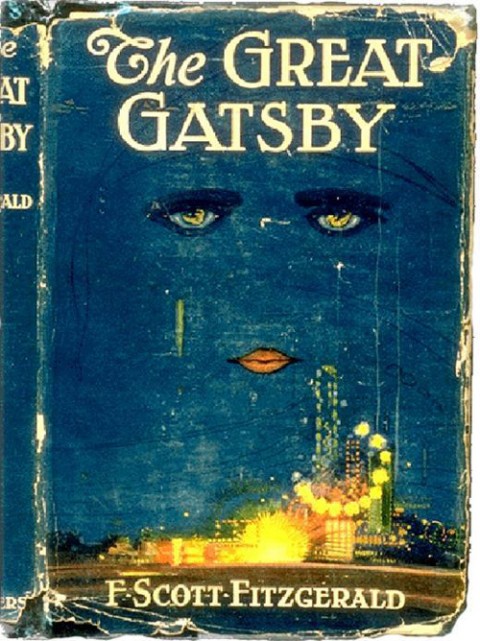 Everybody is familiar with Francis Cugat’s original cover art for The Great Gatsby. It famously gives expression to lines from Fitzgerald’s classic work — lines that talk about Daisy Buchanan as the “girl whose disembodied face floated along the dark cornices and blinding signs.” According to Charles Scribner III, the original publisher, Cugat created the design while Fitzgerald was still writing the novel, and when Fitzgerald saw the disembodied face, he couldn’t resist writing the imagery into the book. Scribner quotes the author as saying, “For Christ’s sake, don’t give anyone that jacket you’re saving for me. I’ve written it into the book.”
Today, Cugat’s original book jacket fetches more at auction than a first edition of the novel itself. And even though many other artists have taken a crack at designing covers for The Great Gatsby, none holds a candle to Cugat’s 1925 design. Just take a look at this photo gallery at The New York Times. (Click on each cover to see them in a larger format.)
The Gatsby book covers all currently reside at the University of South Carolina, which houses other items that Fitzgerald held near and dear to him — like his copy of Joyce’s Ulysses, his leather briefcase, flask, and more. You can also find original dust jackets for Fitzgerald’s other novels on the SC web site, including Tender is the Night, This Side of Paradise, and The Last Tycoon.
Related Content:
Seven Tips From F. Scott Fitzgerald on How to Write Fiction
Lolita Book Covers: 100+ Designs From 37 Countries (Plus Nabokov’s Favorite Design)
Jack Kerouac’s Hand-Drawn Cover for On the Road
Find The Great Gatsby in our Free eBooks collection
Find the Yale Course “Hemingway, Fitzgerald, Faulkner” in our Collection of 700 Free Online Courses
Learn How Richard Feynman Cracked the Safes with Atomic Secrets at Los Alamos
The story has become part of physics lore: A young Richard Feynman, future Nobel winner, was bored with life in the remote New Mexico desert while working on the atomic bomb during World War II, so he amused himself by learning to pick the combination locks in the supposedly secure filing cabinets containing America’s nuclear secrets. As Feynman would later write in his essay, “Safecracker Meets Safecracker”:
To demonstrate that the locks meant nothing, whenever I wanted somebody’s report and they weren’t around, I’d just go in their office, open the filing cabinet, and take it out. When I was finished I would give it back to the guy: “Thanks for your report.”
“Where’d you get it?”
“Out of your filing cabinet.”
“But I locked it!”
“I know you locked it. The locks are no good.”
So the officials at Los Alamos installed cabinets with better locks. But Feynman studied the new ones systematically, and eventually, given a little time, he could open any lock at will. As a joke, he left a note in one cabinet that said, “I borrowed document no. LA4312–Feynman the safecracker.”
I opened the safes which contained all the secrets to the atomic bomb: the schedules for the production of the plutonium, the purification procedures, how much material is needed, how the bomb works, how the neutrons are generated, what the design is, the dimensions–the entire information that was known at Los Alamos: the whole schmeer!
To learn a bit about how Feynman did it, watch this fascinating little video by journalist Brady Haran of the YouTube-funded Numberphile. Haran interviews Roger Bowley, emeritus professor of physics at the University of Nottingham, who explains several of the ingenious methods used by Feynman to solve the problem of cracking a lock with (supposedly) a million possible combinations. And to learn more about Feynman’s adventure as a safecracker, be sure to read “Safecracker Meets Safecracker,” which is included in his book Surely You’re Joking, Mr. Feynman! and can be read on PDF by clicking here.
If you would like to support the mission of Open Culture, consider making a donation to our site. It’s hard to rely 100% on ads, and your contributions will help us continue providing the best free cultural and educational materials to learners everywhere. You can contribute through PayPal, Patreon, and Venmo (@openculture). Thanks!
Related Content:
Free: Richard Feynman’s Physics Course from Cornell (1964)
Richard Feynman’s Ode to a Flower: A Short Animation
Read More...Harvard Thinks Big 4 Offers TED-Style Talks on Stats, Milk, and Traffic-Directing Mimes
Despite having no experience with schools of its stature beyond what I’ve gleaned from Take Ivy, I do know that Harvard University cultivates minds to discuss the next big ideas. That, in fact, has provided the premise for Harvard Thinks Big, a series that takes a handful of Harvard educators and the Harvard-educated and has them talk about what’s next for humanity. The fourth and most recent annual iteration of Harvard Thinks Big brought seven speakers on stage, allowing each of them twelve minutes to break down a topic of great importance. Seemingly with an eye toward the widest intellectual variety, Harvard Thinks Big 4 features information-dense mini-lectures from experts on statistics, literature, evolutionary biology, law, classics, Chinese history, and jackfruit. (That last one comes from Annemarie Ryu, current Harvard junior and founder of Global Village Fruits.) You can watch a collection of Harvard Thinks Big talks on Youtube or on iTunes. At either location, you’ll also find talks from past years including Jill Lepore on the meaning of life and, just below, Edward Glaeser on the ever-increasing importance of cities.
There you can watch selected talks from Harvard Thinks Big 4, to which the Crimson offers a “tl;dr guide” here. “According to Kant, art can communicate that which doesn’t have a name yet,” writes the paper’s Lynn Miao, describing professor Dorris Sommer’s lecture, viewable at the top of this post. “That somehow involves the mayor of Bogota replacing cops with pantomimes to direct traffic, which actually correlated with a decline in traffic accidents and homicide rates. Apparently, the shock value of clowns, and public art, reaches across nations.” Or perhaps you’d prefer to hear why milk “can prevent obesity, save up to 1.5 million deaths from diarrhea by contributing healthy gut bacteria, save premature babies — essentially everything short of curdling when in contact with lemon,” for which check out professor Katherine J. Hinde’s presentation below. It’s called “Why Mammals Suck.” We think of Harvard as one of the most serious places in America, but clearly, at events like Harvard Thinks Big, they know how to have a good time.
Related Content:
Harvard Thinks Big 2012: 8 All-Star Professors. 8 Big Ideas
Harvard Thinks Green: Big Ideas from 6 All-Star Environment Profs
Harvard and MIT Create EDX to Offer Free Online Courses Worldwide
Colin Marshall hosts and produces Notebook on Cities and Culture and writes essays on literature, film, cities, Asia, and aesthetics. He’s at work on a book about Los Angeles, A Los Angeles Primer. Follow him on Twitter at @colinmarshall.
Read More...The Police Sing “Message in a Bottle” for the First Time Live (1979)
The Police pulled off the most unlikely of musical feats. While several bands combined the restless, raw energy of punk with the rhythmic, tuneful urgency of reggae, these guys wrapped it all up in the accomplished musicianship and off-kilter key changes and shifting time signatures of jazzy prog rock. This had never been done before, and anyone who’s tried it since owes a tremendous debt to Sting, Andy Summers, and Stewart Copeland (no one comes to mind, though). The fact that they were able to retain rock credibility while winning pop stardom and a Grammy for a rock instrumental (1979’s krautrock-influenced “Regatta de Blanc”) are all further testaments to the phenomenal oddity that was this band. While I’ve never been much of a fan of Sting’s solo work, The Police have always kind of astonished me with their bravery and virtuosity.
And so we come to the act of bravery above: in a live appearance at Hatfield Polytechnic (now the University of Hertfordshire) in February of 1979, the band decides to drop a new, untested song on the enthusiastic crowd. The song? “Message in a Bottle” from the ’79 album Regatta de Blanc, the same record that produced that Grammy-winning title-track instrumental. What’s so brave about that, you ask? There’s often no better way to try out new material than in front of an already appreciative audience. Well, this gig was recorded for a BBC series called “Rock Goes to College.” Although The Police were skirting stardom with the single “Roxanne” from their first album, they hadn’t quite made it yet, and their first TV appearance was a risky venue for demoing a new tune. But they pull it off. The crowd bounces in time and the three Police, who seem on the edge of a mistake or dropped note somewhere, give the song a flawless turn.
You can watch the full “Rock Goes to College” concert below, which also includes early hits like “Can’t Stand Losing You” (the opener) and “Roxanne” (at 29:45).
Related Content:
Pavarotti Sings with Lou Reed, Sting, James Brown and Other Friends
The First Live Performance of Nirvana’s “Smells Like Teen Spirit” (1991)
Two Very Early Concert Films of R.E.M., Live in ‘81 and ‘82
Josh Jones is a writer and musician based in Washington, DC. Follow him @jdmagness
Read More...Free: Watch Jackie Robinson Star in The Jackie Robinson Story (1950)
This weekend, the new Jackie Robinson biopic, 42, opened up well in the box offices, bringing in $27.3 million in ticket sales. That puts it at the top of the charts, which is a real rarity for a baseball film.
This isn’t the first time Jackie Robinson’s story has been told on film. And today we’re bringing you another noteworthy production, The Jackie Robinson Story from 1950. As reviewers are quick to note, it’s not a work of art. It’s a simple film with low production values. But, it has one thing that other Jackie Robinson films do not — Jackie Robinson playing himself, and quite well at that. Running 76 minuters, the fast-paced film takes the audience through the life and times of the great baseball player and civil rights figure. His youth, college football days, military service, minor league career, amazing 1949 season with the Brooklyn Dodgers — they all get covered here.
The Jackie Robinson Story (which is now in the public domain) has been added to our collection of 525 Free Movies Online.
via Slate
Related Content:
Lou Gehrig, Yankee Legend, Stars in 1938 Western Rawhide
Bill Murray’s Baseball Hall of Fame Speech (and Hideous Sports Coat)
The Grateful Dead Rock the National Anthem at Candlestick Park: Opening Day, 1993
Read More...Remembering Maria Tallchief, America’s Great Prima Ballerina
The brilliant Native American ballerina Maria Tallchief died Thursday at the age of 88. Tallchief is remembered as one of the great ballet stars of the 20th century. In her New York Times obituary, the dancer and choreographer Jacques d’Amboise is quoted as comparing Tallchief to the legendary dancers Galina Ulanova of the Soviet Union and Margot Fonteyn of Britain: “When you thought of Russian ballet, it was Ulanova. With English ballet, it was Fonteyn. For American ballet, it was Tallchief. She was grand in the grandest way.”
Tallchief was born on January 24, 1925 in Fairfax, Oklahoma. Her father was a full-blooded Osage Indian whose family became wealthy when oil was discovered on their land. When she was eight years old her family moved to Los Angeles, partly so that she and her younger sister Marjorie could find better dance instruction. Tallchief showed early promise and eventually became a student of the Russian émigré dancer and choreographer Bronislava Nijinska. In 1942 she joined the Ballet Russe de Monte Carlo in New York, where it was based during World War II. In New York, Tallchief quickly grew to prominence, attracting the attention of the legendary choreographer George Balanchine, who became the first of her three husbands.
The clip above, from the 1989 film Dancing for Mr. B: Six Balanchine Ballerinas, shows Tallchief reminiscing about Balanchine and dancing the title role in his 1949 New York City Ballet production of Igor Stravinsky’s Firebird. Balanchine choreographed the ballet especially for Tallchief, and it became her signature role. The sets and costumes of the 1949 production were designed by Marc Chagall. “Maria Tallchief made an electrifying appearance,” wrote the impressario Lincoln Kirstein after the opening of Firebird, “emerging as the nearest approximation to a prima ballerina that we had yet enjoyed.”
For more of Tallchief’s dancing, see the film clip below of her and Rudolf Nureyev, in his American debut, dancing the pas de deux from the August Bouronville ballet, The Flower Festival in Genzano. The performance was broadcast on the Bell Telephone Hour on January 19, 1962, less than a year after Nureyev’s defection to the West and four years before Tallchief’s retirement as a dancer.
Tom Lehrer’s Mathematically and Scientifically Inclined Singing and Songwriting, Animated
I went through childhood listening to Tom Lehrer’s “New Math”. The 1965 song, performed in part like standard spoken-word comedy, made me laugh every time. “In the new approach,” the satirist says of the revolutionary mathematics he purports to teach us, “the important thing is to understand what you’re doing rather than to get the right answer.” Working aloud through a subtraction problem at the piano, Lehrer sings the operations: “And so you’ve got thirteen tens and you take away seven and that leaves five. Well, six, actually, but the idea’s the important thing.” This struck me at the time as nothing more than an amusingly goofy numeric riff, and perhaps one with harsh implications for the flaky educational fads of the nineties my peers and I then endured. Only years later did I find out that Cold War America of the early sixties actually went through a New Math phase, shaken hard enough by Sputnik to desperately foist abstract, set theory-driven math textbooks upon its elementary schoolers.
Lehrer, who turned 85 on Tuesday, knows the subject well: he holds degrees in mathematics from Harvard, has co-authored such papers as “Random walks with restraining barrier as applied to the biased binary counter” and “The distribution of the number of locally maximal elements in a random sample”, and, after retiring from music in the early seventies, taught math classes at the University of California, Santa Cruz. Legend has it that he would incorporate relevant songs from his catalog into lectures. But he never sang only about mathematics; he also sang about physics, as you can see in the animated version of his 1959 song “The Elements” above, a tribute simultaneously to the periodic table and The Pirates of Penzance. Nobody can deny the importance of learning how to subtract or how to tell one element from another, but we’d do well to keep Lehrer’s sharp human insights, present implicitly in all his music and explicitly in some of it, in mind. So put one of his records on the next time you have a birthday of your own, taking a bracing shot of his wit before you continue, as he put it in “Bright College Days”, “sliding down the razor blade of life.”
Colin Marshall hosts and produces Notebook on Cities and Culture and writes essays on literature, film, cities, Asia, and aesthetics. He’s at work on a book about Los Angeles, A Los Angeles Primer. Follow him on Twitter at @colinmarshall.
Read More...Watch Werner Herzog Eat His Shoe, Cooked by Chef Alice Waters (1980)
Les Blank made quiet, affectionate films about quirky subjects. Many of his films paid homage to the music and food he loved—The Blues Accordin’ to Lightnin Hopkins and Yum Yum Yum! A Taste of Cajun and Creole Cooking. Blank was a lover of many traditional American musical forms. Some of his movies are the only known filmed documents of artists who are now gone.
Blank died April 7 at his home in Berkeley, California. He leaves behind a catalog of films that seem small but in fact take on the biggest subjects: humanity, love, commitment, joy and individualism.
In Gap-Toothed Women, Blank creates a singular love letter to women who shun orthodontics and embrace their diastema (the gap between the two front teeth). The film explores the origins of the belief that women with this feature are unusually lusty (think of Chaucer’s “gap-toothed wife of Bath”) and ends up celebrating unconventional beauty.
One of his most interesting works developed out of an inside joke. Blank was a friend of the director Werner Herzog. Herzog, in turn, had mentored the young filmmaker Errol Morris, who was making his first film, Gates of Heaven. In a characteristically dark attempt to be encouraging, Herzog quipped that he would eat his shoe if Morris completed the film.
A man of his word, Herzog later ate the shoe in front of an audience inside Berkeley’s U.C. Theater. Food pioneer Alice Waters cooked the shoe for five hours in garlic and wine. Blank filmed the event in 1980 and, true to his style, stepped back from the subject and created a film about making honest art. You can watch it above.
Kate Rix writes about digital media and education. Visit her website: .
If you would like to support the mission of Open Culture, consider making a donation to our site. It’s hard to rely 100% on ads, and your contributions will help us continue providing the best free cultural and educational materials to learners everywhere. You can contribute through PayPal, Patreon, and Venmo (@openculture). Thanks!
Related Content:
Werner Herzog and Cormac McCarthy Talk Science and Culture
Errol Morris: Two Essential Truths About Photography
Portrait Werner Herzog: The Director’s Autobiographical Short Film from 1986
Read More...The Rolling Stones Live in Hyde Park, 1969
As the Rolling Stones gear up for their first full tour in five years, we take you back to a more innocent time, when the band was young and the tickets were not $500 each.
The year was 1969. The hippie counterculture was still in bloom, and the Stones were at a moment of transition. The band was in the process of finishing its Let it Bleed album at Olympic Studios in London without founder and multi-instrumentalist Brian Jones, who was asked to leave the group in early June because of his escalating drug problem and increasingly difficult personality. The Stones replaced Jones with the talented guitarist Mick Taylor. Eager to get rolling again, the group asked a promoter to organize a free music festival in Hyde Park, with the Stones at the top of the bill.
On July 5, 1969, a crowd of between 250,000 and 500,000 people gathered for the concert. Only three nights earlier, Brian Jones was found dead at the bottom of his swimming pool. In his honor, Mick Jagger started the Hyde Park concert by reading a passage from Percy Bysshe Shelley’s “Adonais: An Elegy on the Death of John Keats.” The Stones then released thousands of white butterflies and launched into a raw set that included both classics and rarities:
- “I’m Yours & I’m Hers”
- “Jumpin’ Jack Flash”
- “Mercy Mercy”
- “Down Home Girl”
- “Stray Cat Blues”
- “No Expectations”
- “I’m Free”
- “Loving Cup”
- “Love in Vain”
- “(I Can’t Get No) Satisfaction”
- “Honky Tonk Women”
- “Midnight Rambler”
- “Street Fighting Man”
- “Sympathy for the Devil”
The concert was documented by filmmakers Leslie Woodhead and Jo Durden-Smith for Granada Television and was later released on DVD as The Stones in the Park. You can watch the complete film above, although the songs will not appear in the same order as in the concert. It is a fascinating and enjoyable record of one of the most notable concerts the Stones ever gave.
This coming July 6, exactly 44 years and a day after the 1969 concert, the Stones will return to Hyde Park for another concert. This time around it won’t be free. And oh yes: The concert will be sponsored by Barclaycard, from the bank with the trusty slogan, “Fluent in Finance.”
Related Content:
The Rolling Stones Sing Jingle for Rice Krispies Commercial (1964)
The Rolling Stones Sing the Beatles’ “Eight Days a Week” in a Hotel Room (1965)
The Rolling Stones First Played 50 Years Ago; Watch Them Explode Into Fame Shortly Thereafter
Read More...Support Us
We're hoping to rely on loyal readers, rather than erratic ads. Please click the Donate button and support Open Culture. You can use Paypal, Venmo, Patreon, even Crypto! We thank you!

About Us

Open Culture scours the web for the best educational media. We find the free courses and audio books you need, the language lessons & educational videos you want, and plenty of enlightenment in between.
Advertise With Us

FREE UPDATES!
GET OUR DAILY EMAIL
Get the best cultural and educational resources on the web curated for you in a daily email. We never spam. Unsubscribe at any time.
FOLLOW ON SOCIAL MEDIA

Open Culture editor Dan Colman scours the web for the best educational media. He finds the free courses and audio books you need, the language lessons & movies you want, and plenty of enlightenment in between.
Advertise With Us

