The Only Known Footage of the 1926 Film Adaptation of The Great Gatsby (Which F. Scott Fitzgerald Hated)
Everyone’s getting ready for the release of The Great Gatsby, the new film adaptation of F. Scott Fitzgerald’s 1925 classic novel. Directed by Baz Luhrmann, this version stars Leonardo DiCaprio, Tobey Maguire, Carey Mulligan, Isla Fisher and others. It has been shot in 3D.
Undoubtedly, critics will be quick to compare the 2013 adaptation to the 1974 production, which had its own strengths — a screenplay written by Francis Ford Coppola and Vladimir Nabokov for starters. And then a cast with Robert Redford, Mia Farrow, and Sam Waterston in starring roles. See the original trailer above.
Fewer comparisons will be made to the less star-studded adaptation of 1949, which came into theaters and then fell into deep obscurity. And nary a word will be said about how Luhrmann’s film stacks up against the first appearance of The Great Gatsby on celluloid. That’s because the 1926 silent film hasn’t been seen in decades. It’s simply lost. All that remains of the original 80 minute film is the one minute trailer above. And the ghost of F. Scott Fitzgerald isn’t complaining. According to Anne Margaret Daniel’s post in HuffPo, when Scott and Zelda saw the film in Hollywood, they gave the Paramount production one big thumbs down. (That’s for you Roger.) Zelda wrote in a letter: “We saw ‘The Great Gatsby’ in the movies. It’s ROTTEN and awful and terrible and we left.” Hemingway couldn’t have said it better.
Related Content:
Seven Tips From F. Scott Fitzgerald on How to Write Fiction
Rare Footage of Scott and Zelda Fitzgerald From the 1920s
F. Scott Fitzgerald in Drag (1916)
Find The Great Gatsby in our Free eBooks Collection
90 Silent Films in Collection of Free Movies Online
Read More...The Fine Art of Painting Portraits on Coffee Foam
Espresso is his palette. Coffee is his medium. Welcome to the artistic world of Mike Breach, a NYC barista, who painstakingly “paints” portraits on lattes and cappuccinos. After you visit Breach’s tumblr filled with “BaristArt,” you’ll never be quite so impressed by that heart-shaped design other baristas pour onto your expensive foam.
Related Content:
“The Vertue of the COFFEE Drink”: London’s First Cafe Creates Ad for Coffee in the 1650s
Everything You Wanted to Know About Coffee in Three Minutes
The Physics of Coffee Rings Finally Explained
David Lynch’s Organic Coffee (Barbie Head Not Included)
Read More...Daniel Dennett and Cornel West Decode the Philosophy of The Matrix
Apotheosis of cyberpunk culture, 1999’s The Matrix and its less-successful sequels introduced a generation of fanboys and girls to the most stylish expression of some age-old idealist thought experiments: the Hindu concept of Maya, Plato’s cave, Descartes’ evil demon, Hilary Putnam’s Brain in a Vat—all notions about the nature of reality that ask whether what we experience isn’t instead an elaborate illusion, concealing a “real” world outside of our perceptual grasp. In some versions—such as those of certain Buddhists and Christian Gnostics, whose ideas The Matrix directors borrowed liberally—one can awaken from the dream. In others, such as Kant’s or Jacques Lacan’s, that prospect is unlikely, if impossible. These questions about the nature of reality versus appearance are mainstays of intro philosophy courses and stereotypical stoner sessions. But they’re also perennially relevant to philosophers and neuroscientists, which is why such academic luminaries as Daniel Dennett and David Chalmers continue to address them in their work on the nature and problem of consciousness.
Dennett, Chalmers, the always captivating scholar/theologian/activist Cornel West, and a host of other academic thinkers, appear in the documentary above, Philosophy and the Matrix: Return to the Source. Part of the sprawling box-set The Ultimate Matrix Collection, the film comments on how The Matrix does much more than dramatize an undergraduate thesis; it takes on questions about religious revelation and authority, parapsychology, free will and determinism, and the nature of personal identity in ways that no dry philosophical text or arcane mystical system has before, thanks to its hip veneer and pioneering use of CGI. While some of the thinkers above might see more profundity than the movies seem to warrant, it’s still interesting to note how each film glosses the great metaphysical questions that intrigue us precisely because the answers seem forever out of reach.
Related Content:
The Matrix: What Went Into The Mix
Daniel Dennett (a la Jeff Foxworthy) Does the Routine, “You Might be an Atheist If…”
Josh Jones is a writer, editor, and musician based in Washington, DC. Follow him @jdmagness
Read More...Bob Dylan and Van Morrison Sing ‘Knockin’ on Heaven’s Door,’ 1998
Recently we posted a remarkable pair of videos featuring Bob Dylan and Van Morrison singing together on a hilltop in Athens. Today we’re back with another rare duet from the legendary singer-songwriters, this one recorded nine years after the jam session in Greece.
The performance took place on June 24, 1998 at the National Exhibition Centre in Birmingham, England. Dylan was on a world tour to support his Time Out of Mind album, which was released the previous fall. Morrison shared the bill at some parts of the tour, including shows in North America, Northern Ireland, England, Scotland and France. Morrison usually opened for Dylan, but on at least two occasions Morrison closed the show: in his native Belfast, and in Birmingham.
Near the end of Dylan’s Birmingham set, the audience was surprised when Morrison walked onstage in his sunglasses and pork pie hat. The two sang a duet of “Knockin’ on Heaven’s Door,” with Dylan playing acoustic guitar and Morrison the harmonica. It was a rare event: With only a couple of brief exceptions earlier in the tour, the two superstars kept their appearances separate. Fortunately, someone with a video camera was there to capture the moment.
h/t Paul Jones
Related Content:
The Wondrous Night When Glen Hansard Met Van Morrison
Bob Dylan and The Grateful Dead Rehearse Together in Summer 1987. Listen to 74 Tracks.
Two Legends Together: A Young Bob Dylan Talks and Plays on The Studs Terkel Program, 1963
Read More...The Two Roger Eberts: Emphatic Critic on TV; Incisive Reviewer in Print
“It’s not what a movie is about, it’s how it is about it.” Words of writerly wisdom from the late Roger Ebert, whom several generations of Americans came to recognize not just as a film critic, but as the very personification of film criticism. He earned this place in the country’s zeitgeist by mastering two starkly disparate types of media: the medium-length but always substantial review written for newspapers, and the short conversational review broadcast on television. The former we read in the form of his syndicated film pieces for the Chicago Sun-Times; the latter we watched on Siskel and Ebert at the Movies. After his co-host Gene Siskel’s passing in 1999, Ebert continued with Roger Ebert and the Movies, followed by Ebert and Roeper and the Movies. But longtime fans of his film criticism on television, and new fans discovering the show’s old episodes on the internet, will always look back to Ebert’s on-air debates — which sometimes devolved, simply, into fights — as the peak of the form, at least in terms of entertainment value. Above you’ll find a classic example in Siskel and Ebert’s tiff over the firefight in Stanley Kubrick’s Full Metal Jacket. “I have never felt a kill in a movie quite like that,” insists Siskel. “Not in Apocalypse Now? Not in The Deer Hunter? Not in Platoon?” Ebert asks before his riposte: “In that case, you’re going to love the late show, because they have kills like that every night in black and white starring John Wayne.” (BTW, we have a collection of John Wayne films here.)
Ebert knew how to deliver that metaphorical punch (and, when necessarily, to approach the edge of actual fisticuffs) on television. In print, he knew how to remain curious and thoughtful even when served each week’s heaping helping of studio mediocrity. This milder, more complicated, vastly knowledgeable critical persona comes through in his 1996 conversation with Charlie Rose (part one, part two) just above. Though he could celebrate and dismiss with the utmost conviction, he also understood that the film critic has higher duties than evaluation. He demonstrates this understanding all throughout his review archive, which, embracing the web before most critics of his generation, he’d put online by the mid-nineties. Back then, I spent an hour or two every day after school in the library, plowing through his back pages. I thought I was learning about the movies, as indeed I was, and I was certainly learning a thing or two about reviewing the movies, but I was above all learning about the whole craft of writing, and thus about approaching the world, cinematic and otherwise. We won’t remember Roger Ebert for the stars he doled out and withheld, nor for the angle of his thumbs; we’ll remember him for his ability to, through the lens of the movies, consider life itself.
Related content:
Roger Ebert Talks Movingly About Losing and Re-Finding His Voice (TED 2011)
Blade Runner is a Waste of Time: Siskel & Ebert in 1982
Colin Marshall hosts and produces Notebook on Cities and Culture and writes essays on literature, film, cities, Asia, and aesthetics. He’s at work on a book about Los Angeles, A Los Angeles Primer. Follow him on Twitter at @colinmarshall.
Read More...50 Film Posters From Poland: From The Empire Strikes Back to Raiders of the Lost Ark
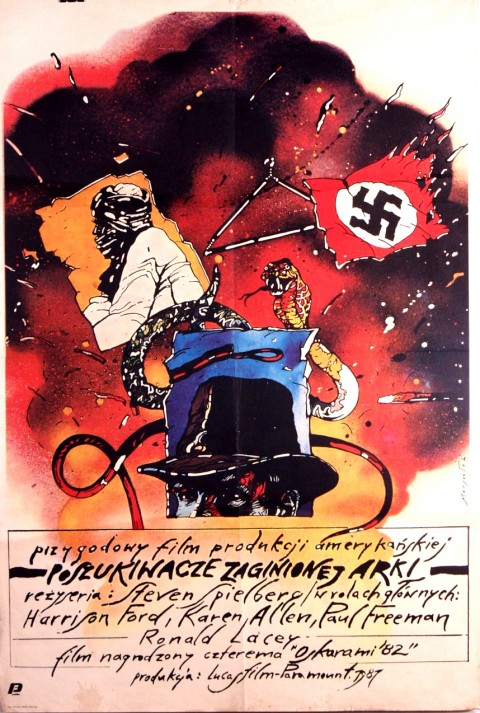
We do not, alas, live in the golden age of American movie poster design. Some United States independent films (and especially their Criterion Collection DVD releases, if they get them) still fly under the banner of striking imagery designed by daring artists and graphic designers, but for mainstream Hollywood pictures, the thrill has definitely gone. Even when their most iconic posters of decades past showcase admirable craftsmanship, they often lack a certain artistic zing. Every Indiana Jones fan, for instance, has a special place in their heart for Raiders of the Lost Ark’s classic poster, but even the sternest Indy purist would have to admit that one of the film’s Polish posters, shown above, immediately communicates something the original, near-photorealistic image doesn’t. You can see another Polish rendition of Raiders, one that conveys even more fully the unexpected intensity of Harrison Ford’s all-American hero archaeologist, in this collection fifty Polish film posters from wellmedicated.
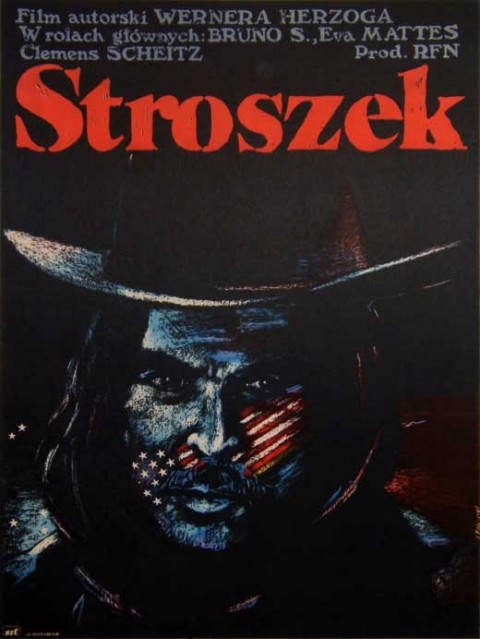
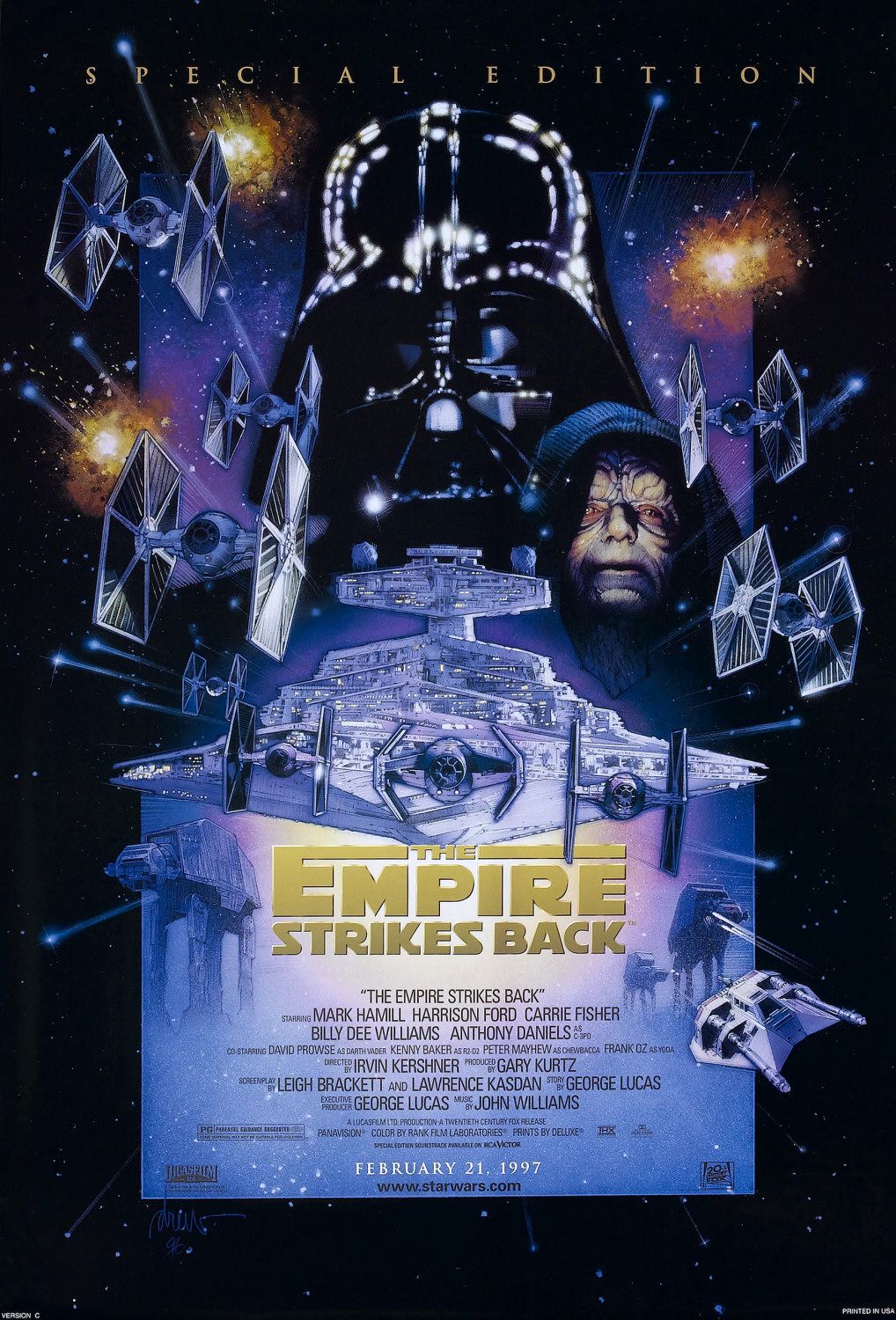
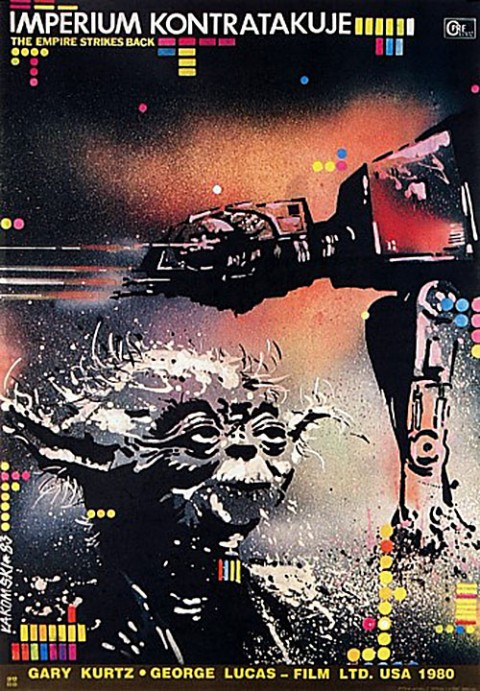
Followers of many varieties of visual art, especially animation, know that Poland has a rich visual tradition indeed. Executed by the hand of a Polish artist, ideas that would seem nonsensical or ridiculous anywhere else in the world suddenly make sense. Just above we have the Polish poster advertising Stroszek by Werner Herzog, whose movies, based on his own inexplicable but somehow satisfying ideas of “ecstatic truth,” perhaps merit Polish posters more than anyone else’s. Just below, we see what Polish viewers saw when they lined up to buy tickets for Star Wars’ sequel The Empire Strikes Back. Maybe it strikes you as heresy to accept anything but Drew Struzan’s hardy, Darth Vader-centric, explosion-laden original, but this one urges me to think about the entirety of Star Wars’ project in a whole new — or at least newly askew — way. The other country which has long led the way with interesting homegrown posters for American movies? Ghana.
via @sheerly
Colin Marshall hosts and produces Notebook on Cities and Culture and writes essays on literature, film, cities, Asia, and aesthetics. He’s at work on a book about Los Angeles, A Los Angeles Primer. Follow him on Twitter at @colinmarshall.
Read More...Anne Bancroft and Mel Brooks Sing “Sweet Georgia Brown” Live…and in Polish
Bancroft and Brooks?
Not exactly, but one thing’s certain. Had married couple Anne Bancroft and Mel Brooks undertaken to co-host a television variety show in the 70’s or 80’s, they would’ve mopped up the era’s competition faster than you can say Mr Clean Sunshine Fresh.
Our best evidence is this clip from the 1983 Brooks-hosted episode of the BBC variety hour, An Audience with… All the tropes of the once popular form—the celebrity ‘as audience plant, the staged spontaneity, the audience eagerly following direction—are on display in the lead up to the big pay off, a light-footed live rendition of Sweet Georgia Brown…in heavily accented Polish.
It definitely leaves one wanting more. (In which case, you could try your luck with Brooks’ remake of To Be or Not to Be, in which he and Bancroft play roles originated by Jack Benny and Carole Lombard).
Related Content:
The Critic: Hilarious Oscar-Winning Film Narrated by Mel Brooks (1963)
Johnny Cash: Singer, Outlaw, and, Briefly, Television Host
Woody Allen Boxes a Kangaroo, 1966
Ayun Halliday’s will be performing live in Brooklyn Brain Frame later this month. Follow her @AyunHalliday
Read More...The Art and Science of Beer
Charles Bamforth is the Anheuser-Busch Endowed Professor of Malting and Brewing Sciences at UC Davis, which means he knows a few things about making beer. He can get into some nitty-gritty topics, like the enzymology of the brewing process, foam stability, and the psychophysics of beer perception. But that’s not what he’s doing here. In the clip above, the “Pope of Foam,” as Bamforth is otherwise known, gives you a quick overview of the beer-making process, describing everything from grinding the malt, to boiling the wort, to bottling with glass versus cans. Finally, the Pope gives you a hot tip: how to pick the freshest pint when you’re at a pub.
If you want to go deeper into Bamforth’s world, you can read his 2009 book: Beer: Tap into the Art and Science of Brewing. Or don’t miss this previous post where a University of Nottingham scientist explains The Physics of Guinness Beer.
via Devour
Related Content:
How to Open a Wine Bottle with Your Shoe for the DIY Connoisseur
The Physics of Coffee Rings Finally Explained
Read More...Climb Three of the World’s Highest Peaks on Google Street View

What’s surprising about Everest Base Camp is the color. It’s a flinty, gray place littered with shards of Himalayan sandstone and shale. Here and there appears a vivid green pool of alpine water. And then there’s the red, blue and green prayer flags hung by Himalayans to blow blessings in the wind.
Google Street View’s latest project, the World’s Highest Peaks, takes us to Everest and two other mountains included in the Seven Summits—the highest mountains on each of the seven continents.
Teams of mountaineers toted digital cameras on treks to the top of each mountain and integrated their images into Google maps so we can trek along with them from the comfort of our laptops, iPhones or Android devices. Like Google Street View’s Ocean gallery, the mountain images bring us to places we may never see with our own eyes.
It’s easy to imagine the dry, cold climate at Camp Colera, where hikers wait for the weather to permit a climb of Aconagua, the highest mountain in the Andes. The views of Tanzania from Arrow Glacier are breathtaking. Hikers camp here before making the treacherous ascent to Uhuru—the “rooftop of Africa” and the summit of Mt. Kilimanjaro.
One of the things Google does really well is create galleries of images that are the kind we might take ourselves, not filtered-lens professional shots that belong on calendars. We see mountaineers resting and hanging out at the frosty Casa de Piedra, on the way up to Aconagua, hikers picnicking at Lemosho Glades as they switch from jeep to foot on the climb up Kilimanjaro, and the weird, abandoned diesel barrels that serve as shelter for folks climbing Mount Elbrus in Russia.
As usual, Google lets us in on the process of collecting all these images with a fun blog written by the photographers.
Related Content:
Reef View: Google Gives Us Stunning Underwater Shots of Great Coral Reefs
Google Presents an Interactive Visualization of 100,000 Stars
Google Street View Takes You on a Panoramic Tour of the Grand Canyon
Kate Rix writes about digital media and education. Read more of her work at .
Read More...How Pi Was Nearly Changed to 3.2 … and Copyrighted!
The story above—from our old friend James Grime of Numberphile and Cambridge University—has all the makings of weirdo Americana: bad amateur science, commercial ventures based upon the same, and a state legislature eager to embrace it all. In 1897, an amateur mathematician named Edwin Goodwin believed he’d solved an ancient problem ruled insoluble fifteen years earlier. He thought that he had squared the circle and could reasonably copyright Pi as 3.2. Yes, that’s right, after his “discovery,” Goodwin, a native of Indiana, decided to copyright his proof so that anyone using it outside of the state would have to pay him royalties.
But kindly, in a gesture of nativist goodwill (or political opportunism), Goodwin decided he would let his home state of Indiana use his proof for free for educational purposes. In fact, he said as much when he introduced a bill to the Indiana House of Representatives to rule his proof correct and grant him sole proprietorship. And, as sometimes happens in stories like this, the bill passed, unanimously, and the legislators were impressed. But one man wasn’t. By sheer chance, a professor of mathematics happened to be in attendance. While he declined to meet mathematics hero Edwin Goodwin, he did take it upon himself to warn the Indiana Senate of what was coming its way. Luckily for the state’s schoolchildren, the Senate threw the bill out, but not before a half-hour spent mocking its silliness.
But is the idea of squaring a circle ridiculous? Dr. Grime cites one Indian mathematician who proposed a somewhat feasible solution. And what exactly does it mean to “square a circle”? If you don’t know (and I don’t), you’ll have to wait till next time on Numberphile, when Grime and his team promise to explain it to us rubes.
Related Content:
The Math in Good Will Hunting is Easy: How Do You Like Them Apples?
The Enigma Machine: How Alan Turing Helped Break the Unbreakable Nazi Code
Incredible Mental Math Gymnastics on “Countdown”
Josh Jones is a writer, editor, and musician based in Washington, DC. Follow him @jdmagness
Read More...Support Us
We're hoping to rely on loyal readers, rather than erratic ads. Please click the Donate button and support Open Culture. You can use Paypal, Venmo, Patreon, even Crypto! We thank you!

About Us

Open Culture scours the web for the best educational media. We find the free courses and audio books you need, the language lessons & educational videos you want, and plenty of enlightenment in between.
Advertise With Us

FREE UPDATES!
GET OUR DAILY EMAIL
Get the best cultural and educational resources on the web curated for you in a daily email. We never spam. Unsubscribe at any time.
FOLLOW ON SOCIAL MEDIA

Open Culture editor Dan Colman scours the web for the best educational media. He finds the free courses and audio books you need, the language lessons & movies you want, and plenty of enlightenment in between.
Advertise With Us