What Happens on the Internet in 60 Seconds
Chances are in the past week you’ve read some argument about how the internet has destroyed the middle class, democracy, culture, etc, or a rebuttal of one of the above. I can’t add much to these debates. They sometimes sound like arguments over whether telephony is a boon or a curse. These technologies—as long as the grid’s up and running—we shall always have with us.
Sociological speculation notwithstanding, the exponentially increasing computing power that pushes our online interactions to ever-dizzying speeds is surely something to pause and marvel at, if not to fear. The short video above from Buzzfeed takes us on a wild ride through the millions of transactions that occur online in a single minute. Here we learn that in sixty-seconds, there will be 2,000,000 Google searches, 27,800 uploads to Instagram, 278,000 Tweets, 1,875,000 Facebook likes, a “low estimate” of 200,000 people streaming porn….
Actually, it does start to seem like all this online activity is pretty narrowly focused, or maybe that’s a limitation of the survey. Another video from 2011 (below) and infographics here and here offer some comparative analytics.
Related Content:
How Brewster Kahle and the Internet Archive Will Preserve the Infinite Information on the Web
Josh Jones is a writer and musician based in Washington, DC. Follow him at @jdmagness
Read More...The National Gallery Makes 25,000 Images of Artwork Freely Available Online
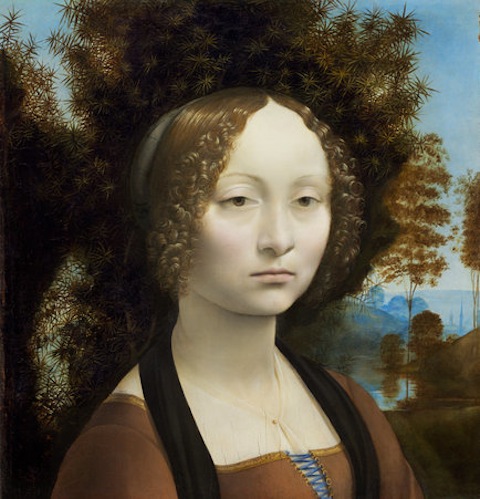
No surprise that in “Masterworks for One and All,” an article about how museums have begun to offer free, high-quality downloadable images of works from their collections, the New York Times’ Nina Siegal brings up Walter Benjamin. The preoccupations of the philosopher behind “The Work of Art in the Age of Mechanical Reproduction” may seem more relevant than ever in these days of not just mechanical reproduction, but universal, developed-world ownership of the means of mechanical reproduction — and nearly instantaneous, effortless mechanical reproduction at that. Many rights-holders, including certain museums, have effectively decided that if you can’t beat the mechanical reproducers, join ’em. “With the Internet, it’s so difficult to control your copyright or use of images,” Siegal quotes the Rijksmuseum’s director of collections as saying. “We decided we’d rather people use a very good high-resolution image of [Vermeer’s] ‘Milkmaid’ from the Rijksmuseum rather than using a very bad reproduction.” (See our previous post: The Rijksmuseum Puts 125,000 Dutch Masterpieces Online, and Lets You Remix Its Art.)
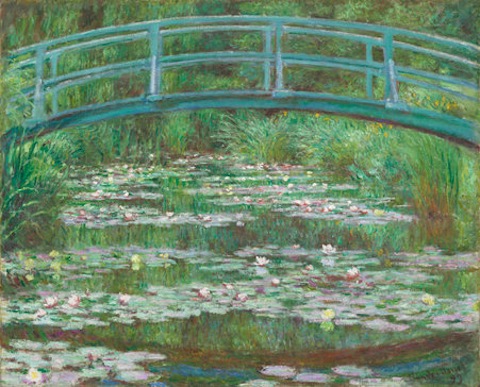
Siegal goes on to mention the efforts of Washington’s National Gallery of Art, which has so far made super high-resolution images of 25,000 works freely available on NGA Images, a site that describes itself as “designed to facilitate learning, enrichment, enjoyment, and exploration.” You can browse the images by collection — French galleries, self-portraits, music — view the most recent additions, or pull up the works of art most frequently requested by others. Leonardo’s portrait of the Florentine aristocrat Ginevra de’ Benci, seen up top, has proven particularly popular, as has Claude Monet’s The Japanese Footbridge just above. But does all this bear out Benjamin’s concerns about mechanical reproduction cheapening the original aura of a work? “I don’t think anyone thinks we’ve cheapened the image of the ‘Mona Lisa,’” an NGA spokeswoman said to Siegal. “People have gotten past that, and they still want to go to the Louvre to see the real thing. It’s a new, 21st-century way of respecting images.”
Related Content:
Google Launches a New “Art Talks” Series: Tune in Tonight
Download Hundreds of Free Art Catalogs from The Metropolitan Museum of Art
Free: The Guggenheim Puts 65 Modern Art Books Online
Colin Marshall hosts and produces Notebook on Cities and Culture and writes essays on literature, film, cities, Asia, and aesthetics. He’s at work on a book about Los Angeles, A Los Angeles Primer. Follow him on Twitter at @colinmarshall.
Read More...Patti Smith Reads Federico Garcia Lorca’s “Little Viennese Waltz” in New York City
Last Wednesday night, New York Institution Patti Smith appeared at downtown venue Bowery Ballroom with a few friends to read poetry and play some music. The occasion? One of many in an almost two-month-long celebration of Spanish poet and playwright Federico Garcia Lorca’s brief sojourn in New York City in 1929–1930 while he was a student at Columbia University. That year inspired a book, Poet in New York, which has been republished in a revised bilingual edition by Farrar, Straus & Giroux.
In the clip above, watch Smith read a selection of Garcia Lorca’s “Little Viennese Waltz.” Her Jersey/New York inflections make the lines her own (love the way she says “piano”), and her banter with the audience is priceless.
If you would like to support the mission of Open Culture, consider making a donation to our site. It’s hard to rely 100% on ads, and your contributions will help us continue providing the best free cultural and educational materials to learners everywhere. You can contribute through PayPal, Patreon, and Venmo (@openculture). Thanks!
Related Content:
Patti Smith Shares William S. Burroughs’ Advice for Writers and Artists
Patti Smith’s Cover of Nirvana’s “Smells Like Teen Spirit” Strips the Song Down to its Heart
Josh Jones is a writer and musician based in Washington, DC. Follow him at @jdmagness
Read More...Watch Idem Paris, David Lynch’s Short Film on the Art of Making Lithographs
Located in the Montparnasse section of Paris, the Idem studio was originally built by the printer Emile Dufrenoy in 1880, as a space to house his lithographic presses. Moving into the next century, various owners preserved the art of lithography, producing lithographs by the likes of Matisse, Picasso, Miro, Braque, Chagall, Léger, Cocteau, and others. Today, the tradition continues. And, amazingly, the atelier still uses 19th century flatbed machines, powered by a gas steam boiler, to keep the tradition of lithography alive. While on a recent trip to Paris, the surrealist filmmaker David Lynch paid a visit to Idem and fell in love with what he saw, so much so that he produced a short documentary highlighting Idem’s artistic process. As a preface to the film, Lynch wrote on the Idem web site:
Hervé Chandès from the Fondation Cartier brought me over to Idem and introduced me to Patrice Forest. I see this incredible place, and I get the opportunity to work there. And this was like a dream! It just opened up this brand-new world of the lithography and the magic of lithography, the magic of the stones. And it was a great, great thing! This thing of lithography, this channel of lithography opened up and a bunch of ideas came flowing out and it led to about a hundred lithographs. I will say that Idem printing studio has a unique, very special mood, and it is so conducive to creating. Patrice has the greatest attitude for all the artists and he creates this space of freedom and this joy of creating. It’s so beautiful! And I think the place is very important—in other wors, the same stone could be moved to another place, and I think that the work that comes out would be different. It’s a combination of the stone, the place, the people, this mood, and out comes these certain ideas.
You can find the short film, Idem Paris, listed in our collection of 525 Free Movies Online. You can also find a primer explaining the basics of lithography here.
via Biblioklept
Related Content:
Free: The Guggenheim Puts 65 Modern Art Books Online
Wassily Kandinsky Caught in the Act of Creation, 1926
How the CIA Secretly Funded Abstract Expressionism During the Cold War
Read More...Watch Animations of Oscar Wilde’s Children’s Stories “The Happy Prince” and “The Selfish Giant”
Long before Oscar Wilde became a literary celebrity for his most famous work—The Picture of Dorian Gray and plays like Salome and The Importance of Being Earnest—he was a bit of a reality star. Wilde traveled the UK and the United States (as portrayed by Stephen Fry here) as a representative of the popular philosophy of “aestheticism,” an urbane nineteenth-century movement against Victorian prudery and the dry moral calculus of utilitarianism and its associations with industrial culture. Aesthetes such as Wilde sought to elevate good taste and the pursuit of beauty alone as a guiding principle of art and life. Wilde expressed the ideas in several well-known epigrams, such as the wryly redundant, “In all unimportant matters, style, not sincerity, is the essential. In all important matters, style, not sincerity, is the essential.”
Wilde was ridiculed for the many of the same reasons he was feted—his flamboyant public persona and devotion to aestheticism, which satirists caricatured as a kind of decadent navel-gazing. But careful readers of Wilde’s diverse canon of poetry, prose, and drama will know of his critical looks at solipsism and superficiality. Some of his best works as a moralist are his children’s stories, such as the 1888 book of fairy stories The Happy Prince and Other Tales. In the title story, a prince is transformed into a glittering statue on a pedestal high above a city, where residents look up to him as an example of human perfection. But the prince, we learn, spends his time weeping in compassion for the poverty and suffering he sees below him. Made in 1974 by Canadian company Potterton Productions, and featuring the voices of Christopher Plummer and Glynis Johns, the animated short film above is a faithful rendering of Wilde’s story. You can find it added to our collection of Free Movies Online, under Animation.
In 1971, Potterton produced an earlier animated short film based on another story from the Happy Prince collection. A Christian allegory, The Selfish Giant (above) tells the tale of a cranky giant who walls off his garden to keep children out. The plight of one little boy changes the giant’s disposition. The film was nominated for an Oscar for best animated short in 1972. Potterton also produced a short film of Hans Christian Andersen’s “The Little Mermaid,” and studio head Gerald Potterton would go on in 1981 to direct the cult stoner film Heavy Metal. An interesting irony of the Wilde animations above: both films, and a third called The Remarkable Rocket, were co-produced with Reader’s Digest, the magazine that represents the hard-headed practicality and sentimental, sexually repressive Victorian values (in American dress) that Wilde disdained.
If you can’t get enough of Wilde’s moving fairy tales, you won’t want to miss Stephen Fry reading “The Happy Prince” below.
Related Content:
Hear Oscar Wilde Recite a Section of The Ballad of Reading Gaol (1897)
“Jersey Shore” in the Style of Oscar Wilde
Josh Jones is a writer and musician based in Washington, DC. Follow him at @jdmagness
Read More...Free: The Great Gatsby & Other Major Works by F. Scott Fitzgerald
In some popular imaginings, F. Scott Fitzgerald becomes so associated with the jazz age frivolity he keenly observed, and the social climbing of his best-known character, that much of his pre- and post-Gatsby writing gets occluded. While Fitzgerald may have been an alcoholic spendthrift who preferred the finer things and those who wore them, he was also a very disciplined and serious writer, especially of short stories, which were his sole source of income throughout much of the ‘20s. Fitzgerald’s desperately prolific output in the form means that there are a few hastily-composed pieces, some lightweight, whimsical fantasies, but all of the work is beautifully written and a joy to read.
The fantasies (which include the now-famous “The Curious Case of Benjamin Button”) reveal quite a bit about Fitzgerald’s preoccupation with artifice. He was a very well-read, if not particularly deep, thinker who approached literature through fairy tales—Orientalist fables, adventure stories, Edmund Spencer’s allegories—and his early stories mix a boyish imagination with the feigned worldliness of a Princeton undergraduate. The most substantial of those early stories “May Day,” almost a novella, opens in a post-World War One New York City described as a fairy kingdom in the throes of market-madness:
So gaily and noisily were the peace and prosperity impending hymned by the scribes and poets of the conquering people that more and more spenders had gathered from the provinces to drink the wine of excitement, and faster and faster did the merchants dispose of their trinkets and slippers until they sent up a mighty cry for more trinkets and more slippers in order that they might give in barter what was demanded of them. Some even of them flung up their hands helplessly, shouting:
“Alas! I have no more slippers! and alas! I have no more trinkets! May heaven help me for I know not what I shall do!”
This excerpt from the opening section of “May Day” reads like Hans Christian Andersen, but with the sly satirical undertone of one of Oscar Wilde’s children’s stories. The story then shifts to a realist mode, introducing the familiar Fitzgerald themes of extravagant wealth and privilege—and their precarious nature. Some of the characters embodying these traits, a group of Yale graduates, soon show the moral failings exemplified by Gatsby’s Buchanans: callous indifference to the needs of others and vain self-regard.
The main plot of “May Day” goes to a very dark place, dealing with the kind of upper-class despair Bret Easton Ellis trades in, with a doomed main character quite obviously a stand-in for Fitzgerald himself. A somewhat clumsy subplot reaches at times for a comic foil but also sounds a grim note. The story—with its almost vicious depiction of class division—is a minor work with major ambition and a complex interweaving of Fitzgerald’s major themes.
“May Day”—first published in The Smart Set magazine in 1920 and later appearing in the collection Tales of the Jazz Age—draws from events of the Cleveland May Day riots of 1919 and some New York experiences in Fitzgerald’s life. Once asked, however, if the story was autobiographical, the author replied, “there are no good biographies of novelists because they are so many people.”
You can encounter all of the various people Fitzgerald carried within him in the stories and novels we’ve gathered in our collections of Free eBooks and Free Audio Books. (Find them below.) And to learn more about Fitzgerald, in relation to two other 20th-century American masters, you might want to check out Wai Chee Dimock’s Open Yale online course, “Hemingway, Fitzgerald, Faulkner,” available on YouTube and iTunes. It otherwise appears in our collection of 700 Free Courses Online.
eBooks
- Collected Stories
- All the Sad Young Men
- Flappers and Philosophers
- Tales of the Jazz Age
- Taps at Reveille
- Tender is the Night
- The Beautiful and Damned
- The Curious Case of Benjamin Button
- The Great Gatsby
- This Side of Paradise
Audio
- Flappers and Philosophers
- The Curious Case of Benjamin Button
- Tales of the Jazz Age
- The Great Gatsby
- This Side of Paradise
Related Content:
Seven Tips From F. Scott Fitzgerald on How to Write Fiction
F. Scott Fitzgerald in Drag (1916)
Ernest Hemingway to F. Scott Fitzgerald: “Kiss My Ass”
Josh Jones is a writer and musician based in Washington, DC. Follow him at @jdmagness
Read More...Atheist Ira Glass Believes Christians Get the Short End of the Media Stick
So, an atheist and a devout Christian walk into a Tacoma hotel restaurant-bar…
Wait, though, it’s not what you think! The atheist in question is public radio star Ira Glass, amiably sitting for an interview with amateur spiritual anthropologist and former This American Life guest Jim Henderson. The mutual respect is refreshing. Henderson makes it his mission to seek out influential people who are “unusually interested in others,” and willing to “stay in the room with difference.” Glass’ relaxed and chatty demeanor translates to mission accomplished.
The non-believing child of secular Jews does his tribe proud by volunteering the opinion that Christians get a bum rap in the national media. The portrayal of Christians as “doctrinaire crazy hothead people” doesn’t square with fond recollections of former public radio colleagues who kept Bibles on their desks and invited him to screenings of Rapture movies (At WBEZ? Really?).
The civility of the discourse could renew your faith in mankind, whatever your beliefs.
You can watch other parts of the longer interview on YouTube here.
Related Content:
Ira Glass on the Art and Craft of Telling Great Radio Stories
Does God Exist? Christopher Hitchens Debates Christian Philosopher William Lane Craig
Alain de Botton Wants a Religion for Atheists: Introducing Atheism 2.0
Ayun Halliday is in Ira’s camp. Follow her @AyunHalliday
Read More...Dexter Gordon’s Elegant Version of the Jazz Standard ‘What’s New,’ 1964
In 1964, when this performance was given, the tenor saxophonist Dexter Gordon was in the second year of his European exile.
Gordon had risen to prominence in the early 1940s, after joining the Lionel Hampton band at the age of 17. He was one of the pioneer translators of the bebop idiom to the tenor sax. And he was an early influence on the playing of John Coltrane and Sonny Rollins.
“Dexter made a great contribution to the bebop language,” Rollins once said. “In fact, I think he defined it during a certain period. He transcribed a lot of the stuff that Bird was doing, and brought that approach to the tenor without being a copier. He was an important figure in bringing people along. Coltrane at one time sounded like Dexter, and I still hear that lineage.”
But by the 1950s Gordon was addicted to heroin. He checked himself into the hospital several times but always fell back. In 1960 he was arrested in Los Angeles on drug charges and spent three months in prison. When he got out he had trouble finding gigs. Even though he had completely kicked his habit by 1962, New York police refused to issue him a cabaret card to play in the city’s nightclubs. An offer to play in Europe changed his life. “I went for three months and stayed for 14 years,” Gordon told People magazine in 1986. “I came alive over there.”
Gordon had clearly hit his stride again by July 29, 1964, when this scene was recorded for Dutch television in Amersfoort, Holland. Gordon is playing the 1939 Bob Haggart and Johnny Burke standard, “What’s New?” His European quartet includes George Gruntz on piano, Guy Pedersen on bass and Daniel Humair on drums. The performance is available as part of the Jazz Icons DVD, Dexter Gordon: Live in ’63 & ’64. In the liner notes, Gordon’s former producer Michael Cuscuna describes him as being in peak form when this film was made: “His tone resonates with power and beauty, his chops enable him to execute whatever occurs to him and his ideas flow seamlessly.”
Gordon learned from his idol Lester Young that it was a good idea to know the lyrics of a song if you want to understand its essence. One of Gordon’s idiosyncrasies was to recite a few lines from the lyrics before playing the song. In this scene, the six-foot, six-inch-tall saxophonist steps up to the microphone and, in his deep baritone voice, recites the opening lines to “What’s New?” before launching into a beautiful instrumental version. Summing up Gordon’s distinctive playing, a biographer at the New Grove Dictionary of Jazz writes: “His rich, vibrant sound, harmonic awareness, behind-the-beat phrasing, and his predilection for humorous quotations combine to create a unique style.”
Related Content:
Advice From the Master: Thelonious Monk Scribbles a List of Tips for Playing a Gig
The Nazis’ 10 Control-Freak Rules for Jazz Performers: A Strange List from World War II
Watch 1959: The Year that Changed Jazz
Read More...Hear Sylvia Plath Read 18 Poems From Her Final Collection, Ariel, in a 1962 Recording
“Add to the available accounts of Plath (there are so many) this, please: nobody brought a house to life the way she did.” So writes Dan Chiasson in a February New Yorker piece commemorating the fiftieth anniversary of Sylvia Plath’s death. Chiasson’s plea is made all the more poignant by his careful readings of the tenderness—amidst the pain and horror—in Plath’s final collection, Ariel, which she left sitting on the kitchen table to be found along with her body. (The collection has recently been restored to correspond to Plath’s final wishes).
Chiasson’s refocusing of Plath’s legacy feels necessary, given that, as James Parker writes in The Atlantic, “Her short life has been trampled and retrampled under the biographer’s hoof, her opus viewed and skewed through every conceivable lens of interpretation.” It is sometimes difficult to connect with work—even with that as stunningly accomplished and resonant as Plath’s—through this thick haze of sensationalism and cult fandom. Even if many of the poems in Ariel—most famously “Lady Lazarus”—seem to request this kind of scrutiny, many others, Chiasson writes, including the title poem, need to be approached afresh, without the morbid celebrity baggage Plath’s name carries.
Is this possible? Perhaps one way to reconnect with the poetry is to hear Plath herself reading it. In these recordings, you can hear her read fifteen poems from Ariel, her New England Brahmin vowels inflecting every line, drawing out internal rhymes and assonance, then clipping at caesuras like a well-bred horse’s trotting hooves.
The title poem “Ariel”—which Chiasson eulogizes as “a perfect poem, perfect in its excesses and stray blasphemies”—is, in fact, partly named after Plath’s favorite horse. Also enfolded in the title is the captive sprite bound to perform tricks for Shakespeare’s mage Prospero in The Tempest, and an Old Testament name given to Jerusalem, meaning “lion of God” (the second stanza begins “God’s lioness…”). Plath’s poetic self-understanding is as complex as this allusive layering suggests, and the poem’s jarring ellipses demand very close attention.
The readings here are from recordings made on October 20, 1962. Poems include: “The Rabbit Catcher,” “A Birthday Present,” “A Secret,” “The Applicant,” “Daddy,” “Medusa,” “Stopped Dead,” “Fever 103°,” “Amnesiac,” “Cut,” “Ariel,” “Poppies In October,” “Nick And The Candlestick,” “Purdah,” and “Lady Lazarus.”
Related Content:
On 50th Anniversary of Sylvia Plath’s Death, Hear Her Read ‘Lady Lazarus’
For Sylvia Plath’s 80th Birthday, Hear Her Read ‘A Birthday Present’
The Art of Sylvia Plath: Revisit Her Sketches, Self-Portraits, Drawings & Illustrated Letters
525 Free Audio Books: Download Great Books for Free
Josh Jones is a writer and musician based in Washington, DC. Follow him at @jdmagness
Read More...Watch Another Green World, a Hypnotic Portrait of Brian Eno (2010)
In September 1975, Brian Eno released his album Another Green World. The following month, the BBC’s acclaimed documentary series Arena first aired, using Another Green World’s title track as its theme music. 35 years later, the show finally got around to documenting Eno himself. This 2010 episode, also called Another Green World, captures the “intellectual guru of the rock world” (as a Desert Island Discs DJ calls him) at work in his studio, in conversation with a variety of interlocutors—including journalist Malcolm Gladwell, record producer Steve Lillywhite, and evolutionary biologist Richard Dawkins—and cycling around the green hills that roll around his neighborhood. Bono from U2, several of whose records Eno produced, calls the man “a mind-expanding drug,” and listening to Eno expound here upon his various ideas about and experiences with art, music, technology, journaling, and his native England, I’d have to agree.
The faintly hypnotic tone and pace of the episode — a sensibility not far removed from Eno’s famous “ambient” records like Discreet Music and Music for Airports — might also have something to do with that. We learn about Eno’s school days, his love of singing, his descent from a long line of “postmen with passion,” his getting more girls than Bryan Ferry in their days with Roxy Music, his preference for inconsistent instruments, his history with Catholicism, his enthusiasm for Stafford Beer’s management book Brain of the Firm, his work with audiovisual installations, and his ever-present interest in how complexity arises from simplicity. But we also feel like we’ve seen something not just about Eno, but Eno-like, where form meets function as closely as in all of Arena’s most memorable episodes and all of Eno’s most memorable projects. Or maybe I just like the sound of the rain outside during the studio segments — a sound which had a lot to do with Eno’s development of ambient music in the first place.
Related Content:
The Genius of Brian Eno On Display in 80 Minute Q&A: Talks Art, iPad Apps, ABBA, & More
Brian Eno Once Composed Music for Windows 95; Now He Lets You Create Music with an iPad App
Brian Eno on Creating Music and Art As Imaginary Landscapes (1989)
Colin Marshall hosts and produces Notebook on Cities and Culture and writes essays on literature, film, cities, Asia, and aesthetics. He’s at work on a book about Los Angeles, A Los Angeles Primer. Follow him on Twitter at @colinmarshall.
Read More...Support Us
We're hoping to rely on loyal readers, rather than erratic ads. Please click the Donate button and support Open Culture. You can use Paypal, Venmo, Patreon, even Crypto! We thank you!

About Us

Open Culture scours the web for the best educational media. We find the free courses and audio books you need, the language lessons & educational videos you want, and plenty of enlightenment in between.
Advertise With Us

FREE UPDATES!
GET OUR DAILY EMAIL
Get the best cultural and educational resources on the web curated for you in a daily email. We never spam. Unsubscribe at any time.
FOLLOW ON SOCIAL MEDIA

Open Culture editor Dan Colman scours the web for the best educational media. He finds the free courses and audio books you need, the language lessons & movies you want, and plenty of enlightenment in between.
Advertise With Us

