James Gandolfini Shows Kinder, Softer, Gentler Side on Sesame Street (2002)
When James Gandolfini first broke into film, he played Virgil, a brutal woman-beating mafioso (viewer beware), in the 1993 thriller, True Romance, written by Quentin Tarantino. In Terminal Velocity, he was back at it again, playing a Russian mobster. By the 1999, when The Sopranos first aired on HBO, Gandolfini had perfected the mobster role. The explosive anger, the raw violence, the colorful language — he had it all down. Of course, this contributed to a good gag when Gandolfini appeared on Sesame Street in 2002. Now the world had the chance to see the actor as it hadn’t seen him before. Meek, timid, and deathly afraid of giant talking vegetables. It’s an endearing little scene.
Related Content:
See Stevie Wonder Play “Superstition” and Banter with Grover on Sesame Street in 1973
Philip Glass Composes for Sesame Street (1979)
Morgan Freeman Teaches Kids to Read in Vintage Electric Company Footage from 1971
Read More...
A Lover’s Spat Set to the Lyrics of 17 Beatles Songs
Those of us who spent hours sitting in front of the record player with our dads’ Radio Shack recorders, striving to duplicate the hilarity of Dickie Goodman’s novelty hit 1975 “Mr. Jaws,” will find much to appreciate in the staged spat above.
Musical pranksters Collective Cadenza raided the Beatles’ catalogue for seventeen songs to drive the narrative of a suspicious wife confronting her philandering husband. Which hussy sent him that passionate text? Lady Madonna? Julia? Michelle? Eleanor Rigby seems to have more comic potential than a tired ageist dig, and given their high production values, I’m mystified that the creators shied away from hiring a realistically hot plumber.
Perhaps I’m over-thinking things. It’s a lark, that’s all. Don’t expect Shakespeare, and you won’t lose sleep wondering why they failed to include “I Am the Walrus.”
Related Content:
Peter Sellers Reads The Beatles’ “She Loves You” in Four Different Accents
Hold Me Closer, Tony Danza and Other Misheard Lyrics for Your Listening Pleasure
Ayun Halliday had a girlish crush on Paul, then switched to George, before wising up and going with John. Follow her @AyunHalliday
Read More...Watch His Girl Friday, Howard Hawks’ Classic Screwball Comedy Starring Cary Grant, Free Online
The movies and journalism have had a long relationship in America, not least because, in Hollywood’s heyday, so many screenwriters began their careers in newsrooms. The prolific Ben Hecht, now known as “the Shakespeare of Hollywood,” started off as a reporter at the Chicago Journal. His collaborator Charles MacArthur first worked over at the Chicago Tribune. They, along with son of the film industry Charles Lederer, co-wrote His Girl Friday, the classic 1940 screwball comedy of steely story-chasing and elaborate romantic intrigue at The Morning Post. Since the film fell into the public domain in 1968 — and this being Friday, after all — why not get a shot of Cary Grant, Rosalind Russell, and Howard Hawks free online today?
His Girl Friday stands out for many reasons, especially by refusing, unlike many Hollywood pictures written by former newspapermen, to instinctively glorify journalism, a mistake more recent films about the news still make. As the New Yorker’s Anthony Lane wrote about Shattered Glass, Billy Ray’s dramatization of the fall of infamous New Republic fabricator Stephen Glass, “Glass may be a rotten apple in the barrel, but the contention of Ray’s film is that the barrel itself, the noble calling of the reporter, is as sturdy and as polished as ever. Give me a break. On second thought, give me His Girl Friday. Five minutes of Howard Hawks’s speedy and cynical view of hacks in sharp suits, as they themselves bend the world to fit the shape of their own cynicism, is a more bracing sight than ninety-four minutes of Stephen Glass and his tragic slide from grace.”
His Girl Friday appears in our collection of 535 Free Movies Online.
Related Content:
26 Free Charlie Chaplin Films Online
Watch The Hitch-Hiker by Ida Lupino (the Sole Female Director of a 1950s Noir Film)
Colin Marshall hosts and produces Notebook on Cities and Culture and writes essays on literature, film, cities, Asia, and aesthetics. He’s at work on a book about Los Angeles, A Los Angeles Primer. Follow him on Twitter at @colinmarshall.
Read More...Chinese Artist Ai Weiwei Releases a “Heavy Metal” Song & Video Recalling His Harsh Imprisonment
Burly Chinese artist and dissident Ai Weiwei has never lost his sense of humor, even when facing harsh repression from his government. But while the idea of 55-year old Ai recording a heavy metal record might seem like a stunt, the source material for his first single, “Dumbass” (above), is anything but funny. The furiously angry, expletive-filled song is inspired by Ai’s harsh treatment during his 81-day imprisonment in 2011. He’s calling the musical project “a kind of self-therapy” and will release six tracks on June 22—the second anniversary of his release—as an album called The Divine Comedy.
Ai sings (or howls, growls, and bellows) in Chinese. As you can see from the grim images in the video above—with the artist re-enacting and re-imagining his experiences in detention—the memories of his incarceration are still raw and painful. While he’s called his music “heavy metal,” The Guardian points out that “it’s not exactly Metallica” (unless you count that Lou Reed collaboration). Ai himself says of his sound:
After I said it would be heavy metal I ran back to check what heavy metal would be like. Then I thought, oh my god, it’s quite different…. So it’s Chinese heavy metal, or maybe Caochangdi [where his studio is based] heavy metal.
Call it what you want: Chinese heavy metal, practical joke, avant garde performance piece… it’s still likely to get Ai in even further trouble with Chinese authorities. As he explained to the New York Times, however, he “wanted to do something impossible…. I wanted to show young people here we can all sing…. It’s our voice.”
Related Content:
Who’s Afraid of Ai Weiwei: A Short Documentary
Ai Weiwei’s Parody of ‘Gangnam Style’
Josh Jones is a writer and musician based in Washington, DC. Follow him at @jdmagness
Read More...The Ramones in Their Heyday, Filmed “Live at CBGB” (1977)
Here’s classic footage of the Ramones in their prime, performing at a club in 1977. The film’s opening title says it was shot on June 10, 1977 at CBGB, but that is apparently not true. Singer Joey Ramone tells the audience that the band’s third album, Rocket to Russia, will be coming out “in about two weeks” as the band launches into a song from the album. But Rocket to Russia wasn’t recorded until late August of 1977, and was released on November 4. So perhaps the film was shot during one of the band’s October 1977 shows. Whatever the exact date and place, the Ramones were clearly at the top of their form when this film was made. In the two clips presented here, they burn through the following songs:
Part one (above)
- “Blitzkrieg Bop”
- “Sheena is a Punk Rocker”
- “Beat on the Brat”
- “Now I Wanna Sniff Some Glue”
Part two (below):
- “Rockaway Beach”
- “Cretin Hop”
- “Oh,Oh, I Love Her So”
- “Today Your Love, Tomorrow the World”
Related content:
The Ramones Play a New Year’s Eve Concert in London, 1977
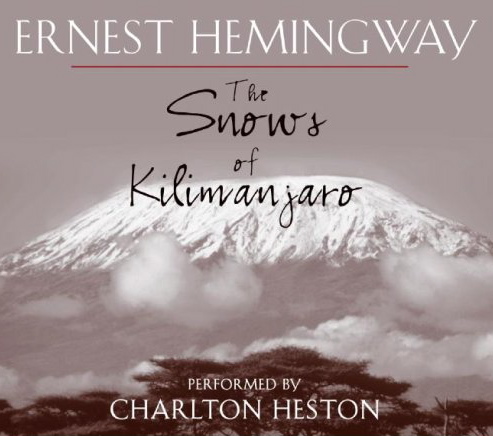
Read More...Hear Charlton Heston Read Ernest Hemingway’s Classic Story, “The Snows of Kilimanjaro”
“ ‘The marvelous thing is that it’s painless,’ he said. ‘That’s how you know when it starts.’
‘Is it really?’
‘Absolutely. I’m awfully sorry about the odor though. That must bother you.’ ”
Most American readers surely recognize these lines, though it may take a moment to remember where they recognize them from. They open “The Snows of Kilimanjaro,” a short story by Ernest Hemingway that first ran in Esquire in 1936, then, two years later, appeared in the collection The Fifth Column and the First Forty-Nine Stories. (Find in our collection of Free eBooks.) Dealing with the memories and regrets of a writer on safari dying of a gangrenous thorn wound, the story has over the past 76 years become one of the most respected works in Hemingway’s oeuvre and an essential piece of twentieth-century American literature. As often happens with essential pieces of American literature, Hollywood got to it, adapting it into a 1952 blockbuster featuring Gregory Peck, Susan Hayward, and Ava Gardner. (Find in our collection of 535 Free Movies Online.)
Though the starring role of Harry, the fast-fading rough-and-tumble man of letters who sees himself as ruined by affluence and hedonism, went to Peck, I could also imagine it played by Charlton Heston. Even if you couldn’t quite place that bit of dialogue from “The Snows of Kilimanjaro,” you’d be immediately able to place Heston’s voice reading the story aloud in the recording available on this HarperAudio Hemingway site. Listen below and see for yourself if the actor’s delivery, so often associated with silver-screen roles meant to project a grand sternness, can also deliver the bitterness of Hemingway’s protagonist, who certainly shares with his creator the conviction that “politics, women, drink, money and ambition” bring writers truly low, down to the point where they can declare, as Harry so memorably does, “The only thing I’ve never lost is curiosity.”
- Part one: .au format (5.5 Mb), .gsm format (1 Mb), .ra format (0.6 Mb)
- Part two: .au format (5.5 Mb), .gsm format (1 Mb), .ra format (0.6 Mb)
- Part three: .au format (5.5 Mb), .gsm format (1 Mb), .ra format (0.6 Mb)
- Part four: .au format (5.5 Mb), .gsm format (1 Mb), .ra format (0.6 Mb)
Bonus: Here you can also listen to Donald Sutherland read an excerpt from Old Man and the Sea.
Related Content:
Ernest Hemingway Reads “In Harry’s Bar in Venice”
The Spanish Earth, Written and Narrated by Ernest Hemingway
Seven Tips From Ernest Hemingway on How to Write Fiction
Colin Marshall hosts and produces Notebook on Cities and Culture and writes essays on literature, film, cities, Asia, and aesthetics. He’s at work on a book about Los Angeles, A Los Angeles Primer. Follow him on Twitter at @colinmarshall.
Read More...Google Wants to Provide Internet Access to Remote Parts of the World with Solar-Powered Balloons
Perhaps you live in a developed nation, or a pocket of a developing nation, where internet access is a relatively cheap commodity. Count yourself lucky. Right now, 5 billion people — or two thirds of the world’s population — lack access to an affordable and reliable Internet connection. Which means they lack access to critical information — medical information that can save lives; scientific information that can improve farming; technical information necessary to build a modern economy; and educational resources that can cultivate young minds.
With Project Loon, Google is launching an audacious experiment that will hopefully make a dent in this serious problem. The experiment involves putting a fleet of high-altitude balloons into the air. Powered solely by the wind and the sun, the balloons will fly high into the stratosphere, well above where commercial planes fly, and they’ll beam Internet access back to the ground “at speeds similar to today’s 3G networks or faster,” claims Google’s main blog. (The clip below explains the gist of the technology.) Right now, they’re running a small scale test in New Zealand (in Christchurch and Canterbury, to be exact) and you can monitor the progress over at Project Loon’s Google Plus page. In the meantime, we’ll keep our fingers crossed and hope the entire world can soon enjoy our collection of Free Online Courses, not to mention the other random curiosities found on the web.
Watch the World Record for the Largest Domino Chain Made of 2,131 Books
In late May, The Seattle Public Library set a world record for the Longest Book Domino Chain, according to the World Record Academy. Watch as 2,131 books — all part of an upcoming book sale — fall one by one. Apparently, it took 27 volunteers seven hours — and five failed attempts — to pull off this feat for the ages. h/t Metafilter
Follow us on Facebook, Twitter and Google Plus and share intelligent media with your friends! They’ll thank you for it.
Related Content:
Spike Jonze Presents a Stop Motion Film for Book Lovers
Portrait of a Bookstore as an Old Man (a 52 minute documentary that pays homage to Shakespeare and Company)
Books Lovingly Savored in Stop Motion Film
Going West: A Stop Motion Novel
Read More...Rick Wakeman Tells the Story of the Mellotron, the Oddball Proto-Synthesizer Pioneered by the Beatles

Image Tobias Akerboom via Wikimedia Commons
Did you know that the Spanish guitar intro to the Beatles’ “Bungalow Bill” was not played by George Harrison, but rather by an odd electronic instrument called a Mellotron, the same strange proto-synthesizer responsible for the flute intro to “Strawberry Fields Forever”? You’ll learn quite a bit more about the “rash breaking out all over pop music” that was the Mellotron in the audio story above, narrated by Rick Wakeman.
From the aforementioned Beatles’ songs to The Band’s “This Wheel’s on Fire” to pretty much every song in 60s pop and 70s progressive rock, as well as in 60s revivalists like Oasis, the Mellotron makes an appearance. It even shows up on Skynyrd’s “Freebird” of all things.
Wakeman sketches the history of the oddball instrument, from its humble beginnings in the garage of California inventor Harry Chamberlin, to its popularization by salesman Bill Fransen, who took Chamberlin’s design and made it his own.
Bear in mind, as we enter the world of Mellotronics, that the instrumental bits you hear throughout Wakeman’s story were played by someone, sometime. The sounds made by this keyboard-like thing are in fact actual parts from live orchestras and sundry other musical arrangements, recorded onto tape loops and configured in an ingenious way so that they correspond to a standard keyboard and a variety of presets and knobby-dially-things.
You might even call it an analog sampler. The more technically-minded among you may wish to read this Sound on Sound article for specs. For you enthusiasts, keyboardist Mike Pindar of the Moody Blues—whose “Nights in White Satin” would never have been without the Mellotron—demonstrates the instrument’s inner workings in the short video above.
Inventor Harry Chamberlin originally designed the Mellotron (which he called, of course, the Chamberlin) to re-create the sound of an orchestra at home, or in the local lodge or cabaret, presumably. This is the use Paul McCartney divines in the funky demonstration of his Mellotron above. Sir Paul, in a cabaret setting, does a goofy lounge singer act, then plays the “Strawberry Fields” intro.
Digital synthesizers and computers overtook the Mellotron, as they did all analog electronics. But like all things old, it’s new again, in simulated form, available to iPhone users via the Manetron app (Mellotron also makes a physical, digital version of their vintage instrument). The story and sound of the Mellotron recently inspired a full documentary treatment in the 2010 film Mellodrama: The Mellotron Movie, now out on DVD, which may be the most compelling documentary about a pioneering electronic instrument ever made (far better than 2004’s disappointing Moog). As former Beach Boy Brian Wilson says in the film, “the Mellotron stays cool.” And indeed, it does.
via Coudal
Related Content:
The Genius of Brian Eno On Display in 80 Minute Q&A: Talks Art, iPad Apps, ABBA, & More
All Hail the Beat: How the 1980 Roland TR-808 Drum Machine Changed Pop Music
The “Amen Break”: The Most Famous 6‑Second Drum Loop & How It Spawned a Sampling Revolution
Josh Jones is a writer and musician based in Washington, DC. Follow him at @jdmagness
Read More...Mick Jagger, 15 Years Old, Shows Off His Rock Climbing Shoes on British TV (1959)
In the 1950s, Mick Jagger (then still called “Mike Jagger”) was a middle class kid growing up in Dartford, Kent, England. His mother, Eva, was a hairdresser; his father, Joe, a PE teacher. Together, they lived in a nice, orderly home, with more than enough money to pay the bills. (His neighbor, Keith Richards, couldn’t say the same.) In 1957, the elder Jagger began consulting on a weekly TV show called Seeing Sport, which promoted the virtues of sports to British children. During the coming years, Mick and his brother Chris made regular appearances on the show, showing viewers how to build a tent, or master various canoeing skills. In the 1959 clip above, Mick shows off the footwear needed for rock climbing. Nothing too fancy. No mountaineering boots or anything like that. Just a pair of “ordinary gym shoes … like the kind Mike is wearing.” The episode was shot in a spot called “High Rocks,” near Tunbridge Wells. This background info comes to us via Philip Norman’s 2012 biography of Mick Jagger.
Related Content:
Jimmy Page, 13, Plays Guitar on BBC Talent Show (1957)
The Rolling Stones Sing Jingle for Rice Krispies Commercial (1964)
Read More...Support Us
We're hoping to rely on loyal readers, rather than erratic ads. Please click the Donate button and support Open Culture. You can use Paypal, Venmo, Patreon, even Crypto! We thank you!

About Us

Open Culture scours the web for the best educational media. We find the free courses and audio books you need, the language lessons & educational videos you want, and plenty of enlightenment in between.
Advertise With Us

FREE UPDATES!
GET OUR DAILY EMAIL
Get the best cultural and educational resources on the web curated for you in a daily email. We never spam. Unsubscribe at any time.
FOLLOW ON SOCIAL MEDIA

Open Culture editor Dan Colman scours the web for the best educational media. He finds the free courses and audio books you need, the language lessons & movies you want, and plenty of enlightenment in between.
Advertise With Us


