Remembering George Whitman, Owner of Famed Bookstore, Shakespeare & Company
http://www.youtube.com/watch?v=67LaM95pBMM&feature=share&list=PL5E409DFE410A41C6
In 2005, the Sundance Channel aired Portrait of a Bookstore as an Old Man, a 52 minute documentary that pays homage to George Whitman, the American founder of the most famous independent bookstore in Paris, Shakespeare and Company. Whitman died yesterday, at age 98, in his apartment above the store.
Sylvia Beach first opened a bookshop named Shakespeare and Company in 1918, and it soon became a home for artists of the “Lost Generation” (Hemingway, Pound, Fitzgerald, Stein, etc.). It also famously published James Joyce’s Ulysses in 1922. The shop eventually closed during the Nazi occupation of Paris. Yet a good decade later, George Whitman came along and established another English-language bookstore on the Left Bank and eventually rechristened it Shakespeare and Company. Whitman’s shop gave sanctuary to Beat writers – Allen Ginsberg, William S. Burroughs and the rest. And it’s this incarnation of the fabled bookstore that the documentary takes as its subject. Give the documentary some time, and be sure to watch the last five minutes – unless you already know how to cut your hair with fire. It will give you a little feel for Whitman and his well-known eccentricities. RIP.
Related Content:
William S. Burroughs Reads His First Novel, Junky
Spike Jonze Presents a Stop Motion Film Set at Shakespeare and Company
Jack Kerouac Reads from On the Road (1959)
Free Audio Books and Free eBooks
Read More...Spike Jonze’s Imaginative TV Ads
Spike Jonze has made a name for himself as a wildly inventive director of music videos and feature films, like Being John Malkovich and Adaptation. He has also created some of the most distinctive television commercials of the past decade. Today we bring you a few of his greatest hits.
In late 2002 Jonze created a stir with his IKEA commercial, “Lamp” (above). The 60-second spot went on to win the Grand Prix at the Cannes Lions International Advertising Festival. Boards magazine listed “Lamp” as one of the top 10 commercials of the decade, writing:
Spike Jonze’s incredibly human directing touch created a believable tenderness between a woman and her new Ikea lighting, eliciting pure empathy for a lonely, discarded object, left to suffer curbside in the rain, and then shattered it all with one brilliant stroke of casting that abruptly and brusquely brought us all back to reality.
Jonze’s startling Gap commercial, “Dust,” (above) became a YouTube sensation immediately following its release in 2005, but the company pulled the 90-second ad after testing it in only a few cities. Perhaps the spectacle of a corporate brand exuberantly doing violence to its image was a bit too much for the boys in the boardroom. The decision to shelve the ad made the company look even less hip than before. As Seth Stevenson wrote in Slate, “I just can’t understand spending all that money on a big-name director, and a big-budget shoot, and then frittering the results away on such a limited purpose. Did Gap not see the possibilities? Were they too scared to go for broke?”
Another ground-breaking Jonze commercial from 2005, “Hello Tomorrow,” (above) was made to introduce a self-adjusting, “intelligent” sneaker from Adidas. The spot uses special effects to create the impression of a lucid dream. The music was created by Jonze’s brother, Sam “Squeak E. Clean” Spiegel (Jonze’s birth name is Adam Spiegel) and sung by his girlfriend at the time, Karen O of the band Yeah Yeah Yeahs. The ad received many awards, including two Gold Lions at Cannes. The sneaker was dropped by Adidas in 2006, but the commercial lives on.
Read More...Sir Isaac Newton’s Papers & Annotated Principia Go Digital
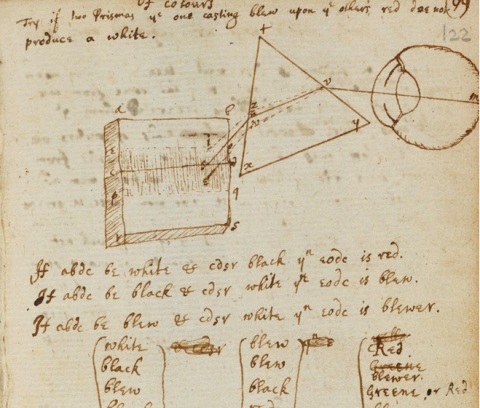 Cambridge University has had many famous graduates, but perhaps none is more famous than Isaac Newton (class of 1665). This week, Cambridge continues to honor Newton by opening a digital archive of Newton’s personal papers, which includes an annotated copy of the Principia, the landmark work where the physicist developed his laws of motion and gravity. The initial archive features 4,000 pages of scanned materials (roughly 20% of the complete Newton archive), and eventually Cambridge will add material from Charles Darwin, another famous alum, and other scientific figures.
In October, The Royal Society opened its historical archives to the public, bringing 60,000 peer-reviewed papers to the web, including Isaac Newton’s first published research paper. You can dive into this parallel digital archive here.
Bonus: If you’re looking to bone up on Physics, you can find many free physics courses in our big collection of Free Online Courses. Leonard Susskind’s class on Classical Mechanics may be of particular interest here.
via The Guardian / ht @eugenephoto
Read More...Jazz for Cows
The French love their jazz. The people love it. Their cows love it no less.
Here we have The New Hot 5, a New Orleans-style band, bringing their act to the pastures of Autrans, France, and treating the audience to an American classic, “When the Saints Go Marching In.” You can learn more about The New Hot 5 at jazzforcows.com.
Speaking of France, we have added French lessons by Carnegie Mellon and the BBC added to our collection of Free Language Lessons.
Related Content:
Mariachi Band Serenades Beluga Whale at Mystic Aquarium
John Coltrane Plays Only Live Performance of A Love Supreme
Read More...The Dark Knight: Anatomy of a Flawed Action Scene
There are many ways to make a movie, says film critic Jim Emerson, and many ways to make a mess.
The truck chase scene from Christopher Nolan’s 2008 film The Dark Knight is frankly a mess, as Emerson demonstrates in a fascinating video essay (above) produced as the first in a three-part series on the language of action sequences for the Indiewire blog Press Play. “We notice lapses in visual logic whether our brains register them consciously or not,” writes Emerson. “I found this scene utterly baffling the first time I saw it, and every subsequent time. At last, I now know exactly why.”
After studying the sequence shot by shot he realized that Nolan had violated fundamental rules of film grammar. You can follow along as Emerson, a Seattle-based critic who writes the Scanners film blog for the Chicago Sun-Times, sorts out the confusion. (There is an accompanying annotated transcript on Scanners.) And be sure to watch Emerson’s follow-up essays (below) which offer shot-by-shot analyses of action scenes that are clearly intelligible.
In Part II of his series (above), Emerson breaks down the highway chase scene from Phillip Noyce’s 2010 film, Salt. The sequence is easy to follow because Noyce is careful to establish the spatial relationships between the various elements, both within the frame and between shots. Writes Emerson:
There are certain directors I think of as “one-thing-at-a-time” filmmakers. That is, they seem to be incapable of composing shots that have more than one piece of information in them at a time. This makes for a very flat, rather plodding style. You see what the camera is pointed at in each shot, but you get very little sense of perspective when it comes to relating it to other elements in the scene. Noyce’s technique is much more fluid, organic and sophisticated. He keeps things from one shot visible in the next, even when shifting perspective–whether it’s only a few feet or clear across several lanes of traffic.
In Part III (above), Emerson revisits classic chase scenes from three films: Don Siegel’s The Lineup (1958), Peter Yates’s Bullitt (1968) and William Friedkin’s The French Connection (1971). In each case the director takes you on a chaotic, bumpy ride–but never loses you.
Read More...
The Seven Wonders of the Microbe World
This video has been removed at the request of open university.
After producing 60 Second Adventures in Thought and The History of English, the Open University returns with a new video series, Seven Wonders of the Microbe World.
Microbes have given us some devastating diseases, everything from the Black Death to cholera, syphilis, typhoid and the occasional yeast infection. But our microbial friends have also done us some good. Without microbes, we wouldn’t have wine and beer (something the Ancient Egyptians started producing some 6,000 years ago), nor much oxygen and fixated nitrogen, all essential for plant, animal and human life. And don’t forget antibiotics, fine cheeses and the rest.
You can watch the Seven Wonders of the Microbe World in seven installments on YouTube (see list below) or via iTunes. Or, simply sit back and watch the 25 minute consolidated video (above) that brings it all together for you.
1. The History of Beer
2. The Black Death
3. Food Preservation
4. Nitrogen Fixation
5. Antibiotics
6. Genetic Engineering
7. Life on Mars
Conformity Isn’t a Recipe for Excellence: Wisdom from George Carlin & Steve Jobs (NSFW)
During the 1960s, George Carlin had something of an epiphany. Confronted by the counterculture, the young comedian realized that he wasn’t staying true to himself — that he was trying to be Danny Kaye, a very mainstream star, when he was really an outlaw and a rebel at heart. (Watch him on The Tonight Show in 1966). Eventually, Carlin learned “not to give a shit,” to break with milquetoast conventions that restrained other comedians, and that’s when his comic genius bloomed. Note that some of Carlin’s comments here are … not surprisingly … not safe for work.
Steve Jobs, another child of the counterculture, didn’t learn Carlin’s lesson over time. As Walter Isaacson makes clear in his new biography, Jobs understood from the beginning that excellence is rarely achieved by walking down the path of conformity. In a 1995 interview, Jobs boiled down his basic approach to life. The mastermind behind the legendary Think Different television campaign (watch the version narrated by Jobs himself) said:
When you grow up, you tend to get told the world is the way it is, and your life is just to live your life inside the world. Try not to bash into the walls too much. Try to have a nice family, have fun, save a little money.
That’s a very limited life. Life can be much broader once you discover one simple fact: Everything around you that you call life was made up by people that were no smarter than you and you can change it, you can influence it, you can build your own things that other people can use. Once you learn that, you’ll never be the same again.
You can find more pearls of wisdom from Jobs over at BrainPickings, and we’ll leave you below with more cultural figures meditating on life:
Stephen Fry: What I Wish I Had Known When I Was 18
Paulo Coelho: Success Never Happens Without Taking Risks
One of the Biggest Risks is Being Too Cautious…
Bono Tells Graduates “Pick a Fight, Get in It” (2004)
Conan O’Brien: Through Disappointment You Can Gain Clarity
J.K. Rowling Tells Harvard Graduates What They Need to Know
Read More...Stephen Colbert Talks Science with Astrophysicist Neil deGrasse Tyson
With a fast-moving mixture of comedy and seriousness, an interview on The Colbert Report is something of an improvisational flying trapeze act. “Stephen Colbert is an amazingly good interviewer,” writes physicist Sean Carroll, “managing to mix topical jokes and his usual schtick with some really good questions, and more than a bit of real background knowledge.”
Beneath the humor there is a sense that Colbert understands and respects science. The sad thing, writes Carroll, “is that more people are exposed to real scientists doing cutting-edge research by watching Comedy Central than by watching, shall we say, certain channels you might have thought more appropriate venues for such conversations.” But the exposure is all too brief. An interview on The Colbert Report typically lasts only a few minutes.
So it was interesting when Colbert stepped away from his comedic character for a more in-depth conversation with one of his frequent guests, astrophysicist Neil deGrasse Tyson. The interview took place last year at Montclair Kimberley Academy in Montclair, New Jersey. Earlier this week Tyson uploaded the video to the website of the Hayden Planetarium, where he is director, but the server was overwhelmed by the resulting surge in traffic. So someone placed the version above on YouTube. It’s an interesting, and witty, one-hour-and-19-minute conversation. For more of Tyson with Colbert, you can watch his appearances on The Colbert Report at the Hayden Planetarium site.
Read More...Post-Apocalyptic Cover Art Created in Amazing Time-Lapse Film
Dei Gaztelumendi is a young Spanish artist. He was commissioned recently to create a cover illustration for the comic book magazine Xabiroi, and decided to make a time-lapse video of the process. The result is a fascinating look at how the artist begins with a rough sketch on paper and then builds layer upon layer of detail using the Adobe Creative Suite software. Thirty hours of work are compressed into 11 minutes. “A lot of emotion went into this painting,” Gaztelumendi said on his blog, “since I made it as a gift to one of my buddies, who tragically lost a leg in a motorbike accident about a year ago.” Gaztelumendi was born in San Sebastian, Basque Country, Spain in 1987, and began illustrating children’s books as a teenager. He studied animation at Sheridan College in Ontario, Canada, where his thesis film was a whimsical tale called Earlth & Moonch. Since graduating with high honors last year, Gaztelumendi has been working as a commercial illustrator, specializing in creature and character art. You can see more of his work at Deisign.com.
Read More...All Together Now: Every Beatles Song Played at Once

The idea is simple, really. Take every Beatles tune, all 226 of them, and play them together, sequencing them so that they end at the exact same moment. And here’s what you get. The Beatles as you’ve never heard them before … and may never want to hear them again.
h/t kottke
Related Content:
The Beatles’ Rooftop Concert: The Last Gig
Jimmy Page Tells the Story of Kashmir
The Beatles Complete on Ukulele
Read More...Support Us
We're hoping to rely on loyal readers, rather than erratic ads. Please click the Donate button and support Open Culture. You can use Paypal, Venmo, Patreon, even Crypto! We thank you!

About Us

Open Culture scours the web for the best educational media. We find the free courses and audio books you need, the language lessons & educational videos you want, and plenty of enlightenment in between.
Advertise With Us

FREE UPDATES!
GET OUR DAILY EMAIL
Get the best cultural and educational resources on the web curated for you in a daily email. We never spam. Unsubscribe at any time.
FOLLOW ON SOCIAL MEDIA

Open Culture editor Dan Colman scours the web for the best educational media. He finds the free courses and audio books you need, the language lessons & movies you want, and plenty of enlightenment in between.
Advertise With Us

