The 25 Best Non-Fiction Books Ever: Readers’ Picks
Last week, we asked Open Culture readers to write in with your favorite non-fiction titles of all time, and you didn’t disappoint. We had a hard time culling from the more than 100 suggestions, but we did have a few criteria to guide us:
1. Priority went to repeat nominees (Bill Bryson, Hunter S. Thompson, and Richard Dawkins, to name a few).
2. We leaned toward books that are available for free online.
3. When all else failed, we relied on our own preferences — or prejudices.
Thanks again for all of your recommendations, and may we congratulate you on your excellent taste in non-fiction, equalled by only your excellent taste in websites.
The List
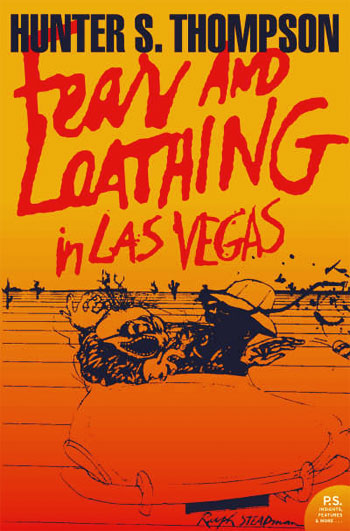
Hunter S. Thompson — Fear and Loathing in Las Vegas
Friedrich Nietzsche — The Gay Science
Richard Dawkins - The Selfish Gene
Wendell Berry — The Way of Ignorance
Joseph Mitchell — Up in the Old Hotel
Brian Greene — The Elegant Universe
Norman Lewis - Voices of the Old Sea
Joan Didion — The White Album
Benjamin Franklin - The Autobiography of Benjamin Franklin
Tony Judt — Postwar: A History of Europe Since 1945
Henry David Thoreau — Walden
Marcus Aurelius — Meditations
Bill Bryson — A Walk in the Woods
George Orwell — Homage to Catalonia
Hannah Arendt — Eichmann in Jerusalem
Booker T. Washington — Up From Slavery
Jorge Luis Borges - Other Inquisitions (1937–1952)
Marcus Rediker — Villains of all Nations: Atlantic Pirates in the Golden Age
Mihaly Csikszentmihalyi — Flow: The Psychology of Optimal Experience
Lao Tzu, Stephen Mitchell, trans. Tao Te Ching
Victor Klemperer — I Will Bear Witness: A Diary of the Nazi Years (1933–1941)
Greil Marcus — Lipstick Traces: A Secret History of the Twentieth Century
Philip Gourevitch — We Wish to Inform You That Tomorrow We Will be Killed with Our Families
Winston Churchill — A History of the English Speaking Peoples
Lastly, and only in part because we’ve been warned that we would be roundly scolded for the omission: The Elements of Style, by William Strunk and E.B. White
Thanks again, and happy reading!
Sheerly Avni is a San Francisco-based arts and culture writer. Her work has appeared in Salon, LA Weekly, Mother Jones, and many other publications. You can follow her on twitter at @sheerly.
Read More...8,000 Chinese Lanterns over Poland
Last Tuesday, the residents of Poznan, Poland set a world record when they released 8,000 Chinese lanterns into the sky to mark the shortest night of the year — or what’s otherwise called Midsummer Night. The video above lets you see the lanterns in full flight. The image below offers a close-up view of a lantern before heading into the night sky…

via @pourmecoffee
Read More...Peter Falk (RIP) in Wings of Desire
Peter Falk made his career playing a quirky detective in the 1960s and 70s television show Columbo. But the art world will remember a moment when Falk played himself in Wim Wenders’ 1987 film, Wings of Desire. In the credits, he was listed simply as ‘Der Filmstar.’ This is our 1:46 tribute to Falk, who passed away Friday at age 83. H/T @SteveSilberman
Related:
Read More...Darwin’s Personal Library Goes Digital: 330 Books Online
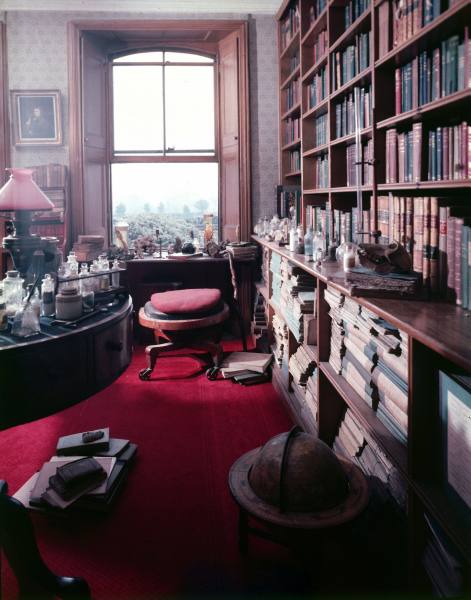
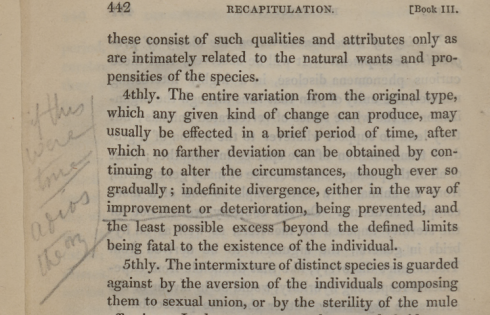
When Charles Darwin finished reading Charles Lyell’s Principles of Geology, a book suggesting that there are clear limits to the variation of species, he wrote in the margins: “If this were true adios theory.” It’s a great piece of marginalia. And it’s just one of many comments that adorn books in Darwin’s personal library, and help illuminate his intellectual path to writing On The Origin Of Species (1859).
Thanks to Cambridge University library and several partners, 330 of Darwin’s most heavily annotated texts have now been digitized and made available online at the website of the Biodiversity Heritage Library. More will come in due time. You can begin your tour here.
Related Content:
via Cambridge News (with thanks to Kirstin Butler and BrainPicker)
Read More...Renata Salecl: The Paradox of Choice
With freedom come choices. Every choice is an opportunity to select the best possible outcome, the one that would make us happiest. More choices lead to more happiness, right? Of course we find the opposite to be true. As choices increase, so does anxiety. In the latest installment of the RSA animated lecture series, Slovenian social and legal theorist Renata Salecl argues that this anxiety, coupled with the capitalist ideal of the self-made person, leads to a kind of social paralysis. “Today’s ideology of choice,” says Salecl, “actually pacifies people and makes us constantly turn criticism to ourselves instead of organizing ourselves and making a critique of the society we live in.” The animated feature was adapted from a lecture Salecl gave last summer in London. (You can watch the entire lecture here.) It draws on ideas presented in her book, Choice.
Other RSA Videos:
Sir Ken Robinson: A Creative Education
Good Capitalist Karma: Zizek Animated
Smile or Die: The Perils of Positive Psychology
Steven Pinker: How Innuendo Makes Things Work
Read More...The Elements of Creativity
The Elements of Creativity. They come down to this: Copy. Transform. Combine. Nothing is truly original. Everything is a remix, more or less.
Director Kirby Ferguson first traced this idea through literature and music, then through filmmaking. Next up? Technology, computers and user interface. Above we have the third and penultimate installment in the “Everything is a Remix” series. (You can watch it in large format here.) Look for the final segment to appear this fall, and consider supporting the project here.
Nice work Kirby and h/t BrainPickings.
Read More...New Fiction by Jonathan Lethem in the Paris Review
Bestselling writer Jonathan Lethem — author of one of my favorite contemporary novels Motherless Brooklyn — has a new short story featured in the summer edition of the Paris Review. The story is called “The Empty Room,” and, once again, the background, childhood, moves to the foreground. It begins:
Earliest memory: father tripping on strewn toys, hopping with toe outraged, mother’s rolling eyes. For my father had toys himself. He once brought a traffic light home to our apartment on the thirty-somethingth floor of the tower on Columbus Avenue. The light, its taxi yellow gone matte from pendulum-years above some polluted intersection and crackled like a Ming vase’s glaze where bolts had been overtightened and then eased, sat to one side of the coffee table it was meant to replace as soon as my father found an appropriate top. In fact, the traffic light would follow us up the Hudson, to Darby, to the house with the empty room. There it never escaped the garage.
Another memory: my playmate Max’s parents had borrowed, from mine, a spare set of china plates. I spent a lot of time visiting with Max and, when he let us inside his room, Max’s older brother. So I was present the afternoon my father destroyed the china set. Max’s family lived in a duplex, the basement and parlor floor of a brownstone, a palace of abundance . . . Max and his brother had separate rooms, and a backyard. All this would pale beside the spaciousness of our Darby farmhouse. That was the point.
You can read the full text here. And please note: the Paris Review has just launched its first digital edition, letting you read the famous literary journal on your computer, iPad or mobile device. More on that here. H/T Biblioklept
Related Content:
The Paris Review Interviews Now Online
Free Audio Books: Download Great Books for Free
Read More...The Black Cab Sessions: One Song, One Take, One Cab
Talk about an intimate venue. A group of friends in England have built an unlikely entertainment franchise, filming performances by the musicians they admire–in the backseat of a London taxicab. The project is called “The Black Cab Sessions,” and the method is simple: “One Song. One Take. One Cab.”
It started in 2007 as something of a lark–an improvised collaboration between members of a music promotion company, Hidden Fruit, and a film company, Just So Films–but the project soon took on a life of its own. Musicians responded enthusiastically, embracing the whimsy and challenge of playing in such cramped, unsteady quarters. Now there are performances by about 100 artists on the Black Cab Sessions website. Most of the musicians are young indie acts, but there are some veteran performers as well, including Martha Wainwright, Richard Thompson and Brian Wilson. There are some famous groups, like Weezer, Mumford and Sons, My Morning Jacket and (yes, of course!) Death Cab for Cutie, but many of the most inspired performances are by musicians you might not have heard about.
The music ranges widely–from Delta blues to beatbox, and from hip hop to Paganini. One of the most popular sessions isn’t music at all, in the strictest sense, but a mesmerizing poetry performance by Benjamin Zephaniah. The one rule, according to Black Cab Sessions co-founder Jono Stevens, is that the filmmakers love the artists’ work. “Big or small,” Stevens said in a TV interview, “It really doesn’t matter. It’s about someone we really, really feel passionate about.”
There’s a lot to discover on the Black Cab Sessions website. You can dive right into the collection here, or start by sampling a few of our favorites, including Death Cab for Cutie singing No Sunlight above, and:
Lykke Li
Amanda Palmer
Langhorne Slim
Killa Kela
Seasick Steve
Beach House
Benjamin Zephaniah
Charlie Siem
My Morning Jacket
Norman Mailer & Martin Amis, No Strangers to Controversy, Talk in 1991
Martin Amis will never win a popularity contest. Nor did Norman Mailer. Back in 1960, Mailer famously stabbed his wife after a dinner party in New York City, and even when things weren’t so extreme, he was often behaving badly. Take for example this appearance on The Dick Cavett Show with Gore Vidal in 1971. It’s hard to find a less sympathetic figure, at least during his early years.
As for Amis, he has never worked hard to make friends, staking out controversial positions on Muslims and euthanasia and then, earlier this year, going out of his way to mock writing for children: “People ask me if I ever thought of writing a children’s book. I say, if I had a serious brain injury I might well write a children’s book, but otherwise the idea of being conscious of who you’re directing the story to is anathema to me, because, in my view, fiction is freedom and any restraints on that are intolerable.” You get the drift.
But good writers rarely win popularity contests. And few will deny that Mailer and Amis have put their stamp on the Anglo-American literary scene. So here you have it — Martin Amis interviewing Norman Mailer in 1991, upon the release of Mailer’s sprawling 1400-page CIA epic, Harlot’s Ghost. The first clip (above) starts with the novel, the remaining parts move in many different directions. The writing life, writing about homosexuality, the state of capitalism, America after the Cold War, Mailer’s legacy — it’s part of the 40 minute conversation. Find Part 2, Part 3, and Part 4.
You can find this video permanently listed in our new collection of 235 Cultural Icons.
via Metafilter
Read More...War & Peace: An Epic of Soviet Cinema
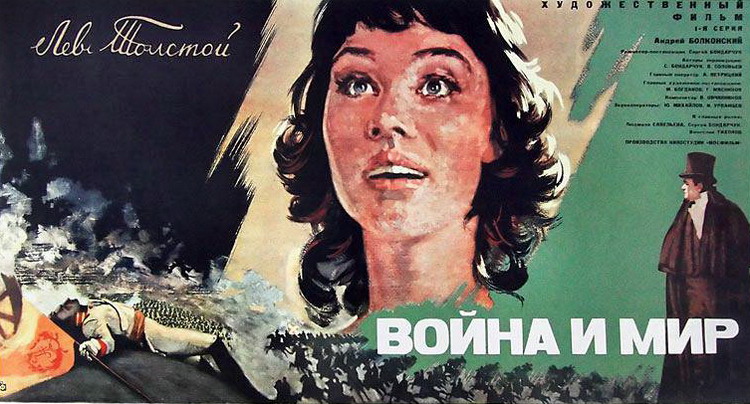
It’s hard to do cinematic justice to any good novel, let alone the greatest of Russia’s many great novels, Leo Tolstoy’s War & Peace. But Soviet director Sergei Bondarchuk somehow managed to pull it off. Reviewing Bondarchuk’s film back in 1969, a young Roger Ebert wrote:
“War and Peace” is the definitive epic of all time. It is hard to imagine that circumstances will ever again combine to make a more spectacular, expensive, and — yes — splendid movie. Perhaps that’s just as well; epics seem to be going out of favor, replaced instead by smaller, more personal films. Perhaps this greatest of the epics will be one of the last, bringing the epic form to its ultimate statement and at the same time supplying the epitaph.
No corners were cut, and no expenses spared, in making the film. Indeed, the film (available on DVD here) was made “at a cost of $100,000,000, with a cast of 120,000, all clothed in authentic uniforms, and the Red Army was mobilized to recreate Napoleon’s battles exactly (it is claimed) as they happened.” What’s more, 35,000 costumes were made for the production, and many Soviet museums contributed artifacts for the production design. That’s staggering, even by today’s standards.
Released in four parts between 1965 and 1967, the Academy Award-winning film runs more than seven hours and you can now find it playing on YouTube. You can watch Part 1 here, and here you have Part 2, Part 3 and Part 4. And if you need subtitles, click CC at the bottom of the videos. The film is, of course, listed in our collection of Free Movies Online.
Thanks Ammar for the heads up on this film!
Read More...Support Us
We're hoping to rely on loyal readers, rather than erratic ads. Please click the Donate button and support Open Culture. You can use Paypal, Venmo, Patreon, even Crypto! We thank you!

About Us

Open Culture scours the web for the best educational media. We find the free courses and audio books you need, the language lessons & educational videos you want, and plenty of enlightenment in between.
Advertise With Us

FREE UPDATES!
GET OUR DAILY EMAIL
Get the best cultural and educational resources on the web curated for you in a daily email. We never spam. Unsubscribe at any time.
FOLLOW ON SOCIAL MEDIA

Open Culture editor Dan Colman scours the web for the best educational media. He finds the free courses and audio books you need, the language lessons & movies you want, and plenty of enlightenment in between.
Advertise With Us