10,000 Galaxies in 3D
In 2004, the Hubble Space Telescope captured 10,000 galaxies in an image that’s now called the Ultra Deep Field. It’s our deepest look into the universe. The video above animates the Deep Field image and puts it into 3D. No need to read more. Just watch.
Read More...Time Travel with Google Earth
 Google Earth’s historical imagery feature now includes aerial footage of the aftermath of World War II, allowing users to comprehend the extent of post-war destruction by comparing photos of cities as they are today to those of bombed out cities immediately after the war.
Here’s Warsaw in 1935, devastated in 1943, and restored today. You can click here to see the pictures in a bigger size.
For more imagery, including pictures of Stuttgart, Naples and Lyon, see the Google Earth blog.
Wes Alwan lives in Boston, Massachusetts, where he works as a writer and researcher and attends the Institute for the Study of Psychoanalysis and Culture. He also participates in The Partially Examined Life, a podcast consisting of informal discussions about philosophical texts by three philosophy graduate school dropouts.
Read More...F. Scott Fitzgerald Reads Shakespeare
The University of South Carolina hosts a few gems, including F. Scott Fitzgerald (The Great Gatsby) reading lines from Shakespeare’s Othello. Or, more specifically, Othello’s oration to Venetian senators.
This comes to us via Mike. Thanks to all who started sending good links our way. Whenever you see something good, please fire us a quick email. It will take one minute out of your day and make the day for many others.
Follow us on Facebook, Twitter, Google Plus and LinkedIn and share intelligent media with your friends. And if you want to make sure that our posts definitely appear in your Facebook newsfeed, just follow these simple steps.
Read More...British Library to Offer 65,000 Free eBooks
From the TIMES ONLINE:
More than 65,000 19th-century works of fiction from the British Library’s collection are to be made available for free downloads by the public from this spring.
Owners of the Amazon Kindle, an ebook reader device, will be able to view well known works by writers such as Charles Dickens, Jane Austen and Thomas Hardy, as well as works by thousands of less famous authors.
You can read the rest about this Microsoft funded initiative here. In the meantime, we’ve made it relatively easy to download major classics to your Kindle, iPhone, smartphone or computer. See our collection of Free eBooks (and Audio Books).
Read More...What Teachers Make
Great message. Give it a minute to get going. Performed by Taylor Mali at the Bowery Poetry Club on November 12, 2005. Thanks Thomas for sharing.
This clip is now added to our YouTube favorites.
Read More...Top 10 Reasons Why iPad Marks Kindle’s Death
Caveat: If you missed it, yesterday’s post was 10 Reasons iPad Will Not Kill Kindle. So take everything here with appropriate grains of salt.
10.) Books with graphics. Many books contain photos, graphics and diagrams that the Kindle does not handle well, if at all. When people realize that the iPad will do this flawlessly, they’ll head in that direction. Example: while reading the new Carver biography on my Kindle, an experience that I loved, I had to miss out on all of the pictures collected from Carver’s life. Once you take into account newspapers and magazines, there’s even more weight on iPad’s side.
9.) Cost: Seriously, Amazon really overstepped their boundaries when they set Kindle’s price at around $300, as they did. If they had made it $100 or less, they would have probably have sold 4 or 5 times the number of devices, hooking more readers to their bookstore and their device. Look at Gillette as an example: which costs more—the razor or the razor blades?
8.) “I love my Kindle!” – less than two million people have bought the Amazon product. By comparison, over forty million iPhones and iPod Touches have been sold. No one knows how many folks will rush out to buy an iPad, but if previous iPhone sales and the buzz around the iPad are any indication, this is going to be another big win for Apple.
7.) iPad is a Kindle: just use that free Kindle app on your iPad and you’ve got the whole Kindle store wide open to you. You can even take your whole Kindle library right over to Apple’s iPad with the Kindle App.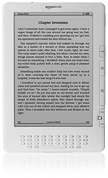
6.) Cost, again: with iPad coming in at a low $499 for a device that’s much better made and features much more capability than the Kindle, with at least four times the memory… well, you get the picture. Oh jeez… I just found out the Kindle DX goes for $489. Oh, Mr. Bezos… what are you thinking?
5.) Capability. People don’t want a dedicated reading device: if you can carry around a device the size of your e‑reader, but also use it to check email, surf the web, watch TV and movies, listen to music, use office-type apps, etc. then that’s going to win in today’s economy.
4.) Book pricing. It looks like Apple, the diabolical pricers of all songs at $.99, might wind up being the publishers’ darling in the e‑book market by pricing their titles higher than Amazon has been. So far it looks like ibooks will be closer to the $14.99 price point that publishers like. Right now, as evinced by this past weekend’s squabble between Amazon and Macmillan, publishers appear to be fed up with Amazon’s pricing strategy. Apple may just become publishers’ white knight. (more…)
Read More...10 Reasons iPad Will Not Kill Kindle
Caveat: before half of you get your shorts in a bunch, tomorrow’s post will be: Top 10 Reasons Why iPad Means Kindle Is Dead. With that said, have at it!
10.) Taking reading from a simple printed page to an e‑book environment such as the Kindle is a great step forward. Its ease of use, portability and storage are ideal for readers. No more innovations needed!
9.) The enjoyment of reading has always taken place within a reader’s mind. This is both why reading is great and why the words on the page don’t need to be in flashy colors or feature fancy graphics.
8.) Added cost of iPad and $30/month fee for 3G from AT&T (the realistic cost) make Kindle a better deal. Enough said.
7.) Everyone hates AT&T, their 3G service is spotty at best, and NO ONE who’s buying a 3G iPad will use less than 250MB a month, so the $14.95 price point for 3G is useless!
6.) Glare/e‑ink. You can always read during the daytime with your Kindle. Take it to the beach, read in broad daylight. e‑ink is simply easier on readers’ eyes than back-lit pixels.
5.) There’s no need for a device that fits between laptop and smart phone. Both are extremely portable and serve different purposes. If I want to curl up in bed with a movie or the web, I can use my laptop for that already. If I want to curl up in bed and read, I can use my Kindle!
4.) Apps! That’s right: The new opening up of Amazon’s Kindle format to app developers will mean a lot more versatility on the device. Once a few folks come along and develop email clients or web browsers for the Kindle, Kindle will become even more useful as a potential smart phone substitute—the niche that iPad seems intent on filling.
3.) The new price-sharing announcement (70% publisher/30% Amazon) for Amazon’s Digital Text Platform (DTP) makes Kindle more attractive once again to all the powers that be in publishing. If they can get this pesky text-to-speech battle cleared up, things will be even better.
2.) Big publishing is currently doing so much of their sales through Amazon, that they might be afraid to carry business over to Apple. Sure, they will sell books there, but keep in mind that Apple might have to keep prices in the iBook store higher than at Amazon.
1.) “I love my Kindle!” –Seriously, a lot of readers are devoted to these devices, including me. I’ve found a nice cover that makes the Kindle easy to hold. I really like the ease of buying/storing books on it. And I just want a plain, simple device to use for reading.
The opinions expressed above are not necessarily those of Open Culture or the author.
Up next (tomorrow): Top 10 Reasons Why iPad Means Kindle is Dead
Seth Harwood is a voracious reader, subversive publishing maven and crime novelist. His next book Young Junius will be available from Tyrus Books this fall. He’s sure to have some crazy promotions going at his site this spring as well.
Read More...PIRACY: A Free eBook (Today Only)
A quick fyi on a free eBook from the University of Chicago. (It’s an offer that seems well timed, given this weekend’s copyright debate on OC.) Here are the details from UC:
Offered as a free e‑book for one day only, February 1: Piracy: The Intellectual Property Wars from Gutenberg to Gates. “[Adrian Johns] traces the tensions between authorized and unauthorized producers and distributors of books, music, and other intellectual property in British and American culture from the 17th century to the present.… The shifting theoretical arguments about copyright and authorial property are presented in a cogent and accessible manner. Johns’s research stands as an important reminder that today’s intellectual property crises are not unprecedented, and offers a survey of potential approaches to a solution.”
For more free eBooks, please visit our collection of Free eBooks.
Read More...Einstein is Money

Newton, Copernicus, Galileo, Bohr and many other great scientists appear on paper currencies from around the world. Note that you can click on each image to see it in a higher resolution.
via @olfus
Read More...The iPad and Information’s Third Age
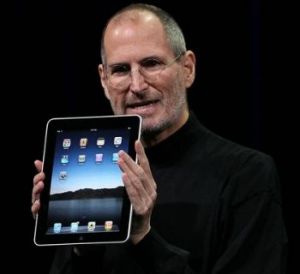 Today we have a guest post by William Rankin, director of educational innovation, associate professor of medieval literature, and Apple Distinguished Educator, Abilene Christian University. ACU was the first university in the world to announce a comprehensive one-to-one initiative based on iPhones and iPod touches designed to explore the impact of mobility in education. For the past year, they have been considering the future of the textbook. Rankin, who made a brief appearance on NBC Nightly News last night, does a great job here of putting the new Apple iPad in historical context and suggesting why it may solve the great informational problems of our age.
It may seem strange in the wake of a major tech announcement to turn to the past—570 years in the past and beyond — but to consider the role of eBooks and specifically of Apple’s new iPad, I think such a diversion is necessary. Plus, as regular readers of Open Culture know, technology is at its best not when it sets us off on some isolated yet sparkling digital future, but when it connects us more fully to our humanity — to our history, our interrelatedness, and our culture. I want to take a moment, therefore, to look back before I look forward, considering the similarities between Gutenberg’s revolution and recent developments in eBook technologies and offering some basic criteria we can borrow from history to assess whether these new technologies — including Apple’s iPad — are ready to propel us into information’s third age.
In the world before Gutenberg’s press — the first age — information was transmitted primarily in a one-to-one fashion. If I wanted to learn something from a person, I typically had to go to that person to learn it. This created an information culture that was highly personal and relational, a characteristic evidenced in apprenticeships and in the teacher/student relationships of the early universities. This relational characteristic was true even for textual information. The manual technology behind the production and copying of books and the immense associated costs meant that it was difficult for books to proliferate. To see a book — if I couldn’t afford to have my own copy hand-made, a proposition requiring the expenditure of a lifetime’s worth of wages for the average person — meant that I had to go visit the library that owned it. Even then, I might not be allowed to see it if I didn’t have a privileged relationship with its owners. So while the first age was rich in information (a truth that has nothing to do with my personal bias as a medievalist), its primary challenge involved access.
Gutenberg’s revolution, ushering in the second age, solved that problem. Driven by one of the first machines to enable mass-production, information could proliferate for the first time. Multiple copies of books could be produced quickly and relatively cheaply — Gutenberg’s Bible was available at a cost of only three years’ wages for the average clerk — and this meant that books took on a new role in culture. This was the birth of mass media. Libraries exploded from having tens or perhaps a few hundred books to having thousands. Or tens of thousands. Or millions. And this abundance led to three distinct revolutions in culture. Though the university initially fought its introduction, the printed textbook provided broad access to information that, for the first time, promised the possibility of universal education. Widespread access to bibles and theological texts fueled significant transformations in religion across the Western Hemisphere. And access to information, philosophy, and news led to the dismantling of old political hierarchies and some of the first experiments with democracy (have you ever stopped to notice how many of the American revolutionaries were involved in printing and publishing?). (more…)
Read More...Support Us
We're hoping to rely on loyal readers, rather than erratic ads. Please click the Donate button and support Open Culture. You can use Paypal, Venmo, Patreon, even Crypto! We thank you!

About Us

Open Culture scours the web for the best educational media. We find the free courses and audio books you need, the language lessons & educational videos you want, and plenty of enlightenment in between.
Advertise With Us

FREE UPDATES!
GET OUR DAILY EMAIL
Get the best cultural and educational resources on the web curated for you in a daily email. We never spam. Unsubscribe at any time.
FOLLOW ON SOCIAL MEDIA

Open Culture editor Dan Colman scours the web for the best educational media. He finds the free courses and audio books you need, the language lessons & movies you want, and plenty of enlightenment in between.
Advertise With Us


