The War of the Worlds: Orson Welles’ 1938 Radio Drama That Petrified a Nation
Back in the late 1930s, Orson Welles launched The Mercury Theatre on the Air, a radio program dedicated to bringing dramatic, theatrical productions to the American airwaves. The show had a fairly short run. It lasted from 1938 to 1941. But it made its mark. During these few years, The Mercury Theatre aired The War of the Worlds, an episode narrated by Welles himself that led many Americans to believe their country was under Martian attack. The legendary production was based on H.G. Wells’ early sci-fi novel, also called The War of the Worlds, and you can listen to the classic radio production here, or above.
The Mercury Theatre also adapted a series of other major novels, including Dracula, Treasure Island, and The Count of Monte Cristo. And then there’s Dickens. In 1938 and 1939, The Mercury Theatre produced two versions of Charles Dickens’ A Christmas Carol. In the 1938 version (get mp3), Welles played the role of Scrooge. The 1939 version (mp3) features Lionel Barrymore (yup, the granduncle of Drew Barrymore) playing the same role. You can listen to these shows and others at this web site dedicated to The Mercury Theatre on the Air.
Related Content:
The Dead Authors Podcast: H.G. Wells Comically Revives Literary Greats with His Time Machine
Orson Welles Explains Why Ignorance Was the Genius Behind Citizen Kane
Various films directed by (or starring) Orson Welles can be found in our collection of Free Movies Online.
Read More...Physics in the Tiger Woods Scandal
Here’s the intellectual upside of the Tiger Woods kerfuffle: A copy of John Gribbin’s Get a Grip on Physics was spotted in Woods’ wrecked Cadillac. (Photo here.) And, ever since, the book has been in high demand. The Wall Street Journal reports that the book’s Amazon sales rank has jumped from 396,224 to 2,268. But, from what I can tell, the book actually seems to be out of print, and you’ll need to pay a minimum of $42 to buy a used copy online. (Here’s an instance where Google’s book digitization initiative would benefit an author.) If you’re looking to bone up on your physics, let me save you a few bucks. With Learning Physics Through Free Online Courses, we have pulled together free courses from MIT, Stanford, UC Berkeley, and Yale, plus a series of famous lectures by Richard Feynman that Bill Gates has put online. These and many other physics courses can also be found in our larger collection of Free Courses Online and on our Free iPhone App. Enjoy and remember to wear your seatbelt.
Read More...Why Open Video?
What is open video? And how does it promote free speech, participation, diversity and a more engaged media sphere? Get the answers from Amy Goodman (Democracy Now), Xeni Jardin (Boing Boing), Nina Paley (Sita Sings the Blues), Yochai Benkler & Jonathan Zittrain (Harvard Berkman Center), among others. This is a mission to get behind. Excellent work by Peter Kaufman and Intelligent Television. Note: You can download this video in OGG and MP4 formats.
Read More...Kindle Competitor Gets Off to a Shaky Start
Looking to take back some of the e‑book market from Amazon’s Kindle, Barnes & Noble has released its new reader, the Nook. This week, Walt Mossberg, the influential tech reviewer, gave his thoughts on the new gadget. Needless to say, it’s not a good PR day when he says that it feels like a product “rushed to market.” Watch the video review here.
New David Foster Wallace in The New Yorker
Appearing in The New Yorker this week is an excerpt from David Foster Wallace’s unfinished novel, The Pale King. It begins:
Once when I was a little boy I received as a gift a toy cement mixer. It was made of wood except for its wheels—axles—which, as I remember, were thin metal rods. I’m ninety per cent sure it was a Christmas gift. I liked it the same way a boy that age likes toy dump trucks, ambulances, tractor-trailers, and whatnot. There are little boys who like trains and little boys who like vehicles—I liked the latter.
Continue reading the rest here. Also see this other previously published excerpt and some pages from DWF’s actual manuscript.
via Kottke.org
PS Is anyone having problems posting comments? If so, please shoot me a note at the email address above. I appreciate your help.
Read More...Learning, Memory and the Brain: A Primer
The Teaching Company has posted online a free video lecture that focuses on what happens in our brain when we learn — something that should pique the interest of pretty much any reader here. (Just what happens with those synapses when you come here every day?) The lecture (watch here) comes from a larger course called Understanding the Brain and is presented by Jeanette Norden, a professor in Cell and Developmental Biology at Vanderbilt University.
Side Note: The Teaching Company is also offering free access to another lecture (this one in audio) that surveys the “Masterpieces of Classical Holiday Music,” including Bach’s Christmas Oratorio of 1734, Handel’s Messiah of 1741; and Tchaikovsky’s Nutcracker Suite of 1892. Listen or download here.
Read More...Visit Pompeii (also Stonehenge & Versailles) with Google Street View
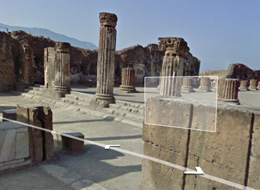 The story of Pompeii is well known. Back in 79 AD, Mount Vesuvius erupted and covered the neighboring Roman city with 60 feet of ash over the course of two days. The city was wiped out and then entombed for centuries, until archaeologists started unearthing the ruins in the 18th and 19th centuries, offering the modern world an amazing window into the finer details of ancient Roman life. (Just for the record, digging continues there today, and I even got to do some this past summer.) Today, Google is helping deepen the modern connection to the ancient world. Using Google Street view, you can tour Pompeii in 3D from the comfort of your own home. To begin walking through the ancient city, just click here.
As a side note, this isn’t the first time Google has used Street View in such a way. You can also find tours of Stonehenge and Louis XIV’s Versailles. Plus, you can also use Google Earth, another Google program, to tour the ancient city of Rome.
Finally, to dig deeper into ancient history, I’d recommend looking through our previous post, Learning Ancient History for Free. This will point you to some of the best free courses available on the web.
via Mashable and the National Post
Read More...Magnetic Fields Made Visible
What do natural magnetic fields look like? This extraordinary footage from NASA’s Space Sciences Laboratory (UC Berkeley) gives you a glimpse and reveals their “chaotic, ever-changing geometries.”
Read More...10 Power Tools for Lifelong Learners
- Free Audio Books: This page contains a vast number of free audio books, including many classic works of fiction, non-fiction, and poetry. Jane Austen, Arthur Conan Doyle, F. Scott Fitzgerald, James Joyce, Kafka, Shakespeare, Orwell and much more. You can download them all straight to your computer or mp3 player, then listen any time. (On a related note, you might want to see our list of Life-Changing Books, according to our readers.)
- Free Courses from Major Universities: This list brings together over 250 free courses from leading universities, including Stanford, Yale, MIT, UC Berkeley, Oxford and beyond. Theses full-fledged courses range across the humanities, social sciences, and sciences, including computer science. The page is a gold mine for lifelong learners.
- Learn Languages for Free: Spanish, English, Chinese & 37 Other Languages: Centralized in one place are free lessons that will teach you 37 languages. Spanish, French, Italian, Mandarin, English, Japanese, Russian, Dutch, even Finnish and Esperanto — they’re all free and portable.
- Free eBooks: Here’s a new collection that features over 100 Free eBooks, most of them classics, that you can access on your PC, smart phone (including iPhone), and Kindle.
- Ideas & Culture Programs/Podcasts: In this one collection, we have gathered together some of the most intellectually stimulating programs available via podcast. The programs will keep you thinking and culturally up-to-date, as will our collection of science podcasts. All can be downloaded straight to your mp3 player.
- The Best Intelligent Video Sites: Where can you go to find intelligent video? We have listed 46 web sites that feature a steady stream of intelligent content: documentaries, lectures, educational programming and much more.
- Smart YouTube Collections: It’s hard to separate the wheat from the chaff on YouTube. But we have done it. Here you will find upwards of 100 YouTube channels that regularly serve up smart video content.
- Our YouTube Picks: Over the past few years, we have featured several hundred YouTube videos on Open Culture. And some of the best ones we have brought together in our own YouTube channel. You can subscribe to this collection and watch new videos as we add them.
- Great Classic Movies: Our new movie collection features landmark films for the student of cinema. Here, you’ll find numerous Chaplin films from the silent era, 12 Alfred Hitchcock films, and many other great works from the 1920s, 30, 40s and 50s. You’ll even find some great contemporary films as well. Many of the great American directors are represented here.
- Open Culture iPhone App: A little something special for iPhone users. When you download our free iPhone app, you can take with you, wherever you go, many of the items listed above. Free Audio Books, Free University Courses, Free Language Lessons, Music and Science Podcasts, etc. Give it a try and tell a friend. Note, that per Apple’s requirements, you will need access to Wi-Fi.
The Best of TED: A Stroke of Insight?
Last week, we waded into the best of TED debate. What’s the best TED Talk out there? It’s hard to say. Purely subjective. But we can say one thing. Jill Bolte Taylor’s “Stroke of Insight” talk reaches the top of many lists. What happens when a neuroanatomist experiences a massive stroke and feels all the brain functions she has studied (speech, movement, understanding, etc) suddenly start to slip away? And how do these losses fundamentally change who we are? You’ll find out in a crisp (and at times emotional) 18 minutes and 40 seconds. You can also read her book that elaborates on her life-altering experience. See My Stroke of Insight: A Brain Scientist’s Personal Journey.
Read More...Support Us
We're hoping to rely on loyal readers, rather than erratic ads. Please click the Donate button and support Open Culture. You can use Paypal, Venmo, Patreon, even Crypto! We thank you!

About Us

Open Culture scours the web for the best educational media. We find the free courses and audio books you need, the language lessons & educational videos you want, and plenty of enlightenment in between.
Advertise With Us

FREE UPDATES!
GET OUR DAILY EMAIL
Get the best cultural and educational resources on the web curated for you in a daily email. We never spam. Unsubscribe at any time.
FOLLOW ON SOCIAL MEDIA

Open Culture editor Dan Colman scours the web for the best educational media. He finds the free courses and audio books you need, the language lessons & movies you want, and plenty of enlightenment in between.
Advertise With Us


