The Art History Web Book
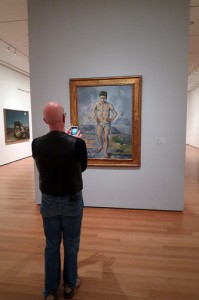 Now there’s a nice alternative to the traditional, expensive art history textbook. The folks at smARThistory have created a free multi-media web-book that offers a dynamic survey of art history. The online resource combines traditional images with audio and videos, and the beauty is that you don’t have to read this web-book in a linear fashion. Rather, you can sort through things by time period, style and artist and find the information that you want. In case you’re wondering about the credibility of this resource, it doesn’t hurt to mention that one of its founders, Beth Harris, is the Director of Digital Learning at the Museum of Modern Art in New York City, and the other, Steven Zucker, is Dean of the School of Graduate Studies at the Fashion Institute of Technology, part of the State University of New York. Have a look.
Harper’s Index Now Open
Read More...In celebration of its 25th year, the Harper’s Index–12,058 lines spanning 300 issues–is now open to all for searching and browsing, with more than one thousand linked categories. Some starting points: Adultery, China, Beer, Vegetables, Sweets,American Men, American Women, Cats, Dogs, Frogs, Bears, and Pandas.
The Odds on America’s Collapse
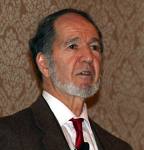 Jared Diamond became a household name with his Pulitzer Prize-winning book Guns, Germs & Steel (2003). Later, the UCLA geographer climbed the charts again with Collapse: How Societies Choose to Fail or Succeed (2005). Now, based on this last book, he’s putting odds on whether the United States will survive this crisis, and he’s putting them only at 51–49. Not too great. And he goes on to say that our best chance of surviving is if America’s wealthy elite suffers far more than it already has. For more, listen here.
via Big Think’s Twitter Feed. Get our Twitter Feed here.
Read More...Bridging the Science-Religion Divide
Is there “a philosophical incompatibility between religion and science. Does the empirical nature of science contradict the revelatory nature of faith? Are the gaps between them so great that the two institutions must be considered essentially antagonistic?” These were the questions raised by Jerry Coyne, a professor at the University of Chicago, in a long and meaty book review (“Seeing and Believing”) appearing in The New Republic. Over at the Edge.org, a number of scientific thinkers, who regularly engage with these essential questions, have offered their own thoughts on the matter. You’ll find short pieces by Stephen Pinker, Daniel Dennett, Sam Harris, George Dyson and others. This one passage by Karl Giberson particularly struck me (though it’s not exactly a reflection of my worldview):
Empirical science does indeed trump revealed truth about the world as Galileo and Darwin showed only too clearly. But empirical science also trumps other empirical science. Einstein’s dethronement of Newton was not the wholesale undermining of the scientific enterprise, even though it showed that science was clearly in error. It was, rather, a glorious and appropriately celebrated advance for science, albeit one not understood by most people. Why is this different than modern theology’s near universal rejection of the tyrannical anthropomorphic deity of the Old Testament, so eloquently skewered by Dawkins? How is it that “science” is allowed to toss its historical baggage overboard when its best informed leaders decide to do so, even though the ideas continue to circulate on main street, but religion must forever be defined by the ancient baggage carried by its least informed?
The world disclosed by science is rich and marvelous, but most people think there is more to it. Our religious traditions embody our fitful and imperfect reflections on this mysterious and transcendent intuition—an intuition that, as articulated by some of our most profound thinkers, seeks an understanding of the world that is goes beyond the empirical.
Milton Friedman on Greed
The new Treasury Secretary unveiled his plan this morning, and apparently the markets hate it, which pretty much guarantees that we’ll be living with our financial mess for a good while longer. As we know, this crisis could have been avoided. But greed got the better of us. So, I wonder what readers think when they see Milton Friedman’s 1979 defense of capitalism and greed. Is it a model, a line of argument, that’s now discredited? Or do we grudgingly concede his points and say that capitalism is the worst economic model except for all the others that have been tried (a cheap play here on Churchill), and then figure out how to mop it up?
via Andrew Sullivan’s Daily Dish
Read More...The Obama “Hope” Poster & The New Copyright Controversy
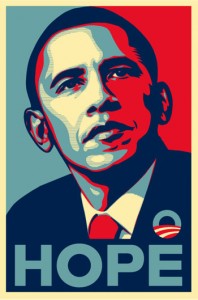 By now, everyone knows the famous Obama “Hope” poster produced by Shepard Fairey. Recently, Fairey has acknowledged that the poster was originally inspired by a photograph belonging to the AP Press, and now the AP is claiming that Fairey has infringed on its copyright and wants “payment for the use of the photo and a portion of any money he makes from it.” (see article in the New York Times). In response, Fairey has filed a preemptive lawsuit, claiming that he used the AP photo as a mere starting point and then transformed it into a “stunning, abstracted and idealized visual image that created powerful new meaning and conveys a radically different message.” If you put the two images side by side (see here), it’s pretty instantly clear that Fairey took an admittedly well done news photo and did something quite transformative with it, which makes things fair game. That’s obvious to almost anyone (including hopefully judges), and it’s a shame to see the AP, which lives by its First Amendment rights, looking to use the copyright clause to limit freedom of expression. Bad move guys.
As a quick side note, Fairey is being represented in court by The Fair Use Project at Stanford Law School’s Center for Internet and Society (to which I have zero connection.)
Related Content:
The Story Behind the Iconic Obama Campaign Poster
Read More...Bill Gates on Changing the World
The 2009 TED conference, which featured a long list of well-known speakers, wrapped up on Friday. And now you can watch two of the key presentations online. First, and featured above, you’ll get Bill Gates, Microsoft founder and now major philanthropist, talking about how to change the world through education and disease prevention. It’s a good 20 minutes, and it will particularly interest any educators who read this blog. Next, Bill Gross, founder of Idealab, gives you 20 minutes on the groundbreaking work being done in solar energy.
We’ve added the Gates talk to our list of YouTube Favorites. Also, you’ll find videos from TED on our list: YouTube Education: 80 Intelligent Video Collections.
Read More...Lincoln on Flickr
The Library of Congress has added a series of images to Flickr that will “let you see how Lincoln looked over 20 years—from the earliest known photographic likeness in 1846, through the U.S. presidential campaign of 1860, and the pressures of the Civil War years. Views from Lincoln’s funeral in 1865 and portraits of his immediate family are also included.”
via The Library of Congress Blog
Read More...Extra Goodies on Twitter
As I gather material for the blog, I often come across content that’s interesting, but not quite right for the blog. It seemed like Twitter might be a good place to add this bonus material. So from here on out, I’ll casually add some extra content there. Today, I just mentioned how you can get 50% off of some classic American literature. Check out our Twitter feed here.
Read More...Amazon: New Kindle and Free E‑Books
Google announced yesterday that it’s making a large number of books available via web-enabled mobile phones. Now, Amazon has said that it will unveil a new version of the Kindle next week and also make Kindle titles available on a variety of mobile phones. You can get more info here.
UPDATE: We have created a large collection of Free eBooks, which includes ebooks provided by Google. Please visit this page to access free ebooks on your computer, smart phone (including iphone), or kindle.
Read More...Support Us
We're hoping to rely on loyal readers, rather than erratic ads. Please click the Donate button and support Open Culture. You can use Paypal, Venmo, Patreon, even Crypto! We thank you!

About Us

Open Culture scours the web for the best educational media. We find the free courses and audio books you need, the language lessons & educational videos you want, and plenty of enlightenment in between.
Advertise With Us

FREE UPDATES!
GET OUR DAILY EMAIL
Get the best cultural and educational resources on the web curated for you in a daily email. We never spam. Unsubscribe at any time.
FOLLOW ON SOCIAL MEDIA

Open Culture editor Dan Colman scours the web for the best educational media. He finds the free courses and audio books you need, the language lessons & movies you want, and plenty of enlightenment in between.
Advertise With Us


