Steve Jobs Demos the First Macintosh in 1984
We originally posted this video back in 2009, and it seems like the right time to bring it back. It captures the first of many times that Steve Jobs thrilled audiences with the promise of what technology could deliver. The video takes you back to January 1984, when Jobs demoed the first Macintosh. A young Jobs, sporting a bow tie and a fuller head of hair, could barely hold back his smile and some tears, and the crowd simply couldn’t contain its enthusiasm, giving Jobs a five-minute standing ovation. That’s where the video ends, fading happily and suitably to black. We’ll miss you Steve.
For another great Steve Jobs moment, don’t miss his inspiring Stanford 2005 graduation talk where he discussed his approach to living and urged the young graduates to “Stay Hungry, Stay Foolish.” So far as commencement speeches go, it’s hard to beat this one.
Read More...
Google Maps the Oceans, Mars and Time
Given that water covers roughly 70% of our planet, it makes sense that Google Earth should take the oceans into account. Thanks to a partnership with the California Academy of Sciences, Google Earth now offers, according to the company blog, detailed maps of the ocean floor “so you can actually drop below the surface and explore the nooks and crannies of the seafloor in 3D.” You’ll also get “thousands of data points including videos and images of ocean life, details on the best surf spots, logs of real ocean expeditions, and much more.”
In this latest release of Google Earth, you’ll also find detailed maps of the planet Mars, plus (rather amazingly) some functionality that lets you see how landscapes have changed over time. How does San Francisco look today as compared to 50 years ago? You should now be able to find out.
You can get more information on these new additions here on Google’s Blog. Also, you can see a video report from The Wall Street Journal that gives you a visual taste of Google Earth 5.0.
Also, as a quick reminder, you can now follow us on Twitter!
Read More...Jon Stewart on the Bizarro World of Wall Street
As usual, Stewart cuts to the chase and says what has to be said. And gets a good laugh along the way…
Read More...Gopnik on Darwin & Lincoln: Read the First Chapter
We noted last week that New Yorker writer Adam Gopnik has just released a new book, Angels and Ages, which examines the unique stamp that Darwin and Lincoln placed on our modern times. Thanks to The New York Times, you can now read the first chapter of Gopnik’s book for free. It will give you a feel for his writing, which never disappoints. As a quick aside, I should mention that the Times has a section called First Chapters. It gives you free access to the first pages of many new and important books. A good resource to keep your eye on.
Read More...The Lincoln Revival
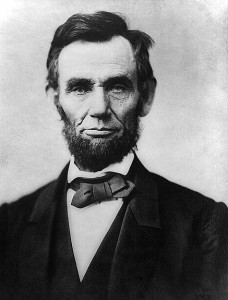 Abraham Lincoln has never exactly gone out of fashion. More books have been written about him than any other American president. But even so, he has recently dominated our thoughts, our public discourse, in a way that we haven’t seen in some time. And that’s because he started something in American history that ended with the inauguration of Barack Obama last week.
To mark the occasion, I wanted to highlight an excellent series of podcasts that focuses on Lincoln and the Civil War. Created by the Gilder Lehrman Institute of American History, this series features talks by some of America’s leading scholars of the Civil War period, and at least two Pulitzer Prize winners. Among the lectures, you’ll find the following:
- Team of Rivals: The Political Genius of Abraham Lincoln (iTunesU) — Doris Kearns Goodwin
- Crossroads of Freedom: Antietam (iTunesU) — James McPherson
- No Party Now: Politics in The Civil War North (iTunesU) — Adam I.P. Smith
- Lincoln’s Emancipation Proclamation (iTunesU) — Allen Guelzo
- Abraham Lincoln: A Biographer’s Notes (iTunesU) — Richard Carwardine
- Race and Reunion: The Civil War in American Memory (iTunesU) — David Blight
For those of you who don’t want to work with iTunes, you can access these presentations and more at the Gilder Lehrman website here. You can also find here a page entirely dedicated Abraham Lincoln and related content.
P.S. Yet more proof that Lincoln is now everywhere. New Yorker writer Adam Gopnik has just released a new book, Angels and Ages, which examines the unique stamp that Darwin and Lincoln placed on our modern times. (Both men, by the way, were born on the same day 200 years ago next month.) You can listen here to an interview with Gopnik that was recorded yesterday.
Read More...Talking with Steven Soderbergh
Here’s a piece from one of my colleagues, Scott Hutchins. Take it away Scott…
Steven Soderbergh was in San Francisco as part of the roll out for his four-and-a-half-hour, two-part epic Che, about the Argentinian doctor turned revolutionary Che Guevara. Guevara is no stranger to American screens, especially after the popular film, The Motorcycle Diaries. So we wondered why Soderbergh wanted to make another movie about him. Soderbergh is widely considered one of the most talented directors at work in Hollywood today, but even some of his fans are scratching their heads over this most recent film. In the New Yorker, film reviewer Anthony Lane says, ‘I still have no idea what truly quickens his heart.’ In this interview, we certainly discovered what gets his blood pumping. Soderbergh (who also directed Traffic, Erin Brokovich, and Sex, Lies and Videotape) discusses his shaken faith in the power of film, what he has in common with Fidel Castro, and how nothing will ever be solved in the Middle East as long as monotheists are involved. You can read the full interview at therumpus.net.
Read More...Bob Dylan Goes a Little Commercial
Stephen in the UK highlighted a piece in Guardian that will interest Bob Dylan fans. It begins:
Bob Dylan has given rare permission for his music to be used in a TV commercial.
Protest song Blowin’ in the Wind will be used to reinforce a message of change in a TV campaign for ethical banking and retail firm the Co-operative Group.
The song, a 1960s anthem for those disaffected with the establishment, is thought to be the first track Dylan has allowed to appear in a UK TV ad.
Blowin’ in the Wind is being used to underpin a multimillion-pound relaunch of the Co-operative Group’s image.
The TV campaign, which breaks next month, aims to showcase the company’s diverse interests from food, funerals and travel to pharmacies and financial services.
In response to all of this, Stephen adds: “The Co-op is ethical; The Co-op supports FairTrade; The Co-op is still a co-operative; They sure ain’t Victoria’s Secret.” Thanks Stephen.
Related Bob Dylan Content:
When Bob Dylan Went Electric: Newport, 1965
Bob Dylan & Johnny Cash Together in 1969: Free MP3s
Bob Dylan — Like A Rolling Stone 1966
Read More...
Academic Earth Goes Live
The open education movement got a little stronger this week with the launch of Academic Earth. Run by Richard Ludlow, a new social entrepreneur only a couple of years out of Yale, Academic Earth brings video lectures from leading universities into a centralized user-friendly site. What you’ll see here is an impressive early implementation of where Academic Earth plans to go. Take content-rich videos from universities, organize the videos well, make the visual experience attractive, add personal customization functionality and the ability to engage with the content, and you have a very useful service to bring to the world. I first started talking with Richard back in the fall and am really glad to see his site now ready for show time. Check it out in beta and watch it grow.
Read More...Google and the Path To Enlightenment
In the latest edition of The New York Review of Books, Robert Darnton, a prominent French historian who now runs Harvard’s Library system, puts out a tantalizing idea: “Google can make the Enlightenment dream come true.” Having settled its lawsuit with publishers and authors, Google is now steaming ahead with its effort to digitize millions of books and create a vast digital library available to individuals and institutions everywhere on a subscription basis. (The fees apply to copyrighted texts only, not to those in the public domain.) This opens up the possibility that Google can fulfill the Enlightenment promise of democratizing knowledge, enriching the intellectual marketplace, and diffusing the ideas that have the greatest social benefit. The question is whether Google will actually make this happen. Will Google’s private interests line up with the public interest? Will the company keep the digital library open and fulfill the hopes of Voltaire, Rousseau, Franklin, and Jefferson? Or will the pursuit of profit gradually lead Google to drive up prices and close off access? Given the recent conduct of the banking community, it’s hard to remain optimistic that market-driven institutions will act altruistically. Yes, Darnton acknowledges, Google seems to be starting off with good intentions. But what the company does long-term with its near monopoly on online information is anyone’s guess, and it’s entirely up to Google to do the right thing. For more on the Enlightenment and Google’s online book initiative, you should dig deeper into Darnton’s piece. Also you can join The New York Review of Books group on Facebook, or follow it on Twitter.
Read More...Download New Horror Stories Free
Toronto writer Robert Boyczuk has released the short story collection Horror Story and Other Horror Stories in trade paperback. You can purchase it on Amazon, or download it in a free PDF format here. Also now available is a free audio/mp3 version of Boyczuk’s short story, “Falling”. These finds were highlighted by Cory Doctorow over at BoingBoing. Doctorow has elsewhere called Boyczuk a “supremely talented short-story writer.” For more information on all this, browse this press release.
Read More...Support Us
We're hoping to rely on loyal readers, rather than erratic ads. Please click the Donate button and support Open Culture. You can use Paypal, Venmo, Patreon, even Crypto! We thank you!

About Us

Open Culture scours the web for the best educational media. We find the free courses and audio books you need, the language lessons & educational videos you want, and plenty of enlightenment in between.
Advertise With Us

FREE UPDATES!
GET OUR DAILY EMAIL
Get the best cultural and educational resources on the web curated for you in a daily email. We never spam. Unsubscribe at any time.
FOLLOW ON SOCIAL MEDIA

Open Culture editor Dan Colman scours the web for the best educational media. He finds the free courses and audio books you need, the language lessons & movies you want, and plenty of enlightenment in between.
Advertise With Us

