The Grey Video: Mixing The Beatles with Jay‑Z
In 2004, Danger Mouse released The Grey Album which layered the rapper Jay-Z’s The Black Album on top of The Beatles’ White Album. Black and white makes grey.
Now, on YouTube, you can find The Grey Video, which experimentally brings Danger Mouse’s concept to video. The video, created by two Swiss directors, meshes clips from The Beatles’ film A Hard Day’s Night with footage of Jay‑Z performing. Watch it below, and get more info on The Grey Album here. Also check our collection of MP3 Music Blogs.

Martin Scorsese on The Rolling Stones, Then George Harrison
Martin Scorsese is on a rock ‘n roll tear.
In 2006, he released No Direction Home, an acclaimed documentary on Bob Dylan (long after he filmed his first rockumentary, The Last Waltz in 1978). Next April, he’s set to release another documentary on The Rolling Stones, tentatively called Shine a Light. (Watch the already released trailer below.) And now he has just agreed to direct a film about George Harrison. The movie, being made with the support of Harrison’s family, will cover his time with the Beatles, his music and film career thereafter, and Harrison’s spiritual engagement with Eastern religion. Reportedly, Paul McCartney and Ringo Starr may also contribute to the making of the film. It won’t be out for a few good years. In the meantime, check out our recent piece, The Beatles: Podcasts from Yesterday.
Read More...Halberstam’s The Coldest Winter
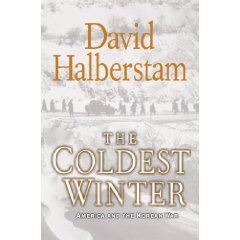
David Halberstam’s no stranger to writing big books about big wars, and he reportedly thought of his final work, The Coldest Winter: America and the Korean War, as a “bookend” to his classic on
Halberstam died in a car crash last spring and so, remarkably, a group of his friends are doing a publicity tour for him. Authors like Joan Didion, Seymour Hersh, Bob Woodward and Anna Quindlen are taking up legs of the grueling publicity trek in honor of Halberstam. According to the New York Times they will be “offering personal reminiscences and readings” in an interesting combination of festschrift and promotion. The tour will start on Tuesday and run until October 15th. In the words of Sy Hersh, “Listen, ain’t nothing like David — you don’t need this to keep David alive. You’ve got to market a book, let’s market a book, but he transcends that. He was a great war reporter and a great baseball reporter, and the most loyal person in the world.”
Related: See our piece from April, David Halberstam’s Last Speech and Supper.
Read More...
Classic Films on Google Video
Here’s a little something for the film buffs out there: TheListUniverse has posted a collection of ten classic films from the 1920s, 30s and 40s that you can watch on Google Video. Just click and watch. On the list, you’ll find Fritz Lang’s M, the 1922 German silent film Nosferatu, The Gold Rush with Charlie Chaplin, The General with Buster Keaton, and three films by the great Frank Capra — It Happened One Night (with Clark Gable), It’s a Wonderful Life and Mr. Smith Goes to Washington (both with Jimmy Stewart). Being one of our favorites, we have posted “Mr. Smith” below.
Note: For more great films, please see our collection of Free Movies Online, which features more than 120 films, many of them classics.
Ten Discoveries That Rewrote History
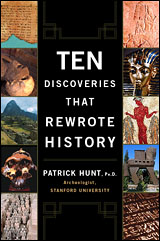
Patrick Hunt: “First I should say that not every archaeologist would agree that these are the ten most important discoveries of all time. On the other hand, the ten stories retold in this book are often regarded as among the most exciting archaeological discoveries of the modern era (since 1750). And no one would deny that these ten vital discoveries have forever changed the world of archaeology, transforming how and what we know about ancient history. Let me tell you a little about them.
Rosetta Stone: This exciting discovery in 1799 was the key to deciphering Egyptian hieroglyphs and unlocking the history of the ancient world texts. It provides a window into the real history of Egypt rather than an imaginary one; all other decipherings of ancient languages since the Rosetta Stone’s initial decoding in 1822 are based on its precedents. (See photo here.)
Troy: Its discovery and excavation beginning in 1870 proved once and for all that Troy was not just a myth based on Homer; Troy was a historical site where real people lived and fought. Its earliest excavator, the oft-maligned and often-unethical Heinrich Schliemann has been mostly credited — right or wrong — as being the “Father of Archaeology” and his techniques became the foundation of archaeological research, however greatly improved, afterward.
Nineveh and the Royal Assyrian Library: This riveting find beginning in 1849 by Austen Henry Layard, a sleuth of antiquity, eventually unearthed a whole lost library of cuneiform texts, including ones not only from ancient Assyria but also from far older Sumer, Akkad, Babylon and other great civilizations. This had a very significant impact on world literature, introducing such seminal works as the Epic of Gilgamesh.
King Tut’s Tomb: The dramatic opening of this royal tomb in 1922 — sought for years by a determined Howard Carter — was the first time in millennia a pharaoh’s tomb had actually been found intact; its treasure gave the world a unique opportunity to actually account for staggering Egyptian royal wealth. [Dan’s note: National Geographic has a nice web site on this archaeological find.]
Machu Picchu: The remarkable high jungle mountain discovery in 1911 of the remote Lost City of the Inca by Hiram Bingham made it possible for the world to finally see an undisturbed Inca royal city mysteriously abandoned on a mountaintop but neither conquered nor changed by the colonial world. (See photo here.)
Pompeii: Preserved by the eruption of Vesuvius in AD 79 and not dug out for almost two millennia, Pompeii (probably accidentally found by a farmer digging a well) is the single most important Roman site in the world; its artifacts offer the largest and fullest record of life in a Roman city. Pompeii’s misfortune is our great fortune. It preserves a city with thousands of objects virtually unchanged. (See images here.)
Dead Sea Scrolls: Since 1947, when two Bedouin boys in the desert stumbled upon the first cave at Qumran, these hidden desert texts have revolutionized our perceptions of early Jewish and Christian religion; their finding has pushed back our knowledge of biblical manuscripts by a thousand years. This discovery and the off-and-on secrecy of the finds reads like spy fiction but is real instead. (See photo here.)
Akrotiri on Thera: Archaeologist Spyridon Marinatos had been laughed at by his peers for his theories and was finally vindicated 30 years later (circa 1967). Like Pompeii, ash from the volcanic eruption in 1620 BC preserved a whole Aegean city that might have been the source of the Atlantis myths but was certainly a wealthy city with fabulous wall paintings depicting Bronze Age life. It gives us for the first time a whole new body of Minoan art and understanding of Mediterranean sea trade. (Images here.)
Olduvai Gorge: Since the 1920’s, the Leakey family doggedly persisted searching in East Africa for the most ancient human origins; dramatic unearthing of bones and tools in 1959 from Olduvai and other sites in Great Rift Africa forever showed the world how long — at least a million years — antecedents to human life have persisted, finally providing proof of Darwinian evolution from earlier primate and hominid finds.
Tomb of 10,000 Warriors: This staggering tomb from around 220–210 BC, spreading over hundreds of acres, single-handedly awakened Western interest in Chinese history and revitalized Chinese archaeology. The opulence and grandeur of an emperor’s tomb astonished the world. Archeotourism in China has profited immensely from the accidental 1974 find of a pre-Han tomb where lies the authoritarian emperor who forcibly united and rewrote Chinese culture in many ways that still survive today.”
Related Content: Above, I mentioned that you can listen to Patrick Hunt’s Stanford course on Hannibal on iTunes. The course is going to be rolled out in installments over the next several weeks. Separately you can listen to a standalone lecture that he gave on Hannibal shortly before the start of the course. (Listen on iTunes here.) This lecture gets referenced in the course at several points. Patrick’s work on Hannibal is sponsored by National Geographic Society.
 Subscribe to our feed and see our complete collection of free university courses.
Bob Dylan Video Goodness
 Mark October 1 on your calendar. That’s when Bob Dylan will release a new box set of his “greatest songs.” Now, cut over to the website designed to market the album, and you’ll find a couple notable pieces of video. First up, you can watch the video that accompanies Mark Ronson’s remixing of “Most Likely You Will Go Your Way (& I’ll Go Mine).” (Watch it on the website here or on YouTube here.) It’s apparently the first time Dylan has allowed a remix of any of his songs, and the song has been getting some airplay this week.
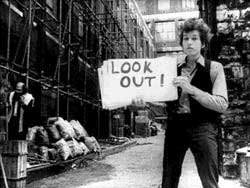
And then there is this video concept. Back in 1967, D. A. Pennebaker released Don’t Look Back, a well-known documentary that covered Dylan’s first tour of England in 1965. The opening segment of the film has Dylan standing in an alley, flipping through cards inscribed with lyrics from Subterranean Homesick Blues. (Also the beat poet Allen Ginsberg looms in the background. We’ve included the original video below.) Now, I’m mentioning this because the aforementioned website lets you re-work this video segment. Click here and you can re-write the cards that Dylan flips through, and then watch your edited version. It’s another form of re-mixing, I guess.
Lastly, I want to direct your attention to the trove of videos that Google put together back when Google Video was a real living, breathing thing. Created to coincide with the release of Dylan’s last studio album, Modern Times (2006), this collection lets you watch 11 videos in total, ranging from unreleased footage from D. A. Pennebaker’s Don’t Look Back, to Dylan’s appearance on The Johnny Cash Show, to his performance of “Dignity” on MTV’s Unplugged. Good stuff, to be sure.
The World of Words & Carnal Knowledge
 Grammar is in vogue. The statistics don’t lie. The Grammar Girl (iTunes — Feed — Web Site) remains one of the most popular podcasts on iTunes, and The Grammar Grater (iTunes — Feed — Web Site) is holding its own. From grammar, it’s just a short step to words, to etymology. And, today, we want to highlight Podictionary (iTunes — Feed — Site) for you. It’s a “word-of-the-day” podcast that spends an easy three to five minutes surveying the history of common words in the English language. (This makes it useful for native and non-native speakers alike). Its creator, Charles Hodgson, has so far tackled over 600 terms, which means that he’s amassed an extensive audio archive that you can access here.
And his work on words doesn’t stop there. Hodgson recently published a new book called Carnal Knowledge: A Navel Gazer’s Dictionary of Anatomy, Etymology, and Trivia (St. Martin’s Press). Far from pedantic, the book uses engaging prose and fun facts to tease out the meaning of words we use to describe our bodies. The whole body gets covered here, from the “eye” to the “simian line” to the “gullet,” and it goes straight down to the nether regions, too. For more information, spend some time with the blog that accompanies the new book.
Related Content:
Ten Podcasts to Build Your Vocabulary
Read More...
Keeping Wikipedia Honest

Recognizing this, some innovative programmers have started developing ways to shore up Wikipedia’s sometimes shaky foundations. In particular, they’re finding ways to monitor Wikipedia entries for tampering and partisan manipulation. A couple weeks ago, we mentioned a new site called Wikipedia Scanner, which allows users to determine whether partisans have edited particular wiki entries by matching the entries against IP addresses. Now, another site, Wikirage, lets you track the pages on “Wikipedia which are receiving the most edits per unique editor over various periods of time.” This is a nice feature partly because it pinpoints which topics/entries are generating buzz at the moment (today it is Blackwater USA, Michael B. Mukasey, Fred Thompson, the United States Constitution and Dane Cooke — a logical sequence, to be sure.) But Wikirage is also handy because it highlights which entries “have high revision, vandalism or undo rates.” The upshot is that millions of people have built Wikipedia. But it’s smart programming, mixed with some manpower, that’s keeping the whole enterprise a little more honest and reliable. Stay tuned for more on how this works out.
See Lifehacker for the 10 Top Wikipedia tricks, and to find the most popular pages on Wikipedia in absolute terms, click here.
Read More...The End of History Revisited
 Stewart Brand, the creator of the iconic Whole Earth Catalog, heads up the The Long Now Foundation, an organization committed to cultivating “slower/better” thinking and fostering greater responsibility over “the next 10,000 years.” (Yes, they’re ambitious.) To help bring this about, Brand hosts a monthly speaking series that you can download as a podcast (iTunes — Feed — MP3s), and, in late June, he brought in Francis Fukuyama to speak. Fukuyama, a professor of international political economy at Johns Hopkins, first made a name for himself in 1989 when, during the waning days of the Cold War, he published an essay called “The End of History?” (Later, he would turn it into a bestselling book, The End of History and the Last Man.) Stealing a page from Karl Marx, Fukuyama maintained that history had a direction to it. It flowed with purpose, always bringing progress. But the end point wasn’t communist utopia. It was liberal democracy mixed with free market economics. That’s where humanity was collectively heading, with a victorious America leading the way. (In his original essay, he wrote, “What we may be witnessing is not just the end of the Cold War, or the passing of a particular period of post-war history, but the end of history as such: that is, the end point of mankind’s ideological evolution and the universalization of Western liberal democracy as the final form of human government.”)
In the intervening years, the world’s movement toward western democracy hasn’t exactly followed a straight line, and the 9/11 attacks and the ensuing “War on Terror” have seemingly lent credence to a dimmer worldview, one outlined by Samuel Huntington in the controversial book, The Clash of Civilizations and the Remaking of World Order. Speaking 18 years after the publication of his original essay (iTunes — Feed — MP3 — Blog), Fukuyama revisits, clarifies and largely defends his thesis that liberal democracy is still on track to prevail. And that’s because, in his mind, there are deep economic, scientific and technological trends in motion that drive almost inexorably toward these political ends. Whether he is right or wrong, it’s impossible to say. Regardless, his talk is smart, hardly dogmatic, and worth your time.
Read More...New R.E.M. Concert Video “Leaving New York”
Below we have “R.E.M. Live, recorded on the Around the World Tour, which promoted Around the Sun, a studio album from 2004. It is to be released October 16.” (Thanks to Justin for the clarification.)
Source: Stereogum. (For more music, check out our collection of MP3 Blogs.)
 For more smart media, subscribe to our feed
Support Us
We're hoping to rely on loyal readers, rather than erratic ads. Please click the Donate button and support Open Culture. You can use Paypal, Venmo, Patreon, even Crypto! We thank you!

About Us

Open Culture scours the web for the best educational media. We find the free courses and audio books you need, the language lessons & educational videos you want, and plenty of enlightenment in between.
Advertise With Us

FREE UPDATES!
GET OUR DAILY EMAIL
Get the best cultural and educational resources on the web curated for you in a daily email. We never spam. Unsubscribe at any time.
FOLLOW ON SOCIAL MEDIA

Open Culture editor Dan Colman scours the web for the best educational media. He finds the free courses and audio books you need, the language lessons & movies you want, and plenty of enlightenment in between.
Advertise With Us


