The Philosophy of Tragedy: A Free Course on the Philosophy of Great Greek Tragedies
This course features lectures by Michael Davis, Professor of Philosophy, delivered in the fall semester of 2018 at Sarah Lawrence College. All 28 lectures in this course can be viewed above, or on this YouTube playlist. This course is now added to our collection, 1,700 Free Online Courses from Top Universities.
Professor Bio:
Davis works primarily in Greek philosophy, in moral and political philosophy, and in what might be called the “poetics” of philosophy. He is the translator, with Seth Benardete, of Aristotle’s On Poetics and has written on a variety of philosophers from Plato to Heidegger and of literary figures from Homer and the Greek tragedians to Saul Bellow and Tom Stoppard.
Course Description:
Greek tragedy has been performed, read, imitated and interpreted for twenty-five hundred years. From the very beginning it was thought to be philosophically significant—somehow pointing to the truth of human life as a whole (the phrase the “tragedy of life” first appears in Plato). As a literary form it is thought especially revealing philosophically by Aristotle, Hegel, Nietzsche and Heidegger to name only a few. Among others, Seneca, Corneille, Racine, Voltaire, Goethe, Shelley, O’Neill and Sartre wrote versions of Greek tragedies. And, of course, there is Freud. Greek tragedy examines the fundamental things in a fundamental way. Justice, family, guilt, law, autonomy, sexuality, political life, the divine—these are its issues. The lectures that follow treat three plays by each of the great Athenian tragedians—Aeschylus, Sophocles and Euripides—with a view to understanding how they deal with these issues and with the question of the importance and nature of tragedy itself.
Translations Used:
Aeschylus, The Oresteia, Hugh Lloyd-Jones trans.
Sophocles I, Grene and Lattimore eds.
Ten Plays by Euripides, Moses Hadas trans.
Lectures:
Lecture 1: Introduction
Lecture 2: Aeschylus’s Agamemnon
Lecture 3: Agamemnon
Lecture 4: Aeschylus’s Libation Bearers
Lecture 5: Aeschylus’s Eumenides
Lecture 6: Eumenides
Lecture 7: Eumenides
Lecture 8: Eumenides
Lecture 9: Eumenides
Lecture 10: Sophocles’ Oedipus Tyrannus
Lecture 11: Oedipus Tyrannus
Lecture 12: Oedipus Tyrannus
Lecture 13: Sophocles’ Oedipus at Colonus
Lecture 14: Oedipus at Colonus
Lecture 15: Oedipus at Colonus
Lecture 16: Oedipus at Colonus
Lecture 17: Sophocles’ Antigone
Lecture 18: Antigone
Lecture 19: Antigone
Lecture 20: Euripides’ Bacchae
Lecture 21: Bacchae
Lecture 22: Euripides’ Iphigenia among the Taurians
Lecture 23: Iphigenia among the Taurians
Lecture 24: Iphigenia among the Taurians
Lecture 25: Iphigenia among the Taurians
Lecture 26: Euripides’ Hippolytus
Lecture 27: Hippolytus
Lecture 28: Conclusion
Google Introduces 6‑Month Career Certificates, Threatening to Disrupt Higher Education with “the Equivalent of a Four-Year Degree”

Update: You can find the first of the Google Career Certificates here. They’re also added to our collection 200 Online Certificate & Microcredential Programs from Leading Universities & Companies.
I used to make a point of asking every college-applying teenager I encountered why they wanted to go to college in the first place. Few had a ready answer; most, after a deer-in-the-headlights moment, said they wanted to be able to get a job — and in a tone implying it was too obvious to require articulation. But if one’s goal is simply employment, doesn’t it seem a bit excessive to move across the state, country, or world, spend four years taking tests and writing papers on a grab-bag of subjects, and spend (or borrow) a large and ever-inflating amount of money to do so? This, in any case, is one idea behind Google’s Career Certificates, all of which can be completed from home in about six months. Find the first ones here.
Any such remote educational process looks more viable than ever at the moment due to the ongoing coronavirus pandemic, a condition that also has today’s college-applying teenagers wondering whether they’ll ever see a campus at all. Nor is the broader economic harm lost on Google, whose Senior Vice President for Global Affairs Kent Walker frames their Career Certificates as part of a “digital jobs program to help America’s economic recovery.” He writes that “people need good jobs, and the broader economy needs their energy and skills to support our future growth.” At the same time, “college degrees are out of reach for many Americans, and you shouldn’t need a college diploma to have economic security.”
Hence Google’s new Career Certificates in “the high-paying, high-growth career fields of Data Analytics, Project Management, and User Experience (UX) Design,” which join their existing IT Support and IT Automation in Python Certificates.
- Google UX Design Professional Certificate
- Google Data Analytics Professional Certificate
- Google Project Management Professional Certificate
- Google IT Support Professional Certificate
- Google IT Automation Professional Certificate
Hosted on the online education platform Coursera, these programs (which run about $300-$400) are developed in-house and taught by Google employees and require no previous experience. To help cover their cost Google will also fund 100,000 “need-based scholarships” and offer students “hundreds of apprenticeship opportunities” at the company “to provide real on-the-job training.” None of this guarantees any given student a job at Google, of course, but as Walker emphasizes, “we will consider our new career certificates as the equivalent of a four-year degree.”
Biggest tech & higher ed story of the last 2 weeks — #Google entering higher ed, offering BA-equivalent degrees@YahooFinance pic.twitter.com/bsGgwHsnRn
— Scott Galloway (@profgalloway) August 30, 2020
Technology-and-education pundit Scott Galloway calls that bachelor’s-degree equivalence the biggest story in his field of recent weeks. It’s perhaps the beginning of a trend where tech companies disrupt higher education, creating affordable and scalable educational programs that will train the workforce for 21st century jobs. This could conceivably mean that universities lose their monopoly on the training and vetting of students, or at least find that they’ll increasingly share that responsibility with big tech.
This past spring Galloway gave an interview to New York magazine predicting that “ultimately, universities are going to partner with companies to help them expand.” He adds: “I think that partnership will look something like MIT and Google partnering. Microsoft and Berkeley. Big-tech companies are about to enter education and health care in a big way, not because they want to but because they have to.” Whether such university partnerships will emerge as falling enrollments put the strain on certain segments of the university system remains to be seen, but so far Google seems confident about going it alone. And where Google goes, as we’ve all seen before, other institutions often follow.
Note: You can listen to Galloway elaborate on how Google may lead to the unbundling of higher ed here. Listen to the episode “State of Play: The Sharing Economy” from his Prof G podcast:
Related Content:
200 Online Certificate & Microcredential Programs from Leading Universities & Companies.
Based in Seoul, Colin Marshall writes and broadcasts on cities, language, and culture. His projects include the book The Stateless City: a Walk through 21st-Century Los Angeles and the video series The City in Cinema. Follow him on Twitter at @colinmarshall, on Facebook, or on Instagram.
Read More...J. Robert Oppenheimer Explains How He Recited a Line from Bhagavad Gita–“Now I Am Become Death, the Destroyer of Worlds”–Upon Witnessing the First Nuclear Explosion
No matter how little we know of the Hindu religion, a line from one of its holy scriptures lives within us all: “Now I am become Death, the destroyer of worlds.” This is one facet of the legacy of J. Robert Oppenheimer, an American theoretical physicist who left an outsized mark on history. For his crucial role in the Manhattan Project that during World War II produced the first nuclear weapons, he’s now remembered as the“father of the atomic bomb.” He secured that title on July 16, 1945, the day of the test in the New Mexican desert that proved these experimental weapons actually work — that is, they could wreak a kind of destruction previously only seen in visions of the end of the world.
“We knew the world would not be the same,” Oppenheimer remembered in 1965. “A few people laughed, a few people cried. Most people were silent. I remembered the line from the Hindu scripture, the Bhagavad Gita; Vishnu is trying to persuade the Prince that he should do his duty and, to impress him, takes on his multi-armed form and says, ‘Now I am become Death, the destroyer of worlds.’ ” The translation’s grammatical archaism made it even more powerful, resonating with lines in Tennyson (“I am become a name, for always roaming with a hungry heart”), Shakespeare (“I am come to know your pleasure”), and the Bible (“I am come a light into the world, that whosoever believeth on me should not abide in darkness”).
But what is death, as the Gita sees it? In an interview with Wired, Sanskrit scholar Stephen Thompson explains that, in the original, the word that Oppenheimer speaks as “death” refers to “literally the world-destroying time.” This means that “irrespective of what Arjuna does” — Arjuna being the aforementioned prince, the narrative’s protagonist — everything is in the hands of the divine.” Oppenheimer would have learned all this while teaching in the 1930s at Berkeley, where he learned Sanskrit and read the Gita in the original. This created in him, said his colleague Isidor Rabi, “a feeling of mystery of the universe that surrounded him like a fog.”
The necessity of the United States’ subsequent dropping of not one but two atomic bombs on Japan, examined in the 1965 documentary The Decision to Drop the Bomb, remains a matter of debate. Oppenheimer went on to oppose nuclear weapons, describing himself to an appalled President Harry Truman as having “blood on my hands.” But in developing them, could he have simply seen himself as a modern Prince Arjuna? “It has been argued by scholars,” writes the Economic Times’ Mayank Chhaya, “that Oppenheimer’s approach to the atomic bomb was that of doing his duty as part of his dharma as prescribed in the Gita.” He knew, to quote another line from that scripture brought to mind by the nuclear explosion, that “if the radiance of a thousand suns were to burst into the sky that would be like the splendor of the Mighty One” — and perhaps also that splendor and wrath may be one.
Related Content:
Introduction to Indian Philosophy: A Free Online Course
Oppenheimer: The Man Behind the Bomb
Haunting Unedited Footage of the Bombing of Nagasaki (1945)
63 Haunting Videos of U.S. Nuclear Tests Now Declassified and Put Online
53 Years of Nuclear Testing in 14 Minutes: A Time Lapse Film by Japanese Artist Isao Hashimoto
Based in Seoul, Colin Marshall writes and broadcasts on cities, language, and culture. His projects include the book The Stateless City: a Walk through 21st-Century Los Angeles and the video series The City in Cinema. Follow him on Twitter at @colinmarshall, on Facebook, or on Instagram.
Read More...A Short Introduction to Caravaggio, the Master Of Light
Like many a great artist, the fortunes of Michelangelo Merisi da Caravaggio rose and fell dramatically. After his death, possibly from syphilis or murder, his influence spread across the continent as followers called Caravaggisti took his extreme use of chiaroscuro abroad. He influenced Rubens, Rembrandt, and Velázquez—indeed, the entire Baroque period in European art history probably would never have happened without him. “With the exception of Michelangelo,” art historian Bernard Berenson wrote, “no other Italian painter exercised so great an influence.”
But later critics savaged his hyper-dramatic, high-contrast realism. His style, called “tenebrism” for its use of deep darkness in paintings like The Calling of St. Matthew, is shocking by comparison with the fanciful Mannerism that came before. In the video above, Evan Puschak, the Nerdwriter, explains what makes Caravaggio’s work so strangely hyperreal. He “preferred to paint his subjects as the eye sees them,” the Caravaggio Foundation writes, “with all their natural flaws and defects instead of as idealized creations…. This shift from standard practice and the classical idealism of Michelangelo was very controversial at the time…. His realism was seen by some as unacceptably vulgar.”
Also controversial was Caravaggio himself. His wild life made an ideal subject for Derek Jarman’s 1986 arthouse biopic starring Tilda Swinton. Famous for brawling, “the transcripts of his police records and trial proceedings fill several pages.” He never married or settled down and the male eroticism in his paintings has led many to suggestions he was gay .(Jarman’s film makes this an explicit part of his biography.) It’s likely, art historians think, that the painter had many tumultuous relationships, sexual and otherwise, with both men and women before his early death at the age of 38.
Despite his profane life, Caravaggio’s paintings evince a “remarkable spirituality” and illustrate, as Puschak notes, exactly the kind of passionate intensity the counter-Reformation Catholic Church wanted to use to stir the faithful. Caravaggio’s popularity meant commissions from wealthy patrons, and for a time, he was the most famous painter in Rome, as well as one of the city’s most infamous characters. Caravaggio painted from life, staging his intricate arrangements with real models who held the poses as he worked.
His figures were ordinary people one might meet on the 17th century streets of the city. And Caravaggio himself, despite his enormous talent, was an ordinary person as well, stereotypes of tragic, tortured geniuses aside. He was deeply flawed, it’s true, yet driven by an incredible longing to become something greater.
Related Content:
Living Paintings: 13 Caravaggio Works of Art Performed by Real-Life Actors
Paintings by Caravaggio, Vermeer, & Other Great Masters Come to Life in a New Animated Video
Why Babies in Medieval Paintings Look Like Middle-Aged Men: An Investigative Video
Josh Jones is a writer and musician based in Durham, NC. Follow him at @jdmagness
Read More...Behold a Beautiful 400-Year-Old ‘Friendship Book’ Featuring the Signatures of Historic Figures
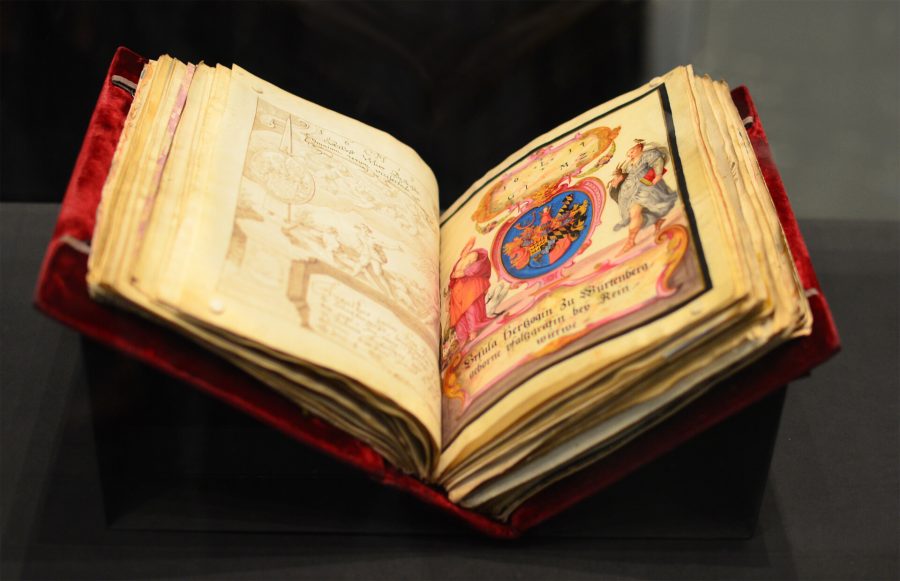
Maintaining the balance of power among European states has always been a fraught affair, but it was especially so in the years when mercantilism made fragile alliances during the religious wars of the 17th century. This was a time when merchants made excellent diplomats, not only because they traveled extensively and learned foreign tongues and customs, but because they spoke the universal language of trade.
German merchant and diplomat Philipp Hainhofer from Augsburg was such a figure, traveling from court to court to meet with Europe’s renowned dignitaries. As he did so, he would ask them to sign his album amicorum, or “friendship book,” also called a stammbuch. Each signer would then “commission an artist to create a painting accompanying their signatures,” Alison Flood writes at The Guardian.
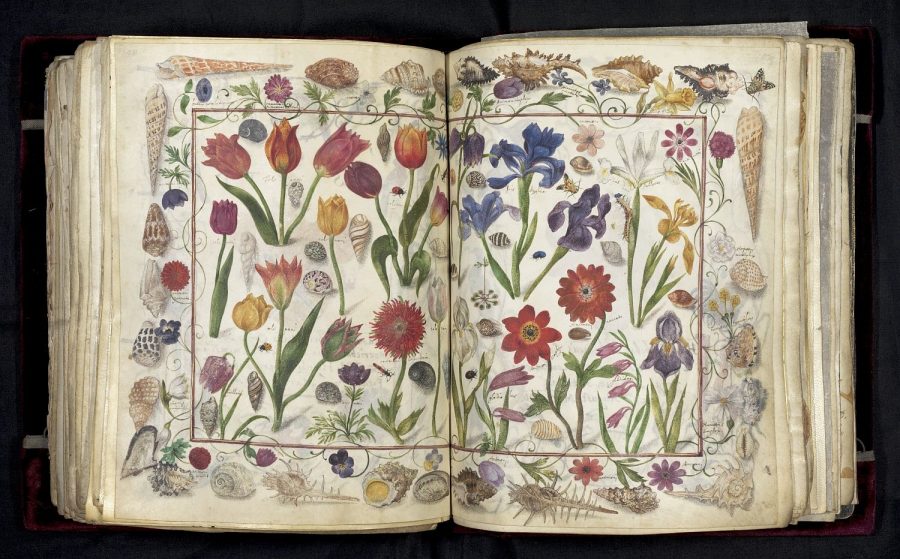
“There are around 100 drawings” in his autograph book, known as the Große Stammbuch, “which took more than 50 years to compile.” After Hainhofer’s death in 1647, his friend August the Younger—who helped collect the hundreds of thousand of books in the Herzog August Bibliothek—tried to acquire the book but failed. Now it has finally landed in the huge library, one of the world’s oldest, almost 400 years later, after a purchase at a private auction this week.
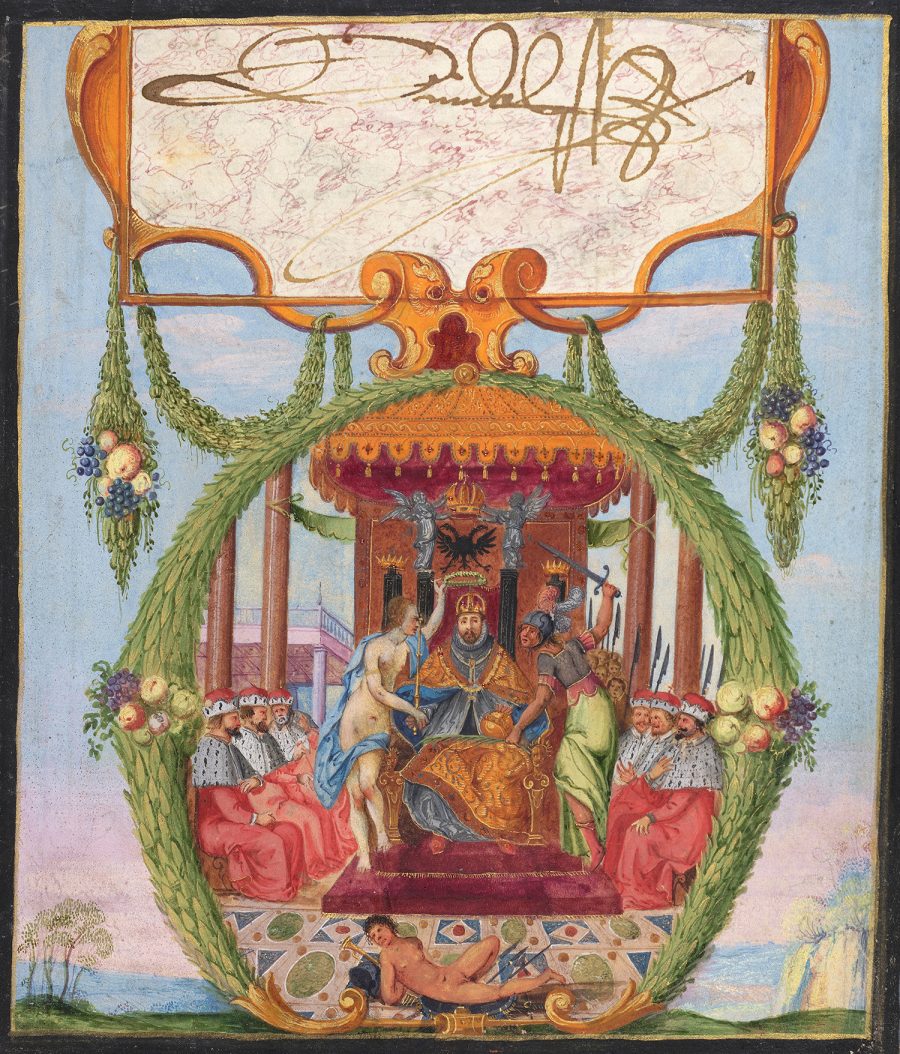
Friendship books were commonly used at the time to record the names of family and friends. Students used them as yearbooks, and Hainhofer began his collection of signatures as a college student. He gradually gained a select clientele as his career advanced. Signatories, the History Blog points out, “include Holy Roman Emperor Rudolf II, another HRE Matthias, Christian IV of Denmark and Norway, Cosimo II de’Medici, Grand Duke of Tuscany…” and many others.
Hainhofer’s Große Stammbuch is, as you can see, a beautiful work of art—or almost 100 collected works of art—in its own right. “The elaborateness of the illustrations directly corresponds to the signatory’s status and rank in society,” as Grace Ebert notes at Colossal. It is also a fascinating record of Early Modern European politics, trade, and diplomacy, a fine art all its own.
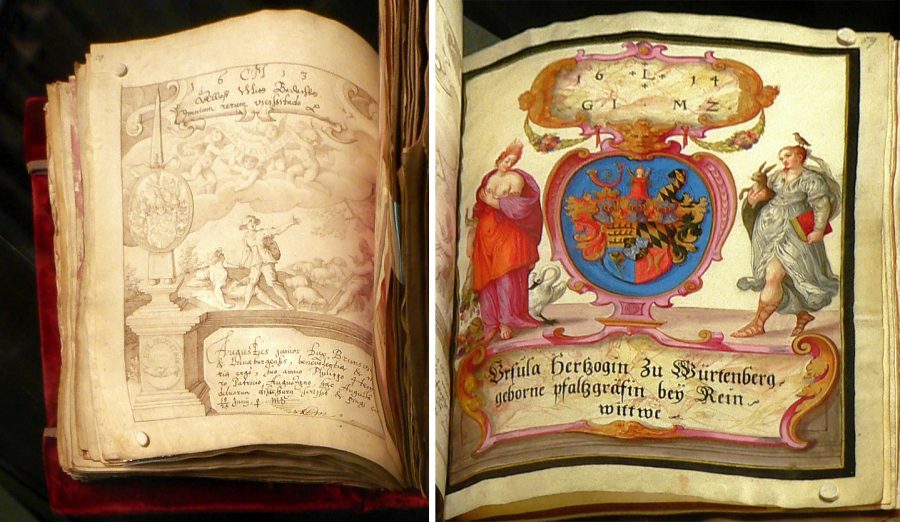
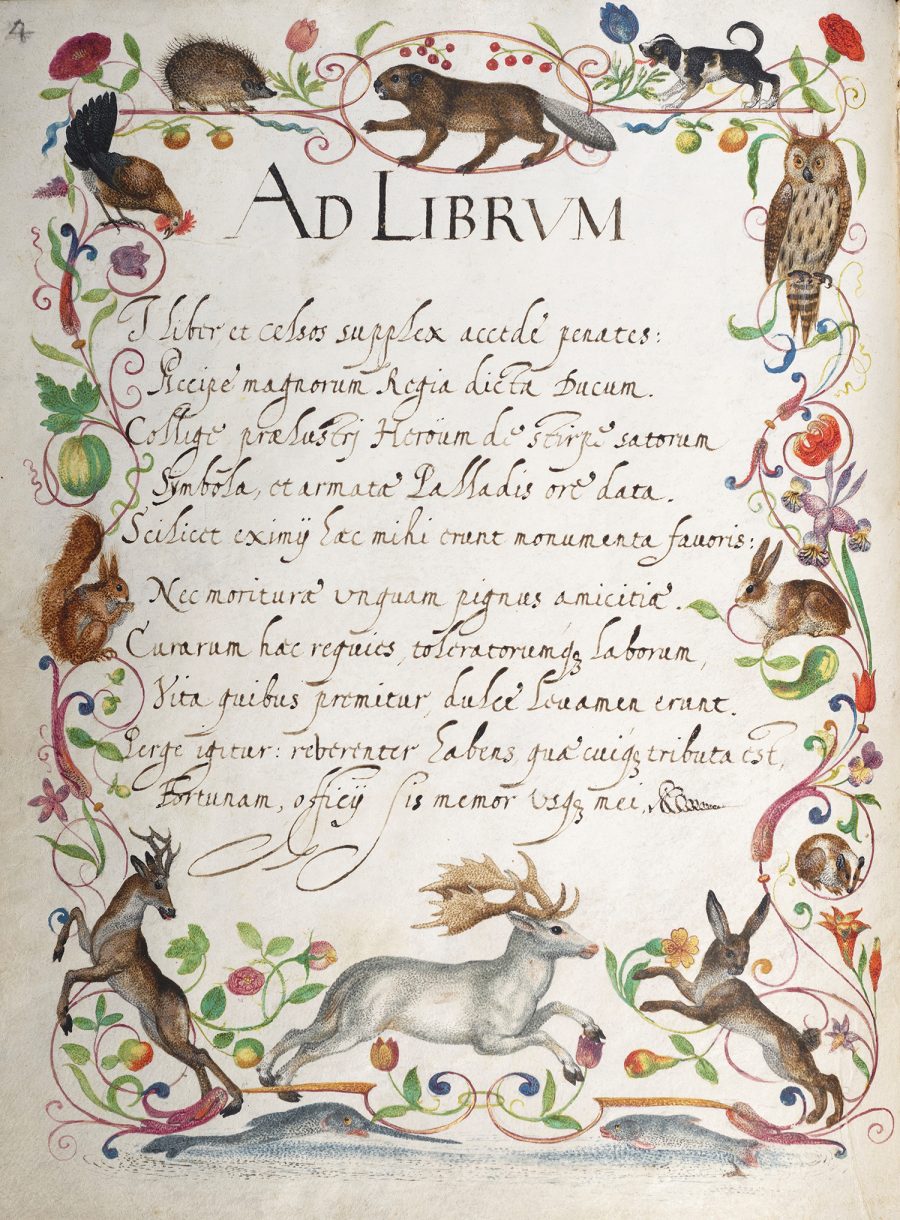
via Colossal
Related Content:
Josh Jones is a writer and musician based in Durham, NC. Follow him at @jdmagness
Read More...Take Immersive Virtual Tours of the World’s Great Museums: The Louvre, Hermitage, Van Gogh Museum & Much More
Can you remember when you last visited a museum? Even if you didn’t much care for them before the time of the coronavirus, you’re probably beginning to miss them right about now. At least the internet technology that has kept our communication open and our entertainment flowing — and, regrettably for some, kept our work meetings regular — has also made it possible to experience art institutions through our screens. Here on Open Culture we’ve previously featured many such online art spaces, digital gallery experiences, and virtual museum tours, and today we’ve rounded up some of the best for you.
Most everyone who had a trip to France scheduled for this spring or summer will have canceled it. But thanks to these three high-definition, first-person videos, you can still tour the Louvre, Liberty Leading the People, the Venus de Milo, the Mona Lisa, and even I.M. Pei’s rooftop pyramid and all. Perhaps you’d planned to spend part of 2020 traveling Europe more widely, in which case you’d almost certainly have gone to Italy and seen Forence’s Uffizi Gallery as well. Luckily, that most famous collection of Renaissance art has gone digital with a complete “street view” tour as well as an archive of 3D sculpture scans.
Of course, no art-oriented trip to Italy would be well spent only in galleries and museums: it would also have to include St. Peter’s Basilica, the Sistine Chapel, and other sacred spaces of the Vatican, in whose virtual versions you can now spend as long as you like. And while some tourists in Europe face time or money constraints too tight to allow visits to smaller countries like the Netherlands, internet travel is subject to no such limitations. So go ahead and take a seven-part tour of the Van Gogh Museum in 4K, or have a look at Rembrandt’s The Night Watch down to every last brushstroke.
You won’t find every Dutch masterpiece in the Netherlands. Take Hieronymus Bosch’s The Garden of Early Delights, for instance, currently held by Spain’s Prado Museum, which has also made a virtual tour of the grotesque and spectacular painting available online. As for the work of Spain’s own artists, you can go even deeper into the work of Salvador Dalí with this 360-degree virtual-reality video of his painting Archaeological Reminiscence of Millet’s ‘Angelus.’ Those who’d like to spend some time off the continent and back down on Earth can view an altogether different 360-degree video, this one of Shakepeare’s Globe Theatre in London — and have a look at the treasures of the British Museum while they’re at it.
The ongoing pandemic having put a temporary stop to not just most travel to Europe but most international travel of any kind, hopeful travelers to and within North America have also been forced to change their plans. If this describes you, consider taking a virtual tour of the Smithsonian National Museum of Natural History, Frank Lloyd Wright’s studio Taliesin, or the Frida Kahlo Museum in Mexico City. But while you’re online, why not mount an even more ambitious worldwide art journey: to the Hermitage in Russia, the Ghibli Museum in Japan, and street art (as well as stolen art) from all over? It’s a big world of art out there — something we can’t let ourselves forget before we can see it in person again.
Related Content:
Take a Virtual Tour of 30 World-Class Museums & Safely Visit 2 Million Works of Fine Art
The Stay At Home Museum: Your Private, Guided Tours of Rubens, Bruegel & Other Flemish Masters
14 Paris Museums Put 300,000 Works of Art Online: Download Classics by Monet, Cézanne & More
The Metropolitan Museum of Art Puts 400,000 High-Res Images Online & Makes Them Free to Use
Free: The Metropolitan Museum of Art and the Guggenheim Offer 474 Free Art Books Online
Chinese Museums, Closed by the Coronavirus, Put Their Exhibitions Online
Based in Seoul, Colin Marshall writes and broadcasts on cities, language, and culture. His projects include the book The Stateless City: a Walk through 21st-Century Los Angeles and the video series The City in Cinema. Follow him on Twitter at @colinmarshall, on Facebook, or on Instagram.
Read More...Bronze Age Britons Turned Bones of Dead Relatives into Musical Instruments & Ornaments

Image via the Wiltshire Museum
The burial rites of ancient and exotic peoples can seem outlandish to us, but there’s nothing particularly normal about the funeral traditions in the United States and the UK, where corpses are sent off to professional undertakers and made to look alive before they’re sealed in boxes and buried or turned into piles of ash.
Andrea DenHoed at The New Yorker refers to the practice of Tibetan Buddhist sky burials, in which “bodies are ritually dissected and left in the open to be consumed by vultures” and of the Torajans of Indonesia, who “have a ritual called Ma’Nene, in which bodies are disinterred, dressed in new clothes, and carried in a parade around the village.” These rites seem almost to mock our western fears of death.
Innovations on the funeral displace us further from the body. DenHoed writes, in 2016, of the then-relatively rare experience of attending a funeral over Skype, now commonplace by virtue of bleak necessity. It’s hard to say if high-tech mourning rituals like turning human remains into playable vinyl records brings us closer to accepting dead bodies, but they certainly bring us closer to an ancestral prehistoric past when at least some Bronze Age Britons turned the bones of their dead into musical instruments.
Is it any more macabre than turning relatives into diamonds? Who’s to say. The researchers who made this discovery, Dr. Thomas Booth and Joanna Brück, published their findings in the journal Antiquity under the tongue-in-cheek title “Death is not the end: radiocarbon and histo-taphonomic evidence for the curation and excarnation of human remains in Bronze Age Briton.”
What’s that now? Through radiocarbon-dating, the researchers, in other words, were able to determine that ancient people who lived between 2500–600 BC “were keeping and curating body parts, bones and cremated remains” of people they knew well, sometimes exhuming and ritually re-burying the remains in their homes, or just keeping them around for a couple generations.
“It’s indicative of a broader mindset where the line between the living and the dead was more blurred than it is today,” Booth tells The Guardian. “There wasn’t a mindset that human remains go in the ground and you forget about them. They were always present among the living.” This is hardly strange. The incredible amount of loss people will feel after COVID-19 will likely bring a proliferation of such rituals.
The find making headlines is a human thigh bone “that had been carved into a whistle” Josh Davis writes at the British Natural History Museum, and buried with another adult male. “When dated, it revealed that the thigh bone came from a person who probably lived around the same date as the man that it was buried with, meaning it is likely that it was someone that they knew in life, or were fairly close to.”
There doesn’t seem to be any suggestion that this was a common or widespread practice, but it’s not that dissimilar to wearing the remains of the dead as jewelry. “The Romans did it,” notes Glenn McDonald at National Geographic, “The Persians did it. The Maya did it.” And the Victorians, also, wore the remains of their dead, 4,000 years after their ancient ancestors. “The technologies change,” says McDonald, “but the basic human experience” of death, loss, and mourning remains the same.
The thigh bone whistle is on display at the Wiltshire Museum in the UK.
Related Content:
Hear the World’s Oldest Instrument, the “Neanderthal Flute,” Dating Back Over 43,000 Years
Hear a 9,000 Year Old Flute—the World’s Oldest Playable Instrument—Get Played Again
Listen to the Oldest Song in the World: A Sumerian Hymn Written 3,400 Years Ago
Josh Jones is a writer and musician based in Durham, NC. Follow him at @jdmagness
Read More...Hear Patti Smith’s First Poetry Reading, Accompanied by Her Longtime Guitarist Lenny Kaye (St. Mark’s Church, 1971)
There are so many origin stories of punk that no single history can count as definitive. But there’s also no disputing its roots in the New York poetry scene from which Patti Smith emerged in the 1960s and 70s. She learned from Allen Ginsberg and William S. Burroughs, and Gregory Corso and Sam Shepherd inspired the poetry/rock hybrid that would become the music of Horses.
Corso, who called himself a “punk debauche” in his 1960 poem “1959,” lived up to the label. He would heckle poets “during their listless performances,” writes Kembrew McLeod in Downtown Pop Underground, “yelling, ‘Shit! Shit! No blood! Get a transfusion!’ Sitting at Corso’s side,” during poetry readings hosted by the Poetry Project at St. Mark’s Church, “Smith made a mental note not to be boring.”
She followed her friend Sam Shepard’s advice to add music to her first public reading and called guitar player Lenny Kaye to accompany her. “It was primarily a solo poetry reading,” McLeod writes, “with occasional guitar accompaniment.” The 1971 appearance, which you can hear in the recording above, set the tone for almost all of her subsequent performances for the next several decades.
“We did ‘Mack the Knife,” Kaye recalls, “because it was Bertolt Brecht’s birthday, and then I came back for the last three musical pieces. I hesitate to call them ‘songs,’ but in a sense they were the essence of what we would pursue.” Oddly, that year also marked the first usage of “punk” to describe a style of music, though it was applied to the garage rock of ? and the Mysterians, not to Smith and Kaye’s music. She herself has said she didn’t consider what they were doing to be “punk” at all.
This doesn’t much matter. It was attitude and the energy Smith translated from St. Marks to the CBGBs scene that secures her “Godmother” status. She was impressed, as she says above, by Jim Morrison and Jimi Hendrix. She was also impressed by a 1971 essay written by Andrew Wylie, who published her first book after her St. Mark’s reading. “Living as we were in an extremely violent, fragile time,” Smith’s Unauthorized Biography recounts, “[Wylie] was drawn to short, almost amputated works.” He concluded that “just to be alive in such times was an act of violence.”
Punk poetry, or whatever we want to call it, was born in a church on St. Mark’s Place in New York City in 1971. From then on, whatever other strains came together to make punk rock, Smith’s channeling of Corso, Shepard, Burroughs, Morrison, etc., backed by Kaye’s steady guitar work, has resonated through the music into the present.
Related Content:
How Patti Smith “Saved” Rock and Roll: A New Video Makes the Case
Patti Smith’s List of Favorite Books: From Rimbaud to Susan Sontag
Patti Smith Sings “People Have the Power” with a Choir of 250 Fellow Singers
Josh Jones is a writer and musician based in Durham, NC. Follow him at @jdmagness
Read More...How to Manage Your Time More Effectively: The Science of Applying Computer Algorithms to Our Everyday Lives
Who among us hasn’t wished to be as efficient as a computer? While computers seem to do everything at once, we either flit or plod from task to task, often getting sidetracked or even lost. At this point most have relinquished the dream of true “multitasking,” which turns out to lie not only beyond the reach of humans but, technically speaking, beyond the reach of computers as well. “Done right, computers move so fluidly between their various responsibilities, they give the illusion of doing everything simultaneously,” says the narrator of the animated TED-Ed lesson above. But in reality, even they do one thing at a time; what, then, can we humans learn from how they’re programmed to prioritize and switch between their many tasks?
A computer operating system has an element called a “scheduler,” which “tells the CPU how long to work on each task before switching.” Schedulers work quite well these days, but “even computers get overwhelmed sometimes.” This used to happen to the open-source operating system Linux, which “would rank every single one of its tasks in order of importance, and sometimes spent more time ranking tasks than doing them. The programmers’ counterintuitive solution was to replace this full ranking with a limited number of priority ‘buckets,’ ” replacing a precise priority ordering with a broader low-medium-high kind of grouping. This turned out to be a great improvement: “The system was less precise about what to do next, but more than made up for it by spending more time making progress.”
The lesson for those of us who habitually list and prioritize our tasks is obvious: “All the time you spend prioritizing your work is time you aren’t spending doing it,” and “giving up on doing things in the perfect order may be the key to getting them done.” In the case of e‑mail, bane of many a 21st-century existence, “Insisting on always doing the very most important thing first could lead to a meltdown. Waking up to an inbox three times fuller than normal could take nine times longer to clear.
You’d be better off replying in chronological order, or even at random.” Robert Pirsig memorably articulated this in Zen and the Art of Motorcycle Maintenance, whose main character offers advice to his son frustrated by the task of writing a letter home from their road trip:
I tell him getting stuck is the commonest trouble of all. Usually, I say, your mind gets stuck when you’re trying to do too many things at once. What you have to do is try not to force words to come. That just gets you more stuck. What you have to do now is separate out the things and do them one at a time. You’re trying to think of what to say and what to say first at the same time and that’s too hard. So separate them out. Just make a list of all the things you want to say in any old order. Then later we’ll figure out the right order.
We don’t write many letters home these days, of course, and even e‑mail may no longer pose the direst threat to our time management. More of us blame our lack of productivity on the interruptions of instant messaging in all its forms, from texting to social media, another problem with an equivalent in computing. That a computer can be interrupted by any number of the processes it runs necessitated the development of a procedure called “interrupt coalescing,” according to which, “rather than dealing with things as they come up,” the system “groups these interruptions together based on how long they can afford to wait.” Even if we can’t eliminate interruptions in our lives, we can group them: “If no notification or e‑mail requires a response more urgently than once an hour, say, then that’s exactly how often you should check them — no more.”
This TED-Ed lesson comes adapted from Brian Christian and Tom Griffiths’ book Algorithms to Live By: The Computer Science of Human Decisions. If you’d like to hear about more of the ways in which they apply computers’ methods of decision making to areas of human life — home-buying, gambling, dating — you can also watch their talk at Google. We also have plenty of supplementary time management-related material here in the Open Culture archives, on everything from the neuroscience of procrastination to the daily routines of philosophers, writers and other creative people to tips for reading more books per year to the presidentially-approved “Eisenhower Matrix.” By all means, click on all these links; just don’t overthink the order in which to do it.
Related Content:
The Neuroscience & Psychology of Procrastination, and How to Overcome It
The Daily Routines of Famous Creative People, Presented in an Interactive Infographic
The Daily Habits of Highly Productive Philosophers: Nietzsche, Marx & Immanuel Kant
The Daily Habits of Famous Writers: Franz Kafka, Haruki Murakami, Stephen King & More
7 Tips for Reading More Books in a Year
Based in Seoul, Colin Marshall writes and broadcasts on cities, language, and culture. His projects include the book The Stateless City: a Walk through 21st-Century Los Angeles and the video series The City in Cinema. Follow him on Twitter at @colinmarshall, on Facebook, or on Instagram.
Read More...Watch Home Movies Starring Salvador Dali, Henri Matisse, Igor Stravinsky, Gertrude Stein, Colette & Other Early 20th Century Luminaries
Léonide Massine may not be not the most famous name to grace socialite Elizabeth Fuller Chapman’s home movies.
In terms of 21st century name brand recognition, he definitely lags behind art world heavies Salvador Dali, Marcel Duchamp, Constantin Brâncuși, Henri Matisse, composer Igor Stravinsky, novelist Colette, playwright Thornton Wilder, the ever-formidable poet and collector Gertrude Stein, and her longtime companion Alice B. Toklas. Such were the luminaries in Mrs. Chapman’s circle.
But in terms of sheer on-camera charisma, the Ballets Russes dancer and choreographer definitely steals the collective show, above, currently on exhibit as part of the Museum of Modern Art’s Private Lives Public Spaces, an exhibit exploring home movies as an art form.
Massine’s unbridled al fresco hip-twirling, prancing, and side kicks (preceded by a slow-motion run at 1:55) exist in stark contrast with Matisse’s stiff discomfort in the same setting (11:11) One need not be a skilled lipreader to guess the tone of the commentary Mrs. Chapman’s 16mm camera was not equipped to capture.
Stein (12:00), whose forceful personality was the stuff of legend, appears relaxed at the summer home she and Toklas shared in Bilignin, but also happy to position their standard poodle, Basket, as the center of attention.
Georges Braque (14:50), the introverted Father of Cubism, clings gratefully to his palette as he stands before a large canvas in his studio, and appears just as wary in another clip at 20:10.
The Surrealist Dali (21:50), as extroverted as Braque was retiring, takes a different approach to his palette, engaging with it as a sort of comic prop. Ditto his wife-to-be, Gala, and a painted porcelain bust he once accessorized with an inkwell, a baguette, and a zoetrope strip.
Dali serves up some serious Tik-Tok vibes, but we have a hunch Colette’s struggles with her friend, pianist Misia Sert’s semi-tame monkey (4:35), would rack up more likes.
As the curators of the MoMA exhibition note:
Chapman Films is immensely popular in the Film Study Center for the rare and intimate glimpses of their lives it provides, from a time when the famous were not readily accessible. Yes, there were gossip columns, fan magazines, and juicy exposés in the 1930s and ‘40s, but many notable figures carefully curated their public personas. We know these figures through their paintings, music, or words, not their faces, so to see them at all—let alone in real life, doing everyday things—is remarkable.
Also charming is the freshness of their interactions with Chapman’s camera—many of her subjects were celebrities, but their fame was in no way tethered to the ubiquity of smart phones. Hard to go viral in 16mm, decades before YouTube.
Though dancing, as Massine, and his close second Serge Lifar (8:50) make plain, is an excellent way to hold our attention.
Related Content:
Salvador Dalí Explains Why He Was a “Bad Painter” and Contributed “Nothing” to Art (1986)
Vintage Film: Watch Henri Matisse Sketch and Make His Famous Cut-Outs (1946)
Gertrude Stein Recites ‘If I Told Him: A Completed Portrait of Picasso’
Ayun Halliday is an author, illustrator, theater maker and Chief Primatologist of the East Village Inky zine. Follow her @AyunHalliday.
Read More...Support Us
We're hoping to rely on loyal readers, rather than erratic ads. Please click the Donate button and support Open Culture. You can use Paypal, Venmo, Patreon, even Crypto! We thank you!

About Us

Open Culture scours the web for the best educational media. We find the free courses and audio books you need, the language lessons & educational videos you want, and plenty of enlightenment in between.
Advertise With Us

FREE UPDATES!
GET OUR DAILY EMAIL
Get the best cultural and educational resources on the web curated for you in a daily email. We never spam. Unsubscribe at any time.
FOLLOW ON SOCIAL MEDIA

Open Culture editor Dan Colman scours the web for the best educational media. He finds the free courses and audio books you need, the language lessons & movies you want, and plenty of enlightenment in between.
Advertise With Us

