Drone Footage of San Francisco Set to the Music of Bladerunner 2049
When real life and dystopian cinema become one and the same. You can compare side-by-side images of Bladerunner 2049 concept art and the San Francisco skyline here.
If you would like to support the mission of Open Culture, consider making a donation to our site. It’s hard to rely 100% on ads, and your contributions will help us continue providing the best free cultural and educational materials to learners everywhere. You can contribute through PayPal, Patreon, and Venmo (@openculture). Thanks!
Related Content:
Three Blade Runner Prequels: Watch Them Online
The Blade Runner Promotional Film
How Ridley Scott’s Blade Runner Illuminates the Central Problem of Modernity
Read More...Watch the First Trailer for Dune, Denis Villeneuve’s Adaptation of Frank Herbert’s Classic Sci-Fi Novel
It takes a fearless filmmaker indeed to adapt Dune. Atop its rich linguistic, political, philosophical, religious, and ecological foundations, Frank Herbert’s saga-launching 1965 novel also happens to have a plot “convoluted to the point of pain.” So writes David Foster Wallace in his essay on David Lynch, who directed the first cinematic version of Dune in 1984. That the result is remembered as a “huge, pretentious, incoherent flop” (with an accompanying glossary handout) owes to a variety of factors, not least studio meddling and the unsurprising incompatibility of the man who made Eraserhead with large-scale Hollywood sci-fi. The question lingered: could Dune be successfully adapted at all?
Well before Lynch took his crack, El Topo and The Holy Mountain director Alejandro Jodorowsky put together his own Dune adaptation. If all had gone well it would have come out as a ten-hour film featuring the art of H.R. Giger and Moebius as well as the performances of Orson Welles, Gloria Swanson, David Carradine, Alain Delon, Mick Jagger, and Salvador Dalí.
But all did not go well, and cinema was deprived of what would have been a singular spectacle no matter how it turned out. At least one element of Jodorowsky’s Dune has survived, however, in the latest attempt to bring Herbert’s complex bestseller to the screen: the music of Pink Floyd, heard in the just-released trailer for Denis Villeneuve’s Dune, starring Timothée Chalemet as the young hero Paul Atreides (as well as Oscar Isaac, Josh Brolin, and a host of other currently big names), scheduled for release in December.
If a credible Dune movie is possible, Villeneuve is the man to direct it. His previous two pictures, Blade Runner 2049 and the alien-visitation drama Arrival, demonstrate not just his capabilities with science fiction but his sense of the sublime. Beginning with its setting, the desert-wasteland planet of Arrakis, Dune demands to be envisioned with the kind of beauty that inspires something close to dread and fear. (The first director asked to adapt Dune was David Lean, perhaps due to his track record with majestic views of sand.) Villeneuve has also made the wise choice of refusing to compress the entire book into a single feature, presenting this as the first of a two-part adaptation. And as a lifelong Dune fan, he understands the attitude necessary to approaching this challenge: “Fear is the mind-killer,” as Paul famously puts it — so famously that the trailer couldn’t possibly exclude Chalamet’s delivery of the line.
Related Content:
Moebius’ Storyboards & Concept Art for Jodorowsky’s Dune
Based in Seoul, Colin Marshall writes and broadcasts on cities, language, and culture. His projects include the book The Stateless City: a Walk through 21st-Century Los Angeles and the video series The City in Cinema. Follow him on Twitter at @colinmarshall, on Facebook, or on Instagram.
Read More...Watch Dan Aykroyd & Bill Murray Goof Off in a Newly Unearthed Ghostbusters Promotional Film (1984)
This is amazing. Dan Aykroyd and Bill Murray shot this short film for independent theater owners to sell them on showing GHOSTBUSTERS.
And check out that original theme song too. Rad stuff. pic.twitter.com/rODR2GXXIE
— TODD SPENCE (@Todd_Spence) September 8, 2020
If you weren’t in the indie cinema exhibition industry in the 1980s, you probably haven’t heard of Showest. But this was *the* convention back then, a chance to travel to Las Vegas, shmooze with film distributors and Hollywood studios, smoke cigars, drink single malt Scotch, run up your company’s tab and have a dim memory in the morning of visiting a strip club. You know: Business, American Style!
And so what we have here is a promotional film for an up-and-coming 1984 movie called Ghostbusters. Not the trailer, you see, that’s for the general public. Instead, this is two of the film’s lead actors, Dan Aykroyd and Bill Murray, directly addressing attendees, imploring them to check out what could be the sci-fi comedy of the summer. “It’s gonna make E.T. look like Raiders of the Lost Ark,” Murray quips.
There’s a few things apparent from this promo film: Ackroyd and Murray are completely winging it, and this probably took as long to shoot as it takes time to watch. Also, perhaps: they’ve been “celebrating” if you know what I mean. Maybe. Allegedly. Either way, you can tell these guys are goofing about and making each other laugh. And it also ends with a Ghostbusters theme that isn’t the Ray Parker, Jr. classic. It’s…well, it’s this, if you need to hear the whole thing.
And finally: there’s a few jokes that, if not totally “rapey” per se, do assume a woman-as-sexual-favor vibe. To that I would posit: Ackroyd and Murray knew their audience (unfortunately). (It was the Reagan era, and don’t forget, the main villain of Ghostbusters is the Environmental Protection Agency!)
But let’s not end on a down note. Instead, let’s just quickly add that as of this writing, the *other* Ghostbusters star, Rick Moranis, has just appeared after years in seclusion to appear with Ryan Reynolds in a cellphone commercial. Yes, it’s also advance promo for a Honey I Shrunk the Kids reboot, but I’ll take what we can get these days.
P.S. If you’re wondering what happened to Showest, the convention arm of the National Association of Theater Owners (NATO, for short, go figure), you can read all about it here.
Related Content:
The Zen of Bill Murray: I Want to Be “Really Here, Really in It, Really Alive in the Moment”
Bill Murray Explains How He Was Saved by John Prine
John Belushi and Dan Aykroyd Get Brian Wilson Out of Bed and Force Him to Go Surfing, 1976
Ted Mills is a freelance writer on the arts who currently hosts the Notes from the Shed podcast and is the producer of KCRW’s Curious Coast. You can also follow him on Twitter at @tedmills, and/or watch his films here.
Read More...David Lynch’s Popular Surrealism Considered on Pretty Much Pop: A Culture Podcast #59

Pretty Much Pop hosts Mark Linsenmayer, Erica Spyres, and Brian Hirt–along with guest Mike Wilson–discuss the director’s films from Eraserhead to Inland Empire plus Twin Peaks and his recent short films. We get into the appeal and the stylistic and storytelling hallmarks of his mainstays–Blue Velvet, Wild at Heart, Lost Highway, and Mulholland Drive–and also consider outliers like Dune, The Elephant Man, and The Straight Story.
What’s with the campy acting and the weird attitudes toward women? Why make us stare at something moving very slowly for a long time? Are these films appealing to young people interested in something different but not on the whole actually enjoyable? Is there actually a “solution” to make sense of the senseless, or are these wacky plots supposed to remain unassimilable and so not dismissible?
Some articles we drew on included:
- “David Lynch Films Ranked from Worst to Best” by Swapnil Dhruv Bose
- “The Remarkable Influence of David Lynch” by Mike Mariani
- “David Lynch in the Beautiful World of Twin Peaks” by Sean O’Neal
- “David Lynch Responds to ‘Twin Peaks’ Fan Theories: ‘We All See Something Different in a Story’” by Jude Dry
- “‘Twin Peaks’ and Beyond: The Best Shows Inspired by David Lynch’s TV Phenomenon” by Hanh Nguyen
- “Lost Highway Explained: The Meaning of David Lynch’s Masterpiece” by Carlo Affatigato
- “Laura Dern, Naomi Watts and Patricia Arquette Reveal What It’s Really Like Working With David Lynch” by Zack Sharf
- “Isabella Rossellini Assesses the Role that Haunted Her” by Laurie Winer
- “David Lynch Is Done With Film, and Promises 2006’s ‘Inland Empire’ Was the Last Movie He’ll Ever Make” by Matt Rourke
- “In Inland Empire, David Lynch Presents Female Suffering as it Should Be – a Living Nightmare” by Clarisse Laughrey
- “Revisit a Young David Lynch Being Interviewed About ‘Eraserhead’ back in 1979” by Jack Whatley
Also, read Roger Ebert’s reviews of Dune and Blue Velvet, and his subsequent thoughts on the latter. What did critics say about “What Did Jack Do?” Watch “Twin Peaks Actually Explained.” Check out his short films if you can sit through them.
Learn more at prettymuchpop.com. If you’re not subscribed to the podcast, then you missed last week’s aftertalk highlights episode. This episode includes bonus discussion that you can only hear by supporting the podcast at patreon.com/prettymuchpop. This podcast is part of the Partially Examined Life podcast network.
Pretty Much Pop: A Culture Podcast is the first podcast curated by Open Culture. Browse all Pretty Much Pop posts
Read More...The Fall of Civilizations Podcast Engagingly Explores the Collapse of Civilizations & Empires Throughout History
Now the country does not even boast a tree.
—Robert Browning, “Love Among the Ruins”
Every empire seems to think (as much as empires seem to think) that it will be the one to outlast them all. And all of them have ended up more or less the same way in the end. This isn’t just a gloomy fact of human history, it’s a fact of entropy, mortality, and the linear experience of time. If imperial rulers forget—begin to think themselves immortal—there have always been poets to remind them, though maybe not so directly. Epic poetry often legitimizes the founding of empires. Another form, the poetry of ruin, interprets their inevitable demise.
All the Romantics were doing it, and so too was an unknown 8th century British poet who encountered Roman ruins during the so-called “Dark Ages.” The poem they left behind “gives us a glimpse of a world of mystery,” says Paul Cooper above in episode one of his Fall of Civilizations podcast, which begins with Roman Britain and continues, in each subsequent (but not chronological) episode, to explore the collapse of empires around the world through literature and culture. “Every ruin,” says Cooper in an interview with the North Star Podcast, “is a place where a physical object was torn apart, and that happened because of some historical force.”
We are enthralled with ruins, though this can seem like the product of a distinctly modern sensibility—that of the poets who inhabited what novelist Rose Macaulay called in her 1953 study Pleasure of Ruins “a ruined and ruinous world.”
But as our Old English poet above demonstrates, the fascination predates Shakespeare and Marlowe. Cooper would know. He has dedicated his life to studying and writing about ruins, earning a PhD in their cultural and literary significance. Along the way, he has written for The New York Times, The Atlantic, National Geographic, Discover Magazine, and the BBC.
Cooper also began publishing one of the most intriguing Twitter feeds in 2017, detailing in “several nested threads” various “ruin-related thoughts and feelings,” as Shruti Ravindran writes at Timber Media. His tweets became so popular that he turned them into a podcast, and it is not your standard informally chatty podcast fare. Fall of Civilizations engages deeply with its subjects on their own terms, and avoids the sensationalist cliches of so much popular history. Cooper “knew, for certain, what he wanted to avoid,” when he began: the “focus on gruesome torture techniques, executions, and the sexcapades of nobles.”
“History writers often don’t trust their audience will be interested in the past if they don’t Hollywoodize it,” says Cooper. Instead, in the latest episode on the Byzantine Empire he recruits the choir from the Greek Orthodox Cathedral in London, “and a number of musicians playing traditional Byzantine instruments such as the Byzantine lyra, the Qanun and the Greek Santur,” he explains. In his episode on the Han dynasty, Cooper looks back through “ancient Chinese poetry, songs and folk music” to the empire’s rise, “its remarkable technological advances, and its first, tentative attempts to make contact with the empires of the west.”
This is a rich journey through ancient history, guided by a master storyteller dedicated to taking ruins seriously. (Cooper has published a novel about ruins, River of Ink, “inspired by time spent in UNESCO sites in Sri Lanka,” Ravindran reports.) There is “love among the ruins,” wrote Robert Browning, and there is poetry and music and story and song—all of it brought to bear in Fall of Civilizations to “make sense about what must have happened,” says Cooper. Find more episodes, on fallen civilizations all around the world, on YouTube or head to Fall of Civilizations to subscribe through the podcast service of your choice.
Related Content:
Josh Jones is a writer and musician based in Durham, NC. Follow him at @jdmagness
Read More...IKEA Digitizes & Puts Online 70 Years of Its Catalogs: Explore the Designs of the Swedish Furniture Giant

The timeless modernism of the IKEA catalog, its promise of tidiness, clean, economical lines, and excellent value belie a struggle ahead, an ordeal customers of the global Swedish build-it-yourself juggernaut know too well. Will the bulky, majorly-inconveniently shaped boxes fit in the car? Will the rebus-like instructions make sense? Will we assemble a bed with love and care, only to find ourselves in a pile of its broken parts come morning?
Clearly outweighing such tragedies are the many happy memories we associate with buying, building, and living with IKEA products. The company itself has built such memories over the course of almost eight decades with an empire of Scandinavian design supermarkets.
“As of 2019,” Marie Patino writes at CityLab, “IKEA boasts 433 stores across 53 countries.” The IKEA catalog is as widely circulated as the Bible and Quran. The Swedish company with the quirkily named products and legendary cafeteria meatballs defines furniture shopping.

The layout of IKEA’s showrooms may turn “retail into retail therapy,” with corridors filled with monochromatic visions of clutter-free living. In these times, of course, we’re far more likely to take refuge in those venerable catalogs or the company’s always-improving website. Now we can do both at once with a trip through seven decades of IKEA catalogs, uploaded to the website for the 70th anniversary of the first 1950 release.

1951 “marked the first proper IKEA catalog,” writes Patino, as well as the first iconic cover featuring the first iconic design, the MK wing chair. Covers became more elaborate, with smooth mid-century modern living room layouts that tantalized, but the contents of the catalog looked like government order forms until the late 60s and 70s. It did not appear in English until 1985. In these early layouts we can see just how dated so many of these designs appear in hindsight.

The company’s signature business model came together slowly at first. It started in 1943, founded by Ingvar Kamprad in Sweden, as a mail-order business for stationary supplies. The furniture arrived soon after, but it would take another decade or so for the flat-pack idea to fully emerge. The BILLY bookshelf, perhaps the most popular IKEA design ever, debuted in 1979. Other staples followed, and in 2013, the original wingback chair made a modified comeback as the STRANDMON. Through it all, the catalog has documented Swedish design trends in a global marketplace.,

The 21st century has seen not only the return of the wingback but of the mid-century Scandinavian modernism with which the company made its name in the 1950s and 60s. Maybe that’s why it’s easy to think of IKEA as consistently embodying this trend, slightly updated every few years. But browsing through these catalogs shows how thoroughly IKEA absorbed all sorts of European influences—as well as the look of hotel room furniture from Miami Vice.

What kind of therapy is this? Gazing at dated or retro-hip products we are years too late to buy? It offers the same experience as all IKEA catalog shopping—without the struggle and expense of transporting and assembling the results: the distraction of a world without distractions. Explore the new archive of IKEA catalogs here.
Related Content:
Meet the Memphis Group, the Bob Dylan-Inspired Designers of David Bowie’s Favorite Furniture
Josh Jones is a writer and musician based in Durham, NC. Follow him at @jdmagness
Read More...MIT Presents a Free Course on the COVID-19 Pandemic, Featuring Anthony Fauci & Other Experts
Most of us use the terms “coronavirus” and “COVID-19” to refer to the pandemic that has gone around the world this year. We do know, or can figure out, that the former term refers to a virus and the latter to the disease caused by that virus. But do we know the full name “severe acute respiratory syndrome coronavirus 2,” or “SARS-CoV‑2” for short? We will if we take the online course “COVID-19, SARS-CoV‑2 and the Pandemic,” which MIT is making available to the general public free online. We’ll also learn what makes both the virus and the disease different from other viruses and diseases, what we can do to avoid infection, and how close we are to an effective treatment.
All this is laid out in the course’s first lecture by Bruce Walker, director of the Ragon Institute of Massachusetts General Hospital, MIT and Harvard. Walker introduces himself by telling us how he graduated from medical school when HIV was at its height in America, timing that placed him well for a career focused on deadly viral diseases.
The course’s complete lineup of guest lecturers, all of them listed on its syllabus, includes many other high-profile figures in the field of epidemiology, immunology, vaccine development, and related fields: Harvard’s Michael Mina, Yale’s Akiko Iwasaki, the Broad Institute’s Eric Lander, and — perhaps you’ve heard of him — the National Institute of Allergy and Infectious Diseases’ Anthony Fauci (find his session below).
“COVID-19, SARS-CoV‑2 and the Pandemic” began last Tuesday, and its lectures, which you’ll find uploaded to this Youtube playlist, will continue weekly until December 8th. Even if you have no background in medicine, biology, or science of any kind, don’t be intimidated: as leading professors Richard Young and Facundo Batista emphasize, this course is meant as an introductory overview.
And as Bruce Walker’s first lecture demonstrates, it’s not just open to the general public but geared toward the understanding and concerns of the general public as well. Taking it may not reassure you that an end to the pandemic lies just around the corner, but it will give you clearer and more coherent ways to think about what’s going on. The virus and disease involved are still incompletely understood, after all — but thanks to these and other researchers around the world, getting better understood every day.
“COVID-19, SARS-CoV‑2 and the Pandemic” will be added to our list, 1,700 Free Online Courses from Top Universities.
Related Content:
Free Courses on the Coronavirus: What You Need to Know About the Emerging Pandemic
Why Fighting the Coronavirus Depends on You
Based in Seoul, Colin Marshall writes and broadcasts on cities, language, and culture. His projects include the book The Stateless City: a Walk through 21st-Century Los Angeles and the video series The City in Cinema. Follow him on Twitter at @colinmarshall, on Facebook, or on Instagram.
Read More...A Medieval Metropolis Existed In What’s Now St. Louis, Then Mysteriously Disappeared in the 14th Century

In our current epoch of human history, when populations of major cities swell into the tens of millions, an urban center of 30,000 people doesn’t seem very impressive. 1,000 years ago, a city that size was larger than London or Paris, and sat atop what is now East St. Louis. At its height in 1050, Annalee Newitz writes at Ars Technica, “it was the largest pre-Colombian city in what became the United States…. Its colorful wooden homes and monuments rose along the eastern side of the Mississippi, eventually spreading across the river to St. Louis.”
It is called Cahokia, but that name comes from later inhabitants who themselves didn’t know who built the ancient metropolis, Roger Kaza explains, “We really have no idea what the builders called their city.” Also, no one, including the people who settled there not long afterward, knows what happened to the city’s inhabitants. Archaeologists call these lost indigenous societies the Mississippians.
They occupied a territory along the river of nearly 1,600 hectares during what is called the Mississippian period, roughly between 800 and 1400 A.D. The society built mounds, “some 120,” notes UNESCO, who have designated Cahokia a world heritage site. (See an introductory video below from the Cahokia Mounds Museum Society and two artist recreations elsewhere on this page.) The largest of these mounds, Monk’s Mound, stands 30 meters high.
Cahokia is “a striking example of a complex chiefdom society, with many satellite mound centres and numerous outlying hamlet and villages.” Size estimates vary. UNESCO’s is more conservative “This agricultural society may have had a population of 10–20,000 at its peak between 1050 and 1150,” they write—still, at any rate, a major city at the time. The Mississippian civilization left behind “pottery, ceremonial art, games and weapons,” Kaza notes. “Their trade network was vast, stretching from the Great Lakes to the Gulf of Mexico.”
The mounds were a symbol of both earthly and religious power, and the city appears to have been a pilgrimage site of some kind, with remains of what may have been a 5,000 square foot temple at the top of Monk’s Mound and evidence of human sacrifice on other mounds. “A circle of posts west of Monk’s Mound has been dubbed ‘Woodhenge,’ because the posts clearly mark solstices and equinoxes,” writes Kaza.

But the true strength of Cahokia, as in all great metropolises, was economic power. As archaeologist Timothy Pauketat of the University of Illinois notes, “it just so happens that some of the richest agricultural soils in the midcontinent are right up against that area of Cahokia.” Corn grew plentifully, produced surpluses, and the society grew rich. Then, seemingly inexplicably, it collapsed. “By the time European colonizers set foot on American soil in the 15th century, these cities were already empty,”
One recent study suggests two natural climate change events several hundred years apart explain both Cahokia’s rise and fall: “an unusually warm period called the Medieval Climatic Anomaly” gave rise to the region’s abundance, and an abrupt cooling period called “the Little Ice Age” brought on its end. Climatologists have found evidence showing how a drought in 1350 caused the pre-Columbian Mississippian corn industry to implode.
Pauketat finds this explanation persuasive, but insufficient. Politics and culture played a role. It’s possible, says archeologist Jeremy Wilson, who coauthored the recent climate paper, that “the climate change we have documented may have exacerbated what was an already deteriorating sociopolitical situation.”
Evidence suggests mounting conflict and violence as food grew scarcer. Climatologist Broxton Bird argues that the Mississippians left their cities and “migrated to places farther south and east like present-day Georgia,” Angus Chen writes at NPR, “where conditions were less extreme. Before the end of the 14th century, the archaeological record suggests Cahokia and other city-states were completely abandoned.”
We should be careful of seeing in this contemporary language any close parallels to the situation major cities face in the 21st century. Just one link in the global supply chain that drives climate change today can employ 10,000–20,000 people. But perhaps it’s possible to see, in the distant indigenous past of North America, the not-so-future vision of a migratory future for the inhabitants of many cities around the world.
via Art Technica and Messy Nessy
Related Content:
Native Lands: An Interactive Map Reveals the Indigenous Lands on Which Modern Nations Were Built
Josh Jones is a writer and musician based in Durham, NC. Follow him at @jdmagness
Read More...Paul Schrader Creates a Diagram Mapping the Progression of Arthouse Cinema: Ozu, Bresson, Tarkovsky & Other Auteurs
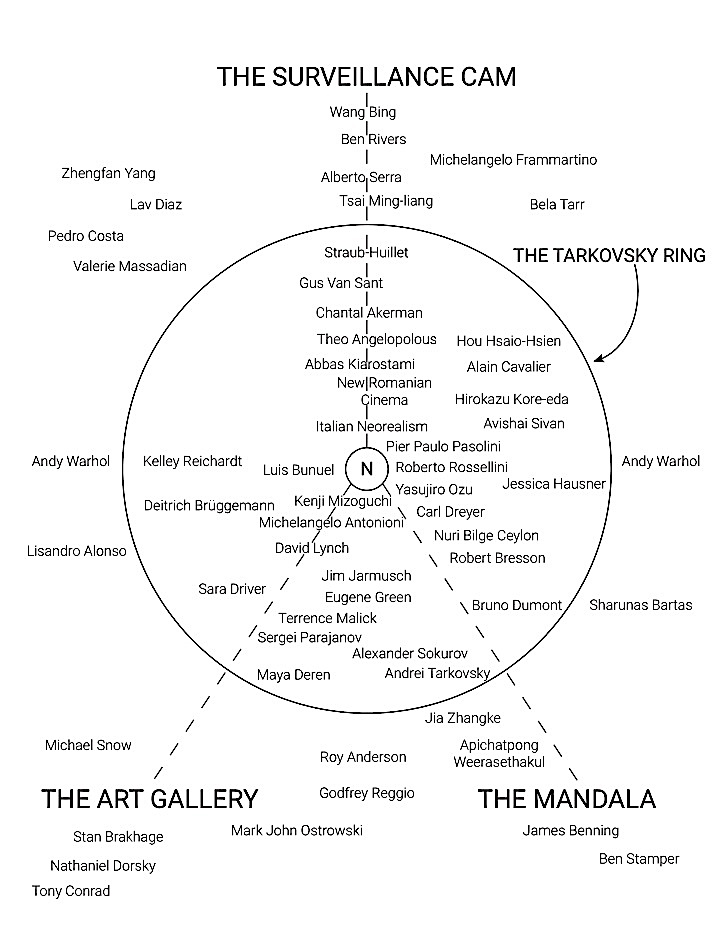
The dozens of filmmakers in the diagram above belong to a variety of cultures and eras, but what do they have in common? Some of the names that jump out at even the casual filmgoer — Andrei Tarkovsky, Jim Jarmusch, Pier Paolo Pasolini, Terrence Malick — may suggest a straightforward connection: cinephiles love them. Of course, not every cinephile loves every one of these directors, and indeed, bitter cinephile arguments rage about their relative merits even as we speak. But in one way or another, all of them are taken seriously as auteurs by those who take film seriously as an art form — and not least by Paul Schrader, one of the most serious auteur-cinephiles alive.
Schrader first made his name as a film critic, with his 1972 book Transcendental Style in Film: Ozu, Bresson, Dreyer. In it he argues that the work of Yasujirō Ozu, Robert Bresson, and Carl Theodor Dreyer have in common a quality that quite literally “transcends” their differences in origin.
This transcendental style in film “seeks to maximize the mystery of existence; it eschews all conventional interpretations of reality: realism, naturalism, psychologism, romanticism, expressionism, impressionism, and, finally, rationalism.” It “stylizes reality by eliminating (or nearly eliminating) those elements which are primarily expressive of human experience, thereby robbing the conventional interpretations of reality of their relevance and power.”
45 years on, Schrader revisits this concept in the Toronto International Film Festival interview clip above. “Most movies lean toward you. They lean toward you aggressively with their hands around your throat, trying to grab every second of your attention.” But transcendental films “lean away from you, and they use time — and as other people would call it, boredom — as a technique.” They linger on the everyday, the uneventful, the repetitive. Used adeptly, this “withholding device” is a way of “activating” viewers and their attention. Then comes the “decisive action,” the moment in which the film does “something unexpected”: the “big blast of Mozart” at the end of Bresson’s Pickpocket, the “big blast of emotion” at the end of an otherwise reserved Ozu picture. “What are you going to do with it, now that he has totally conditioned you not to expect it?”
In the new edition of Transcendental Style in Film published in 2018, Schrader includes the diagram at the top of the post. It illustrates the three major directions in which filmmakers have departed from traditional narrative, represented by the N at the center. Ozu, Bresson, and Dreyer all go off toward the meditative “mandala.” Abbas Kiarostami, Gus Van Sant, and the Italian neorealists start on path that leads to the “surveillance cam,” with its unblinking eye on an unchanging patch of reality. The likes of Kenji Mizoguchi, Michelangelo Antonioni, and David Lynch point the way to the audiovisual abstraction of the “art gallery.” Floating around these aesthetic end points are the names of filmmakers known for the “difficulty” of their work: Stan Brakhage, Wang Bing, James Benning.
Their work resides well past what Schrader calls the “Tarkovsky Ring,” named for the auteur of Mirror, Stalker, and Nostalghia. When an artist passes through the Tarkovsky Ring, as Schrader put it to Indiewire, “that’s the point where he is no longer making cinema for a paying audience. He’s making it for institutions, for museums, and so forth.” Within the Tarkovsky Ring appear a fair few adventurous directors still working today, like Hirokazu Kore-eda, Kelly Reichardt, Alexander Sokurov, and Hou Hsiao-hsien. Schrader has neglected to include his own name on the diagram, perhaps leaving his exact placement as an exercise for the reader. He certainly belongs on there somewhere: after all, some critics have called his last feature First Reformed his most transcendent yet.
Related Content:
The Exhilarating Filmmaking of Robert Bresson Explored in Eight Video Essays
How One Simple Cut Reveals the Cinematic Genius of Yasujirō Ozu
Four Video Essays Explain the Mastery of Filmmaker Abbas Kiarostami (RIP)
Andrei Tarkovsky Reveals His Favorite Filmmakers: Bresson, Antonioni, Fellini, and Others
Watch Online The Passion of Joan of Arc by Carl Theodor Dreyer (1928)
The 5 Essential Rules of Film Noir
Based in Seoul, Colin Marshall writes and broadcasts on cities, language, and culture. His projects include the book The Stateless City: a Walk through 21st-Century Los Angeles and the video series The City in Cinema. Follow him on Twitter at @colinmarshall, on Facebook, or on Instagram.
Read More...Watch an Epic Drum Battle, Pitting a 9‑Year-Old Girl Against Foo Fighter Dave Grohl
Foo Fighter Dave Grohl, formerly of Nirvana, and Nandi Bushell, an Ipswich elementary schooler, have something in common besides their incredible command of the drums.
By all appearances, both seem to have benefited from being reared by grounded, encouraging parents.
Nandi, at 10, likely has a few more years under her folks’ roof despite her growing renown—she’s jammed with Lenny Kravitz, gone viral in last year’s Argos Christmas advert, and most recently, matched Grohl beat for beat in an epic drum battle, above.
Nandi demonstrated a natural rhythmic ear at an early age, bobbing along to the Teletubbies while still in diapers.
Of course, everything she’s achieved thus far can be considered to have occurred at an early age.
On the other hand, it was half a lifetime ago when her father, a software engineer and self-described “massive music fan” introduced the then-5-year-old to “Hey, Jude,” as part of a weekly tradition wherein he makes pancakes with his children while sharing YouTube links to favorite songs.
She was immediately taken with Ringo Starr, and the joy he exuded behind his kit.
Shortly thereafter, she passed a math exam, earning a trip to Toys “R” Us to pick out a promised treat. Her eye went immediately to a £25 kiddie drum set.
The plastic toy was a far cry from the professional kit she uses today, but she’s shown herself to be adaptable in a recent series of video tutorials for Daniel Bedingfield’s “Gonna Get Through This,” encouraging viewers who lack equipment to bang on whatever’s handy—colanders, pot lids, biscuit tins… She recommends kebab skewers tipped with cellophane tape for the stickless.
Her YouTube channel definitely reveals a preference for hard rock.
Her father, John, dislikes playing publicly, but occasionally accompanies her on guitar, hoping she’ll grow accustomed to playing with other people.
Documenting his daughter’s performances lies more within his comfort zone as he told Drum Talk TV in a very glitchy, early-pandemic virtual interview. Asked by host Dan Shinder to share tips for other parents of young drummers, particularly girls, he counsels exposing them to as many musical genres as possible, nurturing their desire to play, and resolving to have as much fun as possible.
It’s clear that Nandi is having a ball twirling her sticks and whaling on the drum part of Foo Fighters’ hit “Everlong,” in a video uploaded last month.
Grohl got wind of the video and the challenge contained therein.
He took the bait, responding with an “epic” video of his own, playing a set of drums borrowed from his 11-year-old daughter:
I haven’t played that song since the day I recorded it in 1997, but Nandi, in the last week I’ve gotten at least 100 texts from people all over the world saying ‘This girl is challenging you to a drum-off, what are you going to do?’
Look, I’ve seen all your videos. I’ve seen you on TV. You’re an incredible drummer. I’m really flattered that you picked some of my songs… and you’ve done them all perfectly. So today, I’m gonna give you something you may not have heard before. This is a song called “Dead End Friends” from a band called Them Crooked Vultures… now the ball is in your court.
(Fast forward to the final thirty seconds if you want to see the ultimate in happy dances.)
The young challenger calls upon the rock Gods of old—Bonzo, Baker, Peart, Moon—to back her side for “THE GREATEST ROCK BATTLE IN THE HISTORY OF ROCK!!!”
(In addition to drum lessons, and participation in the Ipswich Rock Project and junior jam sessions, it looks like her acting classes at Stagecoach Performing Arts Ipswich are so paying off.)
Five days after Grohl threw down his gauntlet, she’s back on her drum throne, clad in a preteen version of Grohl’s buffalo check shirt and black pants, her snare bearing the legend “Grohl rocks.”
That sentiment would surely please Grohl’s mother, Virginia, author of From Cradle to Stage: Stories from the Mothers Who Rocked and Raised Rock Stars.
A born entertainer in his mother’s opinion, Grohl didn’t take up music until he was around the age Nandi is now, after which it monopolized his focus and energy, leading to a disastrous 6th grade report card.
Rather than freaking out about general education dips, Virginia, a public school teacher, was supportive when the opportunity arose for him to tour Europe at 17 with the Washington, DC band Scream after the departure of drummer Kent Stax.
Wise move. Her son may be a high school drop-out, but he’s using his fame to shine a spotlight on the concerns of teachers, who are essential workers in his view. Check out his essay in The Atlantic, in which he writes that he wouldn’t trust the U.S. Secretary of Percussion to tell him how to play “Smells Like Teen Spirit” if they had never sat behind a drum set:
It takes a certain kind of person to devote their life to this difficult and often-thankless job. I know because I was raised in a community of them. I have mowed their lawns, painted their apartments, even babysat their children, and I’m convinced that they are as essential as any other essential workers. Some even raise rock stars! Tom Morello of Rage Against the Machine, Adam Levine, Josh Groban, and Haim are all children of school workers (with hopefully more academically rewarding results than mine).
He’s also leaving time in his schedule for another drum battle:
Ok, @Nandi_Bushell .…..you win round one.…but it ain’t over yet! Buckle up, cuz I have something special in mind…
Stay tuned, Dave https://t.co/THyApmHHep — Foo Fighters (@foofighters) September 4, 2020
Watch more of Nandi Bushell’s drum and guitar covers on her parent-monitored YouTube channel.
Related Content:
The Fundamentals of Jazz & Rock Drumming Explained in Five Creative Minutes
The Case for Why Ringo Starr Is One of Rock’s Greatest Drummers
The Neuroscience of Drumming: Researchers Discover the Secrets of Drumming & The Human Brain
Ayun Halliday is an author, illustrator, theater maker and Chief Primatologist of the East Village Inky zine. Follow her @AyunHalliday.
Read More...Support Us
We're hoping to rely on loyal readers, rather than erratic ads. Please click the Donate button and support Open Culture. You can use Paypal, Venmo, Patreon, even Crypto! We thank you!

About Us

Open Culture scours the web for the best educational media. We find the free courses and audio books you need, the language lessons & educational videos you want, and plenty of enlightenment in between.
Advertise With Us

FREE UPDATES!
GET OUR DAILY EMAIL
Get the best cultural and educational resources on the web curated for you in a daily email. We never spam. Unsubscribe at any time.
FOLLOW ON SOCIAL MEDIA

Open Culture editor Dan Colman scours the web for the best educational media. He finds the free courses and audio books you need, the language lessons & movies you want, and plenty of enlightenment in between.
Advertise With Us

