In a Brilliant Light: Van Gogh in Arles–A Free Documentary
Courtesy of the Met Museum comes the 1984 documentary, In a Brilliant Light: Van Gogh in Arles, narrated by Edward Herrmann:
Near the end of his life, Vincent van Gogh moved from Paris to the city of Arles in southeastern France, where he experienced the most productive period of his artistic career. During his 444 days there, he completed over two hundred paintings and one hundred drawings inspired by the region’s light, wildlife, and inhabitants. This film presents the stories behind many beloved works alongside beautiful footage of daily life in Provence, as well as glimpses of rarely seen canvases held in private collections.
This film will be added to our list of Free Documentaries, a subset of our meta list: 4,000+ Free Movies Online: Great Classics, Indies, Noir, Westerns, Documentaries & More.
Related Content:
Georgia O’Keeffe: A Life in Art, a Short Documentary on the Painter Narrated by Gene Hackman
New Hilma af Klint Documentary Explores the Life & Art of the Trailblazing Abstract Artist
Watch 270+ Short Documentaries of Artists at Work, and Let Them Inspire Your Creative Process
The Curious Death of Vincent van Gogh
Read More...
David Byrne’s American Utopia: A Sneak Preview of Spike Lee’s New Concert Film
First came the album and tour in 2018. Then the Broadway show in 2019. And now the latest incarnation of David Byrne’s American Utopia–the concert film directed by Spike Lee. Debuting on HBO Max on October 17th, this Spike Lee joint shows David Byrne “joined by an ensemble of 11 musicians, singers, and dancers from around the globe, inviting audiences into a joyous dreamworld where human connection, self-evolution, and social justice are paramount.” If the movie is anything like the tour, it will be sublime. For now, we’ll whet your appetite with the sneak preview above.
If you would like to support the mission of Open Culture, consider making a donation to our site. It’s hard to rely 100% on ads, and your contributions will help us continue providing the best free cultural and educational materials to learners everywhere. You can contribute through PayPal, Patreon, and Venmo (@openculture). Thanks!
Related Content:
David Byrne: How Architecture Helped Music Evolve
Read More...The Curious Death of Vincent van Gogh
The story of Vincent van Gogh’s suicide, like the removal of his ear, has been integral to his mythos for a long time, immortalized by Kirk Douglas in the final scene of Vincente Minnelli’s film Lust for Life and in the 1934 biographical novel of the same name by Irving Stone. We’ve all accepted this as brute historical fact, but, apparently, “it’s all bunk,” Gregory White Smith and Steven Naifeh wrote in a 2014 Vanity Fair article based on a decade of research for a new biography (Van Gogh: The Life).
“Though eagerly embraced by a public in love with a handful of memorable images and spellbound by the thought of an artist who would cut off his own ear,” the authors argue, “Stone’s suicide yarn was based on bad history, bad psychology, and, as a definitive new expert analysis makes clear, bad forensics.” An expert analysis, you say? Yes. the world’s biggest posthumous art star has become an unsolved mystery, the subject of a Buzzfeed video above, part a series that also includes Edgar Allan Poe, JFK, Jimmy Hoffa, and Natalie Wood.
Van Gogh’s suicide seems accepted as a fact by the Van Gogh Museum, at least according to their website, evidenced by the morbid gloom of his late letters to his brother. But Van Gogh wrote “not a word about his final days,” Smith and Naifeh point out, and he left behind no suicide note, “odd for a man who churned out letters so profligately.” A piece of writing found on him turned out to be an early draft of his last letter to Theo, which was “upbeat—even ebullient—about the future.” He had every reason to be, given the glowing success of his first show. “He had placed a large order for more paints only a few days before a bullet put a hole in his abdomen.”
The story of how the hole got there involves a then-16-year-old Paris pharmacist named René Secrétan, who cruelly bullied Van Gogh during his 1890 summer in Auvers. (He also sat for some paintings and a drawing.) His involvement explains the “studied silence” the community maintained after Van Gogh’s death. No one mentioned suicide, but no one would say much of anything else either. Secrétan became a wealthy banker and lived to see Kirk Douglas portray the eccentric artist he mocked as “Toto.” He later admitted to owning the gun that killed Van Gogh, but denied firing the shot.
The new evidence surrounding Van Gogh’s possible murder has been in the public eye for several years now, but it hasn’t made much of a dent in the Van Gogh suicide legend. Still, we must admit, that story has always made little sense. Even scholars at the Van Gogh museum privately admitted to the artist’s biographers that they had serious doubts about it. These were dismissed, they claimed, as being “too controversial.” Now that Van Gogh has become a YouTube true crime unsolved mystery, there’s no shutting the door on speculation about his untimely and tragic demise.
Related Content:
Vincent Van Gogh’s Self Portraits: Explore & Download a Collection of 17 Paintings Free Online
Vincent Van Gogh’s Favorite Books
Josh Jones is a writer and musician based in Durham, NC. Follow him at @jdmagness
Read More...David Lynch Tries to Make a List of the Good Things Happening in the World … and Comes Up Blank
David Lynch’s weather report for Sunday September 13th: “Here in LA, grey. Again, smoke-filled sky. Very still right now. 61 degrees fahrenheit. Today I’m making a list of all the good things that are happening in the world. [Pause.] I’m still thinking… No blue skies, no golden sunshine today.”
Maybe David Byrne, creator of the “Reasons to Be Cheerful” web site, would have a better shot at filling out the page. Have your own list of good things happening in the world? Add them to the comments below…
If you would like to support the mission of Open Culture, consider making a donation to our site. It’s hard to rely 100% on ads, and your contributions will help us continue providing the best free cultural and educational materials to learners everywhere. You can contribute through PayPal, Patreon, and Venmo (@openculture). Thanks!
Related Content:
Read More...Four Classic Prince Songs Re-Imagined as Pulp Fiction Covers: When Doves Cry, Little Red Corvette & More
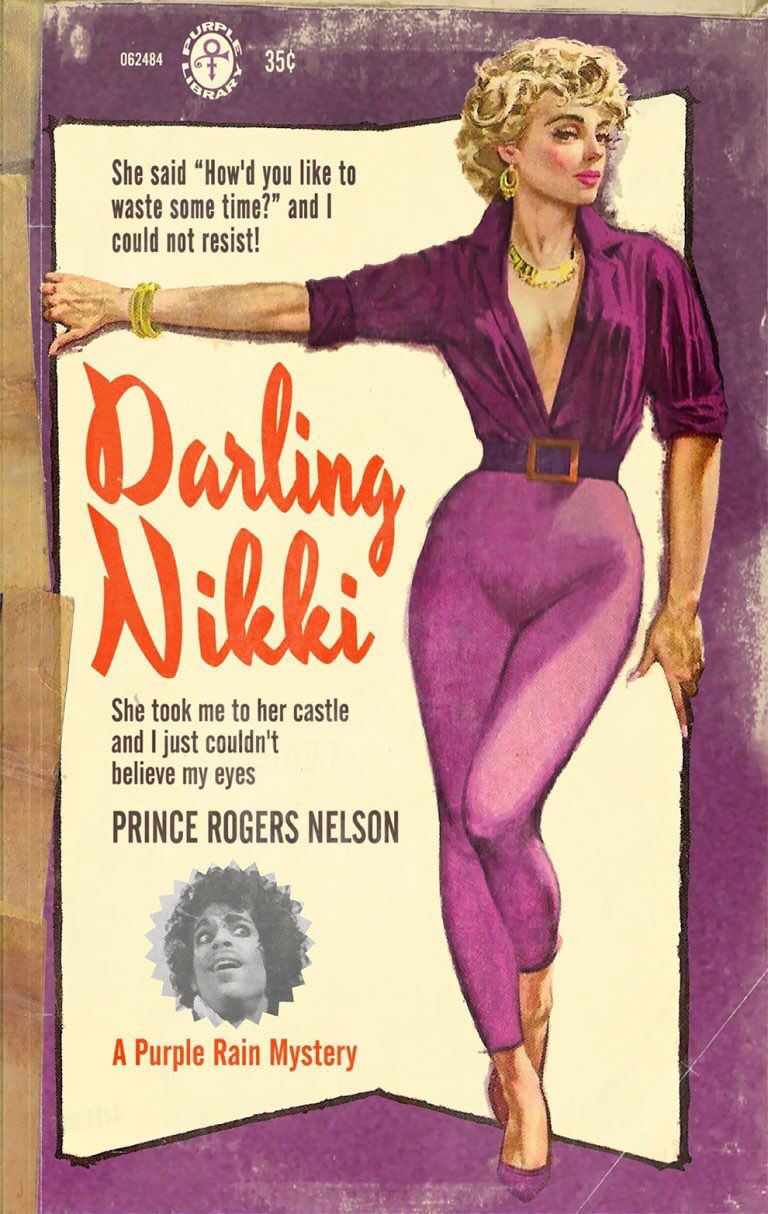
There’s a book-lined Knowledge Room in the late Prince Rogers Nelson’s Paisley Park, but the Prince-inspired faux-books that artist Todd Alcott imagines are probably better suited to the estate’s purple-lit Relaxation Room.
The Knowledge Room was conceived of as a library where the world’s most famous convert to Jehovah’s Witnesses could delve into religious literature, reflect on the meaning of life, and study the Bible deep into the night.
Alcott’s covers harken to an earlier stage in Prince’s evolution—one the star eventually disavowed—as well as several bygone eras of book design.
Lyrically, there’s no mistaking what Prince’s notorious 1984 “Darling Nikki” is about. There’s a direct line between it and the creation of parental advisory stickers for musical releases containing what is politely referred to as “mature content.”
Alcott’s 1950s pulp novel treatment, above, is similarly graphic. Those skintight purple curves are a promise that even purpler prose lays within, or would, were there any text couched behind that steamy cover.
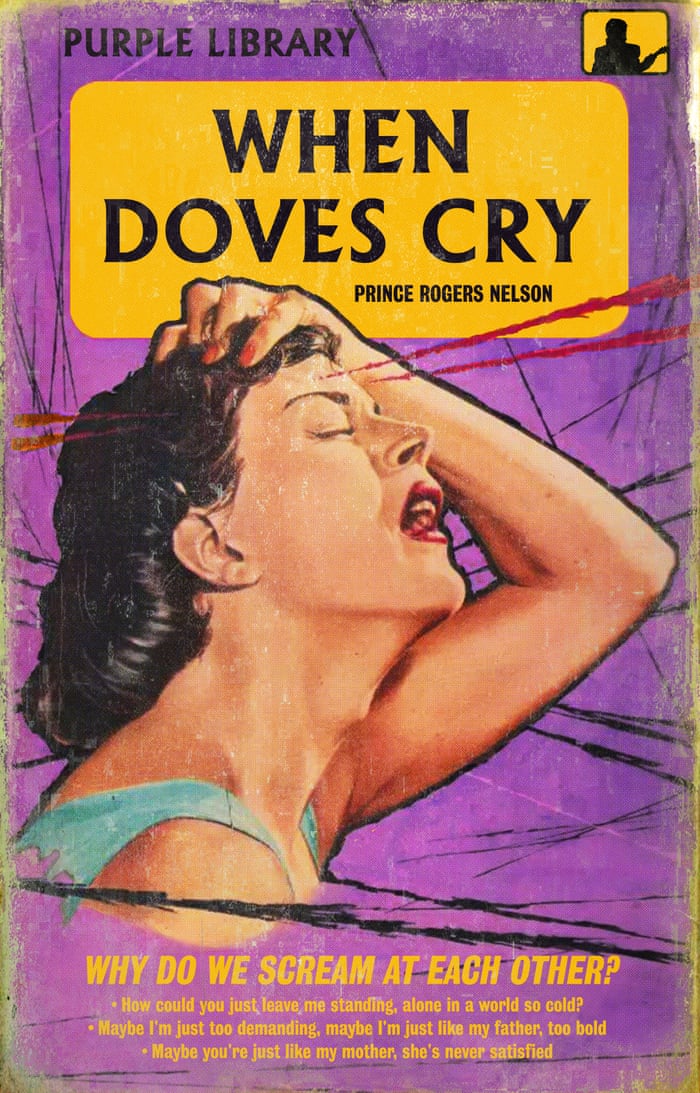
“When Doves Cry” makes for a pretty purple cover, too. In this case, the inspiration is a 1950s self-help book, enriched with some Freudian taglines from Prince’s own pen. (“Maybe you’re just like my mother, she’s never satisfied.”)
Alcott remembers Prince being “an incredibly liberating figure” when he burst onto the scene:
There was his flamboyant, outrageous sexuality, but also his musical omnivorousness; he played funk, rock, pop, jazz, everything. Purple Rain was the Sergeant Pepper’s of its day, a wall-to-wall brilliant album that everyone could recognize as a remarkable achievement. I remember when I first saw Purple Rain, at the very beginning of the movie, before the movie has even begun, the Warner Bros logo came up and you heard the sound of an expectant crowd, and an announcer says “Ladies and Gentlemen, The Revolution,” and the first shot is of Prince, backlit, silhouetted in purple against a dense mist, and he says “Dearly beloved, we have gathered here today to get through this thing called life.” And I was instantly, incontrovertibly, a fan for life. The confidence of that opening, the sheer audacity of it, adopting the tone of a priest at a wedding, in his Hendrix outfit and hairdo, the sheer gutsiness of that statement, alone, just blew me away. And then he proceeded to play “Let’s Go Crazy” which completely lived up to that opening. After that he could have run Buick ads for the rest of the movie and I’d still be a fan.
Decades later, I was sitting in a Subway restaurant at the end of a very, very long, tiring day, and was feeling completely exhausted and miserable, and out of nowhere, “When Doves Cry” came on the sound system. And I was reminded that the song, which was a huge hit in 1984, the song of the year, had no bass line. The arrangement of it made no sense. It was a song put together by force of will, with its metal guitar and its synth strings and its electronic drums. And in that moment, at the end of a long, tiring day, I was reminded that miracles are possible.
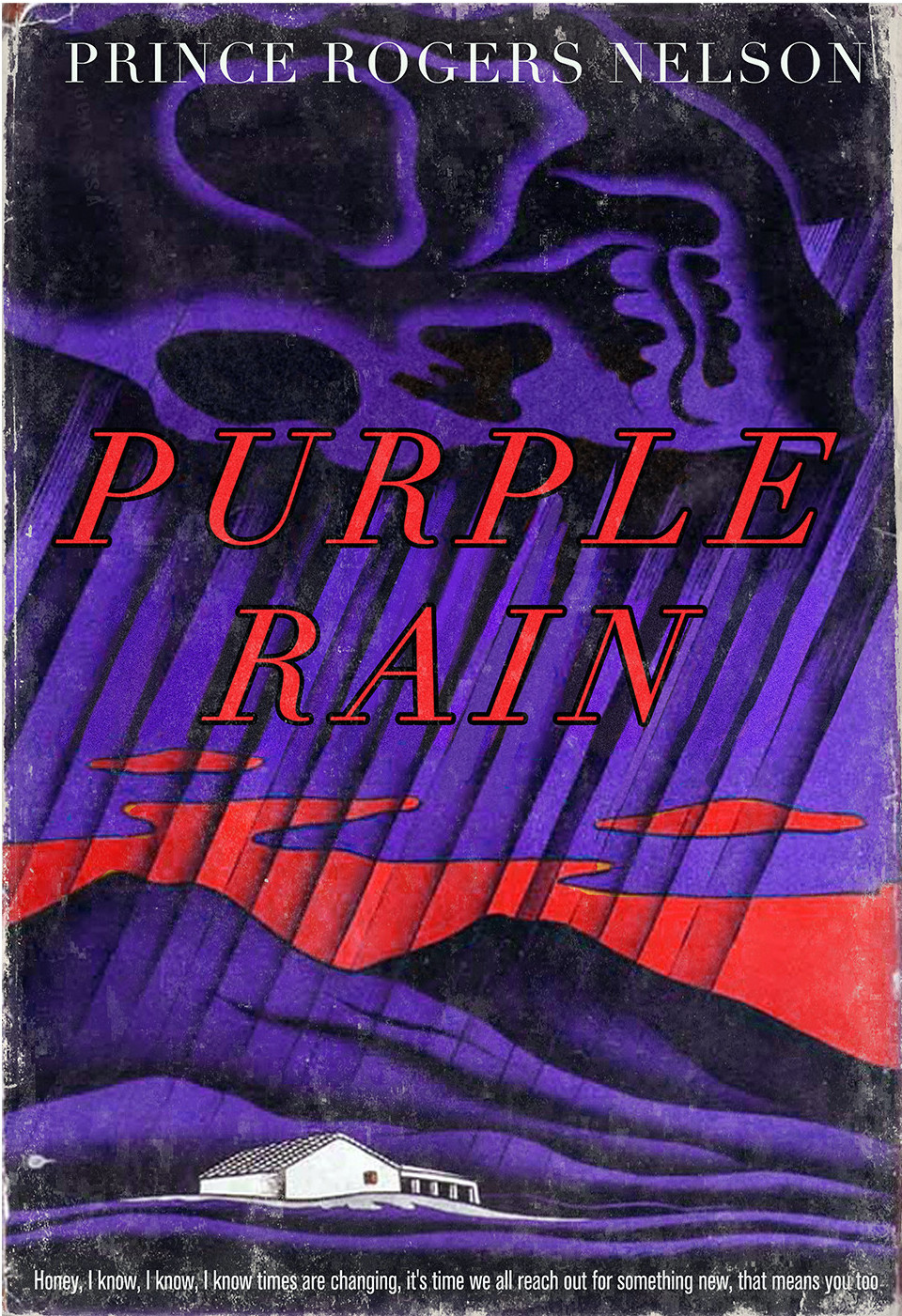
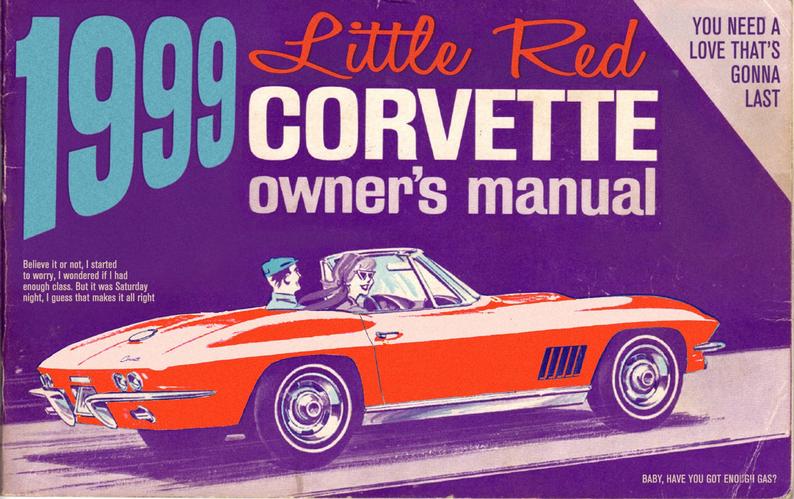
Alcott’s miraculous graphic transformations are rounded out with a comparatively understated 1930s murder mystery, Purple Rain and an ingenious Little Red Corvette owner’s manual dating to the mid-60s. Prints of Todd Alcott’s Prince-inspired paperback covers are available in his Etsy shop.
Related Content:
Ayun Halliday is an author, illustrator, theater maker and Chief Primatologist of the East Village Inky zine. Follow her @AyunHalliday.
Read More...Behold the First Underwater Portrait in the History of Photography (Circa 1899)
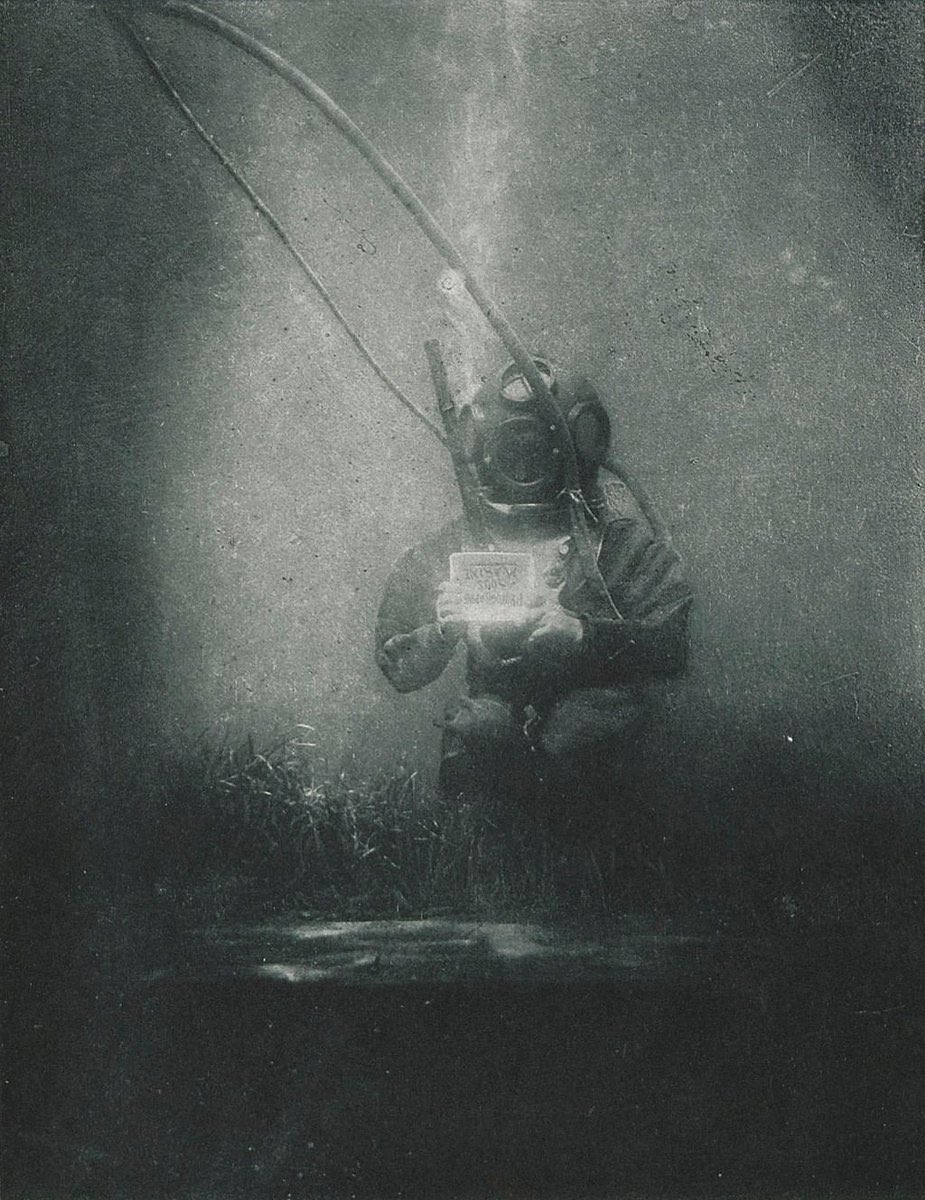
The image above may at first look like a plate from a Jules Verne novel, or perhaps a still from one of Georges Méliès’ more fantastical moving pictures. It does indeed come from fin de siècle France, a time and place in which Verne, Méliès, and many other imaginative creators lived and worked, but it is in fact a genuine underwater photograph — or rather, a genuine underwater portrait, and the first example of such a thing in photographic history. Taken in the 1890s (most likely 1899) by biologist and photography pioneer Louis Boutan, it depicts Boutan’s Romanian colleague Emil Racovitza holding up a sign that reads “Photographie Sous Marine,” or “Underwater Photography.”
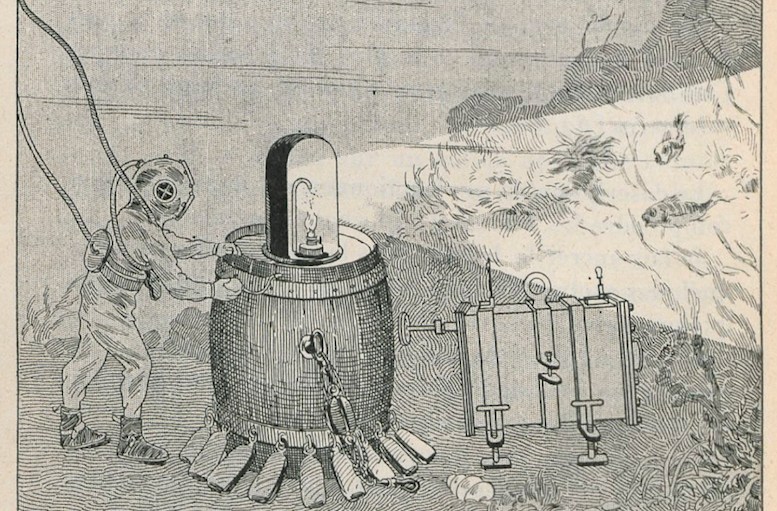
Such an outlandish concept could hardly have crossed many minds back then, and fewer still would have dreamt up practical ways to realize it. To start with the most basic of challenges, there is, as David Byrne sung, water at the bottom of the ocean — but not a whole lot of light, especially compared to the burdensome requirements of late 19th-century cameras. This necessitated the development of what Petapixel’s Laurence Bartone calls a “crazy underwater flash photography rig,” one powerful enough that it “could easily double as a bomb. The creation involved an alcohol lamp on an oxygen-filled barrel. A rubber bulb would then blow a puff of magnesium powder over the flame, creating a flash.”
Photography enthusiasts will understand the magnitude of Boutan’s achievement (made with the help of his brother Auguste and a laboratory technician named Joseph David). Some have gone so far as to recreate it, an effort you can see in the Barcelona Underwater Festival video just above. Not only are there fish and other sea creatures swimming everywhere, a feature of the environment not visible in Boutan’s original shot, but the re-enactors face the pressure of curious passersby, young and old, who walk through a nearby transparent underwater tunnel, not a consideration for Boutan and his collaborators. That groundbreaking success in underwater portraiture came 54 years after a Philadelphia chemist named Robert Cornelius first turned his camera on himself. Has photographic history recorded how long it took humanity after Boutan’s famous picture to snap the first underwater selfie?
via Diane Doniol-Valcroze on Twitter
Related Content:
Underwater Volcanic Eruption Witnessed for the First Time
Reef View: Google Gives Us Stunning Underwater Shots of Great Coral Reefs
Sunken Films: Watch a Cinematic Meditation on Films Found on the Ocean’s Floor
See the First “Selfie” In History Taken by Robert Cornelius, a Philadelphia Chemist, in 1839
The History of Photography in Five Animated Minutes: From Camera Obscura to Camera Phone
Based in Seoul, Colin Marshall writes and broadcasts on cities, language, and culture. His projects include the book The Stateless City: a Walk through 21st-Century Los Angeles and the video series The City in Cinema. Follow him on Twitter at @colinmarshall, on Facebook, or on Instagram.
Read More...19th-Century Japanese Woodblocks Illustrate the Lives of Western Inventors, Artists, and Scholars (1873)
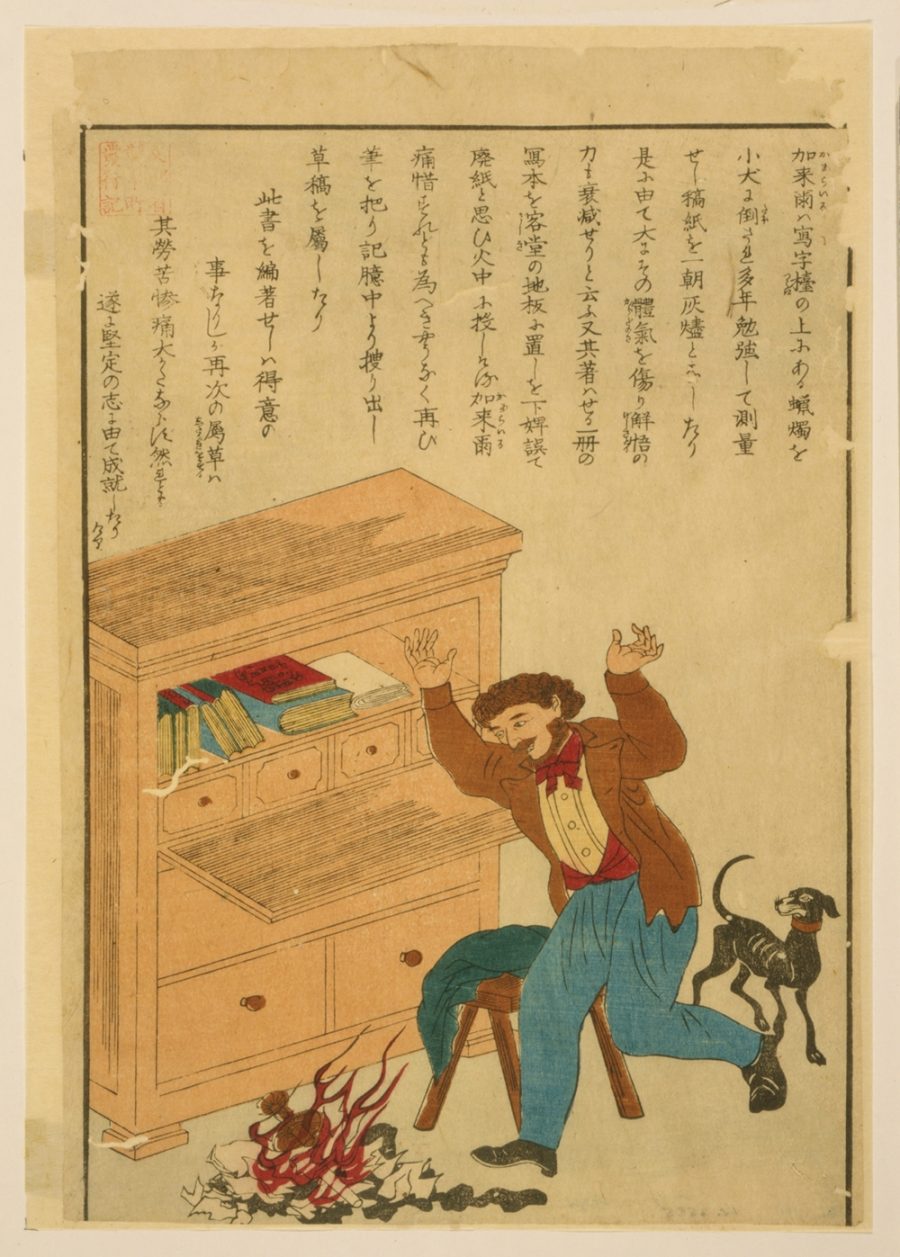
For more than 200 years between the mid-17th and mid-19th century, Japan closed itself to the outside world. But when it finally opened again, it couldn’t get enough of the outside world. The American Navy commodore Matthew Perry arrived with his formidable “Black Ships” in 1853, demanding that Japan engage in trade. Five years later came the Meiji Restoration, which consolidated Japan’s political system under imperial rule and encouraged both industrialization and Westernization. Or rather, it encouraged the importation of Western technology and ideas for use in Japanese ways, a combination known as wakon-yōsai, meaning “Japanese spirit and Western techniques.”
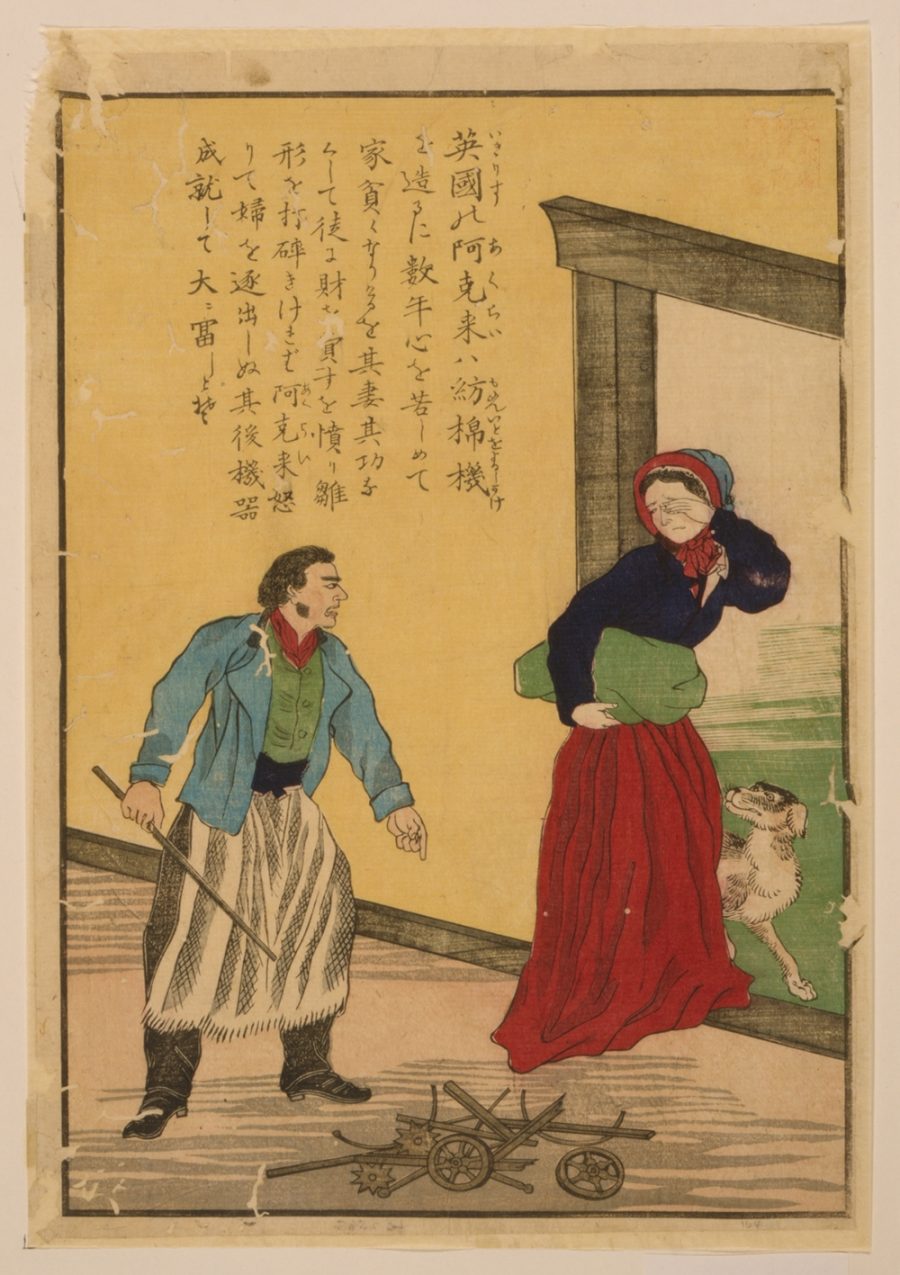
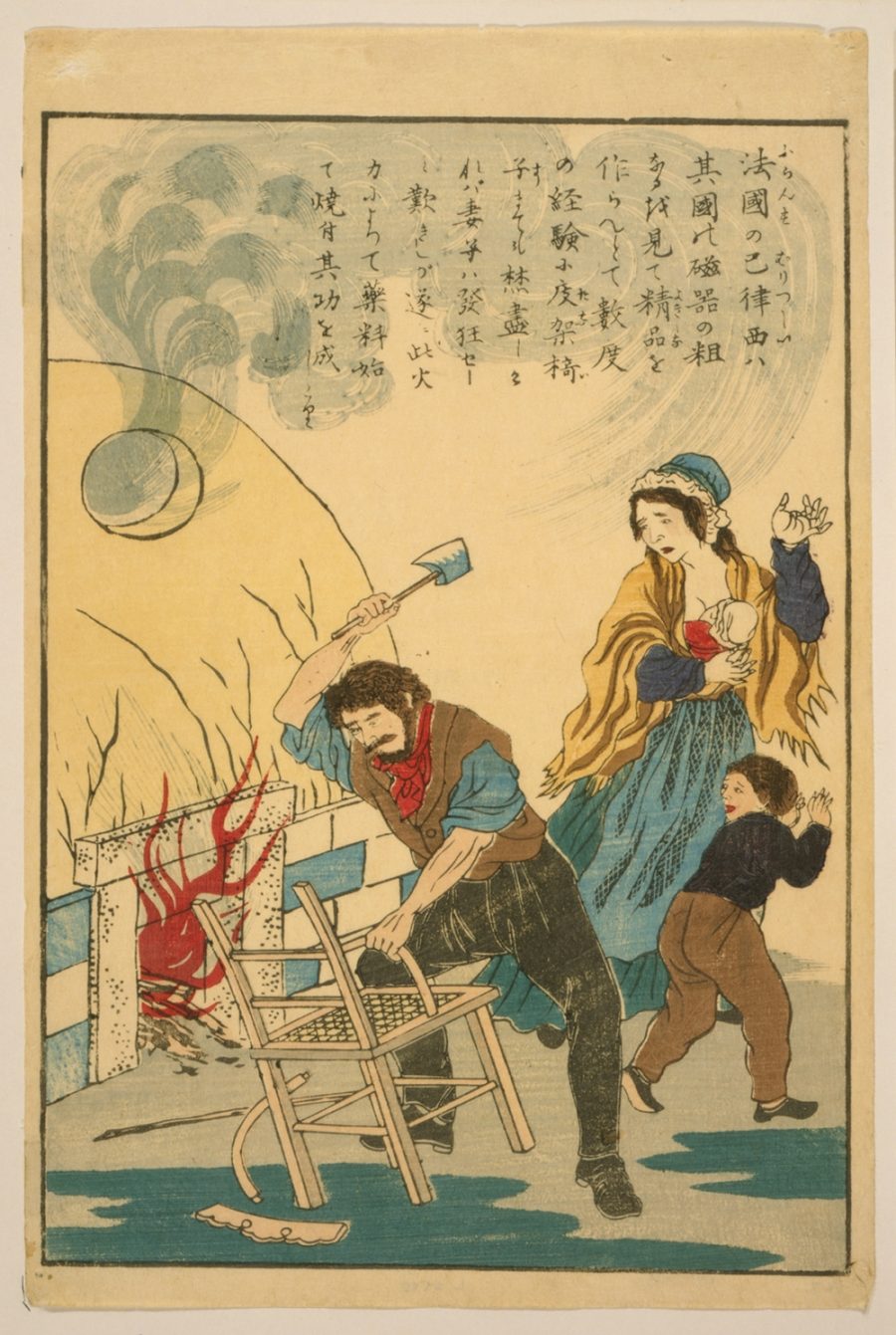
It is in the mindset of wakon-yōsai, says the Public Domain Review, that we should view these Japanese woodblock prints of Western inventors, scholars, and artists. Most likely dating from 1873 — a heady time for the mixture of Japanese spirit and Western techniques — they depict these figures facing a variety of challenges, some more plausible than others.
“The great naturalist John James Audubon battles with a mischievous rat who has eaten his work; the dog of historian and poet Thomas Carlyle has upset a lamp burning his papers; the wife of Richard Arkwright, inventor of the spinning-frame, smashes his creation; the developer of the Watt steam engine James Watt suffers the wrath of his impatient Aunt; pottery impresario Bernard Palissy has to burn his family’s furniture to keep his kiln’s fire going.”
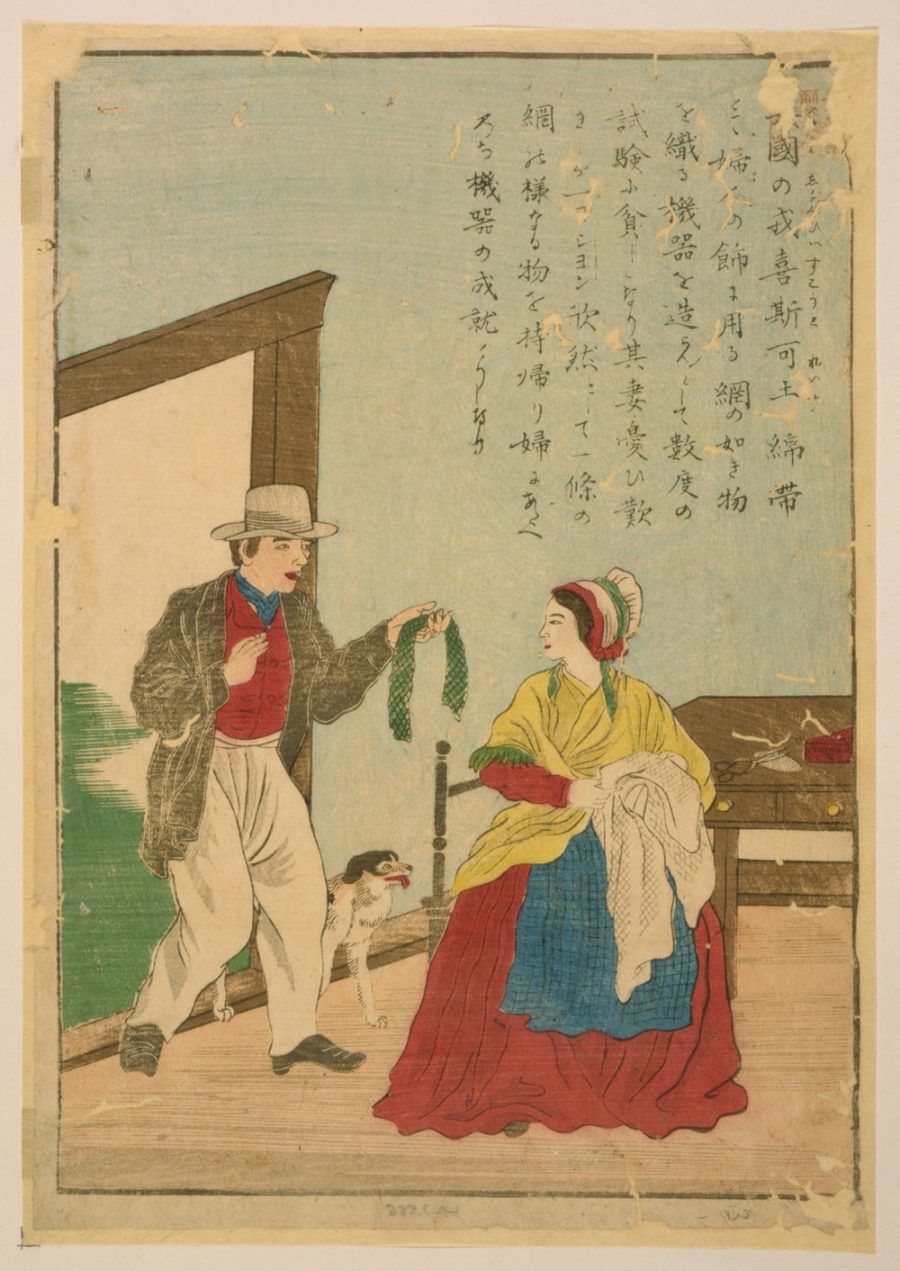
Commissioned by the Japanese Department of Education, these schoolbook illustrations may bring to mind the 1861 Japanese history of America previously featured on Open Culture, with its tiger-punching George Washington and serpent-slaying John Adams. But the text that accompanies these mightily struggling Western luminaries, translations of which you can find along with the images at the Public Domain Review, “paints a slightly more positive picture, revealing the moral, something akin to ‘If at first you don’t succeed then try again,’ or ‘Perseverance prospers.’ ” In Japan’s case, perseverance would indeed make it one of the most prosperous nations in the world — if only after its defeat in World War II, by some of the very nations whose historical figures it had lionized less than a century before. Find more images at the Public Domain Review and the Library of Congress.
Related Content:
Download Hundreds of 19th-Century Japanese Woodblock Prints by Masters of the Tradition
Enter a Digital Archive of 213,000+ Beautiful Japanese Woodblock Prints
The 10 Commandments of Chindōgu, the Japanese Art of Creating Unusually Useless Inventions
Based in Seoul, Colin Marshall writes and broadcasts on cities, language, and culture. His projects include the book The Stateless City: a Walk through 21st-Century Los Angeles and the video series The City in Cinema. Follow him on Twitter at @colinmarshall, on Facebook, or on Instagram.
Read More...Leonardo da Vinci’s Elegant Studies of the Human Heart Were 500 Years Ahead of Their Time
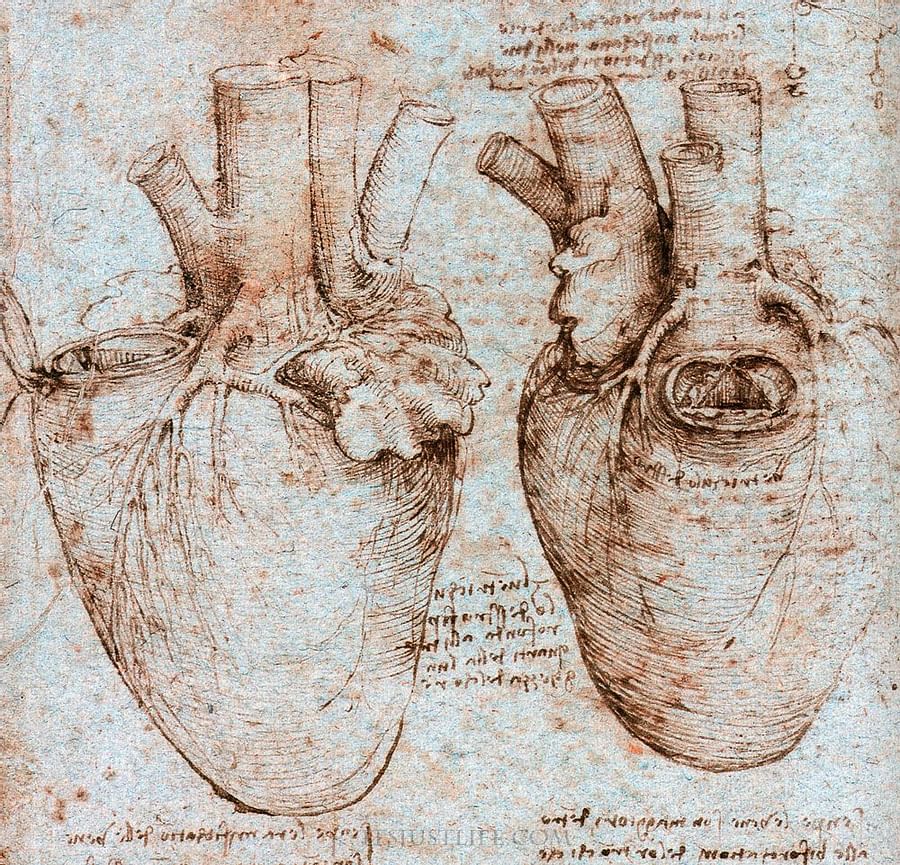
Leonardo da Vinci didn’t really have hobbies; he had passionate, unpaid obsessions that filled whole notebooks with puzzles scientists are still trying to solve. Many of the problems to which he applied himself were those none of his contemporaries understood, because he was the only person to have noticed them at all. The amateur anatomist was the first, for example, “to sketch trabeculae,” notes Medievalists.net, “and their snowflake-like fractal patterns in the 16th century.”
These geometric patterns of muscle fibers on the inner surface of the heart have remained a mystery for over 500 years since Leonardo’s anatomical investigations, carried out first on pig and oxen hearts, then later, in hasty dissections in the winter cold, on human specimens. He speculated they might have warmed the blood, but scientists have recently found they enhance blood flow “just like the dimples on a golf ball reduce air resistance.”
Leonardo may have been wide of the mark in his trabeculae theory, not having access to genetic testing, AI, or MRI. But he was the first to describe coronary artery disease, which would become one of the leading causes of death 500 years later. Many of his medical conclusions have turned out to be startingly correct, in fact. He detailed and elegantly sketched the heart’s anatomy from 1507 until his death in 1519, working out the flow of the blood through the body.
As the Medlife Crisis video above explains, Leonardo’s studies on the heart elegantly brought together his interests in art, anatomy, and engineering. Because of this multi-dimensional approach, he was able to explain a fact about the heart’s operation that even many cardiologists today get wrong, the movement of the aortic valve. In order to visualize the “flow dynamics” of the heart’s machinery, without imaging machinery of his own, he built a glass model, and drew several sketches of what he saw. “Incredibly, it took 450 years to prove him right.”
The mind of this extraordinary figure continues to divulge its secrets, and scholars and doctors across multiple fields continue to engage with his work, in the pages, for example, of the Netherlands Heart Journal. His studies on the heart particularly show how his astonishing breadth of knowledge and skill paradoxically made him such a focused, determined, and creative thinker.
via Medievalists.net
Related Content:
Josh Jones is a writer and musician based in Durham, NC. Follow him at @jdmagness
Read More...Sounds of the Forest: A Free Audio Archive Gathers the Sounds of Forests from All Over the World

Some of my fondest memories are of hiking the Olympic National Forest in Washington State and the forests of the Shenandoah Valley in Virginia, seeking the kind of silence one can only find in busy ecosystems full of birds, insects, woodland creatures, rustling leaves, etc. This experience can be transformative, a full immersion in what acoustic ecologist Gordon Hempton calls a “natural acoustic system,” the endless interplay of calls and responses that evolved to harmonize over millennia.
Tragically, human noise pollution encroaches on the acoustic space of such refuges, and climate change may irrevocably alter their nature. But they will be preserved, in digital recordings at least, thanks in part to the efforts of a project called Sounds of the Forest, which has been documenting the pregnant silences of forests around the world and has so far collected audio files from six continents, with western Europe most heavily represented.
The Sounds of the Forest library, accessible via its interactive map or Soundcloud page, “will form an open source library,” the project announces, “to be used by anyone to listen to and create from.”
Nature lovers can contribute their own recordings, helping to fill in the many remaining areas on the map without representation. “Visit a woodland,” the project recommends, “recharge under the canopy and record your sounds of the forest.” The site gives specific instructions for how to upload audio file submissions.
Sounds of the Forest came out of the annual Timber Festival, an international gathering in the UK’s National Forest, which is the “boldest environmentally-led regeneration project: the creation of England’s first new forest in a thousand years… an imaginative and ambitious statement of sustainable development.” When the pandemic scuttled plans for an in-person 2020 Timber Festival, organizers conceived of the sound files as a way to bring the world together in a virtual forest gathering. They are also foraging material for next year’s fest, in which “selected artists will be responding to the sounds that are gathered, creating music, audio, artwork or something else incredible.”
If you can’t make it to Timber Festival 2021 next summer, or to your forest refuge of choice this autumn, you can still immerse yourself in the restorative sounds of forests worldwide. Open the sound map, click on a file, close your eyes, and imagine yourself in Nelson Lakes National Park in New Zealand, Yasuni National Park at night in Ecuador, or Chernyaevsky Forest in Russia. Experiencing the busy silences of nature brings us back to ourselves—or to the ancient parts of ourselves that once also harmonized with the natural world.
via Kottke
Related Content:
How to Find Silence in a Noisy World
Free: Download the Sublime Sights & Sounds of Yellowstone National Park
10 Hours of Ambient Arctic Sounds Will Help You Relax, Meditate, Study & Sleep
Josh Jones is a writer and musician based in Durham, NC. Follow him at @jdmagness
Read More...Watch Lime Kiln Club Field Day, One of the Earliest Surviving Feature Films with an All Black Cast (1913)
For some of us (no names) the world of TikTok is baffling and bizarre. Why does Gen Z flock to it? Who knows, but they do, in droves. Anyone can be a “creator” on what Jason Parham at Wired calls “the most exciting cultural product of this time.” It also happens to be a place where “digital blackface” has evolved—an online cultural phenomenon in which Black users of a platform get disproportionately censored while others who adopt the trappings of Black American culture, often in exaggerated, stereotypical ways, rack up followers and views.
21st century forms of blackface persist for all sorts of reasons. The intent may not be consciously to demean, but the effects are usually otherwise, especially given the long history of blackface as a way of mocking Black Americans, while forcing Black actors to themselves perform in blackface to gain an audience and get work. Minstrelsy performed by white stage actors, comedians, musicians, etc. set a tragically low bar for Black actors.
A once-prominent example comes from the career of performer Bert Williams. “Largely forgotten today,” Claudia Roth Pierpont writes at The New Yorker, Williams was “the first African-American star: the most famous ‘colored man’ in America during the early years of the twentieth century.” He performed at Buckingham Palace, was the only Black member of Ziegfeld Follies (and a headliner) and played “alongside Fanny Brice and Eddie Cantor—for nearly a decade.”
He did all of it in blackface, decades after the original Jim Crow character appeared in 1830. Born in 1874 in the Bahamas, says Caribbean novelist Caryl Phillips, Williams “was an outsider in all sorts of ways… He didn’t see himself to be fully a part of African American traditions, so in a sense he didn’t quite understand the full implications of the blackface performance. He saw it as part of his costume.” That may not necessarily be so. In his stage act, Williams and his partner resisted the practice for as long as they could, until they realized that they would be subject to constant violence from white audiences without it.
Blackface affectations helped Williams cross over into a film career. He “produced, wrote, directed and starred in two short films for Biograph,” the San Francisco Silent Film Festival notes, “A Natural Born Gambler (1916) and Fish (1916). Produced by a black man for white audiences, they were groundbreaking, however, these films featured characters and storylines that still satisfied dominant racist stereotypes of black men.”
In contrast, a third film, produced three years earlier, titled Lime Kiln Club Field Day, “one of a handful of surviving silent films with an all-black cast,” told a very different kind of story. Williams appeared in blackface, but the other actors did not. “The film … features one of the first examples of on-screen intimacy between a black man and a black woman—a kiss—along with scenes of middle class leisure; story elements that challenged the mostly negative, sometimes evil, depictions of blacks in the majority of white-produced films, which reached a distressing nadir in D.W. Griffith’s The Birth of a Nation, released two years later.”
Lime Kiln Club Field Day was never completed. Its many unedited reels of film were only recently rediscovered, a century later, in the archives at New York’s Museum of Modern Art. See the film above, restored by curator Ron Magliozzi and preservation officer Peter Williamson, who conducted research “over nearly a decade,” the MoMA writes, to decipher the plot of the film and recover its production history, even going so far as to employ a lip reader and explore Staten Island and New Jersey in search of locations.”
Film historians do not know why the project was abandoned. They do know that Williams suffered significantly for the racist caricatures he felt forced to perform. Read more about his extraordinary career at The New Yorker and learn more about the Lime Kiln Club Field Day restoration project at the San Francisco Silent Film Festival site.
Related Content:
Watch the Pioneering Films of Oscar Micheaux, America’s First Great African-American Filmmaker
Josh Jones is a writer and musician based in Durham, NC. Follow him at @jdmagness
Read More...Support Us
We're hoping to rely on loyal readers, rather than erratic ads. Please click the Donate button and support Open Culture. You can use Paypal, Venmo, Patreon, even Crypto! We thank you!

About Us

Open Culture scours the web for the best educational media. We find the free courses and audio books you need, the language lessons & educational videos you want, and plenty of enlightenment in between.
Advertise With Us

FREE UPDATES!
GET OUR DAILY EMAIL
Get the best cultural and educational resources on the web curated for you in a daily email. We never spam. Unsubscribe at any time.
FOLLOW ON SOCIAL MEDIA

Open Culture editor Dan Colman scours the web for the best educational media. He finds the free courses and audio books you need, the language lessons & movies you want, and plenty of enlightenment in between.
Advertise With Us


