The Life, Work & Philosophy of Bill Murray: Happy 70th Birthday to an American Comedy Icon

Image by Gage Skidmore, via Wikimedia Commons
“Bill Murray is to me what calculators are to math,” Jason Schwartzman once said of his esteemed colleague. “I never knew math before calculators, and I never knew life before Bill Murray.” Having been born in the 1980s, a decade Murray entered already well-known after three early seasons of Saturday Night Live, I could say the same. Through characters like Nick the lounge singer and half a nerd couple with Gilda Radner, Murray established himself on that show as a goofball, but a goofball of a higher order. As the 80s got into full swing, Murray got into the movies, and ever more prominent roles in the likes of Caddyshack, Stripes, and Ghostbusters assured him a permanent place in the pantheon of American comedy.
For those who cared to look, there has long been evidence of concentrated thought and feeling behind the deadpan impulsiveness of Murray’s onscreen persona: his supporting turn as Dustin Hoffman’s lemon-eating playwright roommate in Tootsie, his passion-project adaptation of Somerset Maugham’s The Razor’s Edge, his post-Ghostbusters escape to the Sorbonne.
It was in Paris that Murray studied the work of the Greco-Armenian Sufi mystic G.I. Gurdjieff, who describes a path to enlightenment called “the way of the sly man,” one who makes maximum use of “the world, the self, and the self that is observing everything.” This concept, according to the Wisecrack video above, has become integral to Murray’s distinctive way of not just acting, but being.
That counts as just one of the theories advanced over the decades to explain the curious phenomenon of Bill Murray. The man has also been called upon to explain it himself now and again, as when an interviewer at the Toronto International Film Festival asked what it feels like to be him. His response takes the audience into a guided meditation meant to make everyone listening understand how it feels to be themselves, right here, right now.
Maintaining this sense of the moment, as Murray later explained to Charlie Rose, is one of the goals of his own life — and presumably not an easy goal to achieve for someone who’s been so famous for so long, a condition he addresses in the 1988 interview animated for Blank on Blank below. “I’m just an obnoxious guy who can make it appear charming,” he says in summation of his appeal. “That’s what they pay me to do.”
That same year, they paid him $6 million for his role in Scrooged (playing, incidentally, the most obnoxious character of his career). He’d already been cautioned against the dangers of such rapidly acquired wealth and fame by the fate of his fellow Chicagoan and SNL alumnus John Belushi, who by that time had already been dead for five years. Murray had also, he says, undergone a “spiritual change” that showed him “there was some other life to live. It changed the way that I worked,” giving everything “a different presence, a different tension.” Onscreen, this change culminated in the roles he took on after putting broad comedies behind him beginning with 1999’s Rushmore, the breakout feature by an up-and-coming director named Wes Anderson.
Casting Murray opposite the teenage Schwartzman, Rushmore showed that he could be more affecting — and indeed funnier — in minor emotional keys. A few years later, Sofia Coppola’s Lost in Translation took him to Japan, where he drew an Academy Award nomination with his performance from the depths of cultural and personal disorientation. Today, on Murray’s 70th birthday, his fans impatiently await his appearances in Anderson’s The Paris Dispatch and Coppola’s On the Rocks, both of which come out next month. Having long since become an institution (albeit an insistently unconventional and unpredictable one) unto himself, Murray can surely look to the heavens and say what, with uncharacteristic earnestness, he told his SNL audience he wanted to say 33 years ago: “Dad, I did it.”
Related Content:
Bill Murray Explains How a 19th-Century Painting Saved His Life
Art Exhibit on Bill Murray Opens in the UK
Watch Bill Murray Perform a Satirical Anti-Technology Rant (1982)
Listen to Bill Murray Lead a Guided Meditation on How It Feels to Be Bill Murray
Based in Seoul, Colin Marshall writes and broadcasts on cities, language, and culture. His projects include the Substack newsletter Books on Cities, the book The Stateless City: a Walk through 21st-Century Los Angeles and the video series The City in Cinema. Follow him on Twitter at @colinmarshall, on Facebook, or on Instagram.
Read More...A Long, Guided Tour of New York City Captured in Original Color Film (1937)
So much classic black and white footage has been digitally colorized recently, it’s hard to remember that the Eastman Kodak Company’s Kodachrome film debuted way back in 1935.
The above footage of New York City was shot by an unknown enthusiast in and around 1937.
Dick Hoefsloot, the Netherlands-based videographer who posted it to YouTube after tweaking it a bit for motion stabilization and speed-correction, is not averse to artificially coloring historic footage using modern software, but in this case, there was no need.
It was shot in color.
If things have a greenish cast, that’s owing to the film on which it was shot. Three-color film, which added blue to the red-green mix, was more expensive and more commonly used later on.
Hoefsloot’s best guess is that this film was shot by a member of a wealthy family. It’s confidently made, but also seems to be a home movie of sorts, given the presence of an older woman who appears a half dozen times on this self-guided tour of New York sites.
There’s plenty here that remains familiar: the Woolworth Building and the Metropolitan Museum of Art, trussed up Christmas trees propped against makeshift sidewalk stands, the New York Public Library’s lions, Patience and Fortitude.
Other aspects are more a matter of nostalgia.
Over in Times Square, Bulldog Drummond Comes Back starring John Barrymore was playing at the Criterion (now the site of a Gap store), while the Paramount Theater, now a Hard Rock Cafe, played host to True Confession with Barrymore and Carol Lombard.
Oysters were still food for the masses, though records show that locally harvested ones had been deemed too polluted for human consumption for at least a decade.
A bag of peanuts cost 15¢. A new Oldsmobile went for about $914 plus city tax.
Laundry could be seen strung between buildings (still can be on occasion), but people dressed up carefully for shopping trips and other excursions around town. Heaven forbid they step outside without a hat.
Though the Statue of Liberty makes an appearance, the film doesn’t depict the neighborhoods where new and established immigrants were known to congregate. Had the camera traveled uptown to the Apollo—by 1937, the largest employer of black theatrical workers in the country and the sole venue in the city in which they were hired for backstage positions—the overall composition would have proved less white.
The film, which was uploaded a little over a year ago, has recently attracted a fresh volley of attention, leading Hoefsloot to reissue his request for viewers to “refrain from (posting) political, religious or racist-related comments.”
In this fraught election year, we hope you will pardon a New Yorker for pointing out the legion of commenters flouting this polite request, so eager are they to fan the fires of intolerance by expressing a preference for the “way things used to be.”
With all due respect, there aren’t many people left who were present at the time, who can accurately recall and describe New York City in 1937. Our hunch is that those who can are not spending such time as remains rabble-rousing on YouTube.
So enjoy this historic window on the past, then take a deep breath and confront the present that’s revealing itself in the YouTube comments.
A chronological list of New York City sites and citizens appearing in this film circa 1937:
00:00 Lower Manhattan skyline seen from Brooklyn Heights Promenade
00:45 Staten Island steam ferry
01:05 RMS Carinthia
01:10 Old three-stack pass.ship, maybe USS Leviathan
01:28 One-stack pass.ship, name?
01:50 HAL SS Volendam or SS Veendam II
02:18 Westfield II steam ferry to Staten Island, built 1862?
02:30 Floyd Bennett Airfield, North Beach Air Service inc. hangar
02:43 Hoey Air Services hangar at F.B. Airfield
02:55 Ladies board monoplane, Stinson S Junior, NC10883, built 1931
03:15 Flying over New York: Central Park & Rockefeller Center
03:19 Empire State Building (ESB)
03:22 Chrysler building in the distance
03:26 Statue of Liberty island
03:30 Aircraft, Waco ZQC‑6, built 1936
03:47 Reg.no. NC16234 becomes readable
04:00 Arrival of the “Fly Eddie Lyons” aircraft
04:18 Dutch made Fokker 1, packed
04:23 Douglas DC3 “Dakota”, also packed, new
04:28 Green mono- or tri-engine aircraft, type?
04:40 DC3 again. DC3’s flew first on 17 Dec.1935
04:44 Back side of Woolworth Building
05:42 Broadway at Bowling Green
05:12 Brooklyn across East River, view from Pier 11
05:13 Water plane, Grumman G‑21A Goose
05:38 Street with bus, Standard Oil Building ®
05:40 Truck, model?
05:42 Broadway at Bowling Green
05:46 Old truck, “Engels”, model?
05:48 Flag USA with 48 stars!
05:50 Broadway at Bowling Green, DeStoto Sunshine cab 1936
05:52 Truck, “Bier Mard Bros”, model?
05:56 Ford Model AA truck 1930
05:58 Open truck, model?
06:05 Standard Oil Building
06:25 Bus 366 & Ford Model A 1930
06:33 South Street & Coenties Slip
06:45 Cities Service Building at 70 Pine St. right. Left: see 07:12
06:48 Small vessels in the East River
06:50 Owned by Harry F. Reardon
07:05 Shack on Coenties Slip, Pier 5
07:12 City Bank-Farmers Trust Building, 20 Exchange Place
07:15 Oyster bar, near Coenties Slip
07:19 South Street, looking North towards the old Seaman’s Church Institute
07:31 Holland America Line, Volendam‑I, built 1922
07:32 Chrysler Plymouth P2 De Luxe
07:34 Oyster vendor
08:05 Vendor shows oyster in pot
08:16 Wall st.; Many cars, models?
08:30 Looking down Wall st.
08:52 More cars, models?
09:00 Near the Erie Ferry, 1934/35 Ford s.48 De Luxe
09:02 Rows of Christmas tree sales, location?
09:15 Erie Railroad building, location? Quay 21? Taxi, model?
09:23 1934 Dodge DS
09:27 Baltimore and Ohio (B&O) Railroad
09:29 Clyde Mallory Lines
09:48 South end of West Side Highway
09:49, 10:08, 10:11, 10:45 Location?
10:25 Henry Hudson Parkway
11:30 George Washington Bridge without the Lower Level
12:07 Presbyterian Hospital, Washington Heights
12:15 Rockefeller Institute of Medical Research
12:49 New York Hospital at 68th St. & East River
13:14 ditto
13:35 ditto
13:42 Metropolitan Museum of Art
14:51 Rockefella Plaza & RCA building
16:33 Saint Patrick’s Cathedral
16:50 Public Library
17:24 Panoramic view, from ESB
17:45 RCA Building, 30 Rockefeller Plaza
18:16 Original Penn Station
19:27 Movie True Confession, rel. 24 Dec.1937
19:30 Sloppy Joes
20:12 Neon lights & Xmas
26:34 Herald Square
29:48 Police Emergency Service (B&W)
31:00 SS Normandie, French Line, Pier 88
32:06 RMS Queen Mary, White Star Line, Pier 92
32:43 Departure Queen Mary
33:45 Italian Line, Pier 84, Terminal, dd.1935
34:00 SS Conte Di Savoia, Italian Line, Pier 84
34:25 Peanut seller, near the piers
34:35 Feeding the pidgeons
34:52 SS Normandie, exterior & on deck
35:30 View from Pier 88
35:59 Interior
37:06 From Pier 88
37:23 Northern, Eastern, Southern or Western Prince, built 1929
37:32 Tug, William C. Gaynor
38:20 Departure
38:38 Blue Riband!
39:15 Tugs push Normandie into fairway
39:50 Under own steam.
40:00 Statue of Liberty
40:15 SS Normandie leaves NYC
View more of Dick Hoefsloot’s historic uploads on his YouTube channel.
Related Content:
The Lost Neighborhood Buried Under New York City’s Central Park
Ayun Halliday is an author, illustrator, theater maker and Chief Primatologist of the East Village Inky zine. Follow her @AyunHalliday.
Read More...Free Jazz Musicians Intentionally Play Terrible Music to Drown Out the Noise of a Danish Far-Right Politician
Art makes a way where politics fail. I don’t mean that in any mawkish sense. Sure, art brings people together, encourages empathy and common values. Those can be wonderful things. But they are not always necessarily social goods. Violent nationalism brings people together around common values. Psychopaths can feel empathy if they want to.
When faced with fascism, or neo-fascism, or whatever we want to call the 21st century equivalent of fascism, those who presume good faith in their opponents presume too much. Values like respect for human rights or rules of logical debate or use of force, for example, are not in play. Direct confrontation usually provokes more violence, and corresponding state repression against anti-fascists.
Creative thinkers have devised other kinds of tactics—methods for meeting spectacle with spectacle, disrupting and scattering concentrated fear and hate by use of what William S. Burroughs called “magical weapons.” Burroughs meant the phrase literally when he aimed his occult audio/visual magic at a gentrifying London coffee bar. But he used the very same ideas in his novels and manuals for overthrowing corrupt governments.
One might say something similar about the pioneers of free jazz, a product of Black Power politics expressed in music. Coltrane drew on Malcolm X when he divested himself of western musical constraints; Ornette Coleman established “harmolodic democracy” in place of Eurocentric structures. These were inherently revolutionary forms, responding to repressive times in new languages. They were not, as many people thought then, just jazz played badly.
But, as it turns out… free jazz deliberately played badly makes quite an effective rejoinder to fascism, too. So a group of Danish jazz musicians discovered when they began crashing the staged events of far-right politician Rasmus Paludan, founder of the Stram Kurs (Hard Line) party. As Vice reports:
[Paludan] is notorious for organising “demonstrations” in neighbourhoods with large immigrant populations, where he burns, throws, and stomps on Qurans behind walls of police officers. A self-proclaimed “guardian of freedom” and “light of the Danes,” Paludan considers immigrants and Islam enemies of the Danish people, as well as the country’s values, traditions and general way of life.
Does one respectfully argue with such a person? Try to breach the line of cops and knock them out? Hear out their point of view as they inspire acts of violence? Or show up “armed with trumpets, bongo drums and saxophones” and play right in his face, or at least “loudly enough to drown out his voice or draw attention away from him”?
The collective “Free Jazz Against Paludan” takes the magical weapon of Situationist free jazz public and radicalizes harmolodic democracy (done very, very obnoxiously badly on purpose, we must emphasize) for street action. “We’re fighting noise with noise,” one saxophonist and self-described “old man turned activist” says. “I’m of the opinion that rhetoric like his should not be ignored. You have to protest against it, but in a way that is not destructive and violent.” Except that it is destructive—to Paludan’s weaponized ignorance. [Paludan was recently sentenced to jail on racism and defamation.] The revolving collective of activist musicians makes this plain, stating on their Facebook page, “Anyone can join, with the exception of just him. He cannot.”
What gives them the right to exclude him! one might cry indignantly. That’s the game Paludan wants to play. “What he wants is to get beaten up by some immigrants, get some close-ups of a soap eye or a broken arm—that’d be great for him,” says protestor Jørn Tolstrup. “So this is great, because here we have an idiot who won’t shut up, and now we’ve found a way to take his foot off the pedal.” It’s creative de-escalation and redirection. And, we might say, not so much a public “cancelling” as the free expression of opposing ideas.
via Vice
Related Content:
How Ornette Coleman Freed Jazz with His Theory of Harmolodics
How Music Unites Us All: Herbie Hancock & Kamasi Washington in Conversation
Josh Jones is a writer and musician based in Durham, NC. Follow him at @jdmagness.
Read More...High-Resolution Walking Tours of Italy’s Most Historic Places: The Colosseum, Pompeii, St. Peter’s Basilica & More
The global tourism industry has seen better days than these. In regions like western Europe, to which travelers from all parts have long flocked and spent their money, the coronavirus’ curtailment of world travel this year has surely come as a severe blow. This goes even more so for a country like Italy, whose stock of historic structures, both ruined and immaculately preserved, has long assured it touristic preeminence in its part of the world. So much the worse, then, when Italy became one of the countries hardest hit by the virus this past spring. But its recovery is well underway, as is Europe’s reopening to travelers.
Or at least Europe is reopening to certain travelers: much of the continent has remained closed to those from certain afflicted countries, including but not limited to the United States of America. Of course, the U.S. has also banned entry to travelers who have recently been in many of those European countries, and however you look at it, this situation will take some time to untangle.
Until that happens, those of us who’ve had to indefinitely suspend our planned trips to Italy — or even those of us who’d never considered going before the option was removed from the table — can content ourselves with this set of high-resolution journeys on foot from the Youtube channel ProWalk Tours, all shot at length in real tourist spots amid visitors and locals alike.
Whether the Colosseum and Palatine Hill in Rome, St. Peter’s Basilica in Vatican City, and the towns of Pompeii (in two parts) and Herculaneum both ruined and preserved by Mt. Vesuvius, ProWalk’s videos show you all you’d see on an in-person waking tour. But they also include features like maps, marks in the timeline denoting each important site, and onscreen facts and explanations of the features of these historic places. Combine these with the immersive virtual museum tours previously featured here on Open Culture, as well as the recreations of ancient Rome in its prime and Pompeii on the day of Vesuvius eruption, and you’ll have the kind of understanding you couldn’t get in person — and with no danger of being whacked by your fellow tourists’ selfie sticks.
Related Content:
Based in Seoul, Colin Marshall writes and broadcasts on cities, language, and culture. His projects include the Substack newsletter Books on Cities, the book The Stateless City: a Walk through 21st-Century Los Angeles and the video series The City in Cinema. Follow him on Twitter at @colinmarshall, on Facebook, or on Instagram.
Read More...Watch Rare Footage of Jimi Hendrix Performing “Voodoo Child” in Maui, Plus a Trailer for a New Documentary on Jimi Hendrix’s Legendary Maui Performances (1970)
In June of 1969, the original Jimi Hendrix Experience, the band that introduced the sixties to its reigning guitar god, disbanded for good with the departure of Noel Redding following a messy Denver Pop Festival appearance. The story of that gig sounds so apocalyptic—involving heroin, riots, and tear gas—that it reads like cosmic foreshadowing of the tragedy to come: the decades’ greatest psych-rockers go out in a haze of smoke. A little over one year later, Jimi is dead.
But if he seemed burned out in Denver, according to his bandmates, it was no indication at all of where his music was headed. Much of the tension in the band came from Hendrix’s readiness to embark on the next phase of his evolution. After Redding left, he was immediately replaced by Billy Cox, who played with Hendrix at Woodstock in the first incarnation of the Band of Gypsys, with whom Hendrix recorded “Machine Gun,” described by musicologist Andy Aledort as “the premiere example of his unparalleled genius as a rock guitarist.”
In wildly improvisatory performances, Hendrix strove to incorporate the radical moves of Coltrane. He had “transcended the medium of rock music,” writes Aledort, “and set an entirely new standard for the potential of electric guitar.” The drugs intervened, again, and after a disastrous gig at Madison Square Garden in January 1970, the Band of Gypsys broke up. Then, the Experience reformed, with Cox on bass and Mitch Mitchell on drums, and began recording and touring the U.S.
When Jimi wasn’t too high to play, he delivered some of the most blistering performances of his career, including two legendary sets in Hawaii in July, at the foot of Haleakala volcano, that would end up being his final concert appearances in the U.S. These sets were not, in fact, scheduled tour stops but over 50 minutes of performance for a semi-fictional psychedelic film called Rainbow Bridge, notorious for making little sense and for cutting almost all of the promised live footage of Hendrix’s performance, angering everyone who saw it.
The film’s promised soundtrack never materialized, and fans have long coveted these recordings, especially the second set, “a testing ground,” one fan writes, “for his new direction.” Now, they’re finally getting an official release, on CD, Blu-Ray, and LP on November 20th. (See a full tracklist of the two sets here.) This is no outtakes & rarities cash grab, but an essential document of Hendrix at the height of his powers, one year after the Experience seemed to crash and burn. See for yourself in the clip of “Voodoo Child (Slight Return)” at the top.
It’s too bad that this high point of Hendrix’s final year has been overshadowed by the dismal failure of the film that made it happen. But a new documentary, Music, Money, Madness… Jimi Hendrix in Maui aims to restore this episode of Hendrix history. Coming out on the same day as the live recordings, November 20th, the film (see trailer above) includes more live Hendrix footage than appeared in Rainbow Bridge, and tells the story of how a terrible movie got made around the greatest rock musician of the day. The performances that didn’t make the cut tell another story—about how Hendrix was, again, doing things with the guitar that no one had ever done before.
via Boing Boing
Related Content:
See a Full Jimi Hendrix Experience Concert on Restored Footage Thought Lost for 35 Years
Jimi Hendrix’s Final Interview on September 11, 1970: Listen to the Complete Audio
Josh Jones is a writer and musician based in Durham, NC. Follow him at @jdmagness
Read More...A Side-by-Side, Shot-by-Shot Comparison of Denis Villeneuve’s 2020 Dune and David Lynch’s 1984 Dune
As a longtime fan of all things Dune, there’s no living director I’d trust more to take over the “property” than Denis Villeneuve. But why remake Dune at all? Oh, I know, the original film—directed (in several cuts) by “Alan Smithee,” also known as David Lynch—is a disaster, so they say. Even Lynch says it. (Maybe the nicest thing he’s ever said about the movie is, “I started selling out on Dune.”) Critics hated, and largely still hate, it; the film’s marketing was a mess (Universal promoted it like a family-friendly Star Wars clone); and the studio felt it necessary to hand glossaries to early audiences to define terms like Kwisatz Haderach, gom jabber, and sardaukar.
But when I first saw David Lynch’s Dune, I did not know any of this. I hardly knew Lynch or his filmography and had yet to read Frank Herbert’s books. I was a young science fiction fan who saw in the movie exactly what Lynch said he intended: “I saw tons and tons of possibilities for things I loved, and this was the structure to do them in. There was so much room to create a world.” I did not know to be upset about his deviations from the books in the grotesque imagining of the Third Stage Guild Navigator or the decision to cover Baron Harkonnen in bloody, oozing pustules. The film’s impenetrability seemed like a feature, not a bug. This was a world, totally alien and yet uncannily familiar.
In hindsight, I can see its many flaws, though not its total failure, but I still find it mesmerizing (and what a cast!). Villeneuve, I think, was in a very difficult position in updating such a divisive work of cinema. Should he appeal to fans of the books who hate Lynch’s film, or to fans of the classic film who love its imagery, or to the kinds of theatergoers Universal Studios feared would need a glossary to make it through the movie? Add to this the pressures of filmmaking during a pandemic, and you can imagine he might be feeling a little stressed.
But Villeneuve seems perfectly relaxed in a recent interview above for the Shanghai International Film Festival, and the trailer for the new film has so far passed muster with everyone who’s seen it, generating excitement among all of the above groups of potential viewers. As you can see in the video at the top, which matches shots from the preview with the same scenes from the 1984 film, the new Dune both does its own thing and references Lynch’s disputed classic in interesting ways.
No director should try to please everyone, but few adaptations come laden with more baggage than Dune. Maybe it’s a good idea to play it safe, anchoring the film to its troubled past while bringing it in line with the current size and scope of Hollywood blockbusters? Not if you ask the director of the Dune that never was. Alejandro Jodorowsky intended to bring audiences the most epic Dune of all time, and was relieved to find that Lynch’s adaptation was “a shitty picture.” By contrast, he pronounces the Villeneuve trailer “very well done” but also compromised by its “industrial” need to appeal to a mass audience. “The form is identical to what is done everywhere,” he says, “The lighting, the acting, everything is predictable.”
Maybe this is inevitable with a story that filmgoers already know. Maybe Villeneuve’s movie has surprises even Jodorowsky won’t see coming. And maybe it’s impossible—and always has been—to make the Dune that the cult Chilean master wanted (though breaking it into two parts, as Villeneuve has done, is surely a wise choice). Herbert’s vision was vast; every Dune is a compromise—“Nobody can do it. It’s a legend,” says Jodorowsky. But every great director who tries leaves behind indelible images that burrow into the mind like shai-hulud.
Related Content:
The Glossary Universal Studios Gave Out to the First Audiences of David Lynch’s Dune (1984)
Moebius’ Storyboards & Concept Art for Jodorowsky’s Dune
Josh Jones is a writer and musician based in Durham, NC. Follow him at @jdmagness
Read More...A Short Introduction to Manga by Pretty Much Pop #60 with Professor Deborah Shamoon from the National University of Singapore
One of our goals on Pretty Much Pop: A Culture Podcast has been to look into not just our favorite creators and genres but into things that get a lot of buzz but which we really don’t know anything about. Manga is a great example of a “look what these crazy kids are into today” kind of area for many (older) Americans.
Deborah Shamoon, an American who teaches Japanese studies at the National University of Singapore and has loved manga since adolescence, here schools manga noobs Mark Linsenmayer and Brian Hirt–along with Erica Spyres, who also doesn’t read manga but at least has a complicated history with anime. What are the barriers for Americans (whether comics readers or not) to appreciate manga? For some of us, manga is actually easier to appreciate than anime given the latter’s sound and pacing.
We talk about manga’s publication history, how fast to read manga, and its use of iconography to depict sound and movement. Deborah gives us the truth about the famed Osamu Tezuka’s place as “god of comics”; we discuss his Metropolis, Astro Boy and Princess Knight, which is not as you may have been told the first “shojo” manga, meaning aimed at girls. Shojo manga is Deborah’s specialty: She wrote a book called Passionate Friendship: The Aesthetics of Girls’ Culture in Japan. We discuss The Heart of Thomas, Sailor Moon, and how Tezuka actually copied that big-eye style from Hideko Mizuno’s Silver Petals. Do you need to get a handle on these old classics to appreciate the newer stuff that’s made such a dent in America like Death Note? Probably not, though some Akira wouldn’t hurt you.
A few of the articles we looked at included:
- “How to Identify the Basic Types of Anime and Manga” by Richard Eisenbeis
- “Confessions of a Manga Translator” by Zack Davisson
- “Why Are Manga Outselling Superhero Comics?” by Cynthia Medina interviewing Satoru Saito
We also looked at some “best of” lists to know what titles to try to look at:
- Manga Top 100 Most Popular from Anime News Network
- 15 Best Manga of All Time from AnimeList
- Manga and Best Comics Poll (as commented on by Kate Ducey in 2011)
Deborah recommends the Japanese Media and Popular Culture Site from the University of Tokyo for academic writing on manga. She wrote an article on shojo manga for that site that sums up the history conveyed in her book. She’s also been interviewed for the Japan Station and Meiji at 150 podcasts.
Learn more at prettymuchpop.com. This episode includes bonus discussion that you can only hear by supporting the podcast at patreon.com/prettymuchpop. This podcast is part of the Partially Examined Life podcast network.
Pretty Much Pop: A Culture Podcast is the first podcast curated by Open Culture. Browse all Pretty Much Pop posts
Read More...Debbie Harry Demonstrates the Punk Pogo Dance for a U.S. Audience (1978)
Each generation takes what it needs from early punk and discards what it doesn’t, so that countless subgenres have descended from a small, eccentric collection of punk bands from the late 1970s. The speed and brute simplicity of the Ramones took over in the 80s. The Clash’s strident, reggae-inflected anthems guided much of the 90s. The angular art rock and new wave disco of Television, Talking Heads, and Blondie defined the 2000s.
But some things became almost terminally passé, or terminally stupid, after punk’s first wave: like signing to major labels or wearing swastikas, ironically or otherwise. Already out of fashion by 1978, the first punk dance, the pogo, was so tragically unhip that Debbie Harry pronounced it dead on arrival in the U.S. on famed Manhattan cable access show TV Party, above. She offers to demonstrate it anyway as a “historical” artifact.
Her commentary seems like both a sarcastic rip on the ridiculous spread of trends and a genuine warning to those who might try to make this, like, a thing in New York. Don’t bring a creaky pogo stick with you to the club. Do pour beer over your head after a sweaty half-hour of whatever dance you do. There was so much to learn about punk etiquette even then. Unless you happened to be Sid Vicious, or in the audience of the first Sex Pistols shows. Then it was all fair game.
The pogo originated, so the lore goes, with Sid. As Steve Severin of Siouxsie and the Banshees remembers it, “We first met [Sid] at one of the concerts. He began bouncing around the dance floor, the so called legend of the pogo dance. It was merely Sid jumping up and down, trying to see the band, leaping up and down because he was stuck in the back somewhere.” Just as everyone who saw the Sex Pistols started their own band, everyone who saw Sid bounce around started to pogo.

What at first looks like harmless fun, especially compared to the brutal mosh pits that took over for the pogo, was anything but. “Pogoing was very violent and very painful,” one eyewitness remembers. “People were not quite crushed to death, but serious injuries occurred.” We might rethink Men Without Hats’ “The Safety Dance,” the 80s hit written in defense of pogoing. Lead singer Ivan Doroschuk penned the tune after he was kicked out of a club for doing the pogo. “I think people can relate to the empowering kind of message of ‘The Safety Dance,’” he says.
“The Safety Dance” would not have been the empowering worldwide smash it was had it been called “Pogo Dancing,” a minor hit for the Vibrators in 1976. Not nearly as iconic, and overshadowed by a hipper dance of the same name in the 80s, was the robot, elegized by The Saints in “Doing the Robot.” This dance was “both more expressive and less spontaneous,” as cultural theorist Dick Hebdige describes it in Subculture: The Meaning of Style, consisting of “barely perceptible twitches of the head or hands or more extravagant lurches (Frankenstein’s first steps?) which were abruptly halted at random points.” Hardly as practical as the pogo, but probably a lot safer.
via Boing Boing
Related Content:
How Blondie’s Debbie Harry Learned to Deal With Superficial, Demeaning Interviewers
The 100 Top Punk Songs of All Time, Curated by Readers of the UK’s Sounds Magazine in 1981
Josh Jones is a writer and musician based in Durham, NC. Follow him at @jdmagness
Read More...The Pentagon Created a Plan to Defend the US Against a Zombie Apocalypse: Read It Online
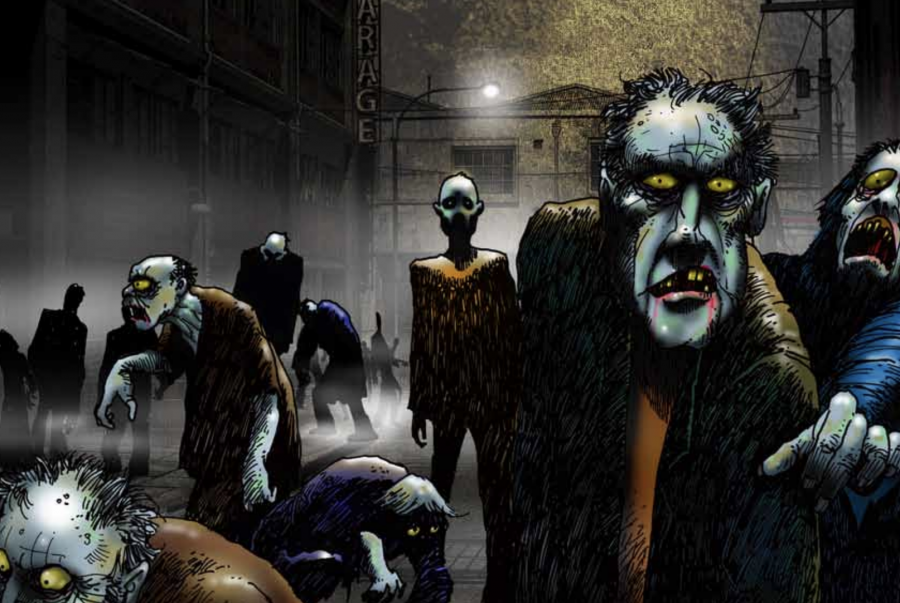
For keen observers of pop culture, the floodtide of zombie films and television series over the past several years has seemed like an especially ominous development. As social unrest spreads and increasing numbers of people are uprooted from their homes by war, climate catastrophe, and, now, COVID-related eviction, one wonders how advisable it might have been to prime the public with so many scenarios in which heroes must fight off hordes of infectious disease carriers? Zombie movies seem intent, after all, on turning not only the dead but also other living humans into objects of terror.
Zombies themselves have a complicated history; like many New World monsters, their origins are tied to slavery and colonialism. The first zombies were not flesh-eating cannibals; they were people robbed of freedom and agency by Voodoo priests, at least in legends that emerged during the brutal twenty-year American occupation of Haiti in the early 20th century. The first feature-length Hollywood zombie film, 1932’s White Zombie, was based on occultist and explorer William Seabrook’s 1929 book The Magic Island and starred Bela Lugosi as a Haitian Voodoo master named “Murder,” who enslaves the heroine and turns her into an instrument of his will.
Subtle the film is not, but no zombie film ever warranted that adjective. Zombie entertainment induces maximum fear of a relentless Other, detached, after White Zombie, from its Haitian context, so that the undead horde can stand in for any kind of invasion. The genre’s history may go some way toward explaining why the U.S. government has an official zombie preparedness plan, called CONOP 8888. The document was written in April 2011 by junior military officers at the U.S. Strategic Command (USSTRATCOM), as a training exercise to formulate a nonspecific invasion contingency plan.
Despite the use of a “fictitious scenario,” CONOP 8888 explicitly states that it “was not actually designed as a joke.” And “indeed, it’s not,” All that’s Interesting assures us, quoting the following from the plan’s introduction:
Zombies are horribly dangerous to all human life and zombie infections have the potential to seriously undermine national security and economic activities that sustain our way of life. Therefore having a population that is not composed of zombies or at risk from their malign influence is vital to U.S. and Allied National Interests.
Substitute “zombies” with any outgroup and the verbiage sounds alarmingly like the rhetoric of state terror. The plan, as you might expect, details a martial law scenario, noting that “U.S. and international law regulate military operations only insofar as human and animal life are concerned. There are almost no restrictions on hostile actions… against pathogenic life forms, organic-robotic entities, or ‘traditional’ zombies,’” whatever that means.
This all seems deadly serious, until we get to the reports’ subsections, which detail scenarios such as “Evil Magic Zombies (EMZ),” “Space Zombies (SZ),” “Vegetarian Zombies (VZ),” and “Chicken Zombies (CZ)” (in fact, “the only proven class of zombie that actually exists”). It’s fascinating to see a military document absorb the many comic permutations of the genre, from George Romero’s subversive satires to Pride and Prejudice and Zombies. No matter how funny zombies are, however, the genre seems to require horrific violence, gore, and siege-like survivalism as key thematic elements.

Tufts University professor Daniel W. Drezner, author of Theories of International Politics and Zombies, has read the Pentagon’s zombie plan closely and discovered some serious problems (and not only with its zombie classification system). While the plan assumes the necessity of “barricaded counter-zombie operations,” it also admits that “USSTRATCOM forces do not currently hold enough contingency stores (food, water) to support” such operations for even 30 days. “So… maybe 28 days later,” Drezner quips, supplies run out? (We’ve all seen what happens next….) Also, alarmingly, the plan is “trigger-happy about nuclear weapons,” adding the possibility of radiation poisoning to the likelihood of starving (or being eaten by the starving).
It turns out, then, that just as in so many modern zombie stories, the zombies may not actually be the worst thing about a zombie apocalypse. Not to be outdone, the CDC decided to capitalize on the zombie craze—rather late, we must say—releasing their own materials for a zombie pandemic online in 2018. These include entertaining blogs, a poster (above), and a graphic novel full of useful disaster preparedness tips for ordinary citizens. The campaign might be judged in poor taste in the COVID era, but the agency assures us, in the event of a zombie apocalypse, “Never Fear—CDC is Ready.” I leave it to you, dear reader, to decide how comforting this promise sounds in 2020.
Related Content:
Where Zombies Come From: A Video Essay on the Origin of the Horrifying, Satirical Monsters
How to Survive the Coming Zombie Apocalypse: An Online Course by Michigan State
Watch Night of the Living Dead, the Seminal Zombie Movie, Free Online
Josh Jones is a writer and musician based in Durham, NC. Follow him at @jdmagness
Read More...Steal Like Wes Anderson: A New Video Essay Explores How Wes Anderson Pays Artful Tribute to Alfred Hitchcock, Ingmar Bergman & Other Directors in His Films
Although not the debut film of director Wes Anderson, and certainly not of star Bill Murray, Rushmore introduced the world to the both of them. Anderson’s first feature Bottle Rocket (an expansion of the short film previously featured here on Open Culture) hadn’t found a particularly large audience upon its theatrical release in 1996. But quite a few of the viewers who had seen and appreciated it seemed to run in Murray’s circles, and in a 1999 Charlie Rose interview the actor told of being sent copy after unwatched copy by friends and professional contacts alive.
But Murray only needed to read a few pages of Anderson’s new script to understand that the young director knew what he was doing, and his abilities became even more evident on set. “I said, ‘What’s this shot we got?’ He goes, ‘Oh, it’s one I saw in Barry Lyndon.’ ” But in Rushmore it depicts “the intermission of the school play,” a full-fledged Kubrickian shot “coming past a lot of, you know, mothers and fathers going — jabbering, and all the way out past people buying Cokes and drinks.” Yes, “the good ones copy, the great ones steal,” but to Murray’s mind that saying “sort of sends a misdirection.”
Not to Anderson, however, whose rare combination of cinephilia and directorial skill have inspired him to make films both rich in cinematic homage and possessed of their own distinctive sensibility — a sensibility that let Murray break out of the standard goofball roles that had threatened to imprison him. In the video essay “Steal Like Wes Anderson,” Thomas Fight examines the now no-longer-young filmmaker’s more recent repurposing of the work of auteurs who came before. In 2014’s The Grand Budapest Hotel, for example, Anderson nearly remakes an entire scene from Torn Curtain, Alfred Hitchcock’s Cold-War thriller with Paul Newman and Julie Andrews that also happens to involve an eastern European hotel.
Anderson doesn’t simply lift Hitchcock’s shots but recomposes them to “fit within his more planometric and symmetrical style,” using the cinematic reference “to add to the experience of the story” and play with audience expectations. If you’ve seen Torn Curtain, you know how Newman’s character shakes the man tailing him; if you’ve seen The Grand Budapest Hotel, you know it doesn’t work out quite so well for Jeff Goldblum’s character. But only if you’ve seen both films can you appreciate Anderson’s sequence — and indeed, Hitchcock’s original — to the fullest. Even now, those of us excitedly anticipating the October release of Anderson’s latest feature The French Dispatch are speculating about not only which classic films inspired it, but also which classic films it will compel us to revisit and enjoy afresh.
Related Content:
A Glimpse Into How Wes Anderson Creatively Remixes/Recycles Scenes in His Different Films
Wes Anderson’s Cinematic Debt to Stanley Kubrick Revealed in a Side-By-Side Comparison
Based in Seoul, Colin Marshall writes and broadcasts on cities, language, and culture. His projects include the book The Stateless City: a Walk through 21st-Century Los Angeles and the video series The City in Cinema. Follow him on Twitter at @colinmarshall, on Facebook, or on Instagram.
Read More...Support Us
We're hoping to rely on loyal readers, rather than erratic ads. Please click the Donate button and support Open Culture. You can use Paypal, Venmo, Patreon, even Crypto! We thank you!

About Us

Open Culture scours the web for the best educational media. We find the free courses and audio books you need, the language lessons & educational videos you want, and plenty of enlightenment in between.
Advertise With Us

FREE UPDATES!
GET OUR DAILY EMAIL
Get the best cultural and educational resources on the web curated for you in a daily email. We never spam. Unsubscribe at any time.
FOLLOW ON SOCIAL MEDIA

Open Culture editor Dan Colman scours the web for the best educational media. He finds the free courses and audio books you need, the language lessons & movies you want, and plenty of enlightenment in between.
Advertise With Us


