What Voltaire Meant When He Said That “We Must Cultivate Our Garden”: An Animated Introduction
“Voltaire’s goal in writing [his 1759 satire Candide] was to destroy the optimism of his times,” says Alain de Botton in the School of Life video above, “an optimism that centered around science, love, technical progress, and a faith in reason.” These beliefs were folly, Voltaire thought: the transfer of faith from a providential God to a perfect, clockwork universe. Candide satirizes this happy rationalism in Doctor Pangloss, whose belief that ours is the best of possible worlds comes directly from the philosophical optimism of Gottfried Leibniz.
The preponderance of the evidence, Voltaire made abundantly clear in the novel’s series of increasingly horrific episodes, points toward a blind, indifferent universe full of needless cruelty and chaos. “Hope was, he felt, a disease,” de Botton says, and “it was Voltaire’s generous goal to try and cure us of it.” But as everyone who has read Candide (or read a summary or brief notes on Candide) knows, the novel does not end with despair, but on a “Stoic note.”
After enduring immense suffering on their many travels, Candide and his companions settle in Turkey, where they meet an old man sitting quietly under a tree. He tells them about his philosophy, how he abstains from politics and simply cultivates the fruits of his garden for market as his sole concern. Invited to feast with the man and his family, they remark upon the luxurious ease in which they live and learn that they do so on a fairly small plot of land.
Voltaire loved to goose his largely Christian readers and delighted in putting the novel’s parting wisdom, “arguably the most important adage in modern philosophy,” in the mouth of an Islamic character: Il faut cultiver notre jardin, “we must cultivate our garden.” What does this mean? De Botton interprets the line in the literal spirit with which the character known only as “the Turk” delivers it: we should keep a “safe distance between ourselves and the world.”
We should not, that is, become overly engaged in politics, and should devote ourselves to tending our own livelihood and welfare, not taking more than we need. We should leave our neighbors alone and not bother about what they do in their gardens. To be at peace in the world, Voltaire argued, we must accept the world as it is, not as we want it to be, and give up utopian ideas of societies perfected by science and reason. In short, to “tie our personal moods” to human affairs writ large is to invite endless misery.
The philosophy of Candide is not pessimistic or nihilistic. A happy, fulfilled human life is entirely possible, Voltaire suggests, if not human happiness in general. Candide has much in common with the ancient Roman outlook. But it might also express what could be seen as an early attempt at a secular Buddhist point of view. Voltaire was familiar with Buddhism, though it did not go by that name. Buddhists were lumped in, Donald S. Lopez, professor of Buddhist and Tibetan Studies at the University of Michigan, writes at the Public Domain Review, with the mass of “idolaters” who were not Christian, Jewish, or Muslim.
Yet the many Jesuit accounts of Eastern religion reaching Europe at the time circulated widely among intellectuals, including Voltaire, who wrote approvingly, though critically, of Buddhist tenets in his 1764 Dictionnaire philosophique. As the secular mindfulness movement has done in the 21st century, Lopez argues, Voltaire sought in the age of Enlightenment to separate miraculous legend from practical teaching. But like the Buddha, whose supposed biography Voltaire knew well, Candide begins his life in a castle. And the story ends with a man sitting quietly under a tree, more or less advising Candide to do what Voltaire had heard of in the “religion of the Siamese…. Meditate in private, and reflect often on the fragility of human affairs.”
Related Content:
An Animated Introduction to Voltaire: Enlightenment Philosopher of Pluralism & Tolerance
Voltaire: “Those Who Can Make You Believe Absurdities, Can Make You Commit Atrocities”
Philosophers Drinking Coffee: The Excessive Habits of Kant, Voltaire & Kierkegaard
Josh Jones is a writer and musician based in Durham, NC. Follow him at @jdmagness
Read More...The Philosophy of Photography with Amir Zaki on Pretty Much Pop: A Culture Podcast #61

Amir Zaki teaches at UC-Riverside and has had his work displayed in numerous galleries, in his recent book California Concrete: A Landscape of Skateparks, and profiled via a short film.
Amir joins your hosts Mark Linsenmayer, Erica Spyres, and Brian Hirt to consider this common act that can stretch from the mundane to the sublime. How have our various purposes for photography changed with the advent of digital technology, the introduction of social media, and the ready access to video? What determines what we choose to take pictures of, and how does taking photography more seriously change the way we experience? We touch on iconic and idealized images, capturing the specific vs. the universal, witnessing vs. intervening via photography, and more.
A few of the articles we looked at to prepare included:
- “Photography as Popular Culture” by Jonathan Green
- “Introduction to Photography: The Universal Language” by Spencer Cox
- “Amateur Vs. Pro: How Differently The Same ‘Ugly’ Location Looks When You Become A Professional Photographer” by Phillip Haumesser
- “15 Legendary Photographers You Should Know” by Marky Ramone Go
- “35 Powerful Photos that Tell a Story” from JotForm
- “WWII’s Most Iconic Kiss Wasn’t Romantic — It Was Terrifying” by Brooke L. Blower
- “You’ll Never See the Iconic Photo of the ‘Afghan Girl’ the Same Way Again” by Ribhu
Learn more at prettymuchpop.com. This episode includes bonus discussion that you can only hear by supporting the podcast at patreon.com/prettymuchpop. This podcast is part of the Partially Examined Life podcast network.
Follow Amir on Instagram @amir_zaki_.
Pretty Much Pop: A Culture Podcast is the first podcast curated by Open Culture. Browse all Pretty Much Pop posts
Read More...An Animated Introduction to Albert Camus’ Existentialism, a Philosophy Making a Comeback in Our Dysfunctional Times
When next you meet an existentialist, ask him what kind of existentialist s/he is. There are at least as many varieties of existentialism as there have been high-profile thinkers propounding it. Several major strains ran through postwar France alone, most famously those championed by Jean-Paul Sartre, Simone de Beauvoir, and Albert Camus — who explicitly rejected existentialism, in part due to a philosophical split with Sartre, but who nevertheless gets categorized among the existentialists today. We could, perhaps, more accurately describe Camus as an absurdist, a thinker who starts with the inherent meaningless and futility of life and proceeds, not necessarily in an obvious direction, from there.
The animated TED-Ed lesson above sheds light on the historical events and personal experiences that brought Camus to this worldview. Beginning in the troubled colonial Algeria of the early 20th-century in which he was born and raised, educator Nina Medvinskaya goes on to tell of his periods as a resistance journalist in France and as a novelist, in which capacity he would write such enduring works as The Stranger and The Plague. Medvinskaya illuminates Camus’ central insight with a well-known image from his earlier essay “The Myth of Sisyphus,” on the Greek king condemned by the gods to roll a boulder up a hill for all eternity.
“Camus argues that all of humanity is in the same position,” says Medvinskaya, “and only when we accept the meaninglessness of our lives can we face the absurd with our heads held high.” But “Camus’ contemporaries weren’t so accepting of futility.” (Here the Quentin Blake-style illustrations portray a couple of figures bearing a strong resemblance to Sartre and de Beauvoir.) Many existentialists “advocated for violent revolution to upend systems they believed were depriving people of agency and purpose.” Such calls haven’t gone silent in 2020, just as The Plague — one of Camus’ writings in response to revolutionary existentialism — has only gained relevance in a time of global pandemic.
Last month the Boston Review’s Carmen Lea Dege considered the recent comeback of the thought, exemplified in different ways by Camus, Sartre, and others, that “rejected religious and political dogma, expressed scorn for academic abstraction, and focused on the finitude and absurdity of human existence.” This resurgence of interest “is not entirely surprising. The body of work we now think of as existentialist emerged during the first half of the twentieth century in conflict-ridden Germany and France, where uncertainty permeated every dimension of society.” As much as our societies have changed since then, uncertainty has a way of returning.
Today “we define ourselves and others on the basis of class, religion, race, and nationality, or even childhood influences and subconscious drives, to gain control over the contingencies of the world and insert ourselves in the myriad ways people have failed and succeeded in human history.” But the existentialists argued that “this control is illusory and deceptive,” an “alluring distraction from our own fragility” that ultimately “corrodes our ability to live well.” For the existentialists, pursuit of good life first demands an acceptance of not just fragility but futility, meaninglessness, absurdity, and ambiguity, among other conditions that strike us as deeply unacceptable. As Camus put it, we must imagine Sisyphus happy. But can we?
Related Content:
The Absurd Philosophy of Albert Camus Presented in a Short Animated Film by Alain De Botton
The Meaning of Life According to Simone de Beauvoir
Based in Seoul, Colin Marshall writes and broadcasts on cities, language, and culture. His projects include the Substack newsletter Books on Cities, the book The Stateless City: a Walk through 21st-Century Los Angeles and the video series The City in Cinema. Follow him on Twitter at @colinmarshall, on Facebook, or on Instagram.
Read More...The Liberal Arts Can Make People Less Susceptible to Authoritarianism, a New Study Finds
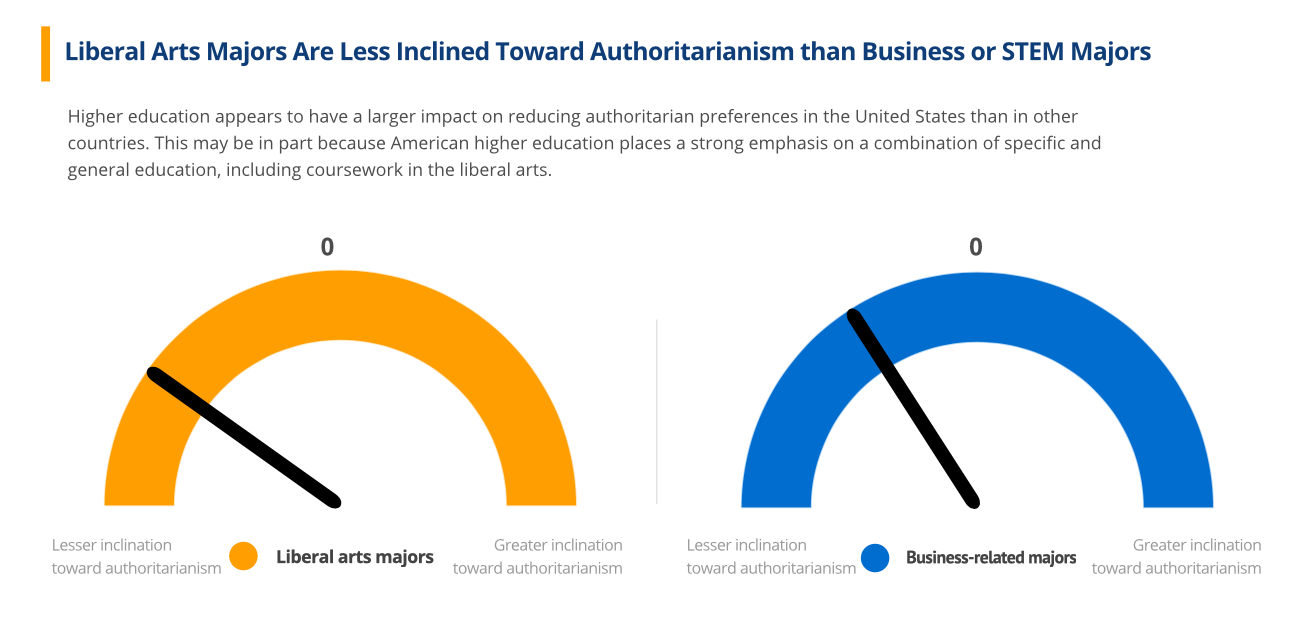
“Correlation does not equal causation” isn’t always a fun thing to say at parties, but it is always a good phrase to keep in mind when approaching survey data. Does the study really show that? Might it show the opposite? Does it confirm pre-existing biases or fail to acknowledge valid counterevidence? A little bit of critical thinking can turn away a lot of trouble.
I’ll admit, a new study, “The Role of Education in Taming Authoritarian Attitudes,” confirms many of my own biases, suggesting that higher education, especially the liberal arts, reduces authoritarian attitudes around the world. The claim comes from Georgetown University’s Center on Education and the Workforce, which analyzed and aggregated data from World Values Surveys conducted between 1994 and 2016. The study takes it for granted that rising authoritarianism is not a social good, or at least that it poses a distinct threat to democratic republics, and it aims to show how “higher education can protect democracy.”
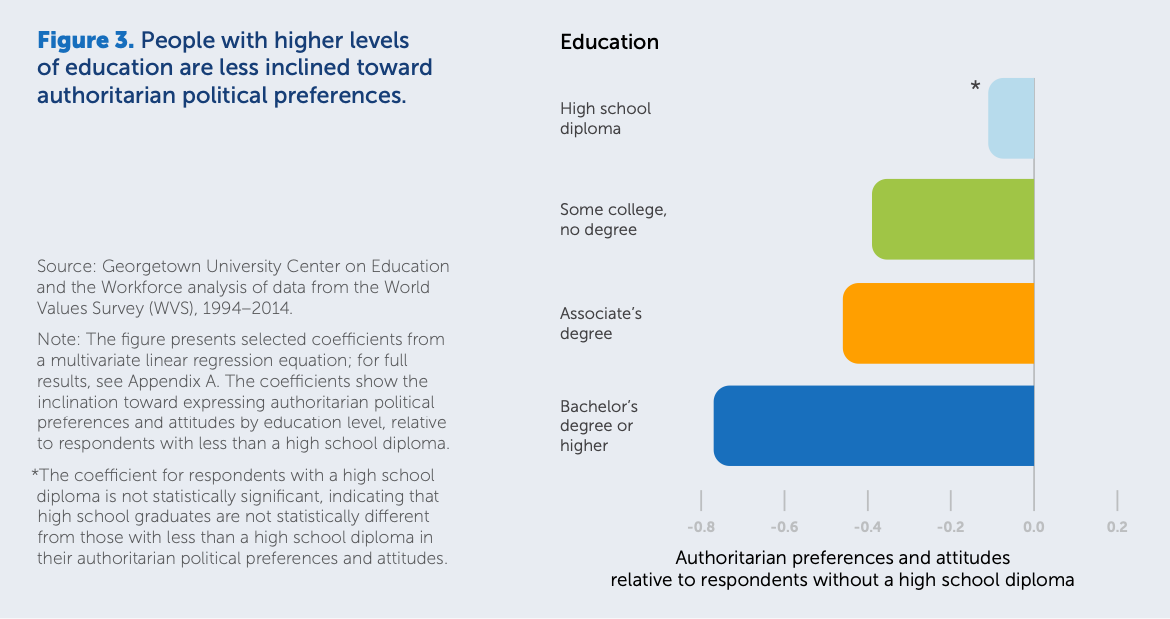
Authoritarianism—defined as enforcing “group conformity and strict allegiance to authority at the expense of personal freedoms”—seems vastly more prevalent among those with only a high school education. “Among college graduates,” Elizabeth Redden writes at Inside Higher Ed, “holders of liberal art degrees are less inclined to express authoritarian attitudes and preferences compared to individuals who hold degrees in business or science, technology, engineering and mathematics fields.”
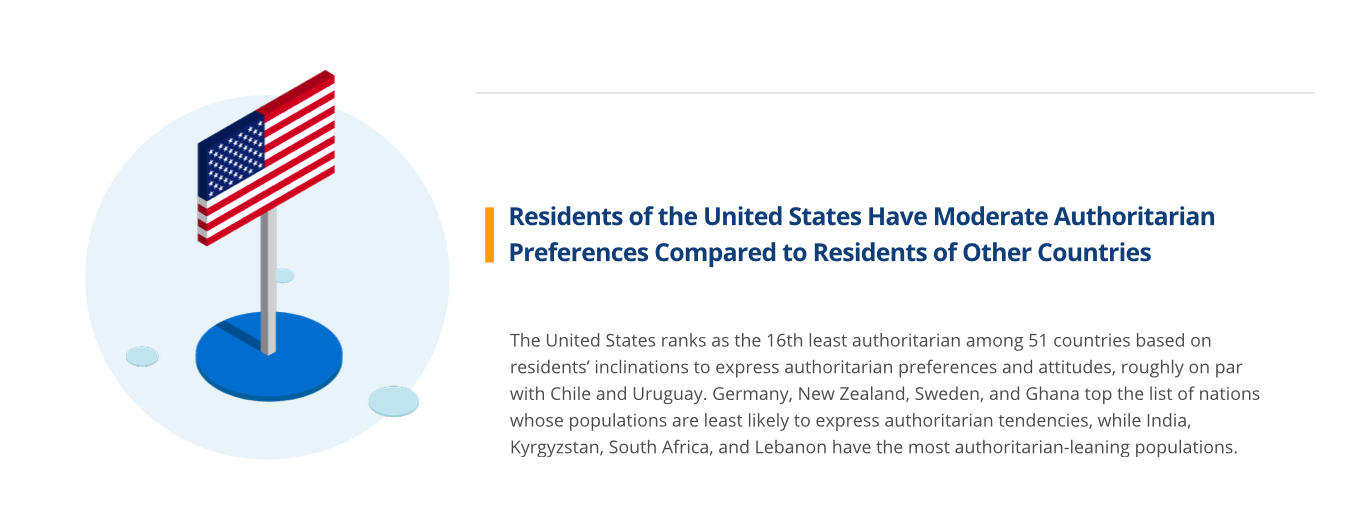
The “valuable bulwark” of the liberal arts seems more effective in the U.S. than in Europe, perhaps because “American higher education places a strong emphasis on a combination of specific and general education,” the full report speculates. “Such general education includes exposure to the liberal arts.” The U.S. ranks at a moderate level of authoritarianism compared to 51 other countries, on par with Chile and Uruguay, with Germany ranking the least authoritarian and India the most—a 6 on a scale of 0–6.
Higher education also correlates with higher economic status, suggesting to the study authors that economic security reduces authoritarianism, which is expressed in attitudes about parenting and in a “fundamental orientation” toward control over autonomy.
The full report does go into greater depth, but perhaps it raises more questions than it answers, leaving the intellectually curious to work through a dense bibliography of popular and academic sources. There is a significant amount of data and evidence to suggest that studying the liberal arts does help people to imagine other perspectives and to appreciate, rather than fear, different cultures, religions, etc. Liberal arts education encourages critical thinking, reading, and writing, and can equip students with tools they need to distinguish reportage from pure propaganda.
But we might ask whether these findings consistently obtain under actually existing authoritarianism, which “tends to arise under conditions of threat to social norms or personal security.” In the 2016 U.S. election, for example, the candidate espousing openly authoritarian attitudes and preferences, now the current U.S. president, was elected by a majority of voters who were well-educated and economically secure, subsequent research discovered, rather than stereotypically “working class” voters with low levels of education. How do such findings fit with the data Georgetown interprets in their report? Is it possible that those with higher education and social status learn better to hide controlling, intolerant attitudes in mixed company?
Learn more at this report summary page here and read and download the full report as a PDF here.
Related Content:
Why We Need to Teach Kids Philosophy & Safeguard Society from Authoritarian Control
Critical Thinking: A Free Course
Josh Jones is a writer and musician based in Durham, NC. Follow him at @jdmagness
Read More...Is Mail-In Voting New in the United States?: It Actually Goes Back to the Civil War
Let’s say you go home for the holidays. Anything’s possible, who knows. It’s a wild world. Let’s say you get there and someone starts laying on you that trip about how Q Continuum said mail-in voting was orchestrated by satanic cables from Anarchist HQ. Let’s say you overhear something more down-to-earth, like how if mail-in voting happens, billions of people will vote illegally… even more people than live in the country, which is how you’ll know….
Maybe you’ll want to speak up and say, hey I know something about this topic, except then maybe you realize you don’t actually know much, but you know something ain’t right with this talk and maybe it’s probably good to have a functioning Postal Service and maybe people should be able to vote. In such situations (who can say how often these things happen), you might wish to have a little information at the ready, to educate yourself and share with others.
You might share information about how mail-in voting has been around since 1775. It has worked pretty well at scale since “about 150,000 of the 1 million Union soldiers were able to vote absentee in the 1864 presidential election in what became the first widespread use of non-in person voting in American history,” Alex Seitz-Wald explains at NBC News. Since the federal government has managed to make mail-in voting work for soldiers serving away from home for over 150 years, “it’s now easier in some ways for a Marine in Afghanistan to vote than it is for an American stuck at home during the COVID-19 lockdown.”
“Some part of the military has been voting absentee since the American Revolution,” Donald Inbody, former Navy Captain turned political science professor at Texas State University, tells NBC News. Inbody refers to one of the first documented instances, when Continental Army soldiers voted in a town meeting by proxy in New Hampshire. But history is complicated, and “mail-in voting has worked just fine so shut up” needs some nuance.
In the very same election in which 150,000 Union soldiers mailed their ballots, Lincoln urged Sherman to send troops stationed in Democratic-controlled Indiana—which had banned absentee voting—back to their home states so that they could vote. The practice has always had its vocal critics and suffered accusations of fraud from all sides, though little evidence seems to have emerged. Absentee voting helped win the Civil War, Blake Stilwell argues at Military.com, in spite of a conspiracy theory alleging fraud that might have unseated Lincoln.
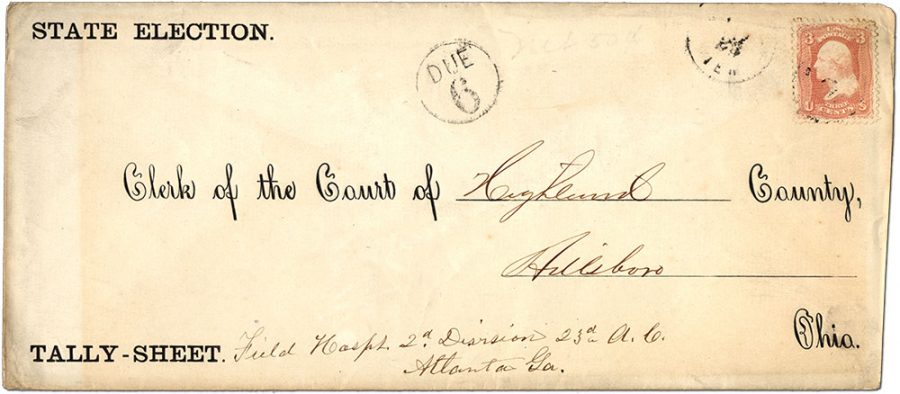
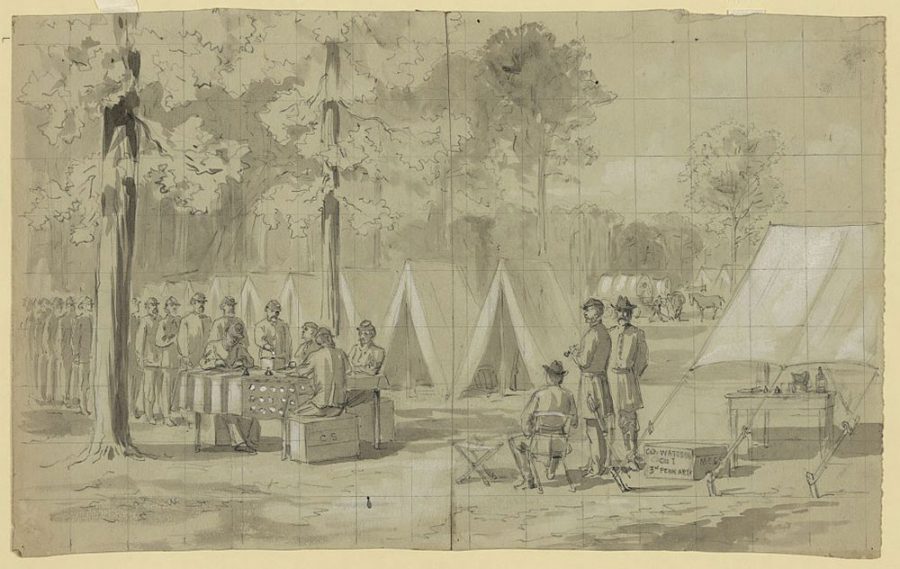
There are several remnants from the time of careful record-keeping, like the pre-printed envelope above that “contained a tally sheet of votes from the soldiers of Highland County the Field Hospital 2nd Division 23rd Army Corps,” notes the Smithsonian National Postal Museum. (The drawing at the top shows Pennsylvania soldiers voting in 1864.) And this is all fascinating stuff. But soldiers are actually absent, which is why they vote absentee, right? I mean, if you’re at home, why can’t you just go to the polling place in the global pandemic in your city that closed all the polling places?
It’s true that civilian mail-in voting often works differently from military absentee voting. While every state offers some version, some restrict it to voters temporarily out of state or suffering an illness. Currently, only “30 states have adopted ‘no-excuse absentee balloting,’ which allows anyone to request an absentee ballot,” Nina Strochlic reports at National Geographic. State laws vary further among those 30.
“In 2000,” for example, “Oregon became the first state to switch to fully vote-by-mail elections.” Things have rapidly changed, however. “In the face of the coronavirus pandemic, voters in every state but Mississippi and Texas were allowed to vote by mail or by absentee ballot in this year’s primaries.” If you live in the U.S. (or outside it) and don’t know what happened next… bless you. It involves defunding the post office instead of the police.
Voting by mail has expanded to meet major crises throughout history, says Alex Keyssar, history professor at the Kennedy School of Government at Harvard. “That’s the logical trajectory” and “we are not in normal times.” If a highly infectious disease that has killed at least 200,000 Americans on top of ongoing voter suppression and an election security crisis and massive civil unrest and economic turmoil aren’t reasons enough to expand the vote-by-mail franchise to every state, I couldn’t say what is.
Should only soldiers have the ability to vote easily? I imagine someone might say YES, loudly over the centerpiece, because voting is a privilege not a right!
You, empowered purveyor of accurate information, understander of absentee voting history, change-maker, will pull out your pocket Constitution and ask someone to find the word “privilege” in amendments that start with “The right of citizens of the United States to vote shall not be denied or abridged by the United States or by any State,” etc. That’ll show ’em. But if the gambit fails to impress, you’ve still got a better understanding of why voting by mail may not be one of the signs of the end times.
Related Content:
Take The Near Impossible Literacy Test Louisiana Used to Suppress the Black Vote (1964)
Three Public Service Announcements by Frank Zappa: Vote, Brush Your Teeth, and Don’t Do Speed
Sal Khan & the Muppets’ Grover Explain the Electoral College
Josh Jones is a writer and musician based in Durham, NC. Follow him at @jdmagness
Read More...30 Buster Keaton Films: “The Greatest of All Comic Actors,” “One of the Greatest Filmmakers of All Time”
The greatest of the silent clowns is Buster Keaton, not only because of what he did, but because of how he did it. —Roger Ebert
In 1987, Video magazine published a story titled “Where’s Buster?” lamenting the lack of Buster Keaton films available on videotape, “despite renewed interest” in a legend who was “about to regain his rightful place next to Chaplin in silent comedy’s pantheon.” How things have changed for Keaton fans and admirers. Not only are most of the stone-faced comic genius’ films available online, but he has maybe eclipsed Chaplin as the most popularly revered silent film star of the 1920s.
Keaton has always been held in the highest esteem by his fellow artists. He was dubbed “the greatest of all the clowns in the history of the cinema” by Orson Welles, and served as a significant inspiration for Samuel Beckett. (He was the playwright’s first choice to play Waiting for Godot’s Lucky, though he was too perplexed by the script to take the role). In Peter Bogdanovich’s new documentary, The Great Buster: A Celebration, Mel Brooks and Carl Reiner discuss his foundational influence on their comedy, and Werner Herzog calls him “the essence of movies.”
For many years, however, the state of Keaton’s filmography made it hard for the general public to fully appraise his work. “The General, with Buster as a train engineer in the Civil War, has always been available,” Roger Ebert wrote in 2002, and has been “hailed as one of the supreme masterpieces of silent filmmaking. But other features and shorts existed in shabby, incomplete prints, if at all, and it was only in the 1960s that film historians began to assemble and restore Keaton’s lifework. Now almost everything has been recovered, restored, and is available on DVDs and tapes that range from watchable to sparkling.”
Access to Keaton’s films has further expanded as a dozen or so entered the public domain in recent years, including two features, Sherlock, Jr. and The Navigator, this year and three more to come in 2021. You can watch thirty-one of Keaton’s restored, recovered films on YouTube, at the links below, shared by MetaFilter user Going to Maine, who writes, “where, oh where, in this modern world, can we find the gems of his golden era? The obvious place.”
Keaton starred in his first feature-length film, The Saphead, in 1920. For the next decade, until the end of the silent era, he dominated the box office, alongside Chaplin and Harold Lloyd, with his canny blend of daredevil slapstick and everyman pathos. After the twenties, his career floundered, then rebounded. His last picture was a return to silent film in Beckett’s 1966 short, “Film,” made the year of his death. Since then, Keaton appreciation has become almost a form of worship.
In 2018, The General came in at number 34 on Sight & Sound’s Greatest Films of All Time list. But the BFI’s Geoff Andrew argued that it deserved the top spot, and Keaton deserves recognition as “not merely the greatest of the silent comedians,” but “the greatest of all comic actors to have appeared on the silver screen… not only a great American filmmaker of the silent era,” but “one of the greatest filmmakers of all time, anywhere.” Andrew likens him to a god, but “unlike gods… Buster has the advantage of being able to make us laugh. And laugh. And laugh.”
Don’t we all need a steady supply of that medicine these days? See Keaton’s classic silent comedy The General further up and watch 29 more Keaton films at the links below. Many will be added to our collection, 4,000+ Free Movies Online: Great Classics, Indies, Noir, Westerns, Documentaries & More.
Short Films
One Week (September 1, 1920)
Convict 13 (October 27, 1920)
Neighbors (December 22, 1920)
The Scarecrow (December 22, 1920)
The Haunted House (February 10, 1921)
Hard Luck (March 14, 1921)
The High Sign (April 12, 1921)
The Goat (May 18, 1921)
The Playhouse (October 6, 1921) (This contains a faux minstrel show segment with blackface.)
The Boat (November 10, 1921)
The Paleface (January, 1922) (Racist depictions of Native Americans)
Cops (March, 1922)
My Wife’s Relations (May, 1922)
The Blacksmith (July 21, 1922)
The Frozen North (August 28, 1922)
The Electric House (October, 1922)
Day Dreams (November, 1922)
The Balloonatic (January 22, 1923)
The Love Nest (March, 1923)Features
Three Ages (September 24, 1923)
Our Hospitality (November 19, 1923)
Sherlock Jr. (May 11, 1924)
The Navigator (October 13, 1924)
Seven Chances (March 15, 1925)
Go West (November 1, 1925)
Battling Butler (September 19, 1926)
The General (December 31, 1926)
College (November 1927)
Steamboat Bill, Jr. (May 20, 1928)Bonus! Two of Keaton’s Last Films
The Railrodder, for the National Film Board of Canada (October 2, 1965)
Film, directed by Samuel Beckett (January 8, 1965)
Related Content:
A Supercut of Buster Keaton’s Most Amazing Stunts
Buster Keaton: The Wonderful Gags of the Founding Father of Visual Comedy
List of Great Public Domain Films
Josh Jones is a writer and musician based in Durham, NC. Follow him at @jdmagness
Read More...How Bong Joon-ho’s Storyboards for Parasite (Now Published as a Graphic Novel) Meticulously Shaped the Acclaimed Film
In Seoul, where I live, the success of Bong Joon-ho’s Parasite at this year’s Academy Awards — unprecedented for a non-American film, let alone a Korean one — did not go unnoticed. But even then, the celebration had already been underway at least since the movie won the Palme d’Or at Cannes. Something of a homecoming for Bong after Snowpiercer and Okja, two projects made wholly or partially abroad, Parasite takes place entirely in Seoul, staging a socioeconomic grudge match between three families occupying starkly disparate places in the human hierarchy. The denouement is chaotic, but arrived at through the precision filmmaking with which Bong has made his name over the past two decades.
When Parasite’s storyboards were published in graphic-novel form here a few months ago, I noticed ads in the subway promising a look into the mind of “Bongtail.” Though Bong has publicly declared his contempt for that nickname, it has nevertheless stuck as a reflection of his meticulous way of working.
The son of a graphic designer, he grew up not just watching movies but drawing comics, a practice that would later place him well to create his own storyboards. In so doing he assembles an entire film in his mind before shooting its first frame (a working process not dissimilar to that of Western filmmakers like the Coen brothers), which enables him and his collaborators to execute complex sequences such as what the Nerdwriter calls Parasite’s “perfect montage.”
With the English translation of Parasite: A Graphic Novel in Storyboards now available, video essayists like Thomas Flight have made comparisons between Bong’s drawings and the film. Starting with that celebrated montage, Flight shows that, where the final product departs from its plan, it usually does so to simplify the hand-drawn action, making it more legible and elegant. In the short video just above, you can watch one minute of Parasite lined up with its corresponding storyboard panels, one of which incorporates a photograph of the real Seoul neighborhood in which Bong located the main characters’ home. This is rich storyboarding indeed, but in his introduction to the book, Bong explains that he doesn’t consider it essential to filmmaking, just essential to him: “I actually storyboard to quell my own anxiety.” Would that we could all draw worldwide acclaim from doing the same.
Related Content:
Martin Scorsese Introduces Filmmaker Hong Sangsoo, “The Woody Allen of Korea”
Watch More Than 400 Classic Korean Films Free Online Thanks to the Korean Film Archive
How the Coen Brothers Storyboarded Blood Simple Down to a Tee (1984)
Based in Seoul, Colin Marshall writes and broadcasts on cities, language, and culture. His projects include the Substack newsletter Books on Cities, the book The Stateless City: a Walk through 21st-Century Los Angeles and the video series The City in Cinema. Follow him on Twitter at @colinmarshall, on Facebook, or on Instagram.
Read More...Ruth Bader Ginsburg’s Favorite Opera Recordings (and Her First Appearance in an Opera)
U.S. Supreme Court justice Ruth Bader Ginsburg’s death has thrown an unbearably fraught political year into further disarray, a fact that has sadly overshadowed memorialization of her inspiring life and career. Ginsburg was a personal hero for millions of activists and students—from grade school to law school; an icon casually identified by her initials by those who felt like they knew her. “For many women, and many girls,” Sheryl Gay Stolberg writes in a New York Times tribute, her loss is “deeply personal.”
How should we remember such a figure at such a time? If you happen to find the news numbing, full of enervating rancor and alarm…. If you want to bring the focus back to the person we have lost, might we suggest a soundtrack? The suggestions come from Ginsburg herself, from the art form—opera—closest to her heart. “She was our greatest advocate and our greatest spokesperson,” says Francesca Zambello, director of the Washington National Opera, “the ideal attendee… who knows everything but is open to interpretations.”
Ginsburg’s commitment to the opera spans decades. She and her husband Marty were in the audience when Leontyne Price made her debut at the Met in 1961. Forty-seven years later, the Justice had occasion to honor Pryce at a 2008 National Endowment for the Arts luncheon. Also in attendance: Antonin Scalia, Ginsburg’s notorious rival. The only thing the two may have agreed on was a passion for the opera. It formed the basis of a fragile peace, and the subject of its own opera, Scalia v. Ginsburg, that explores extreme judicial differences through “Verdi, Puccini, Christmas carols, ‘The Star-Spangled Banner,’ and jazz.”
Scalia v. Ginsberg composer Derrick Wang heard the grandiosity of opera when he read the fiercely opposing written opinions of the two justices. It’s safe to assume that both were listening to their favorite works while they composed. In 2012, Ginsburg gave her list of favorites to Alex Ross at The New Yorker, who points to other Ginsburg connections to the classical world like her son, James Ginsburg, “proprietor of Cedille Records, an independent classical label based in Chicago.” (Read their statement on Ginsburg’s passing here.)
There is far too much to say about Ruth Bader Ginsburg’s judicial influence, and about the power vacuum left behind by her loss. But if we want to understand what mattered to her most as an individual, we should turn to the music she most loved. “Her life was about understanding people’s stories,” says Zambello. The kinds of cases “she made her career of are the stuff of opera.” At the top, see Ginsburg’s first appearance onstage, in a non-singing role as the Duchess of Krakenthorpe in the The Daughter of the Regiment at the Kennedy Center. Just below, see her list of favorite works, peppered with occasional commentary from the late, beloved R.B.G. herself. This list originally comes from The New Yorker. If you have a Spotify account, you can stream the music in this 30-hour playlist.
Verdi, “Aida”; Zinka Milanov, Jussi Björling, Leonard Warren, Fedora Barbieri, Boris Christoff, Jonel Perlea conducting the Rome Opera Orchestra and Chorus (RCA).
Verdi, “Otello”; Plácido Domingo, Renata Scotto, Sherrill Milnes, James Levine conducting the National Philharmonic and Ambrosian Opera Chorus (RCA).
Dvořák, “Rusalka”; Renée Fleming, Ben Heppner, Dolora Zajick, Franz Hawlata, Charles Mackerras conducting the Czech Philharmonic and Kühn Mixed Choir (Decca).
Handel, “Julius Caesar”; Norman Treigle, Beverly Sills, Maureen Forrester, Beverly Wolff, Julius Rudel conducting the New York City Opera Orchestra and Chorus (RCA).
Justice Ginsburg comments: “Listened to LP recording many times. Production was Julius Rudel’s triumph, opened in the State Theatre the year the Met moved to Lincoln Center. Met opened with the not at all triumphant production of Barber’s ‘Antony and Cleopatra.’ Next, my two best-loved operas.”
Mozart, “Don Giovanni”; Cesare Siepi, Fernando Corena, Suzanne Danco, Lisa Della Casa, Anton Dermota, Hilde Gueden, Walter Berry, Kurt Böhme, Josef Krips conducting the Vienna Philharmonic and Vienna State Opera Chorus (Decca).
Mozart, “The Marriage of Figaro”; Samuel Ramey, Lucia Popp, Thomas Allen, Kiri Te Kanawa, Frederica von Stade, Kurt Moll, Robert Tear, Georg Solti conducting the London Philharmonic and London Opera Chorus (Decca).
Strauss, “Der Rosenkavalier”; Elisabeth Schwarzkopf, Christa Ludwig, Teresa Stich-Randall, Otto Edelmann, Eberhard Wächter, Ljuba Welitsch, Nicolai Gedda, Herbert von Karajan conducting the Philharmonia Orchestra and Chorus (EMI).
Tchaikovsky, “Eugene Onegin”; Thomas Allen, Mirella Freni, Neil Shicoff, Anne Sofie von Otter, James Levine conducting the Dresden Staatskapelle and Leipzig Radio Chorus (DG).
Puccini, “Tosca”; Maria Callas, Giuseppe Di Stefano, Tito Gobbi, Victor de Sabata conducting the La Scala orchestra and chorus (EMI).
Menotti, “The Medium”; Joyce Castle, Patrice Michaels, Lawrence Rapchak conducting the Chicago Opera Theatre (Cedille).
Kurka, “The Good Soldier Schweik”; Jason Collins, Marc Embree, Kelli Harrington, Buffy Baggott, Alexander Platt conducting the Chicago Opera Theatre (Cedille).
Justice Ginsburg comments: “Glimmerglass Opera later mounted ‘Schweik’ with perfect-for-the-part Anthony Dean Griffey.”
Stravinsky, “The Rake’s Progress”; Philip Langridge, Samuel Ramey, Cathryn Pope, Stafford Dean, Sarah Walker, John Dobson, Astrid Varnay, Riccardo Chailly conducting the London Sinfonietta and Chorus (Decca).
Britten, “Billy Budd”; Nathan Gunn, Ian Bostridge, Gidon Saks, Daniel Harding conducting the London Symphony Orchestra and Chorus (Virgin Classics).
Justice Ginsburg comments: “Two Lieder recordings I now and then play when working at home: **Schubert, ‘An mein Herz,’ with Matthias Goerne; and songs by Brahms, with Angelika Kirchschlager.”
Related Content:
Acclaimed Ruth Bader Ginsburg Documentary, RBG, Airing Tonight on CNN
The Opera Database: Find Scores, Libretti & Synopses for Thousands of Operas Free Online
Josh Jones is a writer and musician based in Durham, NC. Follow him at @jdmagness
Read More...Blockbuster Courses on the U.S. Presidential Election Getting Started at Stanford Continuing Studies This Week

This fall, Stanford Continuing Studies presents 150+ courses in the Liberal Arts & Sciences, Creative Writing, and Professional Development, including two major courses on the U.S. presidential election. Taught by Pamela Karlan (Stanford law professor) and James Steyer (CEO, Common Sense Media), Election 2020: A Panoramic View of America’s Decisive Election will feature a lineup of distinguished guest speakers–from Bill Clinton and Kara Swisher, to Steve Schmidt, David Plouffe and Andrew Yang. The other course focuses on Technology and the 2020 Election: How Silicon Valley Technologies Impact Our Elections and Shape Our Democracy. Taught by professor Rob Reich and Dutch politician Marietje Schaake, the course will feature visits from Roger McNamee, (author of Zucked: Waking Up to the Facebook Catastrophe), Alex Stamos (Former Chief Security Officer, Facebook), Shoshana Zuboff, (Harvard author of The Age of Surveillance Capitalism), Michael McFaul (former ambassador to Russia), and more.
These live online courses are open to adults. Although the courses aren’t free, they’re timely and bound to engage. Election 2020 starts today. Technology and the 2020 Election starts on Wednesday. Explore the entire Continuing Studies catalogue here.
Note: High school students can also enroll in both of these election courses. To explore that opportunity, follow these links:
Election 2020: A Panoramic View of America’s Decisive Election
Read More...If Werner Herzog Reviewed Trader Joe’s on Yelp: “Madness Reigns. The First Challenge Your Soul Must Endure Is the Parking Lot”
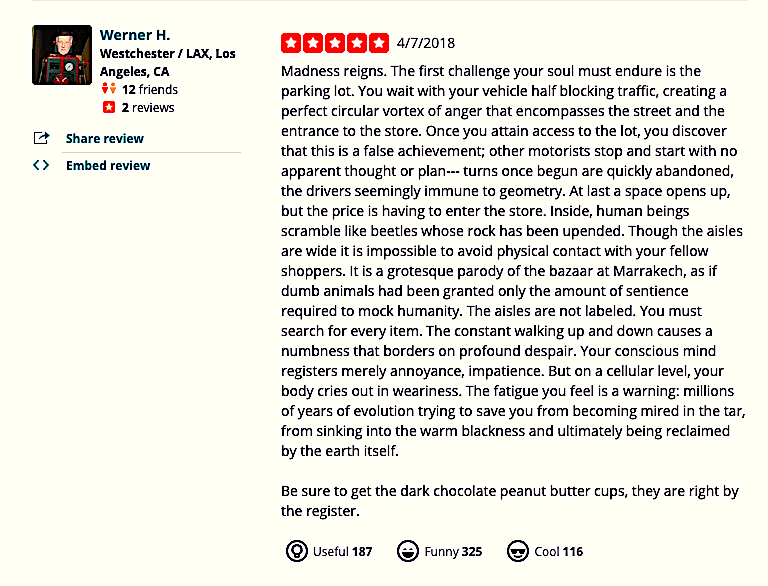
I like the Internet for various things, but it’s limited. I’m not on social media, but you will find me in the social media. There’s Facebook, there’s Twitters, but it’s all not me.
—Werner Herzog in an interview with The Hollywood Reporter
The night before his 2016 documentary Lo and Behold: Reveries of the Connected World premiered at Sundance, director Werner Herzog declared himself “still a liberated virgin” with regard to his reliance on the Internet:
I think we have to abandon this kind of false security that everything is settled now, that we have so much assistance by digital media and robots and artificial intelligence. At the same time, we overlook how vulnerable all this is, and how we are losing the essentials that make us human. That’s my advice … Cook a meal at least three times a week. Play a musical instrument. Read books and travel on foot.
That said, he’s not immune to the rejuvenating effects of random cat videos at the end of a tiring day, as he told Studio 360’s Kurt Andersen during a promotional visit for 2018’s Meeting Gorbachev:
Perhaps guessing that Googling his own name is not one of Herzog’s preferred online activities, Anderson took the opportunity to hip his guest to comedian Paul F. Tompkins’ Teutonic-inflected recitation of a notorious Yelp review of Trader Joe’s in Silver Lake.
To the untrained ear, Tompkins’ Herzog is pitch perfect.
The spoof’s subject suggested that the accent could use improvement, but agreed that the text is “very funny.”
And it is, especially given the pedestrian tenor of the same Trader Joe’s other 5‑star reviews:
This is the best Trader Joe’s location I’ve been to! Been coming here since I was a kid! (I’m 25 now) I’ve moved out of this area but still come to this location just because it beats the rest of them. — Debbie G
TJ is the best!! I’ve been coming here for many years, and the food is great!! The employee’s are awesome! Some of the many things I love to purchase here are: salmon balls, smoothies like the chia seed strawberry, protein almond butter drinks, coconut smoothie, cashew yogurt, south western salad that comes in a bag is BOMB.COM! — Raymond M
Tompkins tapped Herzog’s fascination with man’s animal nature and the brutality of existence for another Yelp review, awarding three stars to San Francisco’s Hotel Majestic and attributing it to Werner H:
Tompkins clearly savors the opportunity to channel Herzog, logging 16 appearances for the character on the Comedy Bang Bang podcast, including episodes wherein he discusses working with Tom Cruise and his desire to be cast as a clueless suburban husband in an appliance commercial. Find them all listed here.
Related Content:
Werner Herzog Creates Required Reading & Movie Viewing Lists for Enrolling in His Film School
Werner Herzog Offers 24 Pieces of Filmmaking and Life Advice
Ayun Halliday is an author, illustrator, theater maker and Chief Primatologist of the East Village Inky zine. Follow her @AyunHalliday.
Read More...Support Us
We're hoping to rely on loyal readers, rather than erratic ads. Please click the Donate button and support Open Culture. You can use Paypal, Venmo, Patreon, even Crypto! We thank you!

About Us

Open Culture scours the web for the best educational media. We find the free courses and audio books you need, the language lessons & educational videos you want, and plenty of enlightenment in between.
Advertise With Us

FREE UPDATES!
GET OUR DAILY EMAIL
Get the best cultural and educational resources on the web curated for you in a daily email. We never spam. Unsubscribe at any time.
FOLLOW ON SOCIAL MEDIA

Open Culture editor Dan Colman scours the web for the best educational media. He finds the free courses and audio books you need, the language lessons & movies you want, and plenty of enlightenment in between.
Advertise With Us

