Download Classic Works of Plague Fiction: From Daniel Defoe & Mary Shelley, to Edgar Allan Poe
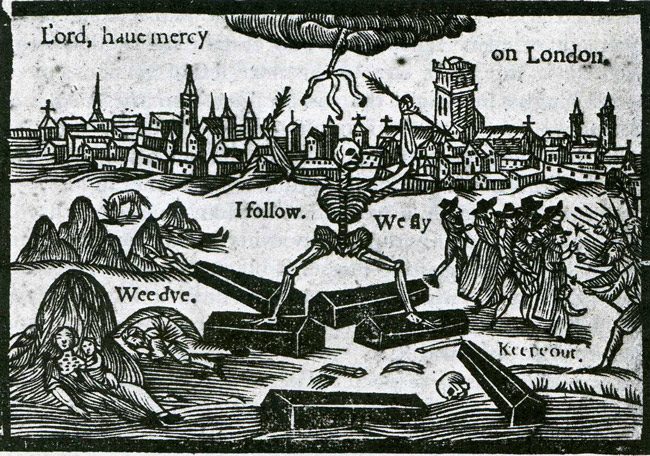
The apotheosis of prestige realist plague film, Steven Soderburgh’s 2011 Contagion, has become one of the most popular features on major streaming platforms, at a time when people have also turned increasingly to books of all kinds about plagues, from fantasy, horror, and science fiction to accounts that show the experience as it was in all its ugliness—or at least as those who experienced it remembered the events. Such a work is Daniel Defoe’s semi-fictional history “A Journal of the Plague Year,” a book he wrote “in tandem with an advice manual called ‘Due Preparations for the Plague,’ in 1722,” notes Jill Lepore at The New Yorker.
In 1722, Defoe had reason to believe the plague might come back to London, and wreak the devastation it caused in 1665, the “plague year” he detailed, when one in every five Londoners died. This was not a story of heroes making sacrifices to save the city. “Everyone behaved badly, though the rich behaved the worst,” Lepore writes. “Having failed to heed warnings to provision, they sent their poor servants out for supplies,” spreading the infection throughout the city. Defoe earnestly hoped to head off such catastrophe. He wrote to issue an admonition, as he put it, “both to us and to posterity, though we should be spared from that portion of this bitter cup.”
The cup, Lepore writes, “has come out of its cupboard.” But so too has the resilience found in Albert Camus’ 1946 novel Le Peste (The Plague), based on a real cholera outbreak in Algeria in 1849. Though fictional, it draws on Camus’ study of historical plagues and his experience as a member of the French Resistance. Camus seems to have found the plague as metaphor particularly uplifting, nicknaming his twins Catherine and Jean, “Plague” and “Cholera,” respectively.
Whether we see it as a story of a siege brought on by sickness, or an allegory of an occupation, Camus wrote of the novel that “the inhabitants, finally freed, would never forget the difficult period that made them face the absurdness of their existence and the precariousness of the human condition. What’s true of all the evils in the world is true of plagues as well. It helps men to rise above themselves.” Defoe might disagree, but plagues in his time were not also accompanied by widespread Nazism, a double crisis that might doubly force us to “reflect on what is real, what is important, and become more human,” says Catherine Camus of the soaring new popularity of her father’s novel.
We can do this through reading in our real-life quarantine. “Reading is an infection,” Lepore writes, “a burrowing into the brain: books contaminate, metaphorically, and even microbiologically” as physical objects capable of ferrying germs. Plagues are mass-existential crises on the level of WWII or the Lisbon earthquake that shook the faith of Europe’s intellectuals. They are also settings for love and terror, from Boccaccio and Gabriel Garcia Marquez to Edgar Allan Poe and Margaret Atwood.
Vulture has published an “essential list” of 20 plague books to read, including many of the classics mentioned above, and a book that is hardly remembered but might be thought of as an ancestor to Atwood’s plague-ridden futures: Mary Shelley’s The Last Man, published in 1826 during the second of two virulent cholera pandemics. In the novel, Shelley claims to have discovered the story in prophetic writing about the end of the 21st century, telling of a disease that wipes out the human race. If you’d rather not indulge that kind of fantasy just yet, you’ll find varying degrees of imaginative and soberly realist fiction and history in the list of plague classics below, all freely available at Project Gutenberg.
A Journal of the Plague Year by Daniel Defoe
History of the Plague in London by Daniel Defoe
Loimologia: or, an Historical Account of the Plague in London in 1665 by Hodges et al.
The Last Man by Mary Wollstonecraft Shelley
The Masque of the Red Death by Edgar Allan Poe
The Decameron of Giovanni Boccaccio
A History of Epidemics in Britain by Charles Creighton
A History of Epidemics in Britain, Volume II
An account of the plague which raged at Moscow, in 1771 by Charles de Mertens
Cherry & Violet: A Tale of the Great Plague by Anne Manning
Libraries may have shut their possibly contaminated books behind closed doors, bookstores may be deemed nonessential, but reading—and writing—about plague years feels like a necessary cultural activity to help us understand who we are apt to become in such times.
Related Content:
The History of the Plague: Every Major Epidemic in an Animated Map
Isaac Newton Conceived of His Most Groundbreaking Ideas During the Great Plague of 1665
Josh Jones is a writer and musician based in Durham, NC. Follow him at @jdmagness
Read More...
Take a 3D Tour Through Ancient Giza, Including the Great Pyramids, the Sphinx & More
Imagine the pyramids of ancient Egypt, and a vivid image comes right to mind. But unless you happen to be an Egyptologist, that image may possess a great deal more vividness than it does detail. We all have a rough sense of the pyramids’ size (impressively large), shape (pyramidical), texture (crumbly), and setting (sand), almost wholly derived from images captured over the past century. But what about the pyramids in their heyday, more than 4,500 years ago? Do we know enough even to begin imagining how they looked, let alone how people made use of them? Harvard Egyptologist Peter Der Manuelian does, and in the video above he gives us a tour through 3D models that reconstruct the Giza pyramid complex (also known as the Giza necropolis) using both the best technology and the fullest knowledge available today.
“You’ll see we’ve had to remove modern structures and excavators, debris dumps,” says Der Manuelian as the camera flies, dronelike, in the direction of the Great Sphinx. “We studied the Nile, and we had to move it much closer to the Giza pyramids, because in antiquity, the Nile did flow closer. And we’ve tried to rebuild each and every structure.”
Of the Sphinx, this model boasts “the most accurate reconstruction that has ever been attempted so far,” and Der Manuelian shows it in two possible colors schemes, one with only the head painted, one with the entire body painted in “the reddish brown reserved for male figures.” He also shows the pyramid temple of Khafre, both in the near-completely ruined state in which it exists today, and in full digital reconstruction, complete with seated statues the Fourth-Dynasty pharaoh Khafre himself.
The model accommodates more than just the built environment. Der Manuelian shows a model bark with another statue being carried into one of the chambers, explaining that it allows researchers to determine “whether or not it’s big enough or small enough to actually fit between the doors of the temple.” Elsewhere in the model we see a re-enactment of the “Opening of the Mouth ceremony,” the “reanimation ceremony for the deceased king, meant to magically and ritually bring him back to life for the netherworld.” The rendering takes place inside the temple of the Pyramid of Khufu, peopled with human characters. But “how many should there be? What should they be wearing? Where are the regular Egyptians? Are they allowed anywhere near this ceremony, or indeed are they allowed anywhere near Giza at all?” The greater the detail in which researchers reconstruct the ancient world, the more such questions come to the surface.
In the video just above, Der Manuelian explains more about the importance of 3D modeling to Egyptology: how it uses the existing research, what it has helped modern researchers understand, and the promise it holds for the future. The latter includes much of interest even to non-Egyptologists, such as tourists who might like to familiarize themselves with Giza necropolis in the days when the Opening of the Mouth ceremonies still took place — or any era of their choice — before setting foot there themselves. These videos come from “Pyramids of Giza: Ancient Egyptian Art and Archaeology,” Der Manuelian’s online course at edX, a worthwhile learning experience if you’ve got your own such trip planned — or just the kind of fascination that has gripped people around the world since the Egyptomania of the nineteenth century. The technology with which we study Egypt has advanced greatly since then, but for many, the mysteries of ancient Egypt itself have only become more compelling.
Related Content:
How the Egyptian Pyramids Were Built: A New Theory in 3D Animation
The Grateful Dead Play at the Egyptian Pyramids, in the Shadow of the Sphinx (1978)
A Drone’s Eye View of the Ancient Pyramids of Egypt, Sudan & Mexico
Based in Seoul, Colin Marshall writes and broadcasts on cities, language, and culture. His projects include the book The Stateless City: a Walk through 21st-Century Los Angeles and the video series The City in Cinema. Follow him on Twitter at @colinmarshall, on Facebook, or on Instagram.
Read More...The Foot-Licking Demons & Other Strange Things in a 1921 Illustrated Manuscript from Iran
Few modern writers so remind me of the famous Virginia Woolf quote about fiction as a “spider’s web” more than Argentinian fabulist Jorge Luis Borges. But the life to which Borges attaches his labyrinths is a librarian’s life; the strands that anchor his fictions are the obscure scholarly references he weaves throughout his text. Borges brings this tendency to whimsical employ in his nonfiction Book of Imaginary Beings, a heterogenous compendium of creatures from ancient folk tale, myth, and demonology around the world.
Borges himself sometimes remarks on how these ancient stories can float too far away from ratiocination. The “absurd hypotheses” regarding the mythical Greek Chimera, for example, “are proof” that the ridiculous beast “was beginning to bore people…. A vain or foolish fancy is the definition of Chimera that we now find in dictionaries.” Of what he calls “Jewish Demons,” a category too numerous to parse, he writes, “a census of its population left the bounds of arithmetic far behind. Throughout the centuries, Egypt, Babylonia, and Persia all enriched this teeming middle world.” Although a lesser field than angelology, the influence of this fascinatingly diverse canon only broadened over time.
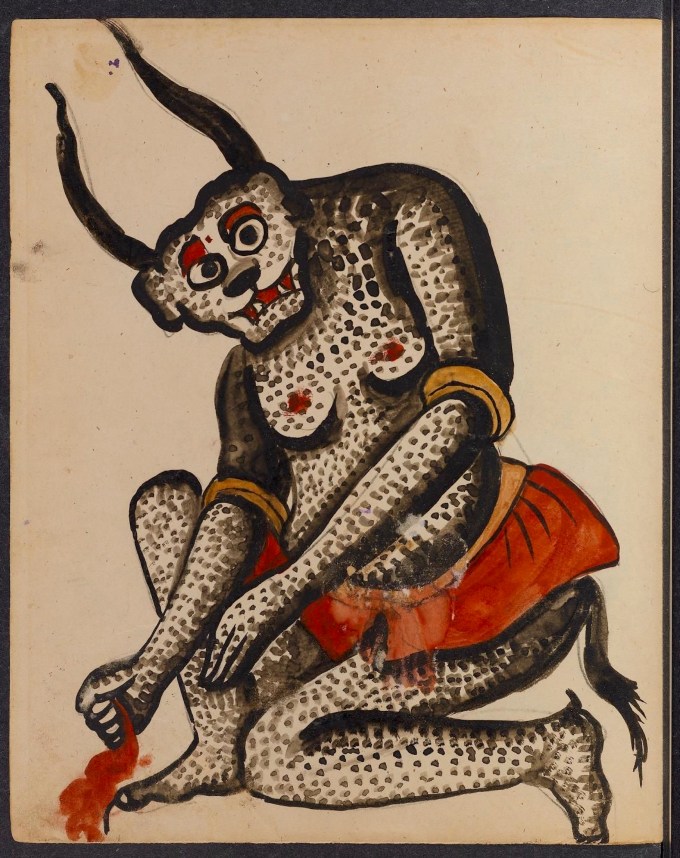
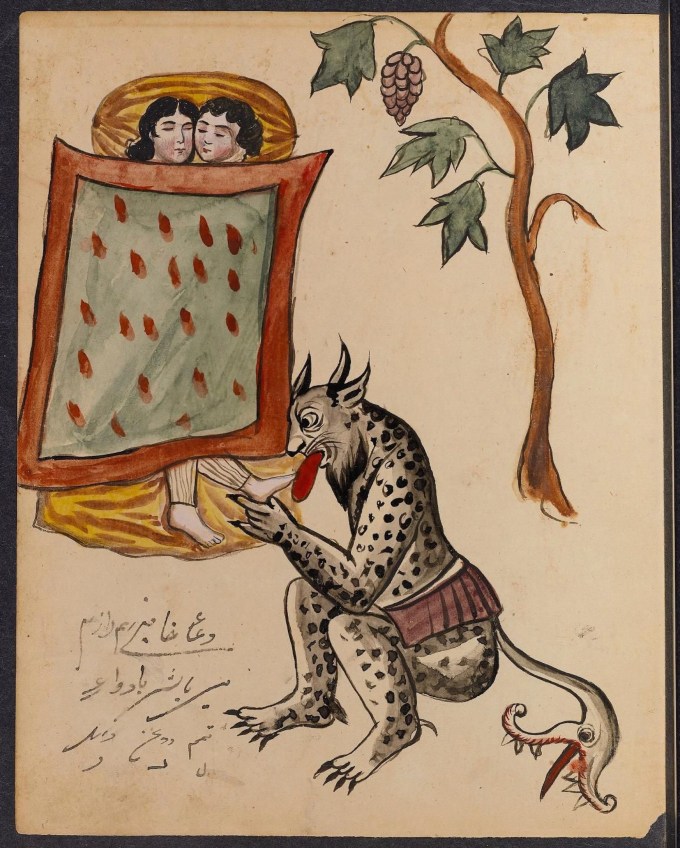
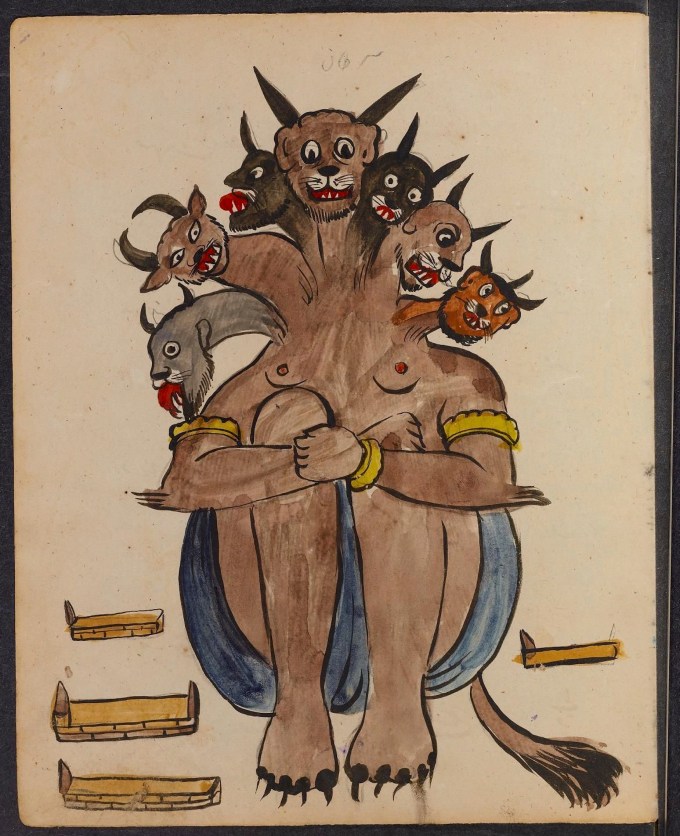
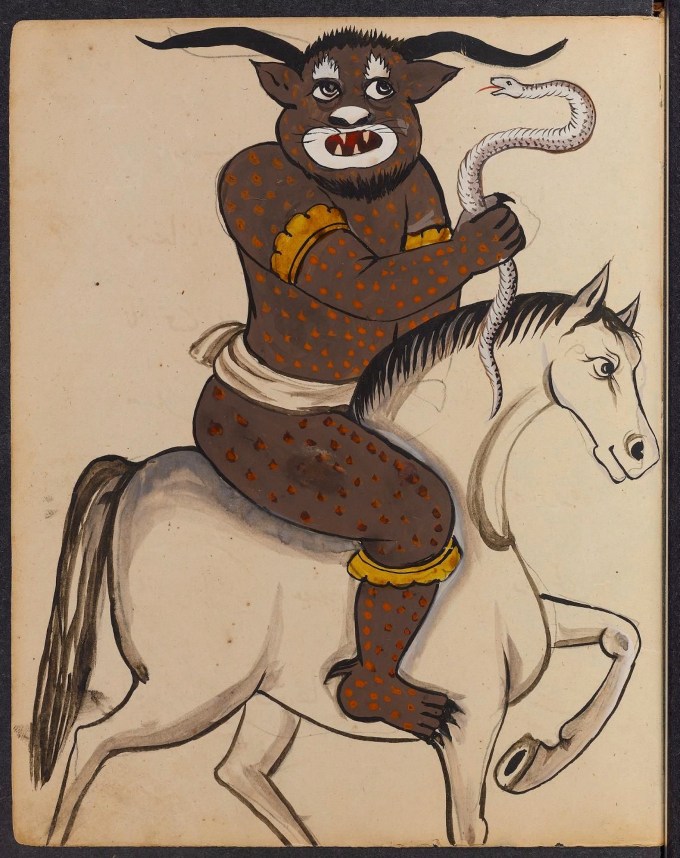
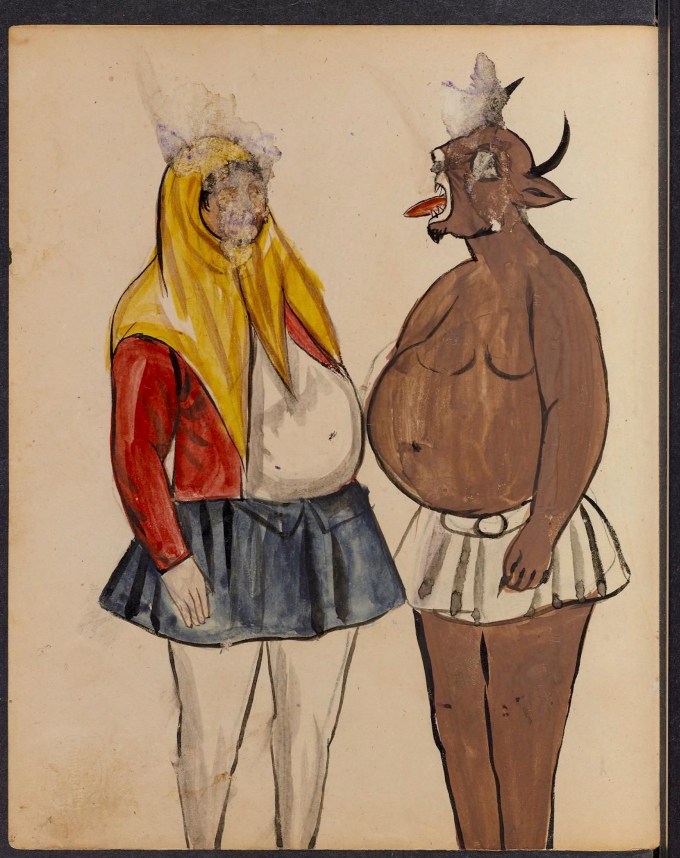
“The natives recorded in the Talmud” soon became “thoroughly integrated” with the many demons of Christian Europe and the Islamic world, forming a sprawling hell whose denizens hail from at least three continents, and who have mixed freely in alchemical, astrological, and other occult works since at least the 13th century and into the present. One example from the early 20th century, a 1902 treatise on divination from Isfahan, a city in central Iran, draws on this ancient thread with a series of watercolors added in 1921 that could easily be mistaken for illustrations from the early Middle Ages.
As the Public Domain Review notes:
The wonderful images draw on Near Eastern demonological traditions that stretch back millennia — to the days when the rabbis of the Babylonian Talmud asserted it was a blessing demons were invisible, since, “if the eye would be granted permission to see, no creature would be able to stand in the face of the demons that surround it.”
The author of the treatise, a rammal, or soothsayer, himself “attributes his knowledge to the Biblical Solomon, who was known for his power over demons and spirits,” writes Ali Karjoo-Ravary, a doctoral candidate in Religious Studies at the University of Pennsylvania. Predating Islam, “the depiction of demons in the Near East… was frequently used for magical and talismanic purposes,” just as it was by occultists like Aleister Crowley at the time these illustrations were made.
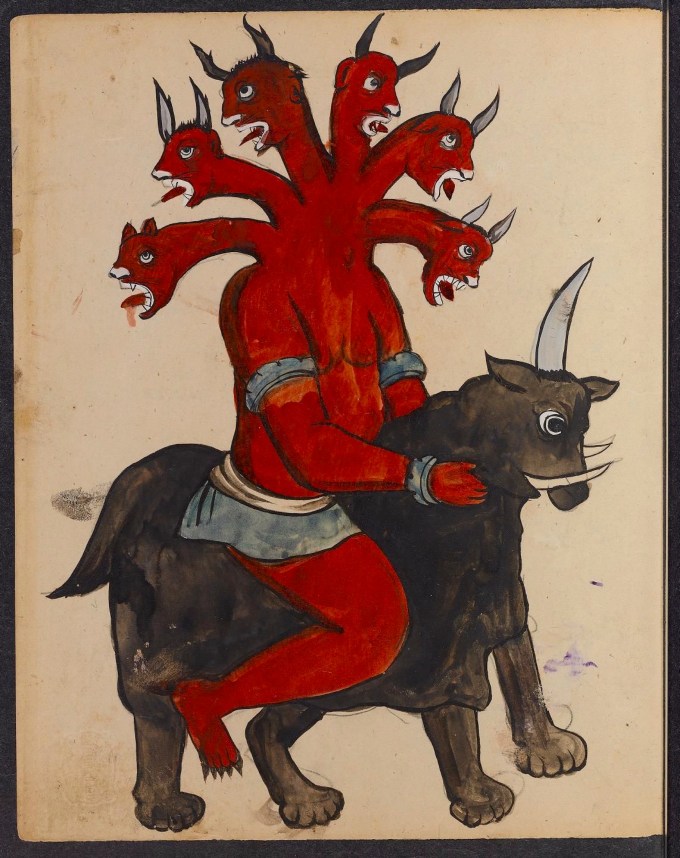
“Not all of the 56 painted illustrations in the manuscript depict demonic beings,” the Public Domain Review points out. “Amongst the horned and fork-tongued we also find the archangels Jibrāʾīl (Gabriel) and Mikāʾīl (Michael), as well as the animals — lion, lamb, crab, fish, scorpion — associated with the zodiac.” But in the main, it’s demon city. What would Borges have made of these fantastic images? No doubt, had he seen them, and he had seen plenty of their like before he lost his sight, he would have been delighted.
A blue man with claws, four horns, and a projecting red tongue is no less frightening for the fact that he’s wearing a candy-striped loincloth. In another image we see a moustachioed goat man with tuber-nose and polka dot skin maniacally concocting a less-than-appetising dish. One recurring (and worrying) theme is demons visiting sleepers in their beds, scenes involving such pleasant activities as tooth-pulling, eye-gouging, and — in one of the most engrossing illustrations — a bout of foot-licking (performed by a reptilian feline with a shark-toothed tail).
There’s a playful Bosch-ian quality to all of this, but while we tend to see Bosch’s work from our perspective as absurd, he apparently took his bizarre inventions absolutely seriously. So too, we might assume, did the illustrator here. We might wonder, as Woolf did, about this work as the product of “suffering human beings… attached to grossly material things, like health and money and the houses we live in.” What kinds of ordinary, material concerns might have afflicted this artist, as he (we presume) imagined demons gouging the eyes and licking the feet of people tucked safely in their beds?
See many more of these strange paintings at the Public Domain Review.


Related Content:
700 Years of Persian Manuscripts Now Digitized and Available Online
Josh Jones is a writer and musician based in Durham, NC. Follow him at @jdmagness
Read More...Bob Dylan Releases a Cryptic 17-Minute Song about the JFK Assassination: Hear a “Murder Most Foul”
Like an Old Testament prophet with smartphone, Bob Dylan has appeared the midst of catastrophe to drop a new previously unreleased track, “Murder Most Foul,” on Twitter. Ostensibly a 17-minute song about JFK’s assassination, it’s “the first evidence of original songwriting that we’ve had in eight years from one of the most original songwriters of our era,” writes Kevin Dettmar, Professor of English at Pomona College, for The New Yorker.
The move seems like a weird one—“’weird’ with its full Shakespearean force, as in the ‘weird sisters’ of ‘Macbeth.’” Its title, however, comes from Hamlet. Uttered by the ghost of Hamlet’s father, the phrase shows us the murdered king pronouncing judgment on his own death. It is also the title of the third Miss Marple film, released in the U.S. in 1964, the same year (to the month) that the Warren commission submitted its report to Lyndon Johnson.
Is Dylan pulling us into what may be the most bottomless of modern conspiracy theories, with a Shakespearean allusion suggesting we might hear the song as emanating from Kennedy himself? He’s more than aware of what he’s doing with the many specific references to the murder, drawing out the most committed of conspiracy theorists in YouTube comments. As Andy Greene writes at Rolling Stone, “Murder Most Foul” is:
Packed with references only JFK buffs will likely recognize, like the ‘triple underpass’ near Dealey Plaza, the removal of his brain during the autopsy, and the ‘three bums comin’ all dressed in rags’ captured on the Zapruder film that conspiracy theorists have been obsessing over for decades. Clearly, Dylan has spent a lot of time reading books and watching documentaries about this.
There is so much more besides. Dylan weaves densely allusive texts, just as another poet to whom he bears some comparison, John Milton, whose work has been background for Dylan’s songwriting for decades, including a sly allusion to Paradise Lost in 1965’s “Desolation Row,” another prophetic work that stretches over the ten-minute mark (and ends with passengers on the Titanic shouting “Which side are you on?”)
In 2006, Dylan opened an episode of his Theme Time Radio Hour broadcast with lines from the first book of Paradise Lost: describing Satan “hurled headlong flaming from the ethereal sky.” Dylan has long been obsessed with the Devil, as literary scholar Aidan Day argues in a comparison of Dylan and Milton. Likewise, he is obsessed with apocalyptic falls from grace. Songs abound with images of the powerful brought low, the lowly brought lower, and the whole world sinking like an ocean liner. He returned to the theme in 2012’s “The Tempest,” a 14-minute epic about the Titanic.
Why JFK, and why now? As he vaguely notes, the song was “recorded a while back.” Dettmar estimates sometime in the last decade. Does it live up to Dylan’s earlier epics? Hear it above and judge for yourself. (And see many of its lyrical references at its Genius page.) Dettmar calls its first half “doggerel” and the opening lines do sound like a fifth-grade history presentation: “’Twas a dark day in Dallas, November, ‘63/The day that would live on in infamy.”
Is this cliché or a satire of cliché? (Dylan was fond of “ ‘Twas the Night Before Christmas.”) Things soon take a darker turn, with lines full of Miltonian portent: assassination becomes regicide: The day they blew out the brains of the king/Thousands were watching, no one saw a thing.
Allusions tumble out, line after line. Once Dylan gets to Wolfman Jack, verse two begins, and “something amazing happens,” writes Dettmar. “We’re presented with another version of the Great American Songbook.”—JFK’s death now prelude for all the cultural shifts to come. “Wolfman, oh Wolfman, oh Wolfman, howl/Rub-a-dub-dub, it’s a murder most foul.” NPR’s Bob Boilen and Ann Powers have compiled a playlist of the dozens of songs referenced in the second half of “Murder Most Foul,” a compilation of the music Dylan admires most.
What is he up to in this track? Is “Murder Most Foul” a summation of Dylan’s career? Dylanologists will be puzzling it out for years. But the last line of his Twitter announcement sure sounds like a cryptic farewell wrapped in a warning: “Stay safe,” Dylan writes, “stay observant, and may God be with you.”
Related Content:
A Massive 55-Hour Chronological Playlist of Bob Dylan Songs: Stream 763 Tracks
Hear Bob Dylan’s Newly-Released Nobel Lecture: A Meditation on Music, Literature & Lyrics
Bob Dylan’s Thanksgiving Radio Show: A Playlist of 18 Delectable Songs
Josh Jones is a writer and musician based in Durham, NC. Follow him at @jdmagness
Read More...What the Iconic Painting, “The Two Fridas,” Actually Tells Us About Frida Kahlo
I never painted dreams. I painted my own reality. —Frida Kahlo
You may be forgiven for assuming you already know everything there is to know about Frida Kahlo.
The subject of a high profile bio-pic, a bilingual opera, and numerous books for children and adults, her image is nearly as ubiquitous as Marilyn Monroe’s, though Frida exercised a great deal of control over hers by painting dozens of unsmiling self-portraits in which her unplucked unibrow and her traditional Tehuana garb feature prominently.
(Whether she would appreciate having her image splashed across shower curtains, light switch covers, yoga mats, and t‑shirts is another matter, and one even a force as formidable as she would be hard pressed to control from beyond the grave. Her immediately recognizable countenance powers every souvenir stall in Mexico City’s Coyoacán neighborhood, where Casa Azul, the home in which she both was born and died, attracts some 25,000 visitors monthly.)
A recent episode of PBS’ digital series The Art Assignment, above, examines the duality at Frida’s core by using her double self-portrait, The Two Fridas (Las Dos Fridas), as a jumping off place.
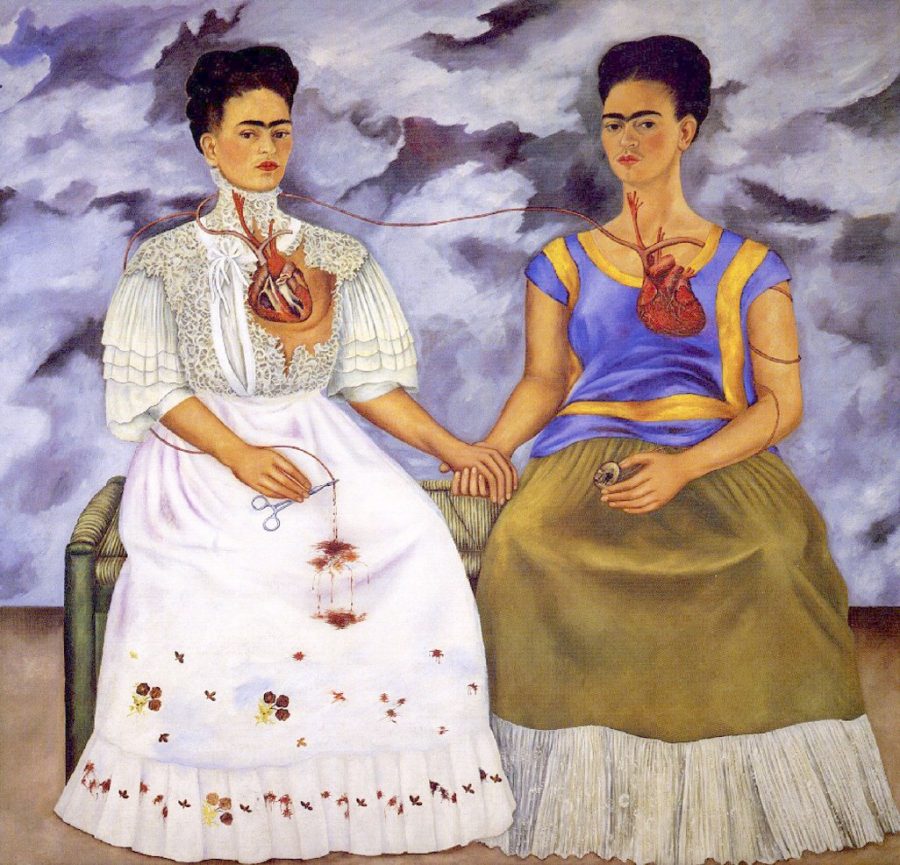
Kahlo herself explained that the traditionally dressed figure on the right is the one her just-divorced ex-husband, muralist Diego Rivera had loved, while the unloved one on the left fails to keep the untethered vein uniting them from soiling her Victorian wedding gown. (The vein, originates on the right, rising from a small childhood portrait of Rivera, that was among Kahlo’s personal effects when she died.)
It’s an expression of loneliness and yet, the twin-like figures are depicted tenderly clasping each other’s hands:
Bereft but comforted
Fractured but intact
Lonely but not isolated
Broken but beautiful
Humiliated but proud
Kahlo’s boundaries, it suggests, are highly permeable, in life, as in art, drawing from such influences as Bronzino, El Greco, Modigliani, Surrealism, and Catholic iconography in both European religious painting and Mexican folk art.
As for the new thing learned, this writer was unaware that when Kahlo married Rivera—her elder by 22 years—in a 1929 civil ceremony, she did so in skirt and blouse borrowed from her indigenous maid… a fact which speaks to the end of her popularity in certain quarters.
Related Content:
A Brief Animated Introduction to the Life and Work of Frida Kahlo
Ayun Halliday is an author, illustrator, theater maker and Chief Primatologist of the East Village Inky zine. Follow her @AyunHalliday.
Read More...The Cork-Lined Bedroom & Writing Room of Marcel Proust, the Original Master of Social Distancing
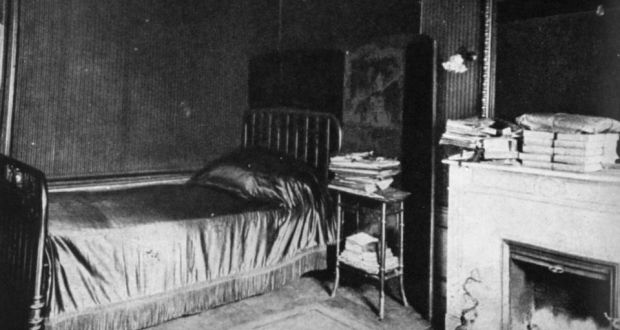
Many of us now find ourselves stuck at home, doing our part to put a stop to the global coronavirus pandemic. Some of us are taking the opportunity to write the ambitious works of literature we’ve long intended to. Such an effort of creativity in confinement has no more suitable precedent than the life of Marcel Proust, who wrote much of his seven-volume masterpiece In Search of Lost Time (À la recherche du temps perdu) in bed. The Paris Review’s Sadie Stein quotes Proust’s biographer Diana Fuss describing him as having written “from a semi-recumbent position, suspended midway between the realms of sleeping and waking using his knees as a desk.”
He did it in a bedroom lined with cork, an addition meant, Stein writes, “not just to soundproof but to prevent pollen and dust from aggravating Proust’s allergies and asthma.” Though the Spanish flu did make its way into France during Proust’s last years, the writer had been worried about his own frail health since his first asthma attack at the age of nine.
He got the idea of lining his bedroom with cork from his friend Anna de Noailles, “a princess and socialite, a patron of the arts and a novelist in her own right,” who also happened to be “plagued with debilitating fears and neuroses.” You can visit faithful reconstructions of both of their bedrooms at Paris Musée Carnavalet, an essential stop on any Proust pilgrimage. So is the Hôtel Ritz Paris, which maintains a “Marcel Proust suite.”
William Friedkin — yes, that William Friedkin — stayed in the Marcel Proust suite, “formerly a private dining room on the hotel’s second floor, where Proust often hosted small dinner parties,” on the Proust pilgrimage he recalls in The New York Times. “I was told by the hotel manager that the room was reserved for Proust to entertain whenever he could venture out from his cork-lined bedroom at 102 Boulevard Haussmann.” No doubt Proust “absorbed inspiration from conversations here, ones that made their way into his writing.” In the last three years of his life, the writing almost entirely displaced the conversation: Proust spent almost all his time in his cork-lined bedroom, sleeping by day and putting everything he had into his work at night. A contemporary photograph of Proust’s cork-lined bedroom appears at the top of the post, as recently included in a tweet by writer Ted Gioia calling Proust the “master of social distancing.”
Just above, you can watch a talk on the writer’s room and hypersensitivities (of both the aesthetic and physical varieties) that put him into it by Proust scholar William C. Carter, author of Marcel Proust: A Life and Proust in Love. What might Proust’s father, the epidemiologist Adrien Proust, have thought about a new epidemic making the people of the 21st century look to his son? Even if we don’t take him as a model for writing life, this is nevertheless an appropriate moment to read his work (now available free online at the Internet Archive’s National Emergency Library). “What Proust inspires in us is to see and to appreciate every seemingly insignificant place or object or person in our lives,” writes Friedkin, “to realize that life itself is a gift and all the people we’ve come to know have qualities worth considering and celebrating — in time.”
via Ted Gioia
Related Content:
Free eBooks: Read All of Proust’s Remembrance of Things Past on the Centennial of Swann’s Way
When James Joyce & Marcel Proust Met in 1922, and Totally Bored Each Other
The First Known Footage of Marcel Proust Discovered: Watch It Online
The National Emergency Library Makes 1.5 Million Books Free to Read Right Now
Based in Seoul, Colin Marshall writes and broadcasts on cities, language, and culture. His projects include the book The Stateless City: a Walk through 21st-Century Los Angeles and the video series The City in Cinema. Follow him on Twitter at @colinmarshall, on Facebook, or on Instagram.
Read More...Watch a Sweet Film Adaptation of Kurt Vonnegut’s Story, “Long Walk to Forever”
Shame, shame to have lived scenes from a women’s magazine. —Kurt Vonnegut
In his introduction to Welcome to the Monkey House, a collection of his short fiction published in 1968, Kurt Vonnegut shows no compunction about throwing its most mainstream entry under the bus:
In honor of the marriage that worked I include in this collection a sickeningly slick love story from The Ladies Home Journal, God help us, entitled by them “Long Walk to Forever.” The title I gave it, I think, was “Hell to Get Along With.”
The simple tale, published, as noted, by Ladies Home Journal in 1960, bears a lot of similarities to events of Vonnegut’s own life. After WWII, having survived the bombing of Dresden as a POW, he made his way back to Indianapolis, and invited Jane Cox, the friend he’d known since kindergarten, who was engaged to another man, to take a walk, during which he suggested she should marry him instead.
Director Jessica Hester’s recent, Kurt Vonnegut Trust-sanctioned adaptation, above, plays it pretty straight, as do several other unauthorized versions lurking on the Internet.
She ups Newt’s rank to corporal from private, and replaces the glossy bridal magazine Catherine is thumbing through when Newt knocks with a coterie of attentive bridesmaids and little girls, apparently getting a jump on their nuptial fussing.
The magazine’s omission is unfortunate.
In the story, Newt asks to see “the pretty book,” forcing Catherine to bring up the impending wedding. Its physical reality then offers Newt a handy emotional refuge, from whence he can crack wise about rosy brides while pretending to read an ad for flatware.
Without that prop, he’s preternaturally aware of the names of silver patterns.
And as an Indianapolis native who went to school in the orchard where the story is set, and who can confirm that it’s in earshot of the bells from the Indiana School for the Blind, I found it jarring to see the action transposed to New York’s Westchester County. (For those keeping score, it was shot on location in Croton State Park and the Rockefeller State Park).
(Breaking Away’s rock quarry aside, the Hoosier State just doesn’t have those sorts of high-up water views.)
Hester honors Vonnegut’s dialogue—nearly everything that comes out of the characters’ mouths originated on the page, while providing a young female director’s spin on this material, half a century removed from its publication.
As she describes it on the storytelling platform Feminist Wednesday, the film gently satirizes the institution of matrimony and the importance placed upon it. It is also, she says:
…a story about courage, as the female has to face herself, her ideas, and her values… Catherine’s journey is so raw, terrifying in the most honest way, and heartfelt yet extremely funny because it is so relatable.
Something tells me the author wouldn’t have put it that way … his Monkey House intro, maybe.
But his admiration for his less-than-traditional muse, avid reader and writer Jane Cox, from whom he split after 26 years of marriage, was immense.
Ginger Strand’s profile in The New Yorker quotes the household constitution Cox drafted after their 1945 marriage:
We cannot and will not live in and be hogtied by a society which not only has not faith in the things we have faith in, but which reviles and damns that faith with practically every breath it draws.
Hester’s crowd-funded film, which the Kurt Vonnegut Museum and Library included as part of a COVID-19 crisis Virtual Vonnegut Fun Pack—(“Have a box of Kleenex at the ready!”)—was shot in 2014.
Had production been delayed by a few years, one wonders if the filmmakers would have come under intense pressure to frame Newt’s refusal to take Catherine’s rejections at face value, his insistence that she continue the walk, and that unvetted kiss as something pernicious and intentional.
If so, we’re glad the film made it into the can when it did.
And we confess, we don’t really share Vonnegut’s avowed distaste for the story, though New York Times critic Mitchel Levitas did, in an otherwise favorable review of Welcome to the Monkey House:
This Vonnegut is obviously a lovable fellow. Moreover, he’s right about the story, which is indeed a sickening and slick little nothing about a soldier who goes A.W.O.L. in order—How to say it?—to sweep his girl from the steps of the altar into his strong and loving arms.
Here’s to future adaptations of this Ladies Home Journal-approved story by one of our favorite authors. May they capture something of his tartness, and forgo a sentimental soundtrack in favor of a chickadee whose cameo appearance after the School for the Blind’s bells prefigures Slaughterhouse-Five’s famous “Poo-tee-weet?”
“*chick-a-dee-dee-dee*,” went a chickadee.
This adaptation of Vonnegut’s “Long Walk to Forever” will be added to our collection, 4,000+ Free Movies Online: Great Classics, Indies, Noir, Westerns, Documentaries & More.
Related Content:
The Graphic Novel Adaptation of Kurt Vonnegut’s Slaughterhouse-Five, Coming Out This Year
A New Kurt Vonnegut Museum Opens in Indianapolis … Right in Time for Banned Books Week
Ayun Halliday is an author, illustrator, theater maker and Chief Primatologist of the East Village Inky zine. Her monthly book-based variety show, Necromancers of the Public Domain is on COVID-19 hiatus. Follow her @AyunHalliday.
Read More...Nine Inch Nails Releases 2 Free Albums: They’re Now Ready to Download

Image by via Wikimedia Commons
FYI: Nine Inch Nails has released two new albums to help you weather the global storm. Download them for free here.
The offer comes prefaced with these words from the band…
FRIENDS-
WEIRD TIMES INDEED…
AS THE NEWS SEEMS TO TURN EVER MORE GRIM BY THE HOUR, WE’VE FOUND OURSELVES VACILLATING WILDLY BETWEEN FEELING LIKE THERE MAY BE HOPE AT TIMES TO UTTER DESPAIR – OFTEN CHANGING MINUTE TO MINUTE. ALTHOUGH EACH OF US DEFINE OURSELVES AS ANTISOCIAL-TYPES WHO PREFER BEING ON OUR OWN, THIS SITUATION HAS REALLY MADE US APPRECIATE THE POWER AND NEED FOR CONNECTION.
MUSIC – WHETHER LISTENING TO IT, THINKING ABOUT IT OR CREATING IT – HAS ALWAYS BEEN THE THING THAT HELPED US GET THROUGH ANYTHING – GOOD OR BAD. WITH THAT IN MIND, WE DECIDED TO BURN THE MIDNIGHT OIL AND COMPLETE THESE NEW GHOSTS RECORDS AS A MEANS OF STAYING SOMEWHAT SANE.
GHOSTS V: TOGETHER IS FOR WHEN THINGS SEEM LIKE IT MIGHT ALL BE OKAY, AND GHOSTS VI: LOCUSTS… WELL, YOU’LL FIGURE IT OUT.
IT MADE US FEEL BETTER TO MAKE THESE AND IT FEELS GOOD TO SHARE THEM. MUSIC HAS ALWAYS HAD A WAY OF MAKING US FEEL A LITTLE LESS ALONE IN THE WORLD… AND HOPEFULLY IT DOES FOR YOU, TOO. REMEMBER, EVERYONE IS IN THIS THING TOGETHER AND THIS TOO SHALL PASS.
WE LOOK FORWARD TO SEEING YOU AGAIN SOON.
BE SMART AND SAFE AND TAKE CARE OF EACH OTHER.
WITH LOVE,
TRENT & ATTICUS
How to Teach and Learn Philosophy During the Pandemic: A Collection of 450+ Philosophy Videos Free Online
The term philosophy, as every introductory course first explains, means the love of wisdom. And as the oldest intellectual discipline, philosophy has proven that the love of wisdom can withstand the worst human history can throw at it. Civilizations may rise and fall, but sooner or later we always find ways to get back to philosophizing. The current coronavirus pandemic, the most frightening global event most of us have seen in our lifetimes, doesn’t quite look like a civilization-ender, though it has forced many of us to change the way we live and learn. In short, we’re doing much more of it online, and a new collection of educational videos free online is keeping philosophy in the mix.
“In order to aid philosophy professors during the pandemic as they transition from in-person to online teaching, Liz Jackson (ANU) and Tyron Goldschmidt (Rochester) created a spreadsheet of videorecorded philosophy classes and lectures,” writes Daily Nous’ Justin Weinberg. At the time of Weinberg’s post on Monday, the spreadsheet, available as an open Google document, contained more than 200 videos, a number that has since more than doubled to 457 and counting.
You’ll find an abundance of introductory courses to the entire subject of philosophy as well as to subfields like logic and ethics, and also specialized lecture series on everything from Hume and Nietzsche to Stoicism and metaphysics to death and the problem of evil.
Weinberg adds that “anyone can add their own videos or ones that they know about,” so if you’re aware of any video philosophy courses that haven’t appeared on the spreadsheet yet, you can contribute to this ongoing effort in at-home philosophy by inserting them yourself. Even as it is, Jackson and Goldshmidt’s course collection offers more than enough to give yourself a rich philosophical education in this time of isolation — or, if you’re a philosophy professor yourself, a way to enrich any remote teaching you have to do right now. Putting as it does so close at hand lectures by such figures previously featured here on Open Culture as Nigel Warburton, Michael Sandel, Peter Adamson, and the inimitable Rick Roderick, it reminds us that the love of wisdom is best expressed in a variety of voices.
In addition to the spreadsheet, can find many more philosophy videos in our collection, Free Online Philosophy Courses.
Related Content:
Learn Philosophy with a Wealth of Free Courses, Podcasts and YouTube Videos
A History of Philosophy in 81 Video Lectures: From Ancient Greece to Modern Times
350 Animated Videos That Will Teach You Philosophy, from Ancient to Post-Modern
Based in Seoul, Colin Marshall writes and broadcasts on cities, language, and culture. His projects include the book The Stateless City: a Walk through 21st-Century Los Angeles and the video series The City in Cinema. Follow him on Twitter at @colinmarshall or on Facebook.
Read More...Stream All 18 Hours of Ken Burns’ Baseball for Free on What Would Have Been Opening Day

Baseball season won’t start today, on what would have been Open Day. So here’s your next best bet. As Sam Barsanti writes at AV Club, “PBS and the world’s preeminent director of extremely watchable and extremely long documentaries have a special treat: The entirety of Ken Burns’ Baseball—over 18 hours—is now available to stream for free on the PBS website and all of its related apps.”
It’s no coincidence that Burns’ documentary becomes free during COVID-19. On Twitter, Burns adds: “With events canceled & so much closed, I asked @PBS to stream BASEBALL for free so we can participate in the national pastime together. Watch at the link below or on any streaming device. And please look out for those with greater needs. Play ball.”
Stream the videos here.
If you would like to support the mission of Open Culture, consider making a donation to our site. It’s hard to rely 100% on ads, and your contributions will help us continue providing the best free cultural and educational materials to learners everywhere. You can contribute through PayPal, Patreon, and Venmo (@openculture). Thanks!
Related Content:
Free: Austin City Limits Opens Up Video Archives During COVID-19 Pandemic
The Met Opera Streaming Free Operas Online to Get You Through COVID-19
Support Us
We're hoping to rely on loyal readers, rather than erratic ads. Please click the Donate button and support Open Culture. You can use Paypal, Venmo, Patreon, even Crypto! We thank you!

About Us

Open Culture scours the web for the best educational media. We find the free courses and audio books you need, the language lessons & educational videos you want, and plenty of enlightenment in between.
Advertise With Us

FREE UPDATES!
GET OUR DAILY EMAIL
Get the best cultural and educational resources on the web curated for you in a daily email. We never spam. Unsubscribe at any time.
FOLLOW ON SOCIAL MEDIA

Open Culture editor Dan Colman scours the web for the best educational media. He finds the free courses and audio books you need, the language lessons & movies you want, and plenty of enlightenment in between.
Advertise With Us


