Blues Musician Plays a Soul-Stirring Version of “Amazing Grace” at His Mother’s Funeral
The Dust to Digital Facebook page sets the scene: “Christone ‘Kingfish’ Ingram, play[s] an amazing and touching version of “Amazing Grace” at the funeral of his mother, Princess Pride, today. She was a great supporter of her son, and would have turned 50 tomorrow.” Amazing and touching indeed. Make sure you play it all of the way through. And when you start the video, manually move up the volume icon at the bottom right of the video.
In case it’s not already clear, Kingfish is a professional blues musician. You can catch his videos on Youtube, including this sweet version of “I Put A Spell On You.” Very sorry for your loss, Kingfish…
Read More...Neil Gaiman Talks Dreamily About Fountain Pens, Notebooks & His Writing Process in His Long Interview with Tim Ferriss
Last February, Neil Gaiman sat down for a 90-minute interview with author, entrepreneur and podcaster Tim Ferriss. At the 13:30 mark, the conversation turns to Gaiman’s writing process, and there begins a long and lovely detour into the world of fountain pens (the Pilot 823, Viscontis, and the New York Fountain Pen Hospital in NYC), notebooks (why he prefers Leuchtturm German notebooks to Moleskines), and how he writes his novels out by hand. It’s all carefully thought out:
Tim Ferriss: Are there any other rules or practices that you also hold sacred or important for your writing process?
Neil Gaiman: Some of them are just things for me. For example, most of the time, not always, I will do my first draft in fountain pen, because I actually enjoy the process of writing with a fountain pen. I like the feeling of fountain pen. I like uncapping it. I like the weight of it in my hand. I like that thing, so I’ll have a notebook, I’ll have a fountain pen, and I’ll write. If I’m doing anything long, if I’m working on a novel, for example, I will always have two fountain pens on the go, at least, with two different colored inks, at least, because that way I can see at a glance, how much work I did that day. I can just look down and go, “Look at that! Five pages in brown. How about that? Half a page in black. That was not a good day. Nine pages in blue, cool, what a great day.”
You can just get a sense of are you working, are you making forward progress? What’s actually happening. I also love that because it emphasizes for me that nobody is ever meant to read your first draft. Your first draft can go way off the rails, your first draft can absolutely go up in flames, it can — you can change the age, gender, number of a character, you can bring somebody dead back to life. Nobody ever needs to know anything that happens in your first draft. It is you telling the story to yourself.
Then, I’ll sit down and type. I’ll put it onto a computer, and as far as I’m concerned, the second draft is where I try and make it look like I knew what I was doing all along.
Tim Ferriss: Do you edit, then, as you’re looking or translating from the first draft on the page to the computer, or do you get it all down as is in the computer and then edit —
Neil Gaiman: No, that’s my editing process. I figure that’s my second draft is typing into the computer. Also, I love — backing up a bit here. When I was, what was I? 27, 28? In the days when we were still in typewriters and we were just a handful of people with word processors, which were clunky things with disks which didn’t hold very much and stuff, I edited an anthology and enjoyed editing my anthology.
Most of the stories that came in were about 3,000 words long. Move forward in time, not much, five, six, seven years. Mid ‘90s, everybody is now on computer, and I edited another short story anthology. The stories that were coming in tended to be somewhere between six- and 9,000 words long. They didn’t really have much more story than the 3,000 word ones, and I realized that what was happening is it’s a computer‑y thing, is if you’re typing, putting stuff down is work. If you’ve got a computer, adding stuff is not work. Choosing is work. It expands a bit, like a gas. If you have two things you could say, you say both of them. If you have the stuff you want to add, you add it, and I thought, “Okay, I have to not do that, because otherwise my stuff is going to balloon and it will become gaseous and thin.”
What I love, if I’ve written something on a computer, and I decide to lose a chunk, it feels like I’ve lost work. I delete a page and a half, I feel like there’s a page and half that just went away. That was a page and a half’s worth of work I’ve just lost. If I’ve been writing in a notebook and I’m typing it up, I can look at something and go, “Oh, I don’t need this page and a half.” I leave it out, I just saved myself work, and it feels like I’m treating myself.
I’m just trying to always have in my head the idea that maybe I’m somehow, on some cosmic level, paying somebody by the word in order to be allowed to write, but if they’re there, they should matter, they should mean something. It’s always important to me.
Tim Ferriss: You mentioned distraction earlier and your dangerously adorable son, which I certainly agree with. I had read somewhere, actually, before I get to that, this might seem like a very, very mundane question, but what type of notebooks do you prefer? Are they large legal pads or are they leather bound? What type of notebooks?
Neil Gaiman: When they came out, I really liked — I’ve used a whole bunch of different ones. I bought big drawing ones, which actually turned out to be a bit too big, though I liked how much I could see on the page. Those are the ones I wrote Stardust and American Gods in, big size, but they weren’t terribly portable. I went over to the Moleskines, and I loved them when they first came out, and then they dropped their paper quality. Dropping paper quality doesn’t matter, unless you’re writing in fountain pen, because all of a sudden it’s bleeding through, and all of a sudden you’re writing on one page, leaving a page blank because it’s bled through and then writing on the next page.
Joe Hill, about six or seven years ago, Joe Hill, the wonderful horror fantasy writer, suggested the Leuchtturm to me. My usual notebook right now is a Leuchtturm, because I really like the way you can paginate stuff in them and the thickness of the paper, and they’re just like Moleskines, but the Porsche of Moleskines. They’re just better.
I also have been writing, I wrote The Graveyard Book and I’m writing the current novel in these beautiful books that I bought in a stationery shop in Venice, built into a bridge. Somewhere in Venice there’s a little stationery shop on a bridge, and they have these beautiful leather-bound blank books that just look like hardback books, but they’re blank pages. I wrote The Graveyard Book in one of those. I bought four of them, and now I’m using the next one on the next novel, and it may well go into another one. I’m not sure.
Then, at home, I say at home, my house in Wisconsin, which is where my stuff is, I’ve got my — we live in Woodstock, but I have an entire life’s worth of stuff still sitting in my house in Wisconsin, and it’s become archives. It’s actually kind of fabulous having a house that is an archive, but waiting for me in that house is a book that I bought for myself about 25 years ago, and before I die, I plan to write a novel in it. It’s an accounts book from the mid-19th century. It’s 500 pages long. Every page is numbered. It’s lined with accounts lines, but really faint so it would be nice to write a book in it, and it is engineered so that every single page lies flat.
It’s huge and it’s heavy and it just looks like a book that Dickens or somebody would’ve written a novel in and I’ve just been waiting until I have an idea that is huge and weird and Dickensian enough, and whether or not I actually get to write it in dip pen, I’m not sure, but I definitely want to write it in an old Victorian, something slightly copper plating. One of those old flex nib pens that they stopped making when carbon paper came in, just so I can get that spidery Victorian handwriting.
Tim Ferriss: I’m just imagining you putting pen to the first page. When you finish the first page and what that will feel like. That’s going to be a good day.
Neil Gaiman: It will be either a good day or an incredibly bad day. When you get to the end of the first page, it’s “Oh no! I had this pristine — ” it is the thing that I tell young writers, and by young writers, a young writer can be any age. You just have to be starting out, which is anything you do can be fixed. What you cannot fix is the perfection of a blank page. What you cannot fix is that pristine, unsullied whiteness of a screen or a page with nothing on it, because there’s nothing there to fix.
Tim Ferriss: You mentioned a word, and it might be that I’m a little slow moving because I’m from Long Island, but Leuchtturm? What is that word?
Neil Gaiman: L‑E-I-C‑H, I think it’s T‑U-R‑M, and then 1917, I think is — their Twitter handle is definitely Leuchtturm1917.
Tim Ferriss: Leuchtturm, and I’ll put that in the show notes for folks, so you’ll be able to find it. Since you gave me — I’m not intending to turn this episode into a shopping list, but I’ve never used fountain pens.
Neil Gaiman: Really?
Tim Ferriss: I have not. My assistant, my dear assistant does. She loves using fountain pens. She enjoys the act. I’ve had a few sloppy false starts and then been rather impatient, but if I wanted to give it a shot, are there any particular fountain pens or criteria that you would use in picking a good pen?
Neil Gaiman: The biggest criteria I would use in picking, if you have the choice, is go somewhere like New York’s Fountain Pen Hospital.
Tim Ferriss: Is that a real place?
Neil Gaiman: It’s a real place. It’s called The Fountain Pen Hospital. They sell lots of new pens, they recondition old pens, they look after pens for you. And try them out, because the lovely thing about fountain pens is they are personal. You go, “No, no, no.” And then you find the one. I tend to suggest to people who are just nervously — “I’ve never used a fountain pen, what should I do?” I will point them at Lamy, L‑A-M‑Y, who have some fabulous starter pens, and they’re not very expensive, and they’re good. They do a pen called The Safari, but they have a bunch of good starter pens, and they’re just nice to get into the idea of, “Do I like doing this?”
Let’s see, what am I using right now? What have I got in here? This one here is a Pilot. It’s a Namiki, and it’s a flexing nib ever so slightly when you put down weight on it, the nib will spread. It’s a beautiful, beautiful pen. That one’s a Pilot. I think this one here is the Namiki. It’s really weird because Namiki is Pilot, so I don’t quite understand that.
Tim Ferriss: Maybe it’s a Toyota/Lexus thing?
Neil Gaiman: I think it is. It’s that kinda thing. This one here is called a Falcon, and again, you put a little bit of weight on it, and the line will just spread and thicken, which is part of the fun of fountain pens. I’ll go and play. There’s a lovely Italian one. I’ve got my agent, I did a thing some years ago when I realized that I was losing a lot of actual writing time to signing foreign contracts.
Tim Ferriss: This is for books?
Neil Gaiman: This is for books, or occasionally for stories or things being reprinted around the world. The contracts would come in and there would be big sheaves of them because they get printed all around the world, and foreign contracts, a lot of them you have to sign a lot. You have to do a lot of initialing and I would sit there going, “I have just spent 90 minutes signing a pile of contracts, and I love that I got to sign it, but —” I contacted my agent. I said, “Can I give you power of attorney? Would you mind? Would you just sign these things for me?”
She was like, “Absolutely!” Great. I got her — she’d never used a fountain pen and I got her a fountain pen. I actually went to The New York Fountain Pen Hospital with her, and did the thing of showing her pens, “What do you like?” I got her a Visconti, which are just these lovely Italian pens. Mostly I love, there’s a slightly fetishistic bit of having bottles of beautifully colored ink. When you start talking to fountain pen people, they really — they pretend to be interested in what pen you like, but they don’t care, because they’ve found their own pens that they love.
They say, “What do you use?”
I use Pilot 823s for signing. Actually now, I’ve got a Pilot 823, ’cause it’s just a fantastic signing pen. It’s a workhorse, it keeps going, and I got one in 2012 and it was my signing pen. I signed through Ocean at the End of the Lane. Before the book had come out, I had already pre-signed, written my signature 20,000 times with this pen.
Tim Ferriss: I have some footage of you icing your hand after said signings.
Neil Gaiman: That was a signing tour that I really got into icing my hand and wrist and arm. I did the numbers, and as far as I can tell, I’ve signed about one and a half million signatures with that pen, which remained, and I had to send it off to Pilot at one point, not because the nib was in trouble, because the plunger mechanism was starting to stick, and they fixed it for me and sent it back. Then my three-year-old son found a place behind a cast iron fireplace in our house in Woodstock where if you just insert your father’s Pilot 823 pen, which you have found on the table, just to see if it would go in there, you can actually guarantee that without disassembling the house, we actually have to take the entire house apart to uninstall a cast iron fireplace from 1913 to get at the pen. That pen now has been given as a sacrifice to the house gods, so I need to get a new one.
Tim Ferriss: Its strikes me, at least it seems as we’re talking that many of the decisions you’ve made, the tools you’ve found and enlisted, act to make not writing unappealing, or at least boring after five minutes, and to enhance the act of writing to make it something that is enjoyable. I don’t know if that’s true.
Neil Gaiman: That is true, but they also exist for another reason, which is kind of weird, which is to try and trivialize what I’m doing and not make it important and freighted down with weight, because that paralyzes me. When I started writing I had a typewriter. It was a manual typewriter. When I sold my first book, I had the money to buy an electric typewriter.
Tim Ferriss: What was that first book?
Neil Gaiman: Gosh. I actually don’t remember whether I bought the electric typewriter with the money from a book called Ghastly Beyond Belief, a book of science fiction and fantasy quotations I did with Kim Newman, or whether it was for the Duran Duran biography that I did. Either way, I was just 23. What I would do back then is I would do my rough draft on scrap paper, single spaced so that it couldn’t be used, and also so that I could get as many words on. Paper was expensive. I could always do that. I remember the joy of getting my first computer, and just the idea that I wasn’t making paper dirty. Nothing mattered until I pressed print, and that was absolutely and utterly liberating.
And then, a decade on, picking up a notebook, it was for Stardust, which I’d decided that I wanted the rhythms of Stardust to be very antiquated rhythms, and I thought there’s probably a difference to the way that one writes with a fountain pen. 17 century writing, 17th, 18th century writing, you notice tends to go in very, very long sentences and long paragraphs. My theory about this is that one reason why you get this is because you’’re using dip pens, and if you pause, they dry up. You just have to keep going. It forces you to do a kind of writing where you’re going for a very long sentence and you’re going to go for a long paragraph and you’re going to keep moving in this thing, and you’re thinking ahead.
If you’re writing on a computer, you’ll think of the sort of thing that you mean, and then write that down and look at it and then fiddle with it and get it to be the thing that you mean. If you’re writing in fountain pen, if you do that, you just wind up with a page covered with crossings out, so it’s actually so much easier to just think a little bit more. You slow up a bit, but you’re thinking the sentence through to the end, and then you start writing.
You write that, and then you pause and then you write the next one. At least that was the way that I hypothesized that I might be writing, and I wanted Stardust to feel like it had been written in the late 1920s. I thought to do that I should probably get myself a fountain pen and a book, so that was how I started writing that. Again, what I loved was suddenly feeling liberated. Saying, “Ah, I’m not actually making words that are not going down in phosphor on a computer screen.”
Watch the full interview above. Stream it as a podcast. Or read the complete transcript here.
Related Content:
18 Stories & Novels by Neil Gaiman Online: Free Texts & Readings by Neil Himself
Where Do Great Ideas Come From? Neil Gaiman Explains
Neil Gaiman Teaches the Art of Storytelling in His New Online Course
Amanda Palmer Animates & Narrates Husband Neil Gaiman’s Unconscious Musings
Read More...Meet the Americans Who Speak with Elizabethan English Accents: An Introduction to the “Hoi Toiders” from Ocracoke, North Carolina
I remember sitting in on a conversation with some old timers in the British village my parents grew up in, and one man remembered a time, very early on in the 20th century, where villages were so isolated you could tell where somebody was from in a radius of about 20 miles. That doesn’t exist so much these days, as radio, television, and now the internet exposes us more and more to accents at an early age.
So that’s why I found the above footage so fascinating. Taken from a documentary on regional accents (possibly this one) from the North Carolina coast, I could hear a bit of that East Anglia accent from my grandparents…but then a few words that sounded like Somerset or Devon in the south-west of England…and then some straight up southern American twang. And that was in one sentence! What’s going on here?
Isolation, that’s what. The island of Ocracoke has over the centuries developed its own dialect, “Hoi Toide” (as in “high tide”), that is also the name for a way of life. Even now, it takes a boat to reach the island–ferries only started arriving in 1957–and back in the 18th century it was a refuge for pirates.
One of them, William Howard, purchased the island in 1759 for £105, after King George I pardoned all pirates. Ocracoke, its name already a bastardization of a Native American word, became a fishing community, a mix of English, Scottish, and Irish settlers, natives, and pirates. The resulting mish-mash of borrowed and made-up words, along with pirate slang, make Hoi Toide one of the few American dialects not identified as American, as it also has its own peculiar grammar.
With a population of just over 900, Ocracoke has its own pace to life, which does attract tourists trying to get away from it all. As this BBC article points out:
Instead of cinemas, there are outdoor theatre groups. Local teashops, spice markets and other family-owned stores take the place of chain supermarkets. Cars are allowed on the 16 mile-long island, but most people just park them and walk everywhere. The island’s children all attend one school, while residents work as everything from fishermen to brewery owners to woodworkers.
Modern life is threatening the dialect, inevitably so, even as the community remains close-knit. By all accounts it will be gone in a few more generations, so let’s celebrate this particularly American brogue, born out of necessity, individuality, and most importantly, a lovely melting pot.
Related Content:
What Shakespeare’s English Sounded Like, and How We Know It
The Speech Accent Archive: The English Accents of People Who Speak 341 Different Languages
Why Do People Talk Funny in Old Movies?, or The Origin of the Mid-Atlantic Accent
Ted Mills is a freelance writer on the arts who currently hosts the artist interview-based FunkZone Podcast and is the producer of KCRW’s Curious Coast. You can also follow him on Twitter at @tedmills, read his other arts writing at tedmills.com and/or watch his films here.
Read More...Traditional Inuit Thoat Singing and the Modern World Collide in This Astonishing Video
Let’s just get this out of the way…
Musically speaking, Inuit throat singing—or katajjaq—is not going to be everyone’s cup of tea.
For all those who find this traditional form mesmerizing, there are others who get antsy with no lyrics or easily discernible melody on which to hang their hat, or who experience the bleak sound of the Arctic wind coupled with the singers’ preliminary breathing as a horror movie soundtrack.
If, as a member of one of the latter camps, you feel inclined to bail after a minute or so of Wapikoni Mobile’s Sundance-endorsed video above—you get it, it’s something akin to Mongolian or Tuvan throat-singing, it’s circular breathing, there’s a lot of picturesque snow up there—we beg you to reconsider, on two counts.
1) In an era of autotuned “everyone’s‑a-star” perfection, Katajjaq is a hearty hold-out, a community-spirited singing game whose competitors seek neither stardom nor riches, but rather, to challenge themselves and amuse each other without screens throughout the long winter nights.
Practitioner Evie Mark breaks it down thusly:
One very typical example is when the husbands would go on hunting trips. The women would gather together when they have nothing to do, no more sewing to do, no more cleaning to do, they would just have fun, and one of the ways of entertaining themselves is throat-singing.
It goes like this. Two women face each other very closely, and they would throat sing like this:
If I would be with my partner right now, I would say A, she would say A, I would say A, she would say A, I say C, she says C. So she repeats after me. It would be a sort of rolling of sounds. And, once that happens, you create a rhythm. And the only way the rhythm would be broken is when one of the two women starts laughing or if one of them stops because she is tired. It’s a kind of game. We always say the first person to laugh or the first person to stop is the one to lose. It’s nothing serious. Throat singing is way of having fun. That’s the general idea, it’s to have fun during gatherings. It is also a way to prove to your friends around you or your family that if you are a good throat-singer, you’re gonna win the game.
Throat-singing is a very accurate technique in a sense that when you are singing fast, the person who is following the leader has to go in every little gap the leader leaves for her to fill in. For instance, if I was to say 1 + 1 + 1 + 1, the ones being what I sing and the pluses the gaps, she would go in-between the ones, singing on the pluses. Then, if I change my rhythm, this woman has to follow that change of rhythm and fill in the gaps of that new rhythm. She has to be very accurate. She has to have a very good ear and she has to follow visually what I am doing.
Throat singing is not exactly easy on your diaphragm. You are using a lot of your muscles in your diaphragm for breathing in and breathing out. I have to find a space between sounds to breath in in order for me to throat-sing for 20 minutes or more. 20 minutes has been my maximum length of time to throat-sing. You have to focus on your lungs or your diaphragm. If you throat-sing using mainly breathing, you are gonna hyperventilate, you’re gonna get dizzy and damage your throat.
2) The video, starring Eva Kaukai and Manon Chamberland from Kangirsuk in northern Québec (population: 394), deflates conventional notions of traditional practices as the provenance of somewhere quaint, exotic, taxidermied…
Beginning around the 90-second mark, the singers are joined by a drone that surveys the surrounding area. Viewers get a glimpse of what their Arctic homeland looks like in the warm season, as well as some hunters flaying their kill prior to loading it into a late model pick up, presumably bound for a building in a wholly suburban seeming neighborhood, complete with telephone poles, satellite dishes, and—gasp—electric light.
Via Aeon
Related Content:
An MRI Shows How a Singer Sings Two Tones at Once (With the Music of Mozart and Brian Eno)
Ayun Halliday is an author, illustrator, theater maker and Chief Primatologist of the East Village Inky zine. Join her in NYC for the new season of her monthly book-based variety show, Necromancers of the Public Domain. Follow her @AyunHalliday
Read More...
“Don’t Try”: The Philosophy of the Hardworking Charles Bukowski
If Charles Bukowski were alive today, what would you ask him? Best to avoid the standard questions put to writers about how or why they chose to become writers — not just because Bukowski would surely respond with a few colorfully choice words of dismissal, but because he embodied the lack of choice that characterizes the life of every serious creator. According to the Pursuit of Wonder video essay above, Bukowski dropped out of college halfway through in order to write. After a period spent “bouncing around the United States, doing short-term blue-collar jobs while writing hundred of short stories,” none of which broke him into the literary big time, came a highly unproductive period of blue-collar jobs without the accompanying writing.
At the end of a writing-free decade, Bukowski “nearly died from a serious bleeding ulcer.” This got him back on track, as brushes with mortality tend to do: he subsequently quit his job at the post office and returned to writing full-time. It was only a few years before he went back to work at the post office, but this time he kept writing, putting in the real work at the typewriter before each shift at the day job. He did so without the prospect of success anywhere in the offing, at least not before he reached middle age. “It took Bukowski years and years of writing and toiling and trying to finally have circumstances work out in his favor so he could gain traction and find success as a writer,” says the video’s narrator. And yet, as we’ve previously noted here at Open Culture, into Bukowski’s gravestone are chiseled these words: “Don’t try.”
“How could a man who became successful in fulfilling his idea of himself — a man who, although it took a while, found immense respect and recognition for his craft, all because of his relentless trying — how could this man leave the words don’t try as his final offering?” We might interpret them in light of a letter from Bukowski to a friend, the writer and publisher William Packard. “Too many writers write for the wrong reasons,” declared Bukowski. “They want to get famous or they want to get rich or they want to get laid by the girls with the bluebells in their hair… When everything goes best, it’s not because you chose writing, but because writing chose you.” Bukowski didn’t decide to be a writer; nobody actually dedicated to a pursuit ever had to decide which pursuit it would be.
“We work too hard. We try too hard,” Bukowski writes to Packard. “Don’t try. Don’t work. It’s there. Looking right at us, aching to kick out of the closed womb.” He may have meant, as the video’s narrator puts it, that “if you have to try to try, if you have to try to care about something or have to try to want something, perhaps you don’t care about it, and perhaps you don’t want it.” And “if the thought of not doing the thing hurts more than the thought of potentially suffering through the process, if the thought of a life without it or never having tried it at all terrifies you, if it comes to you, through you, out of you, almost as if you’re not trying, perhaps Bukowski might say here, try, and ‘if you’re going to try, go all the way.’ ” That quote comes from Bukowski’s novel Factotum — the story of a writer in search of blue-collar work that won’t get in the way of his one true craft — and we might do well to take it one sentence further: “Otherwise, don’t even start.”
Related Content:
“Don’t Try”: Charles Bukowski’s Concise Philosophy of Art and Life
Charles Bukowski Explains What Good Writing and the Good Life Have in Common
Charles Bukowski Reads His Poem “The Secret of My Endurance”
Based in Seoul, Colin Marshall writes and broadcasts on cities, language, and culture. His projects include the book The Stateless City: a Walk through 21st-Century Los Angeles and the video series The City in Cinema. Follow him on Twitter at @colinmarshall or on Facebook.
Read More...Why Should We Read William Shakespeare? Four Animated Videos Make the Case
Sooner or later, we all encounter the plays of William Shakespeare: whether on the page, the stage, or—maybe most frequently these days—the screen. Over four hundred years after his death, Shakespeare is still very much relevant, not only as the most recognizable name in English literature, but also perhaps as its most famous storyteller, even if we don’t recognize his hand in modern adaptations that barely resemble their originals.
But if we can turn Shakespeare’s plays into other kinds of entertainment that don’t require us to read footnotes or sit flummoxed in the audience while actors make archaic jokes, why should we read Shakespeare at all? He can be profoundly difficult to understand, an issue even his first audiences encountered, since he stuffed his speeches not only with hundreds of loan words, but hundreds of his own coinages as well.
The criticism of Shakespeare’s difficulty goes back to his earliest critics. Seventeenth-century English poet John Dryden declared that the playwright “had undoubtedly a larger soul of poesy than every any of our nation.” In the plays, we find “all arts and sciences, all moral and natural philosophy.” And yet, even Dryden could write, in 1664, that Shakespeare’s language was “a little obsolete,” and that “in every page [there is] either some solecism of speech, or some notorious flaw in sense.” (These issues are sometimes, but not always, attributable to scribal error.)
“Many of his words,” wrote Dryden, “and more of his phrases, are scarce intelligible. And of those which we understand, some are ungrammatical, others coarse; and his whole style is so pestered with figurative expressions, that it is as affected as it is obscure.” Seems harsh. How could such a writer not only survive but become an almost godlike figure in literary history?
Maybe it’s all that “poesy.” Shakespeare is surely one of the most musical writers in the language. Read his speeches to children—they will listen with rapt attention without understanding a single word. It is better that we encounter Shakespeare early on, and learn to hear the music before we’re buffeted by exaggerated ideas about how hard he is to understand.
Written in a time when English was undergoing one of most rapid and radical shifts of any language in history, Shakespeare’s ingenious plays preserve a riot of borrowed, invented, and stolen words, of figures of speech both old- and new-fashioned, and of scholarly and popular ideas traveling through England on their way to and from a globalizing world. The torrents of verse that pour from his characters’ mouths give us the language at its most fluid, dynamic, and demotic, full of unparalleled poetic fugues crammed next to the roughness Dryden disliked.
This is the essence of the modern—of later Shakespearen successors like Samuel Beckett and James Joyce who freely mixed high and low and invented new ways of speaking. Why should we read Shakespeare? I can think of no more persuasive argument than Shakespeare’s language itself, which dazzles even as it confounds, and whose strangeness gives it such enduring appeal. But which plays should we read and why? The TED-Ed videos above from Iseult Gillespie, and below from Brendan Pelsue, make the case for four of Shakespeare greatest works: The Tempest, Hamlet, A Midsummer Night’s Dream, and Macbeth.
Learn new facts about the plays, and why their tragedy and humor, and their copious amounts of murder, still speak to us across the gulf of hundreds of years. But most of all, so too does Shakespeare’s gloriously ornate poetry—even when we can barely understand it.
Related Content:
Hear What Shakespeare Sounded Like in the Original Pronunciation
Take a Virtual Tour of Shakespeare’s Globe Theatre in London
The 1,700+ Words Invented by Shakespeare*
Josh Jones is a writer and musician based in Durham, NC. Follow him at @jdmagness.
Read More...Masterclass Is Running a “Buy One, Give One Free” Deal

FYI: This special deal is now over…
You can see their standard 0ffer–an all-access pass to their catalogue of 70+ courses–here.
Read More...David Lynch Turns Twin Peaks into a Virtual Reality Game: Watch the Official Trailer
When David Lynch and Mark Frost’s Twin Peaks premiered on ABC in 1990, viewers across America were treated to a televisual experience like none they’d ever had before. Four years earlier, something similar had happened to the unsuspecting moviegoers who went to see Lynch’s breakout feature Blue Velvet, an experience described as eye-opening by even David Foster Wallace. A dedicated meditator with an interest in plunging into unexplored realms of consciousness, Lynch tends to bring his audience right along with him in his work, whether that work be cinema, television, visual art, music, or comic strips. Only natural, then, that Lynch would take an interest in the artistic and experiential possibilities of virtual reality.
Last year we featured the first glimpse of a Twin Peaks virtual reality experience in development, revealed at Lynch’s Festival of Disruption in Los Angeles. “The best news is that the company developing the game, Collider Games, is giving creative control to Lynch,” wrote Ted Mills, and now, with the release of Twin Peaks VR’s official trailer, we can get a clearer idea of what Lynch has planned for players. As Laura Snoad writes at It’s Nice That, Lynch has used the opportunity to revisit “well-known environments featured in the series, such as the iconic Red Room (the stripy-floored, velvet curtain-clad parallel universe where Agent Cooper meets murdered teen Laura Palmer), the Twin Peaks’ Sheriff’s Department and the pine-filled forest around the fictional Washington town.”
This will come as good news indeed to those of us Twin Peaks enthusiasts who’ve made the pilgrimage to Snoqualmie, North Bend, and Fall City, the real-life Washington towns where Lynch and his collaborators shot the series. But Twin Peak VR will offer a greater variety of challenges than snapping photos of the series’ locations and chatting with bemused locals: Snoad writes that each environment is constructed like an escape room. “Solving puzzles to help Agent Cooper and Gordon Cole (the FBI agent played by Lynch himself), players will also meet some of the show’s weird and terrifying characters, from the backwards-speaking inhabitants of the Black Lodge to the terrifying Bob himself.”
Available via Steam on Oculus Rift, Vive, and Valve Index this month, with Oculus Quest and PlayStation VR versions scheduled, Twin Peaks VR should give a fair few virtual-reality holdouts a compelling reason to put on the goggles — much as Twin Peaks the show caused the cinéastes of the 1990s to break down and watch evening TV. Enjoying Lynch’s work, whatever its medium, has always felt like plunging into a dream: not like watching his dream, but experiencing a dream he’s made for us. If virtual-reality technology has finally come anywhere close to the vividness of Lynch’s imagination, Twin Peaks VR will mark the next step in his artistic evolution. But for now, to paraphrase no less a Lynch fan than Wallace, the one thing we can say with total confidence is that it will be… Lynchian.
via It’s Nice That
Related Content:
Watch an Epic, 4‑Hour Video Essay on the Making & Mythology of David Lynch’s Twin Peaks
Twin Peaks Actually Explained: A Four-Hour Video Essay Demystifies It All
David Lynch Is Creating a Virtual Reality Experience for Twin Peaks
Twin Peaks Tarot Cards Now Available as 78-Card Deck
David Lynch Directs a Mini-Season of Twin Peaks in the Form of Japanese Coffee Commercials
Play the Twin Peaks Video Game: Retro Fun for David Lynch Fans
Based in Seoul, Colin Marshall writes and broadcasts on cities, language, and culture. His projects include the book The Stateless City: a Walk through 21st-Century Los Angeles and the video series The City in Cinema. Follow him on Twitter at @colinmarshall or on Facebook.
Read More...Meditation for Artists: Learn Moebius’ Meditative Technique Called “Automatic Drawing”
Meditation and art have an ancient, intertwined history in China, where the beginnings of Chan Buddhism are inseparable from landscape painting. In Japan, Zen art has constituted “a practice in appreciating simplicity,” of disappearing into the creative act, cultivating degrees of egolessness that allow an artist’s movements to become spontaneous and unhampered by second guesses. The “first Japanese artists to work in [ink],” notes the Metropolitan Museum of Art, “were Zen monks who painted in a quick and evocative manner.” They passed their techniques, and their wisdom, on to their students.
Perhaps the closest analogue to this tradition in the west is comic art. Artist Ted Gula has worked with comics legends Frank Frazetta and Moebius and drawn for Disney, Marvel, and DC. As a child, he watched Jack Kirby work. “He wouldn’t speak,” says Gula. “He’d be in a trance…. The pencil would hit the paper and it wouldn’t stop until the page was complete, like it poured out.” How is that possible? Gula asked himself, astonished. Kirby had disappeared into the work. There were no preliminary sketches or rough indicators. He would draw an entire book like that, Gula says in the video above from Proko.
Say what you will about the content of Kirby’s work—superhero comics aren’t to everyone’s liking. But no distaste for the nature of his storytelling diminishes Kirby’s attainment of a purely extemporaneous method he seems never to have explained to Gula in words. Later, however, while working with Moebius, Gula says, he learned the technique of “automatic drawing.” Demonstrating it for us above, Gula describes a way of drawing that shares much in common with other meditative visual art traditions.
“It’s all doing very organic shapes,” he says, showing us how to “draw your mind’s eye. This takes your mind, and your mind’s eye, to a place that normally is unexplored, and it can’t help but enhance your whole view of your ability.” The ego must step aside, executive functioning isn’t needed here. “I have no idea,” Gula says, “it’s all just happening on its own.” Moebius explained it as “just letting my mind relax” and Gula has observed similar practices among all the artists he’s worked with.
Gula describes automatic drawing as a natural process for the artist’s mind and hands. The interviewer, artist and teacher Sam Prokopenko, also mentions Korean artist Kim Jung Gi in their interview, who does “amazingly accurate drawings from his memory without any construction lines,” as Prokopenko says above, in a video from his “12 Days of Proko” series, which interviews well-known artists about their techniques. What’s Kim Jung Gi’s secret? Is he possessed of a superhuman, photographic memory? No, he tells Prokopenko.
The secret to becoming fully immersed in the work—one that surely goes for so many pursuits, both creative and athletic—is just to do it: over and over and over and over and over again. (To many people’s disappointment, this also seems to be the secret of meditation.) In Kim Jung Gi’s case, “of course, some part of it is a talent he was born with, but we can’t overlook how much that talent was developed.” We need no expert talent, either innate or developed, to get started. Automatic drawing seems to require a beginner’s mind.
Related Content:
Moebius Gives 18 Wisdom-Filled Tips to Aspiring Artists
Watch Moebius and Miyazaki, Two of the Most Imaginative Artists, in Conversation (2004)
Moebius’ Storyboards & Concept Art for Jodorowsky’s Dune
Josh Jones is a writer and musician based in Durham, NC. Follow him at @jdmagness
Read More...Author Imagines in 1893 the Fashions That Would Appear Over the Next 100 Years
The world of tomorrow, today, has been the promise of so much futurism of the modern industrial age, in times that now seem quaint to us from our digital perches. Today’s self-appointed visionaries can’t seem to imagine life on Earth a hundred years from now. They pour their resources into interplanetary ventures. But even if some contingent of humanity goes on to colonize the solar system and beyond, there will always be a role for fashion, even in the austere environs of deep space.
Still, if predicting the future of humanity is a risky proposition, given the number of unpredictable variables at play, predicting future fashions may be even more fraught with peril. Trends don’t come out of nowhere—they draw, self-consciously or otherwise, from the past. But which pasts end up in the latest season’s collections might be anyone’s guess. Unlike technology, in other words, fashion doesn’t appear to follow any sort of linear trajectory from invention to invention.
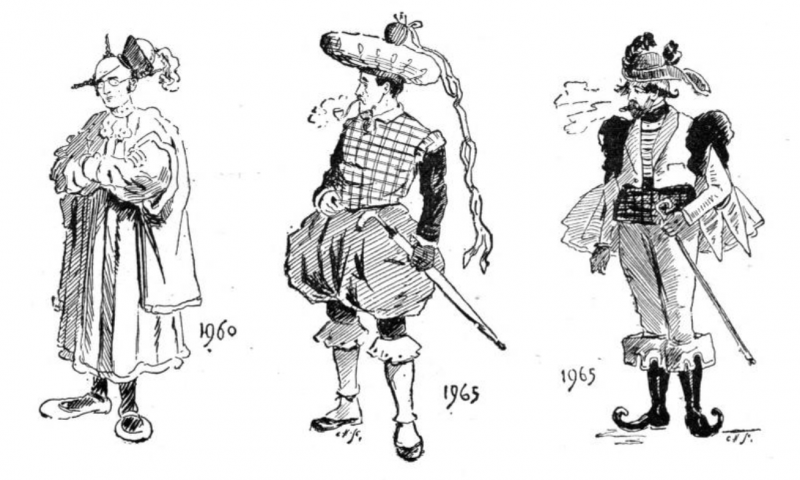
“Fashion,” writes W. Cade-Gall in an 1893 article in the Strand Magazine, “is thought a whim, a sort of shuttlecock for the weak-minded of both sexes to make rise and fall, bound and rebound with the battledore called—social influence.” All of this will be remedied almost fifty years in the future, the author assures their readers. “It will interest a great many people to learn that Fashion assumed the dignity of a science in 1940.” Cade-Gall’s sci-fi satire is not, perhaps, the most serious attempt at predicting future fashions, but it may rank as one of the most amusingly literary.
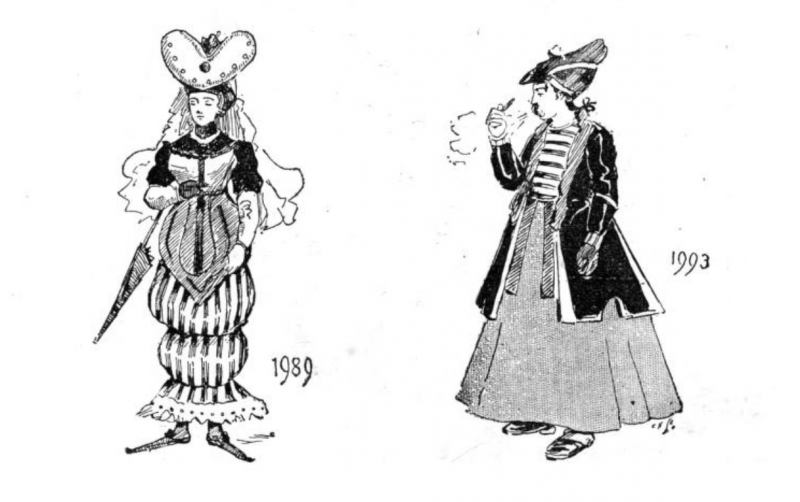
The article, “Future Dictates Fashion” (read online here and at the Internet Archive) purports to describe the contents of a book, discovered by “an elderly gentleman of our acquaintance,” from one hundred years in the future, or 1993, a time, as you can see in the drawing at the top, in which the 18th century has come roaring back, with what appears to be a tricorner hat perched on what appears to be the head of a man smoking a pipe and wearing an ankle-length skirt. Cade-Gall describes the scientific system of fashion in detail, with each historical period acquiring both a “Type” and a “Tendency.”
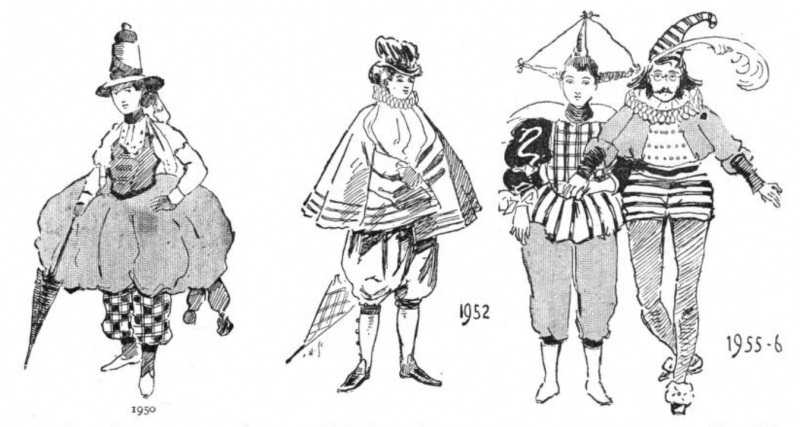
The period between 1915 and 1940, for example, the last one listed in the future fashion history book’s table, is said to be of the type “Hysterical” and the tendency “Angustorial.” Cade-Gall not only invented the word “angustorial” and this clever story within a story (which turns out to be a dream) but also illustrated the fashions of the imagined 20th century, with the conceit that these are printed plates from the future. Readers familiar with the costume designs of the Bauhaus school might see the 1929 illustrations as somewhat uncanny.
Other fashions look like the kind of thing David Bowie might have worn onstage in the early 70s, and some are clearly portmanteaus of different eras and their qualities—from the “bizarre,” “ebullient,” and “hysterical” to the “severe,” “opaque,” and “latorial,” a word, like “angustorial,” that Cade-Gall made up for this occasion. The descriptions of these fashions are as detailed and ridiculous as the illustrations. “Taught by the Darwinian theory” in 1930 we learn, “society discovered whence its tendency to baldness originated. They had recourse by degrees to flexible tiles of extraordinary cut.”
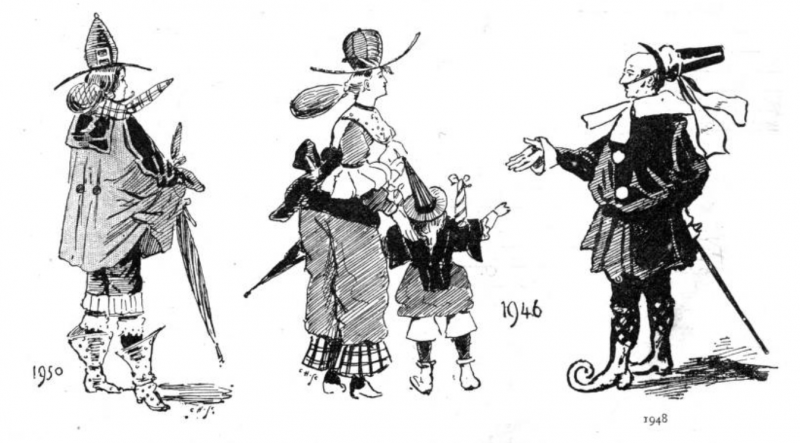
The hairpiece innovation followed some indecision over mens’ pants ten years earlier, which led to a period of knee-breeches. “Trousers, which had been wavering between nautical buttons and gallooned knees—or, in the vernacular of the period, a sail three sheets in the wind—and a flag at half-mast—were the items sacrificed.” It’s all in good fun—more a send-up of the overly-serious meaning attached to clothing than an attempt to look into fashion’s future. But imagining a 20th century dressed the way Cade-Gall imagines it might make us pine for a more ostentatiously (if impractically) dressed past—or a more ebullient and latorial future, whether on Earth or gallooned amongst the stars.
via JF Ptak Science Books/Public Domain Review
Related Content:
Josh Jones is a writer and musician based in Durham, NC. Follow him at @jdmagness
Read More...Support Us
We're hoping to rely on loyal readers, rather than erratic ads. Please click the Donate button and support Open Culture. You can use Paypal, Venmo, Patreon, even Crypto! We thank you!

About Us

Open Culture scours the web for the best educational media. We find the free courses and audio books you need, the language lessons & educational videos you want, and plenty of enlightenment in between.
Advertise With Us

FREE UPDATES!
GET OUR DAILY EMAIL
Get the best cultural and educational resources on the web curated for you in a daily email. We never spam. Unsubscribe at any time.
FOLLOW ON SOCIAL MEDIA

Open Culture editor Dan Colman scours the web for the best educational media. He finds the free courses and audio books you need, the language lessons & movies you want, and plenty of enlightenment in between.
Advertise With Us

