Do Octopi Dream? An Astonishing Nature Documentary Suggests They Do
With regard to the sleeping and waking of animals, all creatures that are red-blooded and provided with legs give sensible proof that they go to sleep and that they waken up from sleep; for, as a matter of fact, all animals that are furnished with eyelids shut them up when they go to sleep.
Furthermore, it would appear that not only do men dream, but horses also, and dogs, and oxen; aye, and sheep, and goats, and all viviparous quadrupeds; and dogs show their dreaming by barking in their sleep. With regard to oviparous animals we cannot be sure that they dream, but most undoubtedly they sleep.
And the same may be said of water animals, such as fishes, molluscs, crustaceans, to wit crawfish and the like. These animals sleep without doubt, although their sleep is of very short duration. The proof of their sleeping cannot be got from the condition of their eyes-for none of these creatures are furnished with eyelids—but can be obtained only from their motionless repose.
-Aristotle, The History of Animals, Book IV, Part 10,350 B.C.E
2,369 years later, Marine Biologist David Scheel, a professor at Alaska Pacific University, witnessed a startling event, above, that allowed him to expand on Aristotle’s observations, at least as far as eight-armed cephalopod mollusks—or octopi—are concerned
Apparently, they dream.
Scheel, whose specialties include predator-prey ecology and cephalopod biology, is afforded an above-average amount of quality time with these alien animals, courtesy of Heidi, an octopus cyanea (or day octopus) who inhabits a large tank of salt water in his living room.
Scheel’s usual beat is cold water species such as the giant Pacific octopus. Heidi, who earned her name by shyly sticking to the farthest recesses of her artificial environment upon arrival, belongs to a warmer water species who are active during the day. Very active. Once she realized that Scheel and his 16-year-old daughter, Laurel, were instruments of food delivery, she came out of her shell, so to speak.
The hours she keeps affords her plenty of stimulating playtime with Laurel, who’s thrilled to have an animal pal who’s less ambivalent than her pet goldfish and outdoor rabbit.
Meanwhile, the co-housing arrangement provides Professor Scheel with an intimacy that’s impossible to achieve in the lab.
He was not expecting the astonishing nocturnal behavior he recorded, above, for the hour-long PBS Nature documentary Octopus: Making Contact.
As Heidi slept, she changed colors, rapidly cycling through patterns that correspond to her hunting practices. Scheel walks viewers through:
So, here she’s asleep, she sees a crab, and her color starts to change a little bit.
Then she turns all dark.
Octopuses will do that when they leave the bottom.
This is a camouflage, like she’s just subdued a crab and now she’s going to sit there and eat it and she doesn’t want anyone to notice her.
It’s a very unusual behavior to see the color come and go on her mantel like that.
I mean, just to be able to see all the different color patterns just flashing, one after another.
You don’t usually see that when an animal is sleeping.
This really is fascinating.
But, yeah, if she’s dreaming, that’s the dream.
As dreams go, the narrative Scheel supplies for Heidi seems extremely mundane. Perhaps somewhere out on a coral reef, another octopus cyanea is dreaming she’s trapped inside a small glass room, feasting on easily gotten crab and occasionally crawling up a teenaged human’s arm.
Watch the full episode for free through October 31 here.
via Laughing Squid/This is Colossal
Related Content:
Every U.S. Vice President with an Octopus on His Head: Kickstart The Veeptopus Book
Environment & Natural Resources: Free Online Courses
Ayun Halliday is an author, illustrator, theater maker and Chief Primatologist of the East Village Inkyzine. Join her in NYC tonight, Monday, October 7 when her monthly book-based variety show, Necromancers of the Public Domaincelebrates the art of Aubrey Beardsley. Follow her @AyunHalliday.
Read More...Watch Animated Scores of Beethoven’s 16 String Quartets: An Early Celebration of the 250th Anniversary of His Birth
Two years ago we posted about a music lover’s life’s work–Stephen Malinowski aka smalin on YouTube–and how he has produced animated, side-scrolling scores to classical music. Older folks will liken them to neon piano rolls. Youngun’s will see a bit of Guitar Hero or Rock Band game design in their march of colorful shapes dancing to everything from Bach to Debussy.
Malinowski let us know that he just recently completed a major work: adapting all of Beethoven’s String Quartets into his particular, always evolving style. And for this he turned to San Francisco’s Alexander String Quartet for their recordings. Says the animator:
I made my first graphical scores in the 1970s, my first animated graphical score in 1985, and the first of these for a movement of a Beethoven string quartet in 2010. In 2014 I began collaborating with the Alexander String Quartet on selected movements of Beethoven string quartets, and in the early months of 2019 we decided to honor the 250th anniversary of Beethoven’s birth by extending our collaboration to the full set. [Note: that anniversary will officially take place next year.]
One important point: Malinowski does not choose colors randomly or because they are pretty. Instead, he uses “Harmonic Coloring”:
I’ve assigned blue to be the “home pitch” (the tonic, notataed Roman numeral “I”) because that seemed the most “settled,” and chosen the blue-toward-red direction as the I‑toward‑V direction because motion toward the dominant (“V”) seems more “active” compared with motion toward the subdominant (“IV”).
This might not make sense just by reading it, but head to this page to see how the color wheel looks. There you can see how classical music has evolved from the Renaissance (mostly staying with the seven pitches in an octave) to the radical changes of Brahms and then through Debussy to Stravinsky, where it is a riot of color.
Beethoven wrote 16 string quartets between 1798 and 1826, as well as a Große Fuge included here that only had one movement, and gained a notoriety in its day as being a chaotic, inaccessible mess. (They were wrong). The last five, known at the Late Quartets, were written in the last three years of his life. He was completely deaf by this time, suffering from all sorts of medical issues, recovering from brushes with death, and yet… the Late Quartets are considered by many to be his masterpieces, even more notable given that he had come to the quartet form later than other composers and wracked with doubt about his talents.
The final movement of his final string quartet (No. 16) was the last complete work Beethoven would ever write. At the top of the score he wrote “Must it be? It must be!” Death was at the door.
For those ready to learn or ready to revisit these challenging works, Malinowski has made it a treat for the eyes as well as the ears. See the complete playlist of animated string quartets here. Or stream them all, from start to finish, below:
Related Content:
How Did Beethoven Compose His 9th Symphony After He Went Completely Deaf?
The Story of How Beethoven Helped Make It So That CDs Could Play 74 Minutes of Music
The Genius of J.S. Bach’s “Crab Canon” Visualized on a Möbius Strip
Ted Mills is a freelance writer on the arts who currently hosts the artist interview-based FunkZone Podcast and is the producer of KCRW’s Curious Coast. You can also follow him on Twitter at @tedmills, read his other arts writing at tedmills.com and/or watch his films here.
Read More...When Ted Turner Tried to Colorize Citizen Kane: See the Only Surviving Scene from the Great Act of Cinematic Sacrilege
Could there be a greater act of cinematic sacrilege than colorizing Citizen Kane? For most of the past 78 years since its premiere, Orson Welles’ debut feature has been widely considered the greatest motion picture ever made: witness, for instance, its domination of Sight & Sound magazine’s critics poll from 1962 until its slip to second place under Alfred Hitchcock’s Vertigo in 2012. Artistically innovative in ways that still influence movies today, it would seem that Citizen Kane requires no help from subsequent generations. But that didn’t stop Ted Turner, the media mogul whose previous colorizations of Casablanca, King Kong, and The Philadelphia Story had already disheartened not just lovers of classic Hollywood films but those films’ surviving makers as well.
“Turner Entertainment Company, which had obtained the home video rights to Citizen Kane in 1986, announced with much fanfare on January 29, 1989 its plans to colorize Welles’ first Hollywood movie,” writes Ray Kelly at Wellesnet. “There was an immediate backlash with the Welles estate and Directors Guild of America threatening legal action.”
Welles himself had died in 1985, but the filmmaker Henry Jaglom quoted the director of Citizen Kane as importuning him not to “let Ted Turner deface my movie with his crayons.” Ultimately Turner’s crayons were indeed stayed, but for legal reasons: a review of Welles’ initial contract with RKO “revealed he had been given absolute artistic control over his first Hollywood film, which it specified would be a black-and-white picture” — an odd specification to declare back in 1940, but declared nonetheless.
Before that discovery, “a team at Color Systems Technology Inc. in Marina del Rey, California” had already “secretly colorized a portion of Orson Welles’ landmark black and white film”: its final ten minutes, Rosebud and all. The only known surviving footage of this project — which took Citizen Kane and not just colorized it but also, of course, reduced it to the resolution and aspect ratio of 1980s television — is included in the BBC Arena documentary The Complete Citizen Kane, the relevant clip of which appears at the top of the post. Kelly quotes William Schaeffer, assistant art director at CST at the time, as remembering the results fondly: “I thought it looked fine.” Then again, Schaeffer had never actually seen the real Citizen Kane — and as for the rest of us, we perhaps breathe a little easier knowing that Vertigo is already in color.
Related Content:
Orson Welles Explains Why Ignorance Was His Major “Gift” to Citizen Kane
Jorge Luis Borges Reviews Citizen Kane — and Gets a Response from Orson Welles
Donald Deconstructs Citizen Kane
Based in Seoul, Colin Marshall writes and broadcasts on cities, language, and culture. His projects include the book The Stateless City: a Walk through 21st-Century Los Angeles and the video series The City in Cinema. Follow him on Twitter at @colinmarshall or on Facebook.
Read More...Is It Really Ever a Good Idea to Revive an Old TV Show? Pretty Much Pop #13 Considers

An appalling number of shows are now being continued long after their deaths. Revivals (not to be confused with reboots) bring us back to the comfort of old friends, who are now really old. What can a revival’s success tell us about why the show was appealing in the first place? Wouldn’t you rather see a new work by the same creative team than more of the same? Mark, Erica, and Brian consider some successes, failures, and hypotheticals.
We consider Arrested Development, The Twilight Zone, X‑Files, Twin Peaks, Will & Grace, Deadwood, Full House, Gilmore Girls, Queer Eye, Doctor Who, Veronica Mars, and talk too much about The Brady Bunch and Alf.
Some articles we looked at:
- “In Defense of TV Reboots and Revivals” by LaToya Furguson
- “TV Keeps Rebooting ‘90s Shows Because Everything Is Bad” by Orlana Schwindt
- “From Arrested Development to Deadwood to Veronica Mars, Fandoms Keep Shows Coming Back From the Dead” by Noel Murray
- “TV Reboots and Revivals” by Emily Longeretta (a current list)
- “Revivals” at tvtropes.com
This episode includes bonus discussion that you can only hear by supporting the podcast at patreon.com/prettymuchpop. This podcast is part of the Partially Examined Life podcast network.
Pretty Much Pop is the first podcast curated by Open Culture. Browse all Pretty Much Pop posts or start with the first episode.
Read More...Metropolis Remixed: Fritz Lang’s German Expressionist Sci-Fi Classic Gets Fully Colorized and Dubbed
Those of us who grew up with late-night cable television will have a few memories of happening upon old movies that didn’t look quite right. Usually drawn from the 1940s or 50s, and sometimes from the depths of genres like science-fiction and horror, these pictures had undergone the process of colorization in hopes of increasing their appeal to a generation unused to black-and-white imagery. Alas, even the most high-profile colorization projects back then tended to look washed-out, with lifelessly pale faces lost among washes of green and brown. On the technical level colorization has improved in the decades since, though on the artistic level its usage remains, to say the least, a suspect endeavor.
But what if the film chosen for colorization was, rather than some piece of drive-in schlock, one of the acknowledged masterpieces of early 20th-century cinema? MetropolisRemix comes as one especially intriguing (if also startling) answer to that question, bringing as it does Fritz Lang’s hugely influential 1927 work of German Expressionist sci-fi from not just the world of black-and-white film into color but from that of silent film into sound.
To add color its makers used DeOldify, “a deep learning-based project for colorizing and restoring old images (and video!)” previously featured here on Open Culture when we posted this colorized footage of Paris, New York, and Havana from the late 19th and early 20th century. You can get a taste of the MetropolisRemix viewing experience from this trailer.
In its entirety this version of Metropolis runs just over two hours, quite a bit shorter than the film’s most recent restoration, 2010’s The Complete Metropolis. The difference owes in large part to the lack of dialogue-conveying intertitles, which have been rendered unnecessary by a full-cast English-language dub that includes music and sound effects. Not everyone, of course, will approve of this “fan modernization,” as its creators describe it. Phil Hall at Cinema Crazed prefers to call it “the most recklessly bad idea for a film since All This and World War II, the infamous 1976 nonsense that united Second World War newsreel footage with mostly unsatisfactory cover versions of Beatles music.” But the sheer brazenness of MetropolisRemix nevertheless impresses — and somehow, Lang and his collaborators’ vision of an industrial art-deco dystopia survives.
via Messy Nessy
Related Content:
Metropolis: Watch a Restored Version of Fritz Lang’s Masterpiece (1927)
Read the Original 32-Page Program for Fritz Lang’s Metropolis (1927)
Fritz Lang Invents the Video Phone in Metropolis (1927)
H.G. Wells Pans Fritz Lang’s Metropolis in a 1927 Movie Review: It’s “the Silliest Film”
10 Great German Expressionist Films: From Nosferatu to The Cabinet of Dr. Caligari
Based in Seoul, Colin Marshall writes and broadcasts on cities, language, and culture. His projects include the book The Stateless City: a Walk through 21st-Century Los Angeles and the video series The City in Cinema. Follow him on Twitter at @colinmarshall or on Facebook.
Read More...The First Music Streaming Service Was Invented in 1881: Discover the Théâtrophone
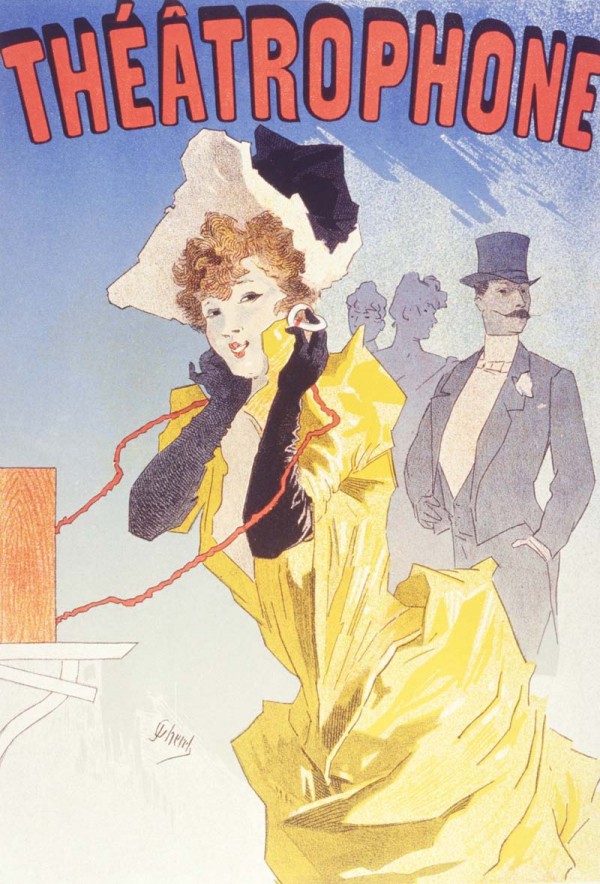
Every living adult has witnessed enough technological advancement in their lifetime to marvel at just how much has changed, and digital streaming and telecommunications happen to be areas where the most revolutionary change seems to have taken place. We take for granted that the present resembles the past not at all, and that the future will look unimaginably different. So the narrative of linear progress tells us. But that story is never as triumphantly simple as it seems.
In one salient counterexample, we find that not only did livestreaming music and news exist in theory long before the internet, but it existed in actual practice—at the very dawn of recording technology, telephony, and general electrification. First developed in France in 1881 by inventor Clement Ader, who called his system the Théâtrophone, the device allowed users to experience “the transmission of music and other entertainment over a telephone line,” notes the site Bob’s Old Phones, “using very sensitive microphones of [Ader’s] own invention and his own receivers.”
The pre-radio technology was ahead of its time in many ways, as Michael Dervan explains at The Irish Times. The Théâtrophone “could transmit two-channel, multi-microphone relays of theatre and opera over phone lines for listening on headphones. The use of different signals for the two ears created a stereo effect.” Users subscribed to the service, and it proved popular enough to receive an entry in the 1889 edition of The Electrical Engineer reference guide, which defined it as “a telephone by which one can have soupçons of theatrical declamation for half a franc.”
In 1896 “the Belle Epoque pop artist Jules Cheret immortalized the theatrophone,” writes Tanya Basu at Mental Floss, “in a lithograph featuring a woman in a yellow dress, grinning as she presumably listened to an opera feed.” Victor Hugo got to try it out. “It’s very strange,” he wrote. “It starts with two ear muffs on the wall, and we hear the opera; we change earmuffs and hear the French Theatre, Coquelin. And we change again and hear the Opera Comique. The children and I were delighted.”
Though The Electrical Engineer also called it “the latest thing to catch [Parisians’] ears and their centimes,” the innovation had already by that time spread elsewhere in Europe. Inventor Tivador Puskas created a “streaming” system in Budapest called Telefon Hermondo (Telephone Herald), Bob’s Old Phones points out, “which broadcast news and stock market information over telephone lines.” Unlike Ader’s system, subscribers could “call in to the telephone switchboard and be connected to the broadcast of their choice. The system was quite successful and was widely reported overseas.”
The mechanism was, of course, quite different from digital streaming, and quite limited by our standards, but the basic delivery system was similar enough. A third such service worked a little differently. The Electrophone system, formed in London in 1884, combined its predecessors’ ideas: broadcasting both news and musical entertainment. Playback options were expanded, with both headphones and a speaker-like megaphone attachment.
Additionally, users had a microphone so that they could “talk to the Central Office and request different programs.” The addition of interactivity came at a premium. “The Electrophone service was expensive,” writes Dervan, “£5 a year at a time when that sum would have covered a couple months rent.” Additionally, “the experience was communal rather than solitary.” Subscribers would gather in groups to listen, and “some of the photographs” of these sessions resemble “images of addicts in an old-style opium den”—or of Victorians gathered at a séance.
The company later gave recuperating WWI servicemen access to the service, which heightened its profile. But these early livestreaming services—if we may so call them—were not commercially viable, and “radio killed the venture off in the 1920s” with its universal accessibility and appeal to advertisers and governments. This seeming evolutionary dead end might have been a distant ancestor of streaming live concerts and events, though no one could have foreseen it at the time. No one save science fiction writers.
Edward Bellamy’s 1888 utopian novel Looking Backward imagined a device very like the Théâtrophone in his vision of the year 2000. And in 1909, E.M. Forster drew on early streaming services and other early telecommunications advances for his visionary short story “The Machine Stops,” which extrapolated the more isolating tendencies of the technology to predict, as playwright Neil Duffield remarks, “the internet in the days before even radio was a mass medium.”
Related Content:
The History of the Internet in 8 Minutes
Hear the First Recording of the Human Voice (1860)
How an 18th-Century Monk Invented the First Electronic Instrument
Josh Jones is a writer and musician based in Durham, NC. Follow him at @jdmagness
Read More...19th-Century Skeleton Alarm Clock Reminded People Daily of the Shortness of Life: An Introduction to the Memento Mori
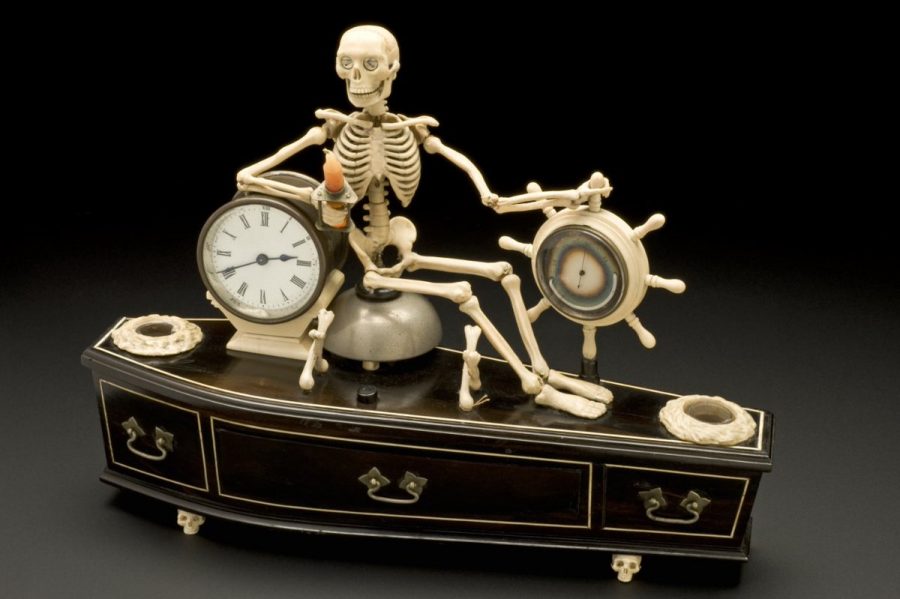
Victorian culture can seem grim and even ghoulish to us youth-obsessed, death-denying 21st century moderns. The tradition of death photography, for example, both fascinates and repels us, especially portraiture of deceased children. But the practice “became increasingly popular,” notes the BBC, as “Victorian nurseries were plagued by measles, diphtheria, scarlet fever, rubella—all of which could be,” and too often were, “fatal.”
Adults did not fare much better when it came to the epidemic spread of killer diseases. Surrounded inescapably by death, Victorians coped by investing their world with totemic symbols, cultural artifacts known as memento mori, meaning “remember, you must die.” Tuberculosis, cholera, influenza… at any moment, one might take ill and waste away, and there would likely be little medical science could do about it.
Perhaps the best approach, then, was an acceptance of death while in the bloom of health, in order to not waste the moment and to learn to pay attention to what mattered while one could. Memento mori drawings, paintings, jewelry, photographs, and trinkets have populated European cultural history for centuries; death as an ever-present companion, not to be hidden away and feared but solemnly, respectfully given its due.

Or maybe not so respectfully, as the case may be. Some of these novelties, like the skeleton alarm clock at the top, look more like they belong at the bottom of a fish tank than a proper parlor mantle. “Presumably when the alarm went off,” writes Allison Meier at Hyperallergic, “the skeleton would shake its bones.” Wake up, life is short, you could die at any time. “Part of the collections of Science Museum, London, it’s believed to be of English origin and date between 1840 and 1900.”
The Tim Burton-esque tchotchke appeared in a 2014 British Library exhibit called Terror and Wonder: The Gothic Imagination, with many other such objects of varying degrees of artistry: “200 objects from a span of 250 years, all centered on the Gothic tradition in art, literature, music, fashion, and most recently film.” Memento mori artifacts offer visceral reminders that real, daily confrontations with disease and death were “at the base of much of Gothic literature and art.”
Where we now tend to read the Gothic as primarily reflective of social, cultural, and religious anxieties, the prevalence of memento mori in European homes both low and high (such as Mary Queen of Scots’ skull watch, in an 1896 illustration above) shows us just how much the gloomy strain of thinking that became the modern horror genre derives from a desire to confront mortality head on, so to speak, and finding that looking death in the face brings on ancient uncanny dread as much as healthy gallows humor and stoic, stiff-upper-lip reckoning with the ultimate fact of life.
Related Content:
An Artist Crochets a Life-Size, Anatomically-Correct Skeleton, Complete with Organs
Celebrate The Day of the Dead with The Classic Skeleton Art of José Guadalupe Posada
Old Books Bound in Human Skin Found in Harvard Libraries (and Elsewhere in Boston)
Josh Jones is a writer and musician based in Durham, NC. Follow him at @jdmagness
Read More...Watch Queen Rehearse & Meticulously Prepare for Their Legendary 1985 Live Aid Performance
It seems no small irony that lean, late-seventies and eighties New Wave bands like U2, Depeche Mode, and the Cure, who made legacy stadium rock acts like Queen seem outmoded, went on to become massive-selling stadium legacy acts themselves. The musical critique of 70’s rock excesses found its most popular expression in bands that took a lot from Freddie Mercury and company: flamboyant sexual fluidity, spectacular light shows, raw emotional confessionalism, stridently sentimental, fist-pumping anthems…
Yet in the eighties, a “wide-sweeping change in musical tastes” displaced Queen’s reign on the charts, writes Lesley-Ann Jones in Mercury: An Intimate Biography of Freddie Mercury. They were “confoundingly on the wane” and “were beginning to feel that they’d had their day. A permanent split was in the cards. They’d talked about it.” But it was not to be, thanks to Live Aid, the near-mythological July 13, 1985 performance at Wembley Stadium. After that gig, remembers Queen keyboardist Spike Edney, “Queen found that their whole world had changed.”
Suddenly, after their short, 20-minute daylight set (see the video at the bottom), they were again the biggest band on the planet. “Queen smoked ‘em,” as Dave Grohl puts it. “They walked away being the greatest band you’d ever seen in your life, and it was unbelievable.” The sentiment was universally echoed by everyone from Elton John to Bowie to Bono to Paul McCartney, all of them upstaged that day. “It has been repeated ad nauseam,” writes Jones, “that Queen’s performance was the most thrilling, the most moving, the most memorable, the most enduring—surpassing as it did the efforts of their greatest rivals.”
The band, however, was “surprised that everyone was surprised,” says Edney. “They were veterans at stadium gigs… this was their natural habitat.” Queen “could practically do this stuff in their sleep.” Mixing his metaphors, Edney also reveals just how hard the band worked to remain the consummate professionals they were: “to them, it was another day at the office.” As such, they put in their time to make absolutely certain that they would be in top form. “They booked out the 400-seat Shaw Theatre, near King’s Cross train station in London,” notes Martin Chilton at Udiscovermusic, “and spent a week honing their five-song set,” planning every single part of it to perfection.
Live Aid organizer Bob Geldof had asked bands not to debut new material but play fan favorites. Edney was “stunned to hear certain artists belting out their latest single.” But Queen took Geldof’s “message to heart,” putting together a carefully curated medley of their biggest hits. In the video at the top of the post, see the band discuss this behind-the-scenes process with an interviewer before going onstage in front of a crowd of “the 72,000 fans who would be at Wembley—and the estimated 1.9 billion people watching on television from 130 countries around the world.”
In answer to a question about going onstage without their usual spectacular stage and light show, or even time for a sound check before their set, Brian May replies, “it all comes down to whether you can play or not, really, which is nice, in a way, because I think there’s probably an element who think that groups like us can’t do it without the extravagant backdrop.” Whoever he might have been referring to, his “We’ll see” sounds supremely confident.
The band was meticulously prepared. After the interview, we see rehearsal footage of nearly their full set, beginning with “Radio Ga Ga,” a song whose chorus during the live event produced what was described as “the note heard around the world.” (See it above.) After their incredible performance May sounded much more modest, even self-effacing. “The rest of us played OK, but Freddie went out there and took it to another level. It wasn’t just Queen fans. He connected with everyone. I’d never seen anything like that in my life.”
The performance is all the more remarkable for the fact that Queen had been shunned just the previous year for breaking the boycott and playing in South Africa, for noble but misunderstood reasons at the time. They were considering calling it quiets, but the pressures they were under seemed only to galvanize them into what everyone remembers as their greatest show ever—”Queen’s ultimate moment,” writes Jones, “towards which they had been building their entire career.”
Related Content:
Josh Jones is a writer and musician based in Durham, NC. Follow him at @jdmagness
Read More...A 900-Page Pre-Pantone Guide to Color from 1692: A Complete Digital Scan
Human beings got along perfectly well for hundreds of millennia without standardized taxonomies of color, but they didn’t do so in a globally connected culture full of logos, brands, and 24/7 screens. It’s arguable whether the world as we now see it would have been possible without monopolistic color systems like Pantone. They may circumscribe the visual world and dictate color from above. But they also enable international design principles and visual languages that translate easily everywhere.
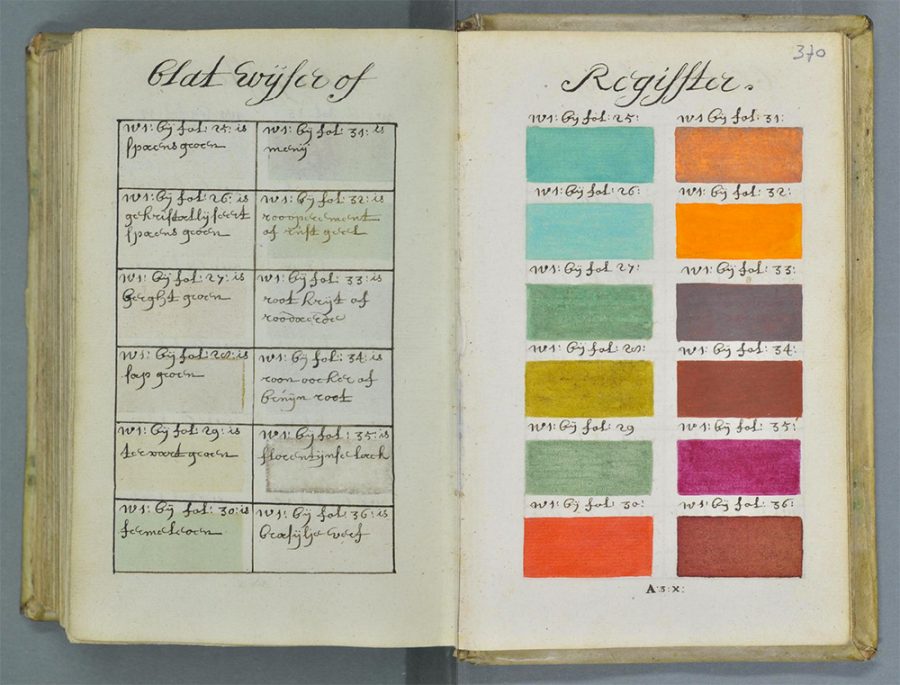
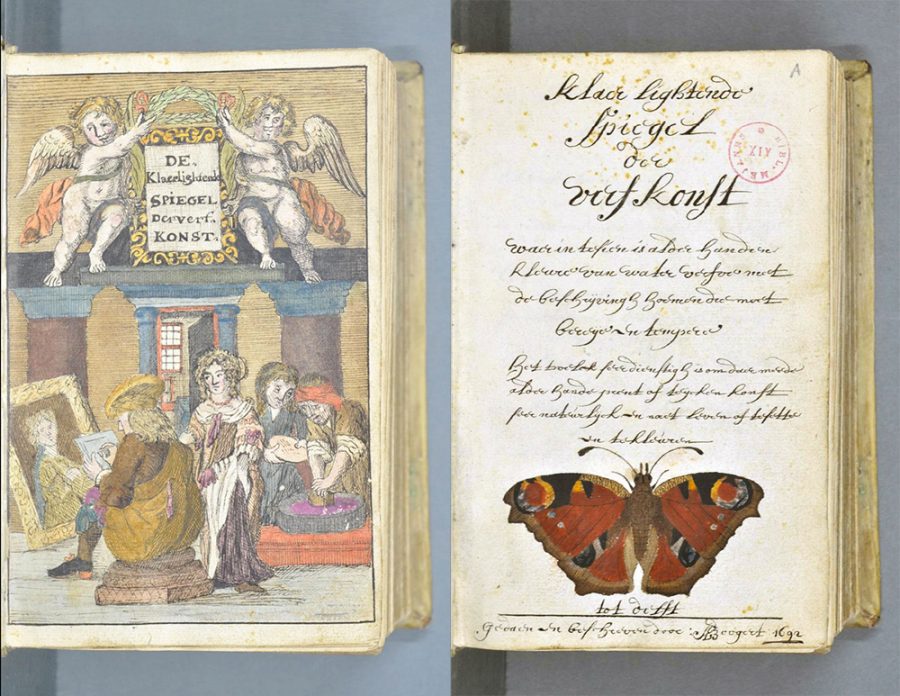
These circumstances did not yet exist in 1692, when Dutch artist A. Boogert created a huge, almost 900-page book on color, Traité des couleurs servant à la peinture à l’eau. But they were slowly coming into being, thanks to studies by philosopher-scientists like Isaac Newton.
Boogert’s book took enlightenment work on optics in a more rigorous design direction than any of his contemporaries, anticipating a number of influential books on color to come in the following centuries, such as the art history-making studies by Johann Wolfgang von Goethe and a book on color used by Charles Darwin during his Beagle voyage.
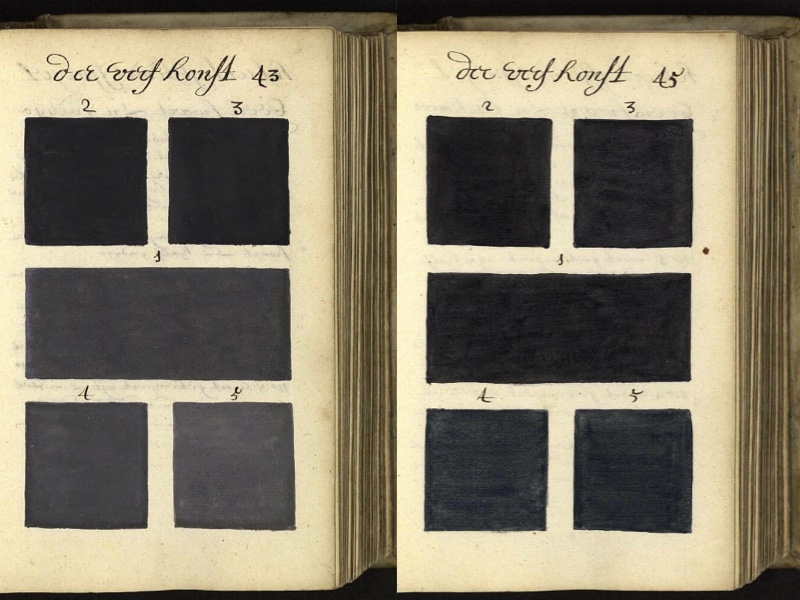
Boogert’s exhaustive study includes handwritten notes and descriptions and hundreds of hand-painted color swatches. This above-and-beyond effort was not, however, made for scientific or industrial purposes but as a guide for artists, showing how to mix watercolors to make every color in the spectrum. The author even includes a comprehensive unit on whites, grays, and blacks. How much historical influence did Boogert’s text have on the development of standardized color systems, we might wonder? Hardly any at all. Its single copy, notes Colossal, “was probably seen by very few eyes.”
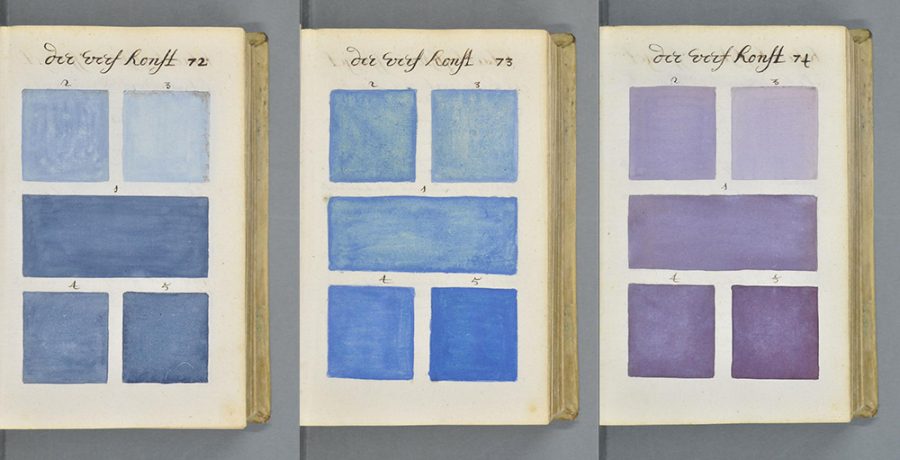
The obscure book disappeared in the archives of the Bibliothèque Méjanes in Aix-en-Provence, France. That is, until its discovery recently by Medieval book historian Erik Kwakkel, who posted scans on his Tumblr and translated some of the introduction from the original Dutch. Since then, the complete text has come online: 898 pages of high-resolution digital scans at the Bibliothèque Méjanes site. (Go to this page, click on the picture, then click on the arrows in the lower right side of the page to move through the book.)
If you read Dutch, all the better to appreciate this rare historic artifact. But you don’t need to understand A. Boogert’s explanations on watercolor technique to be staggered by the incredible amount of work that went into this early, overlooked labor of love for systematic approaches to color. Enter the full text here.
Related Content:
The Vibrant Color Wheels Designed by Goethe, Newton & Other Theorists of Color (1665–1810)
Josh Jones is a writer and musician based in Durham, NC. Follow him at @jdmagness
Read More...Quentin Tarantino Explains How to Write & Direct Movies
When Quentin Tarantino debuted in 1992 with Reservoir Dogs, and even more so when he followed it up with the cinematic phenomenon that was Pulp Fiction, the viewers most dubious about the young auteur’s cultural staying power dismissed his movies as elevations of style over substance. Whether or not Tarantino has converted all his early critics over the past 27 years, he’s certainly demonstrated that style can constitute a substance of its own.
Even many who didn’t care for his latest picture, this year’s Once Upon a Time in Hollywood, nevertheless expressed gratitude at the release of a lavish, large-scale film packed full of ideas, references, set pieces, and jokes — an increasingly rare achievement, or even aspiration, among non-Tarantino filmmakers. How does he do it? The Director’s Chair profile video above, and the accompanying Studio Binder essay by Matt Vasiliauskas, identifies the essential elements that constitute the Tarantinian style and Tarantinian substance.
In the video Tarantino discusses his process: “I was put on Earth to face the blank page,” to bring forth ideas from within and place them in new genre contexts, to write one line of dialogue after another and feel the surprise as the script takes turns unexpected even to him. Everything, from conversations to action scenes to expansive wide shots, plays out in his head before he shoots the first frame: “Before I make the movie, I watch the movie.” And like all auteurs, he makes the movie he wants to see: “I don’t think the audience is this dumb person lower than me,” he has said. “I am the audience.”
A filmmaker looking to follow Tarantino’s example must do the following: “Keep it personal,” using experiences they’ve actually had or emotions they’ve actually felt, even if they present them filtered through “crazy genre world.” “Structure like a novel,” with the willingness to break free of chronological order. “Think like an actor,” since you’ll have to work long and hard with them. Shoot “Hong Kong action sequences,” two or three moves at a time, so that you can organically change and incorporate what happens along the way. “Keep music in mind,” whether that means existing songs that evoke certain times, places, and moods, or original scores like that which Tarantino commissioned for The Hateful Eight from Ennio Morricone.
Morricone is best known for his collaborations with Tarantino’s hero Sergio Leone, and like Leone and “all directors working at the top of their game,” writes Vasiliauskas, Tarantino “uses the camera as his most powerful storytelling implement,” especially when shooting wide. “Whether it’s the Bride battling the Crazy 88 gang in Kill Bill or Django surveying a burned-out home, Tarantino understands the power of the wide-shot to not only create tension, but to utilize the environment in revealing the desires of his characters.” But he also gets serious aesthetic and emotional mileage out of extreme close-ups, crash zooms, and point-of-view shots from inside the trunk of a car (or period equivalents thereof).
Above all, this former Manhattan Beach video-store clerk “absorbs movies,” and has by his own admission stolen from more films than most of us will watch in our lives. But none of this makes predictable what Tarantino will draw from his real-life and filmgoing experiences and put on the screen next: “I should throw them for a loop,” he says in an interview clip included in the video. He means his audience, of course, but before he can throw us for a loop, he has to do it to himself. And whatever thrills and surprises Tarantino will, as we’ve seen over the course of ten feature films so far, thrill and surprise us even more.
Related Content:
How Quentin Tarantino Steals from Other Movies: A Video Essay
Quentin Tarantino Explains The Art of the Music in His Films
Based in Seoul, Colin Marshall writes and broadcasts on cities, language, and culture. His projects include the book The Stateless City: a Walk through 21st-Century Los Angeles and the video series The City in Cinema. Follow him on Twitter at @colinmarshall or on Facebook.
Read More...Support Us
We're hoping to rely on loyal readers, rather than erratic ads. Please click the Donate button and support Open Culture. You can use Paypal, Venmo, Patreon, even Crypto! We thank you!

About Us

Open Culture scours the web for the best educational media. We find the free courses and audio books you need, the language lessons & educational videos you want, and plenty of enlightenment in between.
Advertise With Us

FREE UPDATES!
GET OUR DAILY EMAIL
Get the best cultural and educational resources on the web curated for you in a daily email. We never spam. Unsubscribe at any time.
FOLLOW ON SOCIAL MEDIA

Open Culture editor Dan Colman scours the web for the best educational media. He finds the free courses and audio books you need, the language lessons & movies you want, and plenty of enlightenment in between.
Advertise With Us

