The Simulation Theory Explained In Three Animated Videos
The idea that we are software emanations in a vast, unimaginably complex computer simulation may carry more dizzying philosophical, ethical, and psychological implications than any other metaphysical assumption. It is not, however, quite a new idea, even if machines sophisticated enough to make worlds are only now conceivable. We see ancient sages speculate that solid matter is no more than some sort of graphical (tactile, etc.) user interface originating from the mind of a master coder.
We see a similar idea in the immaterialism of 18th century British empiricist George Berkeley. And where would science fiction be—especially the hallucinatory sci-fi of Philip K. Dick—without varieties of the simulation theory? The TED-Ed lesson on simulation theory, above, by University of Maryland physicist Zohreh Davoudi (animated by Eoin Duffy) opens with a quote from Dick: “This is a cardboard universe, and if you lean too long or too heavily against it, you fall through.”
In Dick’s world, this happens frequently. But if our reality were a simulation, how could we possibly step outside it to confirm? Provable or not, the theory is endlessly compelling. Davoudi walks us through a couple of fascinating scientific attempts to “fall through” by theorizing the evidence we might expect to find if the universe is made of code.
For one thing, there would probably be glitches. To correct for errors, “the simulators could adjust the constants in the laws of nature.” Tiny shifts, perhaps undetectable with current instruments, could signal heuristic revisions. Other theoretical approaches involve using subatomic particles to detect the finite limits of the godlike computer’s power.
Would finding shifts in physical laws prove a simulation. No. And in any case, our entire species could have come and gone before any such shifts have taken place. We cannot presume that humans are the chosen beneficiaries of the simulated universe. Maybe we’re prototypes. Maybe our solar system is someone’s side project. Wouldn’t the simulators notice us figuring it out and prevent us from doing so? (They would, presumably, be watching.)
And why should the great computer have anything resembling the computational limitations of our own machines, Davoudi asks. After all, if it exists outside the universe as we know it and created its physical laws, it’s safe to assume that it exists in a different universe with entirely different laws, which we might never begin to understand. If your mind falls into pools of infinite regress when contemplating the idea—aided by consciousness-raising substances or otherwise—you won’t find anywhere safe to land in the other simulation videos here, from Vox and philosophy YouTube channel Kurzgesagt. But you might begin to see the concept as a little more plausible, and maybe more unsettling, than before.
Elon Musk, for example, drawing on the work of Oxford philosopher Nick Bostrom, suggests that the simulators are not extra-dimensional beings (or whatever), but hyper-sophisticated future humans running Sim versions of their past. This version also becomes the philosophical equivalent of mise en abyme as ancestor simulations, run on other planets, create their own simulations, ship them offworld, and so forth.…
You can go as far down this rabbit hole as you like. Or, you can do as Samuel Johnson supposedly did when he heard Bishop Berkeley claim that matter didn’t exist. Kick the nearest heavy object and shout, “I refute it thus!”
Related Content:
Josh Jones is a writer and musician based in Durham, NC. Follow him at @jdmagness.
Read More...Watch 10 Years with Hayao Miyazaki Free Online: A Four Part-Part Documentary on the Unstoppable Japanese Animator
When Conan O’Brien found himself temporarily out of a late-night television hosting job a few years ago, he went on tour with a stage show instead. If the documentary chronicling that period of his career wasn’t called Conan O’Brien Can’t Stop, a similar title could equally fit the recent films that have captured Hayao Miyazaki’s oscillation between work and “retirement.” In 2013’s Kingdom of Dreams and Madness, previously featured here on Open Culture, we thought we witnessed Miyazaki animating the final frame of his final feature. But his subsequent withdrawal from filmmaking proved short-lived, and his preparation for re-emergence (including his gone-viral critique of experimental computer animation) provides the subject for 2016’s Never-Ending Man.
This year, Never-Ending Man director Kaku Arakawa returns with 10 Years With Hayao Miyazaki, a four-part documentary available to watch free at NHK’s web site, and whose trailer appears at the top of the post. “Whereas Never-Ending Man tracked the director’s career from his short-lived retirement in 2013 to the germination of his forthcoming feature How Do You Live?, this series covers the decade running up to 2013,” writes Cartoon Brew’s Alex Dudok de Wit. Those were busy years for Miyazaki’s Studio Ghibli, involving as they did the production of Ponyo and The Wind Rises, as well as two films directed by Miyazaki’s son Goro: the Ursula K. LeGuin adaptation Tales from Earthsea and the 1960s boarding school-set From Up on Poppy Hill.
Tales from Earthsea came out in 2006, and at the time Miyazaki felt that Goro was unready to make his debut. As awkward as the period of estrangement between Miyazaki père et fils during that movie’s production may feel — especially given how often they’re in the same office — it reflects the near-impossibly high standard to which the man who directed My Neighbor Totoro, Princess Mononoke, and Spirited Away holds not just his successor and his collaborators, but himself. Above all himself, as revealed by the candid footage Arakawa’s decade of access to Miyazaki’s life allowed him to gather.
“We see him at work in his private studio and at Studio Ghibli, and relaxing at home,” writes Dudok de Wit, “insofar as he’s capable of relaxation.” What Miyazaki says to Arakawa about his craft, his worldview, and his life suggests a mind perpetually at work, even during the rare times his hands aren’t. 10 Years With Hayao Miyazaki ends with the making of The Wind Rises, but Arakawa must surely have known not to take the animator’s pronouncements of it being his final feature seriously: Hayao Miyazaki can’t stop, nor do we want him to.
Watch 10 Years With Hayao Miyazaki online here, and find it listed in our collection of Free Documentaries, a subset of our collection, 4,000+ Free Movies Online: Great Classics, Indies, Noir, Westerns, Documentaries & More.
Related Content:
Watch Hayao Miyazaki Animate the Final Shot of His Final Feature Film, The Wind Rises
Watch Moebius and Miyazaki, Two of the Most Imaginative Artists, in Conversation (2004)
Hayao Miyazaki Meets Akira Kurosawa: Watch the Titans of Japanese Film in Conversation (1993)
Based in Seoul, Colin Marshall writes and broadcasts on cities, language, and culture. His projects include the book The Stateless City: a Walk through 21st-Century Los Angeles and the video series The City in Cinema. Follow him on Twitter at @colinmarshall or on Facebook.
Read More...Download Full Issues of MAVO, the Japanese Avant-Garde Magazine That Announced a New Modernist Movement (1923–1925)
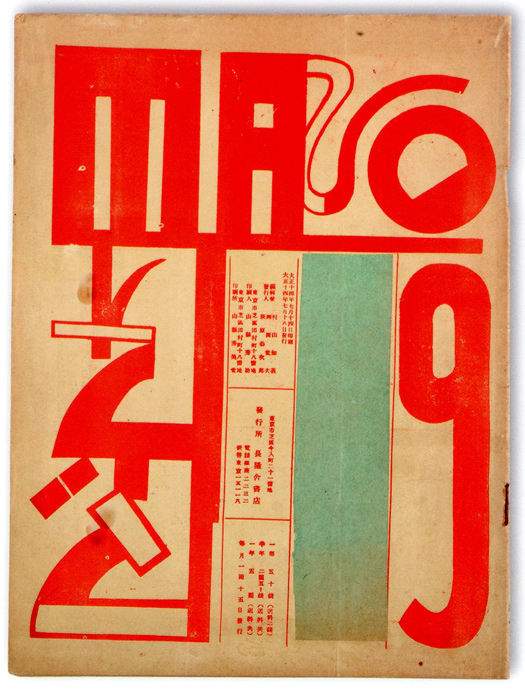
The early 20th century artistic and literary revolution called Modernism appears in history as an almost entirely European-American phenomenon. Textbooks and syllabi tend to leave out important modernist movements on other continents, which means we miss out on important cross-continental conversations. Though, to be fair, very few English-speaking textbook writers and teachers have known much about the work of, Mavo, an avant-garde group of Japanese artists from the 1920s.
Scant literature has been available in translation. Critics “were often dismissive of the group,” notes Margaret Carrigan at Hyperallergic, “and art historians have all but ignored them in favor of larger contemporaneous movements, like German Expressionism.” Whatever the reasons for the slighting of early Japanese modernism, we can now try to rectify the imbalance thanks to online sources covering the fascinating history of Mavo—both its interesting parallels with European Modernism and its important differences.

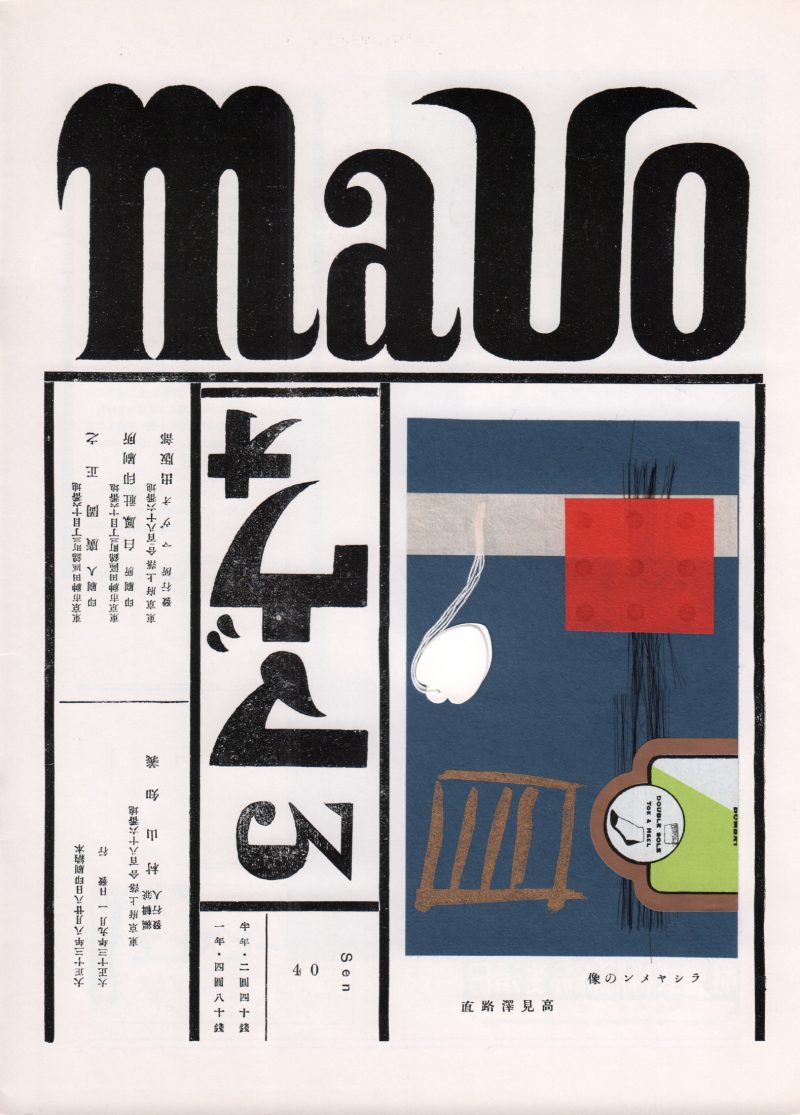
Or we can begin to get an intriguing sense of these things, more or less, depending on our level of familiarity with Japanese language and culture. MAVO magazine, edited by Tatsuo Okada and Tomoyoshi Murayama, “appeared in 7 issues between July 1924 and August 1925,” writes Monoskop, who host six of those issues in high resolution scans. (Click on the PDF link under the image of each cover.) “By the third issue, the magazine was thick with advertisements and the usage of actual newspaper as its pages.” The original linocuts and “photographic reproductions of assemblage, painting, and graphic works” are small and sometimes inscrutable in grayscale.
There are many affinities with European modernisms—dichotomies of playfulness and precision, the love of collage and industrial machinery. The history of Mavo, like that of modernists worldwide, is a history of anarchic, confrontational art, charged with contempt for tradition. In 1923, the Shin-aichi newspaper, notes The Japan Times, covered the story of a Mavo exhibit in which artist Takamizawa Michinao tossed rocks through the windows of a state-sponsored, traditional art exhibit while Mavo artists displayed their own abstract canvases outside the gallery.
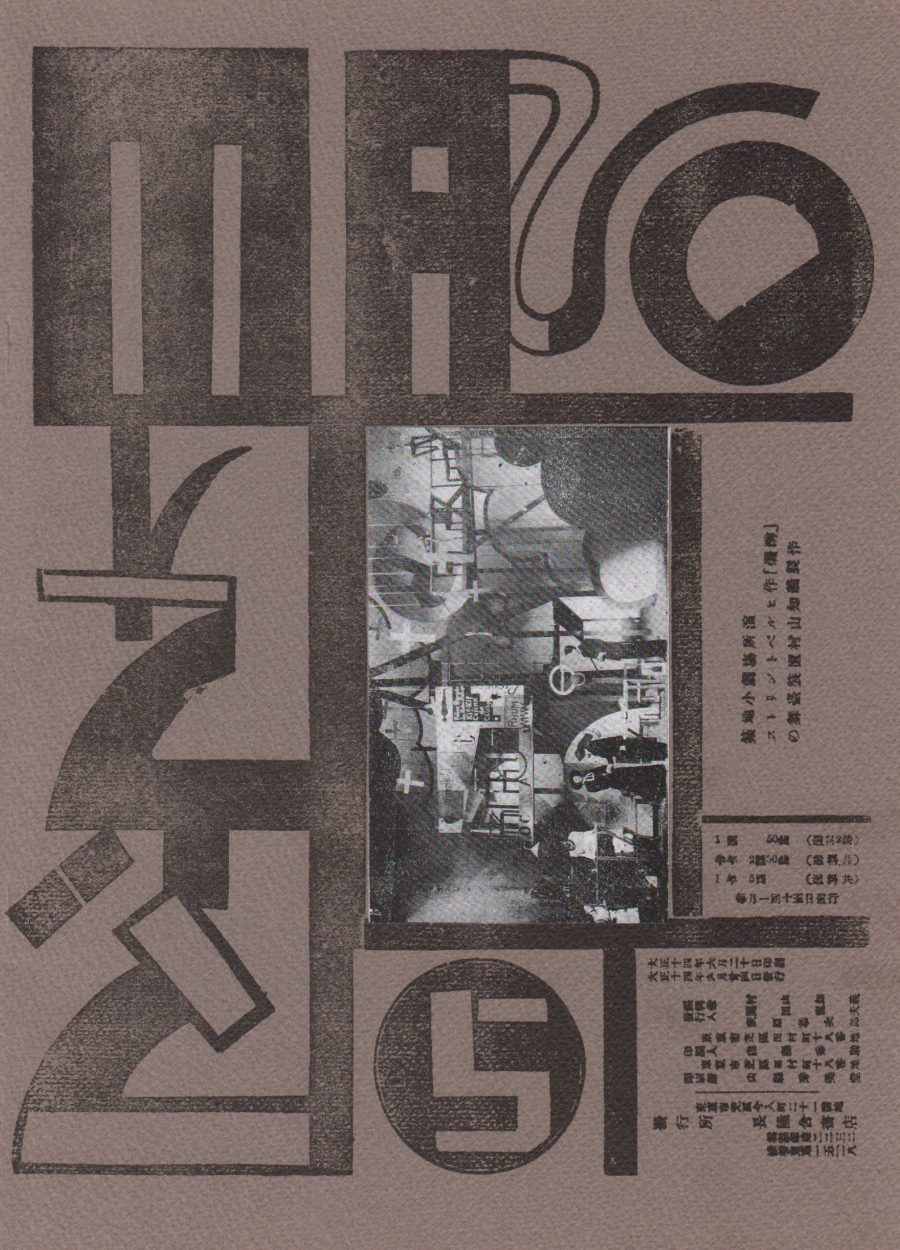
Mavo came about as the rebranding of an earlier group, “Japan’s Association of Futurist Artists, which became the local offshoot of the European Futurist phenomenon that began in Italy in 1909.” They were eclectic, publishing criticism, designing posters, buildings, and dance and theater pieces, incorporating Cubism and Dadaist tendencies. Unlike the Italian Futurists, who became increasingly fascist in their orientation, Mavo opposed the conservative state. “The Great Kanto Earthquake of 1924 brought about a proletarian and socialist bent to Mavo activities.”
See more of MAVO magazine at Monoskop, and learn more about the movement at The Japan Times, Hyperallergic, and Monoskop’s bibliography of a few scholarly sources in English (and Japanese, if you read the language). Also see Gennifer Weisenfeld’s book, MAVO: Japanese Artists and the Avant-Garde, 1905–1931. If the phrase Japanese avant-garde calls up names like Yoko Ono and Yayoi Kusama, now it may also bring to mind the earlier Mavo and the many artists under its umbrella who adapted European influences for Japanese modes of artistic revolution.
Related Content:
Extensive Archive of Avant-Garde & Modernist Magazines (1890–1939) Now Available Online
Josh Jones is a writer and musician based in Durham, NC. Follow him at @jdmagness
Read More...The Appeal of UFO Narratives: Investigative Journalist Paul Beban Visits Pretty Much Pop #14

TV news reporter Paul Beban (ABC, Al Jazeera, Yahoo, and now featured on the Discovery Network’s Contact) joins your hosts Mark Linsenmayer, Erica Spyres, and Brian Hirt to discuss the public fascination with UFOs, both at the peak of their popularity in the 50s and in the current resurgence. Do accounts of sightings necessarily make for good TV? Do you have to believe to be entertained? Is belief in UFOs related to religious belief? To beliefs in conspiracy theories and anti-government venom? To humor?
We get into the mechanics of Contact, the Area 51 hubbub,and also touch on the show Project Blue Book, films like Arrival (2016) and UFO (2018), the documentary Unacknowledged (2017), the short story “Roadside Picnic,” and more. To learn more about UFO lore in America, check out some of these podcasts.
Some of the resources we used for this episode included:
- “The New American Religion of UFOs” by Sean Illing
- “Why Are Area 51 Conspiracy Theories So Popular? Here’s What Psychologists Say” by Jeffrey Kluger
- “35 of the Most Popular Conspiracy Theories in the US” by Frank Olito
- “More UFOs Than Ever Before” by Rich Cohen
- “What Kucinich Saw: Witnesses Describe His Close Encounter” by Michael M. Phillips
- “Those UFO videos are real, the Navy says, but please stop saying ‘UFO’” by Kayla Epstein
Plus, here are some stats from Gallup about UFO sightings and belief, you might want to pick up the book Nostalgia for the Absolute that Paul refers to, and here’s the 2014 talk by Robbie Graham that Brian referred to describing “hyper-reality” and the Hollywood UFO conspiracy. Here’s a list of UFO documentary series.
This episode includes bonus discussion that you can only hear by supporting the podcast at patreon.com/prettymuchpop. This podcast is part of the Partially Examined Life podcast network.
Pretty Much Pop is the first podcast curated by Open Culture. Browse all Pretty Much Pop posts or start with the first episode.
Read More...Hear a Radio Opera Narrated by Kurt Vonnegut, Based on His Adaptation of Igor Stravinsky’s 1918 L’Histoire du Soldat
In the legend of Robert Johnson, American bluesman, a deal with the devil brings instant musical genius, and a brief and troubled life in near obscurity. A two-hundred-year-old Russian folktale has similar events in the opposite order: a soldier hands over his violin, and his musical talent, to the devil in exchange for wealth, and several more adventures and reversals before the final, inevitable path to perdition.
This story struck a chord with Igor Stravinsky, who was maybe ahead of his time in seeing a musical deal with the devil as an archetypal subject for popular song. In the first act of his theater piece, “The Soldier’s Story” (L’Histoire du Soldat)—whose libretto by Charles Ferdinand Ramuz adapts the Russian folktale—the soldier tragically relinquishes his ability to turn sorrow into beauty in the first act, perhaps a poignant statement in 1918, when, as Kurt Vonnegut says, “to be a soldier was really something.”
To have served in a war “in which 65 million persons had been mobilized and 35 million were becoming casualties,” to have witnessed the scarifying beginning of modern warfare, meant bearing the stamp of too much reality. In the folktales, we may see the devil as hardship, loss, or greed personified. These are metaphysical morality plays, far removed from current events. But war was potentially upon us all by 1918, Vonnegut suggests, in a terrifying force that devastated soldiers, mowed down civilians by the thousands, and leveled whole cities.
Asked to narrate the Stravinsky piece, Vonnegut declined. He found Ramuz’s treatment of a soldier’s life “preposterous” and unacceptable. So, George Plimpton challenged him to write his own version. He did, in 1993, but rather than make his soldier a musician (“you know, soldiers get rained on, and a violin wouldn’t have a chance”) or a nameless stock character, he plucked a figure out of history—and out of his own nonfiction book The Execution of Private Slovik, published in 1954.
Eddie Slovik was one of at least 30,000 deserters at the Battle of the Bulge. 49 were tried, and only Slovik was executed, at the express order of General Eisenhower. “He was the only person to be executed for cowardice in the face of the enemy since the Civil War,” Vonnegut told New York magazine. “Ike signed his death certificate. They stood him up in front of his comrades, and they shot him.” Vonnegut saw particular malice in the act. “Slovik deserves to be kept alive. If his name had been McCoy or Johnson, I don’t think he would have been shot.”
Instead of The Devil, in Vonnegut’s A Soldier’s Story, we have the character of The General. The novelist’s replacement of the original text bothered some when his libretto premiered, with Stravinsky’s music, at Lincoln Center’s Alice Tully Hall in 1993. Responding to the New York Times’ critic, Vonnegut said, “Well, it was a desecration. It was a sacred text, and I dared to fool with it. And some people just find that unbearable. That critic—I spoiled his evening.” In other words, he couldn’t have cared less.
Vonnegut’s libretto with Stravinsky’s music was not recorded for international copyright reasons until 2009, but he did record a version—playing The General himself—with music by Dave Soldier (hear it at the top). This recording of “A Soldier’s Story” appeared on the album Ice‑9 Ballads, a compilation of lyrics adapted, and narrated, by Vonnegut from his novel Cat’s Cradle, with music by Soldier. Hear that full album here. And purchase a copy An American Soldier’s Tale: Histoire Du Soldat, with text by Kurt Vonnegut, with music by Igor Stravinsky, performed by the American Chamber Winds, and conducted by David A. Waybright. You can hear samples in this playlist.
Related Content:
Roger Waters Adapts and Narrates Igor Stravinsky’s Theatrical Piece, The Soldier’s Story
A New Kurt Vonnegut Museum Opens in Indianapolis … Right in Time for Banned Books Week
The Night When Charlie Parker Played for Igor Stravinsky (1951)
Josh Jones is a writer and musician based in Durham, NC. Follow him at @jdmagness.
Read More...Talking Heads Songs Become Midcentury Pulp Novels, Magazines & Advertisements: “Burning Down the House,” “Once in a Lifetime,” and More
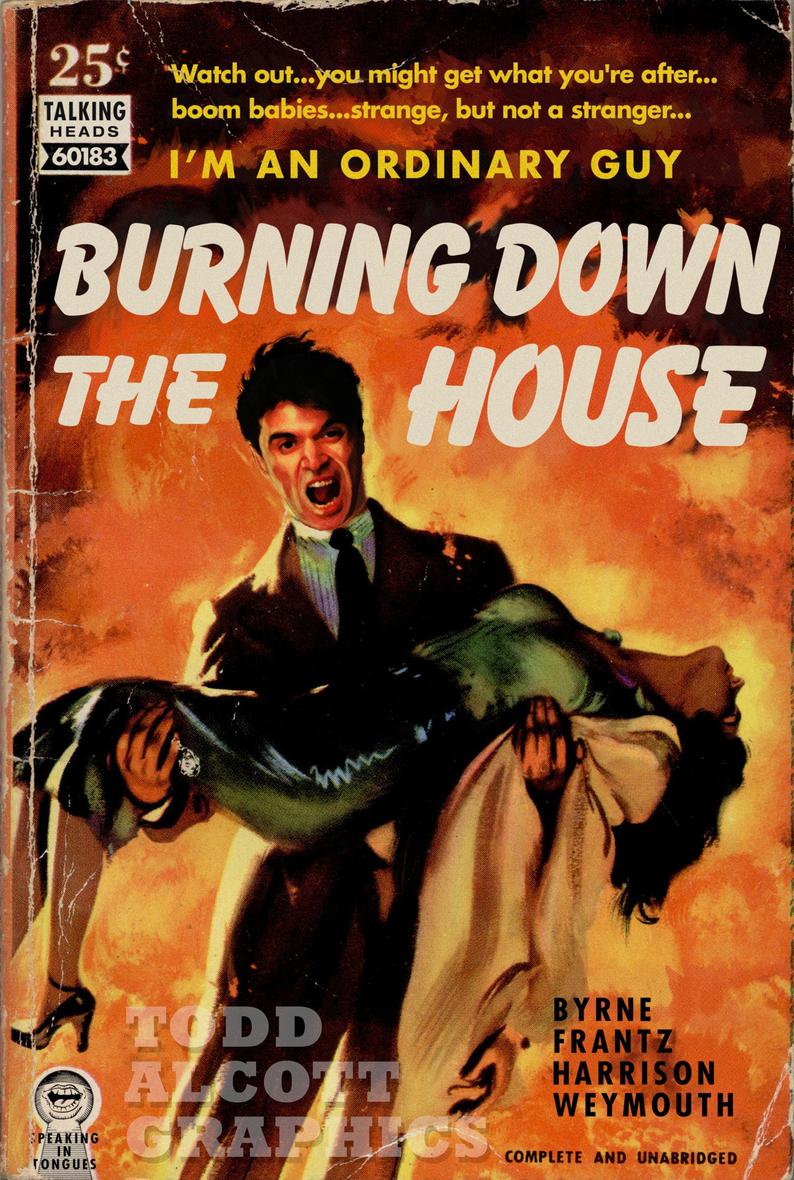
Do you like Talking Heads? Writer and visual artist Douglas Coupland once proposed that question as the truest test of whether you belong to the cohort named by his novel Generation X. Coupland’s contemporary colleague in letters Jonathan Lethem summed up his own early Talking Heads mania thus: “At the peak, in 1980 or 1981, my identification was so complete that I might have wished to wear the album Fear of Music in place of my head so as to be more clearly seen by those around me.” What makes the band that recorded “Psycho Killer,” “This Must Be the Place,” “Once In a Lifetime,” and “Burning Down the House” so appealing to the bookish, and especially the both bookish and visual, born after the Baby Boom or otherwise?

Whatever the essence at work, screenwriter and “graphic-arts prankster” Todd Alcott taps into it with his latest round of popular songs-turned-midcentury book covers, posters, magazine covers, and other pieces of non-musical graphic design. You may remember Alcott’s previous adaptations of the Beatles, Bob Dylan, Joni Mitchell, David Bowie, and Radiohead appearing here on Open Culture.
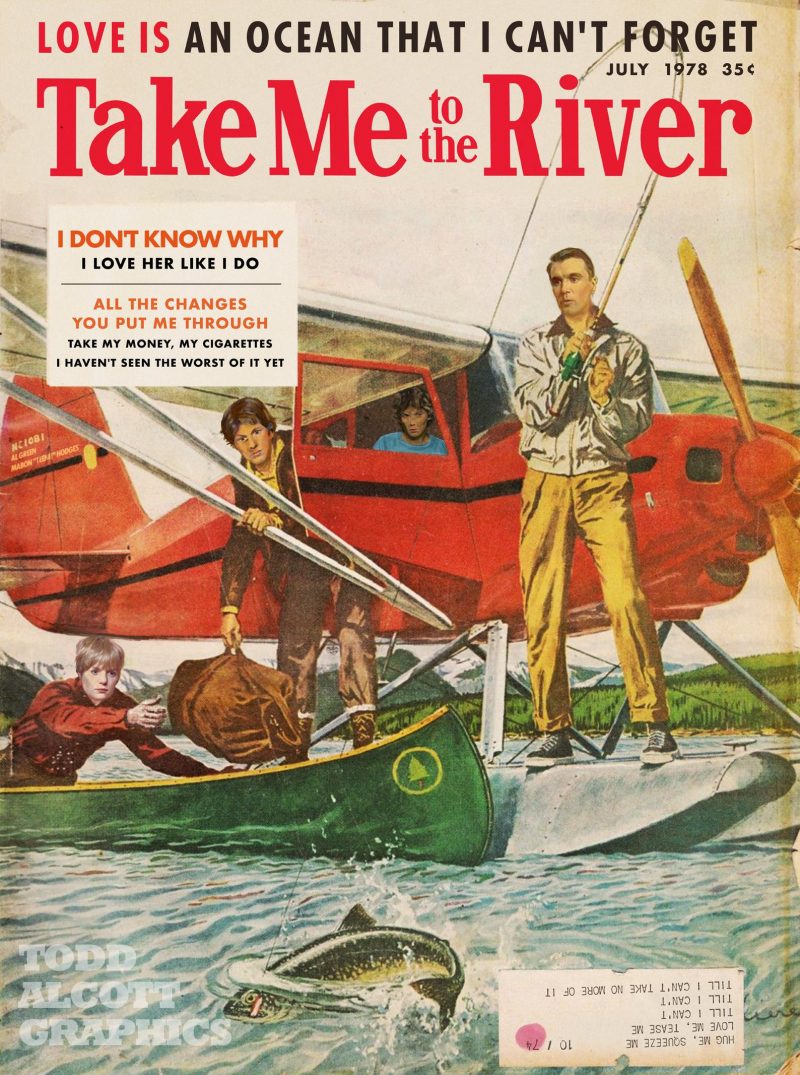
The culturally literate and obliquely referential catalogue of Talking Heads, however, may have provided his most suitable material yet: “Burning Down the House” becomes a “a 1950s pulp novel,” “Life During Wartime” a “1950s men’s adventure magazine,” “This Must Be the Place” an “advertisement for a 1950s suburban housing development,” and “Take Me to the River” the “cover of a 1950s-era issue of Field & Stream, with the four members of the band enjoying a day on the lake.”
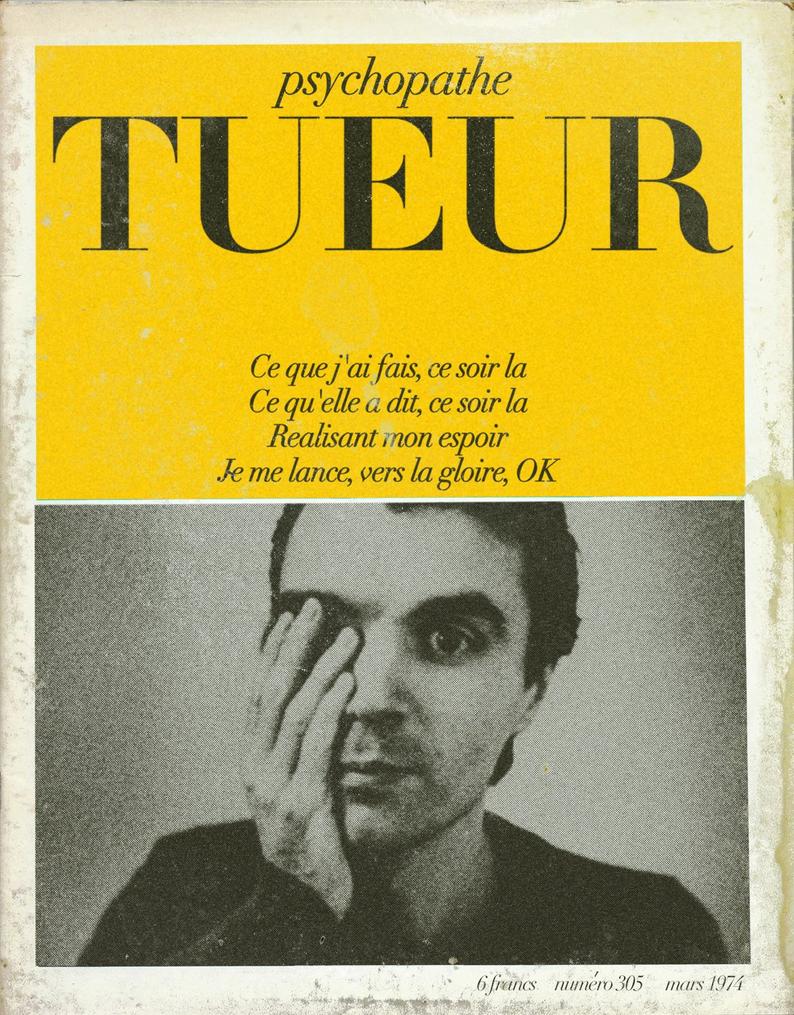
Amusing even at first glance, these cultural mash-ups also repay knowledge of the band’s work and history. “Psycho Killer,” with its French lyrics, becomes an issue of Cahiers du Cinéma featuring David Byrne on a cover dated March 1974, “the earliest date the song ‘Psycho Killer’ is known to have been performed by David Byrne’s band The Artistics.” “Once in a Lifetime,” quite possibly the band’s most impressive piece of songcraft, becomes an equally layered Alcott image: a “a magazine advertisement for the 1962 classic The Man in the Gray Flannel Suit, based on the best-seller by Sloan Wilson” — in other words, an ad designed for a magazine meant to sell a movie based on a book, and a book as tied up with the themes of alienation in postwar America as “Once in a Lifetime” itself.
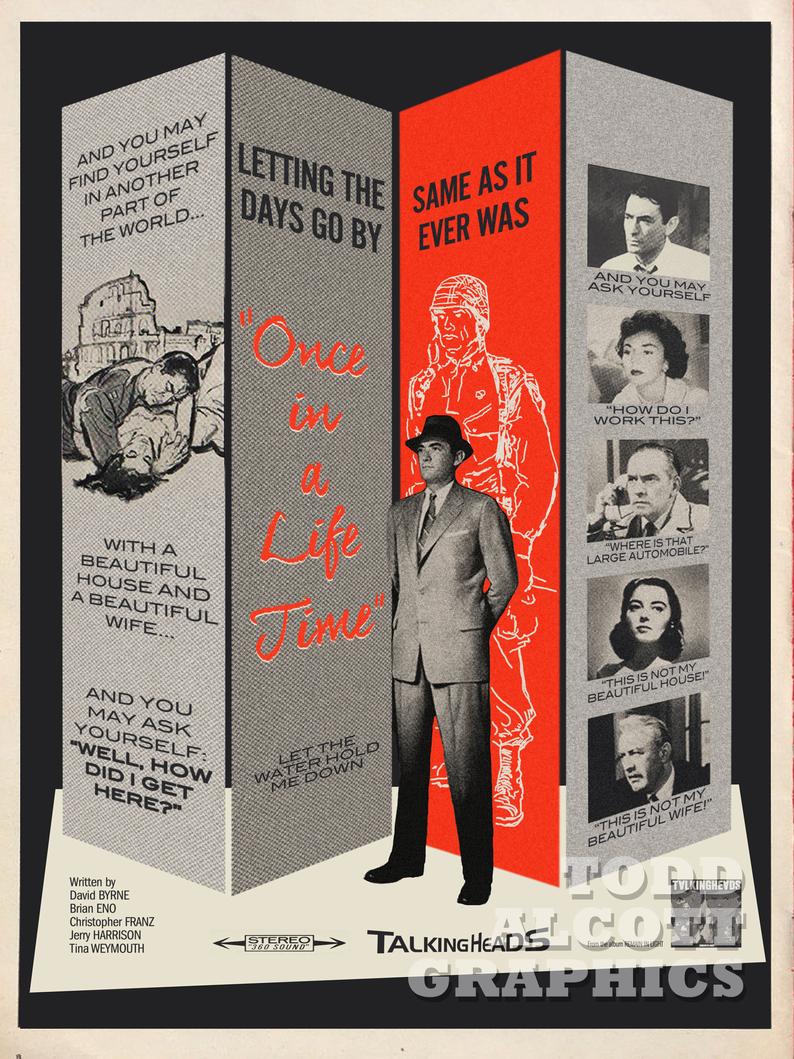
Talking Heads fans will recognize in Alcott’s graphics the very same kind of genius for resounding literal-mindedness coupled with subtle, sometimes obscure wit that characterizes the work of Byrne and his collaborators. You can buy prints of these images at his Etsy shop, which also offers many other works of interest to those for whom music, books, magazines, media, and history constitute not separate subjects but one vast, densely interconnected cultural field. To those who see the world that way, Alcott’s designing the cover for an album by Byrne or another of the ex-Heads — or indeed a Jonathan Lethem novel — is only a matter of time. Enter Todd Alcott’s store here.
Related Content:
Songs by Joni Mitchell Re-Imagined as Pulp Fiction Book Covers & Vintage Movie Posters
Based in Seoul, Colin Marshall writes and broadcasts on cities, language, and culture. His projects include the book The Stateless City: a Walk through 21st-Century Los Angeles and the video series The City in Cinema. Follow him on Twitter at @colinmarshall or on Facebook.
Read More...26-Year-Old Steve Jobs Debates the Utopian & Dystopian Promise of the Computer (1981)
The deeper we get into the 21st century, the fewer aspects of our lives remain disconnected from the digital realm. The convenience of this arrangement is undeniable, but the increasing difficulty of getting through a day without hearing the latest version of the public argument about privacy and data security suggests an accompanying discomfort as well. Have our online lives stolen our privacy — or have we perhaps freely given it away? Some us now even look longingly backward to a time before not just social media but the internet as we know it, a time in which, we imagine, nobody had to worry about the large-scale harvesting and sale of personal information.
As the 1981 Nightline clip above reveals, these concerns went mainstream well before most Americans owned computers, much less went online with them. Even so, Ted Koppel could open the segment claiming that “as a society, we’ve become used to computer problems of one kind or another, just as we’ve become used to computers. We’re so used to them, in fact, that few of us stop to think of the extent to which they now play a role in our everyday lives, a role that shows every sign of growing even bigger.”
There follows footage of the contexts in which computers involved themselves in the lives of the average person in the early 80s: making a phone call, getting money from the ATM, buying groceries at the supermarket, booking an airline ticket. Nevertheless, actually owning a computer yourself could still get you interviewed on the news with the chyron “Home-Computer Owner” beneath your name. After we hear from one such enthusiast, the scene switches to the headquarters of the five-year-old Apple Computer, “the Big Apple in this land of high technology.”
A 26-year-old Steve Jobs appears to describe his company’s creation as “a 21st-century bicycle that amplifies a certain intellectual ability that man has,” one whose effects on society will “far outstrip even those that the petrochemical revolution has had.” But then comes the anti-computer counterpoint: “Some people feel threatened by them,” says reporter Ken Kashiwahara. “Some think they tend to dehumanize, and others fear they may eventually take over their jobs.” Over satellite links, Koppel then brings on Jobs and investigative journalist Daniel Burnham for a debate about the promise and peril of the computer.
“The government has the capacity, by using computers, to get all kinds of information on us that we’re really not even aware that they have,” Koppel asks Jobs, underscoring Burnham’s line of argument. “Isn’t that dangerous?” For Jobs, “the best protection against something like that is a very literate public, and in this case computer literate.” Predicting, correctly, that every household in the country would eventually have its own computer, he finds reassurance in the inevitably wide distribution of computing power and computer literacy across the public, meaning “that centralized intelligence will have the least effect on our lives without us knowing it.”
But Burnham nevertheless warns of “a tremendous danger that the public is not aware of enough at this moment.” He didn’t describe that danger in the forms of overgrown e‑commerce or social media giants — both of those concepts having yet to be realized in any form — or even ideologically opposed foreign countries, but the United States’ own Army and Census Bureau. What happens when they decide to use the data in their possession to “break the rules”? Computers are here to stay, it seems, but so are our inclinations as human beings, and one wonders how cleanly the two can ever be reconciled. As aphorist Aaron Haspel puts it, “We can have privacy or we can have convenience, and we choose convenience, every time.”
via Paleofuture
Related Content:
From the Annals of Optimism: The Newspaper Industry in 1981 Imagines its Digital Future
Steve Jobs on Life: “Stay Hungry, Stay Foolish”
A Young Steve Jobs Teaches a Class at MIT (1992)
Steve Jobs Muses on What’s Wrong with American Education, 1995
Steve Jobs Shares a Secret for Success: Don’t Be Afraid to Ask for Help
Steve Jobs Narrates the First “Think Different” Ad (Never Aired)
Based in Seoul, Colin Marshall writes and broadcasts on cities, language, and culture. His projects include the book The Stateless City: a Walk through 21st-Century Los Angeles and the video series The City in Cinema. Follow him on Twitter at @colinmarshall or on Facebook.
Read More...Lost Depeche Mode Documentary Is Now Online: Watch Our Hobby is Depeche Mode
Like budding ten-year-old paleontologists with their dinosaur guides, music nerds who came of age in the 80s and 90s might spend whole days reading about obscure one-off bands and indie, punk, and alternative giants from all over the English-speaking world in Ira Robbins’ encyclopedic Trouser Press Record Guide reference books. Their critical entries were notable especially for what they were not: fan tributes.
Just the other day, for example, I was browsing through the Trouser Press Guide to ‘90s Rock and was startled to read that Depeche Mode’s 101, a live album I listened to repeatedly in my moody middle school years, offered “permanent evidence of the band’s—a pitch-impaired singer crucified on racks of keyboards—concert inadequacy.”
This, I protested, is too much.
But, I admit, that album, played at full volume in headphones, once carried me as an adolescent through a grim three-day trek across the country, in a van with my fractious family, driving the entire length of Arkansas in sub-zero late December and spending New Years’ Eve in a motel room in a desolate nowheresville outside Pine Bluff, AR.
My sense that there might be a romantically gloomy, weirdly seductive world beyond the frosted windows of our shabby Ford Club Wagon is what I will always associate with the album, its musical merits aside. (That and a serious crush on someone who really loved Depeche Mode.) I can’t remember if I’ve listened to it since.
It’s true Depeche Mode got a lot of mileage out of a limited range of skills and musical ideas, but that seems to be no valid criticism in pop music. The best pop songs are those people experience as operatic statements of their own emotional lives. As we see in the opening scenes of the Depeche Mode documentary above, Our Hobby is Depeche Mode, their most fervent English fans believe that they too might be Depeche Mode.
U.S., Mexican, and Russian fans romanticizing Basildon, Depeche Mode’s hometown, as a placid English village say more about their own longings than about the band’s sound. Depeche Mode may have looked like a New Wave boy band in the 80s, but that was also the decade in which they were at their noisiest and most experimental, “seamlessly blending concrète sounds—factory din, clanking chains and so forth—into the music,” writes Trouser Press.
The sound—says one English fan of “Depeche” from its beginnings—“came from the bricks” of Basildon, a gritty place with frequent fighting in the streets. The bulk of the densely crowded town’s concrete blocks, and factories sprang up after WWII, a working-class community created to house the London population displaced by the bombings. What set Depeche Mode apart from their synthpop peers and inspirations (aside from Siouxsie Sioux and Damned-inspired fetish cosplay) was the industrial noise that populated their saccharine off-key ballads and naughty S&M tracks.
The sound of working-class streets embedded in their music drew fans from Moscow—where singer Dave Gahan’s birthday has become an unofficial holiday. Their music is “technology, the sounds of life, of reality,” says one Muscovite fan above. Depeche Mode bootlegs, which spread over the Soviet world, get partial credit for the fall of the Berlin Wall. Fans in Tehran risk severe punishment from the Islamic authorities for listening to illicit copies of their albums.
They became gloomier, more navel-gazing and “dismal,” our Trouser Press critic writes, and the quirky sounds of Basildon seemed to fade away, replaced by the cavernous reverb and goth-blues guitar riffs of their 90s apotheosis. Their appeal to sensitive and troubled kids everywhere remained as powerful, if not more so. Our Hobby is Depeche Mode documents the band’s spread around the world in dedicated fan communities. Made in 2007, the film mysteriously disappeared and has only just resurfaced recently, as Dangerous Minds reports. “No one’s quite sure what happened there.”
It will be interesting to compare this rediscovered document with a new Depeche Mode movie, Spirits in the Forest, getting a theatrical release November 21st. Shot by Anton Corbijn, the film, as you can see from trailer (above), also keeps its focus on the fans, mixing six stories, writes Rolling Stone, “shot in each of their hometowns, with footage of the concert” in Berlin promoting the band’s newest album Spirit.
They may never have been the greatest live band or most accomplished of musicians, but Depeche Mode has always known how to work a crowd, and how to speak to the private longings of every individual fan. What more can one ask of international pop stars? Gahan says in a statement about the new concert film, a tradition that reached its apex with the 101 documentary companion to the album, “It’s amazing to see the very real ways that music has impacted the lives of our fans.” He’s talking about an evident connection that spans generations and crosses many unlikely cultural, linguistic, and national boundaries.
Our Hobby is Depeche Mode will be added to our collection of Free Documentaries.
The film by Jeremy Deller & Nicholas Abrahams is hosted on Abrahams’ Vimeo channel.
Related Content:
Depeche Mode Releases a Goosebump-Inducing Cover of David Bowie’s “Heroes”
An Animated History of Goth
Josh Jones is a writer and musician based in Durham, NC. Follow him at @jdmagness
Read More...Hear a Full-Cast Reading of Margaret Atwood’s The Testaments, the Sequel to The Handmaid’s Tale
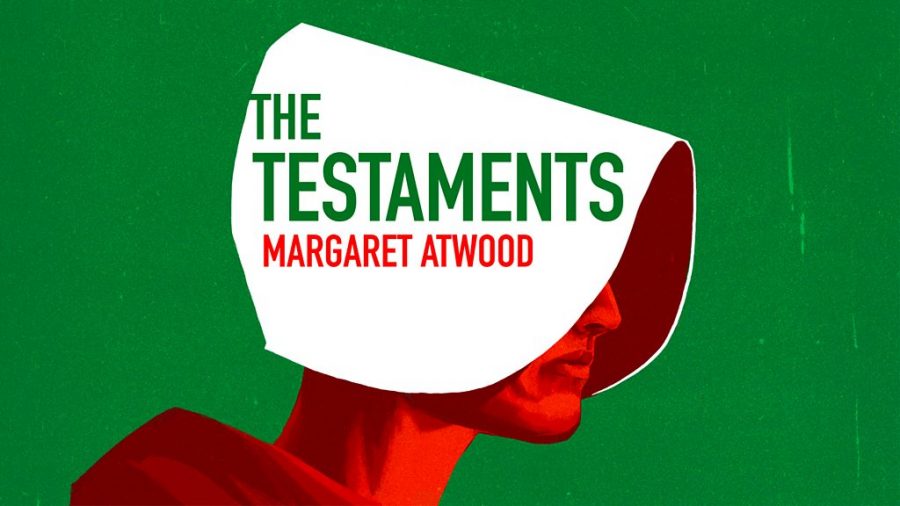
A good heads up from Metafilter. They write:
Available for a limited time, BBC Radio 4 has a full-cast abridged reading of Margaret Atwood’s new novel, The Testaments. This sequel to The Handmaid’s Tale picks up 15 years after the events in the previous book (very mildly revealing review of The Testaments by Anne Enright). All 14-minute episodes have now been released: The first episode is available until Oct. 15, 2019; the fifteenth and final episode is available until Oct. 30.
Stream it all here. And find more audio books in our collection, 1,000 Free Audio Books: Download Great Books for Free.
If you would like to support the mission of Open Culture, consider making a donation to our site. It’s hard to rely 100% on ads, and your contributions will help us continue providing the best free cultural and educational materials to learners everywhere. You can contribute through PayPal, Patreon, and Venmo (@openculture). Thanks!
Related Content:
Margaret Atwood Offers a New Online Class on Creative Writing
Pretty Much Pop #10 Examines Margaret Atwood’s Nightmare Vision: The Handmaid’s Tale
Hear Margaret Atwood’s Story “Stone Mattress,” Read by Author A. M. Homes
Read More...See Why Ginger Baker (RIP) Was One of the Greatest Drummers in Rock & World Music
When talk of classic rock drummers turns to Keith Moon and John Bonham, I smile and nod. What’s the point in arguing? They were both, in their distinctive ways, incredible—and in their early deaths, immortal legends. Who knows what their careers would have looked like had either lived past 32? But truly, for the all-around breadth of his influence, for the amount of respect he gained in musical circles around the world, no greater classic rock drummer ever lived, in my opinion, than Ginger Baker, may he finally rest in peace.
The famously restless, violently cantankerous drummer died yesterday at age 80, outliving most of his peers, despite living twice as hard for well over twice as long as many of them—a feat of strength we might impute to his athletic physical stamina and frightening will.
Like Moon and Bonham, he combined raw power with serious jazz chops. (Baker insisted he never played rock drums at all.) After his polyrhythmic pummeling defined the sound of supergroups Cream and Blind Faith, he burned out and moved to Africa to find sobriety and new sounds.
Baker traveled the continent with Fela Kuti to learn its rhythms, recording live with Kuti’s band in ’71. Afrobeat drummer Tony Allen remarked that he understood “the African beat more than any other Westerner.” (See him jamming in Lagos further down.) Baker’s discography includes classic records with Eric Clapton and Jack Bruce, Kuti, Hawkwind, and other legends. He traveled the world playing drums for over fifty years. Why, then, did he have such a low profile for much of his later life? A 2012 documentary, Beware of Mr. Baker, based on a 2009 Rolling Stone article, offers some answers.
Baker’s serious drug addiction and terrifying personality alienated nearly everyone around him. The documentary opens with an endorsement from another prickly and unlikable red-haired character, John Lydon (formerly Johnny Rotten), whose Public Image Limited is yet another project Baker elevated with his playing. “He helped me rise,” says Lydon, and Baker would no doubt agree. He was not a modest man. He was, by most accounts, a right bastard, through and through, all of his life.
But he was too contrarian to be dismissed as a mere narcissist. As a musician, for example, he always thought of himself as a supporting player. “I never had a style,” he said in 2013. “I play to what I hear, so whoever I’m playing with, what they play has a great influence on what I play, because I listen to what people are playing.” His skill at destroying personal relationships was matched by his ability for forming deep, awe-inspiring, if short-lived, musical connections. It’s a dichotomy many drummers inspired by him have struggled to reconcile—taking lessons from Baker the drummer but not from Baker the man.
How do we separate the man from his art? Why try? His mad pirate life makes for an epic saga, and Baker is a wildly exciting main character. He had early ambitions of becoming a professional cyclist. Though they didn’t pan out, he always retained the characteristics: he was both fiercely competitive and fiercely collaborative. Later he picked up an even more rarified team sport—polo—keeping a stable of horses on his gated South African ranch, where he lived in his old age like a colonial ex-baron in a Nadine Gordimer novel. (He eventually had to sell the spread and move back to London.)
Baker was never one to make apologies, so his fans need not make any on his behalf. See him in some classic performances above—at the top, soloing after an interview, at Cream’s Royal Albert Hall farewell concert; then playing a solo in a Cream reunion in that same venue almost forty years later. After footage of him jamming in Lagos in 1971, we see what the internet calls the “BEST DRUM SOLO EVER,” further up. In the video linked below, meet the man himself, in all his unrepentant glory, and hear from those who knew him best, in the full documentary, Beware of Mr. Baker.
Related Content:
What Makes John Bonham Such a Good Drummer? A New Video Essay Breaks Down His Inimitable Style
Josh Jones is a writer and musician based in Durham, NC. Follow him at @jdmagness
Read More...Support Us
We're hoping to rely on loyal readers, rather than erratic ads. Please click the Donate button and support Open Culture. You can use Paypal, Venmo, Patreon, even Crypto! We thank you!

About Us

Open Culture scours the web for the best educational media. We find the free courses and audio books you need, the language lessons & educational videos you want, and plenty of enlightenment in between.
Advertise With Us

FREE UPDATES!
GET OUR DAILY EMAIL
Get the best cultural and educational resources on the web curated for you in a daily email. We never spam. Unsubscribe at any time.
FOLLOW ON SOCIAL MEDIA

Open Culture editor Dan Colman scours the web for the best educational media. He finds the free courses and audio books you need, the language lessons & movies you want, and plenty of enlightenment in between.
Advertise With Us

