Philosopher Portraits: Famous Philosophers Painted in the Style of Influential Artists
Ludwig Wittgenstein/Piet Mondrian:

What do the Austrian-British philosopher Ludwig Wittgenstein and the Dutch painter Piet Mondrian have in common? For philosopher and artist Renée Jorgensen Bolinger, the two have similar beliefs about the logic of space.
“Many of Mondrian’s pieces explore the relationships between adjacent spaces,” says Bolinger “and in particular the formative role of each on the boundaries and possibilities of the other. I based this painting [see above] off of Wittgenstein’s Tractatus, in which he develops a theory of meaning grounded in the idea that propositions have meaning only insofar as they constrain the ways the world could be; a meaningful proposition is thus very like one of Mondrian’s color squares, forming a boundary and limiting the possible configurations of the adjacent spaces.”
An Assistant Professor at Princeton, Bolinger studied painting a Biola University before making philosophy her second major. “I actually came to philosophy quite late in my college career,” Bolinger says, “only adding the major in my junior year. I was fortunate to have two particularly excellent and philosophic art teachers, Jonathan Puls and Jonathan Anderson, who convinced me that my two passions were not mutually exclusive, and encouraged me to pursue both as I began my graduate education.”
Bolinger now works primarily on the philosophy of language, with side interests in logic, epistemology, mind and political philosophy. She continues to paint. We asked her how she reconciles her two passions, which seem to occupy opposite sides of the mind. “I do work in analytic philosophy,” she says, “but it’s only half true that philosophy and painting engage opposite sides of the mind. The sort of realist drawing and painting that I do is all about analyzing the relationships between the lines, shapes and color tones, and so still very left-brain. Nevertheless, it engages the mind in a different way than do the syllogisms of analytic philosophy. I find that the two types of mental exertion complement each other well, each serving as a productive break from the other.”
Bolinger has created a series of philosopher portraits, each one pairing a philosopher with an artist, or art style, in an intriguing way. In addition to Wittgenstein, she painted ten philosophers in her first series, many of them by request. They can all be seen on her web site, where high quality prints can be ordered.
G.E.M. Anscombe/Jackson Pollock:
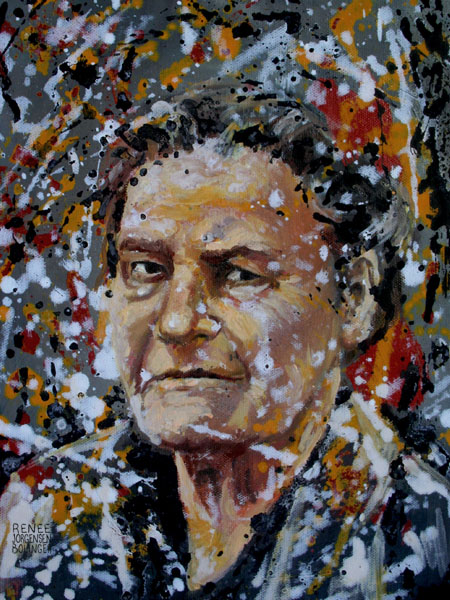
Bolinger says she paired the British analytic philosopher Elizabeth Anscombe with the American abstract painter Jackson Pollock for two reasons: “First, the loose style of Pollock’s action painting fits the argumentative (and organizational) style of Wittgenstein’s Philosophical Investigations, which Anscombe helped to edit and was instrumental in publishing. Second, her primary field of work, in which she wrote a seminal text, is philosophy of action, which has obvious connections to the themes present in any of Pollock’s action paintings.”
Gottlob Frege/Vincent Van Gogh:
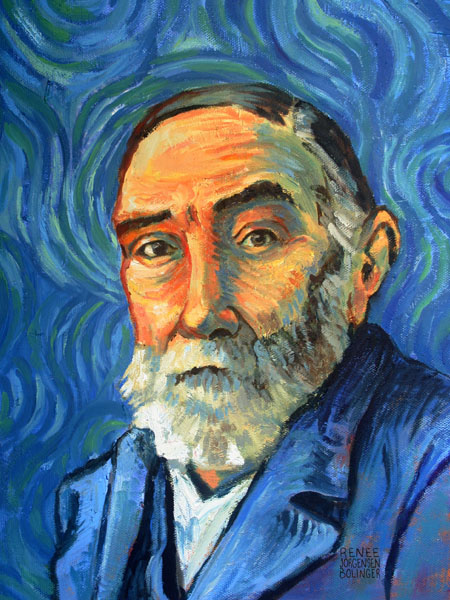
Bolinger paired the German logician, mathematician and philosopher Gottlob Frege with the Dutch painter Vincent Van Gogh as a tongue-in-cheek reference to Van Gogh’s famous painting The Starry Night and Frege’s puzzle concerning identity statements such as “Hesperus is Phosphorus,” or “the evening star is identical to the morning star.”
Bertrand Russell/Art Deco:

Bolinger painted the British logician and philosopher Bertrand Russell in the Art Deco style. “This pairing is a bit more about the gestalt, and a bit harder to articulate,” says Bolinger. “The simplification of form and reduction to angled planes that takes place in the background of this Art Deco piece are meant to cohere with Russell’s locial atomism (the reduction of complex logical propositions to their fundamental logical ‘atoms’).”
Kurt Gödel/Art Nouveau:
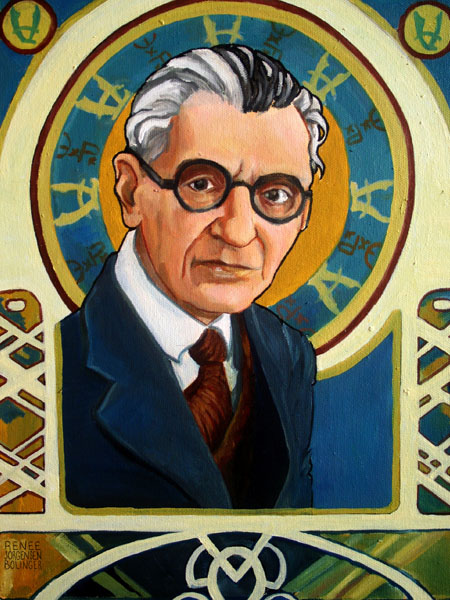
Bolinger paired the Austrian logician Kurt Gödel with Art Nouveau. “The Art Nouveau movement developed around the theme of mechanization and the repetition of forms,” says Bolinger, “and centrally involves a delicate balance between organic shapes — typically a figure that dominates the portrait — and schematized or abstracted patterns, often derived from organic shapes, but made uniform and repetitive (often seen in the flower motifs that ornament most Art Nouveau portraits). I paired this style with Kurt Gödel because his work was dedicated to defining computability in terms of recursive functions, and using the notion to prove the Completeness and Incompleteness theorems.”
To see more of Renée Jorgensen Bolinger’s philosopher portraits, click here to visit her site.
Note: This post originally appeared on our site back in 2013.
If you would like to support the mission of Open Culture, consider making a donation to our site. It’s hard to rely 100% on ads, and your contributions will help us continue providing the best free cultural and educational materials to learners everywhere. You can contribute through PayPal, Patreon, and Venmo (@openculture). Thanks!
Related Content:
A History of Philosophy in 81 Video Lectures: From Ancient Greece to Modern Times
Photography of Ludwig Wittgenstein Released by Archives at Cambridge
180+ Free Philosophy Courses
Read More...Legendary Protest Songs from Woodstock: Hendrix, Jefferson Airplane, Country Joe & More Perform Protest Songs During the Music Festival That Launched 50 Years Ago This Week
This year’s big event to celebrate the 50-year anniversary of the most famous music festival in the world has died an ignominious death. As Variety wrote in a scathing “obituary” last month, “Woodstock 50 passed away today at the age of 7 months, following a brave and very, very long battle with cancel.”
Not a few people have said good riddance. What could the tribute—to take place not in Woodstock but in Baltimore—have in common with its namesake, save a small handful of the still-living original performers? The use of “Woodstock” as a brand seems cynical, but then again, we’ve also grown leery of the legend of Woodstock 1. What was it about? Classic rock stars on a farm? Stoned, naked hippies flailing in the mud? What justifies the fifty years of hype?
Woodstock was about much more than druggy flower children shagging in bedraggled tents, yet this stereotype was propagated from the start. The festival “was a stridently antiwar spectacle,” online history project All About Woodstock explains. “Its message was diluted by the media. Rather than focus on the political statements made, mainstream cultural commentators talked about hippies, long hair, and nudity.” A belated wedding party, Woodstock symbolized “the merger and ambivalence of the counterculture and protest.”
The marriage may be in shambles in the time of Woodstock 50 but it held on for several decades. Woodstock “was the ‘coming out’ party of the rock ‘n’ roll generation,” writes NPR. Folk singer Richie Havens, the festival’s first performer, remembers it as “the beginning of the world, as far as I was concerned.” Booked for a 20-minute set, Havens ended up playing for much longer when Santana couldn’t be found, ad-libbing “Freedom (Motherless Child)” as his closer.
“The word ‘freedom came out of my mouth because this was our real particular freedom,” he says in an interview with NPR’s Tony Cox. “We’d finally made it to above ground.” A few months later, in December, the decade closed on a much darker note, symbolized by the Rolling Stones’ bloody Altamont Free Concert. But for three days that year, August 15–17, 1969, it seemed like music festivals might change the world.
Maybe they did. Woodstock organizer Michael Lang thinks so. “I think Woodstock proved the world that it was possible for people to live peacefully,” he said in a 2015 interview. “It gave credence to the positions we as a young generation took on personal freedoms, ending a war we felt unjust, respect for the planet, the fight for civil rights, women’s rights, and human rights in general. The impact on society continues to this day.”
The festival was also, of course, a massively star-studded event filled with career highlight performances like Hendrix’s radical, blistering “Star-Spangled Banner.” Not every act showed up to make a statement. The Who were pretty sour about the gig, Lang remembers. “They were not part of the ‘hippie’ thing and Pete Townsend had to be talked into taking the date.” But those who came to make a statement weren’t shy about it. Jefferson Airplane called for volunteers for the revolution in their anti-war anthem “Volunteers.” Country Joe and the Fish ended the second set on Saturday with their satirical “I‑Feel-Like‑I’m‑Fixin’-to-Die Rag,” an explicitly anti-Vietnam War song that asked, “what are we fighting for”?
Joan Baez, six months pregnant at the time, sang traditional folk songs, Dylan’s “I Shall Be Released,” and Gram Parson’s “Hickory Wind.” Her closer, spiritual “We Shall Overcome,” bridged the music of the Civil Rights movement with that of the anti-war movement, proclaiming in her glorious soprano, “We shall live in peace someday.” The moment, fifty years ago this week, can never be recreated, no matter how much money organizers throw at Woodstock retreads. But we don’t need millions to remember what the original Woodstock stood for. Sex, drugs, and mud got all the press, but the festival’s intentions were to protest war overseas and hatred and murder at home with three days of peace and music—a vision, as Havens extemporaneously sang out, of another kind of freedom.
The original festival, “essentially a mass movement promoting peace,” gets yet another look in a new American Experience documentary, Woodstock: Peace, Love and Music, which premiered last Tuesday on PBS. (Stream it free here.) With “never-before-seen footage” and testimonials from “those who experienced it firsthand,” the film documents the event’s highs and lows, including the many “near disasters” that “put the ideals of the counterculture to the test.” Also see the New York Times article, “How to Relive Woodstock From the Comfort of Your Couch,” which features “six movies, 12 album collections, two songs and 17 books that will take willing travelers back to August 1969.” This includes, of course, Michael Wadleigh’s iconic documentary, Woodstock: 3 Days of Peace and Music.
Related Content:
Jimi Hendrix Live at Woodstock: Historic Concert Captured on Film
David Crosby & Graham Nash at Occupy Wall Street; Echoes of Woodstock
Wattstax Documents the “Black Woodstock” Concert Held 7 Years After the Watts Riots (1973)
Josh Jones is a writer and musician based in Durham, NC. Follow him at @jdmagness.
Read More...Pretty Much Pop: A Culture Podcast #6: Why Adults Might Play Video Games

Erica Spyres, Brian Hirt, and Mark Linsenmayer are joined by Ian Maio (who worked for marketing for IGN and Turner in e‑sports) for our first discussion about gaming. Do adults have any business playing video games? Should you feel guilty about your video game habits?
Ian gives us the lay of the land about e‑sports, comparing it to physical sports, and we discuss the changing social functions of gaming, alleged and actual gaming disorders, different types of gamers, inclusivity, and more. Whether you game a lot or not at all, you should still find something interesting here.
We touch on the King of Kong documentary, Grand Theft Auto, Overwatch, The Last of Us, Borderlands, Super Mario, Cuphead, NY Times Electronic Crossword Puzzle, and more. Be sure to watch the Black Mirror episode, “Striking Vipers.”
Sources for this episode:
- “The eSports Phenomenon” by Jason Mok
- “For Men Who Hate Talking On The Phone, Games Keep Friendships Alive” by Cecilia D’Anastasio
- “How Video Games Affect the Brain” by Hannah Nichols
- “Seven Reasons to Play Computer Games” by Ryan Anderson
- “Playing Video Games Too Much Might Be Bad for Your Mental Health” by Jesse Hicks
This episode includes bonus content that you can only hear by supporting the podcast at patreon.com/prettymuchpop. This podcast is part of the Partially Examined Life podcast network.
Please go check out Modern Day Philosophers at moderndayphilosophers.net and See You on the Other Side at othersidepodcast.com.
Pretty Much Pop is the first podcast curated by Open Culture. Browse all Pretty Much Pop posts or start with the first episode.
Read More...Watch Animated Scores of Eric Satie’s Most Famous Pieces: “Gymnopedie No. 1” and “Gnossienne No. 1”
In an NPR interview, Caitlin Horrocks, author of a novel about Erik Satie called The Vexations, remembers the first time she encountered the composer’s work. “As a piano student, my teacher assigned me one of the ‘Gymnopiedies.’ And as a kid, I just immediately loved it.” Yet when Horrocks dug deeper into Satie’s catalogue, “very quickly I was running into things like ‘Flabby Preludes (For a Dog)’ or ‘Dried Embryos,’ one of which contains essentially lines of dialogue from the point of view of a sea cucumber. And as an aspiring pianist, I was annoyed. I was disappointed.”
Horrocks essentially describes the way Satie has been remembered by popular culture—as the composer of the extraordinarily popular “Gymopedies” and “Gnossiennes,” and a lot of other strange pieces of music few people care to listen to. (The title of Horrocks novel comes from a Satie composition meant to be played 840 times in succession.) He wrote ballets, stage, orchestral, and choral pieces, chamber music, and, several compositions for solo piano—and he would perhaps be a little annoyed by his legacy: music he composed in his early twenties has defined his entire career, though “Satie’s later output… is arguably more ‘important,’” writes Meurig Bowen at The Guardian.
Satie was “a torchbearer for the avant-garde in his later years.” Described by his contemporaries Ravel and Debussy as a “precursor”–a label that fits perfectly given how much he came to influence composers like John Cage–Satie did not fit in his time, and he does not fit in ours. The preference for what Bowen calls “easy on the ear” music persists, and for good reason. We intuitively respond to melody and harmony, to music with narrative-like structure and stirring emotional content. We so often come to music for exactly these qualities: to be liberated from thinking and give ourselves over to feeling.
Satie understood this, and his genius in his most famous pieces was to make music that appealed to both the intellect and the emotions, not slighting one in favor of other. The animated scores above for “Gymnopedie No. 1” and “Gnossienne No. 1” make this point vividly, with colors and shapes illustrating the duration and pitch of each note played by pianist Stephen Malinowski. These delicate, abstract, short pieces may have reached the level of “pop classics” as Bowen writes, but our familiarity with them masks how revolutionary they were. “Gymnopedie No. 1,” is a “piece that relies heavily on how sympathetic a musician you are,” Classic FM explains, since “there are hardly any notes!”
The invented names “Gymnopedies” and “Gnossiennes” signal that Satie is inventing new forms of music, mostly without time signatures or bar divisions, and with some very esoteric sources of inspiration. Their haunting, wistful qualities are evoked as much by the absence of musical convention as by the presence of pleasingly melodic lines and chords. In these animated scores, the few notes Satie did write become bursts of floral patterns and decorative shapes, and the silences become negative spaces, pregnant, like the long shadows in Giorgio de Chirico’s paintings, with inexpressible longings and gnostic mysteries.
Related Content:
The Velvet Underground’s John Cale Plays Erik Satie’s Vexations on I’ve Got a Secret (1963)
Hear the Very First Pieces of Ambient Music, Erik Satie’s Furniture Music (Circa 1917)
Josh Jones is a writer and musician based in Durham, NC. Follow him at @jdmagness.
Read More...Enjoy Dazzling & Dizzying 360° Virtual Tours of Los Angeles Landmarks
Remember when armchair travel meant a book, a magazine, a handful of postcards, or the occasional after-dinner slideshow of the neighbors’ vacation photos?
Those were the days.
The throngs of travel “influencers”—both professional and aspirant—have taken much of the fun out of living through others’ visits to far-flung locales. The focus seems to have shifted from imagining ourselves in their shoes to feeling oppressed by their highly-staged, heavily-filtered Instagram-perfect existence.
Photographer Jim Newberry’s dazzling, dizzying 360° photos of Los Angeles, like the views of Echo Park, Chinatown, East L.A., and Downtown, above, offer armchair travelers transportation back to those giddy pre-influencer days.
(Angelinos and other LA-versed visitors will enjoy swooping through City of Angels landmarks as if rotating on the no-parallax point, too.)
The Chicago transplant admits that it took a while for him to find his Los Angeles groove:
After being disabused of my Midwestern, anti‑L.A. views, I’ve found that the city has much more to offer than I had imagined, but the gems of Los Angeles often don’t reveal themselves readily; it takes a bit of legwork to seek out the best spots, and well worth it. Mountains, beaches, vibrant urban life, tons of museums, gorgeous nature.
While easy-to-use “one-shot” 360 cameras exist, Newberry prefers the quality afforded by using a high-resolution non-360 camera with a wide angle lens, mounted on a panoramic tripod head that rotates it in such a way as to prevent perspective errors.
With the equipment set up in the center of the room, he shoots four photos, spaced 90° apart. Another shot is aimed directly downward toward the floor.
Panoramic software helps to stitch the images together for a “spherical panorama,” giving viewers an experience that’s the digital equivalent of swiveling their heads in awe.
Newberry’s roving lens turns Lee Lawrie’s Zodiac Chandelier, Dean Cornwell’s California history murals, and the decorative ceiling stencils of the Central Public Library’s Grand Rotunda into a gorgeous kaleidoscope.
The Taoist Thien Hau Temple in Chinatown is a more recent attraction, founded in the 1980s in a former Christian church. Community members raised funds to build the larger temple, above, dedicating it in 2006 as a shrine to Mazu, the goddess of the sea, protector of fisherman and sailors.
The Museum of Jurassic Technology, a self-described “educational institution dedicated to the advancement of knowledge and the public appreciation of the Lower Jurassic,” served as Newberry’s point of entry, when management okayed his request to shoot 360° photos there:
It’s a very special place—my panoramic photos are no match for an in-person visit. Unlike many other museums these days, the Museum of Jurassic Technology doesn’t normally allow photography, and there’s not many photos of the place to be found.
(In return for permission to shoot the museum’s Fauna of Mirrors murals, rooftop courtyard, and Tula Tea Room, Newberry agreed to maintain its mysterious aura by limiting the publication of those photos to his Panoramic Eye site. Feast your eyes here.)
The photographer is looking forward to working with more museums, creating 3‑dimensional documentation of exhibits.
His interest in the ephemeral has also spurred him to create virtual tours of local landmarks on the verge of being torn down. Entries in the ongoing Lost Landmarks series include Los Feliz’s Good Luck Bar (RIP), Tom Bergin’s Pub (above, spared at the last minute when the Los Angeles Conservancy declared it an Historic-Cultural Monument), and the Alpine Village, currently for sale in neighboring Torrance.
Begin your explorations of Jim Newberry’s Panoramic Eye 360° virtual tours of Los Angeles, including the Griffith Park Observatory, the St. Sophia Cathedral, and the Everything Is Terrible! store here.
Related Content:
Take a 360° Virtual Tour of Taliesin, Frank Lloyd Wright’s Personal Home & Studio
Five Cultural Tours of Los Angeles
Ayun Halliday is the author of seven books, including No Touch Monkey! And Other Travel Lessons Learned Too Lateand the Chief Primatologist of the East Village Inkyzine. Join her in NYC on Monday, September 9 for another season of her book-based variety show, Necromancers of the Public Domain. Follow her @AyunHalliday.
Read More...View/Download the Highest Resolution MRI Scan of a Human Brain, Revealing It as We’ve Never Seen It Before
We all know what brains look like. Or in any case, we can picture something symmetrical, a bit squishy, between pink and gray in color, and with a whole lot of folds. But until a team of researchers at the Laboratory for NeuroImaging of Coma and Consciousness did their recent ultra-high resolution MRI scan of a human brain, which took over 100 hours to complete in one of the world’s most advanced MRI machines, nobody had ever seen that many-splendored organ in the kind of detail — detail at a 100-micrometer level of resolution, to be precise — shown in the video above.
“Thanks to an anonymous deceased patient whose brain was donated to science,” writes Science Alert’s Peter Dockrill, “the world now has an unprecedented view of the structures that make thought itself possible.” After its extraction and “a period of preservation, the organ was transferred to a custom-built, air-tight brain holder made of rugged urethane, specially designed for the experiment’s long-duration MRI scan. The holder was placed in a customized seven Tesla (7T) MRI scanner: a powerful machine offering high levels of magnetic field strength, and only approved by the FDA for use in the US in 2017.”
Such a machine could scan a brain still in use — that is, one inside the skull of a living, breathing human being — but only for a short period of time. The great advantage of using an ex vivo brain rather than an in vivo is that it can stay inside, completely unmoving, for as long as it takes to acquire the highest-quality scan yet seen. The team could thus record “8 terabytes of raw data from four separate scan angles,” data they have released to the academic community in a compressed version, which you can view and download here.

“We envision that this dataset will have a broad range of investigational, educational, and clinical applications that will advance understanding of human brain anatomy in health and disease,” write the team, who are also preparing their research for publication in a peer-reviewed journal. But even non-scientists have expressed their wonder at the unprecedentedly detailed visual journey through the brain offered by not just the video here but the two others from two different angles so far released as well. One hesitates to use, but can’t quite avoid, the term “mind-boggling.”

via Kottke
Related Content:
Behold an Anatomically Correct Replica of the Human Brain, Knitted by a Psychiatrist
The Science of Singing: New, High-Speed MRI Machine Images Man Singing ‘If I Only Had a Brain’
A Vintage Infographic of the Human Brain: The Wonders Within Your Head (1938)
Based in Seoul, Colin Marshall writes and broadcasts on cities, language, and culture. His projects include the book The Stateless City: a Walk through 21st-Century Los Angeles and the video series The City in Cinema. Follow him on Twitter at @colinmarshall, on Facebook, or on Instagram.
Read More...An Hour-Long Collection of Live Footage Documents the Early Days of Pink Floyd (1967–1972)
Looking back on the Pink Floyd of the late 60s, the fledgling band first led by Syd Barrett can seem a bit like Britain’s answer to The Velvet Underground. Idiosyncratically druidic, mysterious, and playful, but also inspired by literature (though Barrett was much more Kenneth Graham than Delmore Schwartz), drawn to experimental film and hypnotic stage effects, inspired to turn the experience of being on specific drugs into a disorienting new way of playing music.
The comparison may seem odd, especially given the Velvets reputation as the most famous band no one heard of until after they broke up and Pink Floyd’s reputation as one of the biggest-selling bands of all time. But before they filled stadiums, they were scrappy and strange and psychedelic in the earliest sense of the word.
Sadly departed singer Chris Cornell remembers discovering their first record, The Piper at the Gates of Dawn, in the mid-80s, and meeting a very different Pink Floyd than the one he’d come to know: “It could almost have been a British indie-rock record of the time.” Indeed, Syd Barrett’s work, including the solo albums he recorded after leaving the band, left a long, lasting impression on indie rock.
[T]he important thing about The Piper at the Gates of Dawn was the music’s strange juxtaposition – sometimes whimsical and pastoral, but simultaneously desperate and sad. I don’t think I ever found another record which that type of dichotomy worked so well. With Syd Barrett, it never felt like an invention.
The BBC’s Chris Jones put it a little more succinctly: “this is Edward Lear for the acid generation.”
If all of this sounds appealing and if, somehow, like Cornell, you missed out of the earliest incarnation of Pink Floyd—with elfin savant Barrett first at the helm—you owe it to yourself to watch the hour-long compilation of footage above featuring some of the earliest live performances, first with Barrett, then a fresh-faced David Gilmour taking over for their second album, A Saucerful of Secrets.
As Barrett’s spidery Telecaster lines give way to Gilmour’s gritty Stratocaster riffs, you can hear a more familiar Floyd take shape. They clearly always wanted to reach an audience, but in their first several years, Pink Floyd seemed totally unconcerned with filling arenas and selling albums in numbers measured by precious metals. Songs like “Astronomy Domine” and “Set the Controls for the Heart of the Sun” are all about heady atmosphere, not the gut-level hooks and brevity of pop.
Though they started out in 1965 like every other British classic rock band, obsessively covering American blues songs, Pink Floyd took their rock chops to another galaxy. “If you look back at some of the great psychedelic albums that came out that year”—writes Alex Gaby in an essay tour of the band’s entire catalogue—The Piper at the Gates of Dawn “doesn’t quite sound like any of those…. It’s as if Pink Floyd were the piper and they are opening up the gates to a new dawn of psychedelia and music.” Watch the gates open live, on film, above.
Related Content:
Psychedelic Scenes of Pink Floyd’s Early Days with Syd Barrett, 1967
Pink Floyd Plays With Their Brand New Singer & Guitarist David Gilmour on French TV (1968)
Watch David Gilmour Play the Songs of Syd Barrett, with the Help of David Bowie & Richard Wright
Josh Jones is a writer and musician based in Durham, NC. Follow him at @jdmagness
Read More...Manuscript Reveals How Medieval Nun, Joan of Leeds, Faked Her Own Death to Escape the Convent
“The timeworn image of cloistered nuns as escapists, spurned lovers or naïve waifs has little basis in reality today,” wrote Julia Lieblich in a 1983 New York Times article, “The Cloistered Life.” “It takes more than a botched-up love affair to lure educated women in their 20’s and 30’s to the cloister in the 1980’s.”
The devotion that drew women to cloistered life in the fast-paced 80s, or today, also drew women in the middle ages. But in those days, an education was much harder to come by. Many women became nuns because no other opportunities were available. “Convent offerings,” Eudie Pak explains at History.com, “included reading and writing in Latin, arithmetic, grammar, music, morals, rhetoric, geometry and astronomy.” Other pursuits included “spinning, weaving and embroidery,” particularly among more affluent nuns.
Those “from lesser means were expected to do more arduous labor as part of their religious life.” Who knows what kinds of hardships 14th century Benedictine English nun Joan of Leeds endured while at St. Clement priory in York? The tedium alone may have driven her over the edge. Nor do we know why she first entered the convent—whether driven by faith, a desire for self-improvement, a “botched-up love affair,” or a less-than-voluntary commitment.
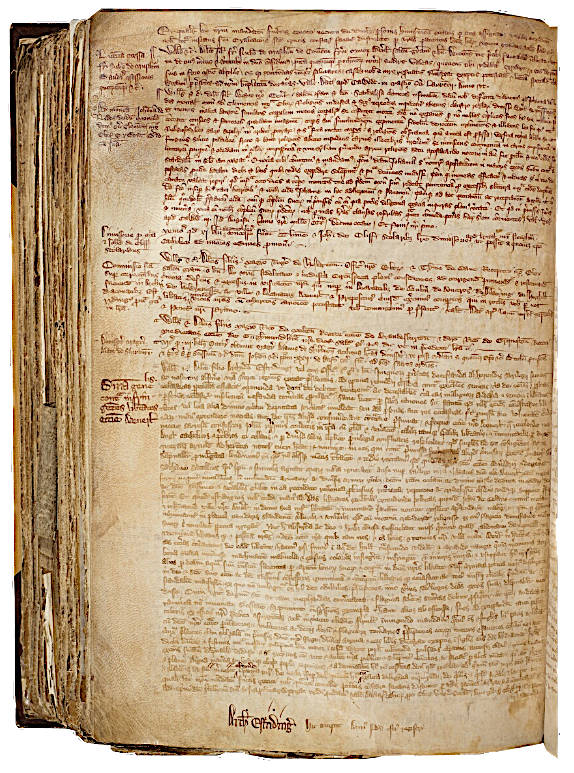
We know almost nothing of Joan’s life, except that at some time in 1318, she faked her death, left behind a fake body to bury, and escaped the convent to pursue what William Melton, then Archbishop of York, called “the way of carnal lust.” Joan’s sisters aided in her great escape, as the archbishop wrote in a letter: “numerous of her accomplices, evildoers, with malice aforethought, crafted a dummy in the likeness of her body in order to mislead the devoted faithful.”
The episode—or what we know of it from Melton’s register—struck University of York professor Sarah Rees Jones as “extraordinary—like a Monty Python sketch.” Joan’s story has become a highlight of The Northern Way, a project that “seeks to assess and analyze the political roles of the Archbishops of York over the period 1306–1406.” A number of records from the period have been digitized, including William Melton’s registry, in which Joan’s escape appears (see the page of scribal notes above).
One of the archbishop’s roles involved interceding in such cases of runaway monks and nuns. “Unfortunately,” Rees Jones remarks, “we don’t know the outcome of the case” of Joan. Often, as one might expect, escapes like hers—though few as picaresque—had to do with “not wanting to be celibate…. Many of the people would have been committed to a religious house when they were in their teens, and then they didn’t all take to the religious life.”
The archbishop put matters rather less charitably: “Having turned her back on decency and the good of religion,” he writes, “seduced by indecency, she involved herself irreverently and perverted her path of life arrogantly to the way of carnal lust and away from poverty and obedience, and, having broken her vows and discarded the religious habit, she now wanders at large to the notorious peril to her soul and to the scandal of all of her order.”
Or, as we might say today, she was ready to embark on a new life path. So desperately ready, it seems, that we might only hope Joan of Leeds remained “at large” and found happiness elsewhere. Learn more about The Northern Way project here.
Related Content:
Why Knights Fought Snails in Illuminated Medieval Manuscripts
Josh Jones is a writer and musician based in Durham, NC. Follow him at @jdmagness.
Read More...Take a Virtual Tour of Jane Austen’s Library
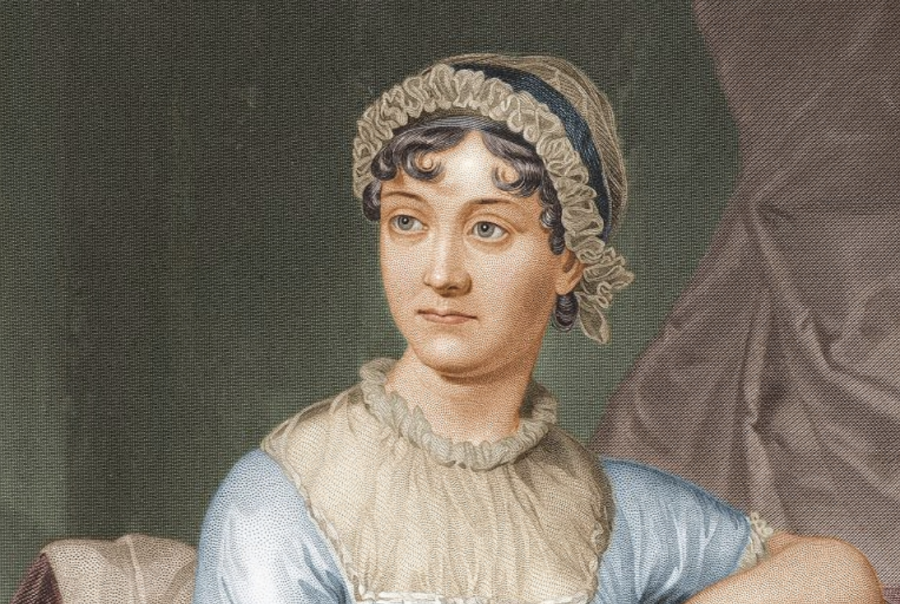
Jane Austen read voraciously and as widely as she could in her circumscribed life. Even so, she told her niece Caroline, she wished she had “read more and written less” in her formative years. Her nephew James Edward Austen-Leigh made clear that no matter how much she read, her work was far more than the sum of her reading: “It was not,” he wrote in his 1870 biography, “what she knew, but what she was, that distinguished her from others.” What she was not, however, was the owner of a great library.
Members of Austen’s family were well-off, but she herself lived on modest means and never made enough from writing to become financially independent. She owned books, of course, but not many. Books were expensive, and most people borrowed them from lending libraries. Nonetheless, scholars have been able to piece together an extensive list of books Austen supposedly read—books mentioned in her letters, novels, and an 1817 biographical note written by her brother Henry in her posthumously published Northanger Abbey.
Austen read contemporary male and female novelists. She read histories, the poetry of Milton, Wordsworth, Byron, Cowper, and Sir Walter Scott, and novels written by family members. She read Chaucer, Locke, Rousseau, Hume, Spencer, and Wollstonecraft. She read ancients and modern. “Despite her desire to have ‘read more” in her youth,” write Austen scholars Gillian Down and Katie Halsey, “recent scholarship has established that the range of Austen’s reading was far wider and deeper than either Henry or James Edward suggest.”
Austen may not have had a large library of her own, but she did have access to the handsome collection at Godmersham Park, the home of her brother Edward Austen Knight. “For a total of ten months spread over fifteen years,” Rebecca Rego Barry writes at Lapham’s Quarterly, “Austen visited her brother at his Kent estate. The brimming bookshelves at Godmersham Park were a particular draw for the novelist.” In the last eight years of her life, Jane lived with her mother and sister Cassandra at Edward’s Chawton estate, in a villa that had its own library.

Reconstructing these shelves show us the books Austen would have regularly had in view, though scholars must use other evidence to show which books she read. In 2009, Down and Halsey curated an exhibition focused on her reading at Chawton. Ten years later, we can see the library at Godmersham Park recreated in a virtual version made jointly by Chawton House and McGill University’s Burney Center.
Called “Reading with Austen,” the interactive site lets us to navigate three book-lined walls of the library. “Users can hover over the shelves and click on any of the antique books,” writes Barry, “summoning bibliographic data and available photos of pertinent title pages, bookplates, and marginalia. Digging deeper, one can peruse a digital copy of the book and determine the whereabouts of the original.”
These volumes are what we might expect from an English country gentleman: books of law and agriculture, historical registers, travelogues, political theory, and classical Latin. There is also Shakespeare, Swift, and Voltaire, Austen’s own novels, and some of the contemporary fiction she particularly loved. The Burney Center “tried,” says director Peter Sabor, “to imagine Jane Austen actually walking around the library…. We’re basically looking over her shoulder as she looks at the bookshelf.” It’s not exactly quite like that at all, but the project can give us a sense of how much Austen treasured libraries.
She wrote about libraries as a sign of luxury. In an early unfinished novel, “Catherine,” she has a furious character exclaim in reproach, “I gave you the key to my own Library, and borrowed a great many good books of my Neighbors for you.” Austen may have feared losing library and lending access, and she longed for a kingdom of books all her own. During her final visit to Godmersham Park in 1813, she wrote to her sister, “I am now alone in the Library, Mistress of all I survey.”
Try to imagine how she might have felt as you peruse the library’s haphazardly arranged contents. Consider which of these books she might have read and which she might have shelved and why. Enter the “Reading with Austen” library project here.
Related Content:
Download the Major Works of Jane Austen as Free eBooks & Audio Books
Josh Jones is a writer and musician based in Washington, DC. Follow him at @jdmagness
Read More...Hear Glenn Gould Celebrate the Moog Synthesizer & Wendy Carlos’ Pioneering Album Switched-On Bach (1968)
Glenn Gould made his name as a pianist with his stark, idiosyncratic interpretations of the music of Mozart, Haydn, Beethoven, and especially Bach. He left behind not just a highly respected body of work in the form of recorded performances, but also a host of strong opinions about music itself and all that culturally and commercially surrounded it. His enthusiasms weren’t always predictable: in 1967 he went on CBC radio to lavish praise on the pop singer Petula Clark, and the next year he returned to the airwaves to make a hearty endorsement of a record for which not everyone in the classical music world would admit to an appreciation: Wendy Carlos’ Switched-On Bach.
After voicing his distaste for compilation albums, comparing them to Reader’s Digest condensed literature, Gould informs his listeners that “the record of the year — no, let’s go all the way, the decade — is an unembarrassed compote of Bach’s greatest hits.” The whole record, he claims, “is one of the most startling achievements of the recording industry in this generation, certainly one of the great feats in the history of keyboard performance,” and “the surest evidence, if evidence be needed, that live music never was best.” Gould had retired from the “anachronistic” practice of live performance four years earlier, seeking his own kind of musical perfection within the technologically enhanced confines of the recording studio.
On that level, it makes sense that a meticulously, painstakingly crafted recording — not to mention one impossible, at the time, to reproduce live — like Switched-On Bach would appeal to Gould. He also takes the opportunity on this broadcast to introduce the Moog synthesizer, which Carlos used to produce every note on the record. “Theoretically, the Moog can be encouraged to imitate virtually any instrumental sound known to man, and there are moments on this disc which sound very like an organ, a double bass or a clavichord,” Gould says, “but its most conspicuous felicity is that, except when casting gentle aspersions on more familiar baroque instrumental archetypes, the performer shuns this kind of electronic exhibitionism” — a sure way of scoring points with the restraint-loving Gould.
The broadcast includes not just Gould’s thoughts on Switched On-Bach and the Moog but two interviews, one with poet and essayist Jean Le Moyne on “the human fact of automation, its sociological and theological implications,” and one with Carlos herself. Asked about the choice of Bach, Carlos frames it as a test of how the new technology of the synthesizer would fare when used to play not avant-garde music, as it then usually was, but music with the most impeccable aesthetic credentials possible. “We’re just a baby,” Carlos says of the enterprise of synthesizer-driven electronic music. “Although now we can see that the child is going to grow into a rather exciting adult, we’ve still got to take one step at a time. It will become assimilated. The gimmick value — thank god — is going to be lost, and true musical expression, and that alone, will result.”
via Synthtopia
Related Content:
Watch a 27-Year-Old Glenn Gould Play Bach & Put His Musical Genius on Display (1959)
Listen to Glenn Gould’s Shockingly Experimental Radio Documentary, The Idea of North (1967)
Glenn Gould Explains the Genius of Johann Sebastian Bach (1962)
How the Moog Synthesizer Changed the Sound of Music
Based in Seoul, Colin Marshall writes and broadcasts on cities, language, and culture. His projects include the book The Stateless City: a Walk through 21st-Century Los Angeles and the video series The City in Cinema. Follow him on Twitter at @colinmarshall, on Facebook, or on Instagram.
Read More...Support Us
We're hoping to rely on loyal readers, rather than erratic ads. Please click the Donate button and support Open Culture. You can use Paypal, Venmo, Patreon, even Crypto! We thank you!

About Us

Open Culture scours the web for the best educational media. We find the free courses and audio books you need, the language lessons & educational videos you want, and plenty of enlightenment in between.
Advertise With Us

FREE UPDATES!
GET OUR DAILY EMAIL
Get the best cultural and educational resources on the web curated for you in a daily email. We never spam. Unsubscribe at any time.
FOLLOW ON SOCIAL MEDIA

Open Culture editor Dan Colman scours the web for the best educational media. He finds the free courses and audio books you need, the language lessons & movies you want, and plenty of enlightenment in between.
Advertise With Us

