Why Is Jackie Chan the King of Action Comedy? A Video Essay Masterfully Makes the Case
When’s the last time you gasped, while watching a movie, at a pure bit of physical comedy? Of a clever move, over a stunt that left you breathless, because you knew that no way was computer graphics or greenscreen involved? There are indeed some–that hallway fight in the first season of Daredevil, the endless apartment melee in Atomic Blonde, and, bear with me here, most of Jackass. But those are few and far between. During the Jackie Chan heyday, that gobsmacking disbelief happened every single film. We laughed, we winced, we cheered. For a moment, Jackie Chan was the king of action comedy.
Personally, I can’t believe we *haven’t* talked about this Tony Zhou YouTube essay, because I have shown it nearly every semester in my film production class. Part of me wants to turn the young’uns on to Jackie Chan (the HK films, not the Rush Hour series), and another part hopes that these future directors will go on to correct what Hollywood gets so so wrong these days.
Chan was compared early on to the giants of silent cinema like Buster Keaton, but as a young cinephile I couldn’t see past the obvious homages in films like Project A, which famously had Chan hanging off a clock tower like Harold Lloyd. It was only later that the true comparison became apparent, and Zhou lays it out for us in one of his best essays.
His main points are thus: 1) Chan starts at a disadvantage and must fight his way back to the top, which links him with Chaplin and Keaton, but not like action heroes at the time like Willis and Schwarzenegger, who come fully formed. 2) Chan uses any prop to fight, not just the usual guns and swords. 3) He fights in clearly lighted scenes, with costume design to make him stand out.
And here’s the main directoral point: Jackie Chan and his group of stuntmen can actually fight, and fight well. So the camera does not need to move a lot and the totality of the human body in space can be appreciated. This could only happen in a filmmaking scene like Hong Kong where productions took time and spent money to get absolutely perfect takes. Hollywood, on the other hand, does not hire actors who can fight or act physical–instead they film and edit around the actors’ lack of skill. When we applaud a clever stunt in a Jackie Chan film, 50 or more imperfect takes lay on the cutting room floor. (Zhou finds some good behind-the-scenes interviews explicitly laying this idea out.)
Zhou also blames Western editors for cutting too fast and cutting too much on every hit, ruining the rhythm. Most directors, editors, and stunt coordinators don’t know editing, says Chan. There’s a technique in Hong Kong editing where you show the impact twice that to an audience feels like one, strong impact.
One of the final points is that these Jackie Chan films focus on the pain of the protagonist. (Which, by the way, is why Jackass succeeds as comedy as well.) But so many Hollywood films skip this bit of reality, as our heroes tend to be invincible. There is a larger social-political critique to be made about the particular lies Hollywood tells itself, and you can have at it in the comments if you wish. But for now, queue up some classic Chan–my jumping off point all those years ago was Drunken Master II–and see how the master does it.
Related Content:
Judd Apatow Teaches the Craft of Comedy: A New Online Course from MasterClass
Buster Keaton: The Wonderful Gags of the Founding Father of Visual Comedy
Ted Mills is a freelance writer on the arts who currently hosts the artist interview-based FunkZone Podcast and is the producer of KCRW’s Curious Coast. You can also follow him on Twitter at @tedmills, read his other arts writing at tedmills.com and/or watch his films here.
Read More...Worlds of Ursula K. Le Guin: Stream Online (for a Limited Time) a New Documentary Exploring the Life & Work of the Legendary Sci-Fi Writer
“There are a lot of dystopias around these days,” writes Kim Stanley Robinson in his recent essay “Dystopia Now.” This, of course, “makes sense, because we have a lot of fears about the future.” We also have a lot of fears about the present, which get mapped onto the future in dystopian fiction, a genre that has become “part of our all-encompassing hopelessness.”
Dystopias feel familiar, even comforting, in that no matter how bad things are, they are perhaps not quite as bad yet as the darkest visions of science fiction. We might still change course if we can finally heed the warnings. But literary and cinematic pessimism, either as grim escapism or a wake-up call, “has done its job,” Robinson argues, “it’s old news now, perhaps it’s self-indulgence to stay stuck in that place any more.”
Another legendary sci-fi writer, Ursula K. Le Guin agreed. “We keep writing dystopias,” she remarked in a 2017 essay, “instead of envisioning a better world.” Le Guin, who passed away last year, wrote of “ambiguous,” “clearsighted,” and “troubled” utopias. And she practiced, over the course of her long career, what Robinson calls our current “task at hand”—“to imagine ways forward to that better place.” We may not see much reason for optimism, but utopian thinking, “is realistic: things could be better.”
An anarchist, feminist, and environmentalist, Le Guin might be called an “ideological” writer, but not in the derogatory sense the word implies. All artists have ideological frameworks, whether they’re aware of them or not, and Le Guin was very much aware of the lenses she used to see the world, what Robinson defines as “the imaginary relationship to our real conditions of existence.”
She consciously restructured her work to imagine new worlds in terms outside the oppressively hegemonic norms that govern ours, norms created by what she called the “yang” desire for absolute control. “I had to rethink my entire approach to writing fiction,” she says above in Worlds of Ursula K. Le Guin, a new PBS documentary directed by Arwen Curry, available free to stream for a limited time.
“It was important,” Le Guin goes on, “to think about privilege and power and domination in terms of gender, which is something science fiction and fantasy had not done.” In so doing, Le Guin showed her readers it was possible to imagine functional, believable, even attainable alternatives to stark realities that seem too deeply entrenched to ever change. She showed other sci-fi and fantasy writers that they could do the same.
The documentary features appearances from contemporaries and successors to Le Guin’s world-building brilliance, including Margaret Atwood, Samuel R. Delany, Analee Newitz, China Miéville, Neil Gaiman, Michael Chabon, and David Mitchell, all of whom cite her as an influence and inspiration. (“I read A Wizard of Earthsea,” says Mitchell, “and things rearranged in my head.”)
In a way, reading Le Guin for the first time feels like being given a pair of VR glasses through which to see what’s truly possible, if only we had the will to collectively imagine it into being. She did not think of utopianism as an eternal state of perfection or a thought experiment, but as a “process,”as Kelly Lynn Thomas writes at The Millions, of “reflection and adjustment, learning and growth… communication and respect, self-awareness and honesty.”
Though the word is typically deployed to describe dangerous naivete or pie-in-the-sky thinking, utopianism need not be a grasping after “rational human control of human life,” Le Guin wrote. Utopias always contain some measure of dystopia, she recognized. But she proposed that we find balance by imagining what she calls “yin utopias,” spaces that involve “acceptance of impermanence and imperfection, a patience with uncertainty and the makeshift, a friendship with water, darkness, and the earth.”
Such are the ideals that informed her vast imaginative output over the course of nearly 60 years, including 21 novels, 11 volumes of short stories, essay collections, children’s books, and poetry. In Worlds of Ursula K. Le Guin, we learn how she developed and refined her creative vision, and her critiques of totalizing “yang” utopianism and its despairing opposite. The film is available to stream in full online for a limited time. Watch it above or on PBS’s American Masters page before it’s gone.
Related Content:
Ursula K. Le Guin’s Daily Routine: The Discipline That Fueled Her Imagination
Ursula K. Le Guin Names the Books She Likes and Wants You to Read
Josh Jones is a writer and musician based in Durham, NC. Follow him at @jdmagness
Read More...RIP D.A. Pennebaker: Watch Scenes from His Groundbreaking Bob Dylan Documentary Dont Look Back
Something happened to popular culture in the late 1960s, and we who seek to understand exactly what owe a debt of gratitude to the documentary filmmaker D.A. Pennebaker, who died last week. That goes for those us who never experienced those heady times ourselves; those of us who did (and may have found the times a bit too heady to recall with any clarity); and even those of us not quite young enough to fathom what was going on at the time, such as those already in middle age by the Summer of Love. Pennebaker was himself a member of that generation, but the films that came out of his coverage of the Monterey Pop Festival — whose performers included Janis Joplin, Ravi Shankar, Jefferson Airplane, The Who, and Jimi Hendrix — reveal that he could see something big was happening.
Pennebaker’s filmmaking also brought him into contact with the likes of John Lennon, David Bowie, Otis Redding, and Bob Dylan, the latter being the star of Pennebaker’s first music film Dont Look Back [sic]. Released in 1967 but shot in 1965, it observes the singer’s tour of England that year as well as the events surrounding it, offering what Roger Ebert called, when the film first came out, “a fascinating exercise in self-revelation carried out by Bob Dylan and friends,” a group that includes such generational icons as Joan Baez and Donovan.
Alas, “the portrait that emerges is not a pretty one,” rendered as it is by the cinéma vérité style Pennebaker had been developing for more than a decade. That was made possible in part by the advent of synchronous-sound cameras that could capture real speech on location — “what people said to each other,” in Pennebaker’s words, as opposed to “what you thought up on a yellow pad.”
All this exposed Dylan, in Ebert’s eyes, as “immature, petty, vindictive, lacking a sense of humor, overly impressed with his own importance and not very bright.” In both his original review of Dont Look Back and his revisitation in 1998, when the film was selected for preservation in the U.S. Library of Congress’ National Film Registry, he highlights the scene of Dylan’s interview with Time London correspondent Horace Freeland Judson. Then, as now, a performer who prefers to be publicized on his own terms, Dylan pushes back against any perceived attempt to define or explain him, especially by a relatively old-school institution like Time. In this young Bob Dylan we have an embodiment of the late-60s youth spirit: amusingly defiant and prolifically creative, if also irresponsible and arrogant. (As Ebert wrote in 1998, “Did we actually once take this twirp as our folk god?”)
Pennebaker discusses Dylan and Dont Look Back in the clip at the top of the post, which comes from a longer interview available here. He also gets into 1966’s Eat the Document, the never-officially-released follow-up to Dont Look Back previously featured here on Open Culture. In the Criterion Collection video just above, Patti Smith — somehow never the subject of a Pennebaker film herself — reflects on the role Dylan played in her life. “He was like my imaginary boyfriend,” Smith says of the singer. “The first time I saw Dont Look Back, I had just come to New York to live.” She describes the intersection of the move and the movie as “a pivotal moment, because it encompassed everything for me: it encompassed the hubris of youth, it encompassed art, poetry, the perfect sunglasses, everything.” She saw the film so many times that she “knew all the dialogue” — dialogue that Pennebaker just happened to capture, but which has long since become part of the culture.
Related Content:
Do Look Back: Pennebaker and Marcus Talk Bob Dylan
Bob Dylan Shares a Drug-Hazed Taxi Ride with John Lennon (1966)
Jefferson Airplane Plays on a New York Rooftop; Jean-Luc Godard Captures It (1968)
Watch the First Trailer for Martin Scorsese’s New Film, Rolling Thunder Revue: A Bob Dylan Story
Andy Warhol’s ‘Screen Test’ of Bob Dylan: A Classic Meeting of Egos
Based in Seoul, Colin Marshall writes and broadcasts on cities, language, and culture. His projects include the book The Stateless City: a Walk through 21st-Century Los Angeles and the video series The City in Cinema. Follow him on Twitter at @colinmarshall, on Facebook, or on Instagram.
Read More...The Authentic Vivaldi’s The Four Seasons: Watch a Performance Based on Original Manuscripts & Played with 18th-Century Instruments
Last week we featured a performance of Pachelbel’s Canon as faithful as possible to how Pachelbel originally composed it, as well as to the instruments and playing styles of the era in which he lived. Today we offer another performance by the same ensemble, San Francisco’ Voices of Music, this one of an even more beloved piece: Antonio Vivaldi’s The Four Seasons. In the video above, violinist Cynthia Miller Freivogel joins Voices of Music to play the suite’s “Winter” concerto on such genuinely early 18th-century instruments as the baroque organ, the Italian single manual harpsichord, and the archlute.
“Of the many composers who helped to bring the Italian Baroque style to its zenith at the beginning of the 18th century, Antonio Vivaldi stands out as perhaps the most creative,” says the web site of the Redlands Symphony. “Like Bach, his energy was primarily directed toward perfecting existing forms rather than creating new ones. Within the works of Vivaldi, we see a perfection of the 17th century Italian concerto and opera forms.”
And in the case of The Four Seasons, made up as it is of one concerto representing each quarter of the year accompanied by a sonnet on the spirit of that season, Vivaldi made “a conscious attempt to write programmatic works. They are, in fact, one of the earliest attempts to compose music of this type.”
For this video, Voices of Music’s official notes explain, a “new edition” of The Four Seasons “was prepared from the original sources, prints and manuscripts for Vivaldi’s music. In addition, a digital overlay has been created for Vivaldi’s sonnets which were inlaid into the original engraving: click the CC button to view the sonnet and the gear icon to choose your preferred language.” This performance of one part of Vivaldi’s best-known compositions, sounding as close as we can possibly get today to the way Vivaldi himself must have heard it, will be seasonally appropriate for southern-hemisphere Open Culture readers now in the middle of their own winter. As for readers in the summertime of the northern hemisphere — well, nine and a half minutes of 17th-century wintertime may be just what they need to cool down.
Related Content:
Why We Love Vivaldi’s “Four Seasons”: An Animated Music Lesson
Vivaldi’s Four Seasons Brought to Life in Sand Animations by the Hungarian Artist Ferenc Cakó
14-Year-Old Girl’s Blistering Heavy Metal Performance of Vivaldi
Based in Seoul, Colin Marshall writes and broadcasts on cities, language, and culture. His projects include the book The Stateless City: a Walk through 21st-Century Los Angeles and the video series The City in Cinema. Follow him on Twitter at @colinmarshall, on Facebook, or on Instagram.
Read More...Why a Cat Always Lands on Its Feet: How a French Scientist Used Photography to Solve the Problem in 1894
In the era of the CATS trailer and #catsofinstagram, it’s easy to forget that scientific research is what originally convinced our feline friends to allow their images to be captured and disseminated.
An anonymous white French pussy took one for the team in 1894, when scientist/inventor Étienne-Jules Marey dropped it from an unspecified height in the Bois de Boulogne, filming its descent at 12 frames per second.
Ultimately, this brave and likely unsuspecting specimen furthered the cause of space exploration, though it took over 50 years for NASA-backed researchers T.R. Kane and M.P. Scher to publish their findings in a paper titled “A Dynamical Explanation of the Falling Cat Phenomenon.”
As the Vox Darkroom episode above makes clear, Marey’s obsession was loftier than a fondness for Stupid Pet Tricks and the mischievous impulse to drop things off of tall buildings that motivated TV host David Letterman once upon a time.
Marey’s preoccupation with the mechanics of organic locomotion extended to horses and humans. It prompted him to invent photographic techniques that prefigured cinematography, and, more darkly, to subject other, less-catlike creatures to deadfalls from similar heights.
(Children and animal rights activists, consider this your trigger warning.)
The white cat survived its ordeal by arching its back mid-air, effectively splitting its body in two to harness the inertia of its body weight, much like a figure skater controlling the velocity of her spin by the position of her arms.
Why waste a single one of your nine lives? Physics is your friend, especially when falling from a great height.
See one of Marey’s pioneering falling cat chronophotographs below.

Related Content:
Thomas Edison’s Boxing Cats (1894), or Where the LOLCats All Began
Explosive Cats Imagined in a Strange, 16th Century Military Manual
Ayun Halliday is an author, illustrator, theater maker and Chief Primatologist of the East Village Inkyzine. Join her in NYC on Monday, September 9 for another season of her book-based variety show, Necromancers of the Public Domain. Follow her @AyunHalliday.
Read More...The Library of Congress Digitizes Over 16,000 Pages of Letters & Speeches from the Women’s Suffrage Movement, and You Can Help Transcribe Them
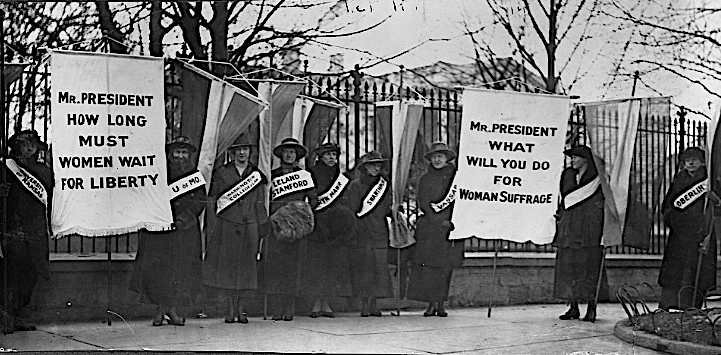
“Democracy may not exist,” Astra Taylor declares in the title of her new book, “but we’ll miss it when it’s gone.” This inherent paradox, she argues, is not fatal, but a tension with which each era’s democratic movements must wrestle, in messy struggles against inevitable opposition. “Perfect democracy… may not in fact exist and never will, but that doesn’t mean we can’t make progress toward it, or that what there is of it can’t disappear.”
Taylor is upfront about “democracy’s dark history, from slavery and colonialism to facilitating the emergence of fascism.” But she is equally celebratory of its successes—moments when those who were denied rights marshaled every means at their disposal, from lobbying campaigns to confrontational direct action, to win the vote and better the lives of millions. For all its imperfections, the women’s suffrage movement of the 19th and early 20th century did just that.
It did so—even before electronic mass communication systems—by building international activist networks and forming national associations that took highly-visible action for decades until the 19th Amendment passed in 1920. We can learn how this all came about from the sources themselves, through the “letters, speeches, newspaper articles, personal diaries, and other materials from famed suffragists like Susan B. Anthony and Elizabeth Cady Stanton.”
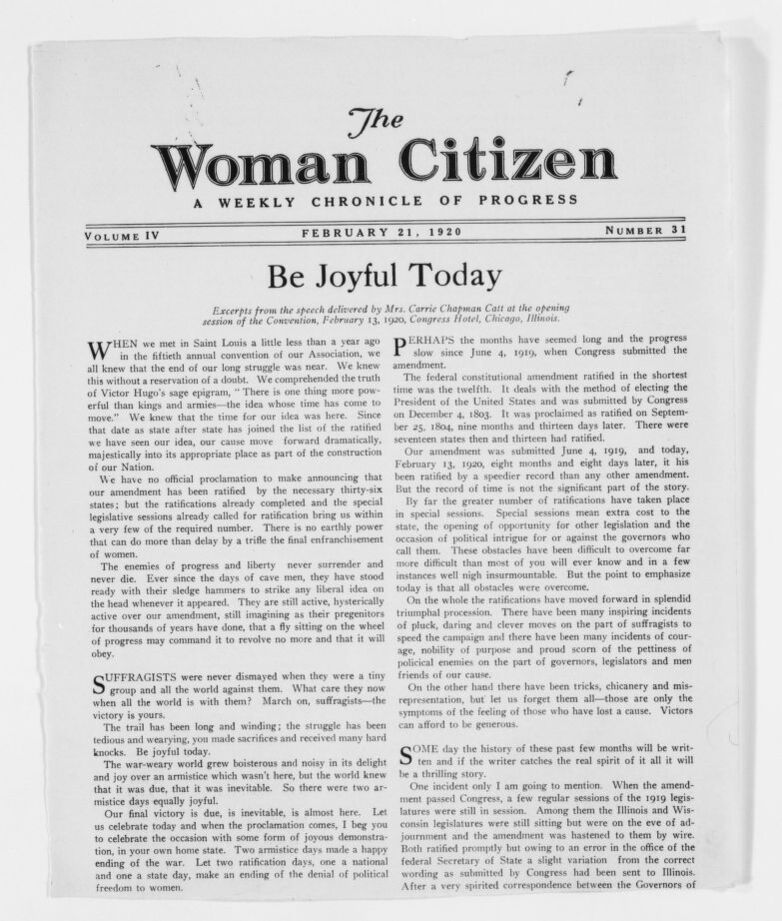
So reports Mental Floss, describing the Library of Congress’ digital collection of suffragist papers, which includes dozens of famous and less famous activist voices. In one example of both international cooperation and international tension, Carrie Chapman Catt, Anthony’s successor (see a published excerpt of one of her speeches below), describes her experience at the Congress of the International Woman Suffrage Alliance in Rome. “A more unpromising place for a Congress I never saw,” she wrote, dismayed. Maybe despite herself she reveals that the differences might have been cultural: “The Italian women could not comprehend our disapproval.”
The fractious, often disappointing, relationships between the larger international women’s suffrage movement, the African American women’s suffrage movement, and mostly male Civil Rights leaders in the U.S. are represented by the diaries. letters, notebooks, and speeches of Mary Church Terrell, “a founder of the National Association of Colored Women. These documents shed light on minorities’ laborious suffrage struggles and her own dealings with Civil Rights figures like W.E.B. Du Bois.” (Terrell became an activist in 1892 and lived to fight against Jim Crow segregation in the early 1950s.)
The collection includes “some 16,000 historic papers related to the women’s rights movement alone.” All of them have been digitally scanned, and if you’re eager to dig into this formidable archive, you’re in luck. The Library of Congress is asking for help transcribing so that everyone can read these primary sources of democratic history. So far, reports Smithsonian, over 4200 documents have been transcribed, as part of a larger, crowdsourced project called By the People, which has previously transcribed papers from Abraham Lincoln, Clara Barton, Walt Whitman, and others.
Rather than focusing on an individual, this project is inclusive of what is arguably the main engine of democracy: large-scale social movements—paradoxically the most democratic means of claiming individual rights. Enter the impressive digital collection “Suffrage: Women Fight for the Vote” here, and, if you’re moved by civic duty or scholarly curiosity, sign up to transcribe.
via Mental Floss
Related Content:
Odd Vintage Postcards Document the Propaganda Against Women’s Rights 100 Years Ago
Josh Jones is a writer and musician based in Durham, NC. Follow him at @jdmagness.
Read More...The Unexpected Ways Eastern Philosophy Can Make Us Wiser, More Compassionate & Better Able to Appreciate Our Lives
I feel compelled to start this post with a disclaimer: do not take the eight-and-a-half-minute video above, “Six Ideas from Eastern Philosophy” from Alain de Botton’s School of Life series, as an authoritative statement on Eastern Philosophy.
Not that you would, or that de Botton makes such a claim, but in an age of uncritical overconsumption, infinite scrolling, and individually-wrapped explainers, it seems worth the reminder. No tradition—and certainly not one as incalculably rich, deep, and ancient as the schools of thought summed up as “Eastern Philosophy”—can be paraphrased in an animated list.
Think of “Six Ideas from Eastern Philosophy” as a teaser. If you’ve resigned yourself to the fact that suffering is ever-present and universal—the first idea on de Botton’s list and the Buddha’s first Noble Truth—you might love… or make a good faith effort to appreciate… The Middle Length Discourses, the Shobogenzo, the poetry and songs of Han Shan and Milarepa, or the thousands of translations, commentaries, adaptations, and etcetera about them.
But the video isn’t about famous texts. The logocentric characterization of philosophy as only writing persists, despite its serious limitations. In many Eastern traditions, writing and study are only one part of complex religious practices. The first two ideas on de Botton’s list come from early Indian Buddhism; the third from Chinese Chan Buddhism, the fourth and fifth are Daoist concepts; and the sixth, kintsugi, comes from Japanese Zen.
De Botton’s title is misleading. As he goes on to show, in brief, but with vivid examples and comparisons, these are not “ideas” in the broadly Platonic sense of pure abstractions but formalized ways of being with others and being alone, of being with objects and natural formations that embody ethical ideals of balance, equanimity, contentment, kindness, care, and deep appreciation for art and nature, with all their imperfections and disappointments.
Can we make much sense of the adoration of the bodhisattva Guanyin (whom de Botton compares to the Virgin Mary) if we never visit one of her temples or call for her compassionate aid? Can we study the subtleties of bamboo without bamboo? Can we grasp the Four Noble Truths if we can’t sit still long enough for serious self-reflection? Sometimes the practices, landscapes, and iconographies of Eastern philosophy do not seem separable from ideas about them.
If there’s a bow to tie on de Botton’s summary, maybe it’s this: from these Buddhist and Daoist perspectives, the endless bifurcations of Western thought are illusory. Pain, imperfection, and uncertainly are inevitable and not to be feared but compassionately accepted. And philosophy is something that happens in the body and mind together, an idea certainly not alien to the walking thinkers of the West.
Related Content:
Eastern Philosophy Explained with Three Animated Videos by Alain de Botton’s School of Life
What Is a Zen Koan? An Animated Introduction to Eastern Philosophical Thought Experiments
Josh Jones is a writer and musician based in Durham, NC. Follow him
Read More...Metallica’s “Enter Sandman” Sung in the Style of David Bowie
If you like what Anthony Vincent has to offer here, there’s more where that came from. Don’t miss his other viral video, “Enter Sandman in 20 Styles,” which features Metallica’s 1998 hit sung in the style of Stevie Wonder, The Police, The Doors and much more.
If you would like to support the mission of Open Culture, consider making a donation to our site. It’s hard to rely 100% on ads, and your contributions will help us continue providing the best free cultural and educational materials to learners everywhere. You can contribute through PayPal, Patreon, and Venmo (@openculture). Thanks!
Read More...Pretty Much Pop: A Culture Podcast #4 — HBO’s “Chernobyl”: Why Do We Enjoy Watching Suffering?

On the HBO mini-series Chernobyl. Mark Linsenmayer, Erica Spyres, and Brian Hirt first get into the various degrees of looseness in something’s being “based on a true story.” Does it matter if it’s been changed to be more dramatic? We then consider the show as entertainment: Why do people enjoy witnessing suffering? Why might a drama work (or not) for you?
We also touch on Game of Thrones, The Killing, God Is Dead, It’s Always Sunny in Philadelphia, Big Little Lies, Schindler’s List, Vice, Ip Man, and more.
Some of the articles we looked at to prepare:
- “HBO’s Chernobyl Isn’t Just Historical Drama, It’s Straight-Up Horror” by Renaldo Matadeen
- “Top UCLA Doctor Denounces HBO’s “Chernobyl” As Wrong And “Dangerous” by Michael Shellenberger
- “What HBO’s ‘Chernobyl’ Got Right, and What It Got Terribly Wrong” by Masha Gessen
- “What Watching “Misery Porn” Shows Like ‘The Handmaid’s Tale’ Does To Your Mental Health” by Louisa Ballhaus
- “The Misery Porn of Game of Thrones Isn’t Profound. It’s Just Miserable” by Sam Brooks
- The TV Tropes page for “Based on a True Story”
Our Lucy Lawless interview will be out next week! Pretty Much Pop: A Culture Podcast is a member of the The Partially Examined Life Podcast Network.
Get more at prettymuchpop.com. Subscribe on Apple Podcasts, Stitcher, or Google Play. Pretty Much Pop: A Culture Podcast is produced by the Partially Examined Life Podcast Network. This episode includes bonus content that you can only hear by supporting the podcast at patreon.com/prettymuchpop.
Read More...The Authentic Pachelbel’s Canon: Watch a Performance Based on the Original Manuscript & Played with Original 17th-Century Instruments
Even if we don’t know its name, we’ve all heard Johann Pachelbel’s Canon in D, better known simply as Pachelbel’s Canon — and probably more than once at a wedding. But though Pachelbel composed the piece in the late 17th or early 18th century, it hasn’t enjoyed a consistent presence in the world of music: the earliest manuscripts we know date from the 19th century, and its latest period of popularity began just over fifty years ago, with an arrangement and recording by the Jean-François Paillard chamber orchestra.
And so, no matter how many times we’ve heard Pachelbel’s Canon, and no matter how many versions we’ve heard, we might well ask ourselves: have we really heard Pachelbel’s Canon? In the video above, San Francisco early-music ensemble Voices of Music — here Katherine Kyme, Carla Moore, and Cynthia Freivogel on violin, Tanya Tomkins on cello, Hanneke van Proosdij on baroque organ, and David Tayler on the theorbo — perform what many enthusiasts would consider a definitive Pachelbel’s Canon. Not only do they play that earliest of its known manuscripts, they play it using instruments from the time of Pachelbel, and with the kind of playing techniques popular back then.
“The string instruments are not only baroque, but they are in baroque setup,” notes the video’s description. “This means that the strings, fingerboard, bridge and other parts of the violin appear just as they did in Pachelbel’s time.” The video shows that “no metal hardware such as chinrests, clamps or fine tuners are used on the violins, allowing the violins to vibrate freely.” As for the organ, it’s “made entirely of wood, based on German baroque instruments, and the pipes are voiced to provide a smooth accompaniment to the strings, instead of a more soloistic sound.”
Just as van Proosdij’s technique might look slightly unfamiliar to a modern organist, so might Kyme, Moore and Freivogel’s to a modern violinist: “All three are playing baroque violins with baroque bows, yet each person has her own distinct sound and bowing style — each bow has a different shape and balance.” Their playing differs in the way, the notes add, that musicians’ playing appears to differ in paintings from the 17th century, a time when “individuality of sound and technique was highly valued,” and none of it was overseen by that most 19th-century of musical figures, the conductor. How many historically-aware brides and grooms — with the means, of course, to hire noted early-music ensembles — will it take to bring those values back into the mainstream?
Related Content:
Mashup Weaves Together 57 Famous Classical Pieces by 33 Composers: From Bach to Wagner
Pachelbel’s Chicken: Your Favorite Classical Pieces Played Masterfully on a Rubber Chicken
Based in Seoul, Colin Marshall writes and broadcasts on cities, language, and culture. His projects include the book The Stateless City: a Walk through 21st-Century Los Angeles and the video series The City in Cinema. Follow him on Twitter at @colinmarshall, on Facebook, or on Instagram.
Read More...Support Us
We're hoping to rely on loyal readers, rather than erratic ads. Please click the Donate button and support Open Culture. You can use Paypal, Venmo, Patreon, even Crypto! We thank you!

About Us

Open Culture scours the web for the best educational media. We find the free courses and audio books you need, the language lessons & educational videos you want, and plenty of enlightenment in between.
Advertise With Us

FREE UPDATES!
GET OUR DAILY EMAIL
Get the best cultural and educational resources on the web curated for you in a daily email. We never spam. Unsubscribe at any time.
FOLLOW ON SOCIAL MEDIA

Open Culture editor Dan Colman scours the web for the best educational media. He finds the free courses and audio books you need, the language lessons & movies you want, and plenty of enlightenment in between.
Advertise With Us

