Mont Saint-Michel Beautifully Viewed from a Drone
This short film was an award winner at the 2015 Drone Film festival held in Cabourg, France. Enjoy the ride.
If you would like to support the mission of Open Culture, consider making a donation to our site. It’s hard to rely 100% on ads, and your contributions will help us continue providing the best free cultural and educational materials to learners everywhere. You can contribute through PayPal, Patreon, and Venmo (@openculture). Thanks!
Read More...How the Yamaha DX7 Digital Synthesizer Defined the Sound of 1980s Music
There is a lot of creatively revised history in the Netflix hit show Stranger Things, and I’m not just talking about extra-dimensional monsters and Soviet scientists under shopping malls. There’s also the pulsing synth score by Kyle Dixon and Michael Stein. Deserving of all its praise, the music nonetheless gives the impression that the sound of the 1980s was made by instruments of the 60s and 70s—analog synthesizers like the MiniMoog Model D and effects like the Roland Space Echo.
Such classic instrumentation does create the perfect weird, fuzzy, wobbly, lush accompaniment to the show’s compelling mix of sci-fi body horror and cuddly nostalgia. But the 80s was the golden age of new sound technology, digital, and the dawn of synthesizers like the Yamaha DX7, released in 1983, the year the saga of the Upside-Down begins. Alongside massively-popular digital synths like the Roland Juno-60, the DX7 defined the 80s like few other electronic instruments, quickly rising “to take over the airwaves,” as the Polyphonic video above explains.
Brian Eno, Kenny Loggins, Whitney Houston, Herbie Hancock, Depeche Mode, Hall & Oates, Vangelis, Steve Winwood, Phil Collins, The Cure… one could go on and on, naming a majority of the artists on the charts throughout the decade. Why was the DX7 more appealing than the analogue sounds we now associate with the height of synth quality? Polyphonic explains how the DX7 used an algorithm called FM (frequently modulated) synthesis, which allowed for more refined control and modulation than the subtractive synthesis of analog synths built by Moog, ARP, Buchla, and other specialized makers in the 70s.
That meant digital keyboards had a wider range of timbres and could convincingly simulate real instruments, like the marimbas in Harold Faltermeyer’s “Axel F.” Digital synths were predictable, and could be programmed and customized, or used for their many already excellent presets. And just as Faltermeyer’s Beverly Hills Cop theme was inescapable in the mid-80s, so too was the sound of the DX7. It was “damned near ubiquitous,” writes Music Radar. “After years of exclusively analogue synths, musicians embraced the DX7’s smooth, crystalline tones and for a while the airwaves were rife with FM bells, digital Rhodes emulations and edgy basses.”
Though it’s hardly as well known, the DX7 may be as influential in 80s music as the Roland TR-808 drum machine. Yamaha’s digital synth was so popular that it “almost single-handedly spawned the third-party sound design industry, and forced other synthesizer manufacturers to take a hard look at how they were building their own instruments.” Learn about the history, versatility, and customization of the DX7 from Polyphonic in the video above. And stream a playlist of songs featuring the DX7 below. While our 80s nostalgia moment favors the richly harmonic tones of analog synths from earlier decades, you’ll learn why the real 1980s belonged to the digital DX7 and its many competitors and successors.
Related Content:
All Hail the Beat: How the 1980 Roland TR-808 Drum Machine Changed Pop Music
How the Moog Synthesizer Changed the Sound of Music
Josh Jones is a writer and musician based in Durham, NC. Follow him at @jdmagness
How Quentin Tarantino Steals from Other Movies: A Video Essay
“Good artists copy, great artists steal,” goes a line we often attribute to Pablo Picasso — even those of us who know little of Picasso’s work and nothing of the work from which he may or may not have stolen. Quentin Tarantino’s version of the line adds another observation about great artists: “They don’t do homages.” The director of Reservoir Dogs, Pulp Fiction, and Jackie Brown may well have spoken those words in frustration, the frustration of having his every picture described as an “homage” to some element or other of cinema history. He puts it more bluntly: “I steal from every single movie ever made.” A bold claim, to be sure, but if anyone is likely to have seen every film ever made, surely it’s him.
“How Quentin Tarantino Steals from Other Movies,” the INSIDER video essay above, surveys the range of his cinematic sources, from The Searchers to The Warriors, Band of Outsiders to City on Fire, Metropolis to The Flintstones.
In each of his ten features so far, Tarantino has bundled all this material into packages describable most succinctly with the adjective Tarantinoesque, which the Oxford English Dictionary defines as “characterized by graphic and stylized violence, non-linear storylines, cineliterate references, satirical themes, and sharp dialogue.” Tarantino’s latest film Once Upon a Time… in Hollywood (subject of its own INSIDER video essay) exhibits all those qualities, and both critical and audience response so far suggests that we have yet to tire of the Tarantinoesque.
How has Tarantino’s cinematic sensibility, practically textbook in its postmodernism, worn so well? As this video’s narrator puts it, Tarantino “never steals from one source. He rather steals from multiple sources spanning decades, and then stitches them together to create something new,” fortifying the process with his strong understanding of the source material (honed during his pre-fame days as a video-store clerk) and his “unique vision and writing.” Roger Ebert once wrote of Lars Von Trier, another notable filmmaker of Tarantino’s generation, that “he takes chances, and that’s rare in a world where most films seem to have been banged together out of other films.” But Tarantino takes his chances precisely by making films out of other films, and as even his detractors have to admit, it’s paid off so far.
Related Content:
Does Quentin Tarantino’s First Film, Reservoir Dogs, Hold Up 25 Years Later?: A Video Essay
Based in Seoul, Colin Marshall writes and broadcasts on cities, language, and culture. His projects include the book The Stateless City: a Walk through 21st-Century Los Angeles and the video series The City in Cinema. Follow him on Twitter at @colinmarshall, on Facebook, or on Instagram.
Read More...An Introduction to Chilean Poet Pablo Neruda: Romantic, Radical & Revolutionary
Does politics belong in art? The question arouses heated debate about creative freedom and moral responsibility. Assumptions include the idea that politics cheapens film, music, or literature, or that political art should abandon traditional ideas about beauty and technique. As engaging as such discussions might be in the abstract, they mean little to nothing if they don’t account for artists who show us that choosing between politics and art can be as much a false dilemma as choosing between art and love.
In the work of writers as varied as William Blake, Muriel Rukeyser, James Baldwin, and James Joyce, for example, themes of protest, power, privilege, and poverty are inseparable from the sublimely erotic—all of them essential aspects of human experience, and hence, of literature. Foremost among such political artists stands Chilean poet Pablo Neruda, who—as the TED-Ed video above from Ilan Stavans informs us—was a romantic stylist, and also a fearless political activist and revolutionary.
Neruda won the Nobel Prize for Literature in 1971, and, among his many other literary accomplishments, he “rescued 2,000 refugees, spent three years in political exile, and ran for president of Chile.” Neruda used “straightforward language and everyday experience to create lasting impact.” He began his career writing odes and love poems filled with candid sexuality and sensuous description that resonated with readers around the world.
Neruda’s international fame led to a series of diplomatic posts, and he eventually landed in Spain, where he served as consul in the mid-1930s during the Spanish Civil War. He became a committed communist, and helped relocate hundreds of fleeing Spaniards to Chile. Neruda came to believe that “the work of art” is “inseparable from historical and political context,” writes author Salvatore Bizzarro, and he “felt that the belief that one could write solely for eternity was romantic posturing.”
Yet his lifelong devotion to “revolutionary ideals,” as Stavans says, did not undermine his devotion to poetry, nor did it blinker his writing with what we might call political correctness. Instead, Neruda became more expansive, taking on such subjects as the “entire history of Latin America” in his 1950 epic Canto General.
Neruda died of cancer just weeks after fascist dictator Augusto Pinochet seized power from elected president Salvador Allende in 1973. Today, he remains a beloved figure for activists, his lines “recited at protests and marches worldwide.” And he remains a literary giant, respected, admired, and adored worldwide for work in which he engaged the struggles of the people with the same passionate intensity and imaginative breadth he brought to personal poems of love, loss, and desire.
Related Content:
Pablo Neruda’s Historic First Reading in the US (1966)
Pablo Neruda’s Poem, “The Me Bird,” Becomes a Short, Beautifully Animated Film
The Lost Poems of Pablo Neruda: Help Bring Them to the English Speaking World for the First Time
Josh Jones is a writer and musician based in Durham, NC. Follow him at @jdmagness.
Read More...Watch Pink Floyd Play Live Amidst the Ruins of Pompeii in 1971 … and David Gilmour Does It Again in 2016
Pink Floyd is one of few bands in rock history who could play the ruins of Pompeii without seeming to overreach, but it wasn’t their idea to put on a concert for Roman ghosts in 1971, the year before they recorded their magnum opus Dark Side of the Moon. According to the director Adrian Maben, who filmed the performance in the ancient necropolis, he decided upon the location after losing his passport during a holiday in Italy in 1971. He wandered Pompeii alone in search of it and had an epiphany.
It was strange. A huge deserted amphitheater filled with echoing insect sounds, flying bats and the disappearing light which meant that I could hardly see the opposite side of this huge structure built more than two thousand years ago.
I knew by instinct that this was the place for the film. It had to be here.
Making creative decisions from a chance encounter with echoes and shadows was, nonetheless, fully in keeping with the band’s process. Despite their decision to write accessible lyrics fitting together under a loose concept for their current album, serendipity and chance operations had always played critical roles in the composition of their post-Syd Barrett soundscapes, and became integral to Dark Side’s creation.
As David Gilmour told Guitar World’s Alan Di Perna, early experiments like “Saucerful of Secrets” (inspired by “weird shapes” drawn by Roger Waters and Nick Mason) gave rise to “Atom Heart Mother” and Meddle’s “Echoes,” which the band played in two parts at the beginning and end of the Pompeii concert film. These songs, Gilmour says, “all lead logically to Dark Side of the Moon.”
And they led through Pompeii, where the band was first “unleashed on film,” as one theatrical poster put it, before they were unleashed on thousands of new fans after Dark Side’s release in December. Where the filmed concert highlighted the band’s mastery of experimental space rock, the album brought this sensibility under the discipline of Roger Waters’ sharp songwriting and Gilmour’s stunning guitar playing and arranging.
Though he is modest about it, Gilmour’s contributions came increasingly to define the band’s massive sound in the early 70s. His role, as he told Di Perna, was “to help create a balance between formlessness and structure, disharmony and harmony.” He was, writes Rolling Stone, “a fiery, blues-based soloist in a band that hardly ever played the blues,” but he was just as “adept at droning avant-garde improv,” “Chic-like flourishes,” and “floating, dreamy textures,” all qualities ensuring that Pink Floyd’s music rose to the level of their creative ambitions.
So when Gilmour returned to Pompeii in 2016, without his Pink Floyd band members, to play the first live public concert the city’s amphitheater had seen in almost 2000 years—and the only laser light show it had ever seen—the performance didn’t seem like overreach at all. Above, see him play “Shine on You Crazy Diamond” and “Comfortably Numb” with a full backing band (including Chuck Leavell on keyboards, singing Roger Waters’ parts on the latter song). The massive stage show and huge, smartphone-toting audience makes this footage more arena rock show than the performance art of the original concert film, but the grandeur of the music, and Gilmour’s soaring solos, still justifies the grandeur of the setting.
You can purchase online the Director’s cut of Pink Floyd — Live at Pompeii.
Related Content:
Josh Jones is a writer and musician based in Durham, NC. Follow him at @jdmagness
Read More...How Ladies & Gentlemen Got Dressed in the 18th Century: It Was a Pretty Involved Process
We can identify most of the last few centuries by their styles of clothes. But it’s one thing to know what people wore in history and quite another to know how, exactly, they wore it. We’ve previously featured videos that accurately re-enact the whole process of of how soldiers and nurses dressed in World War I, and how women got dressed in the fourteenth and eighteenth centuries. Today we go back again to the eighteenth century with two videos from National Museums Liverpool, one that shows us how European gentlemen got dressed in those days, and another that shows us how ladies did.
One obvious way in which dressing points to changes over the past few hundred years: both the gentleman and the lady require the assistance of a servant. The gentleman begins his day wearing his long linen nightshirt and a wrapper over it, Japan- and India-inspired garments, the narrator tells us, that “reflect British interests abroad.”
To replace them comes first a voluminous, usually ruffled shirt; over-the-knee stockings held in place with breech kneebands; occasion-appropriate shoe buckles and cufflinks; optional linen underdrawers; many-buttoned and buckled knee breeches; a waistcoat (whose top few buttons remain open to reveal the shirt’s ruffles); a linen cravat; a buckled stock; a coat on top of the waistcoat; and of course, a freshly-dusted wig.
Getting clothes on for a day in the eighteenth century was even more complicated for ladies than for gentlemen, as evidenced by the fact that its video requires two additional minutes to show every step involved. We begin with the shift, an undergarment worn without knickers. Like the gentleman, the lady wears over-the-knee stockings, but she ties them with ribbon garters (at least for days not involving much dancing). Over that, “a knee-length white linen petticoat worn for warmth and modesty,” and over that, a stay made using whale baleen. Pockets were added in the form of bags worn at the hips, but bags known to get lost if their ties came undone — hence the nursery rhyme “Lucy Locket lost her pocket.”
Proper eighteenth-century female dress also required petticoats of various kinds, a kerchief, a stomacher (often highly decorated), more petticoats, a gown, a linen apron (with a bib pinned into position, hence “pinafore”), a day cap, and then another apron that “serves no purpose other than to indicate the fine status of the individual wearing it.” Conspicuous consumption mattered even back then, but so did the painstaking creation of the ideal female figure, or at least the impression thereof. Not only do these videos show us just the kind of clothing that would have been worn for that purpose and how it would have been put on, they also show us highly plausible attitudes projected by dressed and dresser alike: the former one of faintly bored expectation, and the latter one of resigned industriousness tinged with the suspicion that all this can’t last forever.
Related Content:
The Sights & Sounds of 18th Century Paris Get Recreated with 3D Audio and Animation
The Dresser: The Contraption That Makes Getting Dressed an Adventure
How to Make and Wear Medieval Armor: An In-Depth Primer
Based in Seoul, Colin Marshall writes and broadcasts on cities, language, and culture. His projects include the book The Stateless City: a Walk through 21st-Century Los Angeles and the video series The City in Cinema. Follow him on Twitter at @colinmarshall, on Facebook, or on Instagram.
Read More...The Therapeutic Benefits of Ambient Music: Science Shows How It Eases Chronic Anxiety, Physical Pain, and ICU-Related Trauma
“In forty years of medical practice,” wrote Dr. Oliver Sacks near the end of his famous career, “I have found only two types of non-pharmaceutical ‘therapy’ to be vitally important for patients with chronic neurological diseases: music and gardens.” The comment might not surprise us, coming from such an unorthodox thinker as Sacks. But we might be surprised by the considerable amount of traditional scientific research linking music and mental health.
Sixty years ago, when Sacks was still in medical school, avant-garde jazz bandleader Sun Ra had a very Sacks-like experience when he played for an audience of patients in a mental hospital, and inspired a catatonic woman who hadn’t spoken for years to stand up and say ‘Do you call that music?’” The gig, booked by his manager, constituted a fringe experiment in alternative medicine at the time, not a serious subject of study among medical doctors and neuroscientists.
How things have changed in the last half-century.
Several recent studies, for example, have linked drumming, the oldest and most universal form of music-making, to reduced anxiety, pain relief, improved mood, and improved learning skills in kids with autism. Listening to and playing jazz and other forms of syncopated music, have been shown in study after study to promote creativity, enhance math skills, and support mental and emotional well-being.
But what about ambient music, a genre often characterized by its lack of syncopation, and almost certain to feature as background music in guided meditation and stress reduction recordings; in slow, relaxing yoga videos; and thousands of YouTube videos promoting supposedly stress-reducing frequencies and stereo effects? Ambient seems purpose-built to combat tension and dis-ease, and in a sense, it was.
Brian Eno, the artist who named the genre and often gets credit for its invention, wrote in the liner notes to Ambient 1: Music for Airports, “[this record is] designed to induce calm and space to think.” Whether he meant to make a scientific claim or only an artistic statement of purpose, research has validated his inferences about the salutary effects of long, slow, atmospheric music.
Noisey Associate Editor Ryan Bassil, a longtime sufferer of anxiety and panic attacks, found the statement to be true in his own life, as he explains in the video above (illustrated by Nathan Cowdry). Music from ambient composers like Eno, William Bassinski, and Fennesz helped him “ground” himself during extremely anxious moments, bringing him back into sensory contact with the present.
When Bassil looked into the reasons why ambient music had such a calming effect on his over-stimulated nervous system, he found research from artist and academic Luke Jaaniste, who described an “ambient mode,” a “pervasive all-around field, without anything being prioritized into foreground and background.” Immersion in this space, writes Bassil, “can help the listener put aside what’s on their mind and use their senses to focus on their surroundings.”
We may not—and should not—ask music to be a useful tool, but ambient has shown itself particularly so when treating serious neurological and psychological conditions. Forensic psychiatrist Dr. John Tully of London’s Institute of Psychiatry, Psychology and Neuroscience traces the form back to Bach and Chopin, and especially Erik Satie, who “was the first to express the idea of music specifically as background sound,” and who had no qualms about music serving a specialized purpose.
The purpose of what we broadly call ambient has evolved and changed as classical, minimalist avant-garde, and electronic musicians have penned compositions for very different audiences. But no matter the intent, or where we draw the genre boundaries, all kinds of atmospheric, instrumental music has the therapeutic power not only to reduce anxiety, but also to ease pain in surgical patients and reduce agitation in those suffering with dementia.
When he performed with his group Darkroom at the Critical Care Unit at University College London Hospital, writer and psychologist Charles Fernyhough found out that ambient music had significant benefits for patients trapped in what he calls “a suburb of hell”: the ICU. Stays in intensive care units correlate closely with later PTSD and what was once called “ICU psychosis” in the midst of traumatic emergency room experiences. Sedation turns out to be a major culprit. But music, especially ambient music, brought patients back to themselves.
Hear the 2016 Darkroom performance at the University College London Hospital ICU further up, and read more about Fernyhough’s research and performance at Aeon. The science of how and why ambient works the way it does is hardly settled. Where Fernyhough found that patients benefited from a lack of predictability and an ability to “escape the present moment,” Bassil’s research and experience uncovered the opposite—a sense of safe predictability and enhanced sensory awareness.
Physiological responses from person to person will vary, as will their tastes. “One person’s easy listening is another’s aural poison,” Fernyhough admits. But for a significant number of people suffering severe anxiety and trauma, the droning, minimal, wordless soundscapes of ambient are more effective than any medication.
Related Content:
The “True” Story Of How Brian Eno Invented Ambient Music
The 50 Best Ambient Albums of All Time: A Playlist Curated by Pitchfork
Stream 72 Hours of Ambient Sounds from Blade Runner: Relax, Go to Sleep in a Dystopian Future
This is Your Brain on Jazz Improvisation: The Neuroscience of Creativity
Josh Jones is a writer and musician based in Durham, NC. Follow him at @jdmagness.
Read More...Behold Color Photographs Taken During the Aftermath of San Francisco’s Devastating 1906 Earthquake

If a city has been around long enough, it will more than likely have suffered some sort of catastrophically destructive event: the Great Fire of London in 1666, the Great Chicago Fire of 1871, the Great Kantō earthquake that devastated Tokyo in 1923. Most of their names, come to think of it, include the word “great,” though not every source refers to San Francisco’s 1906 earthquake that way. Not, of course, to minimize its destructiveness: with a force that would measure 7.8 on the Richter scale, the earthquake ultimately destroyed 80 percent of the city — about 25,000 buildings, with lost property equivalent to $11.2 billion in today’s dollars — and killed 3,000 people.

Six months after the disaster, an inventor named Frederick Eugene Ives arrived to document the still-fresh aftermath of the disaster. He had in hand something called a brr, a 3D color camera he designed himself. Its “system of mirrors and filters behind each lens split and filtered the light to create one pair of slides for each primary color of light (red, green, blue).
The slides were bound together in a special order with cloth tapes into a package known as a Krőmgram,” viewable only with a Krőmscőp, “the apparatus used to rebuild the image allowing the viewer to see in three-dimensional color.”
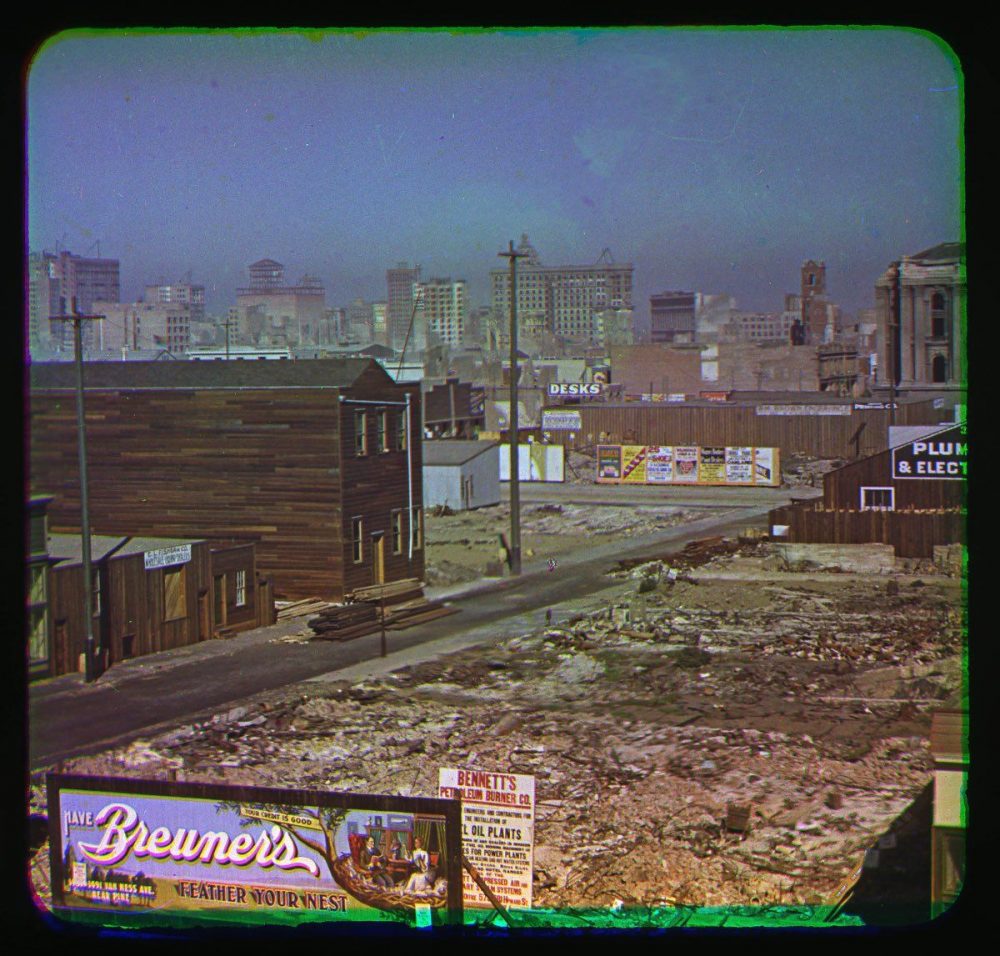
Anthony Brooks discovered Ives’ Krőmgrams of San Francisco in ruins only in 2009, reports the Telegraph. Most of its pictures were taken from a hotel rooftop, and “although hand-colored photographs of the quake’s destruction have surfaced before, Ives’ work is probably the only true color documentary evidence.” Such images would have astonished any contemporary viewer, not just for the devastation they showed but the lifelike color and depth with which they rendered it. And yet the Photochromoscope system never caught on, Brooks writes: “The Krőmscőp viewers were expensive ($50 in 1907 or about $1000 today adjusting for inflation), required strong sunlight or arc light for viewing, and were technically complex to use, despite Ives’ assertions to the contrary.”
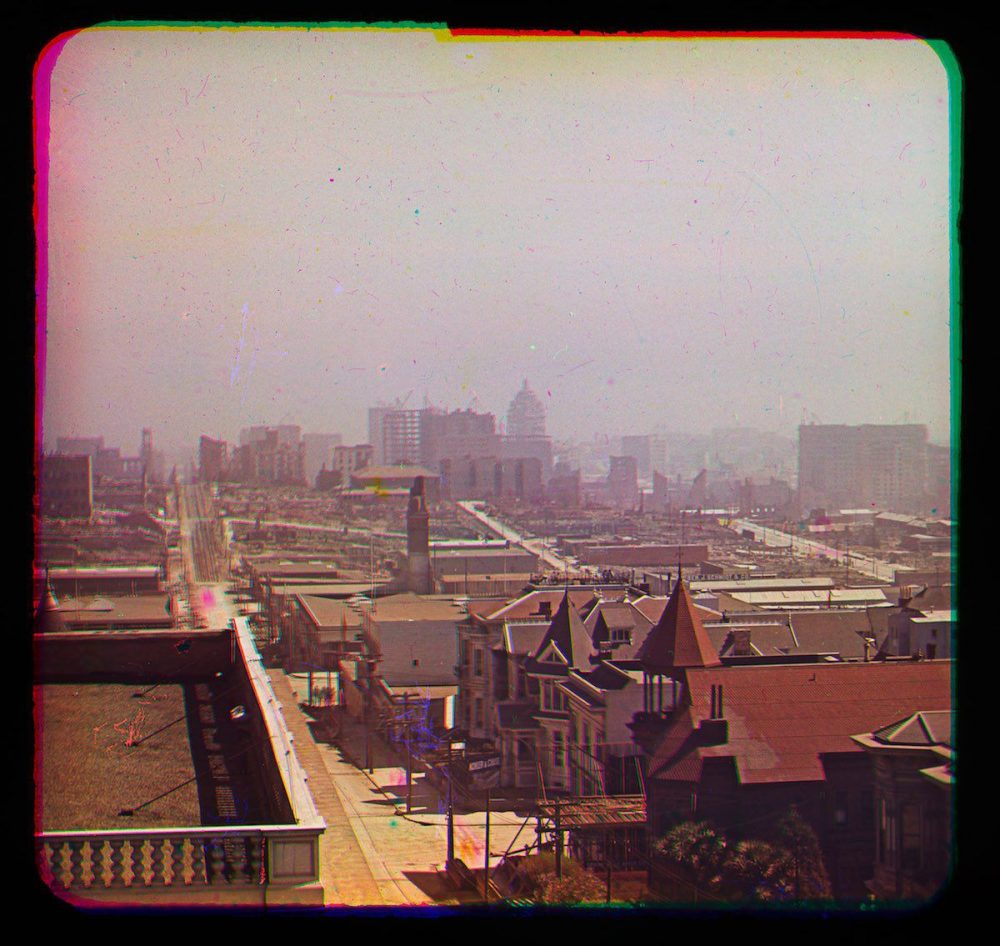
But even though few probably saw these pictures in the early 20th century, Ives was hardly forgotten in the realm of photography. The recipient of several major scientific and engineering awards in his lifetime, he left behind such more widely adopted inventions as one of the several varieties of “halftone process” that allowed photographs to be reproduced in newspapers — just as newspapers around the country did after the earthquake struck, combining them with headlines like “WATER FRONT BURNS ALMOST TO THE FERRY,” “3,000 PEOPLE ARE HOMELESS,” and “SAN FRANCISCO ANNIHILATED.” But H.G. Wells, who was on a visit to the United States at the time, sensed more of a sanguinity in the Americans around him: “There is no doubt anywhere that San Francisco can be rebuilt, larger, better, and soon.”
Related Content:
Take a Visual Journey Through 181 Years of Street Photography (1838–2019)
Voltaire & the Lisbon Earthquake of 1755
Based in Seoul, Colin Marshall writes and broadcasts on cities, language, and culture. His projects include the book The Stateless City: a Walk through 21st-Century Los Angeles and the video series The City in Cinema. Follow him on Twitter at @colinmarshall, on Facebook, or on Instagram.
Read More...Sir Ian McKellen Reads Kurt Vonnegut’s Letter to High School Students: Make Art and “Make Your Soul Grow”
Author Kurt Vonnegut was possessed of a droll, unsentimental public speaking style. A son of Indianapolis, he never lost his Hoosier accent, despite lengthy stints in Cape Cod and New York City.
Actor Ian McKellen, on the other hand, exudes warmth. He’s a charmer who tells a story with a twinkle in his eye, altering his voice and facial expressions to heighten the effect. (Check out his Maggie Smith.) Vocal training has only enhanced his beautiful instrument. (He can make a tire repair manual sound like Shakespeare.)
These two lions may have come at their respective crafts from different angles, but Sir Ian did Vonnegut proud, above, as part of Letters Live, an ongoing celebration of the enduring power of literary correspondence.
The letter in question was penned the year before Vonnegut’s death, in reply to five students at a Jesuit high school in New York City, regretfully declining their invitation to visit.
Instead, he gave them two assignments.
One was fairly universal, the sort of thing one might encounter in a commencement address: make art and in so doing, learn about life, and yourself.
The other was more concrete:
Write a 6 line rhyming poem
Don’t show it or recite it to anyone.
Tear it up into little pieces
Discard the pieces in widely separated trash receptacles
Why?
A chance for Xavier High School’s all male student body to air romantic feelings without fear of discovery or rejection?
Mayhaps, but the true purpose of the second assignment is encapsulated in the first—to “experience becoming” through a creative act.
This notion clearly strikes a chord with Sir Ian, 17 years younger than Vonnegut but by the time of the 2016 performance, closing in on the iguana-like age Vonnegut had been when he wrote the letter.
Should we attribute the quiver on the closing line to acting or genuine emotion on Sir Ian’s part?
Either way, it’s a lovely rendition.
November 5, 2006
Dear Xavier High School, and Ms. Lockwood, and Messrs Perin, McFeely, Batten, Maurer and Congiusta:
I thank you for your friendly letters. You sure know how to cheer up a really old geezer (84) in his sunset years. I don’t make public appearances any more because I now resemble nothing so much as an iguana.
What I had to say to you, moreover, would not take long, to wit: Practice any art, music, singing, dancing, acting, drawing, painting, sculpting, poetry, fiction, essays, reportage, no matter how well or badly, not to get money and fame, but to experience becoming, to find out what’s inside you, to make your soul grow.
Seriously! I mean starting right now, do art and do it for the rest of your lives. Draw a funny or nice picture of Ms. Lockwood, and give it to her. Dance home after school, and sing in the shower and on and on. Make a face in your mashed potatoes. Pretend you’re Count Dracula.
Here’s an assignment for tonight, and I hope Ms. Lockwood will flunk you if you don’t do it: Write a six line poem, about anything, but rhymed. No fair tennis without a net. Make it as good as you possibly can. But don’t tell anybody what you’re doing. Don’t show it or recite it to anybody, not even your girlfriend or parents or whatever, or Ms. Lockwood. OK?
Tear it up into teeny-weeny pieces, and discard them into widely separated trash recepticals. You will find that you have already been gloriously rewarded for your poem. You have experienced becoming, learned a lot more about what’s inside you, and you have made your soul grow.
God bless you all!
Kurt Vonnegut
(Ian McKellen’s other Letters Live performance is a fictional coming out letter from Armistead Maupin’s Tales of the City, from a gay character to his Anita Bryant-supporting parents.)
Related Content:
In 1988, Kurt Vonnegut Writes a Letter to People Living in 2088, Giving 7 Pieces of Advice
Why Should We Read Kurt Vonnegut? An Animated Video Makes the Case
Ayun Halliday is an author, illustrator, theater maker and Chief Primatologist of the East Village Inkyzine. Join her in NYC on Monday, September 9 for another season of her book-based variety show, Necromancers of the Public Domain. Follow her @AyunHalliday.
Read More...How B.B. King & Stevie Ray Vaughan Dealt With Breaking Strings Onstage Mid-Song: A Masterclass in Handling Onstage Mishaps
Playing music live onstage invites any number of mishaps. Breaking a string may not rank that highly as one of them for most professional guitarists. But the experience can still be temporarily embarrassing. It interrupts the groove and forces the kind of creative adaptation not every player appreciates on the spot. Even if you’ve got a perfectly-tuned guitar offstage—or, better yet, a guitar tech to hand you one from a rack of tuned-up guitars—you might only want that guitar: that exact guitar and no other.
If you’re B.B. King, that guitar has a name. While there were many Lucilles over the blues master’s career, when he stood in front of an audience of tens of thousands at Farm Aid in 1985, he wasn’t about to relinquish the current Lucille for a back-up instrument just because he broke a string in the middle of “How Blue Can You Get.” His tech rushes in, but instead of handing him a guitar, he hands King a high E string, and the legend proceeds to restring Lucille without so much as dropping a line of the song.
It helps that he’s got an ace band behind him, but it’s still a bravura display from a performer who wouldn’t get rattled in front of an audience three times this size. (Though he did once say that watching Peter Green play gave him the “cold sweats.”)
As attached as King was to his signature Gibson 335s, so was too Stevie Ray Vaughan to his Fender Stratocasters, especially to the guitar he called his “first wife,” better known as “Number One.”
It’s not got as pretty a name as Lucille, and may not have as colorful a backstory to go with it, but the specs of Vaughan’s vintage ’63 Strat were just as integral to his tone and playing style as Lucille’s were to King’s. In the video above, we see Vaughan break a string on Number One while playing an intense solo on “Look at Little Sister” in Austin in 1989. He opts for the switcheroo instead of changing a string mid-song, but what a switcheroo it is.
First, he tears through the solo with a string hanging loose, then he launches into the chorus, churning out the rhythm after a two second-pause to grab a new guitar from his tech, who attaches his guitar strap while Stevie chugs away. If you turned away for a moment, you’d be surprised to find him playing a different, number two, guitar. And, as in B.B. King’s onstage-string-change, if you closed your eyes, you’d never know anything went wrong at all, a sign of how a true professional deals with the unexpected.
Related Content:
B.B. King Explains in an Animated Video Whether You Need to Endure Hardship to Play the Blues
B.B. King Plays Live at Sing Sing Prison in One of His Greatest Performances (1972)
Josh Jones is a writer and musician based in Durham, NC. Follow him at @jdmagness
Read More...Support Us
We're hoping to rely on loyal readers, rather than erratic ads. Please click the Donate button and support Open Culture. You can use Paypal, Venmo, Patreon, even Crypto! We thank you!

About Us

Open Culture scours the web for the best educational media. We find the free courses and audio books you need, the language lessons & educational videos you want, and plenty of enlightenment in between.
Advertise With Us

FREE UPDATES!
GET OUR DAILY EMAIL
Get the best cultural and educational resources on the web curated for you in a daily email. We never spam. Unsubscribe at any time.
FOLLOW ON SOCIAL MEDIA

Open Culture editor Dan Colman scours the web for the best educational media. He finds the free courses and audio books you need, the language lessons & movies you want, and plenty of enlightenment in between.
Advertise With Us

