Pretty Much Pop #3: CONFORM with Yakov Smirnoff
Is media trying to brainwash us into being ALL THE SAME? Are the excesses of the mob scaring us into conformity? And does this in turn keep us from being actually creative, with healthy relationships?
Mark Linsenmayer, Erica Spyres, and Brian Hirt muse on cultural homogenization and a few sci-fi takes on forced sameness and then bring out our first celebrity guest, beloved comedian and now psychology Ph.D. Yakov Smirnoff, who tells us about growing up in a repressive society and his fears that political correctness and a lack of appreciation for the “reciprocal opposites” necessary for authentic communication is leading us in that direction. We conclude with a bit of host-ful response.
We touch on Cat’s Cradle, Aladdin, Rosanne Barr, The Twilight Zone, Brian’s wearing a Cubs hat in Missouri, and performing comedy in the U.S.S.R. as well as various sensitive audiences here. Will you not join us and dress as Devo every day?
Here’s that article that comes up on Kurt Vonnegut Jr.‘s terms “karass” (voluntary, organic grouping) and “granfalloon” (inherited, basically meaningless grouping).
No, we are not a politics podcast, but sometimes when we reflect on the dynamics involved with our being entertained, politics is hard to avoid! You may enjoy listening to The Partially Examined Life (Mark’s philosophy podcast) discuss Adorno on the Culture Industry, or perhaps their discussion of the world of technological unemployment.
Get more at prettymuchpop.com. Subscribe on Apple Podcasts, Stitcher, or Google Play. Pretty Much Pop: A Culture Podcast is produced by the Partially Examined Life Podcast Network.
Follow Yakov: @Yakov_Smirnoff. Not enough Yakov? Well, of course there are scads of YouTube clips and other podcast appearances that he’s done that you can check out with a mere web search, but if you want to hear EVERY SINGLE WORD he said to us, we did post an entirely unedited version of the interview for $5 supporters at patreon.com/prettymuchpop.
Read More...Moonlight Strikes 107,000 Solar Mirrors & Creates a Portrait of Apollo 11 Computer Programmer Margaret Hamilton
In the middle of the Mojave Desert, Google has created a high-tech tribute to Margaret Hamilton, the lead software engineer of the Apollo space program. Google writes: “The tribute was created by positioning over 107,000 mirrors at the Ivanpah Solar Facility in the Mojave Desert to reflect the light of the moon, instead of the sun, like the mirrors normally do. The result is a 1.4‑square-mile portrait of Margaret, bigger than New York’s Central Park.” You can learn more about Hamilton and her contributions to the 1960s space program here.
If you would like to support the mission of Open Culture, consider making a donation to our site. It’s hard to rely 100% on ads, and your contributions will help us continue providing the best free cultural and educational materials to learners everywhere. You can contribute through PayPal, Patreon, and Venmo (@openculture). Thanks!
Related Content:
NASA Puts Its Software Online & Makes It Free to Download
Read More...
Martin Amis Explains How to Use a Thesaurus to Actually Improve Your Writing
Among all novelists currently working in the English language, how many pay the attention to style Martin Amis does? And among all novelists who have ever worked in the English language, how many pay the attention to style Vladimir Nabokov did? No wonder that the former yields to none in his appreciation for the latter. “Amis has always wanted to see Nabokov as someone resembling his own critical self — essentially, a ‘celebrator,’ a man whose darkness and severities have been overstated,” write The New Yorker’s Thomas Mallon. Amis has explicitly taken note of “Nabokov’s disdain for sympathetic identification with fictional characters, and also of his belief that artistic effect was everything, the descriptor more important than the described.”
Nabokov’s declaration that “for me, ‘style’ is matter,” Mallon writes, “remains almost fearfully thrilling to Amis.” And it is with one of Nabokov’s principles on style that Amis begins in the Big Think video above. “There is only one school of writing,” he quotes Nabokov as writing. “That of talent.” You can’t teach talent, of course, “but what you can do is instill certain principles,” one of them being “the importance of ugly repetition.” But then, “repetition has its uses, and anything is better than trying to avoid repetition through what they call ‘elegant variation’ ” — the use, which Amis dismisses as pointless, of “using a different word when there’s no change in meaning.”
Most of us commit elegant variation with thesaurus in hand; hence, it would seem, that particular reference book’s reputation as the tool of second-class writers and worse. But Amis himself uses the thesaurus, and heavily, as a means of “avoiding repetition of prefixes and suffixes” — he cites Nabokov’s changing the title of Invitation to an Execution to Invitation to a Beheading — “as well as rhymes and half-rhymes, unintentional alliteration, et cetera.” People assume “thesauruses are there so you can look up a fancy word for ‘big,’ ” when in fact they serve their true purpose when you come to a point in a sentence “where you’re unhappy with the word you’ve chosen not because of its meaning, but because of its rhythm. You may want a monosyllable for this concept, or you may want a trisyllable.”
A writer like Amis, or indeed Nabokov (who learned English after his native Russian), will also “make sure they’re not visiting an indecorum on the word’s derivation.” This requires nothing more than the humble dictionary, to check, for example, whether dilapidated can describe a hedge as well as a building. (It can’t, and Amis explains why.) “When you look up a word in the dictionary, you own it in a way you didn’t before,” says Amis, who estimates that he does it himself a dozen times a day. “It’s very labor-intensive. It takes a long time, sometimes, to get your sentence right rhythmically, and to clear the main words in it from misuse. And all you’re winning is the respect of other serious writers. But I think any amount of effort is worth it for that.”
Related Content:
Vladimir Nabokov Names the Greatest (and Most Overrated) Novels of the 20th Century
Norman Mailer & Martin Amis, No Strangers to Controversy, Talk in 1991
Writing Tips by Henry Miller, Elmore Leonard, Margaret Atwood, Neil Gaiman & George Orwell
V.S. Naipaul Creates a List of 7 Rules for Beginning Writers
Nietzsche’s 10 Rules for Writing with Style (1882)
Based in Seoul, Colin Marshall writes and broadcasts on cities, language, and culture. His projects include the book The Stateless City: a Walk through 21st-Century Los Angeles and the video series The City in Cinema. Follow him on Twitter at @colinmarshall, on Facebook, or on Instagram.
Read More...Bryan Magee (RIP) Presents In-Depth, Uncut TV Conversations With Famous Philosophers
Note: We woke this morning to the news that Bryan Magee, academic and popularizer of philosophy, has passed away. He was 89. Below, we bring you a post from our archive that highlights Magee’s many televised interviews with influential philosophers. You can watch them online.
Bryan Magee comes from a tradition that produced some of the twentieth century’s most impressive media personalities: that of the scholarship-educated, Oxbridge-refined, intellectually omnivorous, occasionally office-holding, radio- and television-savvy man of letters. Students and professors of philosophy probably know him from his large print oeuvre, which includes volumes on Popper and Schopenhauer as well as several guides to western philosophy and the autobiographical Confessions of a Philosopher. He also wrote another memoir called The Television Interviewer, and philosophically inclined laymen may fondly remember him as just that. When Magee played to both these strengths at once, he came up with two philosophical television shows in the span of a decade: Men of Ideas, which began in 1978, and The Great Philosophers, which ran in 1987. Both series brought BBC viewers in-depth, uncut conversations with many of the day’s most famous philosophers.
You can watch select interviews of Men of Ideas and The Great Philosophers on YouTube, including:
- Herbert Marcuse on the Frankfurt School
- Bernard Williams on the Spell of Linguistic Philosophy
- Bernard Williams on Descartes
- Miles Burnyeat on Plato
- Martha Nussbaum on Aristotle
- Anthony Kenny on Medieval Philosophy
- Iris Murdoch on Philosophy and Literature
- Geoffrey Warnock on Kant
- J.P. Stern on Nietzsche
- Hubert Dreyfus on Husserl and Heidegger
- Anthony Quinton on Spinoza and Leibniz
- Peter Singer on Hegel and Marx
- Michael Ayers on Locke and Berkeley
- John Passmore on Hume
- Sidney Morgenbesser on the Pragmatists
- A.J. Ayer on logical Positivism
- A.J. Ayer on Frege and Russell
- Anthony Quinton on Wittgenstein
- Hilary Putnam on the Philosophy of Science
- Frederick Copelston on Schopenhauer
At the top of the post, you’ll find Magee talking with A.J. Ayer, a well-known specialist in “logical positivism,” about the development of, and challenges to, that philosophical sub-field. Two philosophers, relaxed on a couch, sometimes smoking, enthusiastically engaged in a commercial-free back-and-forth about the most important thinkers and thoughts in the field — watch something like that, and you can’t possibly think of now as a golden age of television.
Oodles of free philosophy courses, many thought by famous philosophers, can be found in the Philosophy section of our list of 1,300 Free Online Courses from Top Universities.
Colin Marshall hosts and produces Notebook on Cities and Culture. Follow him on Twitter at @colinmarshall.
Related Content:
Free Online Philosophy Courses
44 Essential Movies for the Student of Philosophy
Read More...How Kurt Cobain Confronted Violence Against Women in His “Darkest Song”: Nevermind’s “Polly”
In 1991, Nirvana changed pop music with Nevermind. We know this, and we know—or can confirm with a few clicks—that “Polly,” the 6th track on that album, sits at its very center. We can call to mind, or pull up in seconds, the lullaby chorus melody and the sound of Cobain’s five-string, pawn shop Stella acoustic guitar. And we may even remember the lyrics, or some of them, elliptical, deeply disturbing descriptions of a girl named “Polly,” from the point of view of someone doing horrifying things to her.
“Polly,” as Evan Puschak, better known as video-essayist Nerdwriter, explains above, in fact describes an actual occurrence near Cobain’s hometown of Aberdeen, WA: the abduction, rape, and torture of a 14-year-old girl, written from the perspective of her abductor, rapist, and torturer. “Of all the dark songs” Cobain wrote, says Puschak, “and there are a lot to choose from, the most disturbing to me is ‘Polly.’” The incident happened in 1987; Cobain first wrote “Polly,” then called “Hitchhiker,” in ’88.
“It’s a hard song to talk about,” Puschak admits, but an impossible song to ignore, given its place in one of the biggest-selling albums from one of the biggest bands in the world. And coming from Cobain, whose outspoken activism defined his public persona, it’s a song we must hear in the larger context of a writer perpetually horrified by sexual violence and misogyny, and unable to look away and ignore it.
“Disgusted,” writes Juliet Macy at Go Mag, after “some of his fans spread anti-gay messages in tune to his music,” Cobain left a message for them in the liner notes to Incesticide: “If any of you, in any way, hate homosexuals, people of color or women, please do this one favor for us—leave us the fuck alone. Don’t come to our shows and don’t buy our records.” He meant it, and left an even more furious message for in the notes for In Utero.
“On rape culture,” Macy writes, “Cobain asserted, ‘The problem with groups who deal with rape is that they try to educate women how to defend themselves. What really needs to be done is teaching men not to rape. Go to the source and start there.” “Polly” represents such an attempt to go to the source, Puschak argues, to get closer than we’d ever want to get. Its spare arrangement helps create its sense of intimacy. “’Polly’ is basically Cobain and his guitar.”
Musically, this was not the kind of vulnerability Cobain was at all comfortable putting on display. Two years later, when Nirvana went on MTV’s Unplugged, he “worried the band didn’t have the grace to pull off something so subtle,” as Mike Powell notes at Pitchfork. Notably, one of the songs Cobain chose to play in that exposed, uncomfortable setting venue was Leadbelly’s “In the Pines,” a song written from the point of view of a man interrogating a woman; a man who may be a father, jealous lover, or something much more sinister.
In every version of this old, vaguely tragic American folk-blues, from its first, 1929 recording as “Black Girl” by Peg Leg Howell to “In the Pines” to wordier, and whitewashed, versions by country pickers and crooners, a sense of menace hovers, near or far, fraught with intimations of rape and murder, the klaxons the Rolling Stones rang to announce the end of the flowery, folky ’60s. Bands in the ’90s culled from a much darker strain of the country’s earliest popular music than Pete Seeger, or even Dylan, and “Polly,” in its old-timey instrumentation and blues simplicity, touches into this undercurrent.
In “Polly,” Cobain “forces an emotional identification with evil, to stop us from suppressing this brutality,” Puschak says, searchingly, or “to stop us from evading it.” Perhaps. Maybe he’s asking us to empathize with a monster, but he also pushes us to look at a disturbing American tradition—one evoked by “In the Pines” as well: murder ballads, songs, books, and films about stalking, possession, manipulation, and rape (see the Stones’ “Brown Sugar”): a near-constant aestheticization of violence against women.
This kind of excavation was lost on many of the fans who bought Nevermind—those same fans whom Cobain came to loathe. His evocations of dark Americana were part of a general trend of the time. In 1994, when the Unplugged episode aired, many Nirvana listeners of the band were also howling, “Do you want to die!” to the The Toadies hit “Possum Kingdom,” another song that reached into southern U.S. folklore to tell what seems to be a story of rape and torture in the woods from the perspective of the rapist and torturer. (The song’s video explicitly plays with serial-killer film tropes.)
“Polly” is neither mournful nor playful, and it decidedly does not rock like “Possum Kingdom.” Almost totally acoustic, drumless, delivered in a mumbled monotone in the verses, and an off-key dead-eyed sing-song in the jarringly catchy choruses, it lulls and repulses at the same time. Like every other artist, Cobain had no control over what listeners did with his music. After Nevermind’s success, reports emerged of two men committing a rape while singing the song. Cobain replied, “I have a hard time carrying on knowing there are plankton like that in our audience.”
But he could not have made his own intentions clearer, or the burden he felt to confront a culture that would not listen to women. “A man using himself as an example toward other men,” he once said ruefully, “can probably make more impact than a woman can.” Ironically, given how much he came to resent Nevermind’s massive success, one of its effects was to show cynical male record label executives that rock stars could be edgy and also outspoken about sexism and rape culture and also sell millions of albums: which helped open doors for an explosion of female artists and bands throughout the decade who issued searing punk manifestos and righteously angsty alt-rock against the patriarchy.
Related Content:
Josh Jones is a writer and musician based in Durham, NC. Follow him at @jdmagness
Read More...Watch an Animated Documentary About the Pioneering Journalist & Feminist Icon Nellie Bly
While no longer a household name, the trailblazing journalist Nellie Bly (1864–1922) is definitely an enduring American icon.
Her likeness has graced a postage stamp and a finger puppet.
Her life has been the subject of numerous books and a made-for-TV movie.
Some hundred years after its completion, her record-breaking, 72-day round-the-world trip inspired an episode of The American Experience, a puzzle-cum-boardgame, and a rollicking song by history fans the Deedle Deedle Dees.
And now? Meet Nellie Bly, cartoon action hero. (Heroine? Hard to say which honorific the opinionated and forward-thinking Bly, born in 1864, would prefer…)
Filmmaker Penny Lane’s “Nellie Bly Makes the News,” above, is not the first to recognize this sort of potential in the pioneering journalist, whose 151st birthday was celebrated with an animated Google Doodle and accompanying song by Karen O, but Lane (no relation to Lois, the fictional reporter modeled on you-know-who) wisely lets Bly speak for herself.
Not only that, she brings her into the studio for a 21st-century interview, in which an eye-rolling Bly describes the resistance she encountered from the male elite, who felt it was not just unseemly but impossible that a young woman should pursue the sort of journalistic career she envisioned for herself.
She also touches on some of her most famous journalistic stunts, such as the undercover stints in a New York City “insane asylum”and box-making factory that led to exposés and eventually, social reform.
Biographer Brooke Kroeger and brief glimpses of archival materials touch on some of the other highlights in Bly’s audacious, self-directed career.
The cartoon Bly’s hairdo and attire are period appropriate, but her vocal inflections, courtesy of broadcast reporter and voiceover artist Sammi Jo Francis, are closer in spirit to that of Broad City’s Ilana Glazer.
(Interesting to note, given Bly’s complaints about how prominently the one dress she took on her round the world trip featured in outside stories about that adventure, that dress is a preoccupation of The Appreciation of Booted Newswomen blog. Respectful as that site is, the focus there is definitely not on journalistic achievement.)
Related Content:
74 Essential Books for Your Personal Library: A List Curated by Female Creatives
New Web Project Immortalizes the Overlooked Women Who Helped Create Rock and Roll in the 1950s
Ayun Halliday is an author, illustrator, theater maker and Chief Primatologist of the East Village Inkyzine. Join her in NYC on Monday, September 9 for another season of her book-based variety show, Necromancers of the Public Domain. Follow her @AyunHalliday.
Read More...Neil Armstrong, Buzz Aldrin & Michael Collins Go Through Customs and Sign Immigration Form After the First Moon Landing (1969)
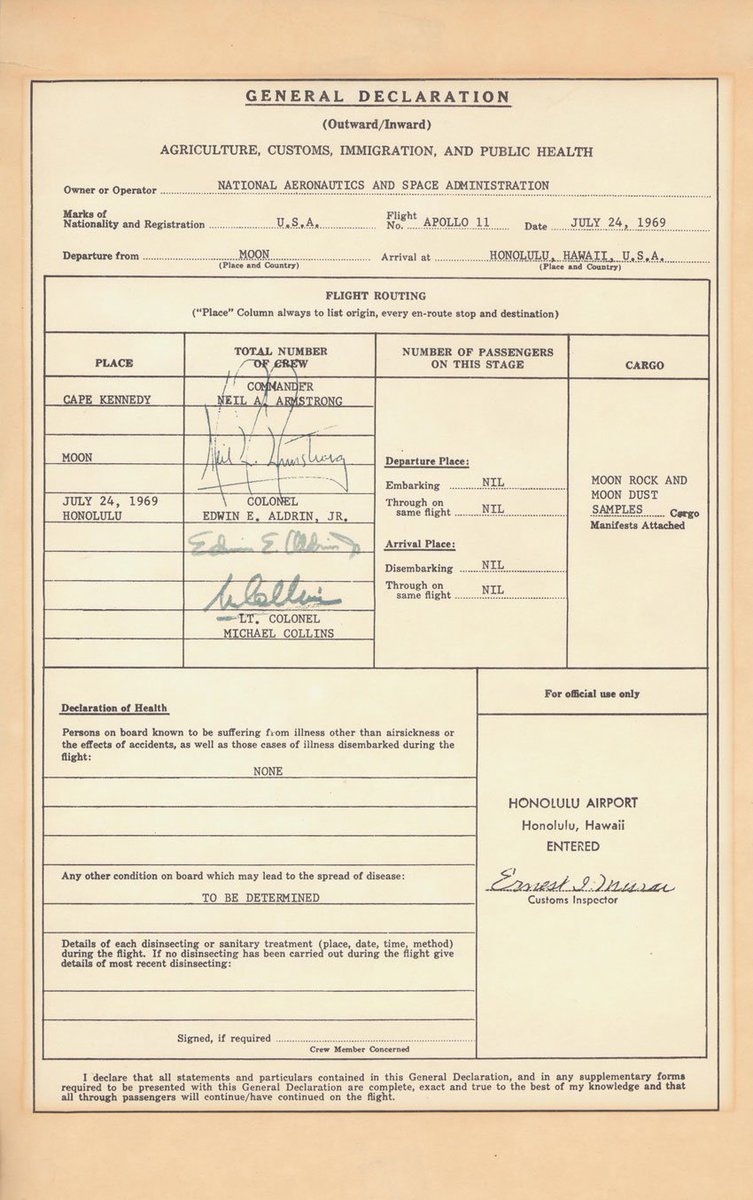
Above, find a document signed 50 years ago by Neil Armstrong, Buzz Aldrin, and Michael Collins after they returned from the first manned trip to the moon. The three astronauts came down in the Pacific Ocean and were taken to Honolulu on July 24, 1969, where they supposedly signed this immigration form, declaring a cargo of moon rocks and dust. President Nixon was good enough to let them back into the country.
The form, NASA spokesperson John Yembrick told Space.com, is authentic. And, he says, it was a joke. He does not, however, say exactly when the form was signed, either on the day the crew splashed down or sometime afterward. They did not actually arrive in Honolulu until the 26th. After their return,
The astronauts were trapped inside a NASA trailer as part of a quarantine effort just in case they brought back any germs or disease from the moon. They even wore special biological containment suits when they walked out on the deck of the USS Hornet after being retrieved.
NASA transported them to Houston, quarantine trailer and all, and they emerged from isolation three weeks later.
Astronauts these days mostly just need a shower when they touch down, although internet savvy International Space Station astronaut Chris Hadfield did tell some customs related stories on a Reddit AMA—maybe nothing so weird as the current space snorkeling up there, but still a pretty great read.
Note: An earlier version of this post originally appeared on our site in December 2013.
Related Content:
“Moon Hoax Not”: Short Film Explains Why It Was Impossible to Fake the Moon Landing
Dark Side of the Moon: A Mockumentary on Stanley Kubrick and the Moon Landing Hoax
Find Astronomy Courses in our Collection of 1300 Free Courses Online
Josh Jones is a writer and musician based in Durham, NC. Follow him at @jdmagness
Read More...“I Saw the Future”: Rutger Hauer (RIP) Remembers His Most Memorable Role in Blade Runner
Rutger Hauer died last Friday at the age of 75, which means he enjoyed a life more than seven decades longer than that of Roy Batty, the character he played in Ridley Scott’s Blade Runner. As a replicant, an artificial human being engineered to perform intense physical labor, Batty has immense strength but an existence deliberately limited to a few years. Seeking an escape from his imminent demise, he and a group of his fellow replicants escape from their off-world mining colony to Earth, specifically Los Angeles, where they intend to seek out their creator and demand an extension of their lives. And so it falls to Harrison Ford’s detective Rick Deckard, trained as a replicant-hunting “Blade Runner,” to hunt them all down.
Hauer’s performance is arguably the film’s most memorable, not least because of the manner in which Batty finally accepts his own death even after sparing the life of the man tasked with terminating him. “I’ve seen things you people wouldn’t believe,” Batty says. “Attack ships on fire off the shoulder of Orion. I watched C‑beams glitter in the dark near the Tannhäuser Gate. All those moments will be lost in time, like tears in rain. Time to die.”
Hauer, as Indiewire’s Zack Sharf noted in a remembrance, rewrote that short monologue himself, having “believed the original speech was written in a way that was too operatic, a tone he felt a replicant would never use.” He kept the script’s “attack ships” and “C‑beams,” sensing in them a kind of techno-poetry, and added the tears in the rain, an image visually resonant with the scene in which he delivers it.
“It didn’t come from me,” Hauer says of the “tears in the rain” line in the interview clip above. “It came from the poet in me, and there was a poet in Roy.” In using those words “to conclude Roy’s quest,” he says, “I was also anchoring myself, as an actor, in my own insecure way. And for an audience to carry that for 30 years was such love.” That audience, he acknowledges, kept Blade Runner alive even after its failure to perform back in 1982: “When the film came out, it was out of the cinema, I think, in a week,” and some critics dismissed it as a waste of time. But Hauer understood its appeal as “a really sexy, erotic, cartoon-opera interesting movie, but it was ahead of its time.”
Blade Runner has long since taken its place in the pantheon of science fiction cinema, but Hauer’s filmography contains pictures of every other sort of reputation as well. A prolific performer given to unconventional choices and distinctive turns of phrase, he was remembered on Twitter by producer Jonathan Sothcott as “one of those great actors who made rubbish watchable.” Though Hauer’s turns in pictures a varied as Ladyhawke, Blind Fury, The Hitcher (in which horror-mode Hauer, writes Stephen King, “will never be topped”), Sin City, and Hobo with a Shotgun won’t soon be forgotten, it will be as Roy Batty — the replicant he has described as wanting to “make his mark on existence” — that he’ll be remembered. “At the same time I was doing this film, I saw the future,” he says of Blade Runner. And he lived to 2019, the once-distant year in which Blade Runner is set, to see that future in real life.
Related Content:
An Animated Version of Ridley Scott’s Blade Runner Made of 12,597 Watercolor Paintings
How Ridley Scott’s Blade Runner Illuminates the Central Problem of Modernity
Based in Seoul, Colin Marshall writes and broadcasts on cities, language, and culture. His projects include the book The Stateless City: a Walk through 21st-Century Los Angeles and the video series The City in Cinema. Follow him on Twitter at @colinmarshall, on Facebook, or on Instagram.
Read More...Why Should We Read Virgil’s Aeneid? An Animated Video Makes the Case
Maybe we take it for granted that Virgil’s Roman epic, the Aeneid, is a sequel—long delayed—of Homer’s Iliad, a classical adventure in verse, part legendary history, part fantasy, part myth. It is all these things, of course, but it also served some very specific purposes for its time, the imperial Rome of Augustus, Virgil’s patron, on whose insistence the Aeneid was published after the poet’s death. (Virgil himself wanted the manuscript burned.) The Aeneid was also political and religious propaganda.
Plato famously railed against Homer and other ancient poets for trivializing religion by turning the gods into vengeful, petty soap opera characters. Virgil and Augustus, on the other hand, explicitly hoped the Aeneid would effect “a revival of faith in the old-time religion,” as Clyde Pharr writes in the introduction to his Latin edition of the poem. “The educated Romans of the day were becoming quite blasé and sophisticated and were gradually losing the faith of their fathers with its simple, unquestioning reliance on the infallible wisdom of the gods and their helpful interference in human affairs.”
Roman religion was, however, not mysterious or remote but “intensely practical,” busying itself “with the everyday life of the people.” By this token, the faith Augustus wanted to promote was also intensely political, encouraging strict patriarchal hierarchies and a sense of sacred duty, the chief heroic burden Aeneus must bear—his pietas. Virgil wrote his hero, Mark Robinson argues in the animated TED-Ed video above, as a model for Augustus, who appears in the poem when Aeneus descends into the underworld and has a vision of the future of Rome.
Augustus is presented “as a victor entering Rome in triumph… expanding the Roman empire.” He is hailed as “only the third Roman leader in 700 years to shut the doors of the temple of Janus, signifying the arrival of permanent peace. But there’s a twist.” Augustus did not read to the end, and apparently did not notice Aeneus’s many flaws, dramatized, Robinson suggests, as a warning to the emperor, or his subjects.
In sections “that could be seen as critical, if not subtly subversive of the emperor’s achievements,” Aeneus struggles to “balance mercy and justice.” The hero arrives as a refugee from the conquered Troy, carrying his aging father on his back and leading his young son by the hand. He ends, proleptically, by founding the great empire to come. But as many scholars have argued, throughout the poem “Virgil undermined the sense of glorious progress, or even overturned it,” as Madeline Miller writes at Lapham’s Quarterly.
This modern reading of the Aeneid may be controversial, but the celebration of Augustus was embraced not only by the emperor himself but by ambitious rulers “as disparate as Elizabeth I, Louis XIV, and Benito Mussolini,” not to mention “the Founding Fathers, who generally preferred Homer.” Perhaps the poem’s endorsement by those in power and those positioned to flatter them has long colored the reception of the Aeneid as an uncritical celebration of empire.
The Aeneid is a foundational epic in the Western literary tradition because of Virgil’s undeniable poetic skill in adapting classical Greek forms into Latin, and because of its influence on hundreds of poets and writers for hundreds of years after. But perhaps, Robinson suggests, “in wanting the story published, Augustus had been fooled by his own desire for self-promotion.” Maybe the poem has also “survived to ask questions about the nature of power and authority ever since” it was first published, to instant acclaim, in 19 BC.
Related Content:
1,600-Year-Old Illuminated Manuscript of the Aeneid Digitized & Put Online by The Vatican
What Ancient Latin Sounded Like, And How We Know It
Rome Reborn: Take a Virtual Tour of Ancient Rome, Circa 320 C.E.
Josh Jones is a writer and musician based in Durham, NC. Follow him at @jdmagness
Read More...Deconstructing Brian Eno’s Music for Airports: Explore the Tape Loops That Make Up His Groundbreaking Ambient Music
Brian Eno debuted Music for Airports in 1978 and in terms of ambient music he’s been remaking it ever since. This groundbreaking album was both composed and left to chance. “Composed” in that for each piece Eno selected a number of notes and simple melodic fragments that would work together without dissonance. And “left to chance” because each fragment was given a tape loop of different length. Once Eno set the loops in motion, the piece created itself in all sorts of permutations and intersections.
Eno no longer uses tape loops, but he still believes in “generative music,” creating albums that are hour-long captures of randomly generated tones that could conceivably go on forever.
Dan Carr over at his site Reverb Machine has written a deconstruction of two of the four pieces on Music for Airports, reverse engineering them to figure out their original loops. And the best thing is, you can set the loops rolling and have your own version play out all day long if you wish.
The first, “2/1” is recognizable from the choral voices used in the score. Each loop contains one note sung for a whole bar, but the note and the length of the tape containing the bar changes. This is the most basic of all the four tracks, but there is something quite magical when all seven loops sync up.
The second “1/2” contains eight loops containing either a single piano note, a melodic phrase, or a glissando chord. (Although the article doesn’t mention it, it also contains the choral loops of “2/1”)
You can play the loops at Reverb Machine simply by clicking on the arrow beneath each bar, or at the bottom “play all” or “pause all.”
For musicians thinking they’d like to make their own loops and follow Eno’s methodology, Dan includes some instructions.
In the comments section, musician Glenn Sogge notes that he took the loops and created his own deconstructed take on Eno’s classic, Blooms Engulfing Deconstructed Airports, which you can play at the top of this post. As he explains, the piece started with downloading the WAV files from Reverb Machine’s post. Then:
Beside the 15 clips of voices and piano, 10 long loops were build from the 10 worlds of the Brian Eno & Peter Chilvers generative music app Bloom: 10 Worlds (Android Version). A mixture of improvised clip-launching and more stucture form resulted in 25 audio files that then mixed & mastered. In keeping with the Oblique Strategies dictum, “Honour thy error as hidden intention,” even a random phone notification sound has been left in.
What do you think of Sogge’s tribute to the master? Let us know in the comments.
Related Content:
A Six-Hour Time-Stretched Version of Brian Eno’s Music For Airports: Meditate, Relax, Study
The “True” Story Of How Brian Eno Invented Ambient Music
Brian Eno Explains the Loss of Humanity in Modern Music
Ted Mills is a freelance writer on the arts who currently hosts the artist interview-based FunkZone Podcast and is the producer of KCRW’s Curious Coast. You can also follow him on Twitter at @tedmills, read his other arts writing at tedmills.com and/or watch his films here.
Read More...Support Us
We're hoping to rely on loyal readers, rather than erratic ads. Please click the Donate button and support Open Culture. You can use Paypal, Venmo, Patreon, even Crypto! We thank you!

About Us

Open Culture scours the web for the best educational media. We find the free courses and audio books you need, the language lessons & educational videos you want, and plenty of enlightenment in between.
Advertise With Us

FREE UPDATES!
GET OUR DAILY EMAIL
Get the best cultural and educational resources on the web curated for you in a daily email. We never spam. Unsubscribe at any time.
FOLLOW ON SOCIAL MEDIA

Open Culture editor Dan Colman scours the web for the best educational media. He finds the free courses and audio books you need, the language lessons & movies you want, and plenty of enlightenment in between.
Advertise With Us

