The Jane Austen Fiction Manuscript Archive Is Online: Explore Handwritten Drafts of Persuasion, The Watsons & More
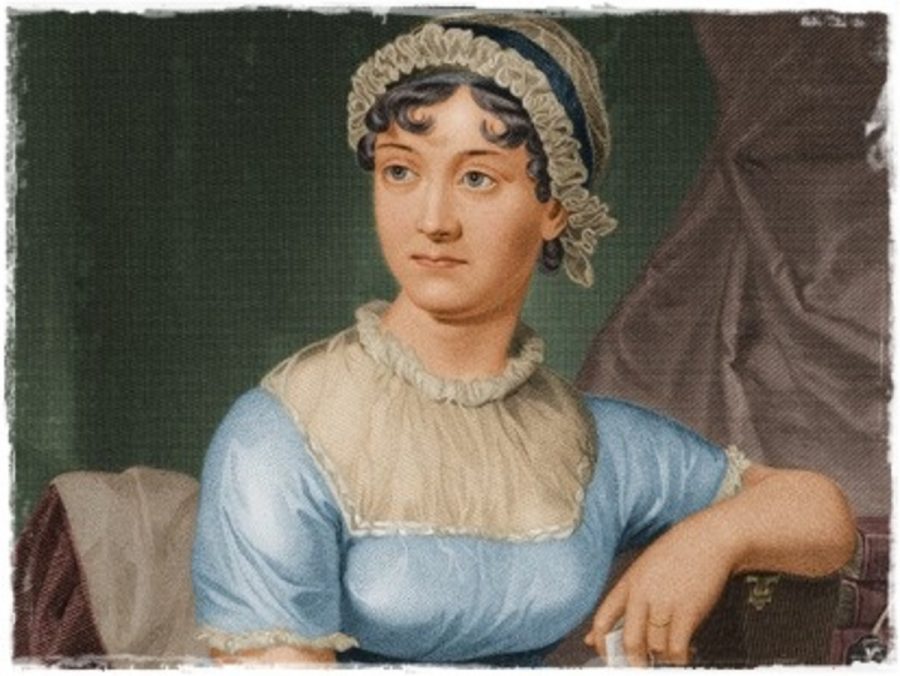
I first came to Jane Austen prepared to dislike her, reared as I had been to think of good fiction as socially transgressive, experimental, full of heavy, life-or-death moral conflicts and existentialist anti-heroes; of extremes of dread and sorrow or alienated extremes of their lack. Austen’s characters seemed too perky and perfect, too circumscribed and wholesome, too untroubled by inner despair or outer calamity to offer much in the way of interest or example.
This is an opinion shared by more perceptive readers than myself, including Charlotte Brontë, who called Pride and Prejudice “an accurate daguerreotype portrait of a commonplace face.” Brontë “disliked [Austen] exceedingly,” writes author Mary Stolz in an introduction to Emma. The author of Jane Eyre pronounced that “Miss Austen is only shrewd and observant,” where a novelist like George Sand is “sagacious and profound.”
A cursory reading of Austen can seem to confirm Brontë’s faint praise. Consider the first description of her heroine matchmaker, Emma:
Emma Woodhouse, handsome, clever, and rich, with a comfortable home and happy disposition, seemed to unite some of the best blessings of existence, and had lived nearly twenty-one years in the world with very little to distress or vex her.
No great, shocking disasters befall Emma. She is buffeted neither by war nor poverty, crime, disease, oppression or any other essentially dramatic conflict. She ends the novel joining hands in marriage with charming gentleman farmer Mr. Knightly, content, maybe ever-after, in “perfect happiness.”
Rarely if ever in Austen do we find the torments, spiritual strivings, sublime and grotesque imaginings, proto-science-fiction, and world-historical consciousness of contemporaries like William Blake, Samuel Taylor Coleridge, or Mary Shelley. Austen is “famous,” writes Stolz, “for having lived through the period of the French Revolution without ever mentioning it in her writings.”
To see this as a critique, however, is to seriously misjudge her. “She did not deal in revolutions of this order. Not a traveled woman, she wrote only of what she knew”: life in English country villages, the travails of “love and money,” as she put it, the everyday longings, courtesies, and discourtesies that make up the majority of our everyday lives.
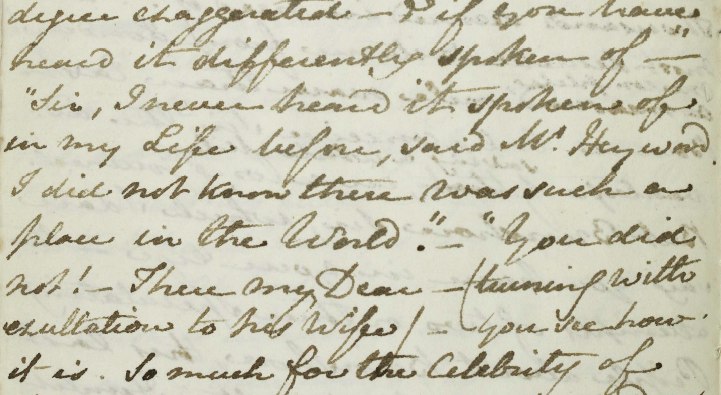
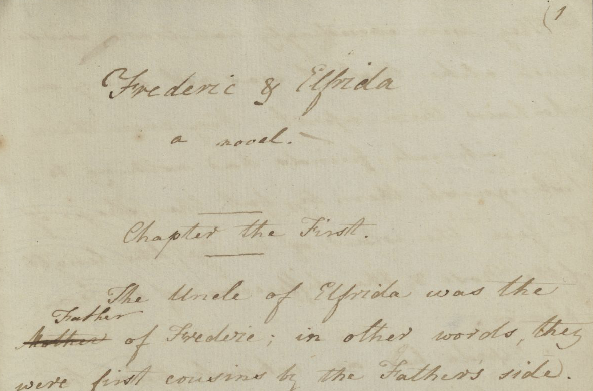
We can see Austen doing just that in her own hand at the Jane Austen’s Fiction Manuscripts Digital Edition. A collection of scanned manuscripts from the Bodleian, British Library, Pierpont Morgan Library, private collectors, and King’s College, Cambridge, this project “represents every stage of her writing career and a variety of physical states: working drafts, fair copies, and handwritten publications for private circulation.”
This is primarily a resource for scholars; much of this work has been published in printed editions, including the Juvenilia (read some of that writing here) and unfinished drafts like The Watsons and her last, uncompleted, novel, Sanditon. (One still-in-print 1975 edition collects the three unfinished novels found at the digital collection). Each digital edition of the manuscript includes a head note on the textual history, provenance, and physical structure, as well as a transcription of the text. There is also an option to view a “diplomatic edition” that transcribes the text with all of Austen’s corrections and additions.
Yet any Austen fan will appreciate seeing her witty, incisive style change and take shape in her own neat script. In an age of superheroes, historical and fantasy epics, and dystopian fantasies, we are beset by “the big Bow-Wow strain,” as Walter Scott self-effacingly called his own novels. In Austen’s writing, we find what Scott described as an “exquisite touch which renders commonplace things and characters interesting from the truth of the description and the sentiment.” She wraps her truths in wicked irony and a satirical voice, but they are truths we recognize as wise and compassionate in her domestic dramas and our own.
Austen knew well that her settings and characters were limited. She made no apologies for it and clearly needn’t have. “Three or four families in a country village,” she wrote to her niece Anna, “is the very thing to work on.” She also knew well the universal tendencies that blind us to the variety found within the everyday, whether our everyday is a sleepy country village life or a tech-laden, 21st-century city.
She almost seems to sigh wearily in Emma when she observes, “human nature is so well disposed toward those who are in interesting situations” … so much so that we fail to notice what’s going on all around us all the time. She wrote neither for money nor fame, and her work wasn’t even published with her name until after her death in July 1817, but she has since become fiercely beloved for the very qualities Brontë disparaged.
Austen didn’t miss a thing, which makes her novels as canny and insightful (and big-screen and fan-fiction adaptable) as when they were first written over two-hundred years ago. Enter the Jane Austen’s Fiction Manuscripts Digital Edition here.
Related Content:
An Animated Introduction to Jane Austen
Download the Major Works of Jane Austen as Free eBooks & Audio Books
Jane Austen Used Pins to Edit Her Manuscripts: Before the Word Processor & White-Out
Josh Jones is a writer and musician based in Washington, DC. Follow him at @jdmagness
Read More...Why 1999 Was the Year of Dystopian Office Movies: What The Matrix, Fight Club, American Beauty, Office Space & Being John Malkovich Shared in Common
On August 11, 1992, the writer Douglas Coupland made an appearance at the grand opening of Minneapolis’ Mall of America, the largest shopping mall on Earth. Against his interviewer’s expectations, Coupland delivered a paean to the ostensibly hyperconsumeristic scene around him, claiming that “future generations are going to look at images of today here in Minnesota and see them as a sort of golden age of American culture. The peace. The calm. The abundance. The bottomless goodwill of everyone here. I’m unsure if it’s going to last much longer and I think we should appreciate it while it’s here.”
What made the 90s the 90s? “Money still generated money. Computers were becoming fast easy and cheap, and with them came a sense of equality for everyone. Things were palpably getting better everywhere. History was over and it felt great.” From the end of the Cold War until the fall of the Twin Towers, North America and Europe enjoyed a stability and prosperity that, to many of us in the 2010s, now seems somehow implausible. But cinema remembers the 90s, especially the cinema of the decade’s final year, differently. Unlike “monster movies showing cold war anxieties and 21st-century horror movies conveying fears of acts of terror,” the films of 1999 “were not about surviving the present, because the present was actually going well. They were about being tired of that stable present and looking for a radically different future.”
Those words come from “Why All Movies From 1999 Are the Same,” the video essay from Now You See It above. Those of us who were moviegoing that year remember The Matrix, Office Space, Fight Club, American Beauty, Being John Malkovich, and all of the other major Hollywood releases featuring “a main character tired of the stability, monotony, and uneventfulness of their life,” almost always involving a steady, dull corporate job. That era, recall, was also when Scott Adams’ comic Dilbert reached the top of the zeitgeist by satirizing the elements of office existence: incompetent bosses, slacking co-workers, and above all, cubicles.
Calling 1999 “the year of the cubicle movie,” this video essay describes its cinematic portrayal of office-worker frustrations as “a perfect mirror of what America was like in the late 90s.” Not that those portrayals were literally “the same”: the terminally bored men of Fight Club “go to great lengths to manufacture conflict and chaos”; Office Space makes comedy out of suspenders and paper jams; Being John Malkovich “exaggerates the oppressive corporate imagery in films like Office Space by creating an absurd office with low ceilings” that “literally bears down on its employees”; American Beauty “criticizes the perceived stability of the era, suggesting that it’s simply a mask that hides the true self.”
And in The Matrix, of course, that veneer of stability and prosperity exist only to conceal the total enslavement of humanity. Modern humanity may never cast off its dystopias, but it’s fair to say the dystopian visions we entertain today look quite a bit different than the ones we entertained twenty years ago, and it’s also fair to say that many of us entertain them while dreaming of the relative safety, stability, and prosperity — real or imagined — that we enjoyed back then, not to mention the secure desk jobs. But as the films of 1999 remind us, those very qualities could also drive us into a kind of madness. Coupland may rightly call the 90s “the good decade,” but even if we could return to that time, we’ve got good reasons not to want to.
Related Content:
The Cringe-Inducing Humor of The Office Explained with Philosophical Theories of Mind
The Philosophy of The Matrix: From Plato and Descartes, to Eastern Philosophy
How to Recognize a Dystopia: Watch an Animated Introduction to Dystopian Fiction
David Foster Wallace on What’s Wrong with Postmodernism: A Video Essay
Based in Seoul, Colin Marshall writes and broadcasts on cities, language, and culture. His projects include the book The Stateless City: a Walk through 21st-Century Los Angeles and the video series The City in Cinema. Follow him on Twitter at @colinmarshall, on Facebook, or on Instagram.
Read More...Can Artificial Intelligence Decipher Lost Languages? Researchers Attempt to Decode 3500-Year-Old Ancient Languages

Image by Olaf Tausch via Wikimedia Commons
We may not see warp drives any time soon, but another piece of Star Trek tech, the universal translator, may become a reality in our lifetime, if it hasn’t already. Machine learning “has proven to be very competent” when it comes to translation, “so much so that the CEO of one of the world’s largest employers of human translators has warned that many of them should be facing up the stark reality of losing their job to a machine,” writes Bernard Marr at Forbes.
But the fact that AI can do things humans can doesn’t mean that it does those things well. One Google researcher put the case plainly in an interview with Wired: “People naively believe that if you take deep learning and… 1,000 times more data, a neural net will be able to do anything a human being can do, but that’s just not true.” AI translators have advanced significantly in the past few years, with Google’s Translatotron prototype (yes, that’s its real name), promising to interpret “tone and cadence.” Still, AI translations are often stilted, awkward, and occasionally incomprehensible approximations that no human would come up with.
Does AI’s limitations with living language hinder its ability to decipher very long dead ones, whose orthography, grammar, and syntax have been completely lost? Yuan Cao from Google’s AI lab and Jiaming Luo and Regina Barzilay from MIT put machine learning to the test when they developed a “system capable of deciphering lost languages.” They took a very different approach “from the standard machine translation techniques,” reports the MIT Technology Review, using less data instead of more, a technique they call “minimum-cost flow.”
The researchers tested their translation machine on both the 3500-year-old Linear B and Ugaritic, an ancient form of Hebrew, both of which have already been deciphered by people. Still, the AI was “able to translate both languages with remarkable accuracy,” with a rate of 67.3% in the translation of cognates in Linear B. The far older Bronze Age Minoan script Linear A, however (see it at the top), “one of the earliest forms of writing ever discovered… is conspicuous for its absence.” No human has yet been able to decipher it.
A lost language translator machine that only works on languages that have already been translated (it needs preexisting data on the progenitor language to function) may not seem particularly useful. Then again, it could be one step in the direction of what the authors call the “automatic decipherment of lost languages,” those that humans can’t already work out on their own. Read the paper “Neural Decipherment via Minimum-Cost Flow: From Ugaritic to Linear B” at arXiv.
Related Content:
Josh Jones is a writer and musician based in Durham, NC. Follow him at @jdmagness
Read More...A 9th Century Manuscript Teaches Astronomy by Making Sublime Pictures Out of Words
Concrete or visual poetry does not get much respect these days. Tersely defined at the Poetry Foundation as “verse that emphasizes nonlinguistic elements in its meaning” arranged to create “a visual image of the topic,” the form looks like a clever but frivolous novelty in our very serious times. It has seemed so in times past as well.
When Guillaume Apollinaire published his 1918 Calligrammes, his major collection of poems after he fought on the front lines of the first world war, he included several visual poems. Critics like Louis Aragon, “at his most hard-nosed,” notes Stephen Romer at The Guardian, “criticized it sharply for its aestheticism and frivolity.”
Apollinaire also wrote of war as a dazzling spectacle, a tendency that “raised the hackles of critics.” One can see there is moral merit to the objection, even if it misreads Apollinaire. But why should visual poetry not credibly illustrate phenomena we find sublime, just as well as it illustrates potted Christmas trees?
Indeed, the form has always done so, argues prolific visual poet Karl Kempton, until it took a “dystopian” turn after World War I. In his vast history of visual poetry, Kempton reaches back into ancient Buddhist, Sufi, European, and Indigenous cultural history. Forms of visual poetry, he writes, “are associated with ongoing traditions and numerous unfolding pathways traceable to humankind’s earliest surviving communication marks.”
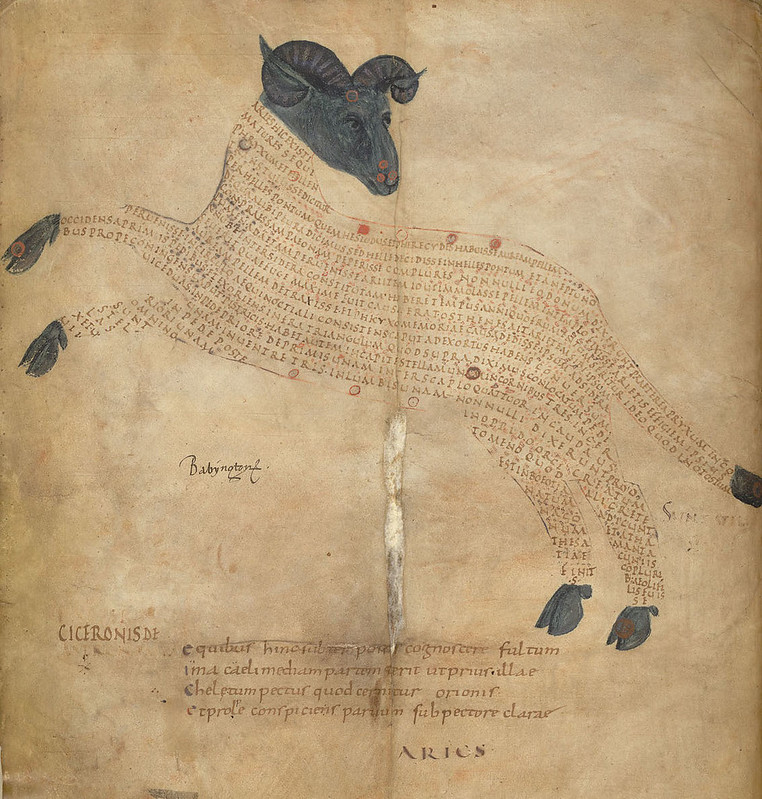
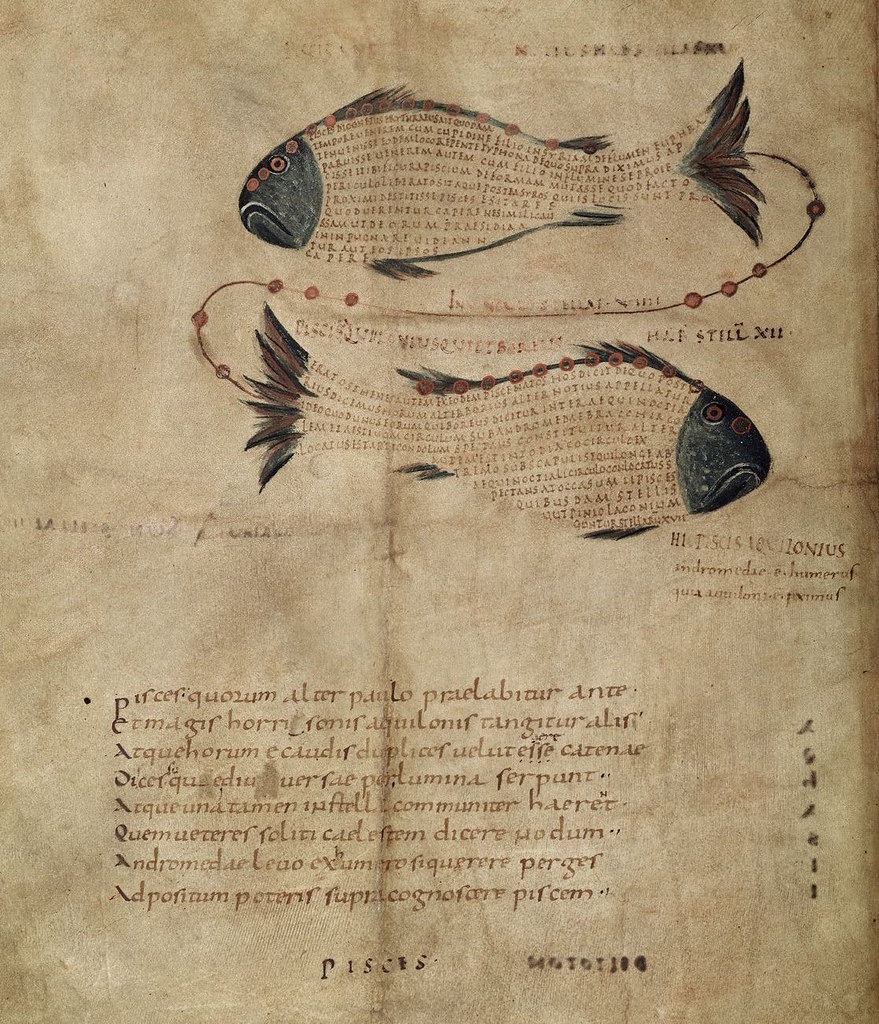
Not as ancient as the examples into which Kempton first dives, the pages here from a manuscript called the Aratea nonetheless show us a use of the form that dates back over 1000 years, and incorporates “nearly 2000 years of cultural history,” writes the Public Domain Review. “Making use of two Roman texts on astronomy written in the 1st century BC, the manuscript was created in Northern France in about 1820.”
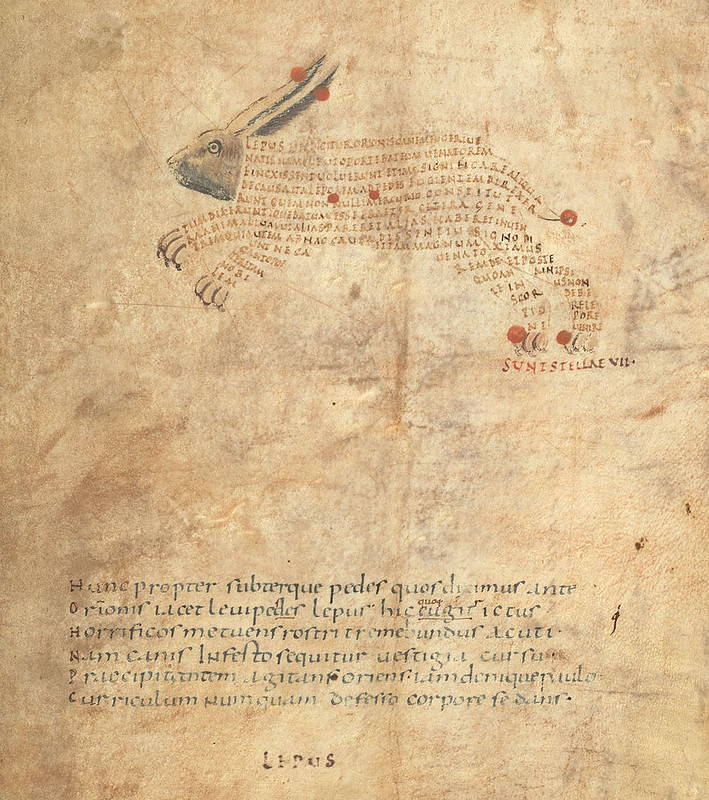
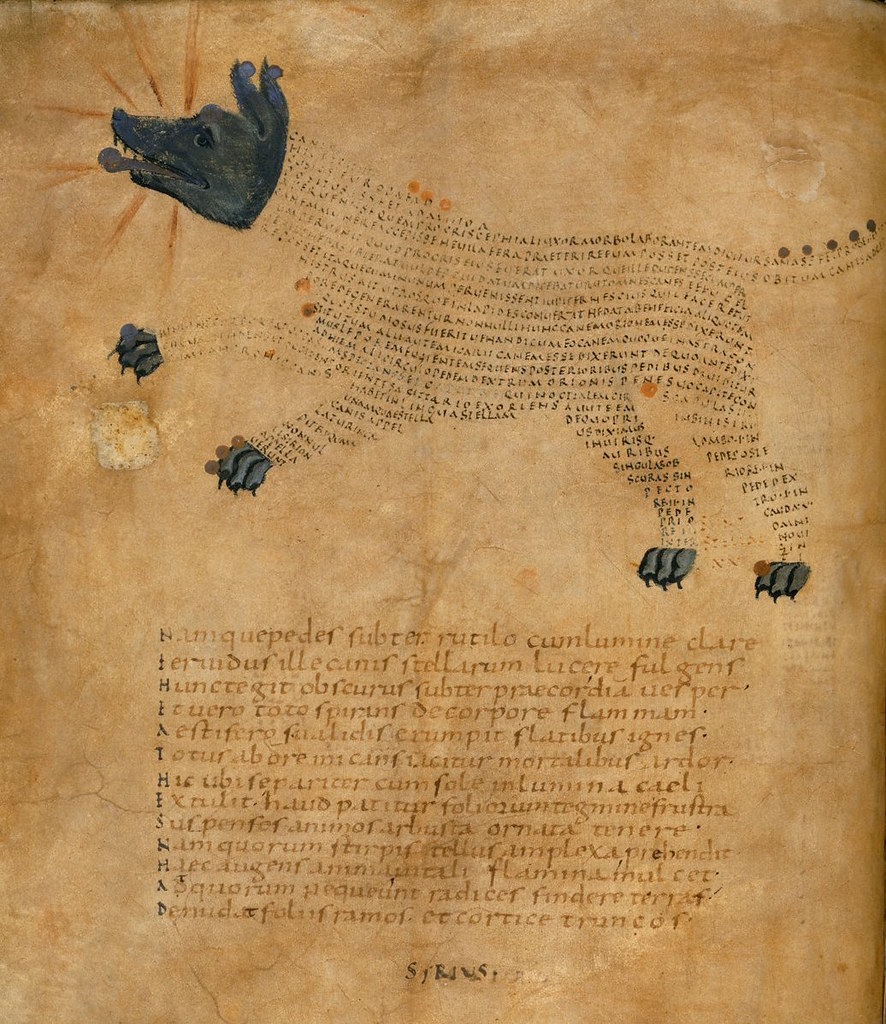
The text that has been arranged into images wasn’t originally poetry, though one might argue that arranging it thus makes us read it that way. Instead, the words are taken from Hyginus’ Astronomica, a “star atlas and book of stories” of somewhat uncertain origin. The poems in lined verse below each image are by 3rd century BC Greek poet Aratus (hence the title), “translated into Latin by young Cicero.”
If this feels like hefty material for a literary production that might seem more whimsical than awe-inspiring, we must consider that the manuscript’s first—and necessarily few—readers would have seen it differently. The text is a visual mnemonic device, the red dots showing the positions of the stars in the constellations: an aesthetic pedagogy that threads together visual perception, memory, imagination, and cognition.
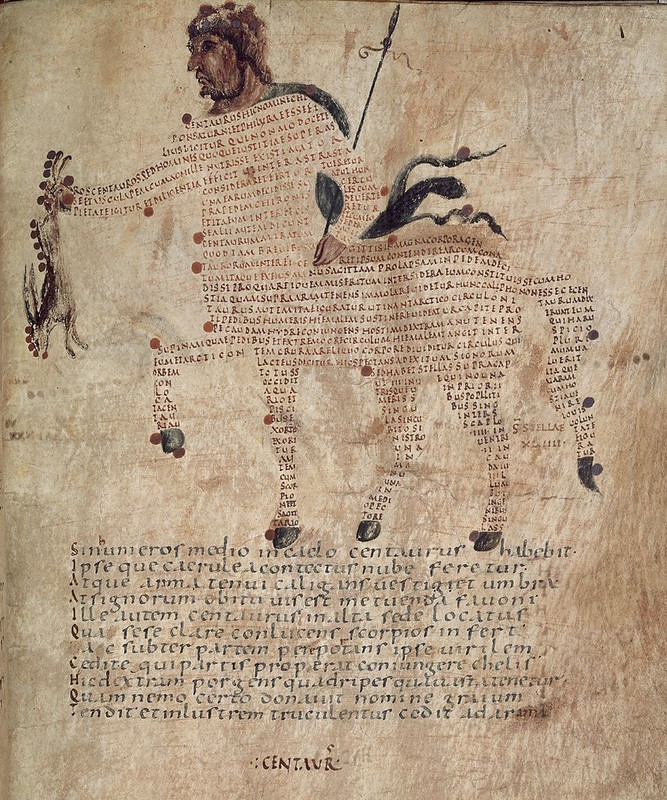
“The passages used to form the images describe the constellation which they create on the page,” the Public Domain Review writes, “and in this way they become tied to one another: neither the words nor the images would make full sense without the other to complete the scene.” We are encouraged to read the stars through art and literature and to read poetry with an illustrated mythological star chart in hand.
The Aratea is a fascinating manuscript not only for its visually poetic illuminations, but also for its significance across several spans of time. Its physical existence is necessarily tied to the British Library where it resides. One of the institution’s first artifacts, it was “sold to the nation in 1752 under the same Act of Parliament which created the British Museum.”
“Part of a larger miscellany of scientific works,” including several notes and commentaries on natural philosophy, as the British Library describes it, the medieval text uses classical sources to contemplate the heavens in a form that is not only pre-Christian and pre-Roman, but perhaps, as Kempton argues, dates to the origins of writing itself.
Related Content:
700 Years of Persian Manuscripts Now Digitized and Available Online
Josh Jones is a writer and musician based in Durham, NC. Follow him at @jdmagness
Read More...The Velvet Underground Captured in Color Concert Footage by Andy Warhol (1967)
The Velvet Underground, the band with which Lou Reed and John Cale achieved artistic and cultural stardom under the management of Andy Warhol, surely have more listeners now than they did when they were active in the 1960s and 70s. But few self-described Velvet Underground enthusiasts ever had the chance to see the group perform. Not in person, anyway: last month we featured color footage from their 1969 Vietnam War protest concert, and we’ve previously offered opportunities to glimpse them playing a 1966 Warhol-filmed show that got broken up by the cops, composing “Sunday Morning,” the opening track from that same year’s album The Velvet Underground & Nico, and reuniting in 1972 to do an acoustic set on French television.
But what would it feel like to actually be at a Velvet Underground concert? The 1967 film above provides a view of the band performing, but even more so of their fans taking it in — not that they had many in those days. But what fans they had turned up over and over again to their shows at a club called The Boston Tea Party, which had opened the same year.
Shot by Warhol, one description says, it makes use of “sudden in-and-out zooms, sweeping panning shots, in-camera edits that create single frame images and bursts of light like paparazzi flash bulbs going off” that “mirror the kinesthetic experience of the Exploding Plastic Inevitable” — Warhol’s series of multimedia events put on in the mid-60s — “with its strobe lights, whip dancers, colorful slide shows, multi-screen projections, liberal use of amphetamines, and overpowering sound.”
As “one of only two known films with synchronous sound of the band performing live,” as well as the only one in color, this half-hour of the Velvet Underground experience captured on 16-millimeter (which you can also find on the Internet Archive) constitutes an important and vivid piece of the band’s recorded history. Today, any listener who has ever taken an interest in the Velvet Underground will have heard the clear-eyed drug song “Heroin” on The Velvet Underground & Nico and the epic of debauchery “Sister Ray” on White Light/White Heat many times. But these Harvard kids and others from more than half a century ago were getting down to them — if that is indeed the term for the behavior Warhol has captured here — well before most of today’s Velvets-inspired rockers were even born.
Related Content:
Lou Reed, John Cale & Nico Reunite, Play Acoustic Velvet Underground Songs on French TV, 1972
Hear Lost Acetate Versions of Songs from The Velvet Underground & Nico (1966)
Based in Seoul, Colin Marshall writes and broadcasts on cities, language, and culture. His projects include the book The Stateless City: a Walk through 21st-Century Los Angeles and the video series The City in Cinema. Follow him on Twitter at @colinmarshall, on Facebook, or on Instagram.
Read More...Pretty Much Pop #2: Binge Watching
This post continues Open Culture’s curation of a new podcast series about popular media and how (and why) we consume it. You may wish to listen to the introductory episode first.
What counts as binge watching? Why do we do it? Is it bad for us?
Mark, Erica, and Brian reveal their watching habits (growing up and now) and marvel at crazy-high stats about how much people watch. We think about what people get out of this activity, what shows work do and don’t taste good in bulk, and whether watching is best done in solitary despair or as a bonding experience as you waste the precious hours of your life sitting next to another person.
We touch on many shows including The Office, Game of Thrones, Battlestar Galactica (by way of Portlandia), Jane the Virgin, Pretty Little Liars, Arrow, CSI, and Chernobyl (which we’ll devote the whole of Ep. 5 to).
Articles we bring up:
- “Infrequently Asked Questions: why do we binge-watch?” by Brandon Baker
- “A Critical Theory of Binge Watching” by Jake Pitre
- “These are the real causes and effects of binge-watching, says science” by Kendi Banks
“I like to watch, Erica. I like to watch.”
This episode includes BONUS CONTENT that you can only get by becoming a $1+ supporter at patreon.com/prettymuchpop. Pretty Much Pop: A Culture Podcast is produced by the Partially Examined Life Podcast Network.
Read More...A New Interactive Visualization of the 165,000 Most-Frequently Assigned Texts in College Courses
For some of us, it’s been a little while since college days. For others of us, it’s been a little while longer. We might find ourselves asking, if we hear news of on-campus activism and unrest (surely unheard of in our day)—
“Do they still read the classics down at old Alma Mater U.?”
Maybe that’s the problem, eh? Too much Marxist theory, not enough Plato? Well, you may be pleased, or not, to learn that classics still regularly—routinely, even—appear on college syllabi, including both The Republic and the Communist Manifesto, in courses taught all over the world, from San Antonio to Tokyo to Karlskrona, Sweden.
As we informed Open Culture readers in 2016, Columbia University’s Open Syllabus Project culled data from over 1,000,000 syllabi from university websites worldwide, to find out which books have been most frequently taught over the past decade or so. Since then, that number has risen to 6,000,000 syllabi. Still, the most-taught books at the top of the list remain largely unchanged.
As two of the project’s directors pointed out soon after the site’s launch, “traditional Western canon dominates the top 100, with Plato’s Republic at No. 2, The Communist Manifesto at No. 3, and Frankenstein at No. 5, followed by Aristotle’s Ethics, Hobbes’s Leviathan, Machiavelli’s The Prince, [Sophocles’] Oedipus and [Shakespeare’s] Hamlet.” These numbers have moved a little, edged downward by writing and research guides, but not by very much.
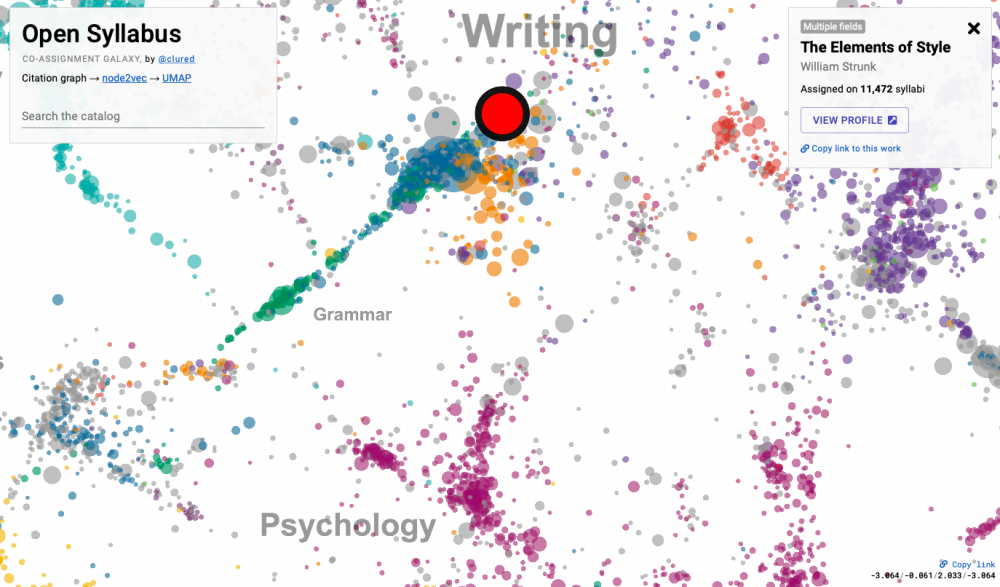
William Strunk’s classic writing guide Elements of Style sits at number one. Other top titles include calculus and anatomy textbooks, other works of Enlightenment philosophy, and texts now central to the Western critical tradition like Martin Luther King, Jr.’s “Letter from Birmingham Jail,” Michel Foucault’s Discipline and Punish, and Edward Said’s Orientalism.
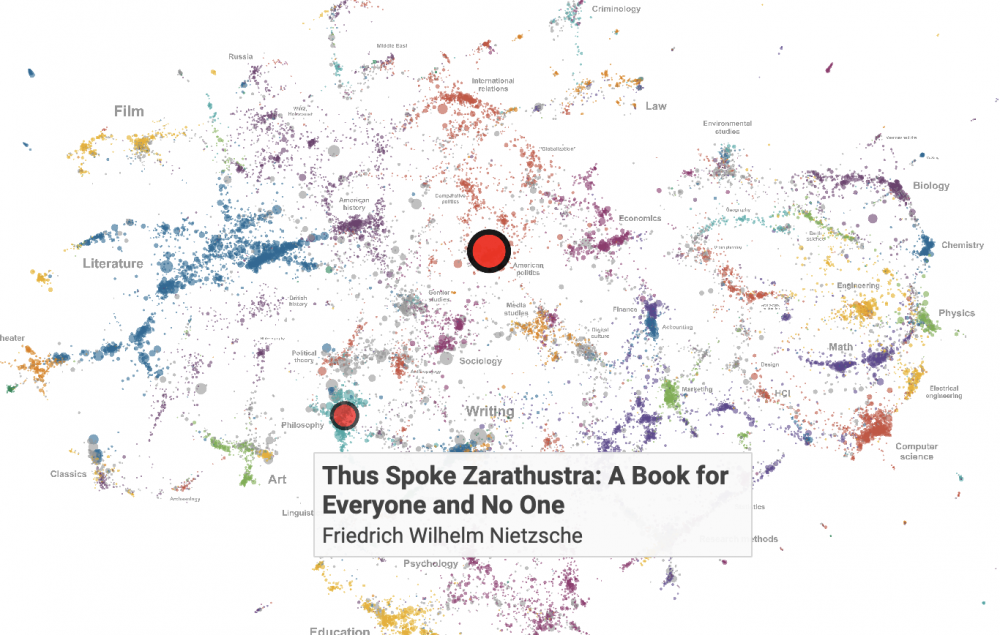
The top 50 is almost totally dominated by male writers, though some of the most frequently-taught novelists include Jane Austen, Toni Morrison, Anne Moody, Leslie Marmon Silko, and Alice Walker. The most-taught books tend to fall into either philosophy, literature, textbook, or guidebook, but the overall range in this list of 165,000 texts encompasses the entire scope of academia around the globe, with more contemporary study areas like gender studies, media studies, digital culture, and environmental studies prominent alongside traditional departments like physics and psychology.
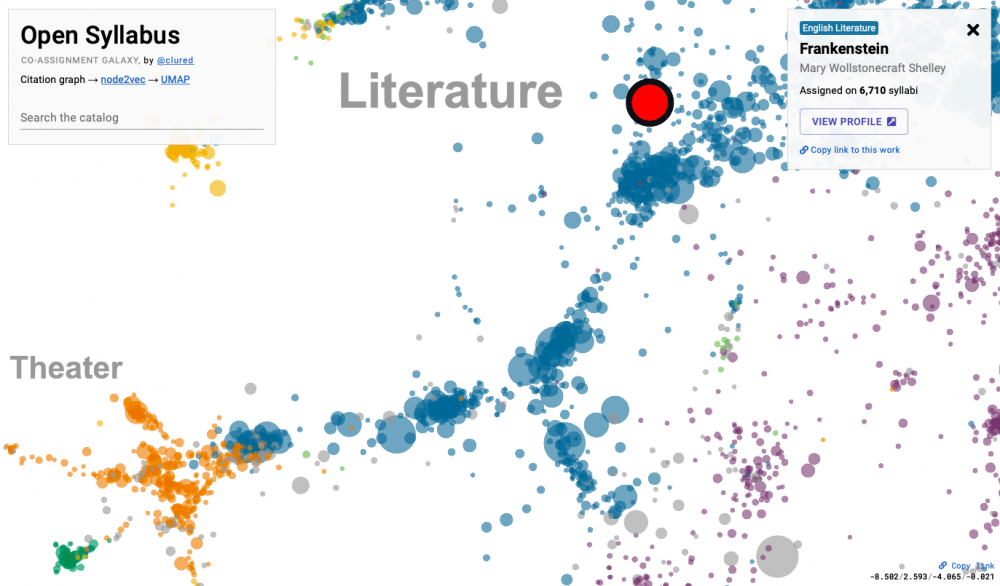
A new interactive visualization from Open Syllabus turns this trove of data into a color-coded stippling of different-sized dots, each one representing a particular text. Float over each dot and a box appears in the corner of the screen, showing the number of syllabi that have assigned the text, and a link to a profile page with more detailed analysis. Called the “Co-Assignment Galaxy,” the infographic does what a list cannot: draws connections between all these works and their respective fields of study.
The Open Syllabus Project was already an impressive achievement, a huge aggregation of freely accessible data for scholars and curious laypeople alike. The addition of this user-friendly cluster map makes the site an even more indispensable resource for the study of how higher education has changed over the past decade or so, and how it has, in some respects, remained the same. Enter the Open Syllabus Project’s Co-Assignment Galaxy map here.
Related Content:
The 20 Most Influential Academic Books of All Time: No Spoilers
Josh Jones is a writer and musician based in Durham, NC. Follow him at @jdmagness
Read More...Mister Rogers Creates a Prime Time TV Special to Help Parents Talk to Their Children About the Assassination of Robert F. Kennedy (1968)
Nearly three minutes into a patient blow-by-blow demonstration of how breathing works, Fred Rogers’ timorous hand puppet Daniel Striped Tiger surprises his human pal, Lady Aberlin, with a whammy: What does assassination mean?
Her answer, while not exactly Webster-Merriam accurate, is both considered and age-appropriate. (Daniel’s forever-age is somewhere in the neighborhood of four.)
The exchange is part of a special primetime episode of Mister Rogers’ Neighborhood, that aired just two days after Senator Robert F. Kennedy’s assassination.
Rogers, alarmed that America’s children were being exposed to unfiltered descriptions and images of the shocking event, had stayed up late to write it, with the goal of helping parents understand some of the emotions their children might be experiencing in the aftermath:
I’ve been terribly concerned about the graphic display of violence which the mass media has been showing recently. And I plead for your protection and support of your young children. There is just so much that a very young child can take without it being overwhelming.
Rogers was careful to note that not all children process scary news in the same way.
To illustrate, he arranged for a variety of responses throughout the Land of Make Believe. One puppet, Lady Elaine, is eager to act out what she has seen: “That man got shot by that other man at least six times!”
Her neighbor, X the Owl, doesn’t want any part of what is to him a frightening-sounding game.
And Daniel, who Rogers’ wife Joanne intimated was a reflection “the real Fred,” preferred to put the topic on ice for future discussions—a luxury that the grown up Rogers would not allow himself.
The episode has become notorious, in part because it aired but once on the small screen. (The 8‑minute clip at the top of the page is the longest segment we were able to truffle up online.)
Writer and gameshow historian Adam Nedeff watched it in its entirety at the Paley Center for Media, and the detailed impressions he shared with the Neighborhood Archive website provides a sense of the piece as a whole.
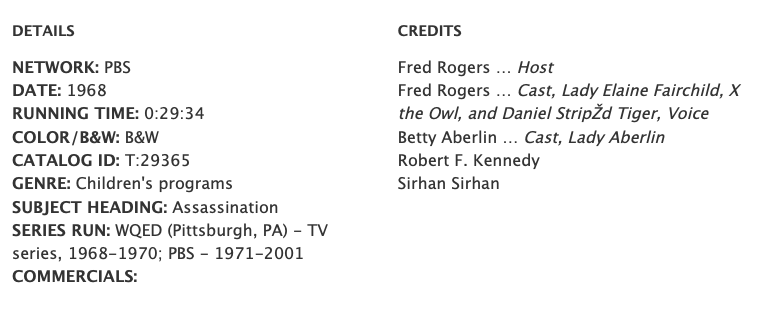
Meanwhile, the Paley Center’s catalogue credits speak to the drama-in-real-life immediacy of the turnaround from conception to airdate:
Above is some of the footage Rogers feared unsuspecting children would be left to process solo. Readers, are there any among you who remember discussing this event with your parents… or children?
Ever vigilant, Rogers returned in the days immediately following the 2001 attack on the World Trade Center, with a special message for parents who had grown up watching him.
Related Content:
Mr. Rogers’ Nine Rules for Speaking to Children (1977)
All 886 episodes of Mister Roger’s Neighborhood Streaming Online (for a Limited Time)
Ayun Halliday is an author, illustrator, theater maker and Chief Primatologist of the East Village Inkyzine. Join her in NYC on Monday, September 9 for another season of her book-based variety show, Necromancers of the Public Domain. Follow her @AyunHalliday.
Read More...Every Harrowing Second of the Apollo 11 Landing Revisited in a New NASA Video: It Took Place 50 Years Ago Today (July 20, 1969)
The idea that human beings might not only fly to the moon, but land on its puckered surface and walk around, seemed like an absolute fantasy for nearly all of human history. In the exactly fifty years since that that very thing happened, “moon shot” has become an almost commonplace reference for grand, historic gestures. “Fifty years after Neil Armstrong walked on the moon, planted an American flag, and flew home,” writes Alex Davies at Wired, “the term moon shot has become shorthand for trying to do something that’s really hard and maybe a bit crazy.”
The problem with this, Davies argues, is that the all-eggs-in-one-basket approach does not apply today’s most pressing, yet most nebulous and global, problems. A “moon shot” climate initiative suffers from a lack of specificity. What exactly would it target? How would it measure success or failure in an unambiguous way when the problem permeates the economy, energy, agriculture, manufacturing, government…? A very different kind of thinking is required.
Maybe the dualisms of the Cold War made some things simpler, in a way. In 1961, John F. Kennedy’s famous articulation of “the goal,” as he put it, could not have been more clear: “landing a man on the moon and returning him safely to Earth.” You either achieve this, or you don’t. There are no half-measures, and no confusion about what constitutes success. Which brings us to another problem with turning “moon shot” into a cliché for doing something hard. We forget just how damned hard it actually was.
Landing Neil Armstrong, Buzz Aldrin, and pilot Michael Collins on the moon required an expenditure unthinkable today: “NASA spent $25 billion on the Apollo program,” Davies points out, “more than $150 billion in today’s dollars.” The U.S. may spend almost seven times that on its military in a year, but it’s unthinkable that this nation, or any other, would invest Apollo dollars in a completely unsure thing, with no immediate potential for control or exploitation.
The same might be said of major corporations. The spacefaring ambitions of today’s titans seem conservative by 1961 standards: “More than 400,000 Americans worked on [Apollo 11] in some capacity, nearly all of them in private industry,” writes Davies. The project absolutely depended on this coordinated, collective level of human ingenuity and expertise because the total computing power of NASA was several millions of times less than that of a smartphone.
From the human “computers” who plotted Apollo 11’s course, to the astronauts who flew the craft, humans not only designed, monitored, and executed the mission, but they also had to improvise when things went wrong. And they did, in some terrifying, life-threatening ways. “The problems began immediately upon separation from the Command Module in which Armstrong, Aldrin and Michael Collins had ridden to the moon,” explains Rod Pyle at Space.com—but, so too did the problem-solving.
To get a better sense of why the endeavor was so earthshaking, and how it almost didn’t happen, watch the video above, “Apollo 11: The Complete Descent.” Part of NASA’s Apollo Flight Journal collection, the 20-minute narrated documentary of the descent and landing provides a “detailed account of every second of the Apollo 11 descent and landing.” It “combines data from the onboard computer for altitude and pitch angle, 16mm film that was shot throughout the descent at 6 frames per second,” and audio transmissions from the astronauts and mission control.
“Most people knew that going to the moon was risky,” Pyle writes, “but few, very few, knew the scope of the dangers that the crew faced.” Fifty years later, we can almost—with only the devices in our pockets—see and hear the original moon shot the way those first few did.
Related Content:
Josh Jones is a writer and musician based in Durham, NC. Follow him at @jdmagness
Read More...Alexis de Tocqueville’s Prediction of How American Democracy Could Lapse Into Despotism, Read by Michel Houellebecq
Michel Houellebecq’s third novel Platform, which involves a terrorist bombing in southeast Asia, came out the year before a similar real-life incident occurred in Thailand. His seventh novel Submission, about the conversion of France into a Muslim country, came out the same day as the massacre at the offices of Islam-provoking satirical weekly Charlie Hebdo. His most recent novel Serotonin, in which farmers violently revolt against the French state, happened to come out in the early stages of the populist “yellow vest” movement. Houellebecq has thus, even by some of his many detractors, been credited with a certain prescience about the social and political dangers of the world in which we live today.
So too has a countryman of Houellebecq’s who did his writing more than 150 years earlier: Alexis de Tocqueville, author of Democracy in America, the enduring study of that then-new country and its daringly experimental political system. And what does perhaps France’s best-known living man of letters think of Tocqueville, one of his best-known predecessors? “I read him for the first time long ago and really found it a bit boring,” Houellebecq says in the interview clip above, with a flatness reminiscent of his novels’ disaffected narrators. “Then I tried again two years ago and I was thunderstruck.”
As an example of Tocqueville’s clear-eyed assessment of democracy, Houellebecq reads aloud this passage about its potential to turn into despotism:
I seek to trace the novel features under which despotism may appear in the world. The first thing that strikes the observation is an innumerable multitude of men, all equal and alike, incessantly endeavoring to procure the petty and paltry pleasures with which they glut their lives. Each of them, living apart, is as a stranger to the fate of all the rest; his children and his private friends constitute to him the whole of mankind. As for the rest of his fellow citizens, he is close to them, but he does not see them; he touches them, but he does not feel them; he exists only in himself and for himself alone; and if his kindred still remain to him, he may be said at any rate to have lost his country.
Above this race of men stands an immense and tutelary power, which takes upon itself alone to secure their gratifications and to watch over their fate. That power is absolute, minute, regular, provident, and mild. It would be like the authority of a parent if, like that authority, its object was to prepare men for manhood; but it seeks, on the contrary, to keep them in perpetual childhood: it is well content that the people should rejoice, provided they think of nothing but rejoicing. For their happiness such a government willingly labors, but it chooses to be the sole agent and the only arbiter of that happiness; it provides for their security, foresees and supplies their necessities, facilitates their pleasures, manages their principal concerns, directs their industry, regulates the descent of property, and subdivides their inheritances: what remains, but to spare them all the care of thinking and all the trouble of living?
Being a writer, Houellebecq naturally points out the deftness of Tocqueville’s style: “It’s magnificently punctuated. The distribution of colons and semicolons in the sections is magnificent.” But he also has comments on the passage’s philosophy, pronouncing that it “contains Nietzsche, only better.” The operative Nietzschean concept here is the “last man,” described in Thus Spoke Zarathustra as the presumable end point of modern society. If conditions continue to progress in the way they have been, each and every human being will become this last man, a weak, comfortable, complacent individual with nothing left to fight for, who desires nothing more than his small pleasure for the day, his small pleasure for the night, and a good sleep.
Safe to say that neither Nietzsche nor Tocqueville looked forward, nor does Houellebecq look forward, to the world of enervated last men into which democracy could deliver us. Houellebecq also reads aloud another passage from Democracy in America, one that now appears on the Wikipedia page for soft despotism, describing how a democratic government might gain absolute power over its people without the people even noticing:
After having thus successively taken each member of the community in its powerful grasp and fashioned him at will, the supreme power then extends its arm over the whole community. It covers the surface of society with a network of small complicated rules, minute and uniform, through which the most original minds and the most energetic characters cannot penetrate, to rise above the crowd. The will of man is not shattered, but softened, bent, and guided; men are seldom forced by it to act, but they are constantly restrained from acting. Such a power does not destroy, but it prevents existence; it does not tyrannize, but it compresses, enervates, extinguishes, and stupefies a people, till each nation is reduced to nothing better than a flock of timid and industrious animals, of which the government is the shepherd.
“A lot of what I’ve written could be situated within this scenario,” Houellebecq says, adding that in his generation the “definitive transformation of society into individuals” has been more complete than Tocqueville or Nietzsche would have imagined.
In addition to lacking a family, Houellebecq (whose second novel was titled Atomized) also mentions having “the impression of being caught up in a network of complicated, minute, and stupid rules” as well as “of being herded toward a uniform kind of happiness, toward a happiness which doesn’t really make me happy.” In the end, adds Houellebecq, the aristocratic Tocqueville “is in favor of the development of democracy and equality, while being more aware than anyone else of its dangers.” That the 19th-century America Tocqueville knew avoided them he credited to the “habits of the heart” of the American people. We citizens of democratic countries, whichever democratic country we live in, would do well to ask where the habits of our own hearts will lead us next.
Related Content:
How to Know if Your Country Is Heading Toward Despotism: An Educational Film from 1946
George Orwell’s Final Warning: Don’t Let This Nightmare Situation Happen. It Depends on You!
The History of Western Social Theory, by Alan MacFarlane, Cambridge University
Based in Seoul, Colin Marshall writes and broadcasts on cities, language, and culture. His projects include the book The Stateless City: a Walk through 21st-Century Los Angeles and the video series The City in Cinema. Follow him on Twitter at @colinmarshall, on Facebook, or on Instagram.
Read More...Support Us
We're hoping to rely on loyal readers, rather than erratic ads. Please click the Donate button and support Open Culture. You can use Paypal, Venmo, Patreon, even Crypto! We thank you!

About Us

Open Culture scours the web for the best educational media. We find the free courses and audio books you need, the language lessons & educational videos you want, and plenty of enlightenment in between.
Advertise With Us

FREE UPDATES!
GET OUR DAILY EMAIL
Get the best cultural and educational resources on the web curated for you in a daily email. We never spam. Unsubscribe at any time.
FOLLOW ON SOCIAL MEDIA

Open Culture editor Dan Colman scours the web for the best educational media. He finds the free courses and audio books you need, the language lessons & movies you want, and plenty of enlightenment in between.
Advertise With Us


