Andy Warhol Demystified: Four Videos Explain His Groundbreaking Art and Its Cultural Impact
We all have a few images to associate with Andy Warhol — Campbell’s soup cans, colorized Marilyns and duplicated Elvises, that wig — and also a few words, usually something to the effect of everyone in the future being famous for fifteen minutes. Now that we seem nearly to have arrived in that future, we might well wonder what else Warhol understood about our world. But we can’t know that until we have a clearer sense of just what he was up to, and these four short primers offer a solid start on grasping the whole Warholian project. Just above, Alain de Botton’s School of Life introduces Warhol as “the most glamorous figure of 20th century art” whose great achievement was to “develop a generous and helpful view of two major forces in modern society: commerce and celebrity.”
“We spend too much of our life wanting something better and extraordinary,” says de Botton. “Andy Warhol aims to remedy this by getting us to look again at things in everyday life” — the soup cans stacked up at the grocery store, for instance. Warhol’s work also reveals an understanding of glamor and prestige, ever more powerful forces in the 20th century in which he lived as well as ones that, in his view, “needed to be redistributed in such a way that society could work better.”
His dual interests in art and changing the world in an unprecedentedly industrial age led him to mass production: “He wanted to translate the things he cared about, like sensitivity, a love of glamor and spectacle, and playfulness into objects and experiences that could touch many people” — as many people and as often, ideally, as Coca-Cola.
But does what Warhol did quite count as art? Khan Academy founder Sal Khan and its Co-Dean of Art and History Steven Zucker get into that question in their Smarthistory video on the silkscreened soup cans from the early 1960s. On one hand, the cans exemplify what Zucker calls “one of the central ideas of modern art,” that you can “take something that’s not necessarily based in technical skill” and relocate it so as to make us “think about it in a different way.” But on the other, Khan says, if Warhol had made them half a century earlier, “people would have thought, ‘This guy’s a quack,’ ” and if he did it now, “they would think he was just derivative.” Was it really “just that time where people happened to think this was art?”
Certainly there can be no separating Warhol from his time. He asked, as Zucker puts it, “What is it about our culture that is really authentic and important?” The answer, as he saw it, “was about mass production, it was about factory.” No coincidence, then, that he named his New York studio “The Factory,” nor that he displayed a great fascination with industry and commerce in all its forms. He started his career as a commercial illustrator, but ultimately, “instead of making art for advertisements, he started making advertisements as art.” Those words come from the Art Assignment video above, which makes “the case for Andy Warhol,” whose work, says host Sarah Urist Green, “charts the development of our obsession with fame and questions the growing commercialization and uniformity of most areas of American life.”
Warhol wasn’t just an artist, Green says, “but also a filmmaker, band manager, magazine publisher, and TV producer who fearlessly explored and embraced new media.” Writing a diet book was perhaps the only way Warhol didn’t tap into the American zeitgeist, but perhaps, as demonstrated in the longer Art Assignment video called “Eat Like Andy Warhol” above, that task is best left to his scholars. In it Green and company work through “a tasting menu that explores Warhol’s life through the food he depicted as well as the food he actually ate.” It includes not just Campbell’s soup and Coca-Cola but frozen hot chocolate, a banana (remember, he gave Velvet Underground their start), diet pills (now known as amphetamines), and perhaps most Warholian of all, something listed only as “cake.” It’s a diet fit for what Green describes as “the ultimate producer and consumer and product all in one” — as well as an artist who both defined and embodied 20th-century America.
Related Content:
130,000 Photographs by Andy Warhol Are Now Available Online, Courtesy of Stanford University
When Steve Jobs Taught Andy Warhol to Make Art on the Very First Macintosh (1984)
Andy Warhol Digitally Paints Debbie Harry with the Amiga 1000 Computer (1985)
Warhol’s Cinema: A Mirror for the Sixties (1989)
When Andy Warhol Made a Batman Superhero Movie (1964)
Based in Seoul, Colin Marshall writes and broadcasts on cities, language, and culture. His projects include the book The Stateless City: a Walk through 21st-Century Los Angeles and the video series The City in Cinema. Follow him on Twitter at @colinmarshall, on Facebook, or on Instagram.
Read More...Watch Patti Smith’s New Tribute to the Avant-Garde Poet Antonin Artaud
The force of Artaud, you couldn’t kill him! — Patti Smith
Found sound enthusiasts Soundwalk Collective join forces with the Godmother of Punk Patti Smith for “Ivry,” the musical tribute to poet and theatermaker Antonin Artaud, above.
The track, featuring Smith’s hypnotic improvised narration, alternately spoken and sung over Tarahumara guitars, Chapareke snare drums, and Chihuahua bells from Mexico’s Sierra Tarahumara, the region that provided the setting for Artaud’s autobiographical The Peyote Dance, has the soothing quality of lullabies from such popular children’s music Folk Revivalists as Elizabeth Mitchell and Dan Zanes.
We’d refrain from showing the kiddies this video, though, especially at bedtime.
It begins innocently enough with mirror images of the beautiful Artaud—as the Dean of Rouen in 1928’s silent classic The Passion of Joan of Arc, and later in the private psychiatric clinic in Ivry-sur-Seine where he ended his days.
Things get much rougher in the final moments, as befits the founder of the Theater of Cruelty, an avant-garde performance movement that employed scenes of horrifying violence to shock the audience out of their presumed complacency.
Nothing quite so hairy as Artaud’s virtually unproduceable short play, Jet of Blood—or, for that matter, Game of Thrones—but we all remember what happened to Joan of Arc, right? (Not to mention the grisly fate of the many peasants whose names history fails to note…)
In-between is footage of indigenous Rarámuri (or Tarahumara) tribespeople enacting traditional rituals—the mirrors on their headdresses and the filmmakers’ use of reflective symmetry honoring their belief that the afterlife mirrors the mortal world.
“Ivry” is the penultimate track on a brand new Artaud-themed album, also titled The Peyote Dance, which delves into the impulse toward expanded vision that propelled the artist to Mexico in the 1930s.
Prior to bringing Smith into the studio, members of Soundwalk Collective revisited Artaud’s journey through that country (including a cave in which he once lived), amassing stones, sand, leaves, and handmade Rarámuri instruments to “awaken the landscape’s sleeping memories and uncover the space’s sonic grammar.”
This mission is definitely in keeping with Smith’s practice of making pilgrimages and collecting relics.
The Peyote Dance is the first entry in a triptych titled The Perfect Vision. Tune in later this year to travel to Ethiopia’s Abyssinian valley in consideration of another Smith favorite, poet Arthur Rimbaud, and the Indian Himalayas, in honor of spiritual Surrealist René Daumal, whose allegorical novel Mount Analogue: A Novel of Symbolically Authentic Non-Euclidean Adventures in Mountain Climbing ended in mid-sentence, when he died at 36 from the effects of tuberculosis (and, quite possibly, youthful experiments with such psychoactive chemicals as carbon tetrachloride.)
You can order Soundwalk Collective’s album, The Peyote Dance, which also features the work of actor Gael García Bernal, here.
Related Content:
Patti Smith’s 40 Favorite Books
Ayun Halliday is an author, illustrator, theater maker and Chief Primatologist of the East Village Inky zine. Join her in New York City this June for the next installment of her book-based variety show, Necromancers of the Public Domain. Follow her @AyunHalliday.
Read More...Why You Should Read Crime and Punishment: An Animated Introduction to Dostoevsky’s Moral Thriller
A desperately poor law student kills a pawnbroker. There we have the story, maximally distilled, of Fyodor Dostoevsky’s Crime and Punishment. Or at least we have the central event, to which everything in Dostoevsky’s best-known novel leads and from which everything else follows. But as with so many 19th-century Russian novels, there’s much more to it than that; some Dostoevsky enthusiasts see the book as not just the story of a murder’s meditation and aftermath but an incisive portrayal of the eternal moral condition of humanity. But since such grand-sounding claims no doubt put off as many readers as they bring in, we’d do better to ask a simpler question: Why should you read Crime and Punishment?
The animated TED-Ed lesson by Alex Gendler above answers that question in four and a half animated minutes. “Though the novel is sometimes cited as one of the first psychological thrillers,” Gendler says, its scope reaches far beyond the inner turmoil of the student-turned-killer Raskolnikov. “From dank taverns to dilapidated apartments and claustrophobic police stations, the underbelly of 19th-century Saint Petersburg is brought to life by Dostoyevsky’s searing prose.”
With its large cast of fully realized and often not-quite-savory inhabitants, this “bleak portrait of Russian society reflects the author’s own complex life experiences and evolving ideas” — experiences that included four years in a Siberian labor camp as punishment for his participation in intellectual discussions of banned socialist texts.
You might assume that such a background would produce a bitter writer concerned only with revenge against the state, but Dostoevsky’s social critique, Gendler says, “cuts far deeper. Raskolnikov rationalizes that his own advancement at the cost of the exploitative pawnbroker’s death would be a net benefit to society,” which “echoes the doctrines of egoism and utilitarianism embraced by many of Dostoyevsky’s contemporary intellectuals.” And all of us, not just intellectuals and political leaders, have the potential to cut ourselves off from our own humanity as Raskolnikov does. Some of us face punishment for the crimes we commit, but many of us don’t — or not official, externally applied punishment, in any case, but “Dostoyevsky’s gripping account of social and psychological turmoil” still shows us how the harshest punishment comes from within.
Related Content:
Fyodor Dostoyevsky’s Life & Literature Introduced in a Monty Python-Style Animation
Batman Stars in an Unusual Cartoon Adaptation of Dostoyevsky’s Crime and Punishment
Based in Seoul, Colin Marshall writes and broadcasts on cities, language, and culture. His projects include the book The Stateless City: a Walk through 21st-Century Los Angeles and the video series The City in Cinema. Follow him on Twitter at @colinmarshall, on Facebook, or on Instagram.
Read More...Finance Theory: A Free Online Course from Yale University
This course from Yale University “attempts to explain the role and the importance of the financial system in the global economy. Rather than separating off the financial world from the rest of the economy, financial equilibrium is studied as an extension of economic equilibrium. The course also gives a picture of the kind of thinking and analysis done by hedge funds.”
Finance Theory is taught by John Geanakoplos, a Yale economist. (He received his Ph.D. in Economics from Harvard in 1980.) You can find the 26 lectures from the course all embedded above, or over on YouTube and iTunes.
Finance Theory has been added to our list of Free Economics Courses, a subset of our collection, 1,700 Free Online Courses from Top Universities.
If you would like to support the mission of Open Culture, consider making a donation to our site. It’s hard to rely 100% on ads, and your contributions will help us continue providing the best free cultural and educational materials to learners everywhere. You can contribute through PayPal, Patreon, and Venmo (@openculture). Thanks!
Related Content:
Read More...Todd Rundgren’s Advice to Young Artists: Be Free and Fearless, Make Art That Expresses Your True Self, and Never Mind the Critics
The Internet has redeemed graduation season for those of us whose commencement speakers failed to inspire.
One of the chief digital pleasures of the season is truffling up words of wisdom that seem ever so much wiser than the ones that were poured past the mortarboard into our own tender ears.
Our most-recently found pearls come from the mouth of one of our favorite dark horses, musician, producer, and multimedia pioneer Todd Rundgren, one of Berklee College of Music’s 2017 commencement speakers.
Rundgren claims he never would have passed the prestigious institution’s audition. He barely managed to graduate from high school. But he struck a blow for lifelong learners whose pursuit of knowledge takes place outside the formal setting by earning honorary degrees from both Berklee, and DePauw University, where the newly anointed Doctor of Performing Arts can be seen below, studying his honoris causa as the school band serenades him with a student-arranged version of his song, All the Children Sing.
Rundgren’s outsider status played well with Berklee’s Class of 2017, as he immediately ditched his ceremonial headdress and conferred some cool on the sunglasses dictated by his failing vision.
But it wasn’t all opening snark, as he praised the students’ previous night’s musical performance, telling them that they were a credit to their school, their families and themselves.
His was a different path.
Rundgren, an experienced public speaker, claims he was stumped as to how one would go about crafting commencement speeches. Rejecting an avalanche of advice, whose urgency suggested his speech could only result in “universal jubilation or mass suicide if (he) didn’t get it right,” he chose instead to spend his first 10 minutes at the podium recounting his personal history.
It’s interesting stuff for any student of rock n roll, with added cool points owing to the Rock n’ Roll Hall of Fame’s failure to acknowledge this musical innovator.
Whether or not the Class of 17 were familiar with their speaker prior to that day, it’s probable most of them were able to do the math and realize that the self-educated Rundgren would have been their age in 1970, when his debut album, Runt, was released, and only a couple of years older when his third album, 1972’s two disc, Ritalin-fueled Something/Anything shot him to fame.
After which, this proud iconoclast promptly thumbed his nose at commercial success, detouring into the sonic experiments of A Wizard, a True Star, whose disastrous critical reception belies the masterpiece reputation it now enjoys.
Rolling Stone called it a case of an artist “run amok.”
Patti Smith, whose absolutely mandatory Creem review reads like beat poetry, was a rare admirer.
Did a shiver of fear run through the parents in the audience, as Rundgren regaled their children with tales of how this deliberate trip into the unknown cost him half his fanbase?
How much is Berklee’s tuition these days, anyway?
Autobiographical urges from the commencement podium run the risk of coming off as inappropriate indulgence, but Rundgren’s personal story is supporting evidence of his very worthy message to his younger fellow artists :
- Don’t self-edit in an attempt to fit someone else’s image of who you should be as an artist. See yourself.
- Use your art as a tool for vigorous self-exploration.
- Commit to remaining free and fearless, in the service of your defining moment, whose arrival time is rarely published in advance.
- Don’t view graduation as the end of your education. Think of it as the beginning. Learn about the things you love.
Related Content:
John Waters’ RISD Graduation Speech: Real Wealth is Never Having to Spend Time with A‑Holes
The First 10 Videos Played on MTV: Rewind the Videotape to August 1, 1981
Ayun Halliday is an author, illustrator, theater maker and Chief Primatologist of the East Village Inky zine. Join her in New York City this June for the next installment of her book-based variety show, Necromancers of the Public Domain. Follow her @AyunHalliday.
Read More...The Mueller Report Released as a Free Well-Formatted eBook (by The Digital Public Library of America)
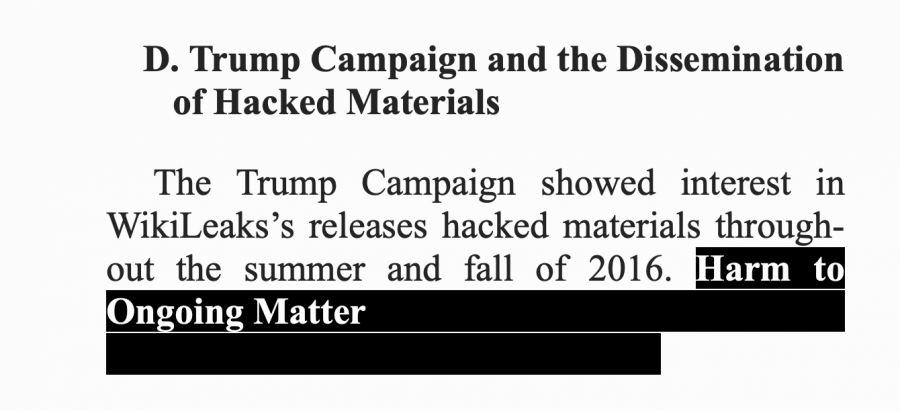
Boing Boing writes: “Back in April, Andrew Albanese from Publishers Weekly wrote a column deploring the abysmal formatting in the DoJ’s release of the Mueller Report, and publicly requesting that the Digital Public Library of America produce well-formatted ebook editions, which they have now done!”
The Digital Public Library of America adds:
The Report On The Investigation Into Russian Interference In The 2016 Presidential Election, or the Mueller Report, is now freely available in ebook format to read on your phone or tablet from DPLA’s website and the Open Bookshelf collection. The Mueller report was released to the public by the Department of Justice as a PDF last month, initially in a format that was not text-searchable. By making the report available as an ebook in our Open Bookshelf collection, anyone can download and read it for free, all in the SimplyE app — no library card or sign in required.
One of the primary objectives of DPLA’s ebooks work is to make the best openly-licensed e‑content available to libraries and their patrons. For libraries offering New York Public Library’s SimplyE app, the Mueller Report can be easily integrated into the ebook offerings made available to their patrons. SimplyE and Open Bookshelf are freely available to anyone with an iOS or Android device.
Read the Mueller Report today
Download on the web: Visit https://muellerreport.dp.la, download it in one click, and read it with your computer’s e‑reader like iBooks.
Read in SimplyE on your phone or tablet:
Use the library selector icon in the upper left corner, select Manage Accounts, then Add Library, and select Digital Public Library of America.
Find the Mueller Report in the top row.
To learn more about Open Bookshelf and other DPLA ebooks offerings, visit https://ebooks.dp.la. DPLA’s Ebook work and the production of the Mueller Report ebook is supported by the Alfred P. Sloan Foundation.
You can also download The Mueller Report in an epub version here.
If you would like to support the mission of Open Culture, consider making a donation to our site. It’s hard to rely 100% on ads, and your contributions will help us continue providing the best free cultural and educational materials to learners everywhere. You can contribute through PayPal, Patreon, and Venmo (@openculture). Thanks!
Related Content
1,000 Free Audio Books: Download Great Books for Free
800 Free eBooks for iPad, Kindle & Other Devices
1,300 Free Online Courses from Top Universities
1,150 Free Movies Online: Great Classics, Indies, Noir, Westerns, etc.
Read More...
Entrepreneurship Through the Lens of Venture Capital: A Free Online Course from Stanford
From Stanford University comes “Entrepreneurship Through the Lens of Venture Capital,” a course that “explores how successful startups navigate funding, managing, and scaling their new enterprise. This process is explored through guest lectures and mentorship from experienced venture capital investors and seasoned entrepreneurs who manage these issues on a daily basis in Silicon Valley.” Topics covered in the course include “customer value equation, board management, market strategy, company culture, and hyper growth.” Stanford adds:
With over a century and a half of venture capital experience and many more years of practice in entrepreneurship, our teaching team and guest lecturers cover the fundamentals for building a successful company. While there is no set formula for building a successful company, basic principles and general patterns are manifested in the most successful start-ups. With assistance from experienced venture capital investors and seasoned entrepreneurs from Silicon Valley, this course proceeds through the stages of growth and challenges experienced by startups.
You can find the lectures above, on YouTube.
“Entrepreneurship Through the Lens of Venture Capital” has been added to our collection of Free Business Courses, a subset of our meta collection, 1,700 Free Online Courses from Top Universities.
If you would like to support the mission of Open Culture, consider making a donation to our site. It’s hard to rely 100% on ads, and your contributions will help us continue providing the best free cultural and educational materials to learners everywhere. You can contribute through PayPal, Patreon, and Venmo (@openculture). Thanks!
Related Content:
150 Free Online Business Courses
Peter Thiel’s Stanford Course on Startups: Read the Lecture Notes Free Online
Read More...
How Computers Ruined Rock Music
There are purists out there who think computers ruined electronic music, made it cold and alien, removed the human element: the warm, warbling sounds of analog oscillators, the unpredictability of analog drum machines, synthesizers that go out of tune and have minds of their own. Musicians played those instruments, plugged and patched them together, tried their best to control them. They did not program them.
Then came digital samplers, MIDI, DAWs (digital audio workstations), pitch correction, time correction… every note, every arpeggio, every drum fill could be mapped in advance, executed perfectly, endlessly editable forever, and entirely played by machines.
All of this may have been true for a short period of time, when producers became so enamored of digital technology that it became a substitute for the old ways. But analog has come back in force, with both technologies now existing harmoniously in most electronic music, often within the same piece of gear.
Digital electronic music has virtues all its own, and the dizzying range of effects achievable with virtual components, when used judiciously, can lead to sublime results. But when it comes to another argument about the impact of computers on music made by humans, this conclusion isn’t so easy to draw. Rock and roll has always been powered by human error—indeed would never have existed without it. How can it be improved by digital tools designed to correct errors?
The ubiquitous sound of distortion, for example, first came from amplifiers and mixing boards pushed beyond their fragile limits. The best songs seem to all have mistakes built into their appeal. The opening bass notes of The Breeder’s “Cannonball,” mistakenly played in the wrong key, for example… a zealous contemporary producer would not be able to resist running them through pitch correction software.
John Bonham’s thundering drums, a force of nature caught on tape, feel “impatient, sterile and uninspired” when sliced up and snapped to a grid in Pro Tools, as producer and YouTuber Rick Beato has done (above) to prove his theory that computers ruined rock music. You could just write this off as an old man ranting about new sounds, but hear him out. Few people on the internet know more about recorded music or have more passion for sharing that knowledge.
In the video at the top, Beato makes his case for organic rock and roll: “human beings playing music that is not metronomic, or ‘quantized’”—the term for when computers splice and stretch acoustic sounds so that they align mathematically. Quantizing, Beato says, “is when you determine which rhythmic fluctuations in a particular instrument’s performance are imprecise or expressive, you cut them, and you snap them to the nearest grid point.” Overuse of the technology, which has become the norm, removes the “groove” or “feel” of the playing, the very imperfections that make it interesting and moving.
Beato’s thorough demonstration of how digital tools turn recorded music into modular furniture show us how the production process has become a mental exercise, a design challenge, rather than the palpable, spontaneous output of living, breathing human bodies. The “present state of affairs,” as Nick Messitte puts it, is “keyboards triggering samples quantized to within an inch of their humanity by producers in the pre-production stages.” Anyone resisting this status quo becomes an acoustic musician by default, argues Messitte, standing on one side of the “acoustic versus synthetic” divide.
Whether the two modes of music can be harmoniously reconciled is up for debate, but at present, I’m inclined to agree with Beato: digital recording, processing, and editing technologies, for all their incredible convenience and unlimited capability, too easily turn rhythms made with the elastic timing of human hearts and hands into machinery. The effect is fatiguing and dull, and on the whole, rock records that lean on these techniques can’t stand up to those made in previous decades or by the few holdouts who refuse to join the arms race for synthetic pop perfection.
Related Content:
Brian Eno Explains the Loss of Humanity in Modern Music
Josh Jones is a writer and musician based in Durham, NC. Follow him at @jdmagness
Read More...Johannes Kepler Theorized That Each Planet Sings a Song, Each in a Different Voice: Mars is a Tenor; Mercury, a Soprano; and Earth, an Alto
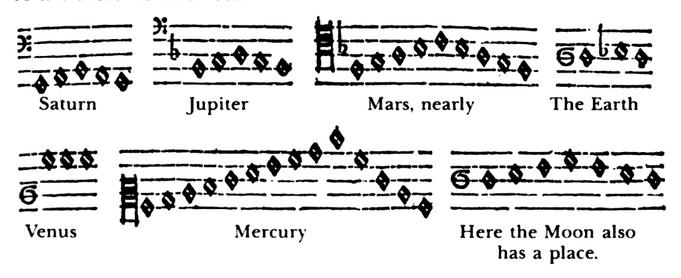
Johannes Kepler determined just how the planets of our solar system make their way around the sun. He published his innovative work on the subject from 1609 to 1619, and in the final year of that decade he also came up with a theory that each planet sings a song, and each in a different voice at that. Mars is a tenor, Mercury is a soprano, and Earth, as the BBC show QI (or Quite Interesting) recently tweeted, “is an alto that sings two notes Mi and Fa, which Kepler read as ‘Miseriam & Famem’, ‘misery and famine’ ” — two phenomena not unknown on Earth in Kepler’s time, even though the scientific revolution had already started to change the way people lived.
Not all of the best minds of the scientific revolution thought purely in terms of calculation. The blog ThatsMaths describes Kepler’s mission as explaining the solar system “in terms of divine harmony,” finding “a system of the world that was mathematically correct and harmonically pleasing.” Truly divine harmony could presumably find its expression in music, an idea that led Kepler to explain “planetary motions in terms of harmonic relationships, a scheme that he called the ‘song of the Earth.’ ”
According to this scheme, “each planet emits a tone that varies in pitch as its distance from the Sun varies from perihelion to aphelion and back” — that is, from the nearest they get to the sun to the farthest they get from the sun and back — “producing a continuous glissando of intermediate tones, a ‘whistling produced by friction with the heavenly light.’ ”
Kepler named the combined result “the music of the spheres,” but what does it sound like? Switzerland-based cornettist Bruce Dickey wants to give us a sense of it with Nature’s Whispering Secret, “a project for a CD recording exploring the ideas about music and cosmology of Johannes Kepler.” Demanding the musicianship of not just Dickey but composer Calliope Tsoupaki, singer Hana Blažíková, and a group of singers and instrumentalists from across Europe and America as well, all “among the most distinguished musicians performing 16th-century polyphonic music today.” The Indiegogo campaign for this ambitious tribute to Kepler’s ideas at the intersection of science and aesthetics, which involves an album as well as a series of live performances into the year 2020, is on its very last day, so if you’d like to hear the music of the spheres for yourself, consider making a contribution.
Related Content:
Hear the Declassified, Eerie “Space Music” Heard During the Apollo 10 Mission (1969)
NASA Puts Online a Big Collection of Space Sounds, and They’re Free to Download and Use
The Soundtrack of the Universe
Kepler, Galileo & Nostradamus in Color, on Google
Based in Seoul, Colin Marshall writes and broadcasts on cities, language, and culture. His projects include the book The Stateless City: a Walk through 21st-Century Los Angeles and the video series The City in Cinema. Follow him on Twitter at @colinmarshall, on Facebook, or on Instagram.
Read More...The Creative Life of Jim Henson Explored in a Six-Part Documentary Series
What is a Muppet? Homer Simpson once offered this explanation: “It’s not quite a mop and it’s not quite a puppet, but man…” — before cracking up with amusement. “So to answer your question, I don’t know.” That episode of The Simpsons aired in the mid-1990s, a somewhat fallow period for Jim Henson’s puppet-like (though less so mop-like) creations, but the decades between now and then have shown them to be at least as culturally influential as Matt Groening’s family of Springfieldians. What gives the Muppets, who made their television debut in 1955 and have now survived their creator by nearly thirty years, their power to endure?
Insight into that question is on offer right now in a new six-part documentary series on Jim Henson’s life and work. It comes as a part of Defunctland, “a YouTube series discussing the history of extinct theme parks and themed entertainment experiences” that has recently expanded its cultural purview.
The first episode of Defunctland’s Jim Henson explores “the history of Jim’s beginnings and his first television show, Sam and Friends”; the second “the origins of Sesame Street, the Muppetland specials, and the failed Muppet pilots”; and the third the proper beginnings of The Muppet Show, whose creators didn’t know they were “about to make the most popular show in the world.” After you’ve caught up with the first three episodes of Jim Henson, the next three episodes will appear on the series’ Youtube playlist.
As you’ll know if you’ve seen the surreal early films, experimental animations, and violent coffee commercials made by Jim Henson previously featured here on Open Culture, the man behind the Muppets hardly sought to produce entertainment for children alone: one of the pilots of The Muppet Show, in fact, was titled “Sex and Violence.” Defunctland’s documentary series gets into that and all the other aspects of Henson’s life and work, two concepts hardly separable for such a famously dedicated creator. There’s much more to Henson’s legacy than a childhood full of Sesame Street — now in its 50th year on the air — would suggest. As for how rigorous a definition of “Muppet” the series will leave us with, we’ll have to wait until it concludes to find out.
Related Content:
Jim Henson Creates an Experimental Animation Explaining How We Get Ideas (1966)
Jim Henson’s Violent Wilkins Coffee Commercials (1957–1961)
Watch Twin Beaks, Sesame Street’s Parody of David Lynch’s Iconic TV Show (1990)
Watch The Surreal 1960s Films and Commercials of Jim Henson
Based in Seoul, Colin Marshall writes and broadcasts on cities, language, and culture. His projects include the book The Stateless City: a Walk through 21st-Century Los Angeles and the video series The City in Cinema. Follow him on Twitter at @colinmarshall, on Facebook, or on Instagram.
Read More...Support Us
We're hoping to rely on loyal readers, rather than erratic ads. Please click the Donate button and support Open Culture. You can use Paypal, Venmo, Patreon, even Crypto! We thank you!

About Us

Open Culture scours the web for the best educational media. We find the free courses and audio books you need, the language lessons & educational videos you want, and plenty of enlightenment in between.
Advertise With Us

FREE UPDATES!
GET OUR DAILY EMAIL
Get the best cultural and educational resources on the web curated for you in a daily email. We never spam. Unsubscribe at any time.
FOLLOW ON SOCIAL MEDIA

Open Culture editor Dan Colman scours the web for the best educational media. He finds the free courses and audio books you need, the language lessons & movies you want, and plenty of enlightenment in between.
Advertise With Us

