Safety Last, the 1923 Movie Featuring the Most Iconic Scene from Silent Film Era, Just Went Into the Public Domain
Safety Last, the 1923 film starring Harold Lloyd, features one of the most iconic scenes from the silent film era. Writes Roger Ebert, the scene above is “by general agreement the most famous shot in silent comedy: a man in a straw hat and round horn-rim glasses, hanging from the minute hand of a clock 12 stories above the city street. Strange, that this shot occurs in a film few people have ever seen. Harold Lloyd’s Safety Last (1923), like all of his films, was preserved by the comedian but rarely shown.” All of that might be about to change. Along with a number of other classic works, Safety Last went into the public domain this week. So now everyone can watch the film, whenever they please. Watch a complete version on YouTube here. Restored versions of the film can be purchased through Criterion.
Safety Last will be added to our collection, 4,000+ Free Movies Online: Great Classics, Indies, Noir, Westerns, Documentaries & More.
Related Content:
65 Free Charlie Chaplin Films Online
Captivating GIFs Reveal the Magical Special Effects in Classic Silent Films
The Power of Silent Movies, with The Artist Director Michel Hazanavicius
Read More...Look How Young They Are!: The Beastie Boys Performing Live Their Very First Hit, “Cooky Puss” (1983)
Would you look at this video? Here we have the original line-up of the Beastie Boys (when they had a fourth, female member, Kate Schellenbach) playing a Christmas-time gig in 1983. And you just wanna scream: LOOK HOW YOUNG THEY ARE! Adam Yauch is probably 17 at the time, Michael Diamond younger, and Adam Horowitz is younger still, and they are plainly enjoying themselves while also being a bit nervous and unsure. (Ad-Rock blanches when he has to brag about the size of his member, while Adam Yauch shows he had flow very early on.) I doubt anybody in the audience was thinking these white kids would go on to be one of the greatest rap groups of all time. Some were wondering what happened to the hardcore punk music they usually played. And some were just having a blast.
The track they’re performing is “Cooky Puss,” their very first attempt at rap and, as it happens, their very first 12” single release. To their surprise the record started getting played in clubs.
For those who picked up the delightful, thorough, and very heavy Beastie Boys Book–we told you about it just recently–the origin of “Cookie Puss” is outlined in detail. A friend of a friend got the young band a chance to record in a studio usually reserved for commercial jingles for two days. The first day the band played a selection of originals and covers, but on playback “we realized they were pretty bad,” writes Ad-Rock. “They weren’t hardcore songs, they were oddly Goth-ish and just sort of, well…pretty bad.”
With a second day at their disposal they returned, and based on a beat from Schellenbach, “Cooky Puss” was born, along with another original, “Beastie Revolution.” The centerpiece of the studio version is a prank phone call between Ad-Rock, a telephone operator, and a worker at Carvel ice cream, which the adult Horowitz now cringes in memory over. (“Can I formally apologize right here and now? I’m sorry.”)
The Beastie Boys had started as a hardcore band, featuring Schellenbach on drums, and had recorded an e.p., Pollywog Stew which finally got released, along with the Cooky Puss e.p. in 1994 as Some Old Bullshit. But rap was everywhere and, as Horowitz tells it, Malcolm McLaren’s “Buffalo Gals” was the record that put hip hop on the map. “Cooky Puss” was their affectionate parody of that track. (Schellenbach, by the way, went on to form Luscious Jackson)
As for the actual Cooky Puss, it was a weird ice cream cake sold by Carvel (with its own character and backstory), and promoted on local TV with a set of ads featuring the voice of owner Tom Carvel himself. Check out the wonder of the Cooky Puss and its plush toy companion. Call now…they honor most major credit cards.
Related Content:
‘Beastie Boys on Being Stupid’: An Animated Interview From 1985
Ted Mills is a freelance writer on the arts who currently hosts the artist interview-based FunkZone Podcast and is the producer of KCRW’s Curious Coast. You can also follow him on Twitter at @tedmills, read his other arts writing at tedmills.com and/or watch his films here.
Read More...A 3D Animated History of Paris: Take a Visual Journey from Ancient Times to 1900
“And this too,” muses Marlow as he floats down the Thames in Joseph Conrad’s Heart of Darkness, “has been one of the dark places on earth.” Whole theses have been written on the meaning of this statement. We can simply take it to mean that before London was London, it was just another obscure, humble town of ordinary farmers and artisans. That is, before the Romans came. So too Paris.
One of the world’s most famous cities got its start as a cluster of humble huts, walled compounds, and low, wooden buildings with thatched roofs and fenced-in pastures—the settlement of a Celtic tribe known as the Parisii, who began inhabiting the region sometime in the 3rd century, BCE. In the first century, the Romans conquered and settled what would become the Left Bank, and began to build an impressive, prosperous city with a forum, temples, bathhouses, and theaters.
The Roman town was first called Lutetia (or Luticia Parisiorum) and the central forum, in French, the Forum de Lutèce. Christianity came in the 3rd century, supposedly by way of Saint Denis, whom the Romans beheaded on the hill later known as Mons Martyrum (“Hill of the Martyrs”)—later still, Montmartre. Then came the Franks in the 5th century, establishing the Merovingian dynasty under Clovis in 508 and bringing with them Frankish speech, and later the Francien dialect of Île-de-France.
The rest—in broad outline or fine detail—you may know, but if not, like all city’s histories, it is worth getting acquainted. As you do, watch the video above from Dassault Systemes’ Paris 3D, an “interactive journey through time” that strips away hundreds of years of history to reveal virtual models of the city during the periods above and through the Middle Ages, French Revolution, and the 1889 World’s Fair, presided over by the just-built Eiffel Tower.
The project “required the work of over 40 people, including numerous experts about Paris’s history, for more than two years.” By 2013, it covered the city’s “18,000 listed monuments” with a website, free iPad app, and augmented reality book. Unfortunately, the features of its web application seem to have been disabled and its app seems unavailable, at least in the U.S. Still—like the virtual 3d videos of Rome we’ve featured recently—the promo video above offers some impressive, beautifully-rendered reconstructions of the city one-thousand, fifteen hundred, and over two thousand years ago.
Related Content:
Prize-Winning Animation Lets You Fly Through 17th Century London
Josh Jones is a writer and musician based in Durham, NC. Follow him at @jdmagness.
Read More...How the Inventor of Dynamite, Alfred Nobel, Read an Obituary That Called Him “The Merchant of Death” and Made Amends by Creating the Nobel Prize
No one can ever fully predict the consequences of their actions. Still, some warning bells should be hard to ignore. Take Alfred Nobel, for instance, the founder of the Nobel Prize. For most of his life, he had a different reputation—as the inventor of dynamite, one of the most destructive technologies of the age. Though he maintained his motives were pure, Nobel had no shortage of signs telling him his creation might do at least as much harm as good. He persevered and lived to regret it, it’s said.
Born in Sweden in 1833, Nobel became obsessed with explosives at a young age after meeting the inventor of nitro-glycerin. He spent some formative years trying to harness its power, even after a botched nitro-glycerin experiment at a factory killed his younger brother and five other workers. Nobel patented dynamite in 1867, a “new, transportable explosive,” notes the Sydney Morning Herald video above, that “was an instant hit in the mining and construction industries.” Originally called “Nobel’s Blasting Powder,” the chemist and engineer soon choose a new name, from the ancient Greek work for “power.”
It wouldn’t take long before dynamite became a conveniently devastating weapon of war, especially in the Spanish American War, which began two years after Alfred’s death. But ten years earlier, in 1888, when the bottle was already well uncorked, Alfred received a shock when a French newspaper misidentified him for his brother, Ludwig, who had just died. His erroneous pre-mortem obituary appeared with the headline “The Merchant of Death is Dead!” The unsparing bio went on to say that Nobel “became rich by finding ways to kill more people faster than ever before.”
This may have not been his intention, so he believed, but when he saw the image reflected back at him, he immediately sought to atone for his wayward invention. “Legend has it, Nobel was mortified… and spent the rest of his life trying to establish a positive legacy.” He sought to connect people around the world, pioneering an early version of Google Earth “with balloons and rockets instead of satellites.” And when he died in 1896, he left half of his wealth, “over half a billion dollars today, to establish the Nobel Prizes.”
It is a fascinating case, if we credit the mistaken obituary for turning Nobel’s life around. Adam Grant—whom Preet Bharara introduces on his podcast Stay Tuned as “an organizational psychologist and star professor at the Wharton School”—mentions Nobel as a “pretty radical example of people changing in pretty radical ways.” There are several problems with this interpretation. Nobel may have seen the light, but he did not radically change as a person. He was already an idealistic inventor, as a Vanderbilt University biography has it, a supporter of “the peace movement” and a “truly international figure.”
Called by Victor Hugo the “wealthiest vagabond in Europe,” Nobel wrote novels, poetry, drama, and letters in five languages. He had a broad humanist outlook but for some reason could or would not see the worst uses of his product, even as his company sold weapons—to Italy for example, an act for which his adopted nation of France deemed him a traitor in 1891.
Nobel’s first Swedish patent was for “ways to prepare gunpowder” and his father, also an inventor, managed the family factory before him and made arms for the Crimean War. Like many a gilded age industrialist, Nobel turned away from the suffering he caused, endowing the arts and sciences after death to ease his conscience in life, many think, but not to truly ameliorate the damage done.
Nobel’s companies have survived him, making rocket launchers and the like as well as undeniably useful mining and construction tools. His prizes, whatever his intentions, have also done the world much good, not least in creating a global platform for deserving luminaries. (Those who have rejected Nobels have vigorously argued otherwise.) Nobel was a sensitive and complicated individual whose life was filled with grief and loss and who left a lasting legacy as a patron of intellectual culture. He was also a manufacturer of deadly weapons of mass destruction. Both of these things were true.
But even if he did not radically change—either his character or his business model—he did shift his perspective enough to have a tremendous impact on his legacy, which is the lesson Grant draws from his story. “Too often,” he tells Bharara, “we’re looking at our lives through a microscope,” oblivious to the larger scale. “What we actually need is a wide-angle lens where we can zoom out and ask, what is my legacy? What is the impact of this behavior on my reputation?” Sometimes, says Grant, “people do not like the person that’s staring them in the mirror, and they decide they want to change.”
Related Content:
Jean-Paul Sartre Rejects the Nobel Prize in Literature in 1964: “It Was Monstrous!”
7 Nobel Speeches by 7 Great Writers: Hemingway, Faulkner, and More
Josh Jones is a writer and musician based in Durham, NC. Follow him at @jdmagness.
Read More...450+ Movie Scenes Where Actors Break the Fourth Wall, Presented in Two Big Supercuts
Do you remember the first time you saw the fourth wall broken? Few of us probably do, but maybe we all should, given how radial a departure from established dramatic convention — specifically, the convention dictating that a work of dramatic art not acknowledge the fact that it is a work of dramatic art — fourth-wall-breakage represents. Then again, a work of art can break the fourth wall subtly, too subtly to make an outsized impact on our consciousness: take, for example, all the brief but knowing glances movie characters have directed at their audiences throughout almost the entire history of cinema.
A fair few of those glances appear in the supercut of 400 breakages of the fourth wall above (which may well contain the first one you ever witnessed). It draws from films from a variety of time periods, Hollywood classics and blockbusters as well as lesser-known pictures.
Together with the Press Play fourth-wall-breakage supercut below, it provides an overview of just how wide a variety of ways filmmakers have found to momentarily breach what Vincent Canby once described as “that invisible scrim that forever separates the audience from the stage.” Most films break the fourth wall for laughs, but others have done it in service of emotional, aesthetic, and even intellectual ends.
None of this is to say that the fourth wall stood perfectly intact before the colossus of cinema came along to smash it. The concept goes at least as far back as 17th-century France, first used as a term by Molière and later more fully defined by Enlightenment icon Denis Diderot. But theatrical performers must have been breaking the fourth wall, or at least poking holes in it, even before the fourth wall was quite up: long ago, we read in historical accounts of theater around the world, audiences even expected a certain degree of interaction with the action onstage — or at least they expressed their thoughts on it, often forcefully, attempting to break the fourth wall from the other direction.
Over time, we, the creators and viewers of drama alike, built the fourth wall, and it has seldom taken us long to expect its protection in every medium we enjoy: theater and film, yes, but television, video games, and even literature as well. “It is not a good idea to interrupt the narrative too often,” writes J.M. Coetzee in Elizabeth Costello, a novel that breaks the fourth wall and a host of other convention besides, “since storytelling works by lulling the reader or listener into a dreamlike state in which the time and space of the real world fade away, superseded by the time and space of the fiction.” A literary storyteller of Coetzee’s caliber would know. But what other art form has been as often compared to a dream, or felt as much like a dream, as film — and what other dreams play out on, literally, a wall?
Related Content:
Watch Them Watch Us: A History of Breaking the “Fourth Wall” in Film
Cinema History by Titles & Numbers
We’re Gonna Build a Fourth Wall, and Make the Brechtians Pay for It
Based in Seoul, Colin Marshall writes and broadcasts on cities, language, and culture. His projects include the book The Stateless City: a Walk through 21st-Century Los Angeles and the video series The City in Cinema. Follow him on Twitter at @colinmarshall or on Facebook.
Read More...Why Is English So Hard to Learn?: The Ingenious Poem, “The Chaos,” Documents 800 Irregularities in English Spelling and Pronunciation
In 1920, Dutch writer and traveler Gerard Nolst Trenité, also known as Charivarius, published a textbook called Drop Your Foreign Accent: engelsche uitspraakoefeningen. In the appendix, he included a poem titled “The Chaos,” a virtuoso, tongue-twisting demonstration of somewhere around 800 irregularities in English spelling and pronunciation. No one now remembers the textbook, and the poem might have disappeared too were it not for efforts of the Simplified Spelling Society, which tracked fragments of it through “France, Canada, Denmark, Germany, the Netherlands, Portugal, Spain, Sweden and Turkey.”
The poem’s history, as told in the Journal of the Simplified Spelling Society (JSSS) in 1994, shows how it traveled around Europe, in pieces, confounding and bedeviling aspiring English speakers. Full of homonyms, loan words, and words which—at one time—actually sounded the way they’re spelled, the poem’s fifty-eight stanzas may be the most clever and comprehensive “concordance of cacographic chaos,” as the JSSS puts it. Admired by linguists and historians of English, it has, since its 1994 republication, become something of a cult hit for enthusiasts of language everywhere.
You can read it here, hear it read above by YouTube’s Lindybeige, and see a transcription into IPA, the international phonetic alphabet. Though it’s popularly represented as a kind of sorting mechanism for “the English-Speaking Elite,” that’s hardly accurate. English once sounded like this and this, then like this, and now sounds completely different according to hundreds of regional dialects and accents around the world. The society gestures toward this in their introduction, writing, “the selection of examples now appears somewhat dated, as do a few of their pronunciations. Indeed a few words may even be unknown to today’s readers.”
“How many will know what a ‘studding-sail’ is, or that its nautical pronunciation is ‘stunsail’?,” asks the JSSS. It seems reasonable to wonder how many people ever did. In any case, English, Lindybeige writes, “is a rapidly-changing language,” and one that has not made much phonetic sense for several centuries. This is exactly what has made it such a bear to learn to spell and pronounce—for both English language learners and native speakers. Try your hand at reading every word in “The Chaos,” preferably in front of an audience, and see how you do.
Related Content:
What English Would Sound Like If It Was Pronounced Phonetically
Hear Beowulf Read In the Original Old English: How Many Words Do You Recognize?
Hear What Shakespeare Sounded Like in the Original Pronunciation
Josh Jones is a writer and musician based in Durham, NC. Follow him at @jdmagness
Read More...Public Domain Day Is Finally Here!: Copyrighted Works Have Entered the Public Domain Today for the First Time in 21 Years
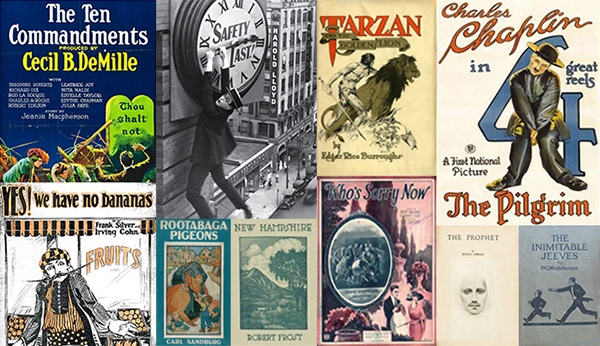
Earlier this year we informed readers that thousands of works of art and entertainment would soon enter the public domain—to be followed every year by thousands more. That day is nigh upon us: Public Domain Day, January 1, 2019. At the stroke of midnight, such beloved classics as Robert Frost’s “Stopping by Woods on a Snowy Evening” and “Yes! We Have No Bananas” will become the common property of the people, to be quoted at length or in full anywhere when the copyright expires on work produced in 1923. Then, 1924 will expire in 2020, 1925 in 2021, and so on and so forth.
It means that “hundreds of thousands of books, musical compositions, paintings, poems, photographs and films” will become freely available to distribute, remix, and remake, as Glenn Fleishman writes at Smithsonian. “Any middle school can produce Theodore Pratt’s stage adaptation of The Picture of Dorian Gray, and any historian can publish Winston Churchill’s The World Crisis with her own extensive annotations… and any filmmaker can remake Cecil B. DeMille’s original The Ten Commandments.”
Those are just a few ideas. See more extensive lists of hits and obscurities from 1923 at our previous post and come up with your own creative adaptations. The possibilities are vast and possibly world changing, in ways both decidedly good and arguably quite bad. Teachers may photocopy thousands of pages without fear of prosecution; scholars may quote freely, artists may find deep wells of inspiration. And we may also see “Frost’s immortal ode to winter used in an ad for snow tires.”
Such crassness aside, this huge release from copyright heralds a cultural sea change—the first time such a thing has happened in 21 years due to a 20-year extension of the copyright term in 1998, in a bill sponsored by Sonny Bono at the urging of the Walt Disney company. The legislation, aimed at protecting Mickey Mouse, created a “bizarre 20-year hiatus between the release of works from 1922 and 1923.” It is fascinating to consider how a government-mandated marketing decision has affected our understanding of history and culture.
The novelist Willa Cather called 1922 the year “the world broke in two,” the start of a great literary, artistic and cultural upheaval. In 1922, Ulysses by James Joyce and T.S. Eliot’s “The Waste Land” were published, and the Harlem Renaissance blossomed with the arrival of Claude McKay’s poetry in Harlem Shadows. For two decades those works have been in the public domain, enabling artists, critics and others to burnish that notable year to a high gloss in our historical memory. In comparison, 1923 can feel dull.
That year, however, marked the film debut of Marlene Dietrich, the publication of modernist landmarks like Virginia Woolf’s Mrs. Dalloway and Jean Toomer’s Cane and far too many more influential works to name here. Find several more at Duke University’s Center for the Study of the Public Domain, Lifehacker, Indiewire, and The Atlantic and have a very happy Public Domain Day.
Public domain films and books will be added to ever-growing collections:
1,000 Free Audio Books: Download Great Books for Free
4,000+ Free Movies Online: Great Classics, Indies, Noir, Westerns, Documentaries & More
800 Free eBooks for iPad, Kindle & Other Devices
Related Content:
List of Great Public Domain Films
Josh Jones is a writer and musician based in Durham, NC. Follow him at @jdmagness.
Read More...Watch an Art Conservator Bring Classic Paintings Back to Life in Intriguingly Narrated Videos
Even in our age of unprecedentedly abundant images, delivered to us at all times by print, film, television, and especially the ever-multiplying forms of digital media, something inside us still values paintings. It must have to do with their physicality, the physicality of oil on canvas or whatever tangible materials the painter originally used. But in that great advantage of the painting lies the great disadvantage of the painting: tangible materials degrade over time, and many, if not most, of the paintings we most revere have been around for a long time indeed, and few of them have come down to us in pristine shape.
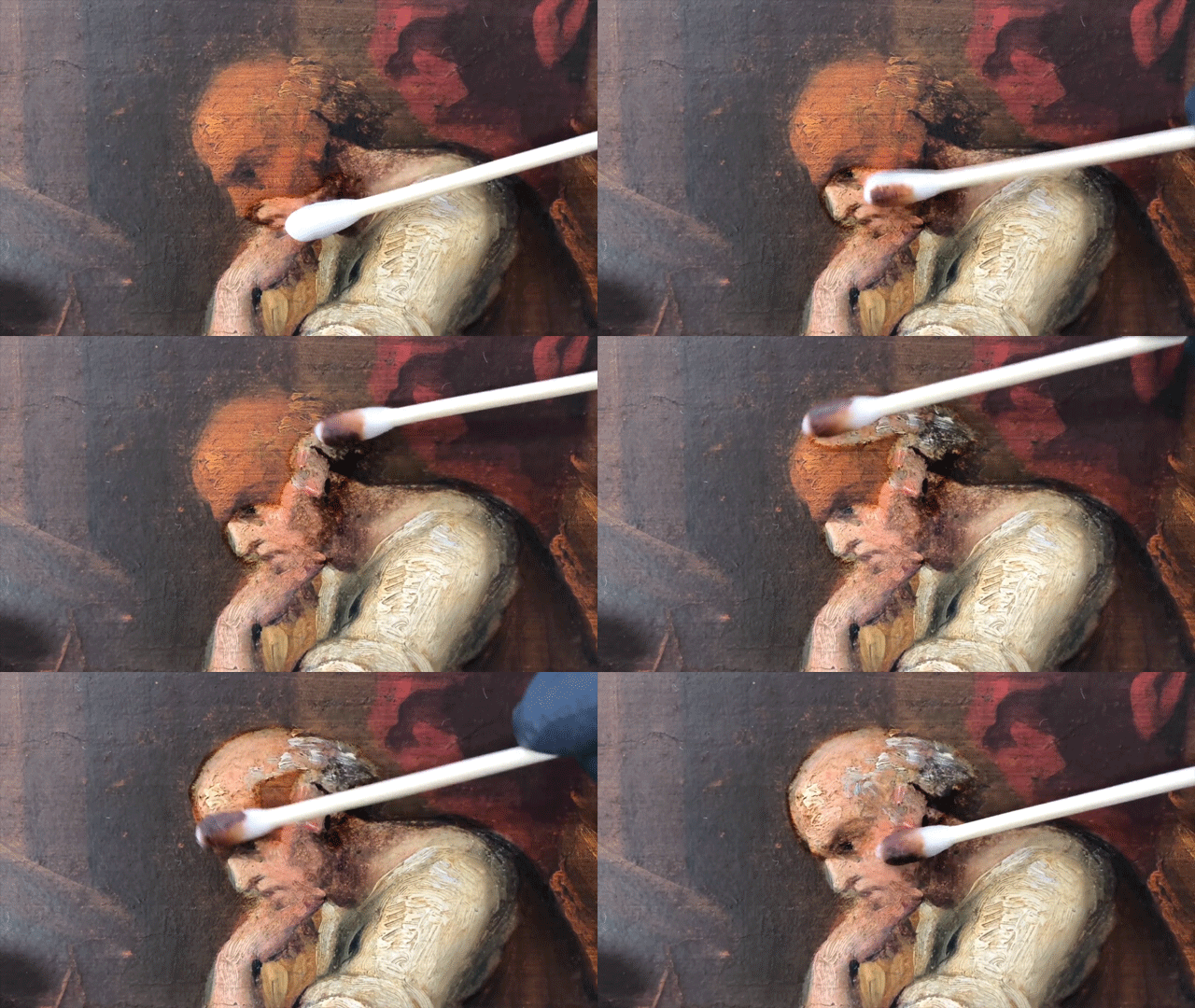
Enter the art restorer, who takes on the task of undoing, painstakingly and entirely by hand, both the ravages of time and the blunders of less competent stewards who have come before. In this case, enter Julian Baumgartner of Chicago’s Baumgartner Fine Art Restoration, a meditative short documentary on whose practice we featured earlier this year here on Open Culture.
You can see much more of it in these videos: in the one above, writes Colossal’s Kate Sierzputowski, Baumgartner “condenses over 40 hours of delicate swiping, scraping, and paint retouching into a 11.5 minute narrated video” showing and explaining his restoration of The Assassination of Archimedes.
The project, not atypical for a painting restoration, “involved cleaning a darkened varnish from the surface of the piece, removing the work from its original wooden panel using both modern and traditional techniques, mounting the thin paper-based painting to acid-free board, and finally touching up small areas that had become worn over the years.” Baumgartner’s Youtube channel also offers similar condensed restoration videos of two other paintings, Mother Mary and a portrait by the American Impressionist William Merrit Chase.
Baumgartner packs into each of these videos an impressive amount of knowledge about his restoration techniques, which few of us outside his field would have had any reason to know — or even imagine —before. They’ve racked up their hundreds of thousands of views in part thanks to that intellectual stimulation, no doubt, but all these physical materials and the sounds they make have also attracted a crowd that shares a variety of enthusiasm unknown before the age of digital media. I’m talking, of course, about ASMR video fans, whom Baumgartner has obliged by creating a version of his The Assassination of Archimedes restoration especially for them. Now there’s an art restorer for the 21st century.
via Colossal
Related Content:
The Art of Restoring a 400-Year-Old Painting: A Five-Minute Primer
The Art of Restoring Classic Films: Criterion Shows You How It Refreshed Two Hitchcock Movies
Based in Seoul, Colin Marshall writes and broadcasts on cities, language, and culture. His projects include the book The Stateless City: a Walk through 21st-Century Los Angeles and the video series The City in Cinema. Follow him on Twitter at @colinmarshall or on Facebook.
Read More...How Nirvana’s Iconic “Smells Like Teen Spirit” Came to Be: An Animated Video Narrated by T‑Bone Burnett Tells the True Story
Credited with igniting the 90s grunge craze and putting Pacific Northwest punk and indie scenes on the map, Nirvana’s “Smells Like Teen Spirit” has eclipsed hundreds of rock hits as “the most iconic song of all time”—at least according to the analytics of computer scientists from the University of London.
Whatever that designation means, it’s without a doubt the most iconic Nirvana song of all time, a tune whose influence may be impossible to measure. Kurt Cobain might have grown weary of it, but fans never stopped clamoring for the hit (his mom loved it, too). An anthem for a generation disaffected with corporate marketing and major label pandering, “Smells Like Teen Spirit” is also—like the decade it came to define—a nesting doll of irony.
Cobain played this up to a degree—the irony of an indie band announcing the second coming of charged DIY punk rock with a song that netted them a major label deal and put him on the path to superstardom. When Nirvana debuted their soon-to-be iconic hit live at Seattle’s OK Hotel on April 17th, 1991, the usually taciturn frontman introduced himself by saying, “Hello. We’re major label corporate rock sellouts.”
Given his sardonic sense of humor, fans have generally assumed some kind of anti-capitalist in-joke in the title of the song, with its reference to a popular brand of deodorant. But in a more dramatic irony, Cobain had no idea when he wrote and recorded it that “Teen Spirit was a product, aimed at teenage girls.” The song’s title, as you’ll learn in the short, animated backstory in the video above, originated with Bikini Kill singer Kathleen Hanna, who scrawled it on Cobain’s wall with a Sharpie after the two shared a night of heavy drinking and politically righteous vandalism.
Narrated by T‑Bone Burnett and animated by Drew Christie, the award-winning short “Drawn & Recorded: Teen Spirit” condenses the song’s story (which you can read about in more depth here) into two and a half minutes of pop culture history and commentary. Upon waking up and seeing Hanna’s message on the wall, Cobain was immediately flattered: “Kurt thought it meant he was a radical, a revolutionary, a feminist, a punk, an anti-authoritarian, anti-capitalist, anarchist crusader.” He got right to work on the song’s chorus.
But Hanna mainly meant to say he literally smelled like Teen Spirit, which happened to be the brand of deodorant his then-girlfriend—Bikini Kill drummer Tobi Vail—used. “I didn’t know that the deodorant spray existed until six months after the single came out,” he told Michael Azerrad in the biography Come as You Are. He didn’t intend to write an advertisement, of course. But in yet another grim twist, “after the song came out,” Burnett monotones, “sales of Teen Spirit went through the roof.”
The lesson, maybe? “Capitalism is very resilient”? Cobain understood this all too well though he may have inadvertently become the last thing he ever wanted, a product pitchman. But his creative misreading of Hanna’s joke also made music history.
Above, you can watch Hanna tell the origin story herself. The scene was recorded at Joes Pub in NYC, back in December 2010.
via Laughing Squid
Related Content:
Josh Jones is a writer and musician based in Durham, NC. Follow him at @jdmagness
Read More...Haruki Murakami Day: Stream Seven Hours of Mixes Collecting All the Jazz, Classical & Classic American Pop Music from His Novels
What makes the novels of Haruki Murakami — originally written in Japanese and almost unfailingly filled with some odd but deeply characteristic mixture of cats, wells, parallel worlds, mysterious disappearing women with well-formed ears, and much else besides — so beloved around the world? A large part of it must have to do with Murakami’s cultural references, sometimes Japanese but most often western, and even more so when it comes to music. “Almost without exception,” writes The Week music critic Scott Meslow in an extensive piece on all the songs and artists name-checked in these novels, “Murakami’s musical references are confined to one of three genres: classical, jazz, and American pop.”
Even the very names of Murakami’s books, “including Norwegian Wood, Dance Dance Dance, and South of the Border, West of the Sun — derive their titles from songs, and his characters constantly reflect on the music they hear.”
You’ll hear all these songs and many more in Meslow’s three streaming mixes, totaling seven hours of listening, that just this month made up “Haruki Murakami Day” on London-based internet radio station NTS. (We previously featured NTS here on Open Culture when they put up a twelve-hour “spiritual jazz” experience featuring John Coltrane, Sun Ra, Herbie Hancock, and many others, a fair few of whom surely appear in Murakami’s own famously large collection of jazz records.)
Haruki Murakami begins with Brook Benton’s 1970 ballad “Rainy Night in Georgia,” the first song Murakami ever included in a novel. In fact, he included it in his very first novel, 1978’s Hear the Wind Sing, which he wrote in the wee hours at his kitchen table after closing up the Tokyo jazz bar he ran in those years before becoming a professional writer. He even created a radio DJ character, whose voice recurs throughout the novel, to announce it and other songs (though his techniques for including his favorite music in his writing have grown somewhat subtler since). “Okay, our first song of the evening,” the DJ says. “This one you can just sit back and enjoy. A great little number, and the best way to beat the heat” — or the cold, or whatever the weather in your part of the world. Wherever that is, it’s sure to have plenty of Murakami fans who want to listen in.
Related Content:
A 3,350-Song Playlist of Music from Haruki Murakami’s Personal Record Collection
A 26-Hour Playlist Featuring Music from Haruki Murakami’s Latest Novel, Killing Commendatore
Haruki Murakami’s Passion for Jazz: Discover the Novelist’s Jazz Playlist, Jazz Essay & Jazz Bar
Based in Seoul, Colin Marshall writes and broadcasts on cities, language, and culture. His projects include the book The Stateless City: a Walk through 21st-Century Los Angeles and the video series The City in Cinema. Follow him on Twitter at @colinmarshall or on Facebook.
Read More...Support Us
We're hoping to rely on loyal readers, rather than erratic ads. Please click the Donate button and support Open Culture. You can use Paypal, Venmo, Patreon, even Crypto! We thank you!

About Us

Open Culture scours the web for the best educational media. We find the free courses and audio books you need, the language lessons & educational videos you want, and plenty of enlightenment in between.
Advertise With Us

FREE UPDATES!
GET OUR DAILY EMAIL
Get the best cultural and educational resources on the web curated for you in a daily email. We never spam. Unsubscribe at any time.
FOLLOW ON SOCIAL MEDIA

Open Culture editor Dan Colman scours the web for the best educational media. He finds the free courses and audio books you need, the language lessons & movies you want, and plenty of enlightenment in between.
Advertise With Us

