Isaac Asimov Predicts in 1983 What the World Will Look Like in 2019: Computerization, Global Co-operation, Leisure Time & Moon Mining

Rochester Institute of Technology, via Wikimedia Commons
“It’s difficult to make predictions,” they say, “especially about the future.” The witticism has been variously attributed. If Yogi Berra said it, it’s adorable nonsense, if Mark Twain, dry plainspoken irony. If Niels Bohr, however, we have a statement that makes us wonder what exactly “the future” could mean in a radically uncertain universe.
If scientists can’t predict the future, who can? Science fiction writers, of course. They may be spectacularly wrong at times, but few professionals seem better equipped to imaginatively extrapolate from current conditions—cultural, technological, social, and political—and show us things to come. J.G. Ballard, Octavia Butler, Arthur C. Clarke, Kurt Vonnegut… all have foreseen many of the marvels and dystopian nightmares that have arrived since their time.
In 1964, Asimov used the occasion of the New York World’s Fair to offer his vision of fifty years hence. “What will the World’s Fair of 2014 be like?” he asked in The New York Times, the question itself containing an erroneous assumption about the durability of that event. As a scientist himself, his ideas are both technologically farseeing and conservative, containing advances we can imagine not far off in our future, and some that may seem quaint now, though reasonable by the standards of the time (“fission-power plants… supplying well over half the power needs of humanity”).
Nineteen years later, Asimov ventured again to predict the future—this time of 2019 for The Star. Assuming the world has not been destroyed by nuclear war, he sees every facet of human society transformed by computerization. This will, as in the Industrial Revolution, lead to massive job losses in “clerical and assembly-line jobs” as such fields are automated. “This means that a vast change in the nature of education must take place, and entire populations must be made ‘computer-literate’ and must be taught to deal with a ‘high-tech’ world,” he writes.
The transition to a computerized world will be difficult, he grants, but we should have things pretty much wrapped up by now.
By the year 2019, however, we should find that the transition is about over. Those who can be retrained and re-educated will have been: those who can’t be will have been put to work at something useful, or where ruling groups are less wise, will have been supported by some sort of grudging welfare arrangement.
In any case, the generation of the transition will be dying out, and there will be a new generation growing up who will have been educated into the new world. It is quite likely that society, then, will have entered a phase that may be more or less permanently improved over the situation as it now exists for a variety of reasons.
Asimov foresees the climate crisis, though he doesn’t phrase it that way. “The consequences of human irresponsibility in terms of waste and pollution will become more apparent and unbearable with time and again, attempts to deal with this will become more strenuous.” A “world effort” must be applied, necessitating “increasing co-operation among nations and among groups within nations” out of a “cold-blooded realization that anything less than that will mean destruction for all.”
He is confident, however, in such “negative advances” as the “defeat of overpopulation, pollution and militarism.” These will be accompanied by “positive advances” like improvements in education, such that “education will become fun because it will bubble up from within and not be forced in from without.” Likewise, technology will enable increased quality of life for many.
… more and more human beings will find themselves living a life rich in leisure.
This does not mean leisure to do nothing, but leisure to do something one wants to do; to be free to engage in scientific research. in literature and the arts, to pursue out-of-the-way interests and fascinating hobbies of all kinds.
If this seems “impossibly optimistic,” he writes, just wait until you hear his thoughts on space colonization and moon mining.
The Asimov of 1983 sounds as confident in his predictions as the Asimov of 1964, though he imagines a very different world each time. His future scenarios tell us as much or more about the time in which he wrote as they do about the time in which we live. Read his full essay at The Star and be the judge of how accurate his predictions are, and how likely any of his optimistic solutions for our seemingly intractable problems might be in the coming year.
Related Content:
Arthur C. Clarke Predicts the Future in 1964 … And Kind of Nails It
Sci-Fi Author J.G. Ballard Predicts the Rise of Social Media (1977)
Josh Jones is a writer and musician based in Durham, NC. Follow him at @jdmagness
Read More...10 Rules for Appreciating Art by Sister Wendy Beckett (RIP), the Nun Who Unexpectedly Popularized Art History on TV
While life lasts, let us live it, not pass through as zombies, and let us find in art a glorious passageway to a deeper understanding of our essential humanity.
- Sister Wendy Beckett (1930–2018)
Sister Wendy, a cloistered nun whose passion for art led her to wander out into the world, where she became a star of global proportions, entertained the television masses with her frank humanist assessments.
Unfazed by nudity, carnality, and other sensual excesses, she initially came across as a funny-looking, grandma-aged virgin in an old-fashioned habit, lisping rhapsodically about appendages and entanglements we expect most Brides of Christ to shy away from.
Attempts to spoof her fell flat.
Having beaten the jokers to the punch, she took her rapt audience along for the ride, barnstorming across the continent, eager to encounter works she knew only from the reproductions Church higher ups gave her permission to study in the 1980s.
She was grateful to the artists—1000s of them—for providing her such an excellent lens with which to contemplate God’s creations. Eroticism, greed, physical love, horrific violence—Sister Wendy never flinched.
“Real art makes demands,” she told interviewer Bill Moyers, below, speaking approvingly of photographer Andres Serrano’s controversial Piss Christ.
“Great art offers more than pleasure; it offers the pain of spiritual growth, drawing us into areas of ourselves that we may not wish to encounter. It will not leave us in our mental or moral laziness,” she wrote in the foreword to Sister Wendy’s 1000 Masterpieces, her handpicked selection of the greatest paintings of Western art. (“A thousand sounded like so many until we got down to it and then began the anguish of choice,” she later opined.)
A lover of color and texture, she was unique in her ability to appreciate shades of grey, delving deeply into the psychological motivations of both the subjects and the artists themselves.
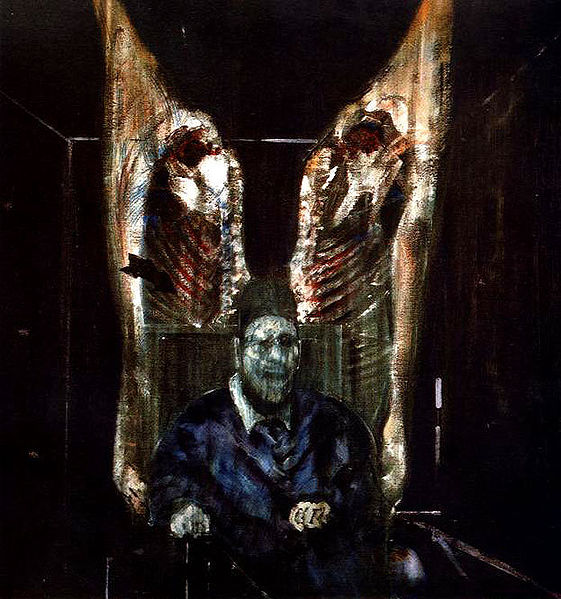
On Francis Bacon’s Figure with Meat (1954):
Here, he shows the pope, father of the Catholic Church, both enthroned and imprisoned by his position. Bacon’s relationship with his own father was a very stormy one, and perhaps he has used some of that fear and hatred to conjure up this ghostly vision of a screaming pope, his face frozen in a rictus of anguish.
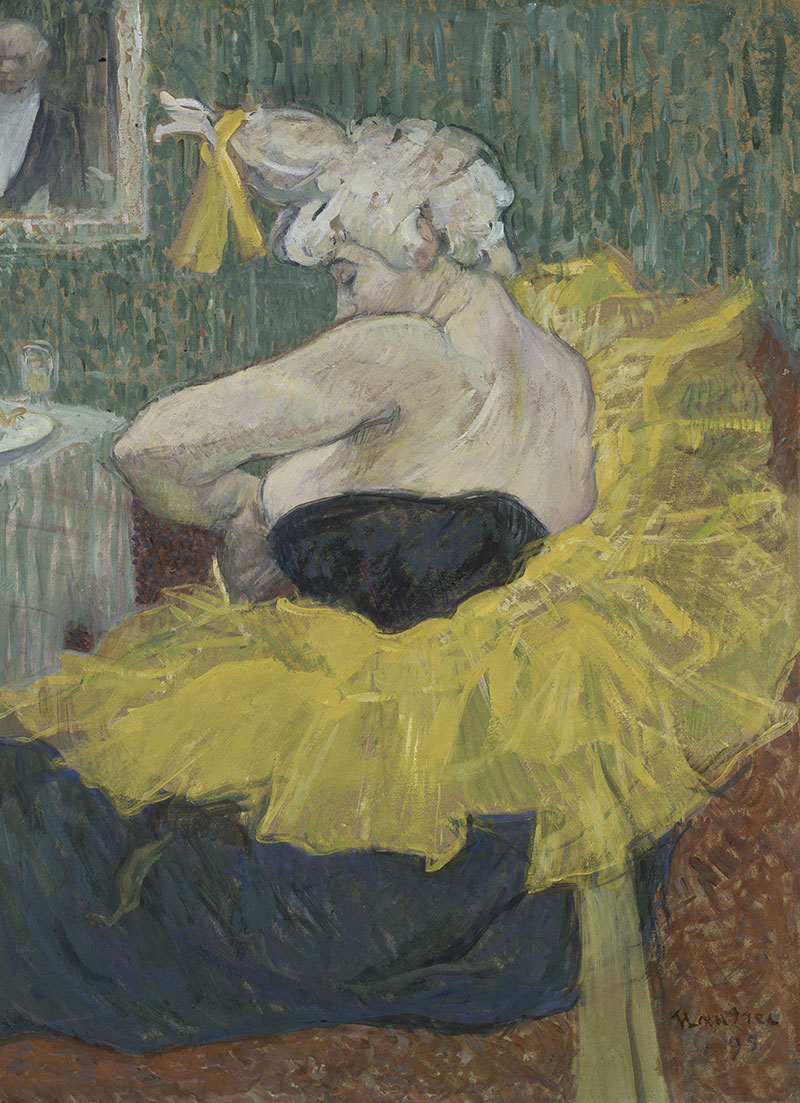
On Henri De Toulouse-Lautrec’s The Clown Chau-u-Kao (1895):
Toulouse-Lautrec, as the last descendant of an ancient French family, must have been bitterly conscious of his own physical deformities and to many people he, too, was a figure of fun…He shows us Chau-U-Kao preparing for her act with dignity and serenity, the great swirl of her frill seems to bracket the clown so that we can truly look at her, see the pathos of that blowzy and sagging flesh, and move on to the nobility of the nose and the intense eyes. This is a degradation, but one that has been chosen by the performer and redeemed by intelligence and will power.
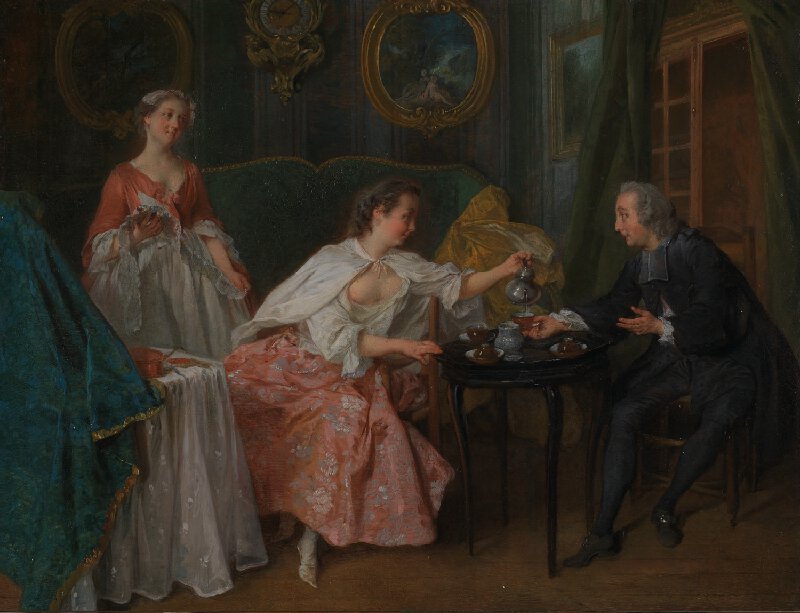
On Nicolas Lancret’s The Four Times of the Day: Morning (1739):
Morning is filled with witty observation — a delightful young woman (who is clearly no better than she should be) is entertaining a young cleric, seemingly unaware of the temptation offered by that casually exposed bosom. He holds out his cup, but his eyes are fied, alas, on that region of the feminine anatomy that his profession forbids him.
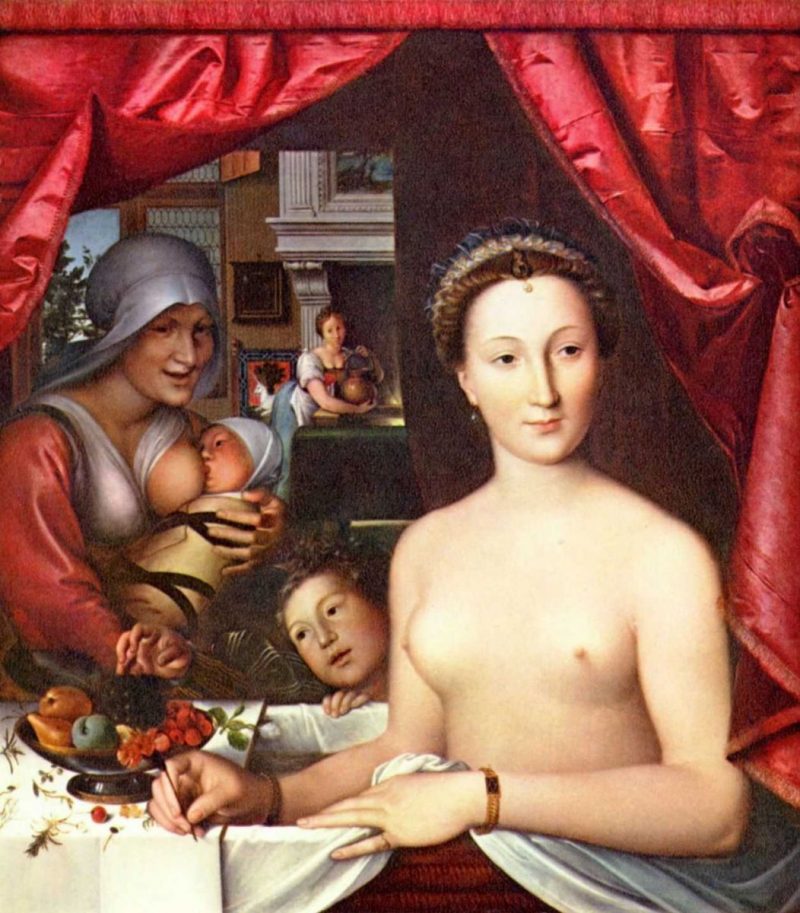
On François Clouet’s Diane De Poitiers (c. 1571)
The implication would seem to be that this shameless beauty with her prominent nipples and overflowing bowl of ripe fruit, is a woman of dubious morals. Yet one cannot but feel that the artist admires the natural freedom of his subject. Her children and her grinning wet-nurse are at her side, and, in the background, the maid prepares hot water. /surely this domestic scene is no more than a simple and endearing vignette.
Her generous takes on these and other artworks are irresistible. How wonderful it would be to approach every piece of art with such thought and compassion.
Fortunately, Sister Wendy, who passed away last week at the age of 88, left behind a how-to of sorts in the form of her 2005 essay, “The Art of Looking at Art,” from which we have extracted the following 10 rules.
Sister Wendy Beckett’s 10 Rules for Engaging with Art
Visit museums
They are the prime locus where the uniqueness of an artist’s work can be encountered.
Prioritize quality time over quantity of works viewed
Sociologists, lurking inconspicuously with stopwatches, have discovered the average time museum visitors spend looking at a work of art: it is roughly two seconds. We walk all too casually through museums, passing objects that will yield up their meaning and exert their power only if they are seriously contemplated in solitude.
Fly solo
If Sister Wendy could spend over four decades sequestered in a small mobile home on the grounds of Carmelite monastery in Norfolk, surely you can go alone. Do not complicate your contemplation by tethering yourself to a friend who cannot wait to exit through the gift shop.
Buy a postcard
…take it home for prolonged and (more or less) distractionless contemplation. If we do not have access to a museum, we can still experience reproductions—books, postcards, posters, television, film—in solitude, though the work lacks immediacy. We must, therefore, make an imaginative leap (visualizing texture and dimension) if reproduction is our only possible access to art. Whatever the way in which we come into contact with art, the crux, as in all serious matters, is how much we want the experience. The encounter with art is precious, and so it costs us in terms of time, effort, and focus.
Pull up a chair, whenever possible
It has been well said that the basic condition for art appreciation is a chair.
Don’t hate on yourself for being a philistine.
However inviolate our self-esteem, most of us have felt a sinking of the spirit before a work of art that, while highly praised by critics, to us seems meaningless. It is all too easy to conclude, perhaps subconsciously, that others have a necessary knowledge or acumen that we lack.
Take responsibility for educating yourself…
Art is created by specific artists living in and fashioned by a specific culture, and it helps to understand this culture if we are to understand and appreciate the totality of the work. This involves some preparation. Whether we choose to “see” a totem pole, a ceramic bowl, a painting, or a mask, we should come to it with an understanding of its iconography. We should know, for example, that a bat in Chinese art is a symbol for happiness and a jaguar in Mesoamerican art is an image of the supernatural. If need be, we should have read the artist’s biography: the ready response to the painting of Vincent van Gogh or Rembrandt, or of Caravaggio or Michelangelo, comes partly from viewers’ sympathy with the conditions, both historical and temperamental, from which these paintings came.
…but don’t be a prisoner to facts and expert opinions
A paradox: we need to do some research, and then we need to forget it…We have delimited a work if we judge it in advance. Faced with the work, we must try to dispel all the busy suggestions of the mind and simply contemplate the object in front of us. The mind and its facts come in later, but the first, though prepared, experience should be as undefended, as innocent, and as humble as we can make it.
Celebrate our common humanity
Art is our legacy, our means of sharing in the spiritual greatness of other men and women—those who are known, as with most of the great European painters and sculptors, and those who are unknown, as with many of the great carvers, potters, sculptors, and painters from Africa, Asia, the Middle East, and Latin America. Art represents a continuum of human experience across all parts of the world and all periods of history.
Listen to others but see with your own eyes
We should listen to the appreciations of others, but then we should put them aside and advance toward a work of art in the loneliness of our own truth.
Sister Wendy’s television shows can be found on PBS, the BBC, and as DVDs. Her books are well represented in libraries and from booksellers like Amazon. (We have learned so much in the year her dictionary-sized 1000 Paintings has been parked next to our commode…)
Related Content:
10 Rules for Students and Teachers Popularized by John Cage
1.8 Million Free Works of Art from World-Class Museums: A Meta List of Great Art Available Online
The Art Institute of Chicago Puts 44,000+ Works of Art Online: View Them in High Resolution
Download 502 Free Art Books from The Metropolitan Museum of Art
Ayun Halliday is an author, illustrator, theater maker and Chief Primatologist of the East Village Inky zine. See her onstage in New York City this January as host of Theater of the Apes book-based variety show, Necromancers of the Public Domain. Follow her @AyunHalliday.
Read More...Getting Dressed During World War I: A Fascinating Look at How Soldiers, Nursers & Others Dressed During the Great War
Not to diminish the nightmare of mortars and shrapnel, but as evidenced by Crow’s Eye Productions’ period accurate dressing video above, one of the greatest horrors of WWI was wet wool.
Decades before the invention of Gore-Tex, Polar Fleece and other high performance, all weather gear, British soldiers relied on their woolies from head to toe.
An army of female knitters sent gloves, scarves, balaclavas and other such “comforts” to the front, in addition to seamless socks designed to last their boys three whole marching days inside their ankle high leather boots.
Alas, no amount of waxing and oiling could keep the trenches’ freezing cold puddles from seeping through those boots.
Nothing’s worse than the scent of three layers of wet wool when you’re catching your death in sodden puttees.
The regiments whose uniform bottoms consisted of kilts had it particularly rough, as the wet material would freeze, cutting across the wearers’ legs like knives.
Prevented from joining the combat on the frontlines, British women helped out where they could, achieving a more comfortable level of dress than they’d known before the war.
Torso-smashing corsets were scrapped to preserve steel for the war effort, though decorum decreed that British Red Cross Society Voluntary Aid Detachment nurses, such as Downton Abbey’s fictional Lady Sybil Crawley, maintain a tidy figure with lighter, front-fastening corsets from hips to just below the bust.
Many of the upper class women swelling the volunteer nursing ranks were unaccustomed to dressing in such utilitarian fashion—cotton dresses, black flat rubber-soled shoes, aprons and sleeve protectors.
Their figures found comparative liberation, while their vanity found humbler outlets in dusting powder and the flattering army-style professional nursing veils they preferred to The Handmaid’s Tale-ish Sister Dora caps.
The greater physical freedom of the nurses’ uniforms extended to ordinary young women as well. Their underwear—a midriff baring chemise, knickers and petticoat—allowed for easier movement, as shorter skirts led to glamorous stockings and—gasp!—shaved legs!
Trendy cardigans, jumpers and waistcoats weren’t just cute, they helped make up for the lost warmth of those oh-so-restrictive corsets.
View more of Crow’s Eye Productions’ short films on the history of dress here.
Knitters, you can find over 70 patterns for WW1 comforts and necessities in the book Centenary Stitches: Telling the Story of One WW1 Family Through Vintage Knitting and Crochet.
Related Content:
The Dresser: The Contraption That Makes Getting Dressed an Adventure
How to Make and Wear Medieval Armor: An In-Depth Primer
Ayun Halliday is an author, illustrator, theater maker and Chief Primatologist of the East Village Inky zine. See her onstage in New York City this January as host of Theater of the Apes book-based variety show, Necromancers of the Public Domain. Follow her @AyunHalliday.
Read More...Where Did the Monk’s Haircut Come From? A Look at the Rich and Contentious History of the Tonsure
One might assume from a modern viewpoint that the hairstyles worn by monks arose to deal with male pattern baldness anxiety. As in the school uniform approach, you can’t single out one person’s baldness when everyone is bald. But this, again, would be a modern view, full of the vanity the tonsured—those with religiously shaven heads—ostensibly vowed to renounce. According to the Catholic Encyclopedia, the tonsure (from the Latin verb for “to shear”) began as a “badge of slavery” among Greeks and Romans. It was adopted “on this very account” by early monastic orders, to mark the total surrender of the will.
Would it surprise you, then, to learn that there were tonsure wars? Probably not if you know anything about church history. Every article of clothing and of faith has sparked some major controversy at one time or another. So too with the tonsure, of which—we learn in the Vox video above—there were three styles. The first, the coronal (or Roman or Petrine) tonsure, is the one we see in countless Medieval and Renaissance paintings: a bald pate at the crown surrounded by a fringe of hair, possibly meant to evoke the crown of thorns. Next is the Pauline, a fully shaved head, seen much less in Western art since it was “used more commonly in Eastern Orthodoxy.”
The third style of tonsure caused all the trouble. Or rather, it was this style that served as a visible sign of religious differences between the Roman Catholic Church and the churches in Britain and Ireland. “Celtic Catholicism was ‘out of sync’ with the Roman Catholic Church,” notes Vox. “Roman Catholics would use the differences between them to portray Celtic Catholicism as pagan, or even as an offshoot, celebrating the power-hungry magician, Simon Magus.” The Celtic tonsure fell under a cloud, but how exactly did it differ from the others? Since it disappeared in the early Middle Ages and few images seem to have survived, no one seems sure.
Daniel McCarthy, fellow emeritus at Trinity College, Dublin set out to solve the mystery. He speculates the Celtic tonsure, as you’ll see on a computer-simulated monk’s head, was a triangular shape, with the apex at the front. When the Roman Catholics took over Ireland, all of the vestments, dates, and haircuts were slowly brought into line with the dominant view. The practice of tonsure officially ended in 1972, and fell out of favor in English-speaking countries centuries earlier, according to the Catholic Encyclopedia. But in any case, McCarthy sees the tonsure not as a spurning of fashion, but as a cult-like devotion to style. In that sense, we can see people who adopt similar haircuts around the world as still visually signaling their membership in some kind of order, religious or otherwise.
Related Content:
How a Baltimore Hairdresser Became a World-Renowned “Hair Archaeologist” of Ancient Rome
Animated: Stephen Fry & Ann Widdecombe Debate the Catholic Church
50 Years of Changing David Bowie Hair Styles in One Animated GIF
Josh Jones is a writer and musician based in Durham, NC. Follow him at @jdmagness.
Read More...Earthrise, Apollo 8’s Photo of Earth from Space, Turns 50: Download the Iconic Photograph from NASA
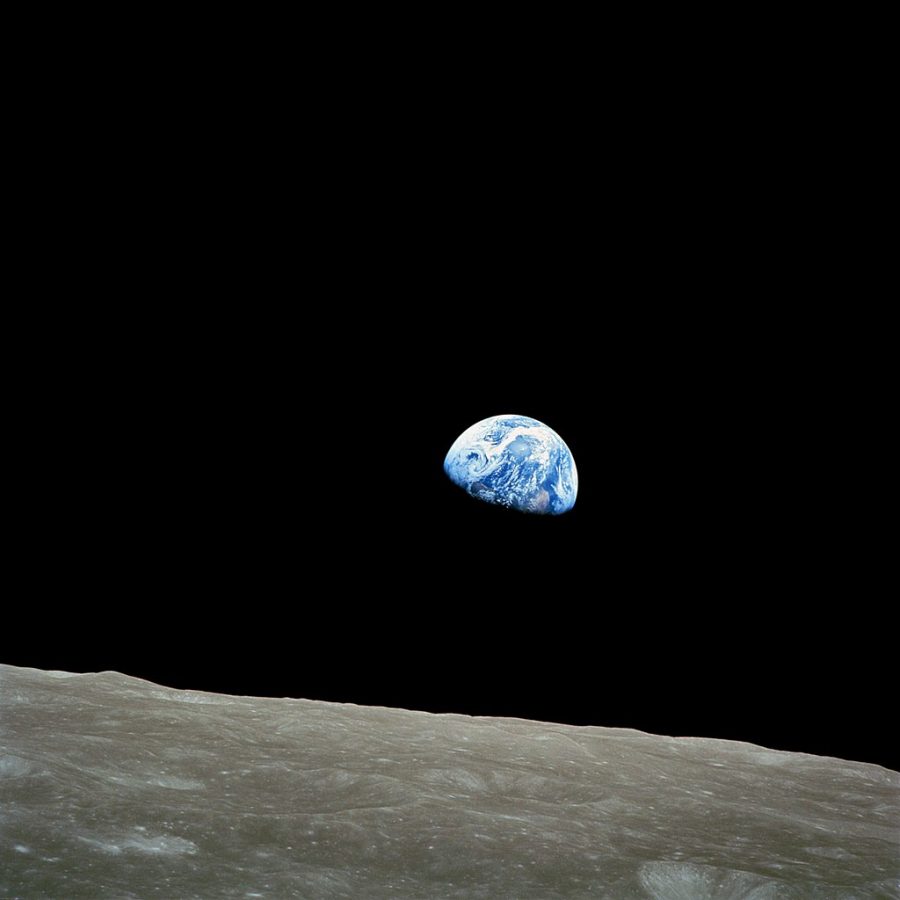
Just a little over fifty years ago, we didn’t know what Earth looked like from space. Or rather, we had a decent idea what it looked like, but no clear color images of the sight existed. 2001: A Space Odyssey presented a particularly striking vision of Earth from space in the spring of 1968, but it used visual effects and imagination (both to a still-impressive degree) to do so. Only on Christmas Eve of that year would Earth be genuinely photographed from that kind of distance, captured with a Hasselblad by Bill Anders, lunar module pilot of NASA’s Apollo 8 mission.
“Two days later, the film was processed,” writes The Washington Post’s Christian Davenport, “and NASA released photo number 68-H-1401 to the public with a news release that said: “This view of the rising earth greeted the Apollo 8 astronauts as they came from behind the moon after the lunar orbit insertion burn.”
The image, called Earthrise, went “as viral as anything could in 1968, a time that saw all sorts of photographs leave their mark on the national consciousness, most of them scars.” Life magazine ran it with lines from U.S. poet laureate James Dickey: “Behold/ The blue planet steeped in its dream/ Of reality.”
It’s often said of iconic photographs that they make their viewers see their subjects in a new way, an effect Earthrise must exemplify more clearly than any other picture. “The vast loneliness is awe-inspiring,” said Apollo 8 command module pilot Jim Lovell at the time, “and it makes you realize just what you have back there on Earth.” At the recent celebration of the mission’s 50th anniversary at the Washington National Cathedral, Anders remembered, “As I looked down at the Earth, which is about the size of your fist at arm’s length, I’m thinking this is not a very big place. Why can’t we get along?”
You can download Earthrise from NASA’s web site and learn more about the taking of the photo from the video above, made for its 45th anniversary. Using all available data on the mission, including audio recordings of the astronauts themselves, the video precisely re-creates the circumstances under which Anders shot Earthrise, forever preserving a view made possible by a roll of the spacecraft executed by Apollo 8 commander Frank Borman. To what extent their photographic achievement has convinced us all to get along remains debatable, but has humanity, since the day after Christmas 1968, ever thought about its blue planet in quite the same way as before?
Related Content:
Countries and Coastlines: A Dramatic View of Earth from Outer Space
What It Feels Like to Fly Over Planet Earth
The Beauty of Space Photography
Based in Seoul, Colin Marshall writes and broadcasts on cities, language, and culture. His projects include the book The Stateless City: a Walk through 21st-Century Los Angeles and the video series The City in Cinema. Follow him on Twitter at @colinmarshall or on Facebook.
Read More...Guillermo del Toro Names Spielberg’s Catch Me If You Can the Most Underrated Great Movie of All Time
Director Guillermo del Toro, as one Twitter wag put it recently, is the kind of film friend we’d all love to have–a great conversationalist, a good listener, a fan at heart, and an encyclopedic knowledge of the form. And while it’s not rare to hear him praise Steven Spielberg, this recent Twitter post most people by surprise:
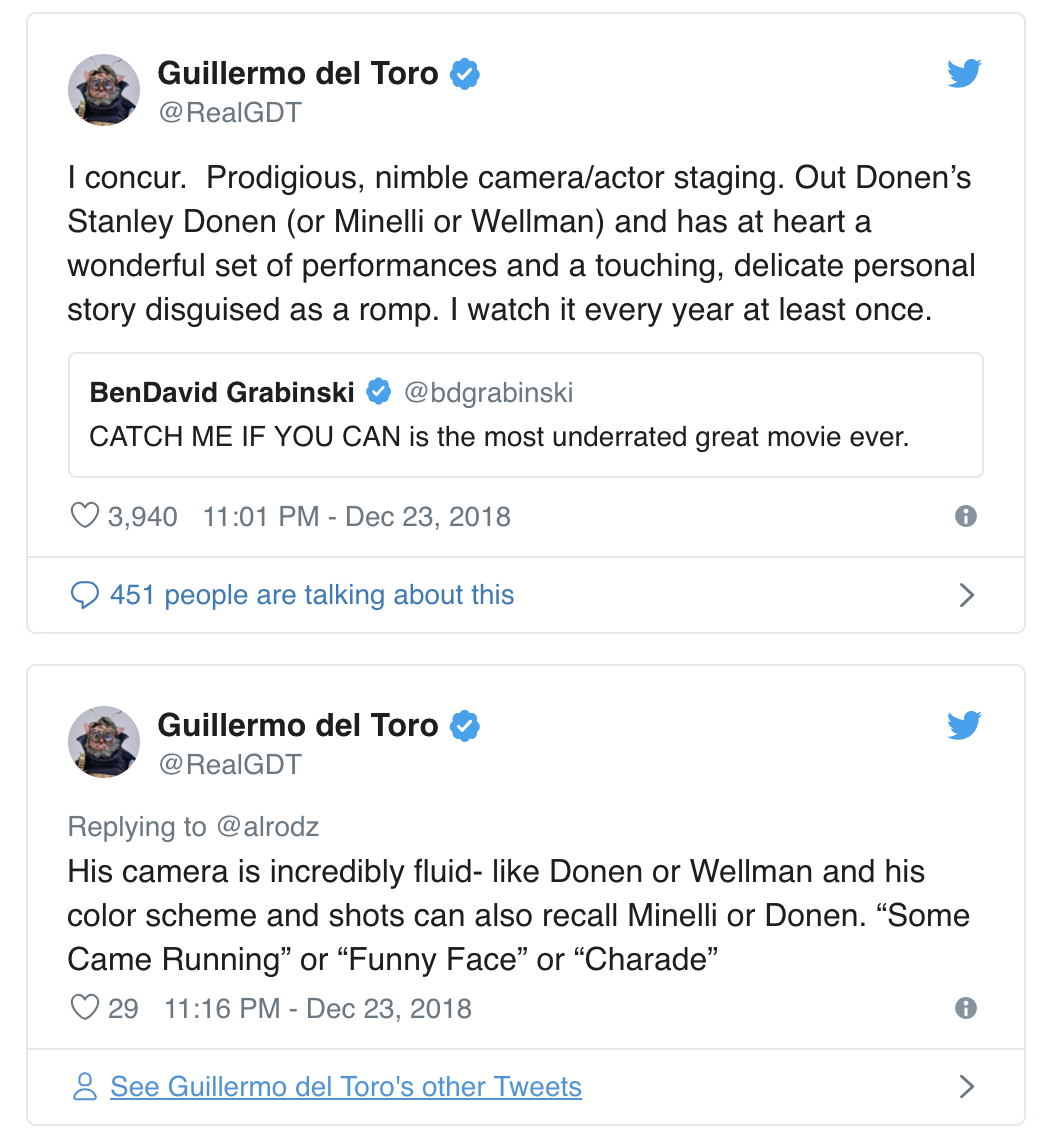
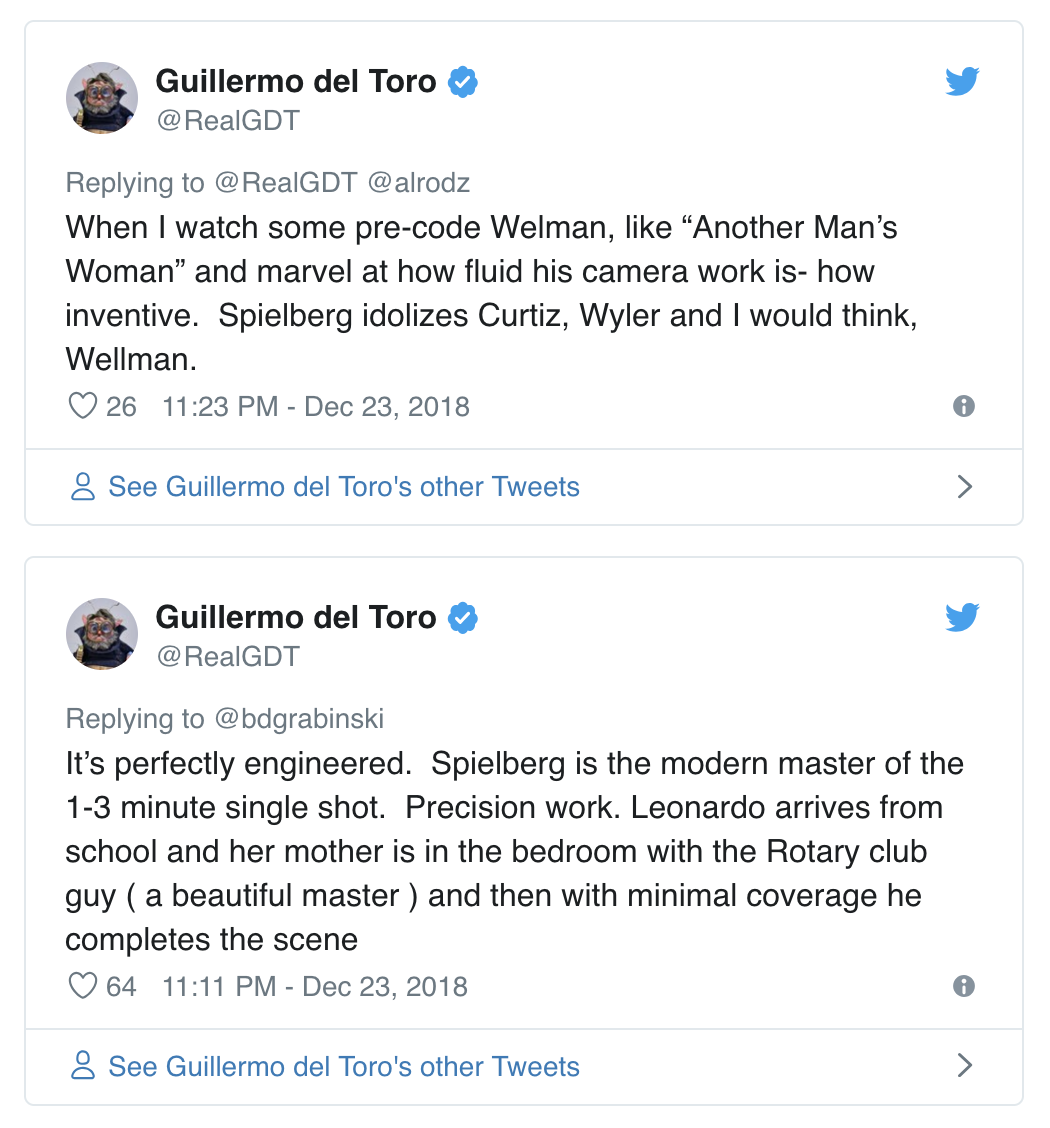
Catch Me If You Can is honestly a film I haven’t thought about since I watched it in the theaters. That’s not to say it was bad–it was an enjoyable romp with Leonardo DiCaprio and Tom Hanks playing cat and mouse with each side appreciating the other side’s wiles, but apparently de Toro has watched it and thought about it often.
BenDavid Grabinski, the man who made the first volley in proclaiming Spielberg’s film underrated, is known for writing the Jackie Chan-Johnny Knoxville vehicle Skiptrace and working on the more recent Blindspotting.
“Probably Walken’s best performance after DEER HUNTER,” he adds, along with “Leonardo DiCaprio is so good you don’t judge Tom Hanks for falling for his shit.” and “There is nothing more entertaining than hearing Tom Hanks angrily yell. Better than the most expensive FX money can buy.”
(One of Grabinski’s followers mentions Amy Adams’ role, long before she hit it big. There’s also a nod to the John Williams’ score, which is light and jazzy unlike his blockbuster work.)
It’s more interesting who del Toro readily calls to mind as influences: Stanley Donen (Charade), William Wellman (The Public Enemy), Vincent Minnelli, Michael Curtiz (Casablanca), and William Wyler (Roman Holiday). These men were all workaday directors within the studio system, all skilled craftsman, but not so idiosyncratic as to stand out.
Spielberg told the American Film Institute once:
“People like Victor Fleming and Michael Curtiz I identify with more [than the likes of Martin Scorsese and Orson Welles] because they didn’t have styles…They were chameleons and they could quickly adapt; they could go from a story about heaven and the afterlife to the Civil War. They could do a lot of different subjects and they could do them well because they were good craftsmen… but they didn’t impose who they were on what that was. And I always felt I was more in their game.”
Some may disagree, as Spielberg, especially in his blockbusters, has a style that others have easily copied (J.J. Abrams, I’m looking at you.) But right from the get-go, Spielberg has always made room for other genres, from romance to historical epics to horror and sci-fi.
del Toro is not that kind of filmmaker, though his best films are when he gets personal and nostalgic, like The Devil’s Backbone. The Shape of Water certainly had its Spielbergian moments, especially in its E.T.-style rescuing of the central creature.
Now that del Toro has weighed in, hopefully he might write a little bit more on the movie in the future. For us, we might need to watch the film again.
Related content:
Steven Spielberg on the Genius of Stanley Kubrick
Watch Steven Spielberg’s Debut: Two Films He Directed as a Teenager
Ted Mills is a freelance writer on the arts who currently hosts the artist interview-based FunkZone Podcast and is the producer of KCRW’s Curious Coast. You can also follow him on Twitter at @tedmills, read his other arts writing at tedmills.com and/or watch his films here.
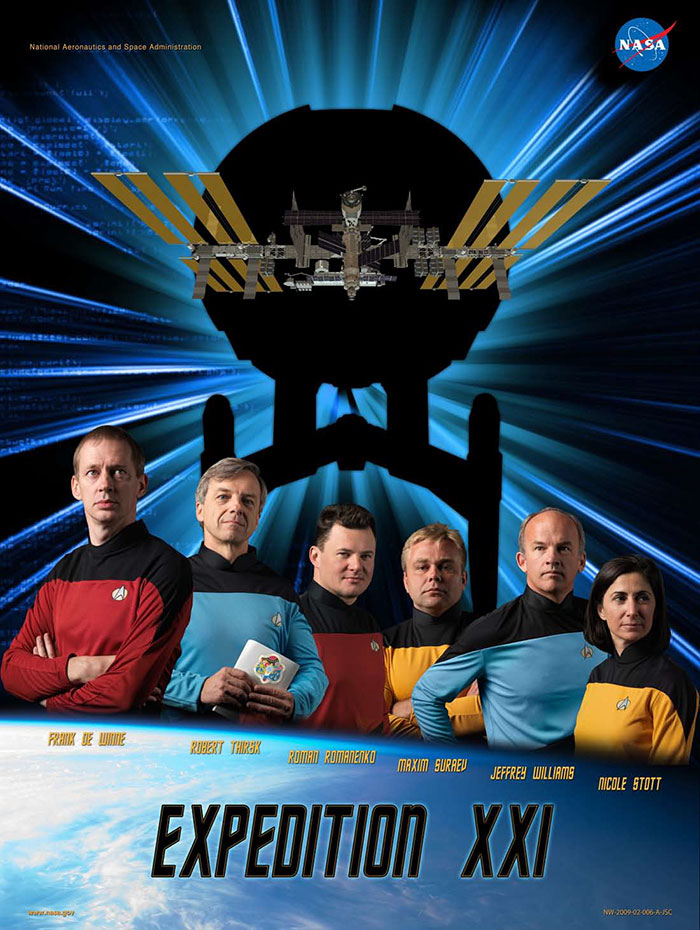
Read More...NASA Creates Movie Parody Posters for Its Expedition Flights: Download Parodies of Metropolis, The Matrix, The Hitchhiker’s Guide to the Galaxy and More
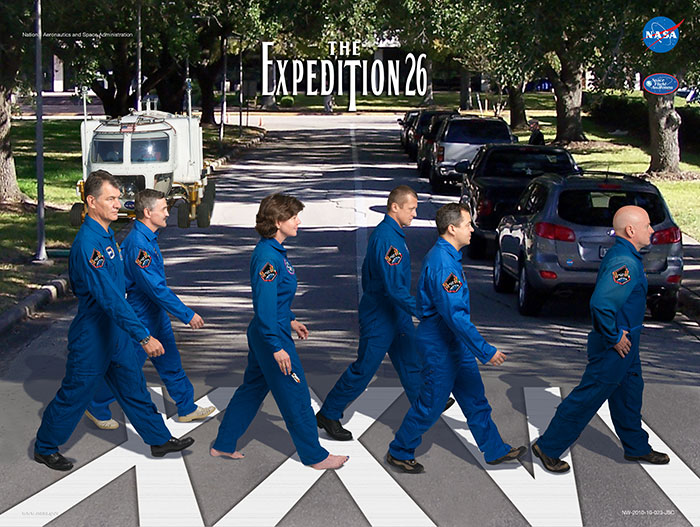
For just over eighteen years now, NASA has been conducting expeditions to the International Space Station. Each of these missions has not just a name, or at least a number (last week saw the launch of Expedition 58), but an official poster with a group photo of the crew. “These posters were used to advertise expeditions and were also hung in NASA facilities and other government organizations,” says Bored Panda. “However, when astronauts got bored of the standard group photos they decided to spice things up a bit.”
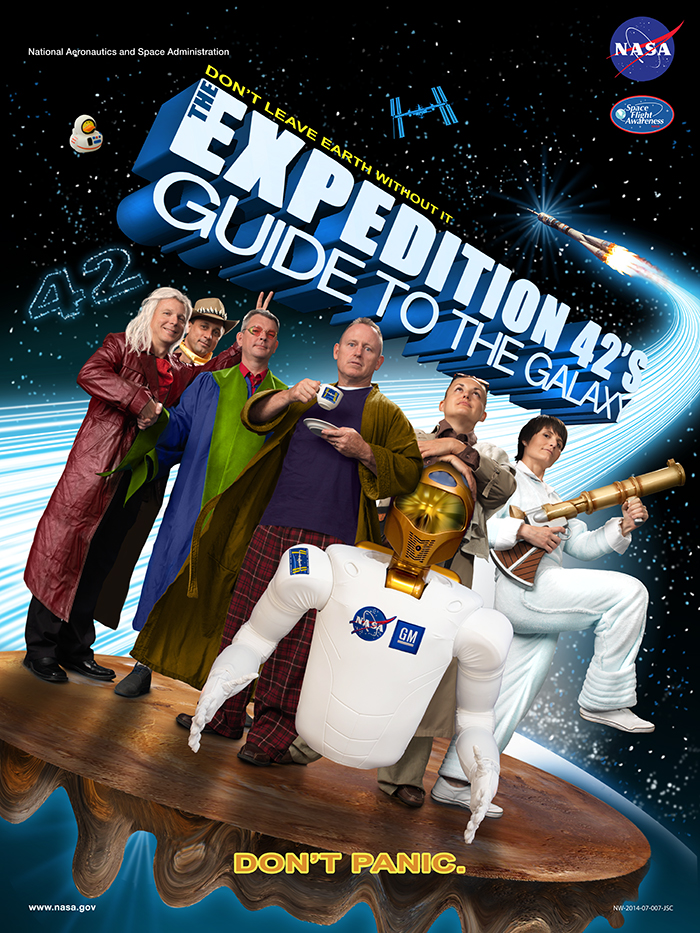
And “what’s a better way to do that other than throwing in some pop culture references?” As anyone who has ever worked with scientists knows, a fair few of them have somehow made themselves into living compendia of knowledge of not just their field but their favorite books, movies, and television shows — not always, but very often, books, movies, and television shows science-fictional in nature.
The prime example, it hardly bears mentioning, would be Star Trek, but the well of fandom at NASA runs much deeper than that.
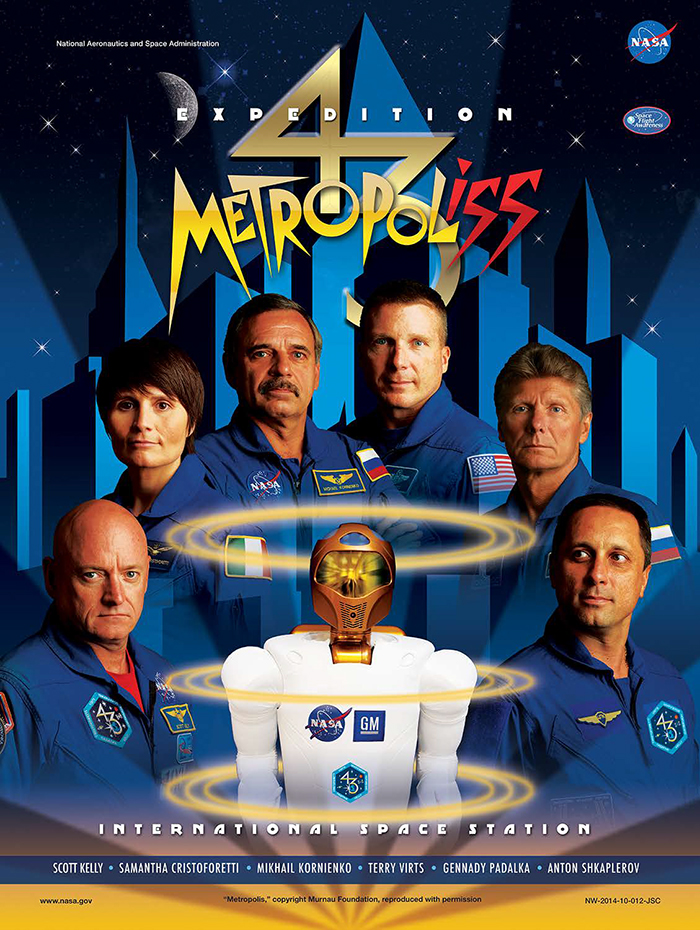
You’ll get a sense of how far that well goes if you have a look through the Expedition poster archive at NASA’s web site. There you’ll find not just pop culture references but elaborately designed tributes — downloadable in high resolution — to the likes of not just Star Trek but Star Wars, The Matrix, The Hitchhiker’s Guide to the Galaxy (the sole possible theme, Douglas Adams fans will agree, for Expedition 42), and even Fritz Lang’s Metropolis, which first gave dystopian sci-fi its visual form in 1927 (and which you can watch here). Albums are also fair game, as evidenced by the Abbey Road poster for Expedition 26.
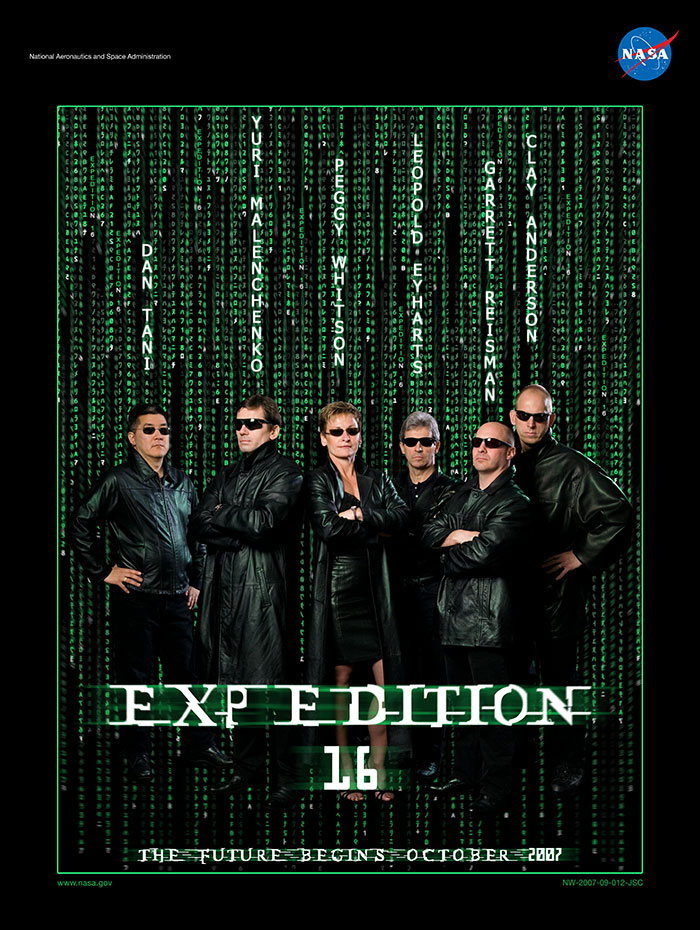
Bored Panda calls these posters “hilariously awkward,” but opinions do vary: “I love them,” writes Boing Boing’s Rusty Blazenhoff. “I think they’re fun and creative.” And whatever you think of the concepts, can you fail to be impressed by the sheer attention to detail that has clearly gone into replicating the source images? It’s all more or less in line with the formidable graphic design skill at NASA, previously featured here on Open Culture, that has gone into its posters celebrating space travel and the 40th anniversary of the Voyager missions.
Going through the Expedition poster archive, I notice that none seems yet to have paid tribute to Andrei Tarkovsky’s Solaris, surely one of the most powerful pieces of outer space-related cinema ever made. Granted, that film has much less to do with teamwork and camaraderie than the intense psychological isolation of the individual, which would make it tricky indeed to recreate any of its memorable images as proud group photos. But if NASA’s poster designers can’t take on that mission, nobody can.
via Boing Boing
Related Content:
NASA Lets You Download Free Posters Celebrating the 40th Anniversary of the Voyager Missions
How the Iconic 1968 “Earthrise” Photo Was Made: An Engrossing Visualization by NASA
NASA Presents “The Earth as Art” in a Free eBook and Free iPad App
Wonderfully Kitschy Propaganda Posters Champion the Chinese Space Program (1962–2003)
Based in Seoul, Colin Marshall writes and broadcasts on cities, language, and culture. His projects include the book The Stateless City: a Walk through 21st-Century Los Angeles and the video series The City in Cinema. Follow him on Twitter at @colinmarshall or on Facebook.
Read More...Napoleon’s English Lessons: How the Military Leader Studied English to Escape the Boredom of Life in Exile
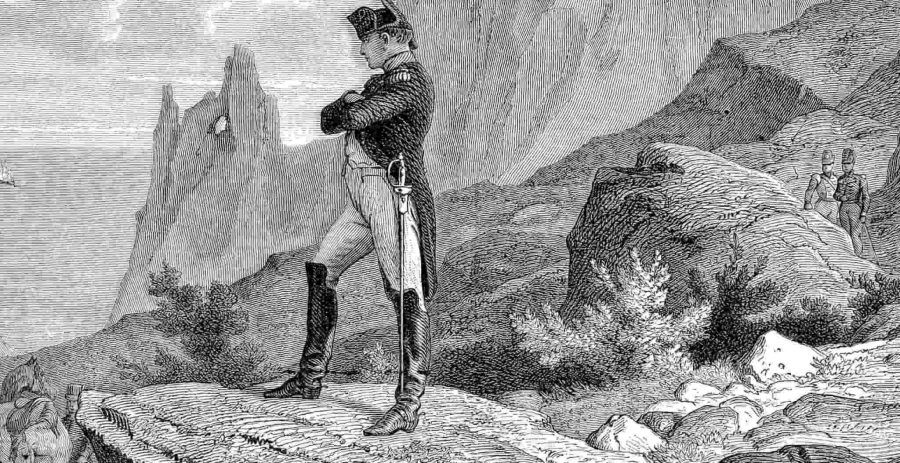
When we talk about country club prison sentences, we tend to imagine a marginal amount of time spent on the inside, though the phrase sounds like an extended vacation. Napoleon Bonaparte—exiled to the island of St. Helena for his crimes against Europe—got the full treatment, what some might even call a sweetheart deal. As the Public Domain Review notes, “the British had agreed to provide Le Petit Caporal with plentiful wine, meat, and musical instruments.” He was given his own comfortable lodgings, a spacious country house, though it’s said to have been draughty and full of rats.
On the other hand, Napoleon had to foreswear “what he most craved—family, power, Europe,” for a condition of extreme isolation. The loss weighed heavily. After spending six years 1200 miles from shore, he died, some say of poisoning, but others say of boredom. Of his few amusements, conversing with Count Emmanuel de Las Cases—“historian and loyal supporter who had been allowed to voyage with him to Saint Helena”—proved most stimulating. Prevented from receiving newspapers in French, he longed to read the few he found in English.
Las Cases endeavored to teach Napoleon the language of his jailers, and the former Emperor struggled mightily to learn it. After three months on the island, he spent the following three studying every day, eventually producing translations from his French like that below:
When will you be wise
Never as long as j should be in this isle
But j shall become wise after having passed the line
When j shall land in France j shall be very content…My wife shall come near to me, my son shall be great and strong if he will be able to trink a bottle of wine at dinner j shall [toast] with him… / The women believe they [are] ever prety / The time has not wings / When you shall come, you shall see that j have ever loved you.
Eight pages in Napoleon’s own hand remain from his time as a student of English on St. Helena in the first few months of 1816. They are “some of the most evocative documents we have from Napoleon’s time” on the island, the Fondation Napoleon writes, bearing “poignant witness to the frustration Napoleon felt in exile…. It is tempting to read a refusal of exile in these sheets, both in the sentences themselves, and in Napoleon’s insistent use of ‘j’ (as in the French ‘je’) rather than the English ‘I.’”
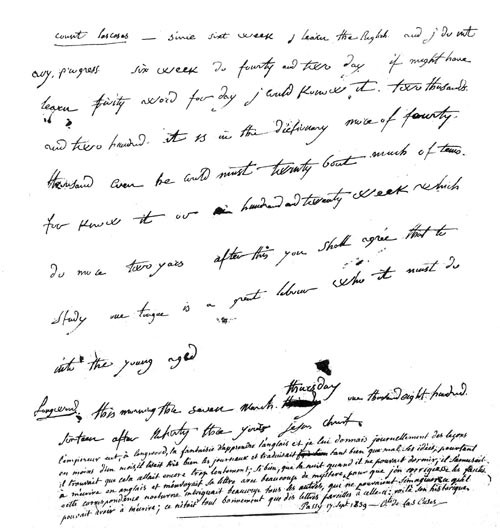
In one letter that survives from March 7, 1816 (see it scanned above), written for Las Cases to correct the following day, Napoleon takes stock of his progress, or lack thereof.
Count lascases — Since sixt week j learn the Englich and j do not any progress. Six week do fourty and two day. If might have learn fivity word four day I could know it two thusands and two hundred. It is in the dictionary more of fourty thousand; even he could must twinty bout much of tems for know it our hundred and twenty week, which do more two yars. After this you shall agrée that to study one tongue is a great labour who it must do into the young aged.
Las Cases reports that his student “had an extraordinary intelligence but a very bad memory.” Grammar came much more easily than vocabulary. His frustration over being “imprisoned in the middle of this language” is recorded in Las Cases’ Mémorial de Sainte-Hélène, a record of his fifteen months on the island with Napoleon. The book became “a publishing sensation” and would “do much,” the Public Domain Review writes, “to turn the perception of Napoleon from a dictator into a liberator.”
Related Content:
Napoleon’s Kindle: See the Miniaturized Traveling Library He Took on Military Campaigns
Vintage Photos of Veterans of the Napoleonic Wars, Taken Circa 1858
Napoleon: The Greatest Movie Stanley Kubrick Never Made
Josh Jones is a writer and musician based in Durham, NC. Follow him at @jdmagness.
Read More...Buckminster Fuller Documented His Life Every 15 Minutes, from 1920 Until 1983
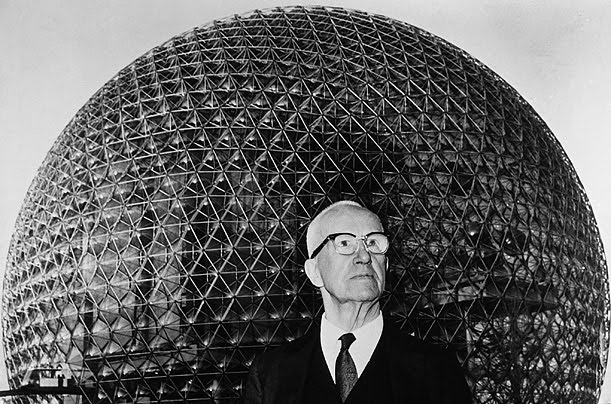
If you’ve heard of Buckminster Fuller, you’ve almost certainly heard the word “Dymaxion.” Despite its strong pre-Space Age redolence, the term has somehow remained compelling into the 21st century. But what does it mean? When Fuller, a self-described “comprehensive, anticipatory design scientist,” first invented a house meant practically to reinvent domestic living, Chicago’s Marshall Field and Company department store put a model on display. The company “wanted a catchy label, so it hired a consultant, who fashioned ‘dymaxion’ out of bits of ‘dynamic,’ ‘maximum,’ and ‘ion,’ ” writes The New Yorker’s Elizabeth Kolbert in a piece on Fuller’s legacy. “Fuller was so taken with the word, which had no known meaning, that he adopted it as a sort of brand name.” After the Dymaxion House came the Dymaxion Vehicle, the Dymaxion Map, and even the two-hour-a-day Dymaxion Sleep Plan.
“As a child, Fuller had assembled scrapbooks of letters and newspaper articles on subjects that interested him,” Kolbert writes. “When, later, he decided to keep a more systematic record of his life, including everything from his correspondence to his dry-cleaning bills, it became the Dymaxion Chronofile.” The Dymaxion Chronofile now resides in the R. Buckminster Fuller Collection at Stanford University, a place that has merited the attention of no less a guide to the fascinating corners of the world than Atlas Obscura.
“The files go back to when he was four-years-old, but he only seriously started the archive in 1917,” writes that site’s Allison C. Meier. “From then until his death in 1983 he collected everything from each day, with ingoing and outgoing correspondence, newspaper clippings, drawings, blueprints, models, and even the mundane ephemera like dry cleaning bills.” Fuller added to the Dymaxion Chronofile not just every day but, from the year 1920 until his death in 1983, every fifteen minutes.
In 1962 Fuller described the Dymaxion Chronofile as what would happen “if somebody kept a very accurate record of a human being, going through the era from the Gay ’90s, from a very different kind of world through the turn of the century — as far into the twentieth century as you might live.” Using himself as the case subject for the project (as he did for many projects, which led him to nickname himself “Guinea Pig B”) meant that “I could not be judge of what was valid to put in or not. I must put everything in, so I started a very rigorous record.” Open Culture’s own Ted Mills has written elsewhere about the rigors of storing and maintaining that record in archive form over the decades since Fuller’s death, and now, as with so much Fuller did, the Dymaxion Chronofile stands as both a compelling oddity and proof of real, if askew, prescience. After all, how many of us have taken to documenting our own lives online with nearly equal intensity — and how many of us do it even more often than every fifteen minutes?
Related Content:
Buckminster Fuller’s Map of the World: The Innovation that Revolutionized Map Design (1943)
A Harrowing Test Drive of Buckminster Fuller’s 1933 Dymaxion Car: Art That Is Scary to Ride
Everything I Know: 42 Hours of Buckminster Fuller’s Visionary Lectures Free Online (1975)
Based in Seoul, Colin Marshall writes and broadcasts on cities, language, and culture. His projects include the book The Stateless City: a Walk through 21st-Century Los Angeles and the video series The City in Cinema. Follow him on Twitter at @colinmarshall or on Facebook.
Read More...Jazz Musician Plays Acoustic Guitar While Undergoing Brain Surgery, Helping Doctors Monitor Their Progress
Unlike many colorful expressions in English whose origins are lost to us, the comparison of majorly consequential tasks to brain surgery makes perfect sense. One false move or miscalculation can result in instant death. The chances of irreversible, life-altering damage are high, should a scalpel slip or a surgeon mistake healthy brain tissue for diseased. This can happen more readily than we might like to think. “It can be very difficult to tell the difference between the tumor and normal brain tissue,” admits Dr. Basil Enicker, a specialist neurosurgeon at Inkosi Albert Luthuli Central Hospital in South Africa.
An operation Enicker led makes the procedure seem like just as much an art as a science. During an “awake craniotomy,” the surgeon and his team removed a tumor from the brain of Musa Manzini, a South African jazz bassist.
To help them monitor the operation as they went, they had him strum an acoustic guitar in the OR. “Presumably, had he hit a wrong note,” writes Kimon de Greef at The New York Times, “it would have been an immediate signal for the surgeons to probe elsewhere.” He also carried on an extended conversation with one of the surgeons, as you can see in the video above.
Such procedures are not at all unusual. In a similar case at the University of Texas’ MD Anderson Cancer Center, young musician Robert Alvarez strummed his guitar while surgeons removed a tumor near his speech and movement centers. In 2014, de Greef reports, “a tenor in the Dutch National Opera, Ambroz Bajec-Lapajne, sang Schubert’s ‘Gute Nacht’ as doctors removed a tumor. In 2015, the saxophonist Carlos Aguilera read music and performed during an operation in Spain.” That same year, a Brazilian man played the Beatles while he underwent brain surgery.
Not all of them are musical, but awake craniotomies are so common that Manzini “watched quite a lot of YouTube videos,” he says, “to prepare myself mentally.” As for the shock of being conscious while surgeons poke around in your most precious of bodily organs, millimeters from possible paralysis, etc., well… it’s certainly more comfortable now than in some of the earliest brain surgeries we have on fossil record—some 8,000 years ago. One wonders how Neolithic patients passed their time under the knife.
Related Content:
This is Your Brain on Sex and Religion: Experiments in Neuroscience
The Brains of Jazz and Classical Musicians Work Differently, New Research Shows
Josh Jones is a writer and musician based in Durham, NC. Follow him at @jdmagness
Read More...Support Us
We're hoping to rely on loyal readers, rather than erratic ads. Please click the Donate button and support Open Culture. You can use Paypal, Venmo, Patreon, even Crypto! We thank you!

About Us

Open Culture scours the web for the best educational media. We find the free courses and audio books you need, the language lessons & educational videos you want, and plenty of enlightenment in between.
Advertise With Us

FREE UPDATES!
GET OUR DAILY EMAIL
Get the best cultural and educational resources on the web curated for you in a daily email. We never spam. Unsubscribe at any time.
FOLLOW ON SOCIAL MEDIA

Open Culture editor Dan Colman scours the web for the best educational media. He finds the free courses and audio books you need, the language lessons & movies you want, and plenty of enlightenment in between.
Advertise With Us


