David Bowie and Bing Crosby’s “Peace On Earth/Little Drummer Boy” Gets Psychedelically Covered by The Flaming Lips
By now, you’ve hopefully seen David Bowie and Bing Crosby’s unlikely encounter in 1977, where they sang a hastily prepared medley of “Peace On Earth/Little Drummer Boy.” It’s a curious Christmas classic, and now the subject of a tribute by The Flaming Lips. Above, watch their psychedelic take on the mashup. And if you need to revisit the original, just head here.
If you would like to support the mission of Open Culture, consider making a donation to our site. It’s hard to rely 100% on ads, and your contributions will help us continue providing the best free cultural and educational materials to learners everywhere. You can contribute through PayPal, Patreon, and Venmo (@openculture). Thanks!
Related Content:
When Christmas Was Legally Banned for 22 Years by the Puritans in Colonial Massachusetts
David Byrne Creates a Playlist of Eclectic Music for the Holidays: Stream It Free Online
Read More...What Makes Music Sound Like Christmas Music? Hear the Single Most Christmassy Chord of All Explained
During the past few months of this year, as in those same months of any year, we’ve been hearing a great deal of Christmas music. Some of the songs in the mix — “Rudolph the Red-Nosed Reindeer,” “Have Yourself a Merry Little Christmas,” “The Christmas Song” — few of us have ever known a time without, and others make it in because of their seasonally themed lyrical content. But certain songs just sound like Christmas songs, somehow, and to understand what, in musical terms, fills those compositions with the spirit of the holiday season, watch the five-minute Vox explainer above that reveals “the secret chord that makes Christmas music sound so Christmassy.”
First we should distinguish popular Christmas songs from popular non-Christmas songs, especially ones recorded in the past half-century. “Rock ’n’ roll songs (and the subsequent pop songs influenced by the genre) may only contain three or four chords, each chord usually being just a major or a minor — the two chord ‘flavors’ analogous to chocolate and vanilla,” writes Slate’s Adam Ragusea. In contrast, a selection from “the Great American Songbook” might “use a Baskin-Robbins shop full of chords and chord flavors — 7ths and 9ths, half and fully diminished, various inversions, and more” under melodies that “tend to include a lot of chromatic notes (the black notes on the piano when playing in the key of C major).”
In the era when most beloved Christmas standards were conceived, songwriters still made much use of that wide musical palette, the sonic colors of which had as much to do with jazz as with pop. But since the 1960s, writers of pop songs have used these now-exotic harmonies “to get a ‘classic’ sound. For instance, John Lennon and Yoko Ono’s ‘Happy Xmas (War Is Over)’ includes some notes in its choral parts that I think are intended to recall the harmonic vocabulary of those 1940s Christmas standards.” No coincidence, surely, that Mariah Carey’s “All I Want for Christmas Is You,” perhaps the only Christmas song written in recent decades to attain the same popularity as the old standards, uses the same compositional techniques.
“I count at least 13 distinct chords at work in ‘All I Want for Christmas Is You,’ resulting in a sumptuously chromatic melody,” writes Ragusea. “The song also includes what I consider the most Christmassy chord of all — a minor subdominant, or “iv,” chord with an added 6, under the words ‘underneath the Christmas tree,’ among other places.” As in Irving Berlin’s “White Christmas,” he notes, “the chord comes immediately after a major subdominant chord, giving the effect of a ‘bright’ major subdominant that you might say ‘sighs’ or ‘melts’ into a ‘dark’ minor subdominant spiked with a ‘spicy’ extra tone (the added 6), before the songs settle back into their tonic, or ‘home,’ chords.” And so we come to the unexpected finding — though hardly a displeasing one — that a properly made Christmas song has more than a little in common with a properly made Christmas cocktail.
Related Content:
Stream a Playlist of 68 Punk Rock Christmas Songs: The Ramones, The Damned, Bad Religion & More
Hear Paul McCartney’s Experimental Christmas Mixtape: A Rare & Forgotten Recording from 1965
Guitarist Randy Bachman Demystifies the Opening Chord of The Beatles’ “A Hard Day’s Night”
The Mother of All Funk Chords
Based in Seoul, Colin Marshall writes and broadcasts on cities, language, and culture. His projects include the book The Stateless City: a Walk through 21st-Century Los Angeles and the video series The City in Cinema. Follow him on Twitter at @colinmarshall or on Facebook.
Read More...New Digital Archive Will Feature the Complete Works of Egon Schiele: Start with 419 Paintings, Drawings & Sculptures
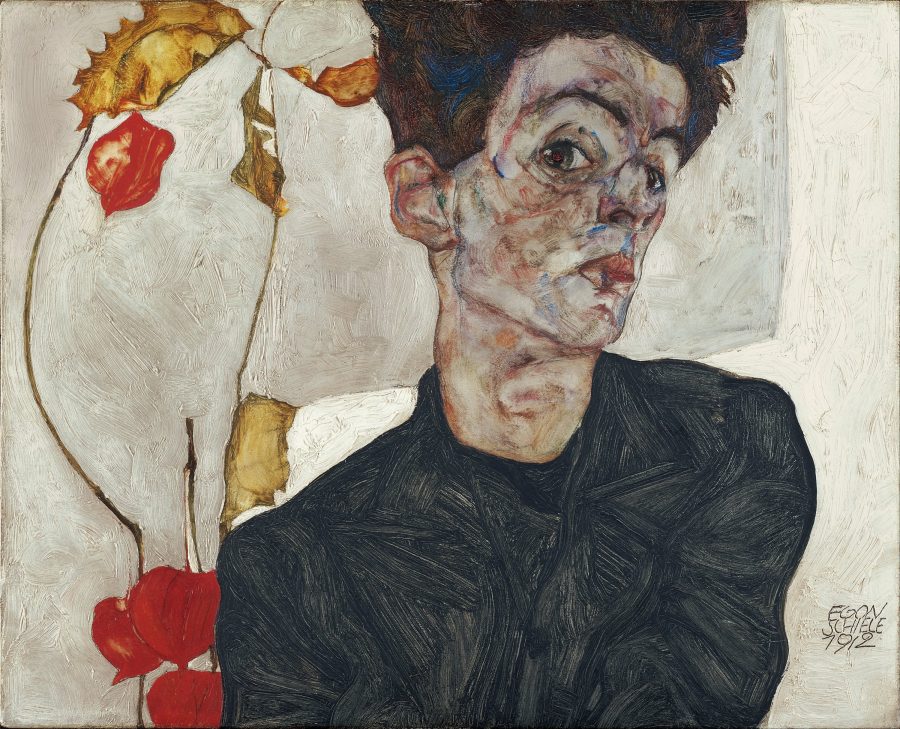
If you’ve ever mistaken an Egon Schiele for a Gustav Klimt, you can surely be forgiven—the Austrian modernist don served as a North Star for Schiele, who sought out Klimt, apprenticed himself, and received a great deal of encouragement from his elder. But he would soon strike out on his own, developing a grotesque, exaggerated, yet elegantly sensual style that shocked his contemporaries and made him a leading figure of Austrian Expressionism.
Now, a century after his death in 1918 at age 28, a number of exhibitions have highlighted the complexity of his brief career, during which he “created a formidable output that turned him into a real icon for new generations,” writes Elena Martinique.
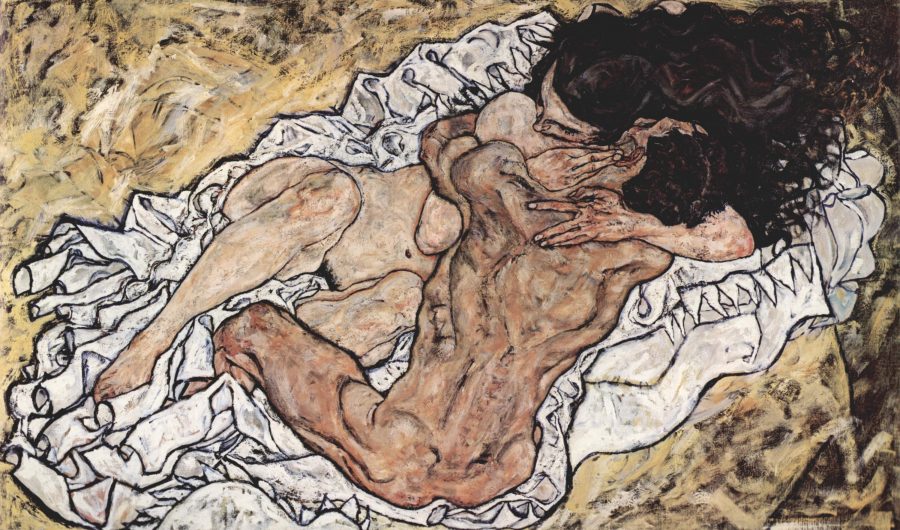
Schiele achieved “a remarkable impact and permanency” and it’s easy to see why. Best known for his erotic, elongated portraits and self-portraits, “searing explorations of their sitter’s psyches,” as The Art Story describes them, his depictions of the human form are considered some of the “most remarkable of the 20th century.”
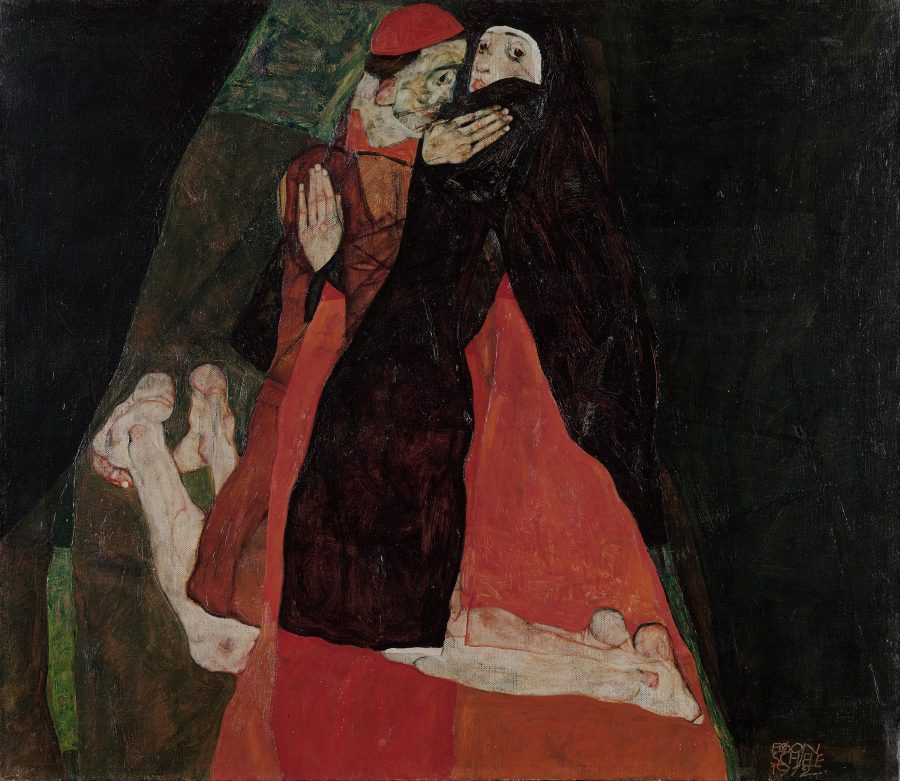
The details of Schiele’s short life paint the picture of a modernist rock star. He is as famous for his work as for his “licentious lifestyle… marked by scandal, notoriety, and a tragically early death… at a time when he was on the verge of the commercial success that had eluded him for much of his career.” In his short life, Martinique notes, Schiele produced “over 400 paintings; close to 3,000 watercolors and drawings; 21 sketchbooks; 17 graphics; and 4 sculptures.”
This incredible body of work will be made available in full online in a project spearheaded by Jane Kallir, co-director of New York’s Galerie St. Etienne, which mounted Schiele’s first American solo exhibition in 1941 and recently staged a “comprehensive survey of the artist’s artistic development.” Kallir authored the most recent catalogue raisonné of Schiele’s work, and rather than publish another print edition, she has decided to put the full catalogue online, under the auspices of her research institute.
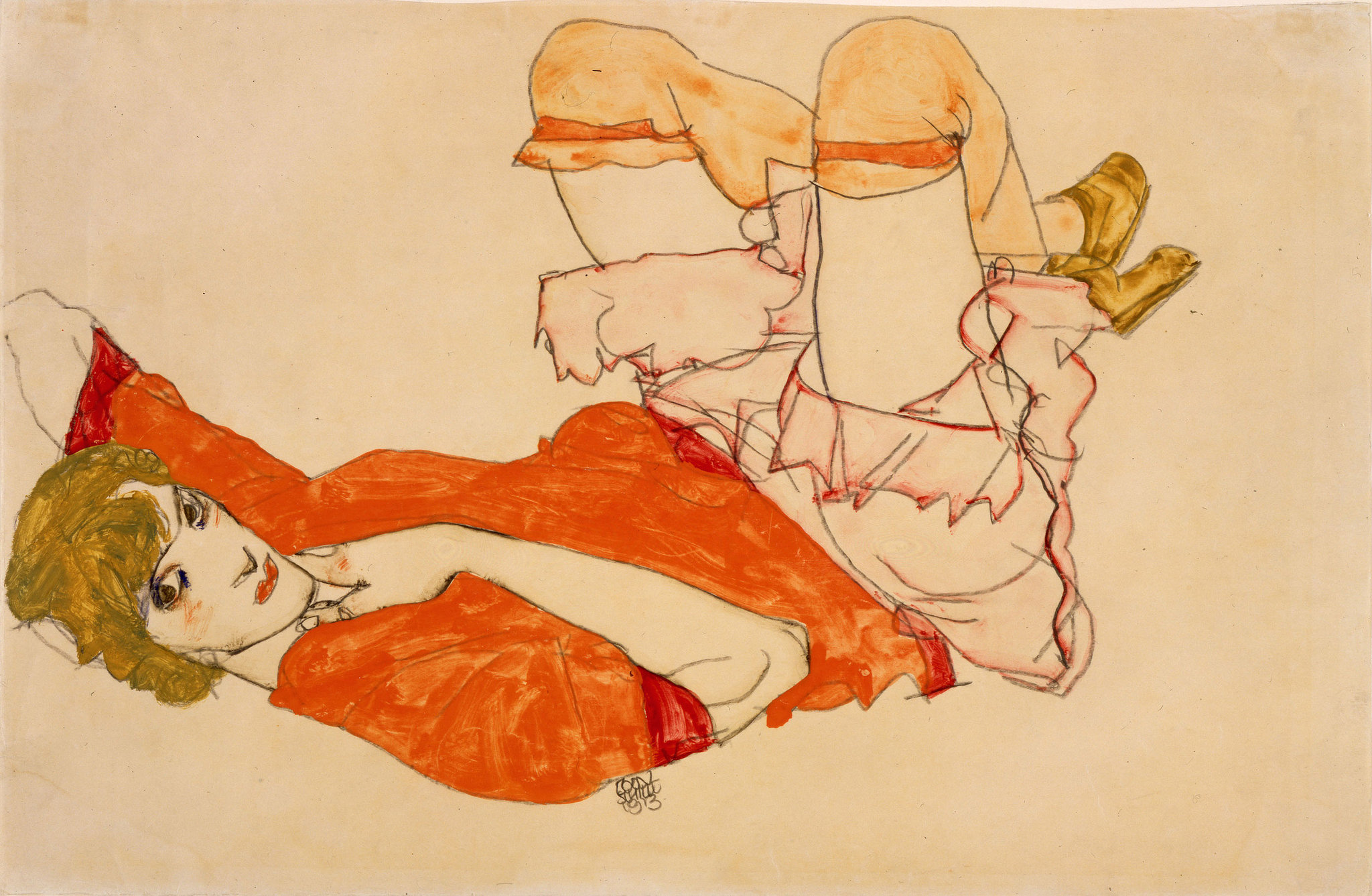
The project currently “details 419 works and counting, with a particular emphasis on Schiele’s paintings,” reports Meilan Solly at Smithsonian. His drawings and watercolors will be added in 2019. Though it is a public resource, the online catalogue is designed for scholars, who can use it to “trace specific pieces’ provenance or debunk the existence of forgeries.” Kallir continues the work of her grandfather, Otto Kallir, who wrote the first complete catalogue of the artist’s work in 1930.
That early reference has proven invaluable “in the tangle courtroom drama surrounding the restitution of Nazi-looted art.” The centenary of Schiele’s death on October 31, 2018 has brought even more interest to his work, and a rise in fakes circulating in the art market. “It is very important to have a reliable and readily accessible means of identifying authentic works of art,” Kallir writes in a statement. There is no one better placed than her to create it.

But while the Kallir Research Institute’s Complete Works of Egon Schiele Online offers necessary information for curators, art dealers, and scholars, it is very accessible to the general public. If you’re new to Schiele, start with a short biography at the site. (Also read The Art Story’s overview and see several high-resolution scans of his most famous works at the Art History Project). Then click on “Works” to view photos and information about sketchbooks, graphics, sculptures, and paintings.
These latter works show a radical development: from the conservative, traditional style of his earliest painting, to the heavily Klimt-influenced work of 1908–9, to 1910–18, when he discovered and perfected his own peculiar vision.
Related Content:
Explore 7,600 Works of Art by Edvard Munch: They’re Now Digitized and Free Online
Josh Jones is a writer and musician based in Durham, NC. Follow him at @jdmagness.
Read More...Banksy Paints a Grim Holiday Mural: Season’s Greetings to All

Season’s greetings from Banksy. Two months after shredding a painting at a London auction, the street artist has resurfaced again. This time in Port Talbot, Wales, where he spray-painted a holiday mural on two sides of a garage. One sides shows a young boy frolicking in what looks like falling snow. The other side makes you realize that the snow is really a fire spewing toxic ash.
According to the BBC, Gary Owen, a Port Talbot resident, messaged Banksy last summer and asked him to put a spotlight on Port Talbot’s chronic pollution problem. The steelworks of the industrial town puts dust in the air, creating potential health risks for children. When Owen learned about the mural, he reportedly said: “It’s brilliant. I couldn’t take it in. I didn’t think it was true.” That’s all before some “some drunk halfwit” tried to attack the painting–very fortunately to no avail.
If you would like to support the mission of Open Culture, consider making a donation to our site. It’s hard to rely 100% on ads, and your contributions will help us continue providing the best free cultural and educational materials to learners everywhere. You can contribute through PayPal, Patreon, and Venmo (@openculture). Thanks!
Related Content:
Behind the Banksy Stunt: An In-Depth Breakdown of the Artist’s Self-Shredding Painting
Read More...Artificial Intelligence Creates Realistic Photos of People, None of Whom Actually Exist

Each day in the 2010s, it seems, brings another startling development in the field of artificial intelligence — a field widely written off not all that long ago as a dead end. But now AI looks just as alive as the people you see in these photographs, despite the fact that none of them have ever lived, and it’s questionable whether we can even call the images that depict them “photographs” at all. All of them come, in fact, as products of a state-of-the-art generative adversarial network, a type of artificial intelligence algorithm that pits multiple neural networks against each other in a kind of machine-learning match.
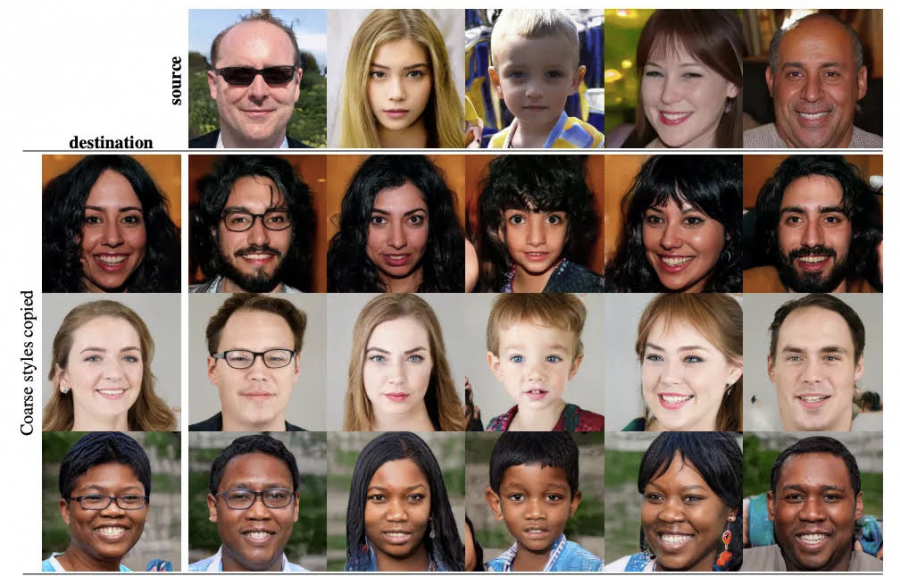
These neural networks have, it seems, competed their way to generating images of fabricated human faces that genuine humans have trouble distinguishing from images of the real deal. Their architecture, described in a paper by the Nvidia researchers who developed it, “leads to an automatically learned, unsupervised separation of high-level attributes (e.g., pose and identity when trained on human faces) and stochastic variation in the generated images (e.g., freckles, hair), and it enables intuitive, scale-specific control of the synthesis.” What they’ve come up with, in other words, has made it not just more possible than ever to create fake faces, but made those faces more customizable than ever as well.
“Of course, the ability to create realistic AI faces raises troubling questions. (Not least of all, how long until stock photo models go out of work?)” writes James Vincent at The Verge. “Experts have been raising the alarm for the past couple of years about how AI fakery might impact society. These tools could be used for misinformation and propaganda and might erode public trust in pictorial evidence, a trend that could damage the justice system as well as politics.”
But still, “you can’t doctor any image in any way you like with the same fidelity. There are also serious constraints when it comes to expertise and time. It took Nvidia’s researchers a week training their model on eight Tesla GPUs to create these faces.”

Though “a running battle between AI fakery and image authentication for decades to come” seems inevitable, the current ability of computers to create plausible faces certainly fascinates, especially when compared to their ability just four years ago, the hazy black-and-white fruits of which appear just above. Put that against the grid of faces at the top of the post, which shows how Nvidia’s system can combine the features of the faces on one axis with the features on the other, and you’ll get a sense of the technological acceleration involved. Such a process could well be used, for example, to give you a sense of what your future children might look like. But how long until it puts convincing visions of moving, speaking, even thinking human beings before our eyes?
via Petapixel
Related Content:
Artificial Intelligence Program Tries to Write a Beatles Song: Listen to “Daddy’s Car”
Based in Seoul, Colin Marshall writes and broadcasts on cities, language, and culture. His projects include the book The Stateless City: a Walk through 21st-Century Los Angeles and the video series The City in Cinema. Follow him on Twitter at @colinmarshall or on Facebook.
Read More...Lin-Manuel Miranda & Emily Blunt Take You Through 22 Classic Musicals in 12 Minutes
Watching James Corden, Lin-Manuel Miranda, and Emily Blunt donning bad wigs to mug their way through a 12-minute salute to 22 movie musical “classics” is a bit reminiscent of watching the three most popular counselors ham it up during an overlong summer camp skit.
Their one-take performance was part of Role Call, a regular feature of the Late Late Show with James Corden. Usually, this fan favorite is an excuse for Corden and a megastar guest—Tom Hanks, Julia Roberts, Samuel L. Jackson—to bumble through the most iconic moments of their career.
These kinds of larks are more fun for being a mess, and the live studio audience screams like besotted campers at every goofy quick change and winking inside reference. Blunt and Miranda are definitely game, though one wonders if they felt a bit chagrinned that the film they are promoting, Mary Poppins Returns, is given pride of placement, while the original 1964 film starring Julie Andrews and Dick Van Dyke is strangely absent.
As is Thoroughly Modern Millie, Victor/Victoria, and even The Sound of Music.
Maybe Corden’s saving up for a Julia Andrews-centric Role Call.
What did make the cut points to how few original movie musicals there are to resonate with modern audiences.
Of the 22, over 2/3 started out as Broadway plays.
And “You Can’t Stop the Beat” from 2007’s Hairspray was born of the 2002 stage adaptation, not the gritty 1988 original starring John Waters’ mainstay, Divine.
Is it wrong to hope that most viewers hearing “Your Song” will think, “Elton John!” not “Moulin Rouge”?
And Beauty and The Beast is perhaps not so much a movie musical as a children’s feature-length animation, so why not The Little Mermaid, The Lion King, or hell, Snow White or Pinocchio?
Alas, 1953’s Gentlemen Prefer Blondes is as far back as this skit’s memory goes, presumably because the audience has a greater likelihood of recognizing Marilyn Monroe than say, Howard Keel.
More interesting than the jokey horseplay with Into the Woods and The Muppet Movie is the choice to blithely cast white actors in roles that were written for black women (Dreamgirls, Little Shop of Horrors). I don’t think anyone would try to get away with that on Broadway these days, even in in a spoofy charitable event like Broadway Bares or Easter Bonnet… though if they did, getting Lin-Manuel Miranda on board would be a very good idea.
As to why Hamilton isn’t one of the titles below … it’s not a movie musical—yet!
Readers—what glaring omissions leap out at you?
Cabaret
Chicago
La La Land
Beauty and the Beast
Guys and Dolls
Evita
Singin’ in the Rain
Mary Poppins Returns
The Muppet Movie
The Wizard of Oz
Hairspray
Dreamgirls
Annie
Fiddler on the Roof
Into the Woods
Little Shop of Horrors
Les Miserables
Moulin Rouge
Once
Fame
Gentlemen Prefer Blondes
Mama Mia
Related Content:
Alexander Hamilton: Hip-Hop Hero at the White House Poetry Evening
Ayun Halliday is an author, illustrator, theater maker and Chief Primatologist of the East Village Inky zine. See her onstage in New York City this January as host of Theater of the Apes book-based variety show, Necromancers of the Public Domain. Follow her @AyunHalliday.
Read More...
Researchers Recreate the Sounds Worshippers Heard in the Mosque of Cordoba Over 1,200 Years Ago

As we know from conversations in subway tunnels or singing in the shower, different kinds of spaces and building materials alter the quality of a sound. It’s a subject near and dear to architects, musicians, and composers. The relationship between space and sound also centrally occupies the field of “Acoustic Archeology.” But here, an unusual problem presents itself. How can we know how music, voice, and environmental sound behaves in spaces that no longer exist?
More specifically, writes EurekAltert!, the question that faced researchers at the University of Seville was “how did words or the rain sound inside the Mosque of Cordoba in the time of Abd al-Rahman I?” The founder of an Iberian Muslim dynasty began construction on the Mosque of Cordoba in the 780s. In the hundreds of years since, it underwent several expansions and, later, major renovations after it became the Cathedral of Cordoba in the 13th century.
The architecture of the 8th century building is lost to history, and so, it would seem, is its careful sound design. “Unlike fragments of tools or shards of pottery,” Atlas Obscura’s Jessica Leigh Hester notes, “sounds don’t lodge themselves in the soil.” Archeo-acousticians do not have recourse to the material artifacts archeologists rely on in their reconstructions of the past. But, given the technological developments in reverb simulation and audio software, these scientists can nonetheless approximate the sounds of ancient spaces.
In this case, University of Seville’s Rafael Suárez and his collaborators in the research group “Architecture, Heritage and Sustainability” collected impulse responses—recordings of reverberation—from the current cathedral. “From there, they used software to reconstruct the internal architecture of the mosque during four different phases of construction and renovation.… Next, they produced auralizations, or sound files replicating what worshippers would have heard.”
To hear what late-8th century Spanish Muslims would have, “researchers used software to model how the architecture would change the same snippet of a recorded salat, or daily prayer. In the first configuration, the prayer sounds full-bodied and sonorous; in the model that reflects the mosque’s last renovation, the same prayer echoes as though it was recited deep inside a cave.” All of those renovations, in other words, destroyed the sonic engineering of the mosque.
As the authors write in a paper recently published in Applied Acoustics, “the enlargement interventions failed to take the functional aspect of the mosque and gave the highest priority to mainly the aesthetic aspect.” In the simulation of the mosque as it sounded in the 780s, sound was intelligible all over the building. Later construction added what the researchers call “acoustic shadow zones” where little can be heard but echo.
Unlike Hagia Sofia, the Byzantine cathedral-turned-mosque, which retained its basic design over the course of almost 1500 years, and thus its basic sound design, the Mosque-Cathedral of Cordoba was so altered architecturally that a “significant deterioration of the acoustic conditions” resulted, the authors claim. The mosque’s many remaining visual elements would be familiar to 8th century attendees, writes Hester, including “gilt calligraphy and intricate tiles… and hundreds of columns—made from jasper, onyx, marble, and other stones salvaged from Roman ruins.” But the “acoustic landscape” of the space would be unrecognizable.
The specific sounds of a space are essential to making “a place feel like itself.” Something to consider the next time you’re planning a major home renovation.
via Atlas Obscura
Related Content:
David Byrne: How Architecture Helped Music Evolve
Josh Jones is a writer and musician based in Durham, NC. Follow him at @jdmagness.
Read More...The Moonlight Sonata But the Bass Is a Bar Late, and the Melody Is a Bar Early
From composer and electronic musician Isaac Schankler comes an experimental take on Beethoven’s Moonlight Sonata. As the title says, the bass is a bar late and the melody is a bar early. Sheet music for the experiment can be found here. And some of Schankler’s more serious compositions here.
If you would like to support the mission of Open Culture, consider making a donation to our site. It’s hard to rely 100% on ads, and your contributions will help us continue providing the best free cultural and educational materials to learners everywhere. You can contribute through PayPal, Patreon, and Venmo (@openculture). Thanks!
Related Content:
How Did Beethoven Compose His 9th Symphony After He Went Completely Deaf?
Beethoven’s Ode to Joy Played With 167 Theremins Placed Inside Matryoshka Dolls in Japan
The Story of How Beethoven Helped Make It So That CDs Could Play 74 Minutes of Music
Read More...
Discover Isotype, the 1920s Attempt to Create a Universal Language with Stylish Icons & Graphic Design
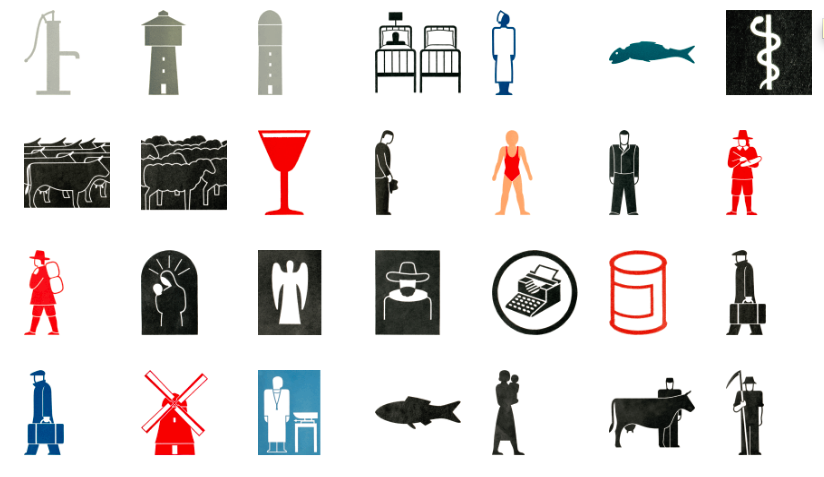
How long has mankind dreamed of an international language? The first answer that comes to mind, of course, dates that dream to the time of the Biblical story of the Tower of Babel. If you don’t happen to believe that humanity was made to speak a variety of mutually incomprehensible tongues as punishment for daring to build a tower tall enough to reach heaven, maybe you’d prefer a date somewhere around the much later development of Esperanto, the best-known language invented specifically to attain universality, in the late 19th century. But look ahead a few decades past that and you find an intriguing example of a language created to unite the world without using words at all: International System Of Typographic Picture Education, or Isotype.
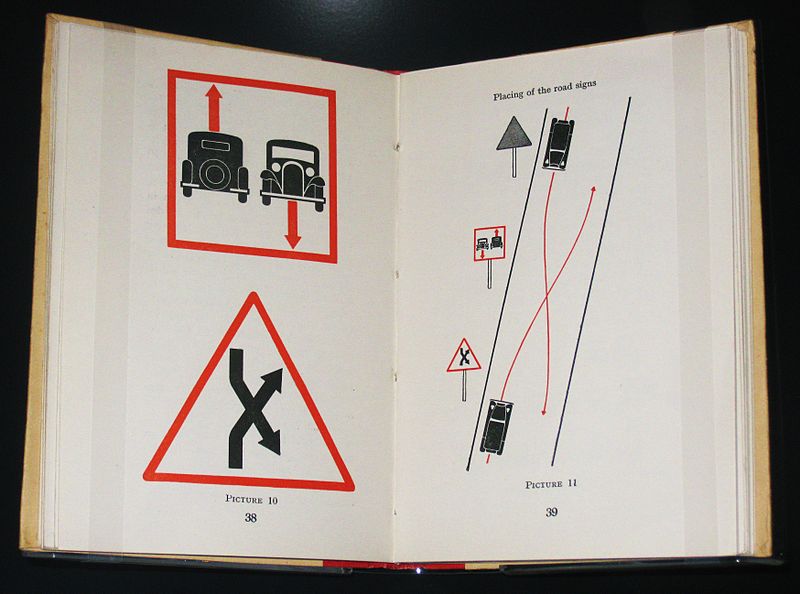
“Nearly a century before infographics and data visualization became the cultural ubiquity they are today,” writes Brain Pickings’ Maria Popova, “the pioneering Austrian sociologist, philosopher of science, social reformer, and curator Otto Neurath (December 10, 1882–December 22, 1945), together with his not-yet-wife Marie, invented ISOTYPE — the visionary pictogram language that furnished the vocabulary of modern infographics.”
First known as the Vienna Method of Pictorial Statistics, Isotype’s initial development began in 1926 at Vienna’s Gesellschafts- und Wirtschaftsmuseum (or Social and Economic Museum), of which Neurath was the founding director. There he began to assemble something like a design studio team, with the mission of creating a set of pictorial symbols that could render dense social, scientific technological, biological, and historical information legible at a glance.
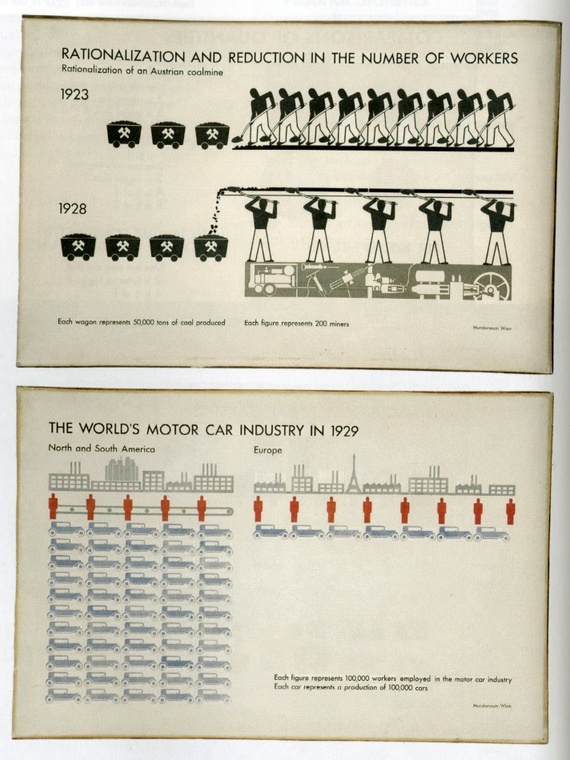
Neurath’s most important early collaborator on Isotype was surely the woodcut artist Gerd Arntz, at whose site you can see the more than 4000 pictograms he created to symbolize “key data from industry, demographics, politics and economy.” Arntz designed them all in accordance with Neurat’s belief that even then the long “virtually illiterate” proletariat “needed knowledge of the world around them. This knowledge should not be shrined in opaque scientific language, but directly illustrated in straightforward images and a clear structure, also for people who could not, or hardly, read. Another outspoken goal of this method of visual statistics was to overcome barriers of language and culture, and to be universally understood.”
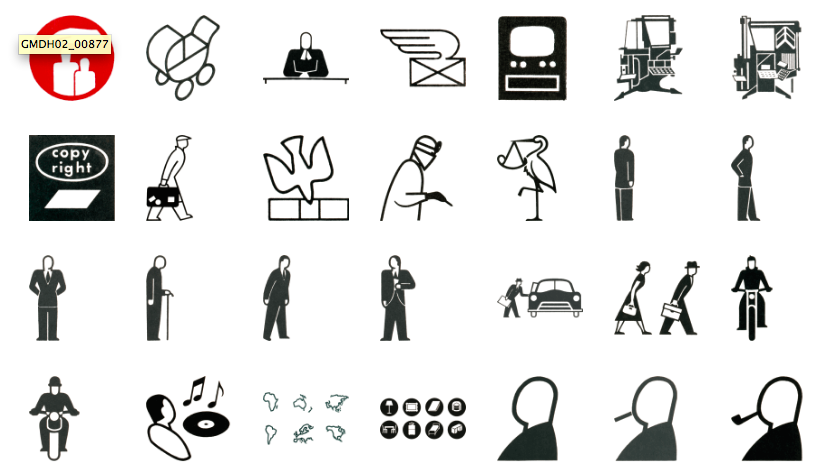
By the mid-1930s, writes The Atlantic’s Steven Heller in an article on the book Isotype: Design and Contexts 1925–1971, “with the Nazi march into Austria, Neurath fled Vienna for Holland. He met his future wife Marie Reidemeister there and after the German bombing of Rotterdam the pair escaped to England, where they were interned on the Isle of Man. Following their release they established the Isotype Institute in Oxford. From this base they continued to develop their unique strategy, which influenced designers worldwide.” Today, even those who have never laid eyes on Isotype itself have extensively “read” the visual languages it has influenced: Gizmodo’s Alissa Walker points to the standardized icons created in the 70s by the U.S. Department of Transportation and the American Institute of Graphic Arts as well as today’s emoji — probably not exactly what Neurath had in mind as the language of Utopia back when he was co-founding the Vienna Circle, but nevertheless a distant cousin of Isotype in “its own adorable way.”
via Brain Pickings
Related Content:
The Art of Data Visualization: How to Tell Complex Stories Through Smart Design
You Could Soon Be Able to Text with 2,000 Ancient Egyptian Hieroglyphs
Say What You Really Mean with Downloadable Cindy Sherman Emoticons
The Hobo Code: An Introduction to the Hieroglyphic Language of Early 1900s Train-Hoppers
Based in Seoul, Colin Marshall writes and broadcasts on cities, language, and culture. His projects include the book The Stateless City: a Walk through 21st-Century Los Angeles and the video series The City in Cinema. Follow him on Twitter at @colinmarshall or on Facebook.
Read More...Listen to a Heartfelt Musical Retelling of O. Henry’s “Gift of the Magi” with Hanky in Hand
It’s that time of year when certain songs conspire with certain moods to hit you right in the ol’ brisket.
The feeling is voluptuous, and not necessarily unpleasant, provided there’s a bathroom stall or spare bedroom should you need to flee a party like Cinderella, as some old chestnut threatens to turn you into a blubbering mess.
Let the kiddies deck the halls, jingle bells, and prance about with Rudolph and Frosty. The best secular songs for grown ups are the ones with a thick current of longing just under the surface, a yearning for those who aren’t here with us, for a better future, for the way we were…
There’s got to be some hope in the balance though, some sweetness to savor as we muddle through.
(Judy Garland famously stonewalled on the first version of “Have Yourself a Merry Little Christmas” until lyricist Hugh Martin agreed to lighten things up a bit. In the end, both got what they wanted. She got her update:
Have yourself a merry little Christmas
Let your heart be light
Next year all our troubles will be out of sight
But the tension between the promise of a better tomorrow and her emotional delivery holds a place for Hughes’ appealingly dark sentiment:
Have yourself a merry little Christmas
It may be your last
Next year we may all be living in the past
“I’ll Be Home for Christmas” manages to ring some of those same bells.
As a rule, the oldies are the goodies in this department.
More recent bids by Coldplay and Taylor Swift have failed to achieve the proper mix of hope and hopelessness.
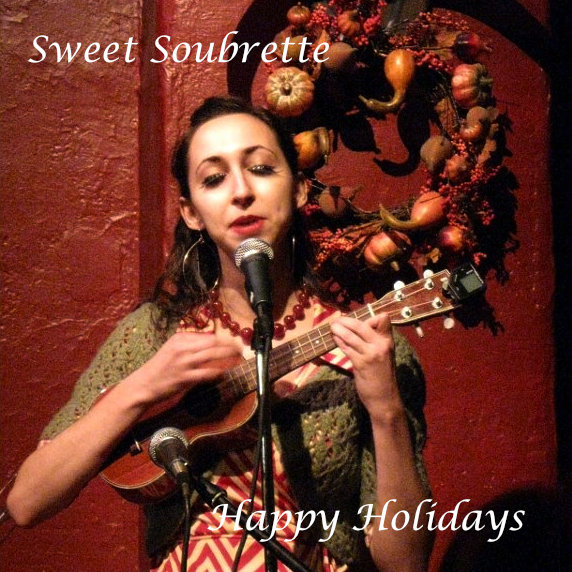
It’s a difficult balance, but singer-songwriter Ellia Bisker pulls it off beautifully, above, by turning to O. Henry’s enduring short story, “The Gift of the Magi.”
Accompanying herself on ukulele as she performs under her parlor rock pseudonym, Sweet Soubrette, Bisker’s sound is both sunny and plaintive. It’s an appropriate choice for a young bride who parts with her most valuable asset, in order to give her cherished husband a “worthy” gift:
I want to give you something that I can’t afford,
Let you believe with me we’re really not so poor.
You see that package waiting underneath the tree?
It’s just a token of how much you mean to me.
(Spoiler for the handful of people unfamiliar with this tale: he does the same, thus negating the utility of both costly presents.)
In an interview with Open Culture, Bisker praised the O. Henry story’s ironic symmetry:
It’s a little like the death scene in Romeo & Juliet, but without the tragedy. The story itself still feels surprisingly fresh, despite the period details. It has more humor and sympathy to it than sentiment. It surprises you with real emotion.
The Romeo and Juliet comparison is apt. The story covers a time period so brief that the newlyweds’ feelings for each other never stray from purest wonder and admiration.
Bisker taps into those feelings in a way Joni Mitchell’s meandering, unreleased take on the same material did not.
The Squirrel Nut Zippers also took a crack at musicalizing “The Gift of the Magi,” but the sound is more Ozarks than shabby, urban New York, with background harmonies hinting that the young couple may be part of a larger support network.
Bisker’s song starts, as it ends, with a pair of young, broke lovers who only have eyes for each other.
Let’s not forget O. Henry’s parting words:
The magi, as you know, were wise men—wonderfully wise men—who brought gifts to the Babe in the manger. They invented the art of giving Christmas presents. Being wise, their gifts were no doubt wise ones, possibly bearing the privilege of exchange in case of duplication. And here I have lamely related to you the uneventful chronicle of two foolish children in a flat who most unwisely sacrificed for each other the greatest treasures of their house. But in a last word to the wise of these days let it be said that of all who give gifts these two were the wisest. Of all who give and receive gifts, such as they are wisest. Everywhere they are wisest. They are the magi.
Enjoy this musical gift, readers. The artist has made the track free for downloading, though perhaps you could scratch up a few coins in thanks, without pawning your watch or cutting your hair.
Read O. Henry’s short story “The Gift of the Magi” here.
Listen to Ellia Bisker’s “Gift of the Magi,” and four other tracks off of Sweet Soubrette’s name-your-own-price Happy Holidays album here.
We were young and broke, but we didn’t care
You had your pocketwatch, I had my golden hair
We were just scraping by, waiting to make it big
I was an ingénue, you were just a kid
But it was Christmas eve, didn’t know what to do
How could I hope to buy some kind of gift for you
Ain’t got no trust fund hon, ain’t got no savings bond
Just got my student loans, the clothes that I’ve got on
I want to give you something that I can’t afford
Let you believe with me we’re really not so poor
You see that package waiting underneath the tree
It’s just a token of how much you mean to me
Frankincense (here’s what I wish, what I imagine)
Gold and myrrh (that I could give, give what you are worth)
Put them in (this is the gift, gift of the magi)
The manger (it’s not a fraction of all that you deserve)
I used to window shop, I would never tell
There was a pair of combs made out of tortoiseshell
I tried them on one time, put up my long long hair
If I were rich and famous that’s what I would wear
You wore your father’s watch, it was a vintage piece
It made you feel like fifty million bucks at least
But it was fastened with a flimsy nickel chain
You wanted better but you said it’s all the same
I want to give a token to you of my love
A little luxury to keep your spirits up
I’ll cut and sell my hair, the only gold I’ve got
To buy a golden chain for your pocketwatch
Frankincense (here’s what I wish, what I imagine)
Gold and myrrh (that I could give, give what you are worth)
Put them in (this is the gift, gift of the magi)
The manger (it’s not a fraction of all that you deserve)
I can’t forget the look that flashed across your face
When I walked into our apartment late that day
And I took off my hat revealed a pixie cut
Gave you a little box told you to open up
You pulled out the golden chain that lay inside
Were you about to laugh were you about to cry
You said I shouldn’t have, because your watch was sold
So you could buy for me a pretty pair of combs
Related Content:
Hear Paul McCartney’s Experimental Christmas Mixtape: A Rare & Forgotten Recording from 1965
Ayun Halliday is an author, illustrator, theater maker and Chief Primatologist of the East Village Inky zine. See her onstage in New York City this January as host of Theater of the Apes book-based variety show, Necromancers of the Public Domain. Follow her @AyunHalliday.
Read More...Support Us
We're hoping to rely on loyal readers, rather than erratic ads. Please click the Donate button and support Open Culture. You can use Paypal, Venmo, Patreon, even Crypto! We thank you!

About Us

Open Culture scours the web for the best educational media. We find the free courses and audio books you need, the language lessons & educational videos you want, and plenty of enlightenment in between.
Advertise With Us

FREE UPDATES!
GET OUR DAILY EMAIL
Get the best cultural and educational resources on the web curated for you in a daily email. We never spam. Unsubscribe at any time.
FOLLOW ON SOCIAL MEDIA

Open Culture editor Dan Colman scours the web for the best educational media. He finds the free courses and audio books you need, the language lessons & movies you want, and plenty of enlightenment in between.
Advertise With Us

