Masterclass Is Running a Special “Buy One, Give One Free” Deal: It Gives You & Family Member/Friend Access to Their Complete Course Catalog

FYI: Masterclass is running a Buy One, Give One Free special through December 27.
Here’s the gist: If you buy an All-Access pass to their 45 courses, you will receive another All-Access Pass to give to someone else at no additional charge. An All-Access pass costs $180, and lasts one year. For that fee, you–and a family member or friend–can watch courses created by Annie Leibovitz, Werner Herzog, Martin Scorsese, David Mamet, Jane Goodall, Margaret Atwood, Helen Mirren, Martin Scorsese, Herbie Hancock, Alice Waters and so many more. If you’re thinking this sounds like a pretty good holiday present, I’d have to agree.
Note: If you sign up for a MasterClass course by clicking on the affiliate links in this post, Open Culture will receive a small fee that helps support our operation.
Read More...Watch a Playthrough of the Oldest Board Game in the World, the Sumerian Royal Game of Ur, Circa 2500 BC
They may not surprise the average market analyst, but the gaming industry’s figures tell a pretty compelling story. Newzoo estimates that “2.3 billion gamers across the globe will spend $137. 9 billion on games in 2018.” VentureBeat reports that mobile games account for over 50 percent of the total. Currently, “about 91 percent of the global market is digital, meaning that $125.3 billion worth of games flows through digitally connected channels as opposed to physical retail.”
That’s a lot of virtual dough floating around in virtual worlds. But this vast and rapid growth in digital gaming does not mean physical games are going away anytime soon—and that includes cards, board games, and other tabletop games, a market that has “surged as players have grown jaded with the digital screens they toil over during the work day,” wrote Joon Ian Wong in 2016.
Venture capital is flowing into board game development. Tabletop bars and cafes are popping up all over the world, encouraging people to mingle over Scrabble and Cards Against Humanity. It seems the time is just right to revive the oldest playable board game in the world. If someone hasn’t already launched a Kickstarter to bankroll a new Royal Game of Ur, I suspect we’ll see one any day now. At least four-and-a-half-thousand years old, according to British Museum Curator Irving Finkel, the Royal Game of Ur was probably invented by the Sumerians. And it seems like it might still be a blast, and a considerable challenge, to play.
“You might think it’s so old that it’s irretrievable to us, that we’ve got no idea what it was like playing, what the rules were like,” Finkel says in the video at the top, “but all sorts of evidence has come to light so that we know how this game was played.” He promises, in no uncertain terms, to wipe the floor with YouTuber Tom Scott in a Royal Game of Ur showdown, and Scott, who has never played the game before, seems at a decided disadvantage. But watch their contest to see how the game is played and whether Finkel makes good on his threat. Along the way, he liberally shares his knowledge.
For a shorter course on the Royal Game of Ur, see Finkel’s video above. It takes him a couple minutes to get around to introducing his subject, the discovery and deciphering of the “world’s oldest rule book.” A consummate ancient history detective, Finkel describes how he decoded an ancient tablet that explained a game, but which game, no one knew. So, the dedicated curator tried the rules on every mysterious ancient game he could find, till he landed on the “game of twenty squares” from Mesopotamia. “It fitted perfectly,” he says with relish. See the original board, pieces, and dice from about 2500 BC, and learn how Finkel had been searching for its rules of play since he was 9 years old.
For more of Finkel’s passionate public scholarship, see him demonstrate how to write in cuneiform and read about how his work on cuneiform tablets led to him discovering the oldest reference to the Noah’s Ark myth.
Related Content:
Josh Jones is a writer and musician based in Durham, NC. Follow him at @jdmagness.
Read More...Take a Virtual Tour of Brazil’s National Museum & Its Artifacts: Google Digitized the Museum’s Collection Before the Fateful Fire
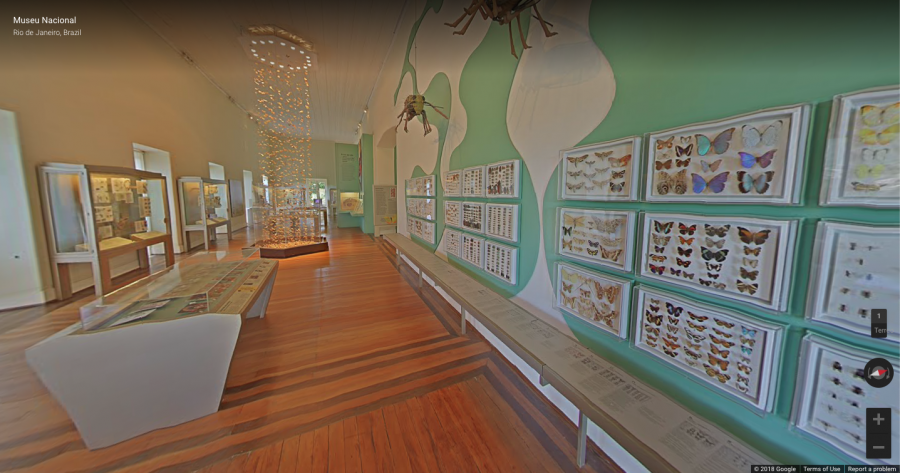
How to describe the magnitude of the loss when Brazil’s Museu Nacional caught fire in September? The New Yorker’s Alejandro Chacoff ventured an analogy that would resonate with readers of that magazine: “It’s as if, in New York, the American Museum of Natural History and the New School, or a part of the Columbia campus, had been built on the same spot, and then was reduced to ashes.” The 200-year-old museum lost an estimated 92.5 percent of its 20-million-item archive, one of the largest collections of natural history and anthropological artifacts in the world — but not before Google Arts & Culture digitized enough to recreate the experience of visiting the Museu Nacional virtually.

“Starting back in 2016, Google Arts & Culture had begun working with the museum to bring their collection online — so that anyone, anywhere in the world could see and learn about these ancient artifacts,” writes Google Arts & Culture Program Manager Chance Coughenour.
“Now for the first time ever, you can virtually step inside the museum and learn about its lost collection through Street View imagery and online exhibits.” In this way you can still experience a portion of “the incredible diversity of artifacts in Brazil’s National Museum” that “reflected centuries of Brazil’s culture and natural history, from the Amazon’s endangered butterflies to beautifully-crafted indigenous masks and decorated pottery.”
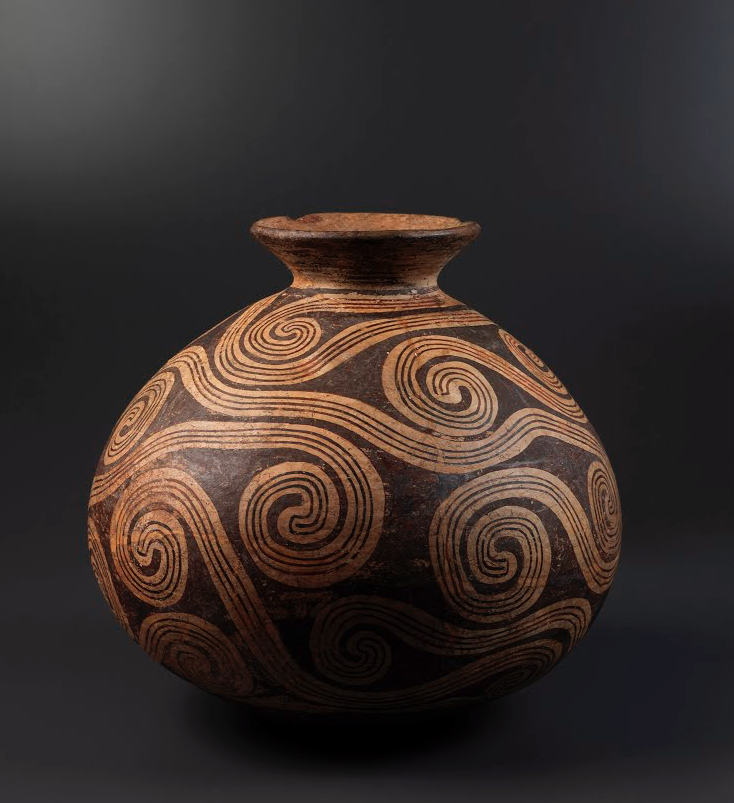
You can take a virtual tour of the highlights of the Museu Nacional as it was here, a tour that of course includes a visit with the museum’s prized possession: the 12,000-year old Luzia, the oldest skeleton found in the Americas, whom you can see just as she stood on display in museum view. Miraculously, Luzia counts as one of the artifacts mostly recovered from the aftermath of the conflagration, and the museum has announced an ambitious restoration plan that will cost R$10 million, an amount provided as emergency funds by the Brazilian Government — and an amount much greater than the Museu Nacional, which by its 200th anniversary had reached a state of not just serious neglect but near-complete abandonment, was ever able to get while still intact. Even in the case of vast repositories of a nation’s cultural heritage, you don’t know what you’ve got until it’s gone.

Related Content:
1.8 Million Free Works of Art from World-Class Museums: A Meta List of Great Art Available Online
Google Lets You Take a 360-Degree Panoramic Tour of Street Art in Cities Across the World
Take a Virtual Reality Tour of the World’s Stolen Art
Based in Seoul, Colin Marshall writes and broadcasts on cities, language, and culture. His projects include the book The Stateless City: a Walk through 21st-Century Los Angeles and the video series The City in Cinema. Follow him on Twitter at @colinmarshall or on Facebook.
Read More...The Beastie Boys Release a New Freewheeling Memoir, and a Star-Studded 13-Hour Audiobook Featuring Snoop Dogg, Elvis Costello, Bette Midler, John Stewart & Dozens More
Quick way to date yourself: name the first Beastie Boys album you bought (or heard). If you somehow got your hands on an original pressing of their first single “Cooky Puss”—released in 1981 when the then-foursome was a New York hardcore band—congratulations, you’re a legend. If you first bought 1986’s Licensed to Ill—their major label debut and coming-out as a crude rap-rock parody threesome (minus fired drummer Kate Schellenbach), precision-engineered to freak your parents out—congrats, you’re old.
In whatever era you discovered them—Paul’s Boutique, Check Your Head, Ill Communication… maybe even their last album, 2011’s Hot Sauce Committee Part Two—you discovered a different Beasties than the previous generation did. Over the course of their 30-year career, the trio evolved and matured, grew up and got down with new grooves to suit new audiences. That’s always been a very good thing.
As Mike D, Ad-Rock, and MCA—three personalities as distinctive as the three Stooges—got better at what they did, they transcended the misogynist, meatheaded mid-eighties incarnation they came to look back on with embarrassment and apology. “We got so caught up with making fun of that rock-star persona,” writes Adam Horowitz (Ad-Rock) in the huge new Beasties memoir, “that we became that persona. Became what we hated.”
Rob Harvilla calls these very genuine moments of self-reflection the best parts of the book. But with so many stories over so many years, so much brilliant writing, and so many guest appearances from celebrity Beastie Boy fans, that’s a tough call. “Part memoir, part photo-heavy zine, part fan-appreciation testimonial… and part sincere apology,” the book seems both fresh and made to order and a veritable buffet table of nostalgia. Or, as Amy Poehler puts it in her intro to a section on their videos: “These days, their music makes me feel young and old at the same time.”
Behind the silliness and sincerity there is mourning for third Beastie Adam Yauch (MCA), who died of cancer in 2012 and whose voice is conspicuously absent from the book. Yet the two remaining members choose not to dwell. “You brace for the heartbreaking account of Yauch’s diagnosis and death,” Harvilla writes, “but those details go undiscussed. ‘Too fucking sad to writing about’ is all Horovitz has to say.’” The prevailing atmosphere is celebratory, like any good Beastie Boys album—this one a party full of adult peers looking back, laughing, and wincing at their younger selves.
The voices on the page are so vivid you can squint and almost hear them (at one point Horovitz describes unwinding a cassette tape as “pulling 60 minutes of wet fettuccine out of a dog’s mouth”). But we don’t have to imagine what they sound like. Along with the 571-page hardbound cinderblock of a book, the band has released what Rolling Stone hails as the “audiobook of the year,” a “brilliant 13-hour radio play” in which Mike D and Ad-Rock are joined by a majorly star-studded cast of guest readers including Snoop Dogg, Kim Gordon, Steve Buscemi, Chloë Sevigny, Wanda Sykes, Jon Stewart, Ben Stiller, and Bette Midler (that’s just the very short list).
New York hip hop legends LL Cool J, Chuck D, and Rev Run (of Run DMC) show up, as does Brooklyn acting legend Rosie Perez and non-New Yorkers Exene Cervenka and Elvis Costello. (See the full cast list at Audible.) It’s not a memoir, it’s a mixtape. Hear excerpts from the audio book in the SoundCloud clips above and buy it online, or download it for free through Audible.com’s 30-day free trial program. Guaranteed, no matter what age you are, to make you feel young and old at the same time.
Related Content:
Hear Kim Gordon, Sonic Youth Rocker, Read From Her New Memoir, Girl in a Band
Josh Jones is a writer and musician based in Durham, NC. Follow him at @jdmagness.
Read More...Meet the Hurdy Gurdy, the Hand-Cranked Medieval Instrument with 80 Moving Parts
Donovan’s “Hurdy Gurdy Man” may be the creepiest song ever written about an obscure medieval instrument (made all the more so by its use in David Fincher’s Zodiac), but the Hurdy Gurdy did not give his recording its ominous sound. Those droning notes come from an Indian tanpura. Yet they evoke the title instrument, an ingenious musical invention “set up primarily for the purpose of making drones,” Case Western Reserve’s College of Art and Sciences explains. “In the Middle Ages, it was known in Latin as the organistrum and the symphonia, and in French as the vielle à roue (the vielle with the wheel).”
With a sound produced by a “rosined wooden wheel, turned by a crank” that set “a number of strings in continuous droning vibration,” the hurdy gurdy can, it’s true, give off a bit of a folk horror vibe. From its very early, maybe 10th or 11th century origins in liturgical music, hurdy gurdy expert Jim Kendros tells us in the video above, the instrument became associated with European folk music, shrinking from a beast played by two people to more portable dimensions, about the size of a large guitar and resembling a hand-cranked violin with keys for playing melodies on certain strings.
Though it grew smaller and more maneuverable, however, the instrument grew no less complicated. Kendros calls it “the equivalent of a medieval spaceship,” with its more than 80 moving parts.
The hurdy gurdy, or “wheel fiddle,” played in the TED Talk above by Caroline Phillips looks less like a fiddle, or a spaceship, and more like a medieval keytar—just one of the many shapes the instrument could take. All of them, however, had one important feature in common: the hurdy gurdy is “the only musical instrument that uses a crank to turn a wheel to rub strings like the bow of a violin to produce music.” Historically, it was used in medieval dance music “because of the uniqueness of the melody combined with the acoustic boom box” of its large body. Try not to shake your body, or to shiver, when Phillips plays a haunting, droning Basque folk song.
The Hurdy Gurdy spread all over Europe, from Britain to France, Spain, Italy, Germany, Hungary, and Sweden, where stringed-instrument enthusiasts The Stringdom caught up with virtuoso Hurdy Gurdy player Johannes Geworkian Hellman. He tells us how the hurdy gurdy and its droning sonic cousin, the bagpipes, set off “an early folk revival” as composers took inspiration from peasant music. The interest from medieval upper classes meant better luthiers and higher-quality hurdy gurdies. Now modern interest in the Hurdy Gurdy is growing. While it may take two to three years to handcraft one, “a lot of new instruments are getting made,” says Hellman.
Should you doubt that the 1000-year old hurdy gurdy can still sound hip, listen to Hellman play an electrified version in his hurdy gurdy/accordion duo, Symbio, or hurdy gurdy/dulcimer two-piece, Maija & Johannes. He coaxes from the instrument such a range of rhythms and timbres that it’s easy to see why it was so immensely popular for so long. Yet for all its musical appeal, it is a complex machine, difficult to tune and subject to any number of mechanical problems. Not for the casual amateur, the instrument still requires a dedicated Hurdy Gurdy man or woman to make it sing—a much more common sight than in Donovan’s day but an exceedingly rare one compared to the many centuries of the hurdy gurdy’s heyday. See more hurdy gurdies at the Vintage News.
Related Content:
How an 18th-Century Monk Invented the First Electronic Instrument
Visit an Online Collection of 61,761 Musical Instruments from Across the World
Watch a Musician Improvise on a 500-Year-Old Music Instrument, The Carillon
New Order’s “Blue Monday” Played with Obsolete 1930s Instruments
Josh Jones is a writer and musician based in Durham, NC. Follow him at @jdmagness
Read More...Watch the First-Ever Kiss on Film Between Two Black Actors, Just Honored by the Library of Congress (1898)
In 1896, Thomas Edison produced The Kiss. One of the first films ever commercially screened, it adapts the then-popular musical The Widow Jones — or at least it adapts about twenty seconds of it, a kiss that happens in the very last scene. Two years later came the equally short but differently groundbreaking Something Good – Negro Kiss, a version of The Kiss starring black actors instead of white ones. Only now, thanks in part to the efforts of University of Southern California archivist Dino Everett and University of Chicago Cinema and Media Studies professor Allyson Nadia Field, has it received proper recognition as the first such kiss on film.
“To uncover the origins of Everett’s footage, Field relied on inventory and distribution catalogs, tracing the film to Chicago,” writes UChicago News’ Jack Wang. “This was where William Selig —a vaudeville performer turned film producer — had shot it on his knockoff of a Lumière Cinématographe. That camera produced the telltale perforation marks which had tipped Everett off to the print’s age.”
With support from the Museum of Modern Art, writes Hyperallergic’s Jasmine Weber, “Field not only identified the filmmaker, but the performers: Saint Suttle and Gertie Brown. Suttle is dressed in a dapper suit and bowtie, while Brown dons an ornate dress — costumes that Field says were typical of minstrel performers.”
“What makes this film so remarkable is that if you look at films from this period that feature African-Americans, first of all, most of them are white actors in blackface,” says Field in the NPR segment above. “They are caricatures. They’re certainly racist. They feature racist tropes like watermelon-eating contests and things like that. The American screen was incredibly hostile to African-Americans for much of its history,” but Something Good — Negro Kiss “refutes those kind of caricatures and asserts an image of humanity and of love.”
That image has received quite a response on the internet as the clip has circulated in the week since its induction into the Library of Congress’ National Film Registry alongside the likes of The Shining, Monterey Pop, Brokeback Mountain, The Lady from Shanghai, and Jurassic Park. One lawyer-slash-critic even brought this piece of early cinema together with a piece of current cinema, mashing it up with the score of Barry Jenkins’ just-released James Baldwin adaptation If Beale Street Could Talk. Selig, Suttle, and Brown must have known full well that they were making something new. But did they know they were also making history?
via Quartz
Related Content:
Watch the Pioneering Films of Oscar Micheaux, America’s First Great African-American Filmmaker
African-American History: Modern Freedom Struggle (A Free Course from Stanford)
Based in Seoul, Colin Marshall writes and broadcasts on cities, language, and culture. His projects include the book The Stateless City: a Walk through 21st-Century Los Angeles and the video series The City in Cinema. Follow him on Twitter at @colinmarshall or on Facebook.
Read More...A Beautifully-Designed Edition of Euclid’s Elements from 1847 Gets Digitized: Explore the New Online, Interactive Reproduction

For two millennia, Euclid’s Elements, the foundational ancient work on geometry by the famed Greek mathematician, was required reading for educated people. (The “classically educated” read them in the original Greek.) The influence of the Elements in philosophy and mathematics cannot be overstated; so inspiring are Euclid’s proofs and axioms that Edna St. Vincent Millay wrote a sonnet in his honor. But over time, Euclid’s principles were streamlined into textbooks, and the Elements was read less and less.
In 1847, maybe sensing that the popularity of Euclid’s text was fading, Irish professor of mathematics Oliver Byrne worked with London publisher William Pickering to produce his own edition of the Elements, or half of it, with original illustrations that carefully explain the text.
“Byrne’s edition was one of the first multicolor printed books,” writes designer Nicholas Rougeux. “The precise use of colors and diagrams meant that the book was very challenging and expensive to reproduce.” It met with little notice at the time.
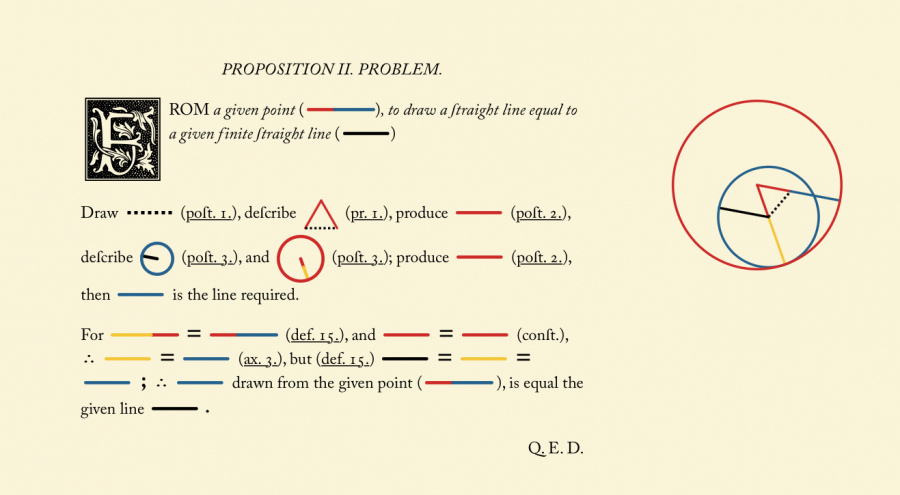
Byrne’s edition—The First Six Books of The Elements of Euclid in which Coloured Diagrams and Symbols are Used Instead of Letters for the Greater Ease of Learners—might have passed into obscurity had a reference to it in Edward Tufte’s Envisioning Information not sparked renewed interest. From there followed a beautiful new edition by TASCHEN and an article on Byrne’s diagrams in mathematics journal Convergence. Rougeux picked up the thread and decided to create an online version. “Like others,” he writes, “I was drawn to its beautiful diagrams and typography.” He has done both of those features ample justice.
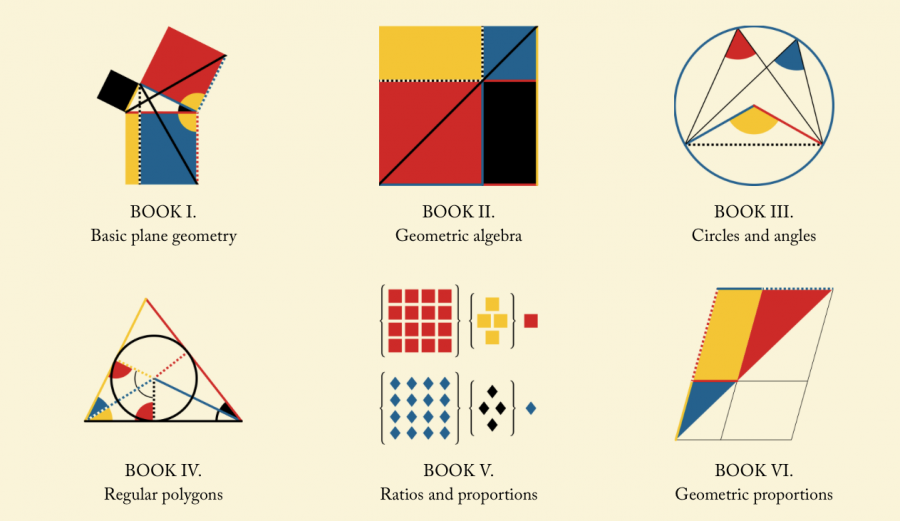
As in another of Rougeux’s online reproductions—his Werner’s Nomenclature of Colours—the designer has taken a great deal of care to preserve the original intentions while adapting the book to the web. In this case, that means the spelling (including the use of the long s), typeface (Caslon), stylized initial capitals, and Byrne’s alternate designs for mathematical symbols have all been retained. But Rougeux has also made the diagrams interactive, “with clickable shapes to aid in understanding the shapes being referenced.”
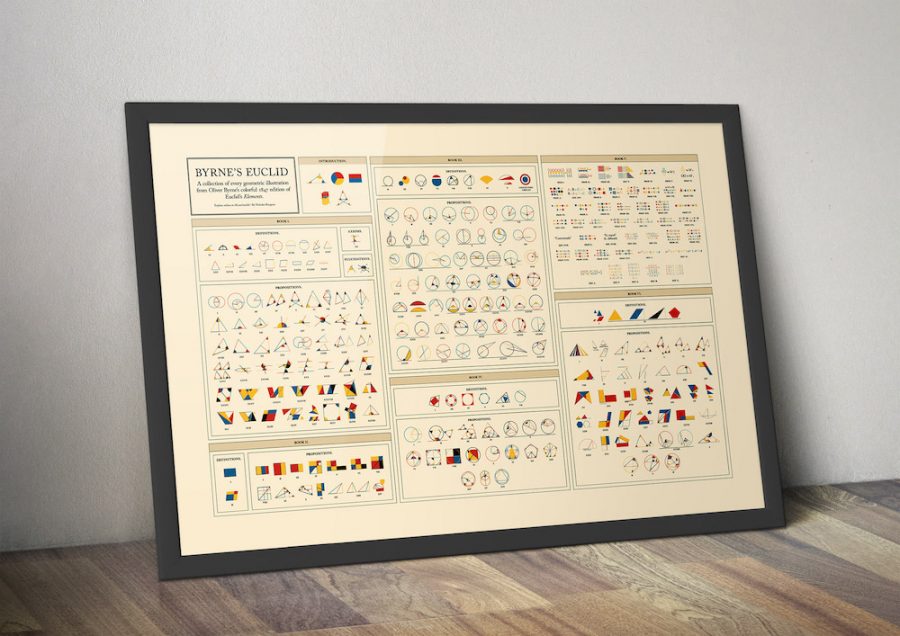
He has also turned all of those lovely diagrams into an attractive poster you can hang on the wall for quick reference or as a conversation piece, though this semaphore-like arrangement of illustrations—like the simplified Euclid in modern textbooks—cannot replace or supplant the original text. You can read Euclid in ancient Greek (see a primer here), in Latin and Arabic, in English translations here, here, here, and many other places and languages as well.

For an experience that combines, however, the best of ancient wisdom and modern information technology—from both the 19th and the 21st centuries—Rougeux’s free, online edition of Byrne’s Euclid can’t be beat. Learn more about the meticulous process of recreating Byrne’s text and diagrams (illustrated above) here.
Related Content:
The Map of Mathematics: Animation Shows How All the Different Fields in Math Fit Together
Josh Jones is a writer and musician based in Durham, NC. Follow him at @jdmagness
Read More...Meet Henry Darger, the Most Famous of Outsider Artists, Who Died in Obscurity, Leaving Behind Hundreds of Unseen Fantasy Illustrations and a 15,000-Page Novel
In his cheeky invention of a character called Marvin Pontiac, an obscure West African-born bluesman, the avant-garde composer and saxophonist John Lurie created “a wry and purposeful sendup of the ways in which critics canonize and worship the disenfranchised and bedeviled,” Amanda Petrusich writes at The New Yorker. Lurie’s satire shows how the critical fetish for outsider artists has a persistent emphasis: a hyperfocus on “misshapen yet pervasive ideas” about class, race, education, and ability as markers of primitive authenticity.
The term “outsider art” can sound patronizing and even predatory, laden with assumptions about who does and who does not deserve inclusion and agency in the art world. Outsider art gets collected, exhibited, catalogued, and sold, usually accompanied by a semi-mythology about the artist’s fringe circumstances. Yet the artists themselves rarely seem to be the primary beneficiaries of any largesse. In the case of the fictional Marvin Pontiac, his status as “dead and heretofore undiscovered” makes the question moot. The same goes for the very real and perhaps most famous of outsider artists, whose life story can sometimes make Lurie’s Pontiac seem underwritten by comparison.
Reclusive hospital custodian Henry Darger spent his early years, after both parents died, in an orphanage and the Illinois Asylum for Feeble-Minded Children. He spent his almost completely solitary adult life in a second-floor room on the North Side of Chicago, attending Mass daily (often several times a day), before passing away in 1973 in the same old age home in which his father died. He had one friend, left only four photographs of himself, and his few acquaintances were never even sure how to pronounce his last name (it’s a hard “g”). In his last diary entry, New Year’s Day, 1971, Darger wrote, “I had a very poor nothing like Christmas. Never had a good Christmas all my life, nor a good new year, and now… I am very bitter but fortunately not revengeful, though I feel should be how I am.”
So much for “outsider.” As for the label “Artist”—inscribed on his pauper’s grave (along with “Protector of Children”)—Darger shocked the art world, who had no idea he even existed, when his landlord discovered the typescript of an unpublished 15,000-page fantasy novel, The Story of the Vivian Girls, in What is Known as the Realms of the Unreal, of the Glandeco-Angelinian War Storm, Caused by the Child Slave Rebellion. Also in his apartment were a 8,500 follow-up, Further Adventures of the Vivian Girls in Chicago, and several hundred “panoramic ‘illustrations,’” notes the “official” Henry Darger website: “many of them double-sided and more than 9 feet in length.”
These works, we learn in the PBS video at the top, “The Secret Life of Henry Darger,” now regularly sell for hundreds of thousands of dollars. Darger, it seems, never meant for anyone to see them at all. Perhaps for good reason. His work leaves “a set of contradictory impressions,” Edward Gómez writes at Hyperallergic, “a celebration of childhood fulsomeness and a whiff of pedophiliac perversion.” The latter impression seems to have less to do with criminal sexual inclinations than with contemporary cultural perceptions about childhood. Compare Darger’s work, for example, with Lewis Carroll’s obsession with children, alarming to us now but not at all unusual at the time.
Still, Darger’s hundreds of “drawings of naked, prepubescent girls whose bodies prominently include male genitals” have raised all sorts of questions. Critics have pointed to the obvious influence of Victorian children’s literature, but perhaps even more pervasive was Darger’s own painful childhood, his considerable discomfort with the adult world, and his expressed desire to protect children who might suffer similarly (a preoccupation shared by Charles Dickens). Learn about Darger’s troubled, tragic childhood in the Down the Rabbit Hole video biography above, and in these two portraits, see why his work deserves—despite but not because of his marginality and oddness, his being self-taught, and his desire for his art to disappear—the posthumous acclaim it has received. Like that quintessential outsider artist, William Blake, Darger left behind a daringly original body of work that is as compelling and beautiful as it is disturbing and otherworldly.
To delve deeper into Darger’s world, check out the 2004 documentary, The Realms of the Unreal, which can be viewed on Youtube, or purchased on Amazon. The film’s trailer appears below.
Related Content:
Lewis Carroll’s Photographs of Alice Liddell, the Inspiration for Alice in Wonderland
Josh Jones is a writer and musician based in Durham, NC. Follow him at @jdmagness.
Read More...Apple Lets You Download Six Free Audio Books Read by Celebrity Narrators: Start with Kate Beckinsale Reading Pride & Prejudice

A quick heads up: Apple has just released six classic books read by celebrity narrators. And they’re all free. The list includes:
- Pride and Prejudice, narrated by Kate Beckinsale
- The Wonderful Wizard of Oz, narrated by Tituss Burgess
- The Secret Garden, narrated by Karen Gillan
- The Time Machine, narrated by Kelsey Grammer
- Frankenstein, narrated by Aaron Mahnke of the Lore podcast
- Winnie the Pooh, narrated by Disney Book Group
From start to finish, that’s 36 hours of free audio. For much more of that, visit our collection: 1,000 Free Audio Books: Download Great Books for Free
Looking for free, professionally-read audio books from Audible.com? Here’s a great, no-strings-attached deal. If you start a 30 day free trial with Audible.com, you can download two free audio books of your choice. Get more details on the offer here.
Related Content:
Christopher Lee Reads Four Classic Horror Stories by Edgar Allan Poe (1979)
Hear Arthur C. Clarke Read 2001: A Space Odyssey: A Vintage 1976 Vinyl Recording
The Great Leonard Nimoy Reads H.G. Wells’ Seminal Sci-Fi Novel The War of the Worlds
Read More...See Classic Japanese Woodblocks Brought Surreally to Life as Animated GIFs

Much of the image we have of life in Japan in the 17th through the 19th century, we have because of woodblock prints, or specifically ukiyo‑e, or “pictures of the floating world,” which vividly capture a great variety of scenes and the people who inhabited them. The once-closed-off Japan has changed a great deal since that era, on most levels even more so than other countries, and the artistic portrayals of Japanese life have also multiplied enormously. Yet even in the 21st century, ukiyo‑e continue to provide a compelling image of Japan in its essence.

But that doesn’t mean that ukiyo‑e prints can’t be updated to reflect the present day. Filmmaker and animator Atsuki Segawa, writes Spoon & Tamago’s Johnny Waldman, “takes traditional Japanese Ukiyo‑e woodblock prints and sets them into motion through digital animation. He began his collection of ‘moving ukiyo‑e’ in 2015 and has been slowly adding to his collection.” At those two linked Spoon & Tamago posts you can see a selection of ten of Segawa’s creations, which hybridize not just art forms but eras.
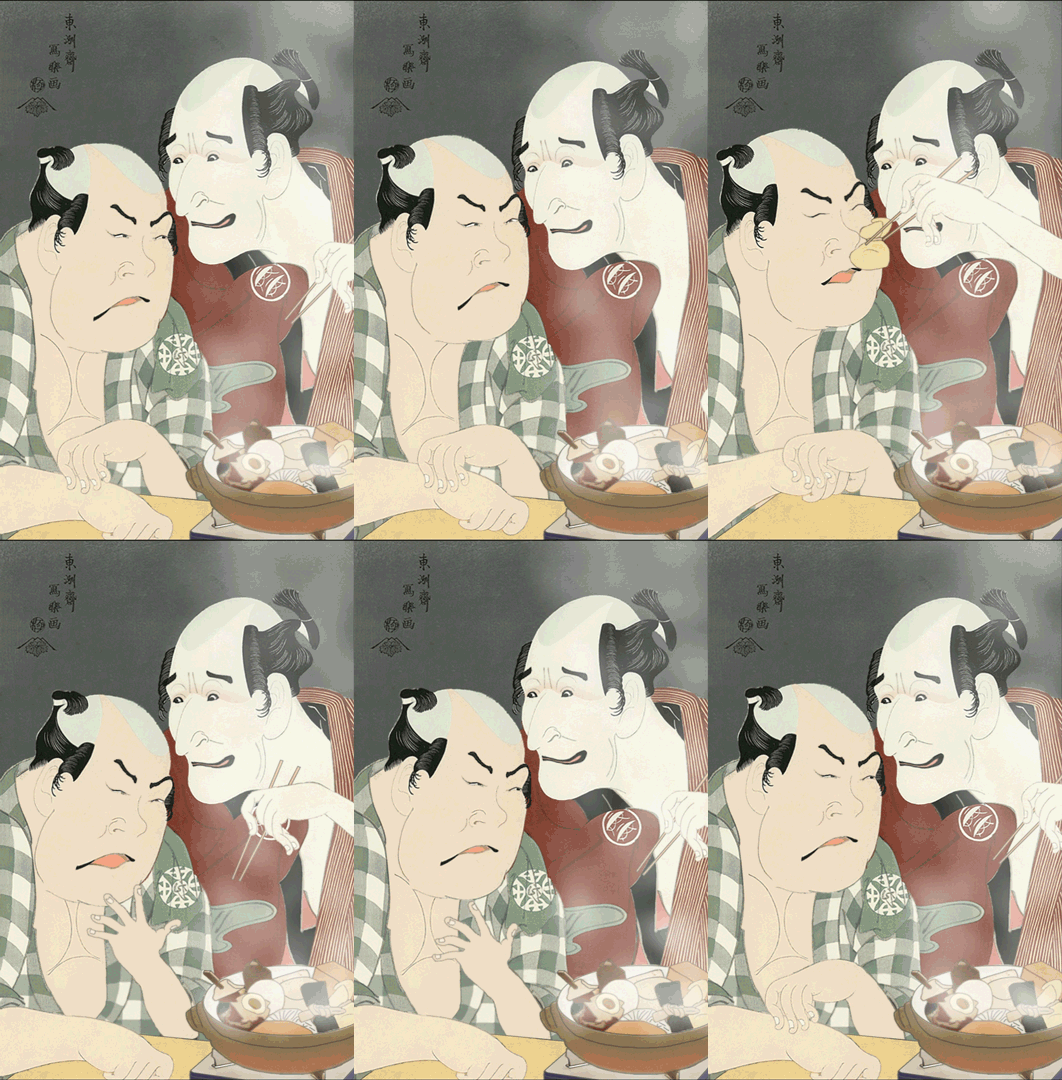
Here you can see Segawa’s take on, from top to bottom, Kiyochika Kobayashi’s Firework Show at Ryogoku, Katsushika Hokusai’s Yoshida at Tōkaidō, Toshusai Sharaku’s Nakamura Konozo and Nakajima Wadayemon (“If anyone has ever eaten oden you’ll know how this man feels,” adds Waldman), Hokusai’s Ejiri in Suruga Province, Hokusai’s Great Wave, and Utagawa Hiroshige’s Fujikawa. Keep your eye on that last and you’ll notice Doc Brown and Marty McFly cruising through the scene, only the most obvious of the anachronistic touches (though as time travelers, what really counts as anachronism?) Segawa has added to these classic ukiyo‑e and set into motion.

Segawa’s other “moving ukiyo” introduce flying drones into an Osaka marketplace, the multicolored lights of speeding cars down a quiet seaside road, a Shinkansen bullet train passing a resting place full of weary foot travelers, and violent motion to the waves and boats in Hokusai’s Great Wave off Kanazawa, quite possibly the most famous ukiyo‑e print of them all.

Sheer incongruity — incongruity between the times of the elements depicted and referenced, between the aesthetics of the past and the aesthetics of the present, and between the technologies used to create and display the originals and these light-hearted revisions — has much to do with the appeal of these images, but somehow it all makes them feel much more, not less, like Japan itself.

Related Content:
Download 2,500 Beautiful Woodblock Prints and Drawings by Japanese Masters (1600–1915)
Download Hundreds of 19th-Century Japanese Woodblock Prints by Masters of the Tradition
Based in Seoul, Colin Marshall writes and broadcasts on cities, language, and culture. His projects include the book The Stateless City: a Walk through 21st-Century Los Angeles and the video series The City in Cinema. Follow him on Twitter at @colinmarshall or on Facebook.
Read More...Support Us
We're hoping to rely on loyal readers, rather than erratic ads. Please click the Donate button and support Open Culture. You can use Paypal, Venmo, Patreon, even Crypto! We thank you!

About Us

Open Culture scours the web for the best educational media. We find the free courses and audio books you need, the language lessons & educational videos you want, and plenty of enlightenment in between.
Advertise With Us

FREE UPDATES!
GET OUR DAILY EMAIL
Get the best cultural and educational resources on the web curated for you in a daily email. We never spam. Unsubscribe at any time.
FOLLOW ON SOCIAL MEDIA

Open Culture editor Dan Colman scours the web for the best educational media. He finds the free courses and audio books you need, the language lessons & movies you want, and plenty of enlightenment in between.
Advertise With Us

