Criterion Announces New Streaming Service To Replace FilmStruck: Become a Charter Subscriber Today
Late last month, Turner and Warner Bros. Digital Networks announced–much to the chagrin of cinephiles–that it planned to close Filmstruck, a streaming service that specialized in arthouse and classic films. Fans and celebrities–from Christopher Nolan to Guillermo del Toro–quickly got behind a petition to save the streaming service. And today their wish came true, more or less.
The Criterion Collection and WarnerMedia just issued a press release, declaring that “the Criterion Channel will launch as a free-standing streaming service” in the spring of 2019. This will effectively allow the Criterion Channel to “pick up where FilmStruck left off, with thematic programming, regular filmmaker spotlights, and actor retrospectives, featuring major classics and hard-to-find discoveries from Hollywood and around the world, complete with special features like commentaries, behind-the-scenes footage and original documentaries.”

If you want to demonstrate your appreciation and support, you can become a Charter Subscriber and gain the following benefits:
- A 30-day free trial.
- A reduced subscription fee for as long as you keep your subscription active. The regular fee will be $10.99 a month or $100 a year, but as a Charter Subscriber you’ll pay $9.99 a month or $89.99 a year.
- Concierge customer service from the Criterion Collection, including a customer ID and a special e‑mail address.
- A holiday gift-certificate present, for use on the Criterion Collection website.
- A Charter Subscriber membership card.
- The satisfaction of knowing you’re keeping the best of film alive and available.
Hope this helps you have a great weekend.
If you would like to support the mission of Open Culture, consider making a donation to our site. It’s hard to rely 100% on ads, and your contributions will help us continue providing the best free cultural and educational materials to learners everywhere. You can contribute through PayPal, Patreon, and Venmo (@openculture). Thanks!
Related Content:
Akira Kurosawa Names His 21 Favorite Art Films in the Criterion Collection
The Art of Restoring Classic Films: Criterion Shows You How It Refreshed Two Hitchcock Movies
120 Artists Pick Their Top 10 Films in the Criterion Collection
Read More...A Japanese Illustrated History of America (1861): Features George Washington Punching Tigers, John Adams Slaying Snakes & Other Fantastic Scenes
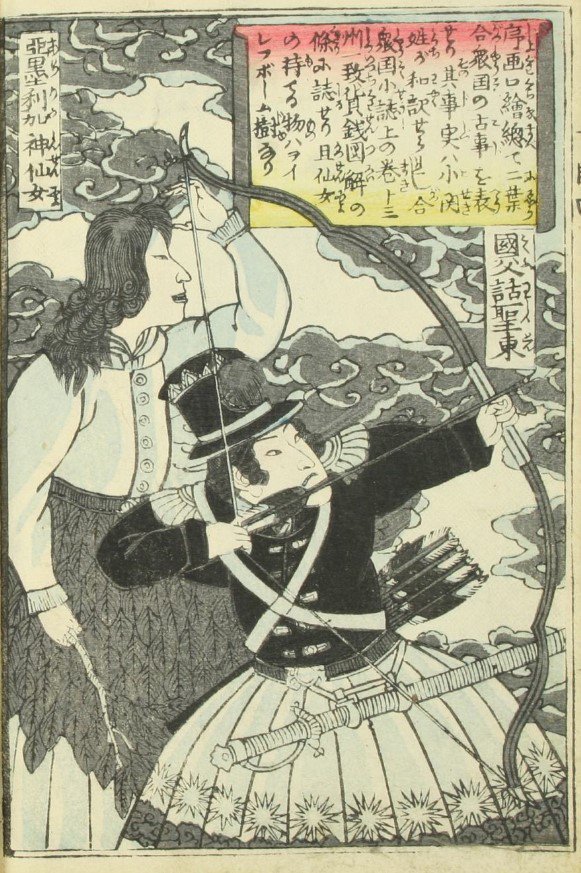
“George Washington (with bow and arrow) pictured alongside the Goddess of America”
Though I’m American myself, I always learn the most about America when I look outside it. When I want to hear my homeland described or see it reflected, I seek out the perspective of anyone other than my fellow Americans. Given that I live in Korea, such perspectives aren’t hard to come by, and every day here I learn something new — real or imagined — about the United States. But Japan, the next country over to the east, has a longer and arguably richer tradition of America-describing. And judging by Osanaetoki Bankokubanashi (童絵解万国噺), an 1861 book by writer Kanagaki Robun and artist Utagawa Yoshitora, it certainly has a more fantastical one. “Here is George Washington (with bow and arrow) pictured alongside the Goddess of America,” writes historian of Japan Nick Kapur in a Twitter thread featuring selections from the book.
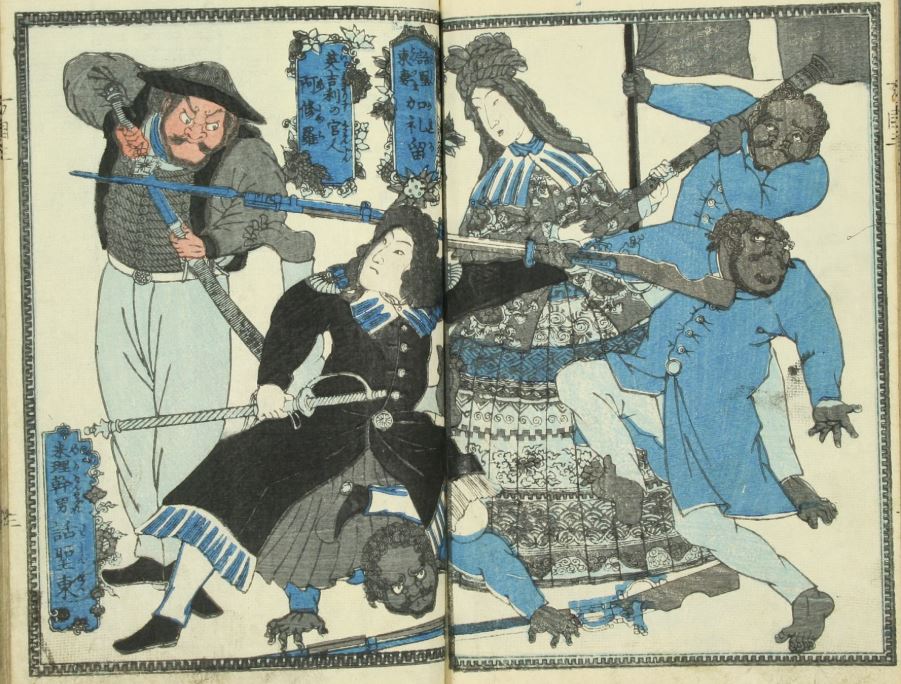
“George Washington defending his wife ‘Carol’ from a British official”
History does record Washington having practiced archery in his youth, among other popular sports of the day, and the image of the Goddess of America does look like a faintly Japanese version of Columbia, the historical female personification of the United States.
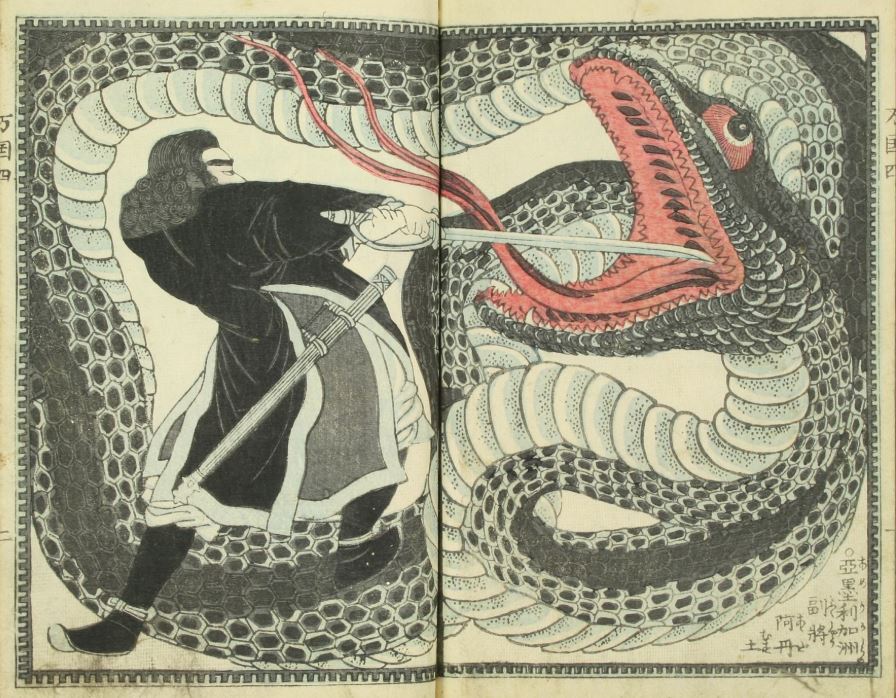
The next image Kaur posts shows Christopher Columbus reporting his discovery of America to Queen Isabella of Spain. “So far, kinda normal,” but then comes a bit of artistic license: a scene from the American Revolution in which we see “George Washington defending his wife ‘Carol’ from a British official named ‘Asura’ (same characters as the Buddhist deity).” Other illustrated events from early American history include “Washington’s “second-in-command” John Adams battling an enormous snake,” “the incredibly jacked Benjamin Franklin firing a cannon that he holds in his bare hands, while John Adams directs him where to fire,” and “George Washington straight-up punching a tiger.”
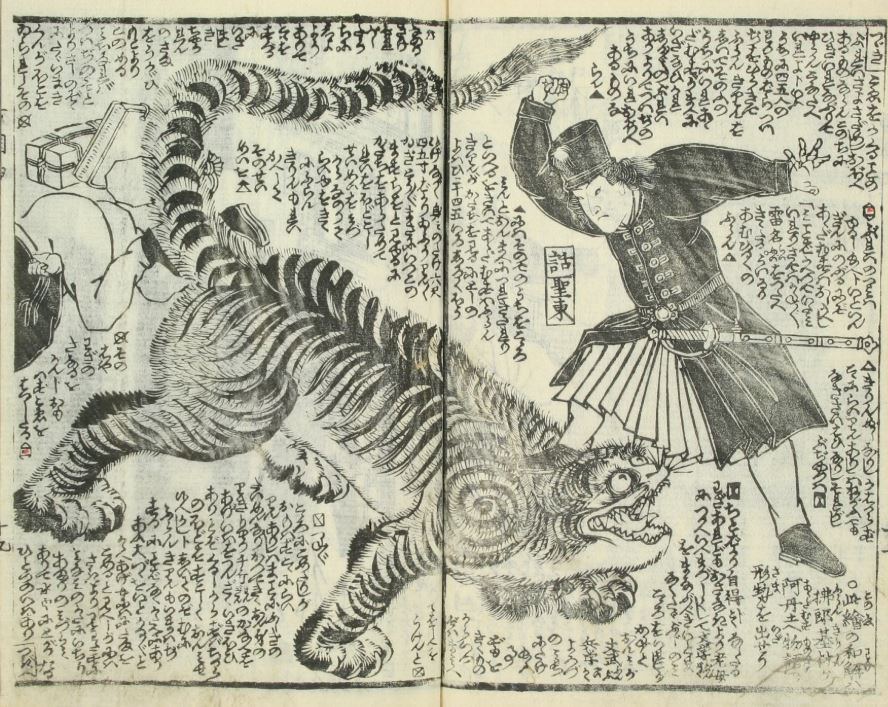
“George Washington straight-up punching a tiger”
The founding of the United States, as Kanagaki and Utagawa saw it, seems to have required the defeat of many a fearsome beast, including a giant snake that eats Adams’ mother and against which Adams must then team up with an eagle to slay. What truth we can find here may be metaphorical in nature: even in the mid-19th century, the world still saw America as a vast, wild continent just waiting to enrich those brave and strong enough to subdue it. Global interest in the still-new republic also ran particularly high at that time, as evidenced by the popularity of publications like Alexis de Tocqueville’s Democracy in America (which still offers an insightful outsider’s perspective on America), first published in 1835 and 1840.
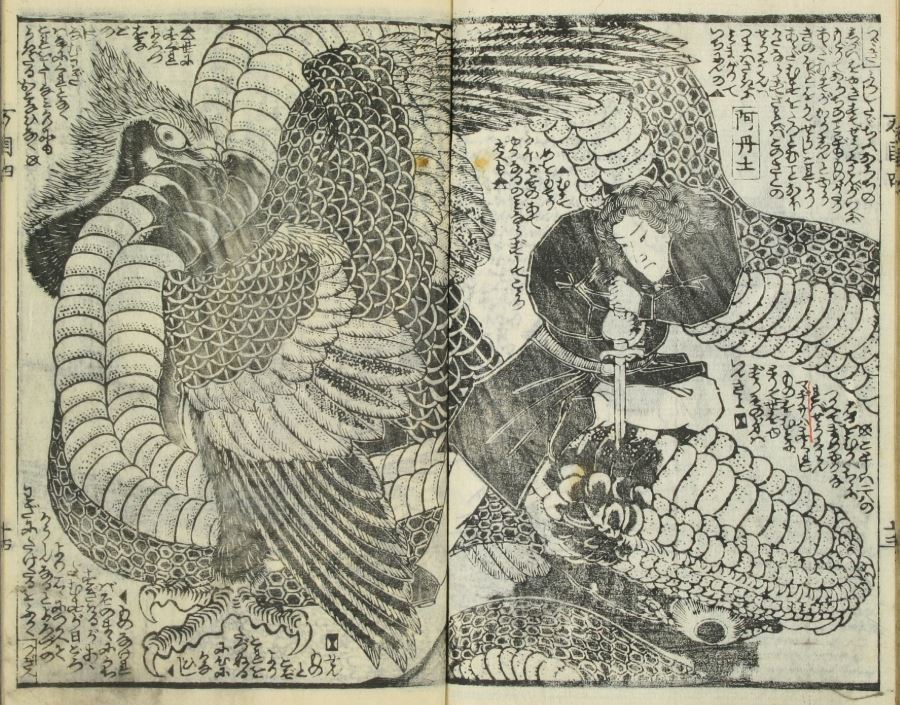
“Together, John Adams and the eagle kill the enormous snake that ate his Mom. The power of teamwork!!!”
Japan, long a closed country, had also begun to take a keen interest in the outside world: American Commodore Matthew Perry and his warships, filled with technology then unimaginable to the Japanese, had arrived in 1853 with an intent to open Japan’s ports to trade. In 1868 the Meiji Restoration would consolidate imperial rule in the country and open it to the world, but Osanaetoki Bankokubanashi, which you can read in its entirety in digitized form at Waseda Unversity’s web site, came out seven years before that. At that time, the likes of Kanagaki and Utagawa, relying on second-hand sources, could still thrill their countrymen — none of whom had any more direct experience of America than they did — with tales of the grotesque creatures, vile oppressors, heroic rebels, and guiding goddesses to be found just on the other side of the Pacific Ocean.
For more images, see Nick Kapur’s twitter stream here.
Related Content:
Download Hundreds of 19th-Century Japanese Woodblock Prints by Masters of the Tradition
Vintage 1930s Japanese Posters Artistically Market the Wonders of Travel
Based in Seoul, Colin Marshall writes and broadcasts on cities, language, and culture. His projects include the book The Stateless City: a Walk through 21st-Century Los Angeles and the video series The City in Cinema. Follow him on Twitter at @colinmarshall or on Facebook.
Read More...Pachelbel’s Chicken: Your Favorite Classical Pieces Played Masterfully on a Rubber Chicken
Music lovers bracing against the annual onslaught of the Singing Dogs’ “Jingle Bells” may find their savage beasts soothed somewhat by Eddy Chen’s performance of Pachelbel’s Canon, above.
Never mind that the instrument on which he plays four different tracks is a rubber chicken… or more accurately, as per Amazon, a Screaming Yellow Rubber Chicken Non Toxic Bite-resistant Squeaky Toy.
It retains its relaxing musicality. Chen, one half of Australian duo TwoSetViolin, plays that bird like the disciplined, classically-trained pro he is.
Classical chicken covers became a surprise hit for Chen and his partner, Brett Yang, veterans of the Sydney and Queensland Symphony Orchestras, whose virtually sold out world tour was the first of its kind to be entirely financed by Kickstarter donations.
The duo describes its mission as “upholding the integrity of classical music” while making it “relevant to the modern generation through fun, humour and simplicity,” noting, in a joint interview with Violinist.com:
There are people out there who are ready to love classical music, and we have to actively find them. It is the way classical music has been presented so far that makes it so austere. We were lucky that we learned the instrument for 20 years; if we were not musicians, it would be very hard to get into.
Everyone has the potential to like it, but sometimes musicians alienate and scare potential listeners with our pride.
Back when classical music was new, it was not ‘classical’; it was just music.
Today our (classical music audience) is very small, but there are many great musicians
Granted, the standards for classical music are there for a good reason: people want the best art, and that is a standard we should uphold. At the same time, sometimes we see people breaking down and freaking out because of those standards. It is sad to think of all that lost potential and love for music. We feel we are losing audiences; we are losing people who used to love music.
The chicken definitely appeals to young listeners, though surely there’s no age limit for enjoying its take on Erik Satie’s Gymnopédie No.1…
Or Johann Strauss’ “The Blue Danube” Waltz, wherein Yang squeezes a chicken in each fist whilst Chen mans the violin…
Or the opening trumpet solo of Gustav Mahler ‘s Symphony No. 5…
Or Beethoven’s “Für Elise,” a favorite first classical piece for pianists and chicken players alike…
Others on TwoSetViolin’s classical chicken playlist include Handel’s “Hallelujah” chorus and the “Waltz of the Flowers” from Tchaikovsky’s Nutcracker Suite.
Catch up with TwoSetViolin on the final leg of their American tour and subscribe to their YouTube channel for their insights into the classical musician’s life and the importance of practice.
Related Content:
Behold the “3Dvarius,” the World’s First 3‑D Printed Violin
New Order’s “Blue Monday” Played with Obsolete 1930s Instruments
Ayun Halliday is an author, illustrator, theater maker and Chief Primatologist of the East Village Inky zine. Join her in NYC this December for the 10th anniversary production of Greg Kotis’ apocalyptic holiday tale, The Truth About Santa, and the next monthly installment of her book-based variety show, Necromancers of the Public Domain. Follow her @AyunHalliday.
Read More...Bertrand Russell Authority and the Individual (1948)
Back in 1948, Britain was making another difficult transition, moving from the trauma of World War II to the chill of the Cold War. Hoping to give radio listeners some clarity on contemporary affairs, the BBC began airing an annual series of lectures — the Reith Lectures — that featured leading thinkers of the day. 60 years later, the tradition continues, and during this long stretch, some legendary figures have graced the BBC’s airwaves: Michael Sandel, Edward Said, John Searle, John Kenneth Galbraith, George Kennan, and Robert Oppenheimer, just to name a few. (And, yes, the list unfortunately skews heavily male.)
Late last month, the BBC put the complete audio archive online, which gives you access to 240 lectures in total. Where’s the best place to start? How about at the beginning, with the inaugural lectures presented by philosopher Bertrand Russell in 1948. His lecture series, Authority and the Individual, delved into an age old question in political philosophy — the individual and his/her relationship with communities and states. The head of the BBC later groused that Russell spoke “too quickly and had a bad voice.” But the real complaints came from the Soviets, who interpreted Russell’s lectures as an attack on Communism. You can find the lectures here, stream them above, or read the transcript here.
If you would like to support the mission of Open Culture, consider making a donation to our site. It’s hard to rely 100% on ads, and your contributions will help us continue providing the best free cultural and educational materials to learners everywhere. You can contribute through PayPal, Patreon, and Venmo (@openculture). Thanks!
Read More...Marxism by Raymond Geuss: A Free Course
This course taught by Raymond Geuss was originally presented at Cambridge University in 2013. All 8 lectures can be streamed above, or on YouTube here. “Marxism” has been added to our collection of 170 Free Philosophy Courses, a subset of our larger collection, 1,700 Free Online Courses from Top Universities.
If you would like to support the mission of Open Culture, consider making a donation to our site. It’s hard to rely 100% on ads, and your contributions will help us continue providing the best free cultural and educational materials to learners everywhere. You can contribute through PayPal, Patreon, and Venmo (@openculture). Thanks!
Read More...Later Heidegger by Hubert Dreyfus: A Free Course
This course taught by Hubert Dreyfus was originally presented at UC Berkeley. All 26 lectures can be streamed above, or on YouTube here. “Later Heidegger” has been added to our collection of 170 Free Philosophy Courses.
If you would like to support the mission of Open Culture, consider making a donation to our site. It’s hard to rely 100% on ads, and your contributions will help us continue providing the best free cultural and educational materials to learners everywhere. You can contribute through PayPal, Patreon, and Venmo (@openculture). Thanks!
Read More...Hubert Dreyfus on Merleau Ponty’s Phenomenology of Perception: A Free Course
This course taught by Hubert Dreyfus was originally presented at UC Berkeley. All 31 lectures can be streamed above, or on YouTube here. “Merleau Ponty’s Phenomenology of Perception” has been added to our collection of 170 Free Philosophy Courses.
If you would like to support the mission of Open Culture, consider making a donation to our site. It’s hard to rely 100% on ads, and your contributions will help us continue providing the best free cultural and educational materials to learners everywhere. You can contribute through PayPal, Patreon, and Venmo (@openculture). Thanks!
Read More...Leonard Cohen’s Last Work, The Flame Gets Published: Discover His Final Poems, Drawings, Lyrics & More
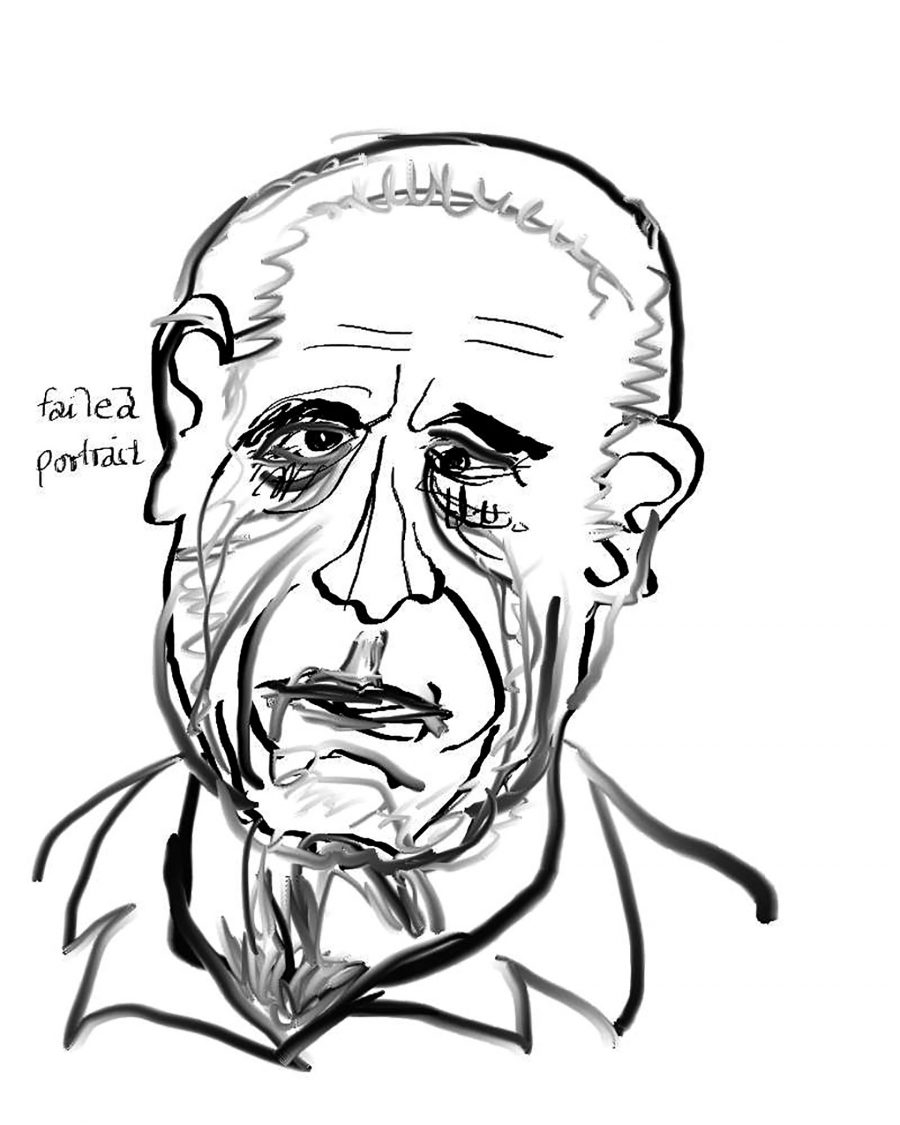
It’s a perverse irony or an apt metaphor: Leonard Cohen is best known for a song that took him five years to write, and that went almost unheard on its debut, in part because the head of Columbia’s music division, Walter Yetnikoff, refused to release Cohen’s 1985 album Various Positions in the U.S. “Leonard, we know you’re great,” said Yetnikoff, “We just don’t know if you’re any good.” It might have been Cohen’s summation of life itself.
It wasn’t until Jeff Buckley’s electric gospel cover in 1994 (itself a take on John Cale’s version) that “Hallelujah” became the massive hit it is, having now been covered by over 300 artists. Canadian magazine Maclean’s has called the song “pop music’s closest thing to a sacred text.” One can imagine Cohen looking deep into the eyes of those who think that “Hallelujah” is a hymn of praise and saying, “you don’t really care for music, do ya?”
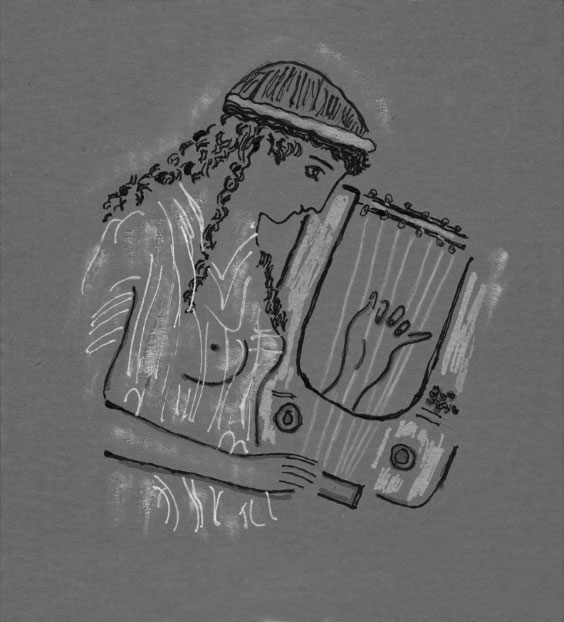
With the trappings and imagery of gospel, and a sleazy synth-driven groove, it tells a story of being tied to a chair and overpowered, kept at an emotional distance, learning how to “shoot somebody who outdrew ya.” Love, sings Cohen sings in his lounge-lizard voice, “is not a victory march… It’s not somebody who’s seen the light.” If you’re looking to Leonard Cohen for redemption, best look elsewhere.
Used in film and television for moments of epiphany, triumph, grief, and relief, “Hallelujah,” like all of Cohen’s work, makes profane and prophetic utterances in which beauty and ugliness always coexist, in a painful arrangement no one gets clear of. Cohen will not let us choose between darkness and light. We must take both.
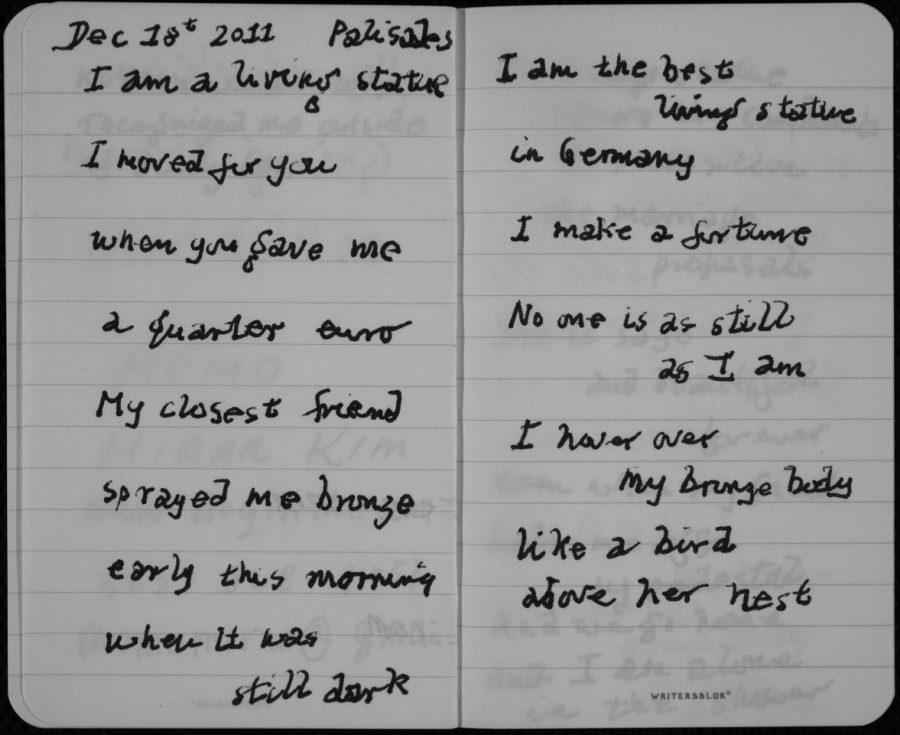
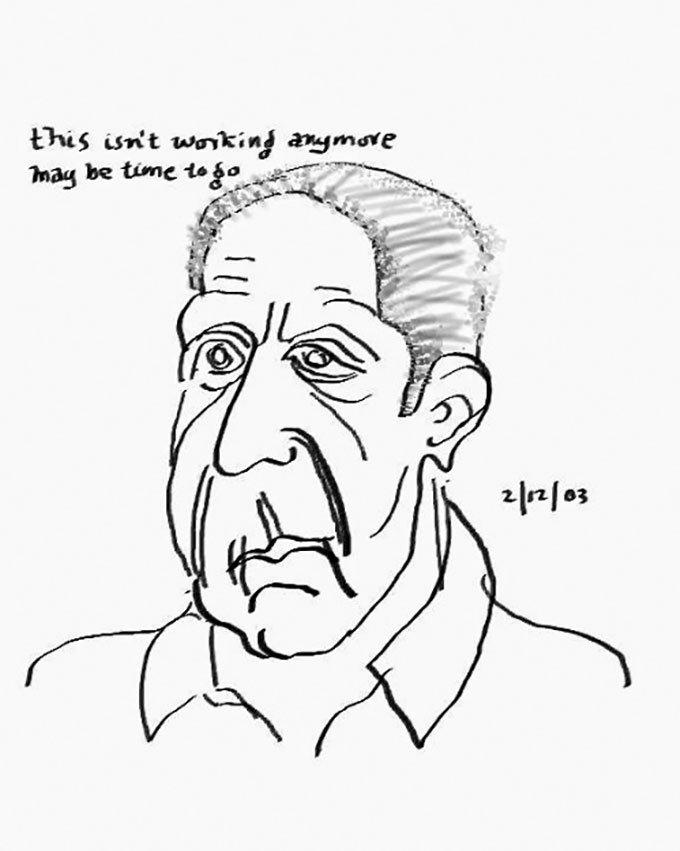
In the last years of his life, he brought his tragic vision to a remarkable climax in his final, 2016 album, You Want it Darker. Last month, the final act in his magisterial career premiered in the form of The Flame. The book is “a collection of poems, lyrics, drawings, and pages from his notebooks,” writes The Paris Review, who quote from Cohen’s son Adam’s forward: “This volume contains my father’s final efforts as a poet…. It was what he was staying alive to do, his sole breathing purpose at the end.”
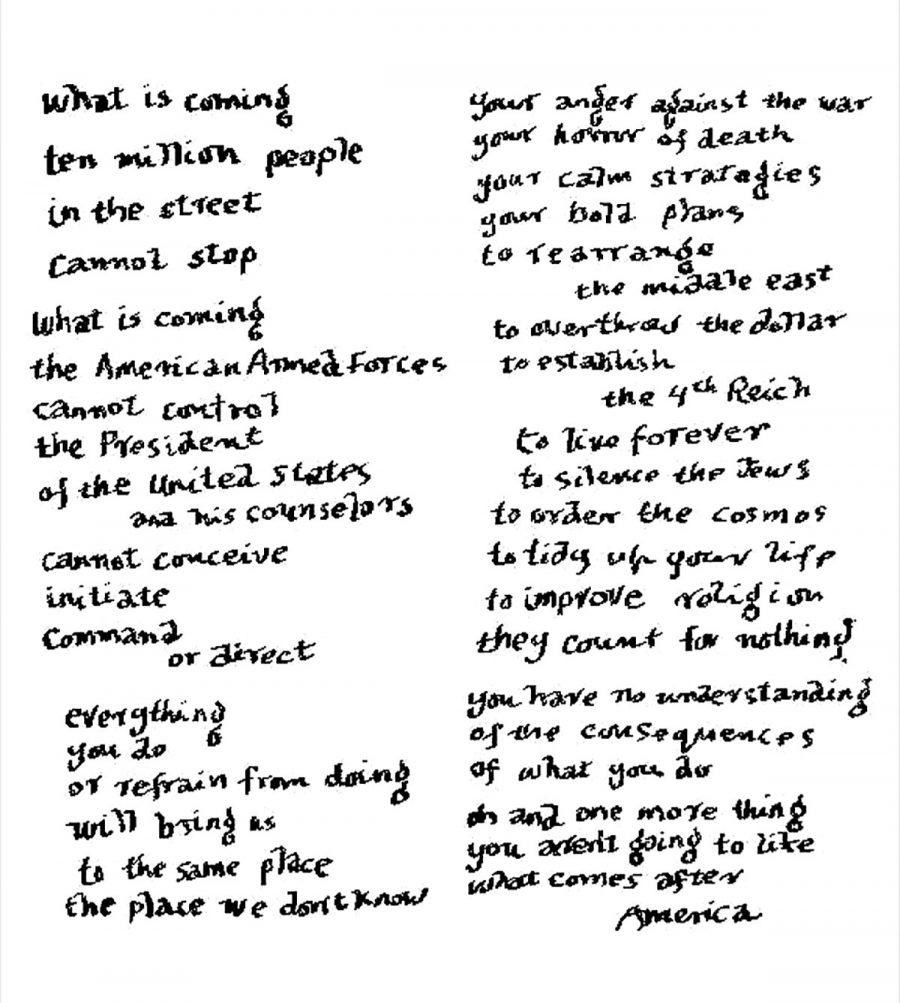
Cohen did not leave words of hope behind. One of his last poems issues forth an enigmatic and terrifying prophecy, hammering away at the conceits of human power.
What is coming
ten million people
in the street cannot stop
What is coming
the American Armed Forces
cannot control
the President
of the United States
and his counselors
cannot conceive
initiate
command
or direct
everything
you do
or refrain from doing
will bring us
to the same place
the place we don’t know
your anger against the war
your horror of death
your calm strategies
your bold plans
to rearrange
the middle east
to overthrow the dollar
to establish
the 4th Reich
to live forever
to silence the Jews
to order the cosmos
to tidy up your life
to improve religion
they count for nothing
you have no understanding
of the consequences
of what you do
oh and one more thing
you aren’t going to like
what comes after
America
But The Flame is not all jeremiad. In some ways it’s a turn from the grim, oracular voice of “You Want it Darker” and to a more intimate, at times quotidian and confessional, Cohen. “All sides of the man are present” in this book of poems and sketches writes Scott Timberg at The Guardian. “Was he, in the end, a musician or a poet? A grave philosopher or a grim sort of comedian? A cosmopolitan lady’s man or a profound, ascetic seeker? Jew or Buddhist? Hedonist or hermit?” Yes.
Cohen’s work, his son says, “was a mandate from God.” The writing of his final poems “was all private.” “My father was very interested in preserving the magic of his process. And moreover, not demystifying it. Speaking of any of this is a transgression.”
However else we interpret Leonard Cohen’s theo-mythic-philosophical incantations, he made a few things clear. What he meant by “God” was deeper and darker than what most people do. And to trivialize the mysteries of life and love and death and song, to pretend we understand them, he suggests, is a grave and tragic, but perhaps inevitable, mistake. “You want it darker,” he sang at the end. “We kill the flame.”
via The Paris Review
Related Content:
Young Leonard Cohen Reads His Poetry in 1966 (Before His Days as a Musician Began)
How Leonard Cohen Wrote a Love Song
Josh Jones is a writer and musician based in Durham, NC. Follow him at @jdmagness
Read More...NASA Digitizes 20,000 Hours of Audio from the Historic Apollo 11 Mission: Stream Them Free Online
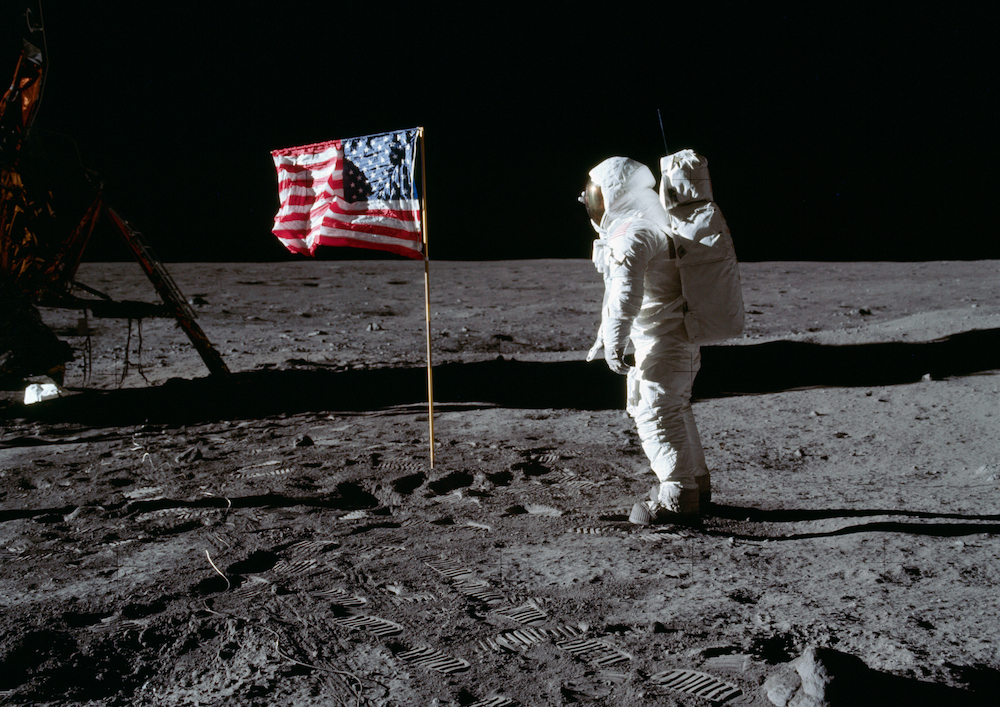
When we think of the Apollo missions, we tend to think of images, especially those broadcast on television during the Apollo 11 moon landing in 1969. And if we think of the sounds of Apollo, what comes more quickly to mind — indeed, what sound in human history could come more quickly to mind — than Neil Armstrong’s “one small step for a man, one giant leap for mankind” line spoken on that same mission? But that’s just one small piece of the total amount of audio recordings made during the Apollo program, which ran from the mid-1960s to the early 1970s. Now, with nearly 20,000 hours of them digitized, they’ve begun to be made available for listening and downloading at the Internet Archive.
“After the Apollo missions ended, most of the audio tapes eventually made their way to the National Archives and Records Administration building in College Park, Maryland,” writes Astronomy’s Catherine Meyers. But even after getting all the recordings in one place (easier said than done given the vast size of the archives in which they resided), a much larger challenge loomed.
“The existing tapes could be played only on a machine called a SoundScriber, a big beige and green contraption complete with vacuum tubes. NASA had two machines, but the first was cannibalized for parts to make the second one run.”
Refurbishing the very last SoundScriber to play these 30-track tapes required the help of a retired technician, and then the research team needed to “play all 30 tracks at once to minimize the time required to digitize them, as well as to avoid damaging the almost 50-year-old tapes by playing them over and over.” What with the 50th anniversary of the Apollo 11 moon landing approaching next summer — and with First Man, Damien Chazelle’s biopic of Neil Armstrong currently in theaters — NASA has cleared that mission’s audio recordings for public release.
You can listen to the Apollo 11 tapes directly at the Internet Archive, or you can make your way through them at Explore Apollo, a site designed by students at the University of Texas at Dallas that highlights the most historically significant of the thousands of hours of audio recorded during Apollo 11: not just Armstrong’s first step, but the launch from Kennedy Space Center, the lunar landing itself, and the astronauts’ walk on the moon’s surface. But space exploration is about much more than astronauts, as you’ll soon find out if you spend much time at the Internet Archive’s collection of Apollo 11 recordings, on which appear not just Neil Armstrong, Buzz Aldrin, and Michael Collins, but the hundreds and hundreds of other NASA personnel who made the moon landing possible. We may never have heard their names before, but now we can finally hear their voices.
Related Content:
Hear the Declassified, Eerie “Space Music” Heard During the Apollo 10 Mission (1969)
8,400 Stunning High-Res Photos From the Apollo Moon Missions Are Now Online
NASA Puts 400+ Historic Experimental Flight Videos on YouTube
The Best of NASA Space Shuttle Videos (1981–2010)
NASA Puts Online a Big Collection of Space Sounds, and They’re Free to Download and Use
Based in Seoul, Colin Marshall writes and broadcasts on cities, language, and culture. His projects include the book The Stateless City: a Walk through 21st-Century Los Angeles and the video series The City in Cinema. Follow him on Twitter at @colinmarshall or on Facebook.
Read More...David Lynch Releases a Disturbing, New Short Film: Watch “Ant Head” Online
David Lynch has just released a new short film, and it’s not very long on plot. Premiered at the Festival of Disruption earlier this year, “Ant Head” runs 13 minutes and features–writes IndieWire–“one shot that depicts a block of cheese in the shape of a head being overtaken by an army of crawling ants.” And it’s all set to music by Thought Gang, Lynch’s experimental collaboration with composer Angelo Badalamenti. You can pick up a copy of their brand new album, eponymously called Thought Gang, here.
If you would like to support the mission of Open Culture, consider making a donation to our site. It’s hard to rely 100% on ads, and your contributions will help us continue providing the best free cultural and educational materials to learners everywhere. You can contribute through PayPal, Patreon, and Venmo (@openculture). Thanks!
Related Content:
Watch All of the Commercials That David Lynch Has Directed: A Big 30-Minute Compilation
The Surreal Filmmaking of David Lynch Explained in 9 Video Essays
Read More...Support Us
We're hoping to rely on loyal readers, rather than erratic ads. Please click the Donate button and support Open Culture. You can use Paypal, Venmo, Patreon, even Crypto! We thank you!

About Us

Open Culture scours the web for the best educational media. We find the free courses and audio books you need, the language lessons & educational videos you want, and plenty of enlightenment in between.
Advertise With Us

FREE UPDATES!
GET OUR DAILY EMAIL
Get the best cultural and educational resources on the web curated for you in a daily email. We never spam. Unsubscribe at any time.
FOLLOW ON SOCIAL MEDIA

Open Culture editor Dan Colman scours the web for the best educational media. He finds the free courses and audio books you need, the language lessons & movies you want, and plenty of enlightenment in between.
Advertise With Us

