The Deeply Meditative Electronic Music of Avant-Garde Composer Eliane Radigue
Among a number of influential women in electronic music whom we’ve profiled here before, French avant-garde composer Eliane Radigue stands out for her single-minded dedication to “a certain music that I wished to make,” as she says in the video portrait above, “this particular music and no other.” Her compositions are haunting and meditative, “prefiguring the concept of ‘deep listening,’ expressed by Pauline Oliveros some years later,” as Red Bull Academy notes in an extensive profile of Radigue.
Using feedback, tape loops, field recordings, and, beginning in the 70s, the ARP 2500 modular synthesizer, Radigue “developed soundscapes… an interweaving of electronic drones, subsequently assimilated to what would later be called drone music.” But she has rejected the term as too static, stressing the variations and constant change in her music:
In Radigue’s work, sounds interact with each other like the cells of an organism, progressing in glissando in an extremely slow and subtle way. “I had found my own vocabulary. For me, maintaining the sound did not interest me as such; it was primarily a means to bring out the overtones, harmonics and subharmonics. This is what made it possible to develop this inner richness of sound.”
Radigue seems particularly self-assured, possessed of an intuitive sense of her work’s directions from the beginning. “I cannot start a piece if I don’t have an idea of what it would become, but what I would call the spirit,” she says in an interview with Electronic Beats.
“The spirit of what I wanted to do should be there… And I keep that spirit, that theme in mind, quite often several months before I start to do something. So, when I come to make the sounds it’s already there.”
But her career took many turns on a path through the compositional centers of mid-century avant-garde music. After studying traditional music theory as a child, she left her home in Nice at 19 and married the artist Arman. She was swept into an “exciting bohemian life” that would soon take her, in 1955, into the orbit of musique concrete pioneers Pierre Schaeffer and Pierre Henry.
While working as an intern for the composers (“If I claimed to be more, I don’t think they would have accepted me, because they were both the damndest machos!”), Radigue learned their methods and collaborated on their compositions. In 1967, she worked with Henry on L’Apocalypse de Jean, a piece designed to last for 24 hours. She ended her (unpaid) apprenticeship that year and began focusing on her own work, like Vice Versa (1970, excerpted further up) and Geerlriandre (1972, above) and Triptych (1978, below).
You can hear more of Radigue’s work at Ubuweb, including a more recent synthesizer piece recorded in 1992, as well as a 1980 interview for program The Morning Concert with Charles Amirkhanian. That same year, she became a convert to Tibetan Buddhism, and her work—like the Adnos series, below—was inspired by the religion’s history, her own meditation practice, and texts like the Bardo Thodol.
As the pulsing, droning, humming compositions she created throughout the late 20th century have become integral to the sound of the 21st, Radique has moved on, since 2001, to writing work for acoustic instruments. She made her last electronic piece, I’lle-Re-sonante, in 2000. The move came in part from requests she received from musicians, but it also represents a deliberate turn away from modern technology. “There’s always something missing with digital,” she says, even if it is somehow cleaner and clearer.”
Radigue has always favored the absorption of analogue sound, intent on taming its unpredictability as a meditator tames the darting, leaping, busy mind. “My music is always changing,” she says, “It comes from the first access I had to electronic sounds which was the wild sounds coming from feedback,” the noise of a microphone and a speaker getting too close to each other. “If you find the right place, which is very narrow, then you can move it very slowly and it changes but that requires a lot of patience.”
The word could define her entire approach, one radically opposed to instant gratification and quick fixes, focused singularly on outcomes while also fully present for the process.
Related Content:
Hear Seven Hours of Women Making Electronic Music (1938- 2014)
Josh Jones is a writer and musician based in Durham, NC. Follow him at @jdmagness
Read More...A Giant Mural of Robin Williams Goes Up in Chicago

If you find yourself near Logan Square, off of Milwaukee Avenue, in Chicago, take a moment to explore the new mural celebrating the life and art of Robin Williams. According to TimeOut Chicago, “The expansive mural is the work of New York street artist Jerkface and New Zealand artist Owen Dippie… Jerkface is known for his subversive depictions of animated pop-culture characters, while Dippie specializes in hyper-detailed portraits.” This Chicago mural comes right on the heels of another mural painted on Market Street in San Francisco. It’s by Argentine artist Andres Iglesias, aka Cobre. Catch a glimpse here.
If you would like to support the mission of Open Culture, consider making a donation to our site. It’s hard to rely 100% on ads, and your contributions will help us continue providing the best free cultural and educational materials to learners everywhere. You can contribute through PayPal, Patreon, and Venmo (@openculture). Thanks!
Related Content:
Robin Williams Uses His Stand-Up Comedy Genius to Deliver a 1983 Commencement Speech
Robin Williams & Bobby McFerrin Sing Fun Cover of The Beatles’ “Come Together”
Read More...The Outsiders: Lou Reed, Hunter S. Thompson, and Frank Zappa Reveal Themselves in Captivatingly Animated Interviews
Lou Reed thought the Beatles were garbage. Or at least he did when he started out in music, as he reveals in a 1987 interview. “We had an ambition and a goal: to elevate the rock song and take it where it hadn’t been before,” he says of his first band — perhaps you’ve heard of them — the Velvet Underground. “I just thought the other stuff couldn’t even come up to our ankles,” he adds. “They were just painfully stupid and pretentious. When they did try to get ‘arty,’ it was worse than stupid rock-and-roll.” Having graduated from college wanting to write “the great American novel,” Reed eventually decided to incorporate literature, and all the culture he knew, into music, to “write rock-and-roll that you could listen to as you got older and it wouldn’t lose anything. it would be timeless in the subject matter and the literacy of our lyrics.” The conversation appears first in “The Outsiders,” a compilation of three recordings made with three pillars of alternative American culture and imaginatively animated by Blank on Blank.
The second, which we’ve previously featured here on Open Culture, finds Studs Terkel sitting down with Hunter S. Thompson in 1967, talking about his first book Hell’s Angels: The Strange and Terrible Saga of the Outlaw Motorcycle Gangs. “The Angels came out of World War Two,” Thompson explains, “this whole kind of alienated, violent, subculture of people wandering around looking for either an opportunity, or if not an opportunity, then vengeance for not getting an opportunity.”
But if people insist on thinking of the Angels and their kind as the only violent troublemakers in existence, “then it’s just putting off the recognition that the same venom that the Angels are spewing around in public, a lot of people are just keeping bottled up in private.” In exploring the culture of the Angels, Thompson found that the venom filled him no less than it does everyone else: “I was seeing a very ugly side of myself a lot of times. I’m much more conscious of the kind of anger that lurks everywhere.”
The third, a 1971 interview with Frank Zappa, takes on the subject of fads. Zappa considered everything a fad, including the supposed political awakening of youth in the 60s: “It’s as superficial as their musical consciousness. It’s just another aspect of being involved in the actions of their peer group. One guy in the group says, ‘Hey, politics,’ and they go, ‘Yeah, politics.’ Or they go, ‘Grand Funk Railroad,’ and they go, ‘Yeah, Grand Funk Railroad. It’s the same thing.’ ” In America Zappa saw “a lot of changes, but I think that they’re all temporary things, and any change for the good is always subject to cancellation upon the arrival of the next fad.” That’s what happens, he explains, in a country that “doesn’t have any real culture. It doesn’t have any real art. It doesn’t have any real anything. It’s just got fads and a gross national product and a lot of inflation.” Does that, asks interviewer Howard Smith, make Zappa himself a fad as well? “I’m an American, I was born here,” Zappa replies. “I automatically got entered in a membership in the club.”
Related Content:
Animations Revive Lost Interviews with David Foster Wallace, Jim Morrison & Dave Brubeck
Watch Janis Joplin’s Final Interview Reborn as an Animated Cartoon
An Animated Bill Murray on the Advantages & Disadvantages of Fame
Based in Seoul, Colin Marshall writes and broadcasts on cities, language, and culture. His projects include the book The Stateless City: a Walk through 21st-Century Los Angeles and the video series The City in Cinema. Follow him on Twitter at @colinmarshall or on Facebook.
Read More...Punking Out, a Short 1978 Documentary Records the Beginning of the Punk Scene at CBGB’s
I hate to be one of those people who goes on about how punk was an all-American phenomenon before it crossed the pond. But hell, I’ve no less an authority on the counterculture than William S. Burroughs on my side, or on the side of Legs McNeil, at least, the music journalist who just happened to give punk its name by co-founding Punk magazine in 1975. Of McNeil’s seminal oral history Please Kill Me, Burroughs remarks, “This book tells it like was.” More accurately, it lets the music’s frontiersmen and women tell it, starting with Lou Reed and the Velvets and other mainstays in Andy Warhol’s Factory scene.
McNeil’s book surveys a number of major American scenesters, most of them from New York, with the exception of The Stooges from Detroit, and one exceptional band from, of all places, Cleveland, Ohio. The Dead Boys rarely get their due, but they were as influential as the Ramones in the downtown New York scene. Along with Iggy Pop, Dead Boys’ lead singer Stiv Bators indulged in the kind of thrilling onstage depravity mainstream audiences came to think of as the special provenance of the Sex Pistols. In the mid-seventies, these bands, along with Patti Smith, the Ramones, the New York Dolls, and Richard Hell and the Voidoids, etc. invented all the moves punk came to be known for.
An excellent companion to McNeil’s print documentary, the short, 1978 film Punking Out, above, surveys three key downtown New York bands—the Ramones, the Dead Boys, who moved to the city in ‘76, and Richard Hell & the Voidoids. (Hell gave McNeil’s book its title, designing a t‑shirt with a bullseye painted on it and the words “please kill me” scrawled above. He admitted he was “too much of a coward” to wear it.) All three bands played central roles in the CBGB’s scene, and Hell—who also played in Neon Boys, Television, and the Heartbreakers—gets credit for more or less inventing punk fashion—from spiked hair to DIY clothing designs held together with safety pins.
Made by Maggi Carson, Juliusz Kossakowski and Ric Shore, the film serves as its own oral history of sorts, featuring interviews with fans and the bands and CBGB’s owner Hilly Kristal (who says, “the more crowded and the louder it is, I think, the less violence.”) Watch it for the history, but also for the classic performances, captured from every angle in black and white, with surprisingly decent audio. And if you’d like to own your own copy, you can purchase it here for $11.95. The film’s site quotes one fan giving it the ultimate old guy thumbs-up: “Great!!! Buy it for your kids!” It’s educational, for sure. Punking Out belongs on every punk syllabus right next to Please Kill Me.
Note: You can check out a copies of Punking Out from the New York Public Library, and you can have them shipped anywhere in the world.
Related Content:
Watch an Episode of TV-CBGB, the First Rock ‘n’ Roll Sitcom Ever Aired on Cable TV (1981)
The Talking Heads Play CBGB, the New York Club That Shaped Their Sound (1975)
Take a Virtual Tour of CBGB, the Early Home of Punk and New Wave
Josh Jones is a writer and musician based in Durham, NC. Follow him at @jdmagness
Read More...
How Pink Floyd’s “Comfortably Numb” Was Born From an Argument Between Roger Waters & David Gilmour
Retrospectives of Pink Floyd tend to devolve into rehashing fights between Roger Waters and David Gilmour, but there’s good reason for that. Some of the band’s best work came out of this personal and creative tension, especially their most beloved song, “Comfortably Numb,” which, as we know it, emerged as a compromise between two different visions.
Unlike, say, Lennon and McCartney, who made some excellent music without each other, Gilmour and Waters never shined as brightly as when they contributed to each other’s work. Part of the bittersweetness of “Comfortably Numb,” then, is that it represents, as Gilmour himself admitted, “the last embers of mine and Roger’s ability to work collaboratively together.”
The song began life as a skeletal demo leftover from songwriting sessions for Gilmour’s first, 1978 solo album, but it only came together, with lyrics by Waters, during sessions for the following year’s epic The Wall.
When it came time to work that album’s songs—essentially a Roger Waters’ solo concept presented to the band—Gilmour wisely took the rudimentary progression off the shelf and offered it to his bandmate. It consisted then, as you can hear above, of nothing more than the chord progression in the chorus and a vocal melody conveyed by “doo doo doos.” In the interview clip below, Gilmour talks about the demo’s “genesis” on a “high strung guitar.”
Despite the delicate acoustic strumming of the demo, Gilmour wanted the Floyd version of the song to have a harder edge. Waters, on the other hand, wanted a big, theatrical sound. As Waters remembers it in an interview with Absolute Radio at the top, the disagreement boiled down to a rhythm track, and the negotiation involved taking pieces of the verse and chorus from two different versions and piecing them together.
Writer Mark Blake, citing co-producer Bob Ezrin, describes the argument in much more detail, as between a “stripped-down and harder” take and what Ezrin calls “the grander Technicolor, orchestral version” Waters liked. “That turned into a real arm-wrestle,” Ezrin recalled. “But at least this time there were only two sides to the argument. Dave on one side; Roger and I on the other.” After much wrangling, “the deal was struck,” Blake explains: “The body of the song would comprise the orchestral arrangement; the outro, including that final, incendiary guitar solo, would be taken from the Gilmour-favoured, harder version.”
As the song was integrated into Waters’ conceptual scheme (which Gilmour later admitted he found “a bit whingeing”), early versions like “The Doctor,” above, show the grittier sound Gilmour wanted. This take also showcases some lyrical howlers (“I am a physician / who can handle your condition / like a magician”) that, thankfully, didn’t make the final cut. The Final Cut also happens to be the title of The Wall’s follow-up, another Waters’ solo concept and the effective end of his collaboration with Gilmour for good.
Learning the history of “Comfortably Numb” makes us appreciate all of the maneuvering that went into turning the song into the masterpiece it became. In listening to it again (below, in a video with the wrong album cover), I’m amazed at how splitting the difference between two competing creative directions created a piece of music that could not be improved upon in any way. If you can think of such a thing happening before or since, in any art form, I’d love to hear about it.
Related Content:
Understanding Pink Floyd’s Wish You Were Here, Their Tribute to Departed Bandmate Syd Barrett
Josh Jones is a writer and musician based in Durham, NC. Follow him at @jdmagness
Read More...The Joy of Experiencing Queen’s Bohemian Rhapsody for the Very First Time: Watch Three Reaction Videos
Remember when you first encountered Queen’s “Bohemian Rhapsody”?
I suspect many of us don’t. It’s not the Kennedy assassination. Nor does it take long for Freddy Mercury’s soaring vocals and monumental lyrics to leach into the blood stream, creating the impression that we were born knowing every note, every word, every staggering transition…
(Note to those unfamiliar with this impossible to categorize 1975 masterpiece: Go give it a listen RIGHT NOW, while the rest of us wait for you here. Here’s the official video. But first, set up whatever equipment you need to film your reaction in real time, as Pennsylvania based YouTuber AFRO REACT, does above.)
He’ll definitely remember where he was when he first heard this wonderful, seminal song, as will over 1000 viewers, most of whom gave him an encouraging thumbs up.
So what if he mispronounces both “bohemian” and “rhapsody”? That he’s unclear whether Queen is the name of the singer or the band? He can cringe later…or not. Such documented boo boos may be a generational hazard, the way crimped and moussed 80s hair was for mine.
(I was surprised, and grateful, that neither he, nor any of the video reaction masters featured today, sniped at the ridiculous coiffures of the artists they were watching.)
Perhaps AFRO REACT’s appreciation will lead him to investigate those unfamiliar words and more: Scaramouche, Bismillah, fandango (No, not the popular movie time site…)
I appreciated how he consulted his mom prior to listening, to see if she thought he’d enjoy the full song as much as he liked the snippet he’d heard in a movie trailer.
My son never asks my opinion like that.
Hold up a sec there, AFRO REACT. Why not leave Mom out of it and just give it a spin (as we used to say)?
I suspect what he was really eager to find out was whether she thought this track would be worthy of a reaction video.
The answer, resoundingly, is yes.
I confess that his habit of pausing the video to interject his own thoughts was driving me out of my gourd. My son does the same thing.
I have since learned this is more than just a symptom of being born into a world where pretty much everything can be paused and restarted at will, at least as far as practitioners of the reaction video arts are concerned.
Taking frequent breaks like that is a solid way to get around copyright claim when including the official videos alongside the reaction. (Other techniques include lowering the volume while offering one’s response or fast forwarding 5 seconds a couple of times per minute.)
I suspect many older fans will feel a lump at the 4:15 mark, as the appreciative first-timer muses, “This man has a beautiful voice. Like, what happened to him?”
Ask your mother, kid.
The real treat comes at 6:15. Scaramouche, scaramouche, whatever our young listener was expecting, it surely wasn’t that!
Thusly another Queen fan is forged. Just a few days ago, he shared his virgin response to “Under Pressure (Live at Wembley)”
Tuscaloosa-based musician Joey Da Prince takes a more understated approach to reaction videos. Watching him bob from side to side, brow furrowed, appreciative involuntary smiles blooming now and again, reminds me of coming home, stripping the cellophane from a just-purchased album (or CD) and giving it a good hard listen, eyeballs glued to the liner notes.
He only hits pause once, shocked by the opening line of the famous first verse:
Mama just killed a man…
Oh, wait a minute. In a just posted 25-minute lyric breakdown, Joey reveals that he misheard that line, and was, understandably, taken aback by the idea of the singer’s mother murdering someone.
(Mercury’s technique was impeccable, so let’s take this as proof that commas are easier to see than hear…)
Like AFRO REACT, Joey quickly queued up the live version of “Under Pressure”…and “Somebody to Love,” “Fat Bottomed Girls,” “We Will Rock You,” the list goes on…
He’s obsessed to such a degree that he’s even filmed his reaction to pop culture essayist Polyphonic’s The Secrets Behind Freddie Mercury’s Legendary Voice, below. This is what lifelong learners do.
It’s worth noting that Joey Da Prince tried “Bohemian Rhapsody” on a commenter’s suggestion.
At the rate he’s going, he’s going to burn through Queen’s sizable catalogue pretty quickly, so toss him some suggestions, people!
I’m gonna go out on a limb and nominate Kate Bush’s “Wuthering Heights.”
Gamer Quamax, aka Qua, did not come to “Bohemian Rhapsody” as a total Queen newbie. By his own admission, he was somewhat familiar with “We Will Rock You,” “We Are the Champions,” “Another One Bites the Dust,” and “Under Pressure” from their appearances in movies and “other pop culture” (which presumably does not cover someone else’s reaction videos.)
As he listens in an intent forward-facing hunch, he seems the most keyed-in to the humor that is a definite part of this song’s listening experience (and possibly performance). He laughs merrily at the phrase “Mama Mia, Mama Mia” and avails himself of some truly delightful after effects in the editing process. (Those in a rush may fast forward to 4:32.)
Final pronouncement? It’s “dope and funny” and he really liked the transitions from one musical style to another.
Welcome to the Queen Army, Quamax! You should try listening to “Under…” oh, you already did.
Readers, if these young men’s open-mindedness and open ears have inspired you to shoot a reaction video of your own, you’ll find a good primer here.
What haven’t you heard?
And what do you wish you could hear again for the very first time?
via Metafilter
Related Content:
Hip Hop Fan Freaks Out When He Hears Rage Against the Machine’s Debut Album for the Very First Time
Queen’s “Bohemian Rhapsody” Played by 28 Trombone Players
Ayun Halliday is an author, illustrator, theater maker and Chief Primatologist of the East Village Inky zine. Join her in NYC on Monday, October 15 for another monthly installment of her book-based variety show, Necromancers of the Public Domain. Follow her @AyunHalliday.
Europe’s Oldest Intact Book Was Preserved and Found in the Coffin of a Saint
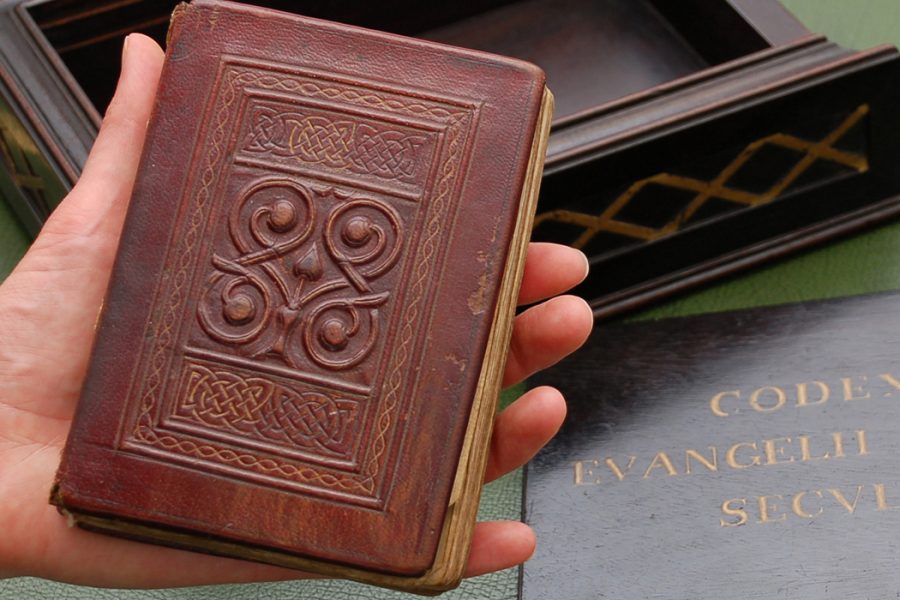
Photo via the British Library
If you’re a British history buff, next month is an ideal time to be in London for the British Library’s “once-in-a-generation exhibition” Anglo-Saxon Kingdoms: Art, Word, War, opening October 19th and featuring the illuminated Lindisfarne Gospels, Beowulf, Bede’s Ecclesiastical History, the “world-famous” Domesday Book, and Codex Amiatinus, a “giant Northumbrian Bible taken to Italy in 716” and returning to England for the first time in 1300 years. But with all of these manuscript stars stealing the show, one special exhibit might go overlooked, the St. Cuthbert Gospel, the oldest surviving intact European book.
A Latin copy of the Gospel of John, the book was originally called the Stonyhurst Gospel, after its first owner, Stonyhurst College. It acquired its current name because it was found inside the coffin of St. Cuthbert, a hermit monk who died in 687 and whose remains, legend has it, were incorruptible. This supposed miracle inspired a cult that placed offerings around Cuthbert’s tomb. Just when and how the small book made its way into his coffin remains a mystery. It was likely sometime between the 700s and 800s CE, when his body was moved to Durham due to Viking raids.
When Cuthbert’s casket was opened in 1104, the book was found “in miraculously perfect condition,” writes the British Library, inside “a satchel-like container of red leather with a badly-frayed sling made of silken threads.” Scholars have dated the book’s creation to between 700 and 730, and its interest for academics and lay people alike lies not only in the legend of St. Cuthbert but in the book’s physical qualities and its own uncorrupted nature. As Allison Meier writes at JSTOR Daily, “the 1,300-year-old manuscript retains its original pages and binding,” a remarkable fact for a book of its age.
Its condition makes it an “important example of Insular art, which was created on the British Isles and Ireland between 600 and 900 CE.” The general features of this style involve “the layering of pattern, line, and color on seemingly flat surfaces,” notes Oxford Bibliographies, in order to create “complex spatial patterns.” Scholar Robert D. Stevick describes these properties on the ornate dyed leather covers of the St. Cuthbert Gospel:
There is interlace pattern in two panels on the front cover, step-pattern implying two crosses on the lower cover, a prominent double vine scroll at the center of the front cover—elements of this early art that have been well catalogued for their individual features as well as for their affinities to similar decorative elements in other artifacts.
Bound with a sewing technique that originated in North Africa (and therefore often called “Coptic sewing”), the “simple but elegant” book, Meier explains, “reflects the transmission of publishing knowledge across Europe” from the Mediterranean. Its small size and placement in a leather pouch is also significant. St. John’s Gospel “was sometimes employed as a protective talisman,” worn in a pouch on the body to ward off evil. Why one of Cuthbert’s admirers would have given such a talisman to his corpse remains unclear.
If you can’t make it to the British Library to see this fascinating artifact in person, you can see its miraculously well-preserved binding and pages in scans at the British Library site here.
via JSTOR Daily
Related Content:
1,000-Year-Old Manuscript of Beowulf Digitized and Now Online
Wearable Books: In Medieval Times, They Took Old Manuscripts & Turned Them into Clothes
Josh Jones is a writer and musician based in Durham, NC. Follow him at @jdmagness
Read More...Hear Karlheinz Stockhausen’s Pioneering Compositions for Music Boxes
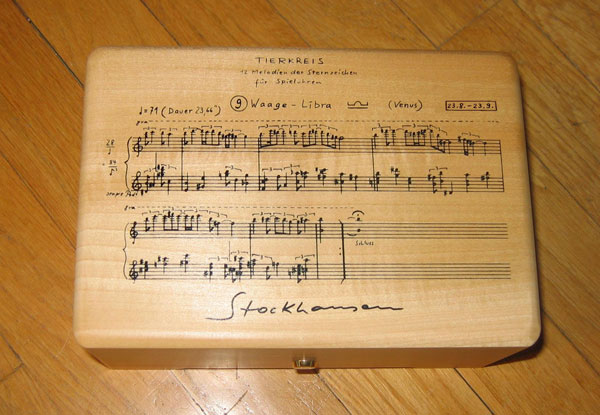
We now remember Karlheinz Stockhausen as a pioneer of electronic music, laboring away in studios dominated by hulking early synthesizers and tape machines toward a new sonic experience, but he wrote his most popular work for much humbler devices: music boxes. Composed in 1974 and 1975, Tierkreis, the German word for zodiac, consists of twelve melodies, each representing a sign on that astrological calendar, each centered on a different pitch, each played on its own dedicated music box. You can hear (and see) all of the Tierkreis boxes in action in these videos:
Despite their simplicity, Stockhausen’s twelve- and sometimes fourteen-tone serial compositions may sound like nothing you ever heard come out of a music box in childhood. But children must have made up a significant part of their early audience: these melodies made their debut as part of the fairy-tale music theater piece called Musik im Bauch, or “Music in the Belly,” a phrase Stockhausen used to describe the noises that would issue from the insides of his young daughter Julika, to her great delight. After coming up with the twelve melodies, quite possibly the first music ever originally composed for the music box, he had to order the boxes themselves custom-made from the Swiss manufacturer Reuge. You can see an original Tierkreis box, playing the Aries melody, in the video below.
Reuge, according to Dangerous Minds’ Oliver Hall, “continued to manufacture the zodiac boxes into the eighties. In ‘98, Stockhausen-Verlag produced a limited run for the composer’s 70th birthday, followed by another series in 2005. The Pisces, Aries and Sagittarius boxes are sold out, but the shop still has a few of the others left at €310 a piece.” Pricey, certainly, but what a gift they would make for musically inclined friends born under the other zodiac signs, given that Stockhausen, writes All Music Guide’s Robert Kirzinger, “carefully considered the characteristics of each sign and each month of the year, as well as the personalities of people he knew were born under a particular sign, in composing this work.” Such a compositional scheme may strike astrological non-believers as odd, but remember: this was back in the age of Aquarius.
Related Content:
Based in Seoul, Colin Marshall writes and broadcasts on cities and culture. His projects include the book The Stateless City: a Walk through 21st-Century Los Angeles and the video series The City in Cinema. Follow him on Twitter at @colinmarshall or on Facebook.
Read More...Jurassic Park Without Dinosaurs: Watch Humans Stare in Amazement at a World Stripped of CGI Creations
How many times have you encountered an otherwise perfect view spoiled by a newly erected high rise, a construction crane, or a CGI brachiosaurus?
Constantly, right?
Video editor William Hirsch makes light work of Jurassic Park’s primary attractions’ first appearance, literally erasing them from the scene.
Hirsch estimated that it took him about a week to get rid of those pesky ‘saurs using nothing fancier than After Effects’s built in tools, which include the motion tracking software Mocha.
It’s equal parts ridiculous and lovely to see humans suddenly thunderstruck by the unspoiled landscape they’ve been driving through.
These days, of course, Laura Dern would have to glance up from her phone, not a paper map.
Though it’s not such a stretch to imagine Jurassic Park’s author’s successor, the late Michael Crichton’s literary heir, hard at work on a dystopian novel titled Park.
At the time of its release, Jurassic Park’s dinosaurs were a special effects game changer. Their numbers were supplemented by some non-computer-generated animatronic models, though no doubt Spielberg was apprehensive given the way his robotic sharks acted up on the set of Jaws. The human players may have had more screen time, but the dinosaurs’ 15 minutes of footage has resulted in a lasting fame, extending decades beyond the expected 15 minutes.
Unexpectedly, Hirsch’s dinosaurs, or rather, lack thereof, have generated the most excitement with regard to his project. But his attention to detail is also laudable. Above, he reveals how he tweaked the access badge dangling from the rear view mirror of the park’s all-terrain vehicle.
Are we wrong to think that John Williams’ swelling original score feels more organic in this dinosaur-free context? Rivers, trees, and vast amounts of skies have been known to spur composers to such heights.
The potentially lethal prehistoric beasts are out of the way, but that line “We’re gonna make a fortune with this place” retains an air of ominous foreshadowing, given the plentiful natural resources on display. Sometimes humans can do more damage than dinosaurs.
If that feels too intense, you can also retreat to the escapist pleasures of the original, below.
Related Content:
Captivating GIFs Reveal the Magical Special Effects in Classic Silent Films
Game of Thrones: A Great Behind-the-Scenes Look at The Show’s Visual Effects
The Blade Runner Promotional Film
Ayun Halliday is an author, illustrator, theater maker and Chief Primatologist of the East Village Inky zine. Join her in NYC on Monday, October 15 for another monthly installment of her book-based variety show, Necromancers of the Public Domain. Follow her @AyunHalliday.
Read More...Brian Eno Reveals His Favorite Film Soundtracks
Think of “interviewing Brian Eno” (listen to it here) like a piece of his generative music. Yes, the man has no problems talking and actually encourages it. But input the same old questions about those same four albums (you know them, right?) and you get the same old answers as output. Feed in a completely different subject–like his favorite film soundtracks–and lo and behold, a very intriguing 80 minutes follows.
That’s what happened when Hugh Cornwell (lead vocalist of The Stranglers) interviewed Mr. Peter George St John le Baptiste de la Salle Eno–that’s Brian to you–in 2013 for his short-lived internet radio show on film.
Eno has always had an interest in film. As he mentions in the second half of the show, he produced his 1976/78 album Music for Films not for any specific film, but in the hopes that they would be used for soundtracks in the future. Also, he hoped that the descriptive titles–“Alternative 3,” “Patrolling Wire Borders”–and the evocative music would lead listeners to create films in their heads. Since then every track has been used at least once, and documentarians like Adam Curtis have used Eno to great effect.
The only track, he reveals, on that album to be written for a film was closer “Final Sunset” put to great, transcendent use in Derek Jarman’s 1976 film Sebastiane.
But if you think Eno might choose similar ambient tracks or instrumentals during the rest of the interview, you’re in for a surprise.
As he grew up, Eno had no exposure to what was “cool” and what was not. And that led to an ear that heard things stripped of cultural context. When he plays a track from the musical Oklahoma called “The Farmer and the Cowboy,” we might just be able to put aside our memories of high school productions and hear the weird, humorous and very exciting vocal arrangement underneath. Similarly, despite not being the biggest fan of Elvis Presley at the time (“I was a snob,” Eno says), he selects this jaunty pop number “Didja Ever” from G.I. Blues. “One of the wittiest, cleverest bits of writing,” as he calls it, written by Sid Wayne and Sherman Edwards, who wrote at least one song in every subsequent Presley movie.
Eno also has space for the jazz of Miles Davis and the evocative score for Louis Malle’s 1961 film Elevator to the Gallows, in particular how it was recorded: improvised live while watching the screen. (Not mentioned: its huge influence on Angelo Badalamenti’s Twin Peaks soundtrack.)
There’s much more in the interview to check out, including the source of a sample used in My Life in the Bush of Ghosts and one of David Bowie’s best but most underrated songs. Listen here.
Related content:
Brian Eno’s Advice for Those Who Want to Do Their Best Creative Work: Don’t Get a Job
The “True” Story Of How Brian Eno Invented Ambient Music
Ted Mills is a freelance writer on the arts who currently hosts the artist interview-based FunkZone Podcast and is the producer of KCRW’s Curious Coast. You can also follow him on Twitter at @tedmills, read his other arts writing at tedmills.com and/or watch his films here.
Read More...Support Us
We're hoping to rely on loyal readers, rather than erratic ads. Please click the Donate button and support Open Culture. You can use Paypal, Venmo, Patreon, even Crypto! We thank you!

About Us

Open Culture scours the web for the best educational media. We find the free courses and audio books you need, the language lessons & educational videos you want, and plenty of enlightenment in between.
Advertise With Us

FREE UPDATES!
GET OUR DAILY EMAIL
Get the best cultural and educational resources on the web curated for you in a daily email. We never spam. Unsubscribe at any time.
FOLLOW ON SOCIAL MEDIA

Open Culture editor Dan Colman scours the web for the best educational media. He finds the free courses and audio books you need, the language lessons & movies you want, and plenty of enlightenment in between.
Advertise With Us

