How the Ancient Mayans Used Chocolate as Money

We’ve had hundreds and hundreds of years to get used to money in the form of coins and bills, though exactly how long we’ve used them varies quite a bit from region to region. Of course, some spots on the globe have yet to adopt them at all, as anyone who’s heard the much-told story of the Yap islanders and their huge limestone discs knows. But the history of money is, in essence, the history of bartering — trading something you have for something you want — becoming more and more abstract; now, with digital crypto-currencies like Bitcoin, it looks like money will ascend one level of abstraction higher. But to imagine what a truly non-abstract currency looks like, just look at the ancient Mayan civilization, the members of which paid their debts with chocolate.
“The ancient Maya never used coins as money,” writes Science’s Joshua Rapp Learn. “Instead, like many early civilizations, they were thought to mostly barter, trading items such as tobacco, maize, and clothing.” Thanks to the work of archaeologist Joanne Baron, a scholar of murals, ceramic paintings, carvings and other objects depicting life in the Classic Maya period which ran from around 250 BC to 900 AD, we’ve now begun to learn how chocolate took on a major, money-like role in the Maya’s economy.
Some images depict cups of chocolate itself, which the Mayans usually enjoyed in the form of a hot drink, being accepted as payment, and others show chocolate traded in the coin-like form of “fermented and dried cacao beans.” In many scenes, Maya leaders receive their tributes (or taxes) most often in the form of “pieces of woven cloth and bags labeled with the quantity of dried cacao beans they contain.”
Cacao beans eventually became such a valuable currency “that it was evidently worth the trouble to counterfeit them,” writes Smithsonian’s Josie Garthwaite in an article about the early history of chocolate (a subject about which you can learn more in the TED-ed video above). “At multiple archaeological sites in Mexico and Guatemala,” she quotes anthropologist Joel Palka as saying, “researchers have come across remarkably well-preserved ‘cacao beans’ ” that turn out to be made of clay. “Some scholars believe drought led to the downfall of the Classic Maya civilization,” Learn notes, and according to Baron, “the disruption of the cacao supply which fueled political power may have led to an economic breakdown in some cases.” That may sound strangely familiar to those of us who — even here in the 21st century, among the many who have gone nearly cashless and may soon not even need a credit card — have breakdowns of our own when we can’t get our chocolate.
Related Content:
The Marvelous Health Benefits of Chocolate: A Curious Medical Essay from 1631
Making Chocolate the Traditional Way, From Bean to Bar: A Short French Film
Modern Artists Show How the Ancient Greeks & Romans Made Coins, Vases & Artisanal Glass
Bitcoin, the New Decentralized Digital Currency, Demystified in a Three Minute Video
Based in Seoul, Colin Marshall writes and broadcasts on cities, language, and culture. His projects include the book The Stateless City: a Walk through 21st-Century Los Angeles and the video series The City in Cinema. Follow him on Twitter at @colinmarshall or on Facebook.
Read More...You’re Only As Old As You Feel: Harvard Psychologist Ellen Langer Shows How Mental Attitude Can Potentially Reverse the Effects of Aging
You’re only as old as you feel, right? The platitude may be true. In a scientifically verifiable sense, “feeling”—a state of mind—may not only determine psychological well-being but physical health as well, including the natural aging processes of the body.
Harvard psychologist Ellen Langer has spent decades testing the hypothesis, and has come to some interesting conclusions about the relationship between mental processes and bodily aging. In order to do the kind of work she has for decades, she has had to put aside the thorny “mind-body” problem—a longstanding philosophical and practical impasse in figuring out how the two interact. “Let’s forget about how you get from one to the other,” she tells CBS This Morning in a 2014 interview above, “and in fact see those as just words…. Wherever you’re putting the mind, you’re necessarily putting the body.”
What happens to the one, she theorized, will necessarily affect the other. In a 1981 experiment, which she called the “counterclockwise study,” she and her research team placed eight men in their late 70s in a monastery in New Hampshire, converted to transport them all to 1959 when they were in their prime. Furniture, décor, news, sports, music, TV, movies: every cultural reference dated from the period. There were no mirrors, only photos of the men in their 20s. They spoke and acted as though they had traveled back in time and gotten younger.
The results were extraordinary, almost too good to be true, she felt. “On several measures,” The New York Times reported in 2014, “they outperformed a control group that came earlier to the monastery but didn’t imagine themselves back into the skin of their younger selves, though they were encouraged to reminisce.” The “counterclockwise” participants “were suppler, showed greater manual dexterity and sat taller…. Perhaps most improbably, their sight improved” as well as their hearing. Given the seemingly miraculous outcomes, tiny sample size, and the unorthodoxy of the experiment, Langer decided not to publish at the time but continued to work on similar studies looking at how the mind affects the body.
Then, almost thirty years later, the BBC contacted her about staging a televised recreation of the monastery experiment, “with six aging former celebrities as guinea pigs,” who were transported back to 1975 by similar means. The stars “emerged after a week as apparently rejuvenated as Langer’s septuagenarians in New Hampshire.” These experiments and several others Langer has conducted over the years strongly suggest that chronological age is not a linear clock pushing us inexorably toward decline. It is, rather, a collection of variables that include psychological well-being and something called an “epigenetic clock,” a mechanism that UCLA geneticist Steve Horvath has discovered directly correlates with the aging process, and may show us how to change it.
But while Horvath has yet to answer several pressing questions about how certain genetic mechanisms interact, Langer has put such questions aside in favor of testing the mind-body connection in a series of experiments, which engage the aging—or people with specific conditions—in studies that stretch their minds. By creating illusions like the monastery time machine, Langer has found that perception has a significant effect on aging. If we perceive ourselves to be younger, healthier, more capable, more vibrant, despite the messages about how we should look and act at our chronological age, then our cells and tissues get the message. Not only can a change in perception affect aging, but also, Langer theorizes, obesity, cancer, diabetes, and other chronic or life-threatening conditions. Much of her research here gets spelled out in her book, Counterclockwise: Mindful Health and the Power of Possibility.
“Whether it’s about aging or anything else,” says Lager, “if you are surrounded by people who have certain expectations for you, you tend to meet those expectations, positive or negative.” The social expectation for the aging is that they will get weaker, less capable, and more prone to deterioration and illness. Ignoring these expectations and changing our perception of what chronological age means—and doesn’t mean—Langer says, seems to actually slow or partially reverse the decline and to ward off disease. Those psychological changes can come about through interventions like caring for children, plants, or animals and using mindfulness practices to learn how to be attentive to change.
You can read more about Langer and Horvath’s specific findings on aging, psychology, and epigenetics at Nautilus.
Note: you can get Langer’s book–Counterclockwise Mindful Health and the Transformative Power of Possibility–as a free audiobook through Audible.com’s free trial program. Get more details on the free trial here.
Related Content:
Josh Jones is a writer and musician based in Durham, NC. Follow him at @jdmagness
Read More...Banksy Shreds His $1.4 Million Painting at Auction, Taking a Tradition of Artists Destroying Art to New Heights
The first time vandals defaced his sculpture, Dirty Corner, at Versailles, artist Anish Kapoor wrote an essay in which he considered his options:
Should the paint that has been thrown all over the sculpture be removed? Or should it remain and be part of the work? Does the political violence of the vandalism make Dirty Corner “dirtier”? Does this dirty political act reflect the dirty politics of exclusion, marginalisation, elitism, racism, Islamophobia?
The question I ask of myself is: can I, the artist, transform this crass act of political vandalism and violence into a creative act? Would this not be the best revenge?
Sometimes artists are the ones behind the vandalism.
Ai Weiwei starred in a 1995 black-and-white photo triptych that documents his intentional destruction of a Han Dynasty urn from his private collection.
Brothers Jake and Dinos Chapman purchased a mint condition set of Goya’s The Disasters of War, painstakingly re-rendered the victims’ heads as grotesquely cute, colorful cartoons, and exhibited the altered etchings under the title Insult to Injury.
Robert Rauschenberg sought and received permission to erase a drawing that his fellow Abstract Expressionist Willem de Kooning had given him, at his request.
Certainly, artists of all stripes have been known to eradicate their own work in fits of pique, passion, and self-reproach.
But until last week, no artist had ever vandalized their own work with such a dispassionate, pre-meditated sense of fun as Banksy, the anonymous clown prince of street art and massive scale pranks.
As you’ve likely heard by now, within seconds of his iconic Girl With Balloon (2006) selling at Sotheby’s for £1,042,000—$1.4 million—the painting began to self-destruct, thanks to a custom-built shredder the artist had pre-loaded into its frame.
No one seemed particularly distressed about it.
Auction attendees quickly scrambled to capture the moment with their cell phones.
Auctioneer Oliver Barker looks on in admirably mild confusion.
No self-appointed hero rushed forward to jam the works with an umbrella or broom handle.
The as-yet-unidentified buyer was not in the room, no doubt to their ever-lasting regret. Imagine losing out on those bragging rights!
While Sotheby’s and the buyer hammer out their unprecedented next steps, some art experts have stated that it would be possible, given the clean geometry of the cuts, to restore the canvas.
Though who would want to, given the speculation that this stunt immediately increased the value of the work, anywhere from 50% to near double the purchase price?
Perhaps the buyer will choose to finish the job and sell it off strip-by-strip.
Office supply stores will see an uptick in shredder sales to vendors selling Banksy knock-offs stencilled on subway maps.
Sotheby’s senior director, Alex Branczik, insisted that no one there was in on the joke, but The New York Times smells a rat:
The frame would presumably have been rather heavy and thick for its size, something an auction house specialist or art handler might have noticed. Detailed condition reports are routinely requested by the would-be buyers of high-value artworks. Unusually, this relatively small Banksy had been hung on a wall, rather than placed by porters on a podium for the moment of sale.
The fact that Girl with Balloon was the final item on the block is either a great piece of luck, or a bit of canny stage management on the auction house’s part. Recapturing the attendees’ attention after that stunt would be an uphill battle.
It’s doubtful that buyers will shy away from Sotheby’s as a place where highly valued artwork starts to devour itself the moment the gavel comes down. That kind of lightning strikes but once.
What may circle back to bite the venerable firm in its well padded rear is the ease with which someone in the crowd was able to activate the mayhem, using a device concealed in his bag. What’s worse, lax security or maybe lying about foreknowledge of the prank? It’s hard not to raise those as possibilities.
The man with the bag was escorted out. Not even the conspiracy theorists are pegging him as Banksy.
As for the steady-handed fellow another attendee caught calmly zooming in on his phone from the perfect angle… well, let’s just say the tabloids have picked up on his resemblance to Robin Gunningham, oft thought to be Clark Kent to Banksy’s Superman.
Banksy’s post-mortem, unlike Kapoor’s, does not suggest a man tortured by unresolved questions.
“A few years ago I secretly built a shredder into a painting, in case it was ever put up for auction,” he wrote on his Instagram. “Going, going, gone.”
Related Content:
Patti Smith Presents Top Webby Award to Banksy; He Accepts with Self-Mocking Video
Ayun Halliday is an author, illustrator, theater maker and Chief Primatologist of the East Village Inky zine. Join her in NYC on Monday, October 15 for another monthly installment of her book-based variety show, Necromancers of the Public Domain. Follow her @AyunHalliday.
Read More...The Emperor of Japan, Akihito, Is Still Publishing Scientific Papers in His 80s

State Department photo by William Ng, via Wikimedia Commons
On April 30, 2019, Emperor Akihito of Japan will abdicate, and pass the throne to his son, Crown Prince Naruhito. What will he do in his retirement? Probably the same thing he has done most of his life: make “taxonomic studies of gobies,” as the Ministry of Foreign Affairs of Japan reports, “small fish found in fresh, brackish and marine waters.” Akihito has been a member of Japan’s Ichthyological Society of Japan for decades and “published 30 papers in the society’s journal between 1963 and 1989.”
Akihito ascended the throne in 1989, at age 56, and yes, Japan still has an emperor, though—since the post-war Constitution of 1947—the constitutional monarch has no political power and serves only a ceremonial role. This has left Akihito with a lot of time to fill with scientific pursuits: to become an honorary member of the Linnean Society of London, Zoological Society of London, and Research Institute for Natural Science of Argentina, and a research associate at the Australian Museum.
Emperor Akihito remained an active scientist in his emperorship, publishing a history of science article in Nature titled “Linnaeus and taxonomy in Japan” in 2007. In 2016, Akihito appeared as first author in a study published in Gene. The second author is his younger son, Crown Prince Fumihito Akishino, who studied fish taxonomy at St. John’s College, Oxford, then completed a doctoral degree in ornithology. The prince now serves as the president of the Yamashina Institute for Ornithology and the Japanese Association of Zoological Gardens and Aquariums.
The family’s interest in science goes beyond the dabbling of bored aristocrats or a sense of noblesse oblige. Fumihito introduced tilapia to Thailand as an important food source and has helped Thai scientists expand their aquacultural research. The Emperor’s brother, Prince Masahito, is a cancer researcher who has been recognized for making significant contributions to the field, publishing in journals like Cancer Research and the Journal of the International Union Against Cancer.
The Imperial family may represent an outmoded and archaic institution, one humankind can do just as well without. But it’s refreshing to see people with such vast resources and privilege use them for the pursuit of intellectual inquiry and the betterment of human and animal life. You can read the first page of one of Emperor Akihito’s papers, “Early Cultivators of Science in Japan” at Science in which he makes a case for the global sharing of knowledge.
“Through my own study of ichthyology,” Akihito writes, “I have come to feel strongly the importance of international cooperation in conducting scientific studies. I recall with a sense of gratitude that behind each one of the papers I have published there has been the unsparing cooperation of people abroad.”
via Shahaf Peleg
Related Content:
The Entire History of Japan in 9 Quirky Minutes
Aftermath of the Tsunami in Japan
Josh Jones is a writer and musician based in Durham, NC. Follow him at @jdmagness
Read More...“Lynchian,” “Kubrickian,” “Tarantinoesque” and 100+ Film Words Have Been Added to the Oxford English Dictionary
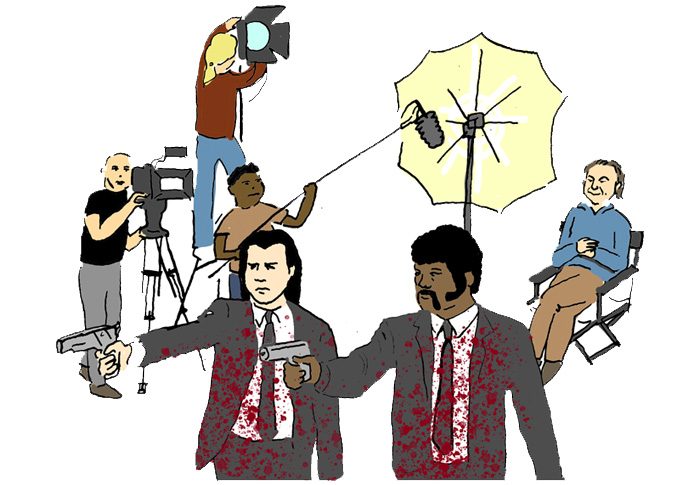
Image via Oxford English Dictionary
Get interested enough in anything, and you soon discover its language. Each subject, pursuit, and area of culture has its own slang, its own jargon, even its own grammar: that goes as well for physics and fishing as it does for cooking and cinema. Though quite specialized, the vast lexicon of that last has also contributed a great deal to English as generally used. The latest update to the venerable Oxford English Dictionary has added more than 100 of these terms, from already well-known expressions like “edge-of-your-seat,” “not in Kansas anymore,” and “blink and you’ll miss it” to the less-common likes of kaiju (the Japanese battling-monster genre that gave us Godzilla), and Foley (the art of adding incidental sounds to movies in post-production), and gorehound (an enthusiast of the gorefest, a genre whose sensibility you can well imagine).
Many of the new entries have to do with particular directors and their styles. “The list runs through a range of genres and locations, from the wide landscapes of the American West evoked by Fordian to Swedish soul-searching with Bergmanesque,” writes the OED’s Craig Leyland. The oldest, Keatonesque, “dates from 1921, near the start of an extraordinary run of success for the comic actor and film-maker, and typically refers to Keaton’s famous deadpan expression and penchant for physical comedy. The most recent is Tarantinoesque, first seen in 1994 – the year Pulp Fiction appeared in cinemas,” which refers to qualities like “graphic and stylized violence, cineliterate references, non-linear storylines, sharp dialogue, and more – and is a reminder of the impact these films had on cinema in the 1990s.”
Other auteur-specific additions include Spielbergian (“fantastical or humanist themes or a sentimental feel”), Lynchian (“noted for juxtaposing surreal or sinister elements with mundane, everyday environments”), and of course Kubrickian (“meticulous perfectionism, mastery of the technical aspects of film-making, and atmospheric visual style in films across a range of genres”). Several terms denoting broader movements and styles have also made it in, including mumblecore, “a style of low-budget film typically characterized by naturalistic and (apparently) improvised performances and a reliance on dialogue rather than plot or action” which emerged about a decade ago, and Hammer, denoting the horror films made from the 1950s to the 70s by British production company of that name, “still famous and loved for their lurid, melodramatic style.”
Master these words and you’ll surely hold your own in casual cinephile conversation. But you can only get so deep into talking about movies if you can’t confidently bring out terms like arc shot, diegetic, and mise-en-scène. As one of the most capacious art forms, cinema brings together a number of languages all at once, including the visual language as defined by directors like Soviet montage pioneer Sergei Eisenstein (he of Eisensteinian) and the language the screenplay gives its characters to speak (an especially distinctive element in the case of filmmakers like Tarantino). But those are essentially solitary pleasures, enjoyed in a darkened theater or living room. Isn’t one of the most enduring joys of filmgoing talking about the movies with other people later — and to sound as expert as possible while doing so?
Related Content:
What Makes a David Lynch Film Lynchian: A Video Essay
How the Sounds You Hear in Movies Are Really Made: Discover the Magic of “Foley Artists”
Columbia U. Launches a Free Multimedia Glossary for Studying Cinema & Filmmaking
Vintage Film Shows How the Oxford English Dictionary Was Made in 1925
Based in Seoul, Colin Marshall writes and broadcasts on cities, language, and culture. His projects include the book The Stateless City: a Walk through 21st-Century Los Angeles and the video series The City in Cinema. Follow him on Twitter at @colinmarshall or on Facebook.
Read More...When Andy Warhol Made a Batman Superhero Movie (1964)
Each of us has a favorite Batman movie. My own allegiance still lies with the one Tim Burton directed in 1989, a prototype of the modern dark superhero blockbuster in which Jack Nicholson made quite an impact as the Joker. But Heath Ledger made an even bigger one in The Dark Knight, an especially beloved entry in Christopher Nolan’s acclaimed Batman pictures of the 21st century. These days, with enough distance, some even admit to enjoying Joel Schumacher’s ultra-campy takes on Batman from the late 1990s, or their spiritual predecessor Batman: The Movie from 1966, an extension of the self-parodying television series starring Adam West. But before all of them there was Batman Dracula, directed by no less a visionary — and no less a Batman fan — than Andy Warhol.
Starring Warhol’s fellow experimental filmmaker Jack Smith in both title roles, Batman Dracula pits the Caped Crusader of comic-book fame against the vampiric Transylvanian count of legend, the millionaire vigilante who seems to fear nothing but bats against the immortal recluse who spends much of his time in the form of a bat.
Smith may bear a faint resemblance to Christian Bale, Nolan’s Batman, but there all aesthetic resemblance to the “real” Batman movies ends. Shot in black and white on various rooftops around New York and Long Island as well as in Warhol’s “Factory,” Warhol’s unauthorized approach to the material seems to get as abstract and spontaneous as most of the cinema put together by his coterie — or at least the surviving footage makes it look that way. Though Warhol did complete Batman Dracula, he only showed it at a few of his art shows before DC Comics called and demanded an immediate end to its screenings.
Nobody has found a complete print since, but you can watch a few minutes of the surviving footage cut to “The Nothing Song” by the Velvet Underground & Nico (a much more enduring product of the Factory) in the video at the top of the post. Below that we have the LowRes Wünderbred video essay “Deconstructing Andy Warhol’s Batman Dracula,” which provides more details on the making of Batman Dracula and its context in the careers of Warhol and his collaborators. The Film Histories video on Batman Dracula just above gets into how the movie opened up a “Pandora’s box” of unauthorized Batman and Batman-like movies, including The Wild World of Batwoman and the Filipino Alyas Batman at Robin. So many Batman projects, official and otherwise, now exist, and so many more remain to be made. But will any of the material’s future stewards push its artistic boundaries as much as Warhol did?
Related Content:
The Evolution of Batman in Cinema: From 1939 to Present
City of Scars: The Impressive Batman Fan Film Made for $27,000 in 21 Days
Watch Nosferatu, the Seminal Vampire Film, Free Online (1922)
Warhol’s Cinema: A Mirror for the Sixties (1989)
The Uncensored Andy Warhol-Directed Video for The Cars’ Hit “Hello Again” (NSFW)
Based in Seoul, Colin Marshall writes and broadcasts on cities, language, and culture. His projects include the book The Stateless City: a Walk through 21st-Century Los Angeles and the video series The City in Cinema. Follow him on Twitter at @colinmarshall or on Facebook.
Read More...Designer Creates a 3D-Printed Stamp That Replaces Andrew Jackson with Harriet Tubman on the $20 Bill
Above we have a very short video of a hand stamping the face of freedom fighter and abolitionist Harriet Tubman, aka Araminta Ross, over the stony mug of Andrew Jackson, aka Old Hickory, “Indian Killer,” and slaveholding seventh president of the United States who presided over the Indian Removal Act that inaugurated the Trail of Tears with a speech to Congress in which he concluded the only alternative to forcing native people off their land might be “utter annihilation.”
Hero to America Firsters, Jackson has featured on the U.S. twenty-dollar bill since 1928. Ironically, he was bestowed this honor under Calvin Coolidge, a progressive Republican president when it came to Civil Rights, who in 1924 signed the Indian Citizenship Act into law, granting all Indigenous people dual tribal and U.S. citizenship.
Anyway, you’ll recall that in 2016, Treasury Secretary Jacob Lew announced “the most sweeping and historically symbolic makeover of the American currency in a century,” as The New York Times reported, “proposing to replace the slaveholding Andrew Jackson on the $20 bill with Harriet Tubman.”
Furthermore, Lew planned to add historic feminist and Civil Rights figures to the five and ten dollar bills, an idea that did not come to fruition. But as we awaited the replacement of Jackson with Tubman, well… you know what happened. Andrew Jackson again became a figurehead of American racism and violence, and the brutal new administration walked back the new twenty. So designer Dano Wall decided to take matters into his own hands with the creation of the 3D-printed Tubman stamp. As he shows in the short clip above, the transformed bills still spend when loaded into vending and smart card machines.
Of course you might never do such a thing (maybe you just want to print Harriet Tubman faces on plain paper at home?), but you could, if you downloaded the print files from Thingiverse and made your own Tubman stamp. Wall refers to an extensive argument for the legality of making Tubman twenties. It perhaps holds water, though the Treasury Department may see things differently. In the British Museum “Curator’s Corner” video above, numismatist Tom Hockenhull shows us a precedent for defacing currency from shortly before World War I, when British suffragists used a hammer and die to stamp “Votes for Women” over the face of Edward VII.
The “deliberate targeting of the king,” writes the British Museum Blog, “could be likened to iconoclasm, a direct assault on the male authority figures that were perceived to be upholding the laws of the country.” It’s a practice supposedly derived from an even earlier act of vandalism in which anarchists stamped “Vive l’Anarchie” on coins. The process would have been difficult and time-consuming, “probably carried out by a single person using just one set of individual alphabet stamps.” Thus it is unlikely that many of these coins were made, though historians have no idea how many.
But the symbolic protest did not stand alone. The defaced currency spread the message of a broad egalitarian movement. The ease of making Tubman twenties could spread a contemporary message even farther.
via Kottke
Related Content:
Josh Jones is a writer and musician based in Durham, NC. Follow him at @jdmagness
Read More...How Joan Jett Started the Runaways at 15 and Faced Down Every Barrier for Women in Rock and Roll
These are dark days for everyone who cares about equality. After decades of painful progress and some hard-won victories for women in the U.S., the guardians of patriarchy seem hellbent on undoing modernity and setting the clock back decades to keep power. The misogynistic spectacle is nauseating. One remedy, Rebecca Traister recommends in her new book of the same name, is to get “good and mad.” The voices of women resisting the current wave of political attacks can guide righteous outrage in constructive directions, and we can learn much from women who pushed past the same barriers in the past through sheer force of will.
Women like Joan Jett, who, in a recent interview with Courtney Smith at Refinery 29 expressed her thoughts on the challenges of the present (“I think it’s still very much the same as it was many years ago”). Her advice: conquer fear.
“People count on you being fearful,” she says, “as a woman or whoever you are and whatever you want to do. They count on that fear to keep them from forging ahead and figuring that out. It’s definitely fear-inducing, and it’s not a fear you want to face. But it is doable.” The rock icon director Kevin Kerslake (who has just released a Jett documentary) calls a “feminist manifesto in the flesh” should know.
Jett herself expresses some discomfort with the label of feminism (“I’m for people being what they want to be”), but her career has served for decades as a model for women seizing power in the music industry, and she’s never had any patience with sexist discrimination. She “wanted to be a rocker ever since she got a hold of a guitar, even though she was told girls don’t play rock and roll. That didn’t stop her from forming The Runaways despite the sexist roadblocks the band faced.” So goes the description for Marc Maron’s recent interview with Jett on his WTF podcast. The ugliness women in rock faced in the 70s is depressingly familiar. Before she even learned to play, Jett was told by a guitar teacher, “girls don’t play rock and roll.”
Undaunted, she quit lessons, taught herself, and learned her favorite songs (Free’s “Alright Now” topped the list). Then, when her family moved to L.A., she sought out other like minds to form an all-girl rock band. With no examples to look to, Jett figured it out on her own, finding a club that played glam rock for teenagers and finding her people. At fifteen years old, without songs or a demo tape, she called producer Kim Fowley, then started assembling the Runaways, starting with drummer Sandy West, then, after playing as a trio with Micki Steele, recruiting lead guitarist Lita Ford, bassist Jackie Fox, and singer Cherie Currie. “We went in the studio right away,” she tells Maron.
The Runaways were “trying to express ourselves the way we knew how,” Jett says in her interview with Smith. “Not much different from what the Rolling Stones were doing. We didn’t want barriers put up on what we were allowed to sing about, say, or play.” By 1976, they were signed to Mercury Records, releasing their debut album, and touring with Cheap Trick, Van Halen, Talking Heads, and Tom Petty and the Heartbreakers. The following year, they released Queens of Noise and quickly became associated with punk. American critics savaged the band, and they faced violence and sneering condescension at home but were beloved superstars in Japan (see them play “Cherry Bomb” live in Japan at the top).
When Curry left The Runaways that year, Jett took over as the lead singer, and when the band broke up in 1979, she put herself back together, moved to New York, created her own label after a couple dozen rejections, and formed The Blackhearts. An unstoppable musical force, Jett still plays and tours and still refuses to back down for anyone, even though, she tells Smith, “on some level, it can be easier not to fight and to go along. That’s what women have to decide: do you want to go along, and maybe your life will be a little bit more comfortable if you don’t make waves?”
Her advice is as straightforward as her path has been rocky—“stand up for yourself… You’ve got to resist that. Find someone to support you…. We’re still fighting the same issues that I was discussing years ago. There’s a thing on a loop about what girls can achieve. When they come up, you’ve got to challenge those assumptions at every turn.” If anyone’s earned the right to give advice like that to young musicians, it’s Joan Jett. Check out the trailer for her new documentary Bad Reputation just above.
Related Content:
Four Female Punk Bands That Changed Women’s Role in Rock
Chrissie Hynde’s 10 Pieces of Advice for “Chick Rockers” (1994)
Josh Jones is a writer and musician based in Durham, NC. Follow him at @jdmagness
Read More...Blondie Drummer Clem Burke and Scientific Researchers Show That Drumming Can Help Kids with Autism Learn More Effectively in School
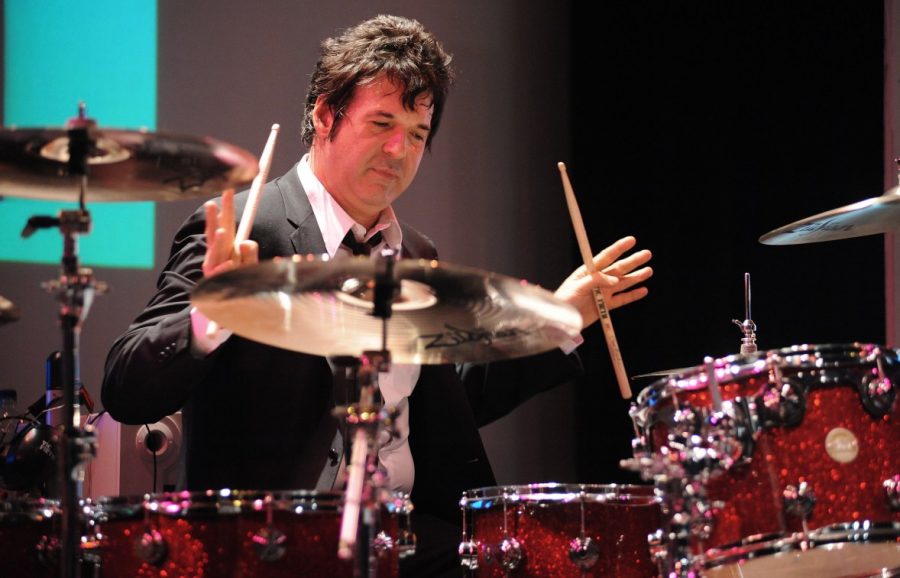
Photo via the Clem Burke Drumming Project
Musicians from classic bands take all sorts of unexpected paths in their late careers. We’ve seen Grateful Dead drummer Mickey Hart collaborate with NASA, Talking Heads frontman David Byrne take on—among a dozen other roles—the mantle of librarian, and Bruce Springsteen guitarist Steven Van Zandt become a curriculum developer. Turning musical experience to consciousness-expanding avocation has produced very admirable results—perhaps no more so than in the case of two musicians who have used the latest research on music therapy to help kids with autism.
We’ve previously featured Cheap Trick bassist Tom Petersson’s “Rock Your Speech” project, inspired by his autistic son Liam’s positive response to music. Now reports from the University of Chichester describes how drummer Clem Burke of Blondie fame has invested his celebrity into research on how drumming can help kids on the spectrum improve learning and enhance social interactions. It must be noted that Burke has not come lately to the science. His Clem Burke Drumming Project (CBDP), an association of academics, drummers, university partners, and honorary “Doctor of Rock” Burke, just celebrated its 10-year anniversary.
The project has previously researched “the physical demands of drumming; enhanced health and wellbeing of drumming; enhanced brain structure and function following drumming practice,” and other drumming-related subjects, including a drumming video game for stress relief. The latest findings, from the University of Chichester and University Centre Hartpury, show that “drumming for 60 minutes a week can benefit children diagnosed with autism.” The University of Chichester notes that preliminary results of a ten-week drumming intervention comprising two 30-minute drumming sessions per week showed:
- A vast improvement in movement control while playing the drums, including dexterity, rhythm, timing.
- Movement control was also enhanced while performing daily tasks outside the school environment, including an improved ability to concentrate during homework.
- A range of positive changes in behaviour within school environment, which were observed and reported by teachers, such as improved concentration and enhanced communication with peers and adults
These significant benefits do not apply only to students with autism; “Rock drumming,” says lead researcher and CBDP co-founder Marcus Smith, can be “a potent intervention for individuals experiencing brain disorders” of all kinds, and can also improve dexterity, rhythm, and timing (naturally).
Although a number of studies over the years have made headlines with similar claims, the Clem Burke Project’s ten years of research into the effects of drumming on brain health and behavior give this study particular weight. Still, as always in scientific research, more evidence can help refine the applications. Another researcher in the study, Dr. Ruth Lowry, sounds both excited and cautiously optimistic in her assessment of the findings, expressing hopes that more research will “provide further evidence that not only does rock drumming have positive benefits in terms of changes in dexterity and concentration but that wider social and behavioural conduct benefits can be observed.”
Maybe Dr. Clem Burke and his team should start a side project with Tom Petersson, whose musical interventions in the lives of kids with autism seem to be finding exactly such wider benefits.
Related Content:
The Neuroscience of Drumming: Researchers Discover the Secrets of Drumming & The Human Brain
Josh Jones is a writer and musician based in Durham, NC. Follow him at @jdmagness
Read More...How Youtube’s Algorithm Turned an Obscure 1980s Japanese Song Into an Enormously Popular Hit: Discover Mariya Takeuchi’s “Plastic Love”
Spend time listening to 1980s hits, Japanese pop, or disco classics on Youtube, and you’ll almost certainly encounter Mariya Takeuchi’s addictive song “Plastic Love.” Though first released in 1985 in Japan, it remained almost entirely unknown in the rest of the world until a few years ago, when it all of a sudden attained an enormous popularity. Now, having racked up more than 20 million views, the song has quite a few people — even many of those who have put it into heavy rotation on their personal playlists — asking what it is and where it came from. The video essay above, by explainer of animation and Japanese music Stevem, breaks down the history of “Plastic Love,” both as an obscure 80s Japanese pop song and an internet-era phenomenon.
“Plastic Love” has become the best-known example of “city pop,” a genre we’ve previously featured here on Open Culture and one Stevem describes as “a type of music that was reflective of the new, shiny, modern Japan” that emerged as the country’s rebuilt economy boomed in the 1970s and 80s. “Considering Japan didn’t, nor could they, have a military, some of this money was funneled into new technology: cassettes, Walkmans, VHSs, cars, TVs, video game consoles.”
The soundtrack to “the cosmopolitan lifestyle in full swing” took “bits and pieces from New Wave, synth pop, disco, jazz, and whatever else was relevant at the time and shoved them into a blender to make what could be some of the sharpest pop music to come out of the Land of the Rising Sun.”
The young Mariya Takeuchi was one of the era’s first defining pop idols. Scoring a number-one album in 1980, she lowered her profile over the next few years, marrying the singer-songwriter Tatsuro Yamashita (now recognized as a city pop icon in his own right) and collaborating with him on an album called Variety, with which she re-emerged in 1984, retaking the top spots on the Japanese charts. “Plastic Love” comes as its second track, laying down a “shimmering hypnotic groove, striking you with its beat and never letting go.” Not only “a meditation on heartbreak, it really speaks to the hollow, plastic feeling of what people do to fill in the sorrows of their life and loneliness,” acts such as “buying commercial goods in the hopes that they will make us feel more and avoid dealing with our own personal anguish.”
Whatever the song’s musical strengths, it took an algorithm to bring them to worldwide attention. Youtube, which 80s Japanese pop enthusiasts discovered early as a way of sharing their music, has become a veritable “record store in the digital space, affecting how people define their taste in the modern era, mass-producing the feeling of finding these obscure gems on your own in a way that feels natural, doing it so well with the puppet strings that you don’t even see them.” “Plastic Love,” as Vice’s Ryan Basil puts it, “is a rare tune that doesn’t exactly need words to expertly describe a specific, defined feeling – one of lust, heartbreak, love, fear, adventure, loss, all caught up in the swirling midst of a night out on the town.” Countless music fans here in the 21st century — living in Takeuchi’s homeland Japan, elsewhere in Asia as I do, in the West, or anywhere besides — can now make the surprising declaration he does: “It is, at the moment, my favorite pop song in the world.”
Related Content:
Based in Seoul, Colin Marshall writes and broadcasts on cities, language, and culture. His projects include the book The Stateless City: a Walk through 21st-Century Los Angeles and the video series The City in Cinema. Follow him on Twitter at @colinmarshall or on Facebook.
Read More...Support Us
We're hoping to rely on loyal readers, rather than erratic ads. Please click the Donate button and support Open Culture. You can use Paypal, Venmo, Patreon, even Crypto! We thank you!

About Us

Open Culture scours the web for the best educational media. We find the free courses and audio books you need, the language lessons & educational videos you want, and plenty of enlightenment in between.
Advertise With Us

FREE UPDATES!
GET OUR DAILY EMAIL
Get the best cultural and educational resources on the web curated for you in a daily email. We never spam. Unsubscribe at any time.
FOLLOW ON SOCIAL MEDIA

Open Culture editor Dan Colman scours the web for the best educational media. He finds the free courses and audio books you need, the language lessons & movies you want, and plenty of enlightenment in between.
Advertise With Us


