R. Crumb Illustrates Jean-Paul Sartre’s Nausea: Existentialism Meets Underground Comics
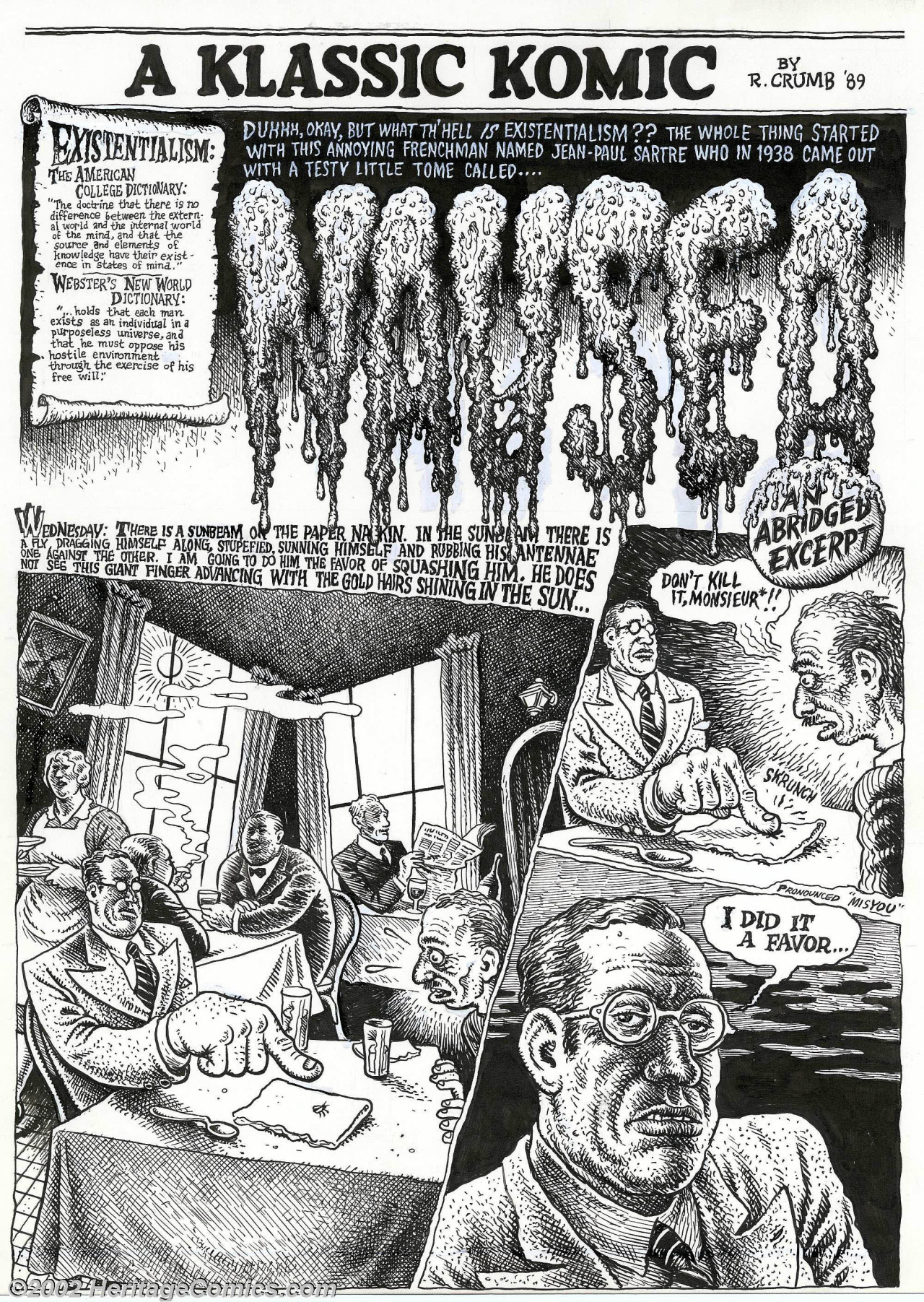
Sartre’s novel Nausea introduced his philosophical view as a form of illness to a WWII readership. “Nausea is existence revealing itself—and experience is not pleasant to see,” he wrote in his own summary of his first book, published in 1938. The novel’s dramatization of Historian Roquentin’ s crisis presents a case of existential sickness as mostly involuntary.
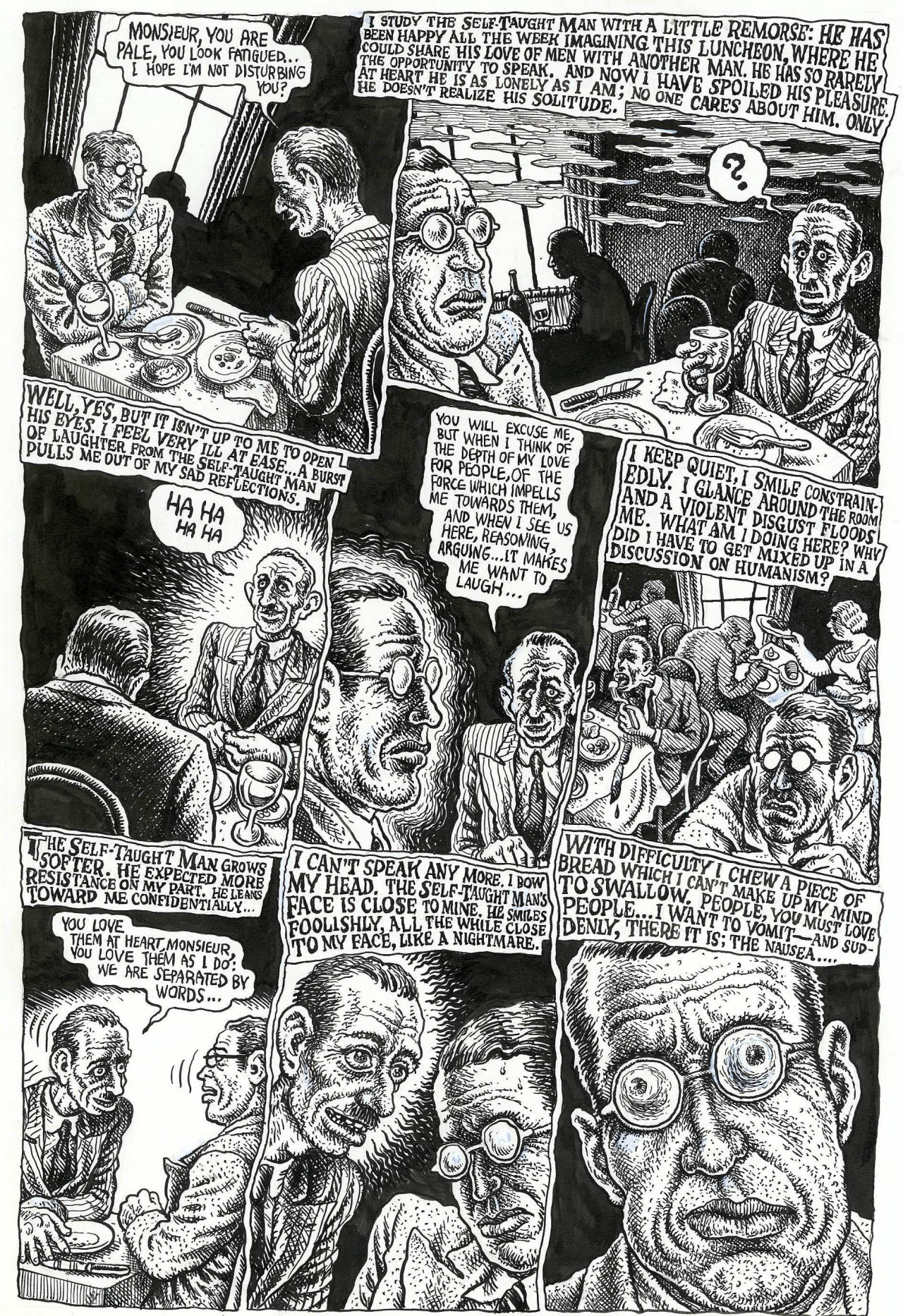
Though published before his many Marxist books and essays, Nausea connects the malaise to a certain class experience. “I have no troubles,” thinks Roquentin in Robert Crumb’s short adaptation of the book above, “I have money like a capitalist, no boss, no wife, no children; I exist, that’s all…. And that trouble is so vague, so metaphysical that I am ashamed of it.” Nausea, in one sense, is bourgeoise alienation, while Roquentin’s conversation partner, the Self-Taught Man, confesses a naïve humanist idealism.
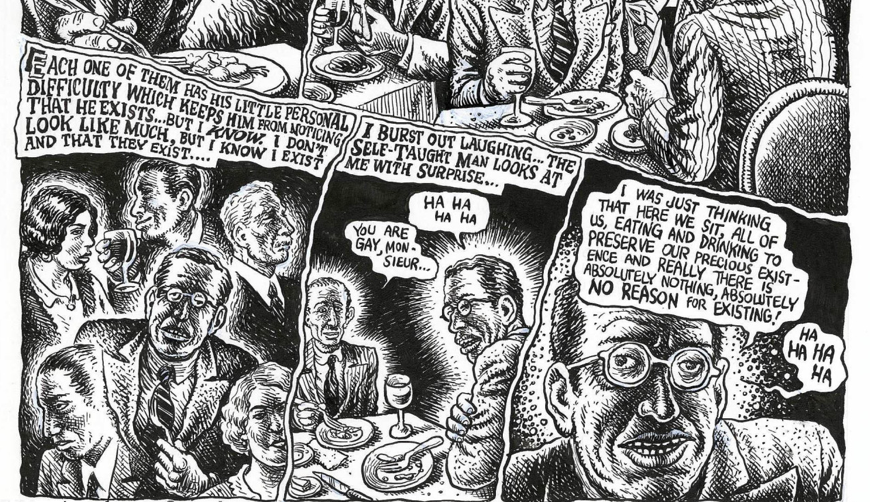
The characters alone, some critics suggest, imbue the book with a subtle parody. As he listens to the Self-Taught Man’s troubles and ruminates on his own, Crumb’s Roquentin grows more Sartre-like. Significantly, the Self-Taught Man takes on a Crumb-like demeanor and aspect. Their dialogue moves briskly, the scene resembling My Dinner with Andre with less banter and more neurosis. Sartre’s tone lends itself well to Crumb’s obsessive, tightly-composed panels.
Crumb’s literary interpretations have gravitated toward other anxious writers like Charles Bukowski and Franz Kafka, as well as the murder and incest of the book of Genesis. The underground comics legend is right at home with Sartrean dread and despair. Crumb became famous for Fritz the Cat, an animated film version of his raunchy hipster, what many called his grossly sexist and racist sex fantasies, and the drawing and slogan “Keep on Truckin’.” He was a figure of 60s and 70s counterculture, but that’s never where he belonged.
Crumb was a Sartrean protagonist , even when he “often portrayed himself in his work as naked… and priapic.” In an an interview with Crumb The Guardian describes him:
his words are depressive and lugubrious, and yet he appears mellow, laughing easily through his existential nausea. The most terrible stories amuse him as much as they pain him. He tells me how a best friend killed himself by swallowing four bottles of paper correction fluid, and he chortles. He talks of his own despair, and giggles. He admits that he could never have imagined a life quite so fulfilled—with Aline, and his beloved daughter Sophie, also a cartoonist, and success and money—and says he’s still miserable as hell, and laughs.
He is a little Roquentin, a little bit Sartre, a little bit Self-Taught man, applying to his reading of literature and philosophy an LSD-assisted, sex-positive, and unavoidably controversial and depressive sensibility. See the full Crumb-illustrated Nausea here.
Related Content:
R. Crumb Describes How He Dropped LSD in the 60s & Instantly Discovered His Artistic Style
Josh Jones is a writer and musician based in Durham, NC. Follow him at @jdmagness
Read More...Paul McCartney Breaks Down His Most Famous Songs and Answers Most-Asked Fan Questions in Two New Videos
Paul McCartney has played it safe for decades, relying on the brilliance of his songwriting and musicianship, which no one ever doubts and so he never has to prove. His songs usually fall into a formula familiar from Beatles’ days: “silly love songs,” writes Stephen Earlewine at Pitchfork, “mini-suites… polite political protests, and old-fashioned rockers.” But while the Beatles had each other, the experiments of George Martin, LSD, transcendental meditation, and a moment of perfect cultural kismet to twist and warp their music into all sorts of weird shapes, McCartney’s solo releases tend to stick to his established strengths, sometimes to the detriment of what can happen when he moves out of his comfort zone to get deeper and more vulnerable.
Yet as nearly every critic has so far noted of his newest album, Egypt Station—which he heavily promoted, for example, with an appearance on Carpool Karaoke and a “secret” show at Grand Central Station—McCartney lets listeners in on some surprising confessional darkness. The Nick Drake-like lyrics of opener “I Don’t Know” show him earnestly confronting aging, mortality, and depression, without any of the usual sunniness or comedic turns of phrase: “I got crows at my window/Dogs at my door/I don’t think I can take anymore.” The candid admission, Erlewine writes, “would be startling in any context, but what stings most is the tacit acknowledgment that 76-year-old McCartney realizes he’s nearing the end of his long, winding road.”
In interviews, like his latest with Rolling Stone, however, McCartney sounds as upbeat as ever. He describes sitting in Apple meetings after the breakup of the Beatles as “like seeing the death of your favorite pet,” but he also enthuses about his patched-up relationship with Yoko (“Now it’s like we’re mates”), love for his band—who have now been playing together longer than both the Beatles and Wings—and his pride in his musical legacy (“It’s a damn good job I did”). He sounds just as pleased to be onstage in his mid-70s as he was in his 20s—the genuine love of performing and engaging with fans hasn’t dulled one bit with age, just as his ability to write and sell hit records remains solid.
As for his time-tested formula, Erlewine comments, it only “makes the moments where Paul attempts something slightly new seem all the more apparent.” One new thing he’s gamely tried in recent years is making online videos for fans. A few years back, he dropped a few lessons showing how to play the bass and guitar parts on “Ever Present Past” from 2007’s Memory Almost Full. This year, McCartney’s fan service includes the two videos here. First at the top, he spends almost a half an hour discussing the best-known songs in his 60-year-career for GQ: “I Lost My Little Girl,” “Yesterday,” “I Saw Her Standing There,” “And I Love Her,” “Eleanor Rigby,” “A Day in the Life,” “Hey Jude,” “Helter Skelter,” “Blackbird,” “Let It Be,” “Hi Hi Hi,” “Here Today,” “Jet,” and Egypt Station’s “I Don’t Know.”
Above, McCartney accept’s Wired’s “autocomplete challenge,” answering the internet’s most searched questions about himself, such as “Why is Paul McCartney’s nickname ‘Macca’?” and “Why did Paul McCartney write ‘Let it Be’?” (Answers: “Cause I’m from Liverpool, and they abbreviate everything in Liverpool” and he was “a bit stressed out”—and a little high—and his mother came to him in a dream with the advice: “just let it be.”) Is there always more learn about Paul McCartney? Yes, apparently there is. But even when he repeats himself, he’s still great fun to watch.
Related Content:
Chaos & Creation at Abbey Road: Paul McCartney Revisits The Beatles’ Fabled Recording Studio
The Genius of Paul McCartney’s Bass Playing in 7 Isolated Tracks
Paul McCartney Offers a Short Tutorial on How to Play the Bass Guitar
Josh Jones is a writer and musician based in Durham, NC. Follow him at @jdmagness
Read More...Umberto Eco Explains Why We Make Lists
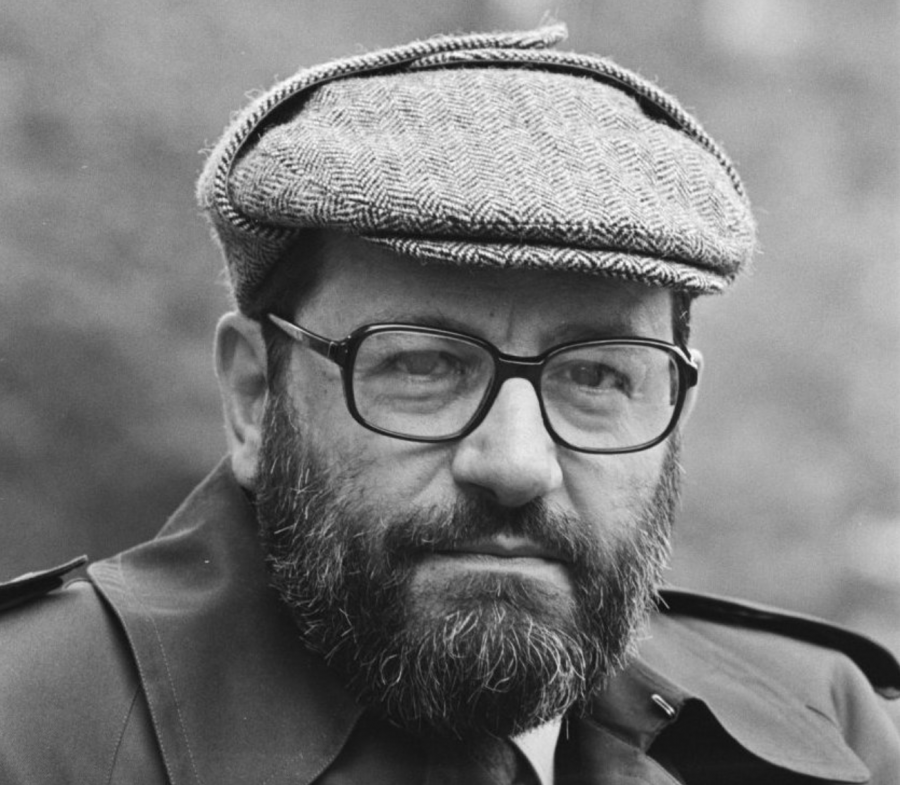
Creative Commons image by Rob Bogaerts, via the National Archives in Holland
We hate lists, which have told us what to do since at least the days Leonardo da Vinci, and which now, as “listicles,” constitute one of the lowest strata of internet content. But we also love lists: a great many of us click on those listicles, after all, and one might argue that the list, as a form, represents the beginning of written texts. “The list is the origin of culture,” said Umberto Eco in a 2009 Der Spiegel interview about the exhibition on the history of the list he curated at the Louvre. “It’s part of the history of art and literature. What does culture want? To make infinity comprehensible. It also wants to create order — not always, but often.”
How, as mere human beings, do we impose order when we gaze up into infinity, down into the abyss — pick your metaphor of the sublimely, incomprehensibly vast? We do it, Eco thought, “through lists, through catalogs, through collections in museums and through encyclopedias and dictionaries.” The breadth as well as depth of the knowledge he accumulated throughout his 84 years — which itself could seem sublimely and incomprehensibly vast, as anyone who has read one of his list-filled novels knows — placed him well to explain the origins, functions, and importance of the list. In the Spiegel interview he names Don Giovanni’s 2,063 lovers, the contents of Leopold Bloom’s drawers, and the many ships and generals specified in the Iliad as just a few of the classic lists and enumerations of Western culture.
Eco’s research into and/or obsession with lists produced not just the exhibition at the Louvre but also a book, The Infinity of Lists: An Illustrated Essay. Did it also lead him to any other answers about why, whether in the Middle Ages with its “very clear image of the universe,” the Renaissance and Baroque eras with their “worldview based on astronomy,” the “postmodern age” in which we live today, or any other time, “the list has prevailed over and over again?” Ultimately, we make lists whenever we experience a “deficiency of language,” such as when lovers describe one another (“Your eyes are so beautiful, and so is your mouth, and your collarbone”) or when we remember the “very discouraging, humiliating limit” of death. Making lists of things that seem infinite is “a way of escaping thoughts about death. We like lists because we don’t want to die.”
Having died in 2016 himself, Eco left behind an immense personal library (his walkthrough of which we’ve previously featured here on Open Culture). “It might actually be 50,000 books,” he said to the Spiegel interviewer, but he refused to put them on a list and find out for sure: “When my secretary wanted to catalogue them, I asked her not to. My interests change constantly, and so does my library.” If he were to try to list his interests, he would have had to keep scrapping the list and drawing up a new one; more than providing abundant material for his writing, this constant and lifelong circulation of fascinations (he mentioned first loving Chopin at 16, and again in his seventies) confirmed his engagement with the infinite world around him: “If you interact with things in your life, everything is constantly changing. And if nothing changes, you’re an idiot.”
Related Content:
Umberto Eco Explains the Poetic Power of Charles Schulz’s Peanuts
Umberto Eco Makes a List of the 14 Common Features of Fascism
Watch Umberto Eco Walk Through His Immense Private Library: It Goes On, and On, and On!
Umberto Eco Dies at 84; Leaves Behind Advice to Aspiring Writers
Leonardo Da Vinci’s To Do List (Circa 1490)
Based in Seoul, Colin Marshall writes and broadcasts on cities and culture. His projects include the book The Stateless City: a Walk through 21st-Century Los Angeles and the video series The City in Cinema. Follow him on Twitter at @colinmarshall or on Facebook.
Read More...A Massive, Knitted Tapestry of the Galaxy: Software Engineer Hacks a Knitting Machine & Creates a Star Map Featuring 88 Constellations
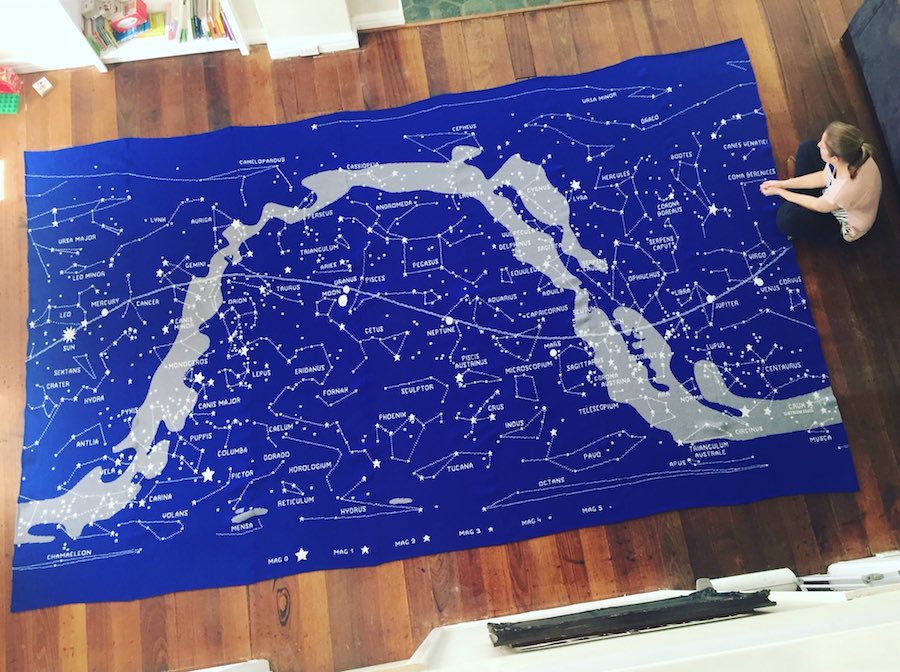
The next time some non-crafty type disparages your hobby as a frumpy pursuit, show them software engineer Sarah Spencer’s “Stargazing.”
The 9’x 15’ knitted tapestry is an accurate equatorial star map featuring all 88 constellations as viewed by the naked eye, including the Milky Way and the Southern Cross, the best known star group in Spencer’s native Australia.
The project ate up 33 pounds of Australian wool in three shades, including the same ultramarine blue sported by a number of accomplished Australian women whose portraits are on display as part of the 2018 Archibald Prize.
While “Stargazing” is machine knit, its creation took longer than most hand-knitted projects.
What started as a lark, hacking and programming a 40-year-old, secondhand Empisal knitting machine, grew into something much larger when Spencer developed a computer algorithm that allowed one tri-colored knit stitch per pixel.
Years later, she was ready to start knitting her star map, a reflection of her interest in STEM—science, technology, engineering, and mathematics.
“Stargazing” is actually comprised of seven panels, each the result of dusk-to-dawn labor on the part of the hacked machine. Stitching them together required many more human hours.
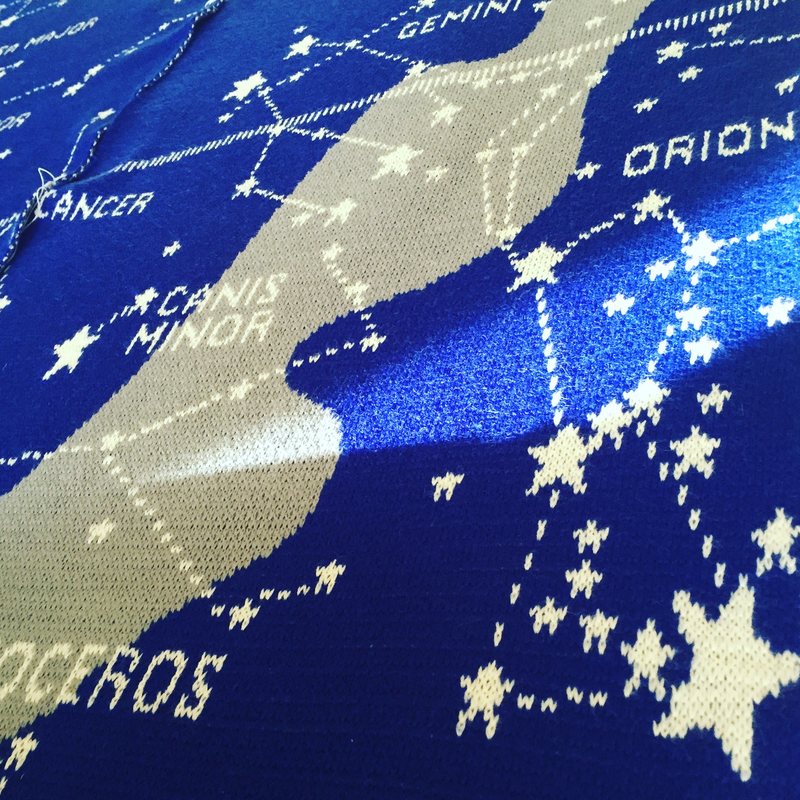
The piece was unveiled at the UK’s tech-and-arts festival, Electromagnetic Field, on August 31. Spencer had calibrated the placement of the tapestry’s planets to correspond with their celestial counterparts’ locations that night.
For now, the tapestry is one-of-a-kind, but given its industrial origins, it’s not hard to foresee a future in which couples can cuddle under astronomically correct afghans, while gazing up at the stars.
Related Content:
Free Online Astronomy Courses
The Ancient Astronomy of Stonehenge Decoded
Ayun Halliday is an author, illustrator, theater maker and Chief Primatologist of the East Village Inky zine. Join her in NYC on Monday, September 24 for another monthly installment of her book-based variety show, Necromancers of the Public Domain. Follow her @AyunHalliday.
Read More...How the Grateful Dead’s “Wall of Sound”–a Monster, 600-Speaker Sound System–Changed Rock Concerts & Live Music Forever
There is a scene in Return of the Jedi when Luke Skywalker defeats the monstrous, man-eating Rancor, crushing its skull with a portullis, and we see the beast’s keeper, a portly shirtless gentleman in leather breeches and headgear, weeping over the loss of his beloved friend. I think of this scene when I read about a night in 1974 at San Francisco’s Winterland Ballroom when Grateful Dead drummer Mickey Hart walked on the stage and found the band’s sound engineer Owsley “Bear” Stanley standing in front of “a solid wall of over 600 speakers.”
As Enmore Audio tells it:
Tears streamed down his face and he whispered to the mass of wood, metal, and wiring, with the tenderness of any parent witnessing their child’s first recital, “I love you and you love me—how could you fail me?”
The story sums up Owsley’s total dedication to what became known as “The Wall of Sound,” a feat of technical engineering that “changed the way technicians thought about live engineering.” The “three-story behemoth… was free of all distortion… served as its own monitoring system and solved many, if not all of the technical problems that sound engineers faced at that time.” But, while it had required much trial and error and many refinements, it did not fail, as you’ll learn in the Polyphonic video above.
Live sound problems not only bedeviled engineers but bands and audiences as well. Throughout the sixties, rock concerts grew in size and scope, audiences grew larger and louder, yet amplification did not. Low-wattage guitar amps could hardly be heard over the sound of screaming fans. Without monitoring systems, bands could barely hear themselves play. This “noise crisis,” writes Motherboard, “confronted musicians who went electric at the height of the war in Vietnam,” but it has been “routinely snuffed from the annals of modern music.”
In dramatic recreations of the period, drums and guitars boom and wail over the noise of stadium and festival crowds. For ears accustomed to the power of modern sound systems, the actual experience, by contrast, would have been underwhelming. Most Beatles fans know the band quit touring in 1966 because they couldn’t hear themselves over the audience. Things improved somewhat, but the Dead, “obsessed with their sound to compulsive degrees,” could not abide the noisy, feedback-laden, underpowered situation. Still, they weren’t about to give up playing live, and certainly not with Owsley on board.
“A Kentucky-born craftsman and former ballet dancer”—and a manufacturer and distributer of “mass quantities of high-grade LSD,” whose profits financed the Dead for a time—Owsley applied his obsession with “sound as both a concept and a physical thing.” To solve the noise crisis for the Dead, he first built an innovative sound system in 1973 (after serving a couple stints in prison for selling acid). The following year, he suggested putting the PA system behind the band, “a crazy idea at the time.”
His experiments in ‘74 evolved to include line arrays—“columns of speakers… designed to control the dispersion of sound across the frequency range”—noise-canceling microphones to clear up muddy vocals, six separate sound systems that could isolate eleven channels, and a quadraphonic encoder for the bass, “which took a signal,” Enmore notes, “from each string and projected it through its own set of speakers.” The massive Wall of Sound could not last long. It had to be streamlined into a far more manageable and cost-effective touring rig. All the same, Owsley and the band’s willingness take ideas and execution to extreme lengths changed live sound forever for the better.
Related Content:
11,215 Free Grateful Dead Concert Recordings in the Internet Archive
The Grateful Dead’s Final Farewell Concerts Now Streaming Online
Josh Jones is a writer and musician based in Durham, NC. Follow him at @jdmagness
Read More...Queen’s “Bohemian Rhapsody” Played by 28 Trombone Players
28 trombone players got together and played Queen’s beloved 1975 hit, “Bohemian Rhapsody.” They call it, “Bonehemian Rhapsody.” Enjoy.
Contributors in the video above include:
Jiggs Whigham — Glenn Miller, Stan Kenton
Denson Paul Pollard — Met Opera / Jacobs School of Music
Jennifer Wharton — Leader Bonegasm — https://jenniferwharton.com/
Thomas Hultén — Houston Grand Opera/Houston Ballet
Josiah Williams — Blast: The Music of Disney
Joseph L. Jefferson — Southeast Missouri State University — http://www.josephljefferson.com/
Gerry Pagano — Symphony — http://gerrypagano.org/
Javier Stuppard — Fresh2Def Horns/ Rath Artist
Peter Moore — London Symphony Orchestra
Marshall Gilkes — New Album! https://www.marshallgilkes.com/
Martin McCain — Texas State University — https://www.martinmccain.com/
Zsolt Szabo — Western Carolina University
Jeremy Wilson — Vanderbilt University — https://jeremywilsonmusic.com/
Isabelle Lavoie — Thunder Bay Symphony
Amanda Stewart — St. Louis Symphony — http://amandatrombone.com/
Dr. Natalie Mannix — UNT — http://www.nataliemannix.com/
Zoltan Kiss — Mnzoil Brass — http://www.zoltankiss.com/
Matyas Veer — Essener Philharmoniker Saatsoper Stuttgart — http://www.matyasveer.com/
Paul The Trombonist — The Internet — https://www.youtube.com/channel/UCJ6e…
Karen Marston — Mt San Antonio College/Omni Brass
Javier Nero — Jazz Soloist / Composer — https://www.javiernero.com/
Dr. Deb Scott — Stephen F. Austin State University — https://sfatrombones.wordpress.com/
Tolga Akman — Lätzsch Performing Artist
Domenico Catalano — SlideSticks Trio/Basel Symphony/Haag Artist
José Milton Vieira — Orchestra Brazil
György Gyivicsan — Szeged Trombone Ensemble — http://szegedtrombones.com/en
Brian Hecht — Atlanta Symphony — http://www.brianhecht.com/
Read More...Jocelyn Bell Burnell Discovered Radio Pulsars in 1974, But the Credit Went to Her Advisor; In 2018, She Gets Her Due, Winning a $3 Million Physics Prize
Say you made a Nobel-worthy scientific discovery and the prize went to your thesis supervisor instead. How would you take it? Probably not as well as Jocelyn Bell Burnell, discoverer of the first radio pulsars, to whom that very thing happened in 1974. “Demarcation disputes between supervisor and student are always difficult, probably impossible to resolve,” she said a few years later. “It is the supervisor who has the final responsibility for the success or failure of the project. We hear of cases where a supervisor blames his student for a failure, but we know that it is largely the fault of the supervisor. It seems only fair to me that he should benefit from the successes, too.”
But now, 44 years later, Bell Burnell’s achievement has brought a different prize her way: the Special Breakthrough Prize in Fundamental Physics, to be precise, and the $3 million that comes with it, all of which she will donate “to fund women, under-represented ethnic minority and refugee students to become physics researchers.” “Like the stars of Hidden Figures and DNA researcher Rosalind Franklin, Bell Burnell’s personal story embodies the challenges faced by women in scientific fields,” write the Washington Post’s Sarah Kaplan and Antonia Noori Farzan. “Bell Burnell, who was born in Northern Ireland in 1943, had to fight to take science classes after age 12.”
Rejecting an expected life of cookery and needlework, Bell Burnell “read her father’s astronomy books cover to cover, teaching herself the jargon and grappling with complex concepts until she felt she could comprehend the universe. She complained to her parents, who complained to the school, which ultimately allowed her to attend lab along with two other girls. At the end of the semester, Bell Burnell ranked first in the class.” Still, by the time she arrived at Cambridge University for graduate school, she “was certain someone had made a mistake admitting her.” Her subsequent work there on one of “the most important astronomical finds of the 20th century,” which you can see her talk about in the clip above, should have dispelled that notion.
But as Josh Jones wrote here on Open Culture last month, Bell Burnell was a victim of the “Matilda effect,” named for suffragist and abolitionist Matilda Joslyn Gage, which identifies the “denial of recognition to women scientists” seen throughout the history of science. The new generation of prizes like the Breakthrough Prize in Fundamental Physics, founded in 2012 by physicist-entrepreneur Yuri Milner, have the potential to counteract the Matilda effect, but many other Matildas have yet to be recognized. “I am not myself upset about it,” as Bell Burnell put it in 1977 when asked about her non-reception of the Nobel. “After all, I am in good company, am I not!”
Related Content:
Based in Seoul, Colin Marshall writes and broadcasts on cities and culture. His projects include the book The Stateless City: a Walk through 21st-Century Los Angeles and the video series The City in Cinema. Follow him on Twitter at @colinmarshall or on Facebook.
Read More...94-Year-Old Stroke Survivor Plays Jazz Piano for the First Time in Years
French musician Fred Yonnet posted on Instagram an ever so poignant video. He writes: “Great day today — took my mentor Don Burrows to visit our old mate Julian Lee in Mossvale 🎺🎹. He hasn’t played piano for many years since his stroke — he turns 95 this year and we share the same birthday.”
The scene that unfolds will make your day…
If you would like to support the mission of Open Culture, consider making a donation to our site. It’s hard to rely 100% on ads, and your contributions will help us continue providing the best free cultural and educational materials to learners everywhere. You can contribute through PayPal, Patreon, and Venmo (@openculture). Thanks!
Related Content:
96-Year-Old Holocaust Survivor Fronts a Death Metal Band
Read More...Behold Mystical Photographs Taken Inside a Cello, Double Bass & Other Instruments
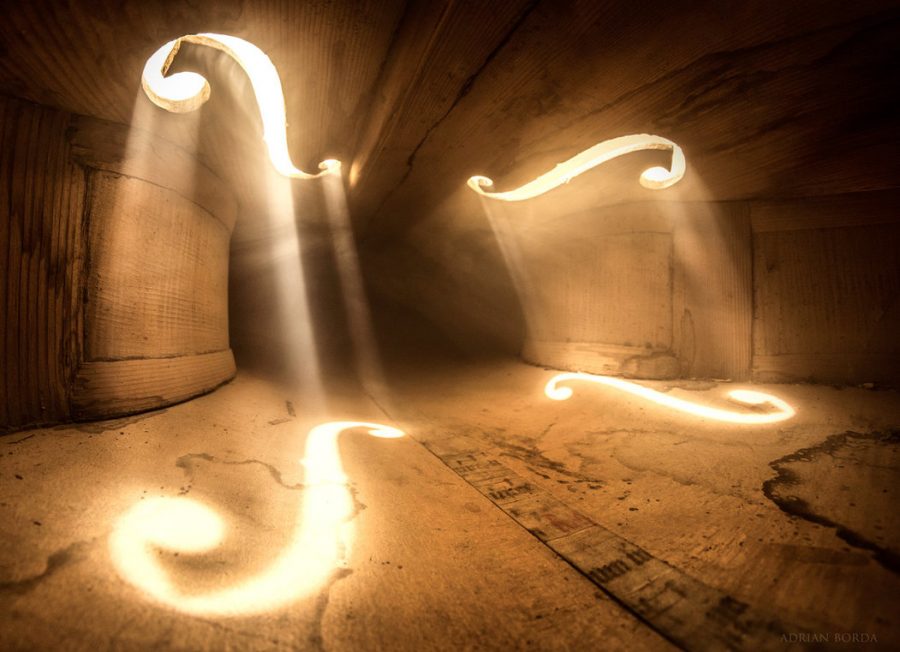
“If God had designed the orchestra,” remarks a character in Rick Moody’s Hotels of North America, “then the cello was His greatest accomplishment.” I couldn’t agree more. The cello sounds sublime, looks stately… even the word cello evokes regal poise and grace. If orchestral instruments were chess pieces, the cello would be queen: shapely and dignified, prime mover on the board, majestic in symphonies, quartets, chamber pop ensembles, post rock bands….
With all its many sonic and aesthetic charms, I didn’t imagine it was possible to love the cello more. Then I saw Romanian artist Adrian Borda’s magnificent photos taken from inside one. The photo above, Borda tells us at his Deviant Art page, was taken from inside “a very old French cello made in Napoleon’s times.” It looks like the belly of the HMS Victory mated with the nave of Chartres Cathedral. The light descending through the f‑holes seems of some divine origin.
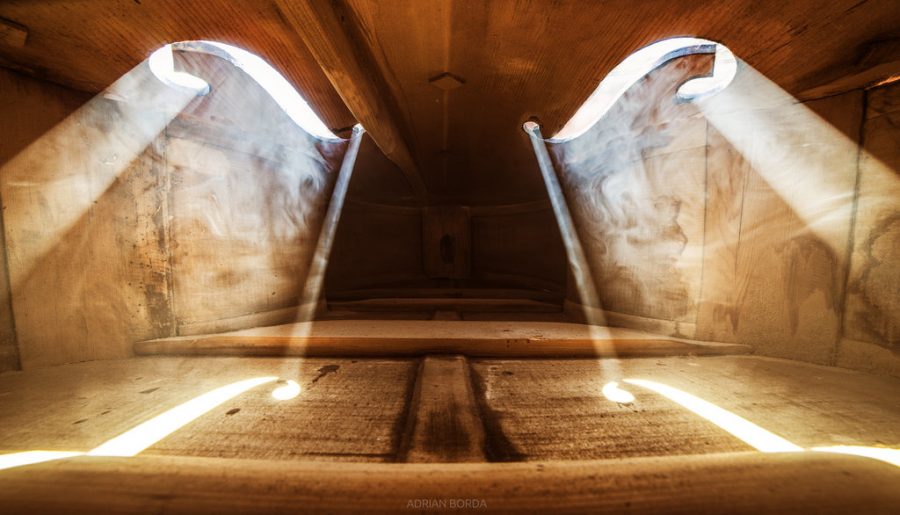
Borda has also taken photos from inside an old double bass (above), as well as a guitar, sax, and piano. The stringed orchestral instruments, he says, yielded the best results. He was first inspired by a 2009 ad campaign for the Berliner Philharmoniker that “captured the insides of instruments,” writes Twisted Sifter, “revealing the hidden landscapes within.” Without any sense of how the art director created the images, Borda set about experimenting with methods of his own.
He was lucky enough to have a luthier friend who had a contrabass open for repairs. Later he traveled to Amiens, where he found the French cello, also open. “To achieve these shots,” Twisted Sifter notes, “Borda fit a Sony NEX‑6 camera equipped with a Samyang 8mm fisheye lens inside the instrument and then used a smart remote so he could preview the workflow on his phone.” Depending on the angle and the play of light within the instrument, the photos can look eerie, somber, ominous, or angelic—mirroring the cello’s expressive range.
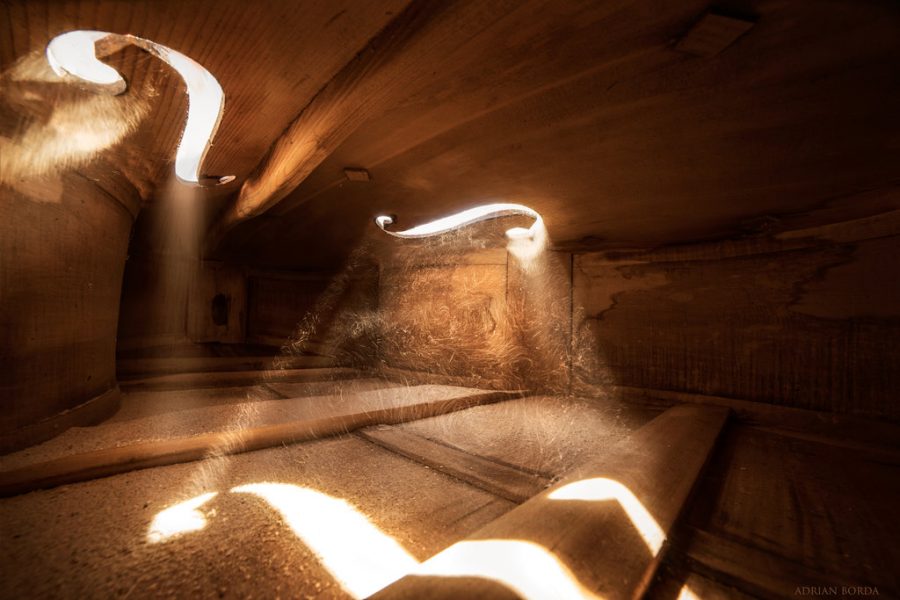
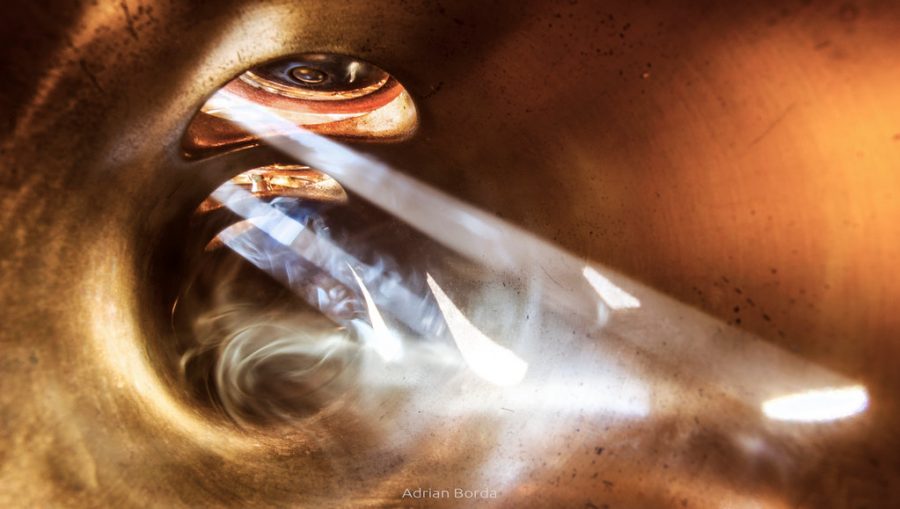
Borda gives the cello interior shot above the perfect title “A Long, Lonely Time….” Its play of smoke and light is ghostly noir. His photo below, of the inside of a saxophone, pulls us into a haunted, alien tunnel. If you want to know what’s on the other side, consider the strange surrealist worlds of Borda’s main gig as a surrealist painter of warped fantasies and nightmares. Unlike these photos, his paintings are full of lurid, violent color, but they are also filled with mysterious musical motifs. See more of Borda’s interior instrument photos at Deviant Art and Twister Sifter.
via Twisted Sifter
Related Content:
Watch a Luthier Birth a Cello in This Hypnotic Documentary
Why Violins Have F‑Holes: The Science & History of a Remarkable Renaissance Design
Josh Jones is a writer and musician based in Durham, NC. Follow him at @jdmagness
Read More...One Second from Each Episode of Twin Peaks: Experience David Lynch’s Groundbreaking TV Drama in Less than a Minute
One second from every episode of Twin Peaks. pic.twitter.com/e5Pc3g5oB4
— Andy Kelly (@ultrabrilliant) September 6, 2018
Even if you watched Twin Peaks during its original broadcast on ABC in 1990 and 1991 and have never revisited the show since, you’ll vividly remember a great many moments from it: some because of their emotional impact, some because of their aesthetic impact, and some because you had no idea what to make of them. But despite the incomprehension it famously caused its viewers, Twin Peaks nevertheless slowly and inexorably drew them into its reality: the reality of the eponymous small Washington logging town whose homecoming queen has been murdered and in which FBI Special Agent Dale Cooper has arrived to investigate.
David Lynch and Mark Frost planned it that way: people who tuned in week after week to find out who killed Laura Palmer would, in theory, keep watching even after that unsolved part of the story had long since faded into the background. But pressure from ABC eventually forced the creators to resolve that mystery, at which point even many die-hard Peaks-heads wondered whether the show had lost its way.
You’ll see that period, as well as every every other, represented in the video above, which compresses the entire run of Twin Peaks — the thirty episodes of the original two seasons plus the eighteen episodes of Twin Peaks: The Return, which aired last year on Showtime — into less than a minute, drawing one second from each episode.
Other respected television shows, like Seinfeld and Curb Your Enthusiasm, have undergone this treatment before. But to watch Lynch and Frost’s groundbreaking drama as an assembly of particularly powerful individual seconds provides an entirely different kind of experience, one that may well bring back memories of surprise, confusion, hilarity, and even a kind of awe. Perhaps it doesn’t allow you to inhabit the distinctive long-form Lynchian (and Frostian) vision in the way that the series itself does, but this condensed, single-shot version may well get you wanting to visit Twin Peaks again, whether you last visited 27 years ago or just yesterday.
Related Content:
Watch an Epic, 4‑Hour Video Essay on the Making & Mythology of David Lynch’s Twin Peaks
David Lynch Draws a Map of Twin Peaks (to Help Pitch the Show to ABC)
Angelo Badalamenti Reveals How He and David Lynch Composed the Twin Peaks‘ “Love Theme”
David Lynch Directs a Mini-Season of Twin Peaks in the Form of Japanese Coffee Commercials
The Late Alan Thicke Hosts a Twin Peaks Behind-the-Scenes Special (1990)
David Lynch Falls in Love: A Classic Scene From Twin Peaks
Based in Seoul, Colin Marshall writes and broadcasts on cities and culture. His projects include the book The Stateless City: a Walk through 21st-Century Los Angeles and the video series The City in Cinema. Follow him on Twitter at @colinmarshall or on Facebook.
Read More...Support Us
We're hoping to rely on loyal readers, rather than erratic ads. Please click the Donate button and support Open Culture. You can use Paypal, Venmo, Patreon, even Crypto! We thank you!

About Us

Open Culture scours the web for the best educational media. We find the free courses and audio books you need, the language lessons & educational videos you want, and plenty of enlightenment in between.
Advertise With Us

FREE UPDATES!
GET OUR DAILY EMAIL
Get the best cultural and educational resources on the web curated for you in a daily email. We never spam. Unsubscribe at any time.
FOLLOW ON SOCIAL MEDIA

Open Culture editor Dan Colman scours the web for the best educational media. He finds the free courses and audio books you need, the language lessons & movies you want, and plenty of enlightenment in between.
Advertise With Us

