Discover an Archive of Taped New York City-Area Punk & Indie Concerts from the 80s and 90s: The Pixies, Sonic Youth, The Replacements & Many More
“For decades now,” John Coulthart writes at Dangerous Minds, “Hoboken has been on an implacable course of gentrification… to the point that scruffy and legendary music venues can’t hack it there anymore.” One could replace “Hoboken” with the name of virtually any US city that once hosted a seminal live venue. You live long enough, you see the world completely change, and all the punk and indie clubs shut down or moved to Brooklyn. The 21st century has given us cities few indie artists or their fans can afford, even as it also gives us high-speed internet, huge servers, cheap web hosting, and hard drives that can hold terabytes of digital music.
But at least the club shows of the past can live on in incredibly awesome archives like The McKenzie Tapes, “a collection of live audio recordings from some of the New York City-area’s most prominent music venues of the 1980s and 1990s.”
Recorded by David McKenzie, a former employee of legendary Hoboken venue Maxwell’s and consummate concert-goer, the taped gigs come from such venues as The Ritz, Tramps, Irving Plaza, The Roxy, the Cat Club, Bowery Ballroom, CBGB’s, the Knitting Factory, and, of course, Maxwell’s.
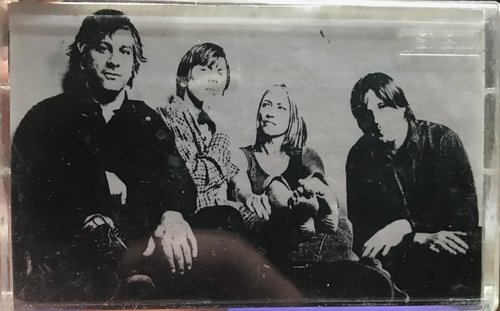
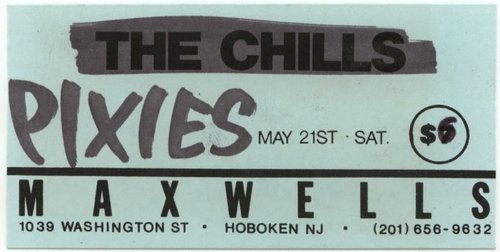
Too many legendary bands to list in full show up here: some major highlights include The Replacements at the Ritz in 1986, right after the release of Tim. (See them at the top in a soundcheck at Maxwell’s that same year); the Pixies at Maxwell’s in 1988, playing songs from their just-released watershed Surfer Rosa; Sonic Youth on back-to-back nights at CBGB’s in 88, playing Daydream Nation the month before recording the album. Hüsker Dü, Wire, John Spencer Blues Explosion, The Fall, The Feelies, Afghan Whigs, Mudhoney, Violent Femmes, Mojo Nixon—the shows are a who’s who of punk and indie from the last two decades of the century, with appearances from 70s legends like Patti Smith and Tom Verlaine.
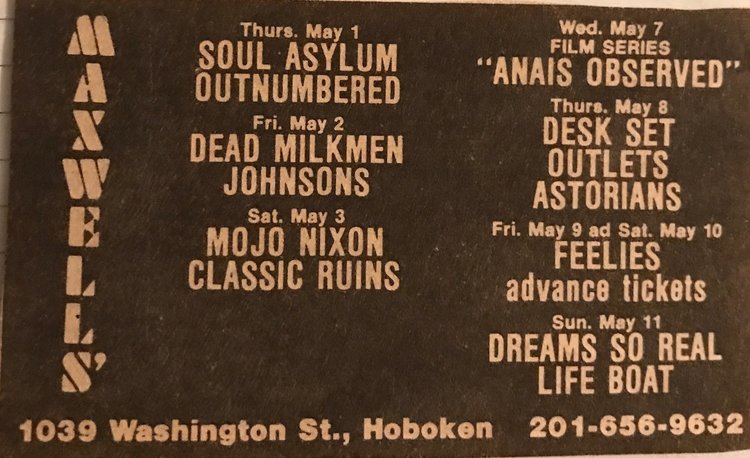
Sprinkled throughout are surprises like a 1989 performance from Sun Ra and his Intergalactic Arkestra at Maxwell’s and gigs by blues stalwarts T Model Ford and R.L. Burnside, as well as the occasional outlier show abroad. The project is the work of Jersey City record collector, archivist, event producer, and podcaster Tom Gallo, friend of David McKenzie, and he has done an excellent job of preserving not only the music from McKenzie’s tapes, but images of the tapes themselves—with hand-written band names and song titles and black-and-white Xeroxed covers—as well as Village Voice listings of the gigs and occasional ticket stubs, setlists, and live photos.
Don’t expect much in the way of sound quality—that’s part of the charm of a taped show. These are raw documents of the cassette age, a time come and gone, never to come again. We might not mourn its passing, but something—a spirit of experimental, noisy, tuneful, angry, raucous, lo-fi, analog indie fun—seems to have disappeared along with it. All of these digitized tapes are downloadable. Put ’em on your phone and relive the glory days, or discover these treasures from the recent past for the first time at The McKenzie Tapes here.
Related Content:
A Massive 800-Track Playlist of 90s Indie & Alternative Music, in Chronological Order
Stream a Massive Collection of Indie, Noise Industrial Mixtapes from the 80s and 90s
Josh Jones is a writer and musician based in Durham, NC. Follow him at @jdmagness
Read More...Dancing in Movies: A Montage of Dance Moments from Almost 300 Feature Films
Someone went through a great deal of effort to stitch together a montage of dance scenes from some 300 feature films. Below find a list of films in order of their appearance, and with the appropriate timestamp.
00:00:06 — Tropic Thunder (2008)
00:09:17 — 10 Cloverfield Lane (2016)
00:10:10 — Frank (2014)
00:11:02 — Deadpool (2016)
00:12:02 — Girlhood (2015)
00:13:10 — West Side Story (1961)
00:16:18 — Scott Pilgrim vs. the World (2010)
00:18:00 — Big (1988)
00:18:14 — Risky Business (1983)
00:19:05 — Forrest Gump (1994)
00:19:21 — 20th Century Women (2016)
00:21:02 — God Help the Girl (2014)
00:22:07 — Begin Again (2013)
00:23:16 — The Rocketeer (1991)
00:25:13 — Dead Poets Society (1989)
00:27:21 — Braveheart (1995)
00:28:22 — Snow White and the Seven Dwarfs (1937)
00:29:23 — Robin Hood (1973)
00:31:00 — Austin Powers: The Spy Who Shagged Me (1999)
00:32:14 — Titanic (1997)
00:33:14 — Big Fish (2003)
00:35:07 — Go (1999)
00:36:14 — Fiddler on the Roof (1971)
00:37:12 — Citizen Kane (1941)
00:38:12 — Life is Beautiful (1997)
00:40:01 — White Nights (1985)
00:42:08 — Swing Time (1936)
00:44:13 — Pee-wee’s Big Adventure (1985)
00:45:21 — Mermaids (1990)
00:48:14 — Home Alone (1990)
00:49:18 — Mulholland Drive (2001)
00:50:22 — Boy (2010)
00:51:20 — Girl Asleep (2015)
00:52:08 — Despicable Me (2010)
00:55:05 — Airplane (1980)
00:57:08 — Carrie (1976)
00:58:21 — Love, Rosie (2014)
00:59:21 — The Mask (1994)
01:00:14 — Dope (2015)
01:01:13 — Rock of Ages (2012)
01:02:21 — Robin Hood: Men in Tights (1993)
01:04:14 — Monthy Python and the Holy Grail (1975)
01:04:19 — Kung Fu Hustle (2004)
01:05:12 — Bill & Ted’s Excellent Adventure (1989)
01:06:07 — (500) Days of Summer (2009)
01:08:23 — Star Wars: Episode IV — A New Hope (1977)
01:10:03 — The Muppets (2011)
01:11:00 — Revenge of the Nerds (1984)
01:10:03 — The Muppets (2011)
01:14:00 — Love Actually (2003)
01:16:05 — Mean Girls (2004)
01:19:01 — Austin Powers in Goldmember (2002)
01:20:15 — Scarface (1983)
01:22:05 — Grease (1978)
01:24:22 — It’s a Wonderful Life (1946)
01:26:13 — The Lord of the Rings: Return of the King (2003)
01:28:13 — Young Frankenstein (1974)
01:29:16 — Get Smart (2008)
01:31:07 — My Fair Lady (1964)
01:32:12 — An Education (2009)
01:33:21- The Deer Hunter (1978)
01:35:06 — The Sitter (2011)
01:35:22 — Up in the Air (2009)
01:36:20 — Silver Linings Playbook (2012)
01:38:10 — This Is the End (2013)
01:39:13 — Hairspray (2007)
01:40:07 — Dumb and Dumber (1994)
01:41:03 — The Way Way Back (2013)
01:42:01 — Moonrise Kingdom (2012)
01:43:05 — Blazing Saddles (1974)
01:44:05 — Adventures in Babysitting (1987)
01:45:18 — Shrek 2 (2004)
01:47:18 — Flashdance (1983)
01:48:14 — The Gold Rush (1925)
01:49:10 — Magic Mike (2012)
01:50:20 — Viva Las Vegas (1964)
01:52:00 — Clerks II (2006)
01:53:10 — The Great Gatsby (2013)
01:54:08 — Eagle vs Shark (2007)
01:57:06 — What We Do in the Shadows (2014)
01:58:15 — The Cabin in the Woods (2012)
01:59:17 — Rush Hour (1998)
02:01:17 — Eyes Wide Shut (1999)
02:02:17 — The Last Picture Show (1971)
02:03:18 — Band of Outsiders (1964)
02:05:23 — Weird Science (1985)
02:07:15 — Reservoir Dogs (1992)
02:09:10 — Batman (1989)
02:12:20 — Mommy (2014)
02:14:00 — Desperately Seeking Susan (1985)
02:15:20 — Hot Shots! (1991)
02:16:14 — Borat (2006)
02:17:14 — American Beauty (1999)
02:18:18 — Moonlight (2016)
02:19:14 — Superbad (2007)
02:20:15 — Garden State (2004)
02:21:15 — Royal Wedding (1951)
02:22:17 — The Big Lebowski (1998)
02:24:07 — My Week with Marilyn (2011)
02:25:13 — Mary Poppins (1964)
02:27:20 — Kickboxer (1989)
02:29:07 — The Blues Brothers (1980)
02:30:21 — Bring it On (2000)
02:32:07 — Ferris Bueller’s Day Off (1986)
02:33:17 — Trainspotting (1996)
02:34:10 — American Gangster (2007)
02:34:21 — Don Jon (2013)
02:35:14 — Morris from America (2016)
02:36:08 — Hunt for the Wilderpeople (2016)
02:36:08 — A.I. Artificial Intelligence (2001)
02:39:06 — Striptease (1996)
02:40:10 — Donnie Darko (2001)
02:41:04 — The Pink Panther (1963)
02:41:20 — Monsters University (2013)
02:43:09 — Everybody Wants Some (2016)
02:44:18 — Clueless (1995)
02:46:13 — The Imaginarium of Doctor Parnassus (2009)
02:47:04 — All That Jazz (1979)
02:48:04 — The Princess Diaries (2001)
02:50:16 — Sing Street (2016)
02:52:12 — While We’re Young (2014)
02:54:06 — Once Bitten (1985)
02:55:15 — Lost River (2014)
02:56:10 — Ruby Sparks (2012)
02:58:03 — Saturday Night Fever (1977)
02:59:05 — Boogie Nights (1997)
03:00:15 — The Reunion 2: The Funeral (2014)
03:01:11 — American Hustle (2013)
03:02:20 — Ex Machina (2015)
03:04:10 — The Losers (2010)
03:06:00 — Little Miss Sunshine (2006)
03:06:20 — The Best Man Holiday (2013)
03:07:10 — Step Up Revolution (2012)
03:08:19 — Shaun of the Dead (2004)
03:10:07 — Billy Elliot (2000)
03:11:22 — Funny Face (1957)
03:14:09 — King of New York (1990)
03:15:10 — Mistress America (2015)
03:16:13 — The Perks of Being a Wallflower (2012)
03:17:15 — Save the Last Dance (2001)
03:18:14 — Elf (2003)
03:19:03 — The Edge of Seventeen (2016)
03:19:16 — Little Sister (2016)
03:21:00 — The Rocky Horror Picture Show (1975)
03:22:04 — Moon (2009)
03:23:12 — The Boondock Saints (1999)
03:26:03 — Monsters University (2013)
03:27:08 — Let’s Be Cops (2014)
03:29:09 — The World’s End (2013)
03:31:04 — Fun Size (2012)
03:32:10 — Spider-Man 3 (2007)
03:34:14 — To Die For (1995)
03:35:16 — The Breakfast Club (1985)
03:37:11 — The Goonies (1985)
03:38:11 — The Wolf of Wall Street (2013)
03:39:15 — Blue Valentine (2010)
03:41:01 — Napoleon Dynamite (2004)
03:42:22 — Popstar: Never Stop Never Stopping (2016)
03:43:16 — 13 Going On 30 (2004)
03:44:04 — Wedding Crashers (2005)
03:44:15 — Pitch Perfect (2012)
03:45:07 — Wayne’s World (1992)
03:45:21 — Milk (2008)
03:46:11 — Something Borrowed (2011)
03:47:17 — School of Rock (2003)
03:48:16 — Hitch (2005)
03:49:19 — The Kings of Summer (2013)
03:50:17 — Bling Ring (2013)
03:52:10 — Neighbors (2014)
03:53:04 — Animal House (1978)
03:54:07 — A League of Their Own (1992)
03:55:19 — Hot Rod (2007)
03:57:11 — Zoolander (2001)
03:58:17 — Gentlemen Prefer Blondes (1953)
03:59:17 — The Great Dictator (1940)
04:01:23 — Charlie’s Angels (2000)
04:03:03 — Romeo + Juliet (1996)
04:04:05 — Kill Your Darlings (2013)
04:05:02 — Amadeus (1984)
04:06:00 — Days of Heaven (1978)
04:10:07 — Lars and the Real Girl (2007)
04:12:15 — The Lobster (2015)
04:14:01 — House of Flying Daggers (2004)
04:15:13 — Big Night (1996)
04:17:23 — Band of Robbers (2015)
04:19:06 — Almost Famous (2000)
04:21:03 — Rain Man (1988)
04:22:15 — Brooklyn (2015)
04:23:10 — The Imitation Game (2014)
04:24:09 — Moulin Rouge! (2001)
04:27:13 — Slumdog Millionaire (2008)
04:29:12 — The Godfather (1972)
04:30:11 — The Sound of Music (1965)
04:32:01 — Dirty Dancing (1987)
04:34:08 — Focus (2015)
04:35:10 — The Dark Knight Rises (2012)
04:36:08 — Zombieland (2009)
04:37:07 — Beauty and the Beast (1991)
04:40:23 — The Addams Family (1991)
04:44:06 — Beetlejuice (1988)
04:47:02 — Eternal Sunshine of the Spotless Mind (2004)
04:49:12 — Like Crazy (2011)
04:50:09 — End of Watch (2012)
04:51:14 — Pretty in Pink (1986)
04:53:03 — House Party (1990)
04:54:05 — Along Came Polly (2004)
04:55:23 — Some Like it Hot (1959)
04:56:23 — Reality Bites (1994)
04:59:01 — Wet Hot American Summer (2001)
05:01:10 — Obvious Child (2014)
05:02:14 — The Man from U.N.C.L.E (2015)
05:04:14 — Lost in Translation (2003)
05:06:03 — Guardians of the Galaxy (2014)
05:06:18 — A Clockwork Orange (1974)
05:08:14 — Harry Potter and the Goblet of Fire (2005)
05:09:16 — Star Wars: Episode VI — Return of the Jedi (1983)
05:10:18 — Penguins of Madagascar (2014)
05:11:19 — European Vacation (1985)
05:13:02 — The Wizard of Oz (1939)
05:15:04 — The Inbetweeners Movie (2011)
05:16:12 — Three Amigos (1986)
05:18:00 — The 40 Year Old Virgin (2005)
05:18:23 — A Night At The Roxbury (1998)
05:20:01 — Coming To America (1988)
05:20:21 — Cinderella (2015)
05:21:17 — About Time (2013)
05:23:16 — Groundhog Day (1993)
05:25:03 — Chef (2014)
05:26:07 — Somewhere (2010)
05:28:08 — Office Space (1999)
05:30:03 — Shall We Dance (2004)
05:31:04 — The Artist (2011)
05:31:18 — The Red Shoes (1948)
05:33:21 — Strictly Ballroom (1992)
05:36:07 — The Turning Point (1977)
05:37:05 — Do the Right Thing (1989)
05:38:03 — Singin’ In The Rain (1952)
05:39:09 — Chicago (2002)
05:41:09 — Footloose (1984)
05:43:17 — When Harry Met Sally… (1989)
05:45:02 — The Producers (1967)
05:46:05 — The Full Monty (1997)
05:47:20 — Back to the Future Part III (1990)
05:49:00 — Dances with Wolves (1990)
05:50:07 — Hook (1991)
05:50:22 — Short Circuit (1986)
05:51:13 — Pulp Fiction (1994)
05:53:08 — Only Lovers Left Alive (2013)
05:53:22 — Dazed and Confused (1993)
05:54:20 — From Dusk Till Dawn (1996)
05:55:16 — My Golden Days (2015)
05:56:12 — Midnight in Paris (2013)
05:58:21 — The Naked Gun 2½: The Smell of Fear (1991)
05:59:12 — The Intouchables (2011)
06:00:10 — Les Misérables (2012)
06:01:08 — A Royal Affair (2012)
06:02:11 — King Kong (2005)
06:03:17 — Happy Feet (2006)
06:04:20 — Tangled (2010)
06:06:01 — Tarzan (1999)
06:07:01 — Top Hat (1935)
06:08:01 — Hail, Caesar (2016)
06:09:05 — Center Stage (2000)
06:10:03 — American Pie (1999)
06:11:10 — A Hard Days Night (1964)
06:12:01 — 45 Years (2015)
06:12:15 — La Dolce Vita (1960)
06:13:10 — O Brother, Where Art Thou? (2000)
06:14:00 — West Side Story (1961)
06:14:20 — Straight Outta Compton (2015)
06:15:12 — La La Land (2016)
06:16:12 — Her (2013)
06:17:08 — Being John Malkovich (1999)
06:18:03 — Flashdance (1983)
06:19:01 — Barton Fink (1991)
06:19:22 — The Artist (2011)
06:24:09 — Casablanca (1942)
06:26:13 — Sunset Boulevard (1950)
06:27:15 — Black Book (2006)
06:28:08 — Edward Scissorhands (1990)
06:29:17 — Labyrinth (1986)
06:31:18 — Short Term 12 (2013)
06:33:18 — When Marnie Was There (2014)
06:36:18 — Before Sunrise (1995)
06:37:15 — Scent of a Woman (1992)
06:39:14 — Sabrina (1954)
06:40:20 — Lolita (1962)
06:41:23 — Schindler’s List (1993)
06:42:14 — Gangs of New York (2002)
06:43:16 — Black Swan (2010)
06:44:23 — Pride and Prejudice (2005)
06:46:15 — Sweeney Todd: The Demon Barber of Fleet Street (2007)
06:48:06 — Up (2009)
06:49:23 — One Flew Over the Cuckoo’s Nest (1975)
06:51:05 — Out of Africa (1985)
06:52:22 — Jackie (2016)
06:54:15 — Rushmore (1998)
Read More...How Innovative Jazz Pianist Vince Guaraldi Became the Composer of Beloved Charlie Brown Music
Nostalgia gets a bad rap these days, and for good reason. Too many people who pine for the past seem to want the very worst parts of it back. Sadly, even fun retreads—8‑bit video games, 90s cartoon kitsch—became dark harbingers, as the memes of “Remember when?” listicles turned into carriers of viral evil. What a bummer. Is there any pop culture from the past that survives untainted by cynicism, sappiness, or trolldom? Unequivocally yes—that purest of artifacts is A Charlie Brown Christmas, and its perfection of a soundtrack by the Vince Guaraldi trio. Nothing can touch its sublime mix of joy, innocence, melancholy, and bossa nova-driven cool.
The 1965 movie, an earnest exploration of the holiday through the worldly-wise eyes of Charles Schulz’s Peanuts gang, has affected several generations since it first aired. But at first, the “unabashedly anti-consumerist story” met with disapproval from its sponsors, Coca-Cola and CBS, who “had no choice but to air it,” writes Liz Pelly at Rolling Stone, “they had already advertised it in TV Guide.”
Guaraldi trio drummer Jerry Granelli remembers that the corporate execs “really didn’t like that a little kid was going to come out and say what Christmas was all about, which wasn’t about shopping. And then the jazz music, which was improvised.”
Although each holiday season we’re supposed to believe there’s a war on Christmas, everyone, from every faith or none, loves A Charlie Brown Christmas. Its plainspoken piety is a big part of its appeal, but equally so is the music: the unalloyed delight of “Linus and Lucy” and its dance scene (top), the downbeat charm of “Christmastime is Here” and its children’s choir…. The story of how the special came to be is a fascinating one, a series of serendipitous encounters that begins in 1963 with producer Lee Mendelson at work on a documentary about Schulz.
While driving over the Golden Gate Bridge, he just happened to catch Guaraldi’s hit “Cast Your Fate to the Wind” (above). “It was melodic and open,” he thought, “and came in like a breeze off the bay. And it struck me that this might be the kind of music I was looking for.” He tracked the pianist and composer down to score his Schulz documentary. While that project fizzled, Coca-Cola liked it enough to enlist Mendelson for the Christmas special, and some of Guaraldi’s original music—including “Linus and Lucy”—migrated over, written, notes Derrick Bang, to “reflect Charlie Brown’s gentle, kid-oriented universe.” The whole soundtrack was laid down in three hours in the studio. “That’s just the way jazz records were recorded,” recalls Granelli.
“Christmastime is Here” was originally an instrumental (above), but at the last moment, Mendelson had the idea to “put some words to this.” Unable to find a lyricist in time, he penned those words himself. “We rushed it to the choir that Vince Guaraldi had been working with in San Francisco. And he recorded it, and we got it into the show about a week before it went on the air.” Guaraldi “probably would have loved to recycle much of the music from the never-aired documentary,” writes Bang, but the Christmas special called for a slightly different tone, so he wrote two additional compositions, including the bouncy “Skating,” below, “a lyrical jazz waltz highlighted by sparkling keyboard runs that sounded precisely like children ice-skating joyously on a frozen pond.”
The combined talents of Mendelson, Schulz, Guaraldi, and animator Bill Melendez have made A Charlie Brown Christmas an enduringly beloved classic, so critically successful at the time that the four collaborated on several other Peanuts films. In fact, Guaraldi composed music for a total of sixteen Peanuts movies, including the 1969 feature film A Boy Named Charlie Brown. Guaraldi’s compositional and instrumental skills will be forever linked to Charles Schulz’s iconic characters, perhaps no more so than during the winter holidays.
But he should by no means be solely remembered as the Peanuts composer—any more than the similarly bossa-nova inspired Burt Bacharach should be forever tied to his film themes. Guaraldi’s work stands on its own, or as jazz writer Ted Gioia recently tweeted, “I’ll say it straight: Vince Guaraldi was a brilliant, underrated jazz musician. No one need feel any embarrassment about enjoying (or praising) his music.” If, for some reason, you happened to feel you needed permission to love Guaraldi, there you have it.
Related Content:
Umberto Eco Explains the Poetic Power of Charles Schulz’s Peanuts
How Franklin Became Peanuts‘ First Black Character, Thanks to a Caring Schoolteacher (1968)
Josh Jones is a writer and musician based in Durham, NC. Follow him at @jdmagness
Read More...You Don’t “Find” Your Passion in Life, You Actively Develop It, Explains Psychologist Carol Dweck, Theorist of the “Growth Mindset”
You might spend your whole life trying to find your life’s passion, or passively hoping it comes to you. Many have done so and, tragically, have never discovered it. Were they looking for purpose in all the wrong places? Maybe. Or maybe the idea that our life’s calling waits out there for us to find—like the fairy tale notion of a one true perfect love—is kind of crap. That’s not how Stanford psychologists Carol Dweck and Gregory Walton put it, exactly, but their research suggests that “the adage so commonly advised by graduation speakers,” as Stanford News reports, “might undermine how interests actually develop.”
In other words, when people think of interests or talents as “fixed qualities that are inherently there,” they are more likely to give up on pursuits when they encounter difficulty, believing they aren’t destined for success. Working with data acquired by Stanford postdoctoral fellow Paul O’Keefe (now at Yale), Dweck and Walton explained some recent research findings in a paper titled “Implicit Theories of Interest: Finding Your Passion or Developing it?” The article is forthcoming in Psychological Science, and you can read a PDF version online.
The paper describes five studies on “implicit theories of interest” and contrasts a fixed theory with a “growth theory” of interest, an idea that comes out of Dweck’s prior research on what she calls a “growth mindset.” She has published a bestselling book on the subject and given very popular talks on what she calls in her TED appearance in Sweden above “the power of yet”—a phrase she derives from a high school in Chicago that gave students the grade of “not yet” when they hadn’t successfully passed a course. This hopeful assessment encouraged them to keep trying rather than to think of themselves as failures.
Dweck tells her TED audience about giving a group of ten-year-olds’ problems she knew would be too hard for them to solve. Those with a “growth mindset” responded with excitement, eager for a challenge and the opportunity to expand their capabilities. The kids who had a “fixed mindset” crumpled, feeling like they had been judged and come up wanting. “Instead of luxuriating in the power of yet,” says Dweck, “they were gripped in the tyranny of now.” Children thus “tyrannized” by feelings of failure might be more likely to cheat rather than study, make downward comparisons to boost feelings of self-worth, or become avoidant and “run from difficulty.”
These strategies are even visible in images of brain activity. None of them, of course, will lead to progress. But Dweck claims that the problem is endemic to a generation of people who need constant validation and who fold when they meet challenges. So how can parents and teachers help kids become more growth-oriented or, in Dweck’s lingo, build “the bridge to yet”? Her recommendations may not sound that revolutionary to those who have followed the backlash against the well-meaning but misguided “self-esteem movement” of the past few decades.
For one thing, praising effort, rather than intelligence or talent, will help kids develop more resilience and value ongoing process over instant results. Judicious applications of “good try!” go much farther than repetitions of “you’re brilliant and amazing!” Dweck’s other strategies involve a similar focus on process and progress. Unsurprisingly, when we believe we can change and improve, we are far more likely to work at developing talent, instead of assuming we’ve either got it or we don’t, an unscientific and self-defeating way of thinking that has done a lot of people needless harm. Dweck and her colleagues show that our life’s passion isn’t a fully-formed thing out there waiting for us, or an inborn, immutable quality, but rather it comes as the result of patient and persistent efforts.
Related Content:
Josh Jones is a writer and musician based in Durham, NC. Follow him at @jdmagness
Read More...How the Uptight Today Show Introduced the Sex Pistols & British Punk to American TV Viewers (1978)
It’s depressingly easy to rile up millions of people these days with the click of a mouse. Billion-dollar industries and political campaigns are built on such technology. But before the empires of social media, there was television, a one-way medium and, prior to cable, an extremely limited one. In those bygone days, you really had to put your back into it if you wanted widespread attention. The Sex Pistols—including their manager and promoter, visionary huckster Malcolm McLaren—worked hard to cultivate infamy, using television as a primary means of generating shock value.
Although the band members, at least, never made any money, they were highly paid in notoriety on both sides of the Atlantic. Their image as violent junkies who couldn’t play their instruments owed mainly to Sid Vicious, who replaced competent bassist and songwriter Glen Matlock in 1977, a move that boosted the band’s ability to freak people out while simultaneously setting them on a course for certain demise within the year.
The spectacular self-destruction occurred, as every fan knows well, on a tour of the US South that McLaren booked with the wickedest of intentions, springing the band on cowboy bars in Texas, for example, for the sake of sheer provocation. Their final show at San Francisco’s Winterland Ballroom was caught on film, complete with the last song they ever played together, a cover of the Stooges “No Fun.” After the one-song encore, Johnny Rotten sneered “ever get the feeling you’ve been cheated?” and dropped the mic, disgusted with the whole “ridiculous farce,” he later wrote.
Before embarking on their comically disastrous US tour, the Pistols got a heavy dose of free publicity from an American news media as eager then as ever to chase after a sensation. In the vintage Today Show clip above, see how US viewers were introduced to British punk. “Whether naturally or calculatedly so,” says NBC’s Jack Perkins after reporting on Vicious and drummer Paul Cook’s refusal to grant an interview unless they were each paid $10, “the four young men are outrageous. They’re also vile and profane.”
Perkins then walks viewers through the hardly shocking details of rudeness to hotel staff and bit of a mess left in their room, shaking his head sadly. No band could hope to top Led Zeppelin when it came to this most cliched of rock and roll stunts. But Perkins pretends it’s the first time anything like it had ever happened. McLaren could not have scripted better finger-wagging outrage to inspire American gawkers (some of whom give brief post-concert interviews) to come out and see the Pistols flame out on their final tour.
Then there are the record execs Perkins gets on camera, including A&M’s Kip Cohen, who sized up the situation astutely: “There’s a case of an act and management and intelligence behind an act, brilliantly utilizing the media, cashing in and creating a whole hype for itself.” Cohen, a seasoned industry man who had previously managed the Fillmore East, predicts great things for the Sex Pistols. But he expresses some skepticism about whether their savvy media manipulation was a new phenomenon, citing the Beatles and the Stones as having already broken such ground.
One could go back even further to Chuck Berry and Elvis, who pushed many of the same outrage buttons for what constituted “clicks” in olden times. But as Perkins points out—shaking his head in disapproval, before cutting back to a snickering Jane Pauley and very serious Tom Brokaw—the Pistols pulled it off by looking like they couldn’t possibly have cared any less about being good at what they did, which took an entirely different kind of talent.
Related Content:
Watch the Sex Pistols’ Very Last Concert (San Francisco, 1978)
The Sex Pistols Play in Dallas’ Longhorn Ballroom; Next Show Is Merle Haggard (1978)
Malcolm McLaren: The Quest for Authentic Creativity
Josh Jones is a writer and musician based in Durham, NC. Follow him at @jdmagness
Read More...12-Year-Old Piano Prodigy Takes Four Notes Randomly Picked from a Hat and Instantly Uses Them to Improvise a Sonata
Last fall, 60 Minutes spent some time with Alma Deutscher, a prodigy on the piano and the violin. As her Wikipedia page tells us, “At age six she composed her first piano sonata. At age seven, she completed her first major composition, the opera The Sweeper of Dreams. Aged nine, she wrote a concerto for violin and orchestra, which she premiered in a 2015 performance.” And at “the age of ten she completed her first full-length opera, Cinderella, which had its European premiere in Vienna on 29 December 2016 under the patronage of conductor Zubin Mehta.” Fast forward to age twelve, you can watch Alma pull off something that, at this point, shouldn’t come as a surprise. Above, 6o Minutes correspondent Bob Pelley pulls four random notes out of a hat. Then, soon enough, Deutscher uses the notes to start improving a sonata. Watch more of her performances on her YouTube channel. And find more prodigy performances in the Relateds right below.
If you would like to support the mission of Open Culture, consider making a donation to our site. It’s hard to rely 100% on ads, and your contributions will help us continue providing the best free cultural and educational materials to learners everywhere. You can contribute through PayPal, Patreon, and Venmo (@openculture). Thanks!
Related Content:
Great Violinists Playing as Kids: Itzhak Perlman, Anne-Sophie Mutter, & More
Read More...James Joyce’s Crayon Covered Manuscript Pages for Ulysses and Finnegans Wake
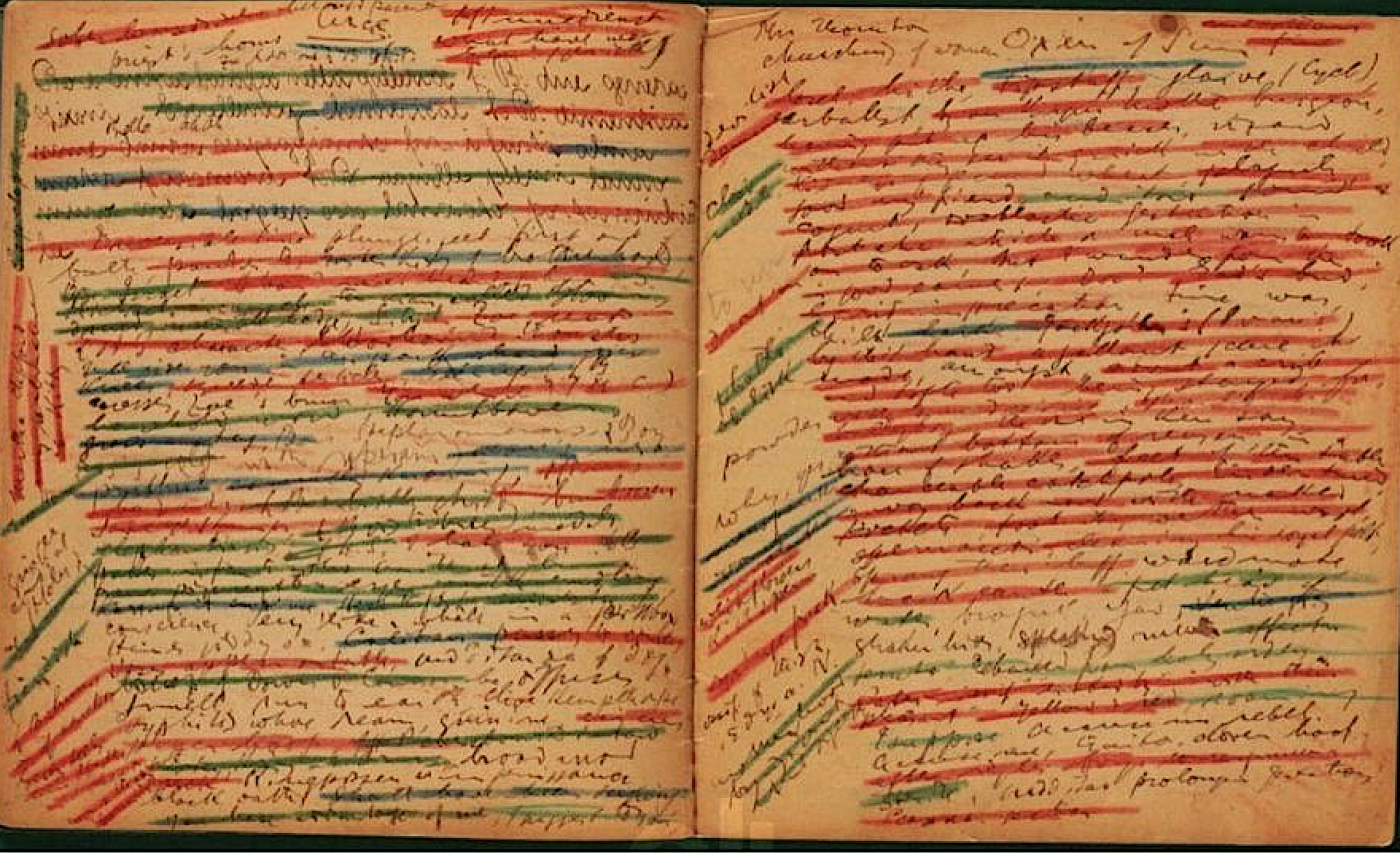
Even the most avid James Joyce fans surely have times when they open Finnegans Wake and wonder how on Earth Joyce wrote the thing. Painstakingly, it turns out, and not just because of the infamous difficulty of the text itself: he “wrote lying on his stomach in bed, with a large blue pencil, clad in a white coat, and composed most of Finnegans Wake with crayon pieces on cardboard,” writes Brainpickings’ Maria Popova. By the time Joyce finished his final novel, the eye problems that had plagued him for most of his life had rendered him nearly blind. “The large crayons thus helped him see what he was writing, and the white coat helped reflect more light onto the page at night.”
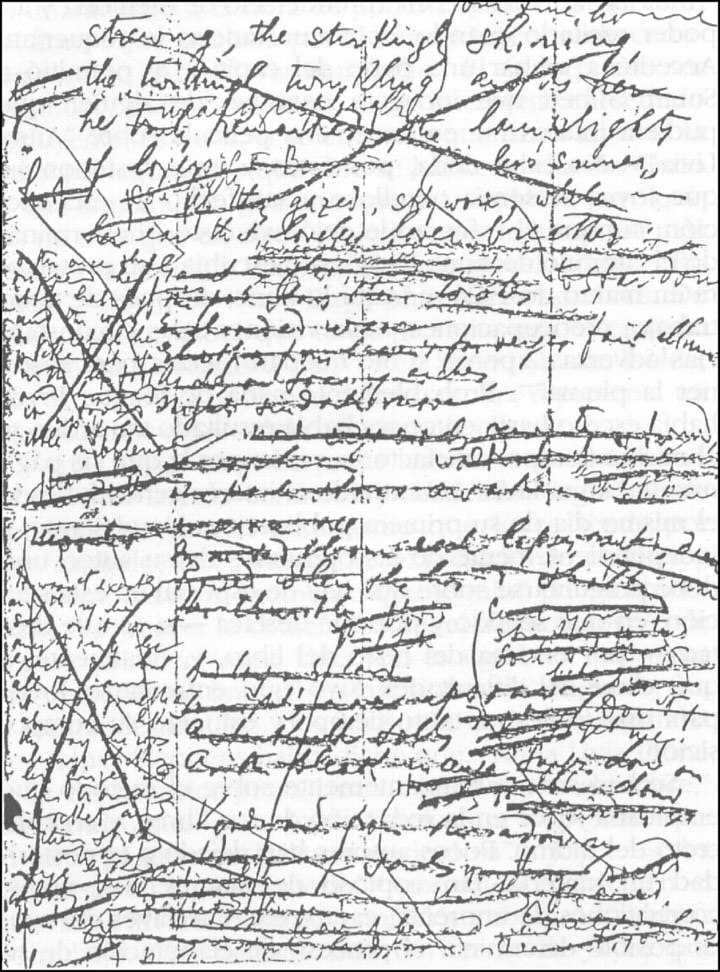
Crayons also had a place in his intricate revision process. “Joyce used a different colored crayon each time he went through a notebook incorporating notes into his draft,” writes Derek Attridge in a review of The Finnegans Wake Notebooks at Buffalo, a compilation of all the extant working materials for Joyce’s final novel. He also calls Joyce’s colored crayon method part of “a scrupulousness which has never been satisfactorily explained” — but then, much about Joyce hasn’t, and may never be. “I’ve put in so many enigmas and puzzles that it will keep the professors busy for centuries arguing over what I meant,” he once wrote, “and that’s the only way of insuring one’s immortality.”
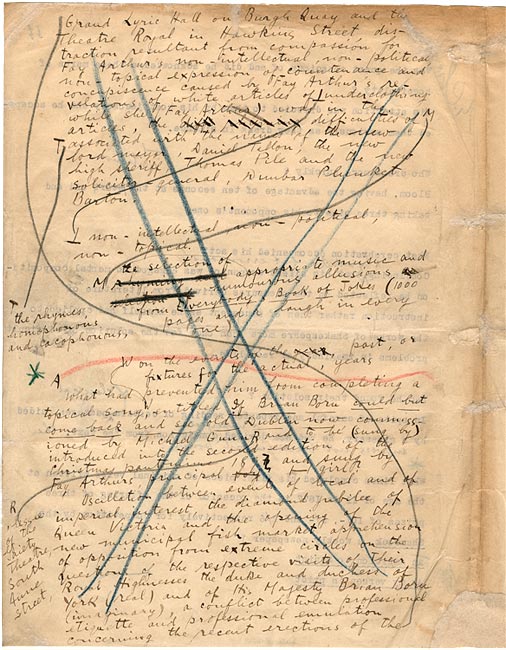
But he wrote that about Ulysses, a breeze of a read compared to Finnegans Wake, but a work that has surely inspired even more scholars to devote their careers to its author. Some become full-blown “Joyceaholics,” as Gabrielle Carey recently put it in the Sydney Review of Books, and must eventually find a way to “break up” with the object of their unhealthy literary fixation. She got hooked when a piano teacher introduced her to Molly Bloom’s soliloquy at the end of Ulysses. “The last page of Ulysses confirmed my youthful idea that there was such a thing as star-crossed lovers,” Carey writes. “Molly and Leopold were clearly meant for each other.” The conviction with which that idea resonated, she writes, “was to lead me down so many ill-fated paths.”
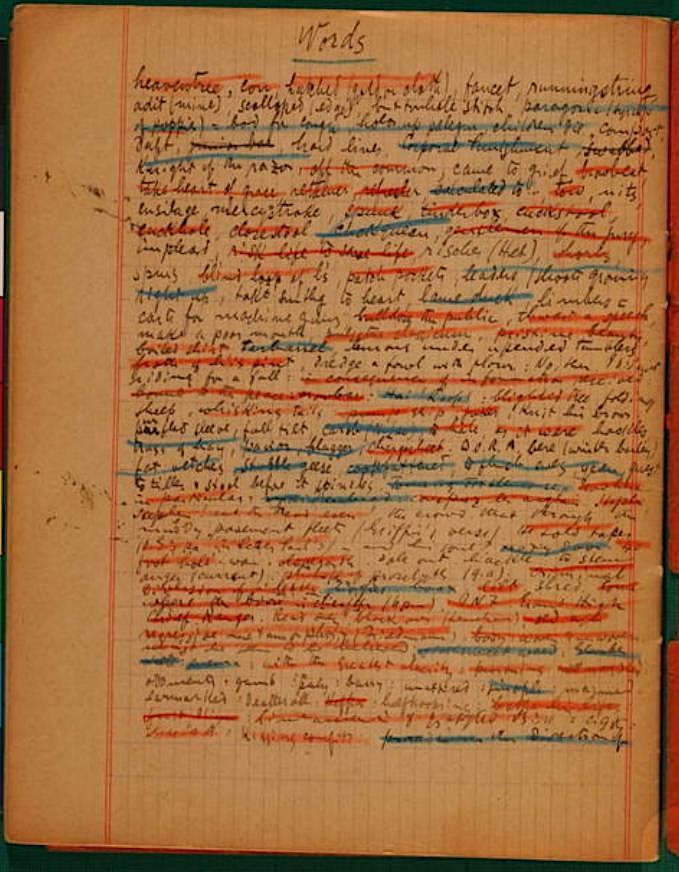
Carey stepped onto the long path that would lead her away from Joyce when she looked upon his manuscripts: “It was only then, almost thirty years after reading Joyce for the first time, that I noticed a tiny revision to the final paragraph.” Joyce’s insertion added a critical, deflating phrase to the passage that had brought her Joyce in the first place: “and I thought well as well him as another.” Whatever your own experience with Ulysses, Finnegans Wake, or any of Joyce’s other enduring works of literature, the actual pages on which he crafted them (the color ones seen here from Ulyssses and the black and white from Finnegans wake) can offer all kinds of illumination. They also remind us that the books must have required nearly as much mental fortitude to write as they do to properly read.
Related Content:
James Joyce: An Animated Introduction to His Life and Literary Works
Why Should You Read James Joyce’s Ulysses?: A New TED-ED Animation Makes the Case
James Joyce Reads From Ulysses and Finnegans Wake In His Only Two Recordings (1924/1929)
James Joyce, With His Eyesight Failing, Draws a Sketch of Leopold Bloom (1926)
See What Happens When You Run Finnegans Wake Through a Spell Checker
Based in Seoul, Colin Marshall writes and broadcasts on cities and culture. His projects include the book The Stateless City: a Walk through 21st-Century Los Angeles and the video series The City in Cinema. Follow him on Twitter at @colinmarshall or on Facebook.
Read More...Watch a 4000-Year Old Babylonian Recipe for Stew, Found on a Cuneiform Tablet, Get Cooked by Researchers from Yale & Harvard
Walk like an Egyptian, but eat like an ancient Babylonian.
While cookbooks containing Mesopotamian fare do exist, to be really authentic, take your recipes from a clay tablet, densely inscribed in cuneiform.
Sadly, there are only four of them, and they reside in a display case at Yale. (Understandable given that they’re over 4000 years old.)
When Agnete Lassen, associate curator of Yale’s Babylonian Collection, and colleague Chelsea Alene Graham, a digital imaging specialist, were invited to participate in a culinary event hosted by New York University’s Institute for the Study of the Ancient World, they wisely chose to travel with a 3D-printed facsimile of one of the precious tablets.
T’would have been a shame to knock the original off the counter while reaching for a bunch of leeks.
While other presenters prepared such delicacies as Fish Sauces at the Roman Table, Buddhist vegetarian dishes from the Song Dynasty, and a post-modern squid-ink spin on Medieval Blancmange, the Yale team joined chef Nawal Nasrallah and a crew from Harvard to recreate three one-pot dishes detailed on one of the ancient artifacts.
Judging by the above video, the clear winner was Tuh’i, a beet and lamb stew which Lassen describes as a “proto-borscht.”
The vegetarian Unwinding Stew’s name proved unnecessarily vexing, while the milk-based Broth of Lamb was unappetizing to the eye (as well as the palate, according to Graham). Perhaps they should have substituted animal blood—another favorite Babylonian thickener.
As one of Lassen’s predecessors, Professor William W. Hallo, told The New York Times in 1988, it’s unlikely the average Mesopotamian would have had the opportunity to tuck into any of these dishes. The vast quantities of speciality ingredients and the elaborate instructions suggest a festive meal for the elite.
In addition to the dishes served at NYU’s Appetite for the Past conference, the tablets include recipes for stag, gazelle, kid, mutton, squab, and a bird that’s referred to as “tarru.”
Next time, perhaps.
And not to quibble with the Bulldogs, but the BBC reports that researchers from the University of Wales Institute are claiming a pudding made from nettles, ground barley, and water is actually the world’s oldest recipe, clocking in at 6000 BC. (Serve it with roast hedgehog and fish gut sauce…)
While the Yale team has yet to share its recipes in a language other than cuneiform, The Silk Road Gourmet has a good guide to various Mesopotamian spices and staples.
Related Content:
Discover the Oldest Beer Recipe in History From Ancient Sumeria, 1800 B.C.
Cook Real Recipes from Ancient Rome: Ostrich Ragoût, Roast Wild Boar, Nut Tarts & More
How to Bake Ancient Roman Bread Dating Back to 79 AD: A Video Primer
Ayun Halliday is an author, illustrator, theater maker and Chief Primatologist of the East Village Inky zine. Join her in NYC on Thursday June 28 for another monthly installment of her book-based variety show, Necromancers of the Public Domain. Follow her @AyunHalliday.
Read More...The Simpsons Take on Ayn Rand: See the Show’s Satire of The Fountainhead and Objectivist Philosophy
Say what you will about the tenets of Objectivism—to take a fan favorite line from a little film about bowling and white Russians. At least it’s an ethos. As for Ayn Rand’s attempts to realize her “absurd philosophy” in fiction, we can say that she was rather less successful, in aesthetic terms, than literary philosophers like Albert Camus or Simone de Beauvoir. But that’s a high bar. When it comes to sales figures, her novels are, we might say, competitive.
Atlas Shrugged is sometimes said to be the second best-selling book next to the Bible (with a significant degree of overlap between their readerships). The claim is grossly hyperbolic. With somewhere around 7 million copies sold, Rand’s most popular novel falls behind other capitalist classics like Think and Grow Rich. Still, along with The Fountainhead and her other ostensibly non-fictional works, Rand sold enough books to make her comfortable in life, even if she spent her last years on the dole.
Since her death, Rand’s books have grown in popularity each decade, with a big spike immediately after the 2008 financial crisis. That popularity isn’t particularly hard to explain as an appeal to adolescent selfishness and grandiosity, and it has made her works ripe targets for satire—especially since they almost read like self-parody already. And who better to take on Rand than The Simpsons, reliable pop satirists of great American delusions since 1989?
The show’s take on The Fountainhead, above, has baby Maggie in the role of architect Howard Roark, the book’s genius individualist whose extraordinary talent is stifled by a critic named Ellsworth Toohey (a cardboard caricature of British theorist and politician Harold Laski). In this version, Toohey is a vicious preschool teacher in tweed, who insists on educating his charges in banality (“mediocrity rules!”) and knocks down Maggie’s block cathedral with a snide “welcome to the real world.”
In response to Toohey’s abuse, Maggie delivers a pompous soliloquy about her own greatness, as Rand’s heroes are wont to do. She is again subjected to preschool repression in the clip just above—this time not at the hands of a socialist critic but from the headmistress of the Ayn Rand School for Tots. The domineering disciplinarian tells Marge her aim is to “develop the bottle within” and dissuade her students from becoming “leeches,” a dig at Rand’s tendency—one sadly parroted by her acolytes—to dehumanize recipients of social benefits as parasites.
Readers of Roald Dahl will be reminded of Matilda’s Miss Trunchbull, and the barracks-like daycare, its walls lined with Objectivist slogans, becomes a site for some Great Escape capers. These sly references hint at a deeper critique—suggesting that the libertarian philosophy of hyper-individualism contains the potential for tyranny and terror as brutal as that of the most dogmatically collectivist of utopian schemes.
Related Content:
Flannery O’Connor: Friends Don’t Let Friends Read Ayn Rand (1960)
When Ayn Rand Collected Social Security & Medicare, After Years of Opposing Benefit Programs
Josh Jones is a writer and musician based in Durham, NC. Follow him at @jdmagness
Read More...Get a First Glimpse of Terry Gilliam’s The Man Who Killed Don Quixote, the “Cursed” Film 29 Years in the Making
One possible response to the tantalizing notion of a Terry Gilliam film about Don Quixote: How hasn’t he made one already? Another possible response: Wait, hasn’t he made one already? The Man Who Killed Don Quixote, which premiered at Cannes last month, arrives 29 years after Gilliam first started working on it — and 16 years after Lost in La Mancha, a well-received documentary about one of his failed attempts to shoot it. Long the perfect symbol of a “cursed” production doomed to an eternity in “development hell,” it has somehow come back from the dead, resurrected by the sheer doggedness of Gilliam and his collaborators, time and time again.
The movie even survives John Hurt and Jean Rochefort, two of the stars previously signed on to play Quixote himself. (The list also includes Robert Duvall and Gilliam’s fellow Python Michael Palin.) Jonathan Pryce, best known at the moment as Game of Thrones’ High Sparrow, has ultimately taken on the role, having been attached to play others in the project over the previous decades. But just as Gilliam’s film doesn’t straightforwardly adapt Cervantes’ classic of Spanish literature, Pryce doesn’t straightforwardly portray Cervantes’ iconic character. He does it, rather, through a Spanish shoemaker who truly believes he is Cervantes’ iconic character, having played him in a student film years before.
The student filmmaker has grown up to become a cynical adman, one meant to be played in previous versions of The Man Who Killed Don Quixote by Robin Williams, Johnny Depp, Ewan McGregor, and Jack O’Connell. In the trailer above you’ll see the character played by Adam Driver, who in recent years has fast ascended into the realm of indie-film royalty. Whereas earlier scripts flung him back through time from modern day into 17th-century Spain, this one stays in the present and forces him to confront the outsized impact of his small film on the even smaller village in which he shot it. And so the story of the film, not just the story behind it, takes on themes of the unpredictable complications, consequences, and even dangers of filmmaking.
Those complications have ground on for The Man Who Killed Don Quixote. The latest manifestation of the film’s supposed curse takes the form of a lawsuit by a former producer, Paulo Branco, who insists he still owns the rights to it. Gilliam’s current producer says otherwise, but their recent loss in the Paris Court of Appeals has given the notoriously forceful Branco reason — valid or not, nobody seems quite able to say — to publicly declare victory. Whichever party will finally have to cough up however much money to settle all of this, the epic journey of Gilliam’s Don Quixote project looks as if it has entered its home stretch. However the world receives the film itself, Gilliam’s fans can almost certainly look forward to another acclaimed documentary about it as well.
Related Content:
Terry Gilliam Reveals the Secrets of Monty Python Animations: A 1974 How-To Guide
Watch “The Secret Tournament” & “The Rematch,” Terry Gilliam’s Star-Studded Soccer Ads for Nike
Yale Presents a Free Online Course on Miguel de Cervantes’ Masterpiece Don Quixote
Gustave Doré’s Exquisite Engravings of Cervantes’ Don Quixote
Based in Seoul, Colin Marshall writes and broadcasts on cities and culture. His projects include the book The Stateless City: a Walk through 21st-Century Los Angeles and the video series The City in Cinema. Follow him on Twitter at @colinmarshall or on Facebook.
Read More...Support Us
We're hoping to rely on loyal readers, rather than erratic ads. Please click the Donate button and support Open Culture. You can use Paypal, Venmo, Patreon, even Crypto! We thank you!

About Us

Open Culture scours the web for the best educational media. We find the free courses and audio books you need, the language lessons & educational videos you want, and plenty of enlightenment in between.
Advertise With Us

FREE UPDATES!
GET OUR DAILY EMAIL
Get the best cultural and educational resources on the web curated for you in a daily email. We never spam. Unsubscribe at any time.
FOLLOW ON SOCIAL MEDIA

Open Culture editor Dan Colman scours the web for the best educational media. He finds the free courses and audio books you need, the language lessons & movies you want, and plenty of enlightenment in between.
Advertise With Us

