A Meditative Look at a Japanese Artisan’s Quest to Save the Brilliant, Forgotten Colors of Japan’s Past
We might assume that 21st-century technology enables us to produce fabric in all imaginable colors, most of them totally unknown to our ancestors. Yet none of it has ever quite replicated the striking hues achieved by dyers of centuries and centuries ago. That premise underlies the slow and painstaking work of Sachio Yoshioka, whose family’s fabric-dyeing heritage goes back to Japan’s Edo period of the 17th to the mid-19th century. Having taken over his father’s workshop Textiles Yoshioka in 1988, he has spent the past thirty years working only with traditional plant dyes, the kind that once, in a time long before his family even got into the dyeing business, made his homeland so colorful.
The Japanese dyeing tradition, in this reading of its history, reached its long apex of brilliance in the Nara and Heian periods, which together lasted from the years 710 to 1185. Most of the world admires Japanese aesthetic sensibilities, but often with reference to internationally well-known concepts like wabi-sabi that idealize the rustic, the imperfect, and the subdued. Unlike in the Edo period, when the strict Tokyugawa Shogunate mandated that common people stick to grays and browns, Nara and Heian cities would have been rich with vivid reds, blues, yellows, oranges, and even purples, all in varieties one seldom sees even today, in Japan or anywhere else.
Hence Yoshioka’s mission to practice and even refine the same labor-intensive dyeing methods used back then. Formerly a student of philosophy as well as a publisher of books on the history of color and fabric arts, he now seems devoted to what goes on in his Kyoto workshop. You can watch what he and his assistants do there in the video from the Victoria and Albert Museum above. Composed of four short films, it includes a segment on Yoshioka’s production of paper flowers for the Omizutori festival at the Tōdai-ji Buddhist temple in Nara, the historical capital outside Kyoto, that culminates in an evening fire ceremony.
That fire ceremony, called Otaimatsu, remains as compelling a spectacle today as it must have been more than a millennium ago, just as surely as the colors Yoshioka has rediscovered have lost none of their allure since then. His dedication to the work of traditional dyeing — work his daughter Sarasa will take into its sixth generation — comes not out of a desire to pay tribute to Japanese history, nor even out of filial piety, but something much simpler: “The colors you can obtain from plants are so beautiful,” he says. “This is the one and only reason I do what I do.”
via Kottke/Metafilter
Related Content:
How Japanese Things Are Made in 309 Videos: Bamboo Tea Whisks, Hina Dolls, Steel Balls & More
The Making of Japanese Handmade Paper: A Short Film Documents an 800-Year-Old Tradition
Watch a Japanese Craftsman Lovingly Bring a Tattered Old Book Back to Near Mint Condition
Japanese Craftsman Spends His Life Trying to Recreate a Thousand-Year-Old Sword
Based in Seoul, Colin Marshall writes and broadcasts on cities and culture. His projects include the book The Stateless City: a Walk through 21st-Century Los Angeles and the video series The City in Cinema. Follow him on Twitter at @colinmarshall or on Facebook.
Read More...How Does Language Shape the Way We Think? Cognitive Scientist Lera Boroditsky Explains
Imagine a jellyfish waltzing in a library while thinking about quantum mechanics. “If everything has gone relatively well in your life so far,” cognitive scientist Lera Boroditsky says in the TED Talk above, “you probably haven’t had that thought before.” But now you have, all thanks to language, the remarkable ability by which “we humans are able to transmit our ideas across vast reaches of space and time” and “knowledge across minds.”
Though we occasionally hear about startling rates of language extinction — Boroditsky quotes some estimates as predicting half the world’s languages gone in the next century — a great variety still thrive. Does that mean we have an equal variety of essentially different ways of thinking? In both this talk and an essay for Edge.org, Boroditsky presents intriguing pieces of evidence that what language we speak does affect the way we conceive of the world and our ideas about it. These include an Aboriginal tribe in Australia who always and everywhere use cardinal directions to describe space (“Oh, there’s an ant on your southwest leg”) and the differences in how languages label the color spectrum.
“Russian speakers have to differentiate between light blue, goluboy, and dark blue, siniy,” says the Belarus-born, American-raised Boroditsky. “When we test people’s ability to perceptually discriminate these colors, what we find is that Russian speakers are faster across this linguistic boundary. They’re faster to be able to tell the difference between a light and dark blue.” Hardly a yawning cognitive gap, you might think, but just imagine how many such differences exist between languages, and how the habits of mind they shape potentially add up.
“You don’t even need to go into the lab to see these effects of language; you can see them with your own eyes in an art gallery,” writes Boroditsky in her Edge essay. “How does an artist decide whether death, say, or time should be painted as a man or a woman? It turns out that in 85 percent of such personifications, whether a male or female figure is chosen is predicted by the grammatical gender of the word in the artist’s native language.” More Germans paint death as a man, and more Russians paint it as a woman. Personally, I’d like to see all the various ways artists speaking all the world’s languages paint that waltzing jellyfish thinking about quantum mechanics in the library. We’d better hurry commissioning them, though, before too many more of those languages vanish.
Related Content:
Learn 40+ Languages for Free: Spanish, English, Chinese & More
How Languages Evolve: Explained in a Winning TED-Ed Animation
Speaking in Whistles: The Whistled Language of Oaxaca, Mexico
Steven Pinker Explains the Neuroscience of Swearing (NSFW)
Based in Seoul, Colin Marshall writes and broadcasts on cities and culture. His projects include the book The Stateless City: a Walk through 21st-Century Los Angeles and the video series The City in Cinema. Follow him on Twitter at @colinmarshall or on Facebook.
Read More...The French Village Designed to Promote the Well-Being of Alzheimer’s Patients: A Visual Introduction to the Pioneering Experiment
Having seen firsthand in my own family how devastating Alzheimer’s disease can be to the sufferer and those who care for them, I acutely feel the need for better social remedies than those we currently have. Institutionalizing relatives places them at risk of abuse, neglect, or extreme loneliness and anxiety, over and above what they already experience. Relying on family members can result in highly overstressed caretakers who lack resources, time, and training. In either case, patients and caretakers can end up isolated, emotionally overwhelmed, and heavily reliant on medications.
While there is yet no cure for Alzheimer’s and age-related dementia, the good news is that there may soon be a treatment that provides sufferers with care, attention, dignity, and generous social interaction, while also giving researchers humane and ethical opportunities to study the progression of the disease. The not-so-good news is that it might require building an entire village, complete with a supermarket, hairdresser, library, gym and other facilities. But if an experiment in Dax, in southwestern France, proves viable, many other municipalities might willingly shoulder the expense.
Designed by Champagnat & Grègoire Architects and NORD Architects, the 12-acre Village Landais Alzheimer will cost a hefty $28 million, reports Newsweek. Curbed quotes the even higher figure of $34 million, “primarily funded by the government.” Expected to open at the end of 2019, the village will “house 120 patients, 100 live-in caretakers, 12 volunteers, and a team of researchers who will approach the treatment center as a testbed for alternative Alzheimer’s care.” Designed to replicate a traditional medieval town common to the area, the experiment was inspired by a similar undertaking in the Netherlands, in which residents showed increased well-being and lived longer than expected.
Neurologist and epidemiologist Jean-François Dartigues explains the purpose of the village as maintaining “the participation of residents in social life,” a proven factor in slowing memory loss and improving mental health, as studies have shown. The village will also give residents a sense of freedom and control over their environment, while making sure attentive care is on hand at all times, and it will “host trained dogs,” reports the BBC, “to help residents escape their psychological isolation.” Moreover, “drug treatments will be set aside,” along with the side effects of medication that can negatively affect quality of life.
The previous experiment and current state of the research predict that Village Landais Alzheimer will be successful in improving the lives of its residents. While one can imagine this idea taking hold among private investors willing to build exclusive villages for wealthy patients, the question is whether countries far less inclined to fund healthcare would invest public resources. Local officials in Dax at least “have promised,” Curbed reports, “to match nursing home fees and make some form of government assistance available so as not to prevent poorer patients from residing in the facility.”
Related Content:
What’s a Scientifically-Proven Way to Improve Your Ability to Learn? Get Out and Exercise
Josh Jones is a writer and musician based in Durham, NC. Follow him at @jdmagness
Read More...An Introduction to Ivan Ilyin, the Philosopher Behind the Authoritarianism of Putin’s Russia & Western Far Right Movements
Fascism had been creeping back into European and North American politics for many years before the word regained its currency in mainstream discourse as an alarming description of present trends. In 2004, historian Enzo Traverso wrote of the “unsettling phenomenon” of “the rise of fascist-inspired political movements in the European arena (from France to Italy, from Belgium to Austria).” Many of those far-right movements have come very close to winning power, as in Austria and France’s recent elections, or have done so, as in Italy’s.
And while the sudden rise of the far right came as a shock to many in the US, political commentators frequently point out that the erosion of democratic civil rights and liberties has been a decades-long project, coinciding with the financialization of the economy, the privatization of public goods and services, the rise of the mass surveillance state, and the extraordinary war powers assumed, and never relinquished, by the executive after 9/11, creating a permanent state of exception and weakening checks on presidential power.
This is not even to mention the autocratic regimes of Turkey’s Recep Tayyip Erdoğan and Russia’s Vladimir Putin, which are tied to other anti-democratic movements across the West not only geopolitically but also philosophically, a subject that gets far less press than it deserves. When analysis of the philosophical underpinnings of neo-fascism comes up, it often focuses on Russian academic Alexander Dugin, “who has been called,” notes Salon’s Conor Lynch, “everything from ‘Putin’s brain’ to ‘Putin’s Rasputin.’” (Bloomberg calls Dugin “the one Russian linking Putin, Erdogon and Trump.”)
Dugin’s fusion of Heideggerian postmodernism and apocalyptic mysticism plays a significant role in the ideology of the globalized far right. But Yale historian Timothy Snyder—who has written extensively on both Soviet Russia and Nazi Germany—points to an earlier Russian thinker whom he says exercises considerable influence on the ideology of Vladimir Putin, the fascist philosopher Ivan Ilyin.
Anton Barbashin and Hannah Thoburn called Ilyin “Putin’s philosopher” in a Foreign Affairs profile. Ilyin was “a publicist, a conspiracy theorist, and a Russian nationalist with a core of fascistic leanings.” David Brooks identified Ilyin as one of a trio of nationalist philosophers Putin quotes and recommends. Snyder defines Ilyin’s philosophy as explicitly “Russian Christian fascism,” describing at the New York Review of Books the Russian thinker’s prolific writing before and after the Russian Revolution, a hodgepodge of German idealism, psychoanalysis, Italian fascism, and Christianity.
In brief, Ilyin’s theoretical works argued that “the world was corrupt; it needed redemption from a nation capable of total politics; that nation was unsoiled Russia.” Ilyin’s, and Putin’s, Russian nationalism has had a paradoxically global appeal among a wide swath of far right political parties and movements across the West, as Snyder writes in his latest book The Road to Unfreedom: Russia, Europe, America. “What these ways of thinking have in common,” write The Economist in their review of Snyder’s book, “is a quasi-mystical belief in the destiny of nations and rulers, which sets aside the need to observe laws or procedures, or grapple with physical realities.”
Snyder summarizes Ilyin’s ideas in the Big Think video above in ways that make clear how his thought appeals to far right movements across national borders. Ilyin, he says, is “probably the most important example of how old ideas”—the fascism of the 20s, 30s, and 40s—“can be brought back in the 21st century for a postmodern context.” Those ideas can be summarized in three theses, says Snyder, the first having to do with the conservative reification of social hierarchies. “Social advancement was impossible because the political system, the social system, is like a body… you have a place in this body. Freedom means knowing your place.”
“A second idea,” says Snyder, relates to voting as a ratification, rather than election, of the leader. “Democracy is a ritual…. We only vote in order to affirm our collective support for our leader. The leader’s not legitimated by our votes or chosen by our votes.” The leader, instead, emerges “from some other place.… In fascism the leader is some kind of hero, who emerges from myth.” The third idea might immediately remind US readers of Karl Rove’s dismissal of the “reality-based community,” a chilling augur of the fact-free reality of today’s politics.
Ilyin thought that “the factual world doesn’t count. It’s not real.” In a restatement of gnostic theology, he believed that “God created the world but that was a mistake. The world was a kind of aborted process,” because it lacks coherence and unity. The world of observable facts was, to him, “horrifying…. Those facts are disgusting and of no value whatsoever.” These three ideas, Snyder argues, underpin Putin’s rule. They also define American political life under Trump, he concludes in his New York Review of Books essay.
Ilyin “made of lawlessness a virtue so pure as to be invisible,” Snyder writes, “and so absolute as to demand the destruction of the West. He shows us how fragile masculinity generates enemies, how perverted Christianity rejects Jesus, how economic inequality imitates innocence, and how fascist ideas flow into the postmodern. This is no longer just Russian philosophy. It is now American life.” There are more than enough homegrown sources for American authoritarianism and inequality, one can argue. But Snyder makes a compelling case for the obscure Russian thinker as an indirect, and insidious, influence.
Related Content:
Umberto Eco Makes a List of the 14 Common Features of Fascism
George Orwell’s Final Warning: Don’t Let This Nightmare Situation Happen. It Depends on You!
Josh Jones is a writer and musician based in Durham, NC. Follow him at @jdmagness
Read More...Visit the Largest Collection of Frida Kahlo’s Work Ever Assembled: 800 Artifacts from 33 Museums, All Free Online
Some films achieve the rare feat of being both colorful escapist fantasy and artful means of reconnecting us with our imperiled humanity. Pixar’s wonderful, animated Coco is such a film, “an exploration of values,” writes Jia Tolentino at The New Yorker, “a story of a multigenerational matriarchy, rooted in the past—whereas real life, these days, feels like an atemporal, structureless nightmare ruled by men.” Central to its fictionalized celebration of Mexican culture and history is a historical figure every grown-up viewer knows—that foremother of Mexican modernism, Frida Kahlo, an artist who seems as necessary to remember now as ever.
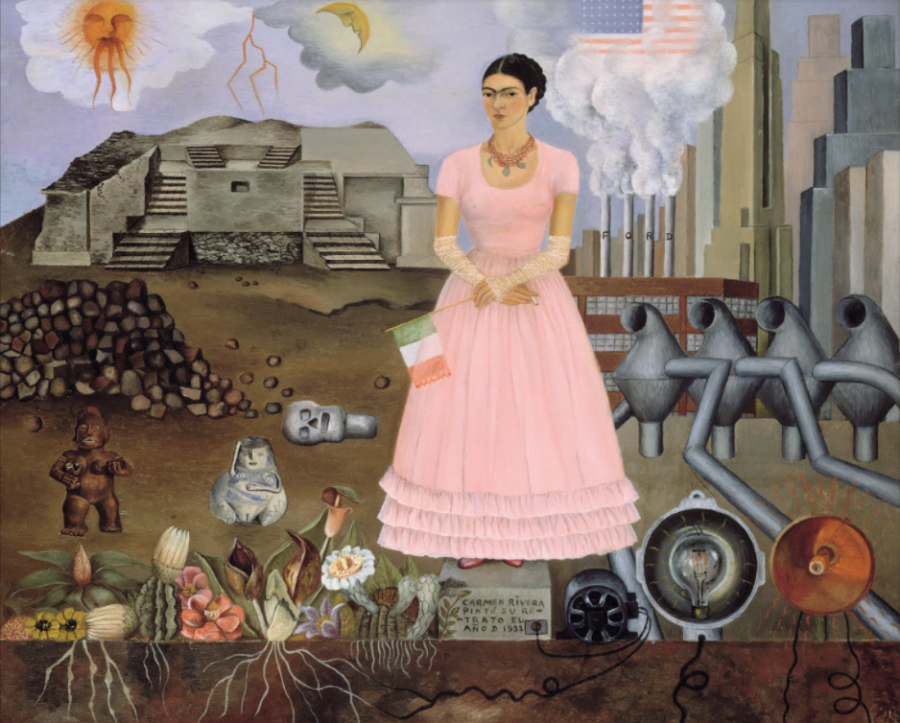
Not that Frida Kahlo is in danger of being forgotten. She is adored around the world, an icon for millions of people who see themselves in the various intersections of her identity: Mexican, mestiza, queer, disabled, feminist, uncompromisingly radical, etc….
Kahlo’s identities matter, and she made them matter. She would not be erased or let her edges be planed away and sanded down. Like other confessional artists to whom she is often compared, Kahlo turned her tragically painful, joyously vibrant life into enduring art. To crib Audre Lorde’s description of poetry, her work is a “revelatory distillation of experience.”
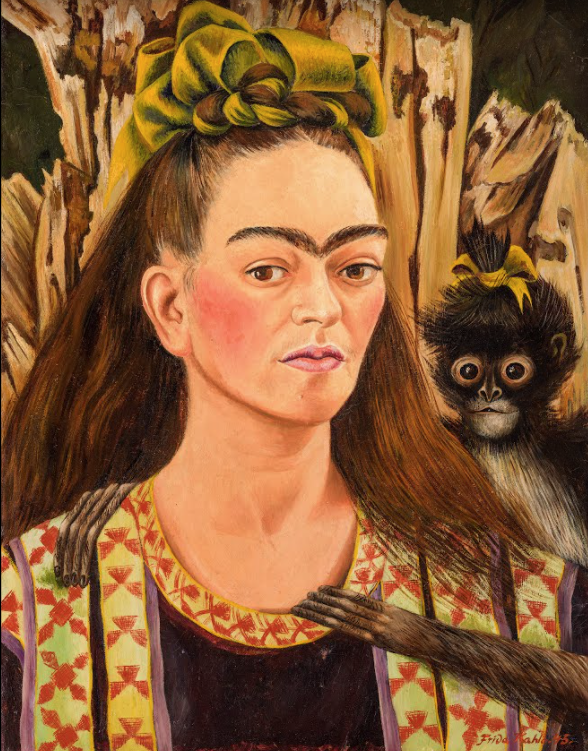
But the confessional understanding of Kahlo can present a critical problem, namely the emergence of what Stephanie Mencimer calls “the Kahlo Cult.”
…her fans are largely drawn by the story of her life, for which her paintings are often presented as simple illustration…. But, like a game of telephone, the more Kahlo’s story has been told, the more it has been distorted, omitting uncomfortable details that show her to be a far more complex and flawed figure than the movies and cookbooks suggest.
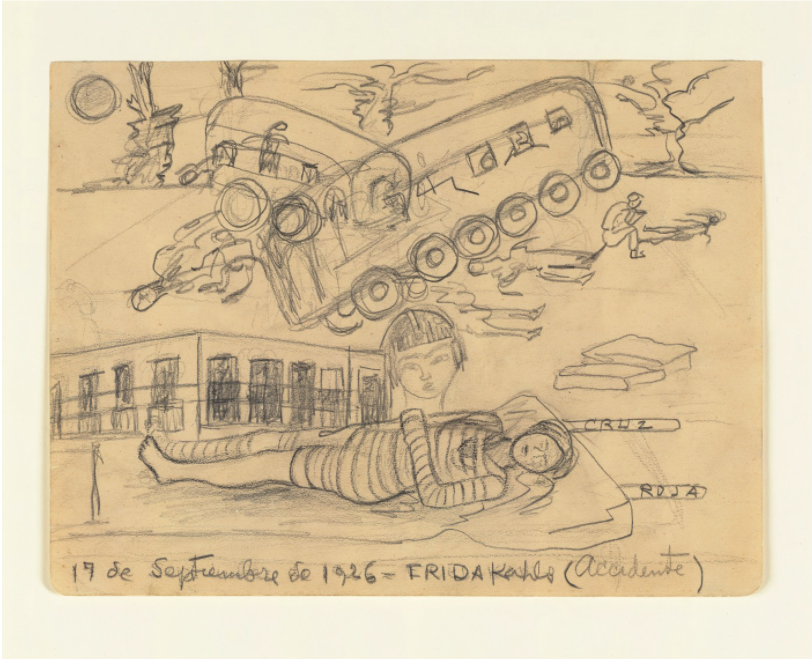
In any case, we may not need more hagiography of Frida. We find her life, flaws and all, in her work. From the ravages of childhood polio and a horrific traffic accident at 18 (depicted in the drawing below but never in a painting), from love affairs, a deep immersion in Mexican folk art, and a commitment to socialism and the Mexican Revolution, Kahlo created an autobiographical oeuvre like no other. That said, Kahlo herself is so undeniably fascinating a character that “no one need appreciate art to justify being a Kahlo fan or even a Kahlo cultist,” as Peter Schjeldahl once wrote. “Why not? The world will have cults, and who better merits one?”
For the art appreciators and Kahlo cultists alike, Google Arts & Culture has created a project that brings together her life and work in ways that illuminate both, with biographical and critical essays, and a thorough exhibit of her work from museums all over the world, including many little-known pieces like her sketches, drawings, and early works; a look at her letters and many photographs of her throughout her life; an online exhibition of her famous wardrobe; several features of her influence on LGBTQ artists, musicians, fashion designers, and much, much more. It’s “the largest Kahlo curation ever assembled,” notes My Modern Met. “The best part? No need to pay a museum fee—it’s available online for anyone to enjoy for free.”
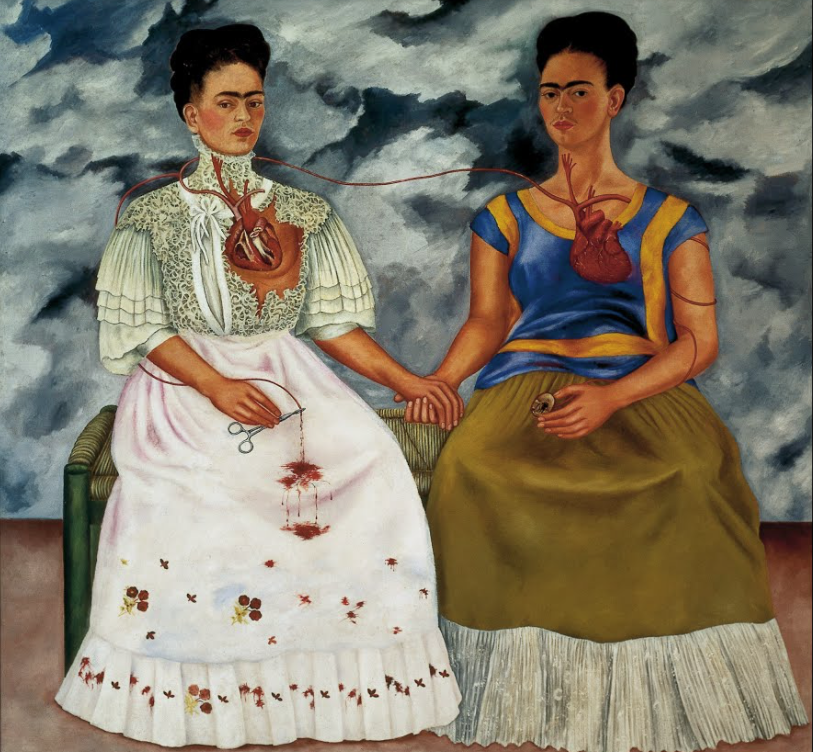
A collaboration “between the tech giant and a worldwide network of experts and 33 partner museums in seven countries,” notes Hyperallergic, Faces of Frida contains 800 artifacts, “including 20 ultra-high resolution images… never digitized till now.” Some of these artifacts are extremely rare, such as “early versions of her work, sketched and etched onto the backs of finished paintings, unseen by anyone without the ability to touch them.” You can also see the places that most influenced her career through five Google Street view tours, “including the famous Blue House in Mexico City in which she was born and died.”
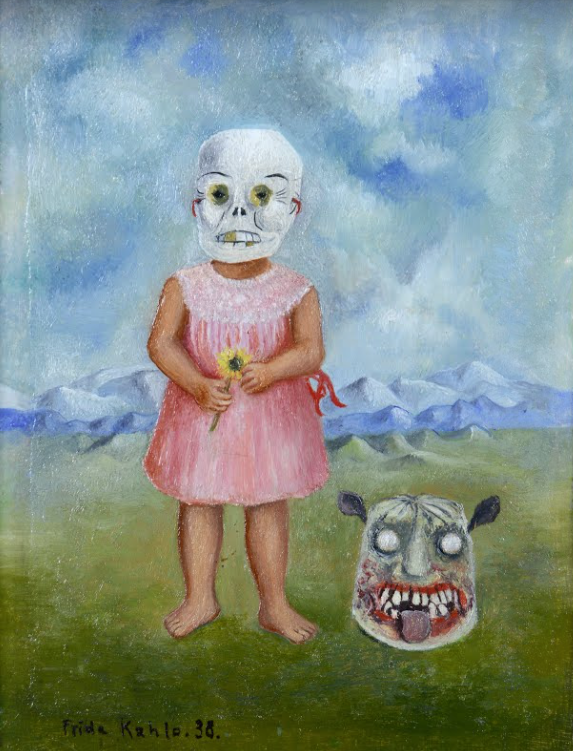
This comprehensive online gallery seeks to encompass every part of Frida’s life, but rarely takes the focus from her work. “Of the 150 or so of her works that have survived,” notes Mencimer, “most are self-portraits. As she later said, ‘I paint myself because I am so often alone, because I am the subject I know best.’” Working outward from herself, she also painted the specific resonances of her time and place, and explored human experiences that transcend personality. “As with all the best artists,” says author Frances Borzello in one of the Google Arts features, “Kahlo’s art is not a diary ingeniously presented in paint but a recreation of personal beliefs, feelings and events through her particular lens into something unique and universal.”
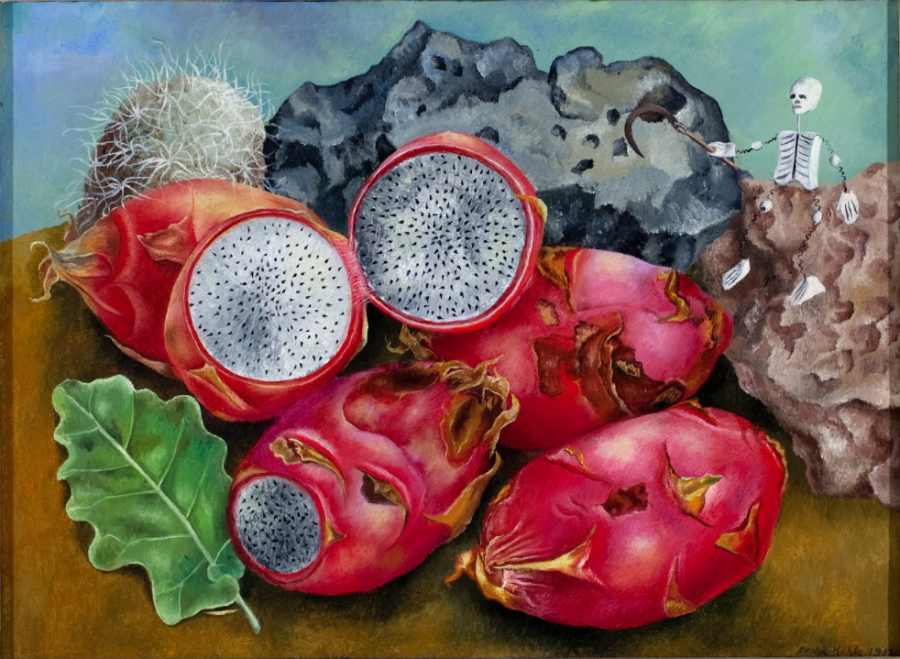
Though a superstar in the land of the dead, during her life Kahlo’s work was greatly overshadowed by that of her famous husband Diego Rivera. She only had two shows in her lifetime, one of them arranged by surrealist Andre Breton, who called her painting “a ribbon around a bomb.” After her death in 1954, she “largely disappeared from the mainstream art world.” There is a certain irony in pointing out that fascination with Kahlo’s work sometimes reduces down to interest in her biography, since it took a 1983 biography by Hayden Herrera to bring her back into the public consciousness. “When it was published” Mercimer writes, “there wasn’t a single monograph of Kahlo’s work to show people what it looked like, but the biography, which could have been the basis for a Univision telenovela, sparked a Frida frenzy.”
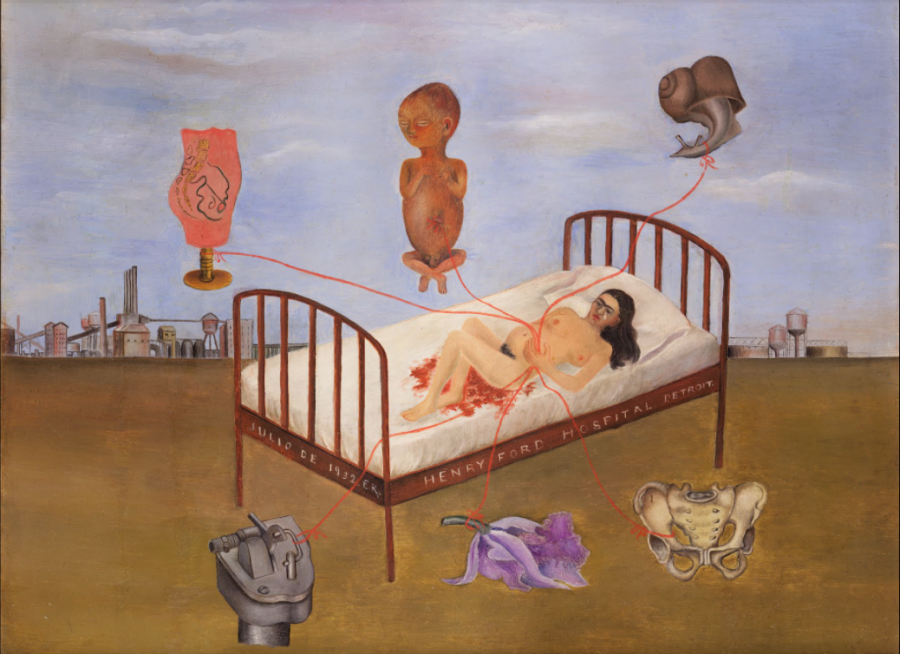
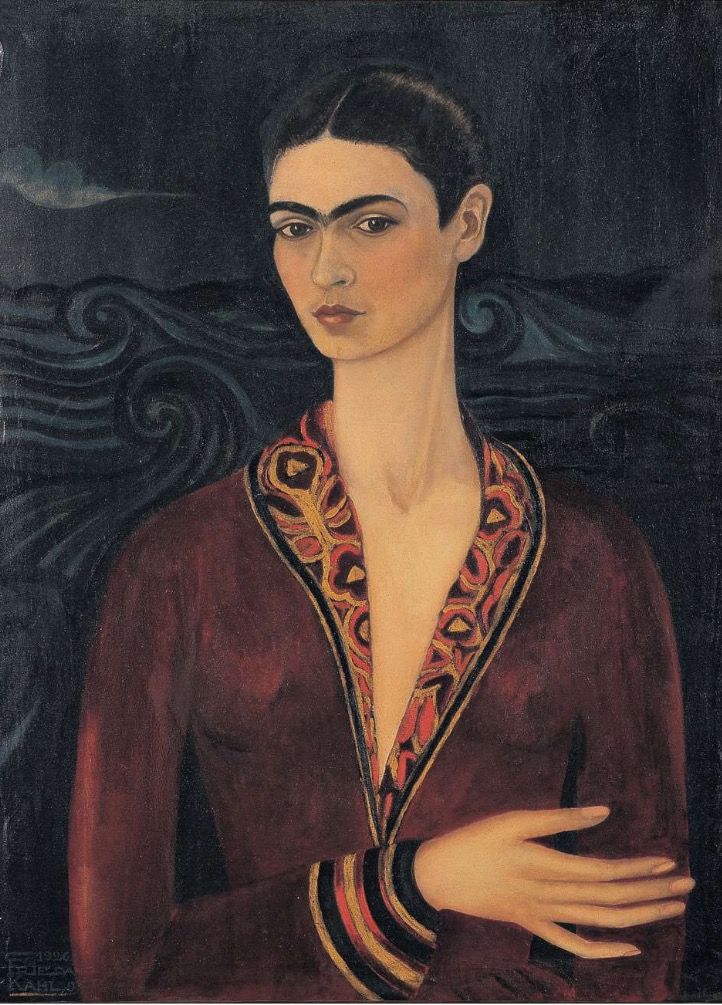
How things have changed. No reader of Herrera’s book, or any of the many treatments of Kahlo’s life since then, will come to it sight unseen. Frida’s face—defiant, mustachioed, monobrowed—stares out at us from everywhere. The Google exhibit guides us through a comprehensive contextualization of that haunting, yet familiar gaze. The letters and biographical entries contain insight after insight into the artist’s private and public lives. But ultimately, it’s the paintings that speak. As Borzello puts it, when we really confront Frida’s work, we may be struck by “how helpless words are in the face of the strange richness of those images.” She invented new visual vocabularies of pain, pleasure, pride, and perseverance. Visit Faces of Frida here.
Related Content:
Frida Kahlo’s Colorful Clothes Revealed for the First Time & Photographed by Ishiuchi Miyako
Artists Frida Kahlo & Diego Rivera Visit Leon Trotsky in Mexico: Vintage Footage from 1938
The Frida Kahlo Action Figure
Josh Jones is a writer and musician based in Durham, NC. Follow him at @jdmagness
Read More...The Isolated Vocal Tracks of the Talking Heads’ “Once In A Lifetime” Turn David Byrne into a Wild-Eyed Holy Preacher
Same as it ever was
Same as it ever was
Same as it ever was
…until you isolate the vocal tracks, above.
Talking Heads’ Afrobeat-inflected “Once In A Lifetime ” has become one of the band’s most iconic numbers. Even casual fans are prone to aping lead singer David Byrne’s shouty, freaked out preacher man delivery, a style born of experiments in human sampling, and cowriter Brian Eno’s interest in early hip hop, Nigerian musician Fela Kuti, and combining multiple rhythmic elements in a single song.
Byrne insists that the infectious lyrics are not a critique of consumerism, as is popularly believed. Instead, he explains, they’re about mindfulness and the unconscious:
We operate half-awake or on autopilot and end up, whatever, with a house and family and job and everything else, and we haven’t really stopped to ask ourselves, “How did I get here?”
Cut loose from the bass, guitar, keyboards and drums, the lyrics seem less like semi-improvisational art-geek constructions than the semi-sinister ramblings of a self-styled holy man, maybe the wild-eyed preacher character Byrne channels in the original video below.
People who’ve listened to the stripped down version online gather in the comments section like friends comparing notes near the exit of a haunted house:
I feel like David Byrne is holding me at gunpoint and yelling at me in an abandoned warehouse.
This sounds like David Byrne is lost alone in a cave and shouting nonsense into the darkness.
It’s like hearing a cult somewhere in a cavern.
This sounds like something you’d hear before being murdered??
Readers, what associations do you have with this song, and where do you find yourself after listening to it sans orchestration?
And you may find yourself
Living in a shotgun shack
And you may find yourself
In another part of the world
And you may find yourself
Behind the wheel of a large automobile
And you may find yourself in a beautiful house
With a beautiful wife
And you may ask yourself, well
How did I get here?
Letting the days go by, let the water hold me down
Letting the days go by, water flowing underground
Into the blue again after the money’s gone
Once in a lifetime, water flowing underground
And you may ask yourself
How do I work this?
And you may ask yourself
Where is that large automobile?
And you may tell yourself
This is not my beautiful house!
And you may tell yourself
This is not my beautiful wife!
Letting the days go by, let the water hold me down
Letting the days go by, water flowing underground
Into the blue again after the money’s gone
Once in a lifetime, water flowing underground
Same as it ever was
Same as it ever was
Same as it ever was
Same as it ever was
Same as it ever was
Same as it ever was
Same as it ever was
Same as it ever was
Water dissolving and water removing
There is water at the bottom of the ocean
Under the water, carry the water
Remove the water at the bottom of the ocean!
Letting the days go by, let the water hold me down
Letting the days go by, water flowing underground
Into the blue again in the silent water
Under the rocks, and stones there is water underground
Letting the days go by, let the water hold me down
Letting the days go by, water flowing underground
Into the blue again after the money’s gone
Once in a lifetime, water flowing underground
And you may ask yourself
What is that beautiful house?
And you may ask yourself
Where does that highway go to?
And you may ask yourself
Am I right? Am I wrong?
And you may say to yourself, “My God! What have I done?”
Letting the days go by, let the water hold me down
Letting the days go by, water flowing underground
Into the blue again in to the silent water
Under the rocks and stones, there is water underground
Letting the days go by, let the water hold me down
Letting the days go by, water flowing underground
Into the blue again after the money’s gone
Once in a lifetime, water flowing underground
Same as it ever was
Same as it ever was
Same as it ever was
Look where my hand was
Time isn’t holding up
Time isn’t after us
Same as it ever was
Same as it ever was
Same as it ever was
Same as it ever was
Same as it ever was
Same as it ever was
Same as it ever was
Same as it ever was
Same as it ever was
Letting the days go by (same as it ever was)
Letting the days go by (same as it ever was)
Once in a lifetime
Letting the days go by
Letting the days go by
Related Content:
Ayun Halliday is an author, illustrator, theater maker and Chief Primatologist of the East Village Inky zine. Join her in NYC on Thursday June 28 for another monthly installment of her book-based variety show, Necromancers of the Public Domain. Follow her @AyunHalliday.
Read More...Eight-Year-Old Drum Prodigy Plays Led Zeppelin’s “Good Times Bad Times;” Robert Plant Watches in Wonder
On her Vimeo page, Yoyoka Soma, an eight-year-old-drumming prodigy, tells you everything you need to know to appreciate this video. Her blurb, accompanying the video above, reads as follows:
My name is Yoyoka Soma. I am 8 year old Japanese drummer.
When I was a just small baby, my parents had a home studio and there were various kinds of instruments. My parents were performing music activities as amateur singer-songwriters and they cradled me with their music. When I listened to their songs and guitar performances, I was eager to join them and couldn’t stop beating out a rhythm. That was why I started playing the drums. The drum was the first instrument in which I felt an interest in my life. My parents’ music peers often visited us to play together. I was glued to the powerful and dynamic performances by the drummers. At age 2, I was playing the drums as if I were playing with toys. At age 4, I started performing at concerts. At age 5, my family band “Kaneaiyoyoka” was formed by my parents. We have released 2 self-produced CD albums so far. Not only the drums, I also play the keyboard and perform as a vocalist. I compose lyrics and music as well.
My favorite drummers are John Bonham, Chris Coleman and Benny Greb.
As a drummer, I enjoy being groove, tones and try to support vocalists carefully. My dream is to be the best drummer in the world. In addition, I want to be an artist who can do anything: playing all instruments, recording music, mixing the sound and designing the CD album jackets. As I am aiming at overseas activities, I am studying English conversation. I want to become friends with people all over the world through my musical activities!
As HLAG [Hit Like a Girl] is a contest only for women, I definitely can’t lose it. I want to be the best female drummer. Thanks to the great support by my family and fans, I can continue the practice and other musical activities. I want to show the best result of my daily practice and come out on top of this contest!
Yoyoka’s gleeful performance of John Bonham’s drum section from Zeppelin’s “Good Times Bad Times” served as her entry for the 2018 edition of the Hit Like a Girl contest. She wasn’t amongst the winners this year alas. But she undoubtedly has time–plenty of time–to take another shot.
Below, you can watch Robert Plant’s reaction upon viewing Yoyoka at work. “I know where she could get a good job.” “That’s amazing, isn’t it?”
h/t Mike S.
If you would like to support the mission of Open Culture, consider making a donation to our site. It’s hard to rely 100% on ads, and your contributions will help us continue providing the best free cultural and educational materials to learners everywhere. You can contribute through PayPal, Patreon, and Venmo (@openculture). Thanks!
Related Content:
What Makes John Bonham Such a Good Drummer? A New Video Essay Breaks Down His Inimitable Style
John Bonham’s Isolated Drum Track For Led Zeppelin’s ‘Fool in the Rain’
Read More...Experience the Mystical Music of Hildegard Von Bingen: The First Known Composer in History (1098 – 1179)
The German abbess, visionary, mystic poet, composer, and healer Hildegard von Bingen “has become a symbol to disparate groups,” writes Brian Wise at WQXR, including “feminists and theologians, musicologists and new-age medicine practitioners. Her chants have been set to techno rhythms; her writings on nutrition have yielded countless cookbooks (even though she never left behind a single recipe.)” She did leave behind an astounding body of work that has made her improbably popular for a 12th century nun, with a lively presence on Facebook and her own Twitter account, @MysticHildy (“very into technology, love to travel”).
Her fame rests not only on the beauty of her work, but on her extraordinary life story and the fact that she is the first composer to whose work we can put a name. She was born in 1098 in Bermersheim, the tenth child of a noble family. It being the custom then to dedicate a tenth child (a “tithe”) to the church, Hildegard was sent to the Monastery of Saint Disibodenberg to become a Benedictine nun under the tutelage of Jutta, a highly-respected anchoress.
“After Jutta’s death,” notes Fordham University’s sourcebook, “when Hildegard was 38 years of age, she was elected the head of the budding convent living within cramped walls of the anchorage.”
Throughout her life, Hildegard had experienced visions, beginning at the age of 3. (Oliver Sacks attributed these to migraines). At age 42, she had a powerful experience that radically changed her life. She described this moment in her writings:
And it came to pass … when I was 42 years and 7 months old, that the heavens were opened and a blinding light of exceptional brilliance flowed through my entire brain. And so it kindled my whole heart and breast like a flame, not burning but warming… and suddenly I understood of the meaning of expositions of the books…
Overwhelmed, and fearful of writing down her visions “because of doubt and a low opinion of myself and because of diverse sayings of men,” she nonetheless found encouragement from leaders in the church to write and circulate her theological work: “With papal imprimatur, Hildegard was able to finish her first visionary work Scivias (“Know the Ways of the Lord”) and her fame began to spread through Germany.” Soon after, she relocated her convent to Bingen, and began an incredibly productive period in the last few decades of her life.
All told, she turned out an “extraordinary array of creative treasures,” writes Wise: a drama in verse, “more than 70 musical works, medical texts filled with 2,000 remedies, writings presenting feminine archetypes for the divine.” Although she held to orthodox doctrine, opposing the Cathars, for example, and other “schismatics,” she was a mystic whose ideas far exceeded the cramped theological confines of so many male counterparts. “Hildegard’s visions caused her to see humans as ‘living sparks’ of God’s love, coming from God as daylight comes from the sun,” writes Fr. Don Miller. “This unity was not apparent to many of her contemporaries.”
Her transcendent sight did not blind her to the diverse beauty of the natural world. “She not only had faith,” says German director and actress Margarethe Von Trotta, who made a 2010 biopic about Hildegard, “but she was so curious. Today, perhaps she would have been a scientist because she did so much research on healing people, on plants and animals.” Hildegard’s talent, intellect, and forceful personality made her a formidable person, “the only known female figure of her time,” writes Music Academy Online, “who achieved such intellectual stature and whose contributions have had lasting impact.” The revived interest in her music coincided with “the ‘new age’ chant craze in the mid-1990s,” but Hildegard’s work differs markedly from medieval chant written for male voices.
Varying from “highly syllabic to dramatic melismas (swirling melodies on a single open syllable,” Melanie Spiller explains, “her music is quite distinctive and easily recognizable, with unsual elements for the time, including exceeding an octave by a fourth or fifth, and large and frequent leaps.” Her music also functioned as “a vehicle for her own mystical experience,” and it continues to move listeners—of faith and no faith—who hear in her song celebrations of the divinely feminine and the wonders of the natural world.
Related Content:
Mashup Weaves Together 57 Famous Classical Pieces by 33 Composers: From Bach to Wagner
Josh Jones is a writer and musician based in Durham, NC. Follow him at @jdmagness
Read More...Rapping, Deconstructed: How Some of the Greatest Rappers Make Their Rhymes
If high school English teachers can challenge skeptical students to cultivate an appreciation for Shakespeare and poetry with rap-based assignments, might the reverse also hold true?
Many aficionados of high culture turn up their noses at rap, believing it to be a simple form, requiring more braggadocio than talent.
Estelle Caswell, rap fan and producer of Vox’s Earworm series, may get them to rethink that position with the above video, showcasing how great rappers assemble rhymes.
Caswell uses visual graphing to explain the progress from the A‑A-B‑B scheme of early rapper Kurtis Blow’s “The Breaks” (1980) to the complex and surprising holorimes of her personal favorite, MF DOOM.
To appreciate her visual breakdowns, you must understand that raps can be scored like traditional music. Here the bar reigns supreme—each bar consisting of four beats. The further out we go from rap’s origins, the more its practitioners play with placement and rhyme.
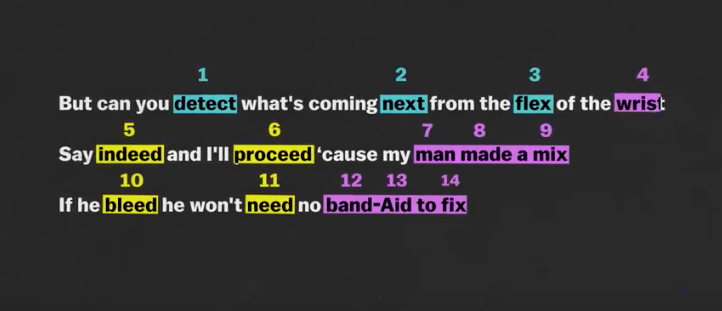
Above are some lyrics from Eric B. and Rakim’s 1986 cut, “Eric B. Is President,” featuring internal rhymes highlighted in yellow and multi-syllabic rhymes picked out in pink. You’ll also find them escaping the tyranny of the bar line, continuing the rhyme on the first beat of the next bar.
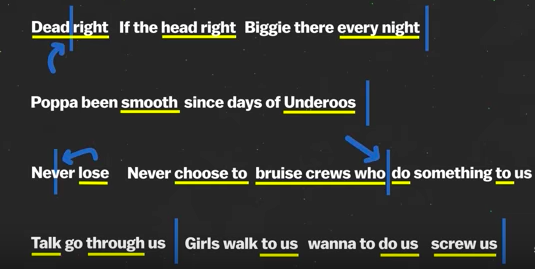
Caswell is so intent on examining the late Notorious B.I.G.‘s “Hypnotize,” that she overlooks a rather sizable elephant in the room, the misogynistic POV behind those en and oo sounds.
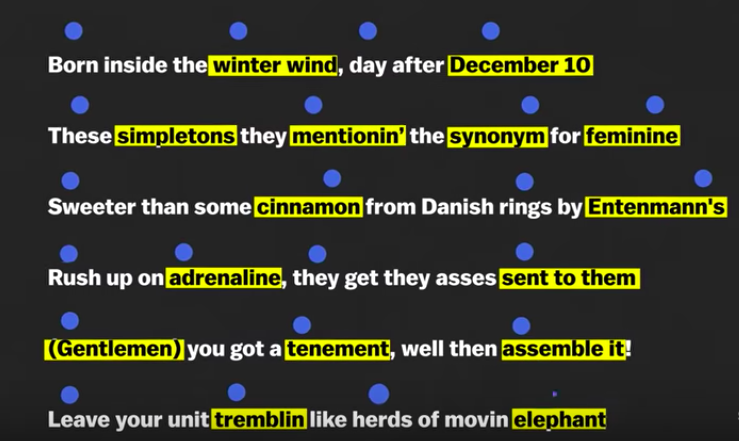
Shortly thereafter, Mos Def ups both the rhyming game and the feminist accountability, by stuffing his compositions with multi-syllabic words and phrases that sort of rhyme—cinnamon, Entenmann’s, adrenaline and “sent to them.”
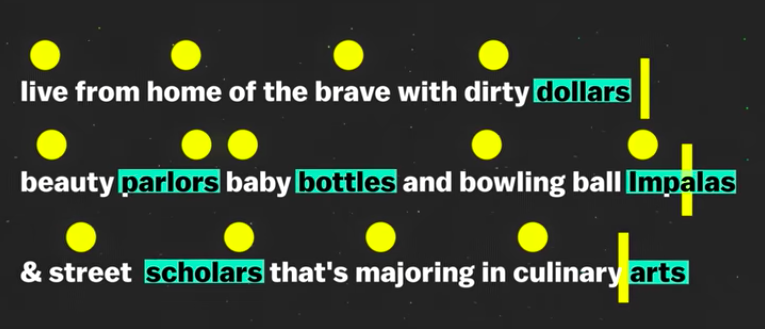
Meanwhile, Andre 3000 is playing with varying the accent of his rhymes, relative to the beat and bar, rather than committing to a predictable thudding.
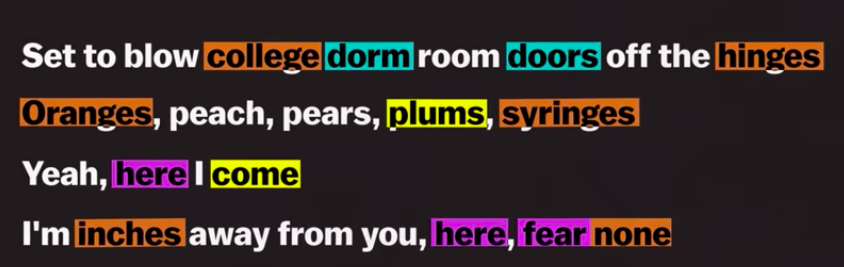
Eminem, who has the distinction of penning the first rap to win an Academy Award, places a premium on narrative, and refuses to concede that nothing rhymes with orange.
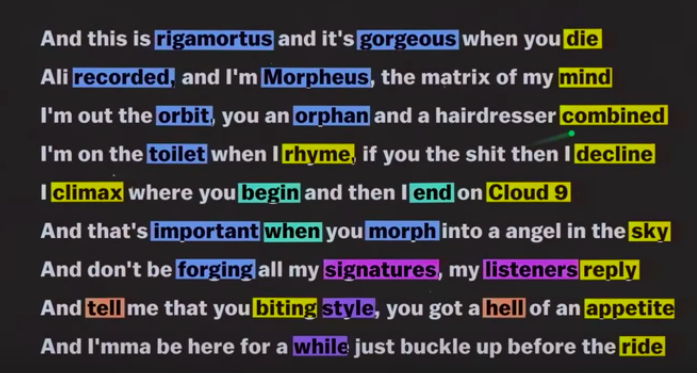
Current chart topper Kendrick Lamar’s galloping “Rigamortis” establishes a musical motif that Caswell compares to Beethoven’s famous fifth.

MF DOOM kicks the ball further down the court with double entendres, wordplay and a willingness to steer clear of the expected “b word.”
Listen to a Spotify playlist of the songs referenced in the video.
Delve further into the subject by reading the thoughts of rap analyst Martin Connor, whom Caswell credits as a sort of beacon.
Related Content:
Ayun Halliday is an author, illustrator, theater maker and Chief Primatologist of the East Village Inky zine. Follow her @AyunHalliday.
Read More...Hear the First Track From John Coltrane’s Lost Album: The Newly-Discovered 1963 Collection Will Get Officially Released Later This Month
Sainthood and incalculable influence aside, John Coltrane didn’t always break new ground in the studio. “If you heard the John Coltrane Quartet live in the early-to-mid 1960s,” writes Giovanni Russonello at The New York Times—referring to the classic lineup of bassist Jimmy Garrison, drummer Elvin Jones, and pianist McCoy Tyner—you heard “a ground-shaking band, an almost physical being, bearing a promise that seemed to reach far beyond music.”
Prior to 1965’s supernatural A Love Supreme, however, few of the eight albums the classic quartet recorded for Impulse! Records captured “the band’s live ethic.” The “funny problem” Coltrane had was his commercial viability, which made the label eschew recording the quartet’s considerably experimental tendencies in favor of “concept-driven and consumer-friendly projects.” Now, Russonello writes, “that story needs a major footnote.” A lost Coltrane album from 1963 has emerged, discovered by the family of his first wife, Naima.
Coltrane history may be rewritten on June 29th when the album, Both Directions at Once, gets its release. We have a glimpse at what fans have been missing for the past 55 years in the soaring first track, “Untitled Original 11383,” above, a “brisk minor blues.” The album’s remaining treasures may justify Sonny Rollin’s comparison of this discovery to “finding a new room in the Great Pyramid.” In addition to two previously unheard original compositions, the album features some very intriguing recordings.
The final track, a studio version of “One Up, One Down,” was “previously heard only on a bootleg recording made at the Birdland jazz club,” notes Fact Magazine. “One of Coltrane’s most famous compositions, ‘Impressions,’ is featured in a trio without piano,” and the album also contains the first recording of “Nature Boy,” which later appeared on The John Coltrane Quartet Plays. (See Fact Mag for a full tracklisting of the standard and two-CD deluxe editions of the album.) This collection comes very close “to the breadth of what Coltrane and his associates were delivering onstage,” claims Russonello.
It may also represent a presciently transitional document, as its title suggests. As Coltrane’s son Ravi puts it, “you do get a sense of John with one foot in the past and one foot headed toward his future.” After the album’s 1963 recording at the Rudy Van Gelder Studio in New Jersey, the master tapes somehow went missing, but Coltrane had taken home the reference tape that only recently surfaced. Both Directions at Once fills in a gap between the “marvelous” albums Coltrane and Crescent, showing off the band’s dynamism in the period between “spring 1962 to spring 1964” and letting them cut loose while staying within familiar harmonic forms.
Coltrane’s avant-garde brilliance may have changed the course of modern music, but some of his most forward-thinking experiments can be difficult listening for those uninitiated in the rites of modal free jazz. According to pianist and scholar Lewis Porter, commenting on an advance copy of Both Directions at Once, the rediscovered album, contains “a lot of that musical meat” that Coltrane’s quartet delivered to live audiences in the early-to-mid-sixties, “but in a context that will be more accessible to a lot of listeners.”
Maybe more conservative listeners, however, can find in the lost album a key that unlocks the incredible mysteries of later recordings like Ascension, Meditations, and the wild, posthumously-released Interstellar Space.
Related Content:
John Coltrane’s Handwritten Outline for His Masterpiece A Love Supreme (1964)
Josh Jones is a writer and musician based in Durham, NC. Follow him at @jdmagness
Read More...Support Us
We're hoping to rely on loyal readers, rather than erratic ads. Please click the Donate button and support Open Culture. You can use Paypal, Venmo, Patreon, even Crypto! We thank you!

About Us

Open Culture scours the web for the best educational media. We find the free courses and audio books you need, the language lessons & educational videos you want, and plenty of enlightenment in between.
Advertise With Us

FREE UPDATES!
GET OUR DAILY EMAIL
Get the best cultural and educational resources on the web curated for you in a daily email. We never spam. Unsubscribe at any time.
FOLLOW ON SOCIAL MEDIA

Open Culture editor Dan Colman scours the web for the best educational media. He finds the free courses and audio books you need, the language lessons & movies you want, and plenty of enlightenment in between.
Advertise With Us

