Hear Eric Clapton’s Isolated Guitar Track From the Beatles’ ‘While My Guitar Gently Weeps’ (1968)
George Harrison of the Beatles was an accomplished guitar player with a distinctive soloing style. So you might think that with a song as personal and guitar-centric as “While My Guitar Gently Weeps,” he would do his own playing. In fact, the song features guitar playing by Eric Clapton.
It was recorded on September 6, 1968, during the acrimonious White Album sessions. Harrison had been struggling off and on for over a month to get the song right. He first tried it with his own playing on a Gibson J‑200 guitar along with an overdubbed harmonium. He later experimented by running the guitar solo backwards. Nothing seemed to work.
So finally Harrison asked his friend Clapton for a little help. When Harrison walked into Abbey Road Studios with Clapton, the other Beatles started taking the song seriously. In a 1987 interview with Guitar Player magazine, Harrison was asked whether it had bruised his ego to ask Clapton to play on the song.
No, my ego would rather have Eric play on it. I’ll tell you, I worked on that song with John, Paul, and Ringo one day, and they were not interested in it at all. And I knew inside of me that it was a nice song. The next day I was with Eric, and I was going into the session, and I said, “We’re going to do this song. Come on and play on it.” He said, “Oh, no. I can’t do that. Nobody ever plays on the Beatles records.” I said, “Look, it’s my song, and I want you to play on it.” So Eric came in, and the other guys were as good as gold–because he was there. Also, it left me free to just play the rhythm and do the vocal. So Eric played that, and I thought it was really good. Then we listened to it back, and he said, “Ah, there’s a problem, though; it’s not Beatley enough”–so we put it through the ADT [automatic double-tracker], to wobble it a bit.
For the impression of a person weeping and wailing, Clapton used the fingers on his fretting hand to bend the strings deeply, in a highly expressive descending vibrato. He was playing a 1957 Gibson Les Paul, a guitar he had once owned but had given to Harrison, who nicknamed it “Lucy.” You can hear Clapton’s isolated playing above. And for a reminder of how it all came together, you can listen to the official version here.
Note: An earlier version of this post appeared on our site in May, 2013.
Related Content:
The Lost Guitar Solo for “Here Comes the Sun” by George Harrison, Discovered by George Martin
A Young Eric Clapton Demonstrates the Elements of His Guitar Sound
George Harrison Explains Why Everyone Should Play the Ukulele
Read More...Life Lessons from Anthony Bourdain: How He Developed His Iron Professionalism, Achieved Creative Freedom & Learned from Failure
Anthony Bourdain was not a particularly good chef. That statement comes not as a cheap shot at the recently departed, but a quote from the departed himself. Bourdain freely admitted it over a couple of Tiger beers with a Fast Company interviewer last year. “I was very deservedly fired on a number of occasions,” he adds for good measure, referencing his decades of dirty work and drug abuse before he rose to prominence in the worlds of food- and travel-centric books and television. But in more than one way, those decades prepared him to ride the kind of success he would eventually achieve into a body of work that could have arisen from no other life or personality.
“Most of the people I’ve met who’ve been in the television industry for a long time, their greatest fear is that they will not be in the television industry next year,” Bourdain says. “That they’ll say something or do something or make a decision that will be so unpopular that they’ll lose their gig and won’t end up back on television again. I don’t have that fear.” He knew, surely better than anyone who has publicly remarked on it, that he may not have shown the genius in the kitchen to attain star-chef status. But he also knew he had something ultimately more important: the skills to turn out meal after flawless meal, day in and day out. “If I have to,” he says, “I’m pretty sure I can keep up on an omelet station.”
Many remembrances of Bourdain have highlighted his iron professionalism. “He is controlled to the point of neurosis: clean, organized, disciplined, courteous, systematic,” wrote the New Yorker’s Patrick Radden Keefe in a profile published last year. “He is Apollo in drag as Dionysus.” Bourdain credited that to his lean years in the kitchen: “Everything important I ever learned, I learned as dishwasher and as a cook: you show up on time, you stay organized, you clean up after yourself, you think about the people you work with, you respect the people you work with. You do the best you can.” This went for matters personal as well as professional: “If I say to you I’m going to meet you tomorrow at twelve minutes after five to see John Wick 7, I will be there at 5:02.”
He would also, he adds, be “hanging out across the street, discreetly observing to see what time you show up. And I’ll be making some very important decisions based on your arrival time.” Bourdain’s exacting standards, for himself and others, allowed him to achieve an unusual degree of freedom for a major media personality. “I detest competent, workmanlike storytelling,” he says of his and his collaborators’ penchant for creative risk. “A powerful reaction, in one way or the other, is infinitely preferable to me than pleasing everybody.” Yet despite taking books and television shows ostensibly about food in new and unpredictable aesthetic and intellectual directions, in the kitchen he remained a traditionalist to the end. “You put chicken in a carbonara? You lost me. It’s an unforgivable sin against God.”
Related Content:
Hear Leonard Cohen’s Final Interview: Recorded by David Remnick of The New Yorker
Carl Sagan Issues a Chilling Warning to America in His Final Interview (1996)
David Foster Wallace: The Big, Uncut Interview (2003)
Paulo Coelho on How to Handle the Fear of Failure
Based in Seoul, Colin Marshall writes and broadcasts on cities and culture. His projects include the book The Stateless City: a Walk through 21st-Century Los Angeles and the video series The City in Cinema. Follow him on Twitter at @colinmarshall or on Facebook.
Read More...Weezer Covers Toto’s “Africa” & Makes a Young Fan’s Dream Come True: The Latest, Greatest Cover of the 1983 Song
Last month, rock band Weezer performed a remarkable bit of fan service: taking a request from a fan’s Twitter and granting it. A user called, appropriately, “Weezer Cover Africa by Toto,” has been badgering the band since December of 2017 to do just that. The person behind the account is 15-year-old Mary from Ohio, who is both a serious fan of Weezer and of “Africa,” which she first heard on an episode of “Stranger Things.”
Though the band decided to help Mary out, they had a little bit of fun first, trolling her and covering “Rosanna,” Toto’s bigger hit (it won Record of the Year at the 1983 Grammys ). A few days later, they dropped “Africa”…and watched as it sailed to the top of the iTunes charts. (If you’re wondering, the original reached the top spot in the Billboard 100 back in 1983).
Now, if you know the original, Weezer’s cover is pretty note-for-note. One could argue that Toto, mocked for its smooth pop leanings, actually rock harder than Weezer, especially in the song’s chorus.
But Mary’s obsession with “Africa” doesn’t come out of nowhere. YouTube is full of odd covers of the song.
Here’s a loop pedal and piano version from Peter Bence:
Or how about a choral group’s version, complete with a ASMR-tastic recreation of a rainstorm.
You could also watch a rubber chicken have a go:
But my current favorite is this very enthusiastic Nordic metal cover from Leo Moracchioli and friends:
Why do people more than ever love “Africa”? When it came out it was definitely a hit, but over 35 years or so it’s transcended its cheesy pop status to become a “classic” of pop construction, filled with dynamic changes, multipart harmonies, and a complex arrangement. There’s nothing ironic in loving it.
Annie Zaleski, in her Salon article on the song’s enduring power, describes its world music indulgences and its rhythm:
Without flash or fanfare, “Africa” incorporates congas, marimbas, the gong and other percussion flourishes, giving the song a textured velocity. Underneath it all is a hypnotic groove, resembling a constant, gentle push — one that keeps the song pulsating forward. When listening to “Africa,” it’s impossible to stay still; the song’s innate movement is infectious.
Co-writer David Paich (Toto’s keyboardist) explained the thoughts behind the lyrics in a Grantland interview, explaining they stemmed from his days as a Catholic schoolboy and hearing tales of missionary work:
I had all these things rattling about in my brain when I was writing the song. All these thoughts about priests and young social workers that have gone over there, devoting their lives to helping people, and having to choose what kind of life they’re going to have — whether to keep doing this, what I’m doing here, or can I have a life, get married, have kids, and do that kind of thing. So it was a life choice mixed in with a geographical fascination there.
But as he also says, the line “I bless the rains down in Africa” just popped out when he first started working on the chorus. The verses were written after to explain the mystery of the chorus. Also: the song was added at the last minute, closing off the album, which opens with “Rosanna,” perfect bookends which the rest of the album can’t reach.
And finally, if you’re still fascinated with the song, Rick Beato checks out the individual multi-tracks on his series “What Makes This Song So Great.” By the end, you might just have the answer.
Related Content:
John Bonham’s Isolated Drum Track For Led Zeppelin’s ‘Fool in the Rain’
Ted Mills is a freelance writer on the arts who currently hosts the FunkZone Podcast. You can also follow him on Twitter at @tedmills, read his other arts writing at tedmills.com and/or watch his films here.
Read More...How to Film Thought: A Close Look at the Masterful Editing of Sherlock, Starring Benedict Cumberbatch
What has drawn Sherlock, the BBC television series starring a modern-day version of Arthur Conan Doyle’s beloved consulting detective, such great acclaim? Some of it, of course, has to do with the formidable acting skills of Benedict Cumberbatch in the title role. But if you believe Evan Puschak, better known as the video essayist the Nerdwriter, much of the genius of this “intoxicatingly inventive TV show” lies in the editing.
The plot of each episode runs on how Sherlock “gets from point A to point B, from problem to solution, mystery to clarity,” and just as Cumberbatch must convincingly portray the figuring-out process with his performance, so must the editors with their cuts. Puschak illustrates Sherlock’s creative, idea-dense way of doing this with just one sequence of three minutes and 42 seconds. It comes triggered by a bout of withdrawal from cocaine, a choice that stays true to the nature of the character Conan Doyle created, brilliant but also a drug addict.
During this sequence, Sherlock arrives at just what every good detective story needs: a revelation, a moment when both he and we see the pieces of information the story has previously presented from a new angle, in a way that reveals the crucial relationship between them. And as essentially a cinematic work, Sherlock literally shows it from not just one but many new angles, even from perspectives impossible in real life. As with any well-crafted piece of editing, you can only feel this sequence’s power when you watch it, not when you read it described. Puschak takes full advantage of his own form, the video essay, to not just show it to us but break it down to its constituent elements.
Conan Doyle’s original Sherlock Holmes stories won their wide and avid readership by offering a glimpse into the workings of an unusual mind, making them legible in text. Sherlock goes a dimension further by making them legible in image and sound. The relationship between the two parallels the relationship between the traditional essay and the video essay: the latter, in this case, allows us to follow the process of Puschak’s thoughts about Sherlock not just textually but audiovisually as well. And with his channel’s just having passed one million subscribers, he seems well on the way to achieving a Sherlockian level of popularity himself.
Related Content:
Download the Complete Sherlock Holmes, Arthur Conan Doyle’s Masterpiece
Based in Seoul, Colin Marshall writes and broadcasts on cities and culture. His projects include the book The Stateless City: a Walk through 21st-Century Los Angeles and the video series The City in Cinema. Follow him on Twitter at @colinmarshall or on Facebook.
Read More...Enter a Digitized Collection of 38,000 Pamphlets & Periodicals From the French Revolution
“What other solution but revolution?” asks Jonah Walters of the conditions for most of the population in late-18th century France. The majority lived in abject poverty; “the economic subjugation in the countryside was profound.” The urban workers—or sans-culottes—fared little better. “The clergy and nobility,” on the other hand, “comprising about 1.6 percent of the population, were doing just fine—most nobles lived in extreme opulence.” This outline sketches the barest context for the resentment that fueled the violence of the French Revolution and the thousands of executions eventually carried out by the Revolutionary Tribunal.
Lawyer and orator Georges Danton, who had argued forcefully for the killing of Louis XVI, proposed the Tribunal, in fact, as a means of stemming terror. “I shall go so far as to say,” he declared, “that if a tribunal had been in existence” in the years between 1789 and 1793, “the people, who have been so often and so cruelly rebuked for the actions of these days, would not have covered them with blood.” He advocated that the tribunal “be terrible in order that the people may be spared the necessity of being terrible.” The following year, Danton himself was beheaded, accused of leniency and self-indulgence.
Like his contemporaries Robespierre and Marat, Danton’s story illustrates the revolutionaries’ eloquent idealism and their commitment to the execution of royalists, counterrevolutionaries, and thousands of accused criminals as a means of remaking the nation and fully destroying the Ancien Régime. Kingston University’s Marisa Linton sums up the political crisis:
The French went almost overnight from being an absolute monarchy to a political system in which the will of the people replaced that of the king. In the absence of traditions of parliamentary rule, the French fell back on universalist abstract principles and Enlightenment rhetoric which were to prove increasingly divisive and leave no space for legitimate opposition. In this climate, all political rivals had the potential to be denounced as conspirators against popular sovereignty.
As in the American Revolution a few years earlier, these debates took place in public via speeches, periodicals, and pamphlets, which were printed by the tens of thousands. Chicago’s Newberry Library French Revolution Collection houses on the Internet Archive “more than 30,000” such pamphlets and “more than 23,000 issues of 180 periodicals published between 1780 and 1810…. The collection represents the opinions of all the factions that opposed and defended the monarchy during the turbulent period between 1789 and 1799 and also contains innumerable ephemeral publications of the early Republic.”
Much of the impressive Newberry collection, “among the most comprehensive in the world,” has been digitized and made freely available via the French Revolution Pamphlets Digital Initiative. Additionally, the Newberry has an open project for translating these pamphlets into English “in order to broaden access, aid classroom instruction, and support scholarship.” The overwhelming majority of the materials are, of course, in French, but some few are also in Latin and other languages.
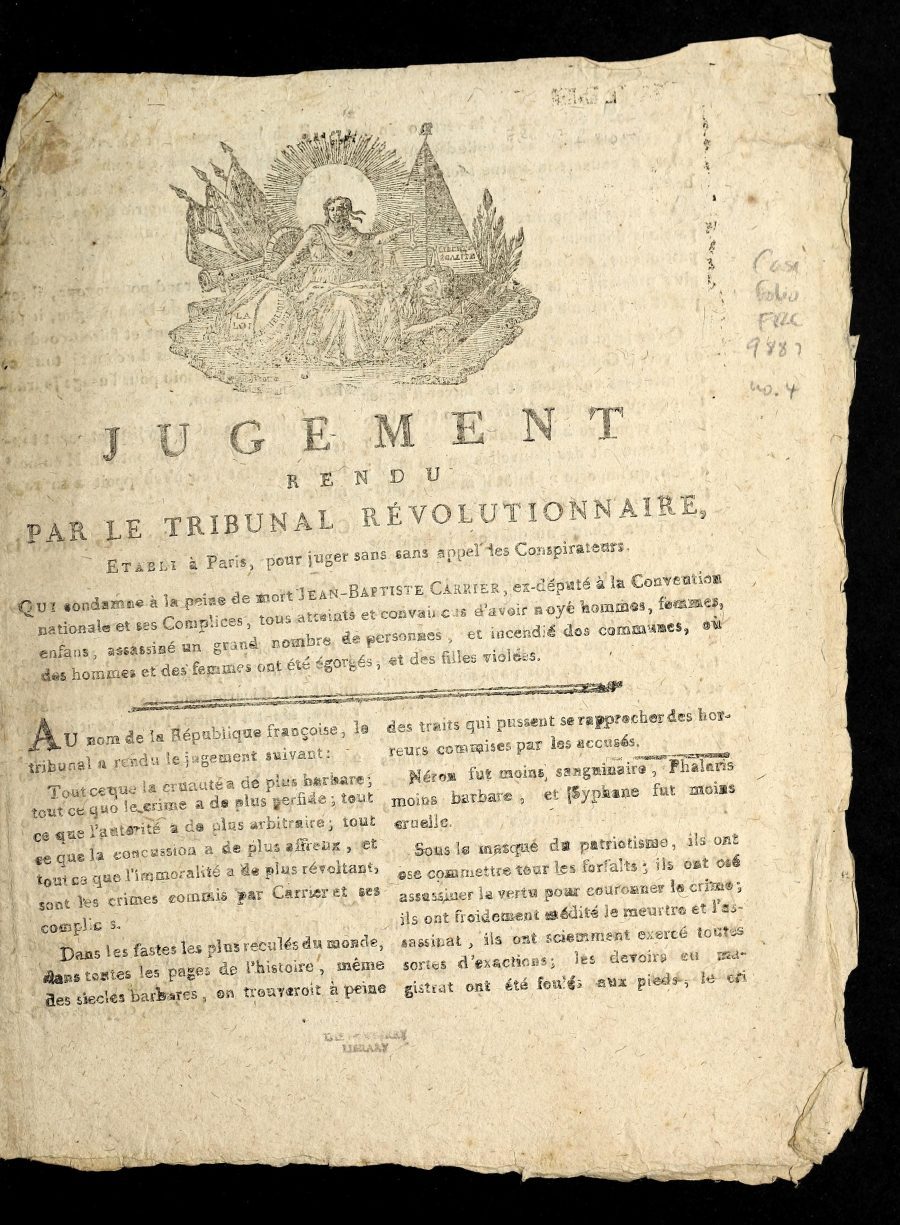
The pamphlet at the top is one of several translated by the students of DePaul University Professor Pascale-Anne Brault. This document announces the verdict of the Revolutionary Court against Jean-Baptiste Carrier, a former deputy of the National Convention who stood accused of horrific atrocities in the commission of his duties, including “drowning men, women, children” and “assassinating a large number of people and burning towns, where men and women had their throats cut and girls were raped.” The judgment claims that “Nero was less bloodthirsty” than Carrier and his accomplices.
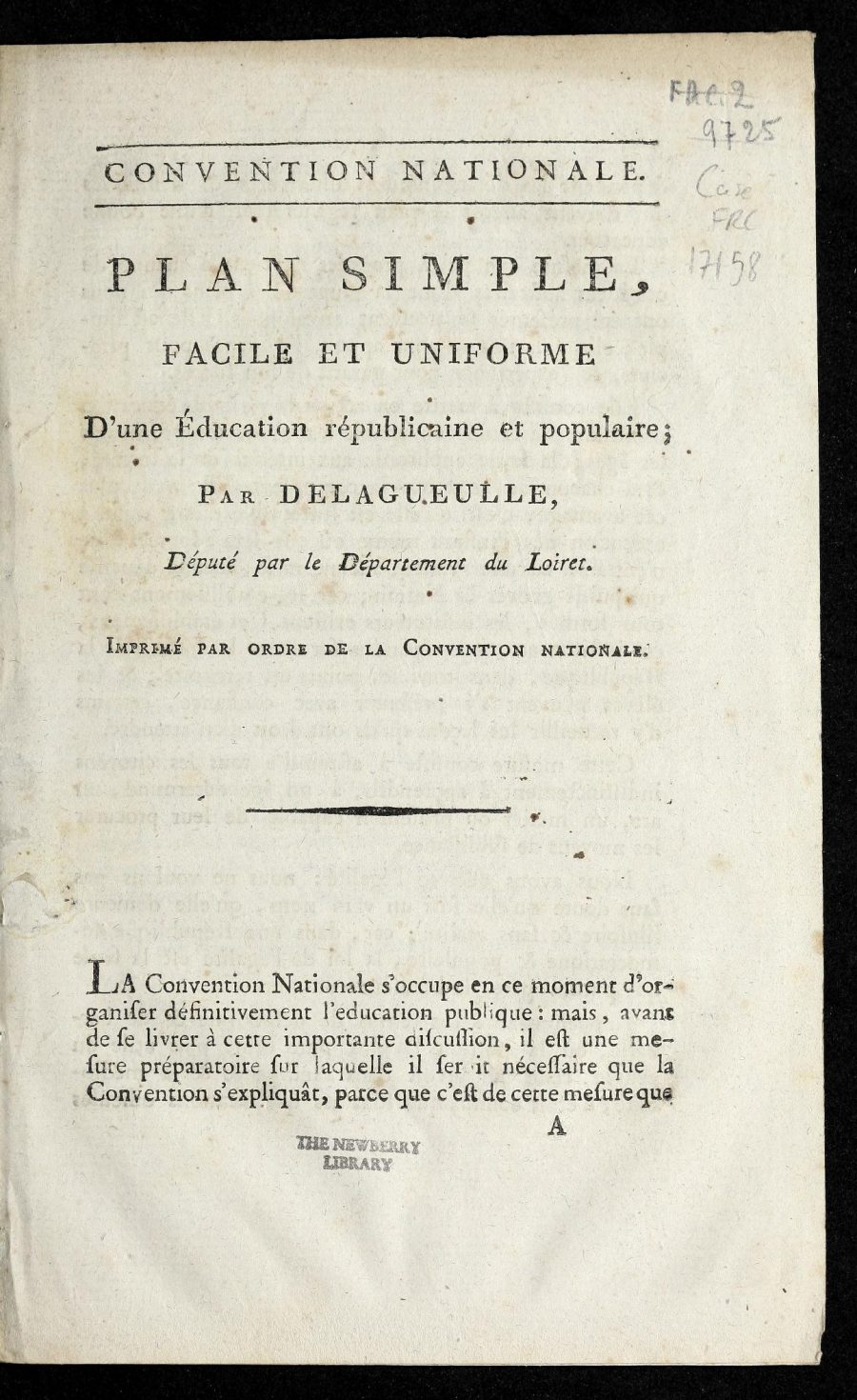
Further up, we see the first page of a pamphlet written by René Louis Delagueulle, a member of the National Convention, detailing plans for “a Republican Education of the People.” Delagueulle begins his proposal with a set of justifications, among them the need for full employment. “This measure equally obliges all citizens to learn,” he writes, “at a set age, an art, a trade or a profession capable of procuring them the means of subsistence. We have decreed equality: we wish it not to be an empty name, that it remain illusory & without reality; for in a democratic & popular Republic, the law of equality is the only law that can bring about common happiness.”
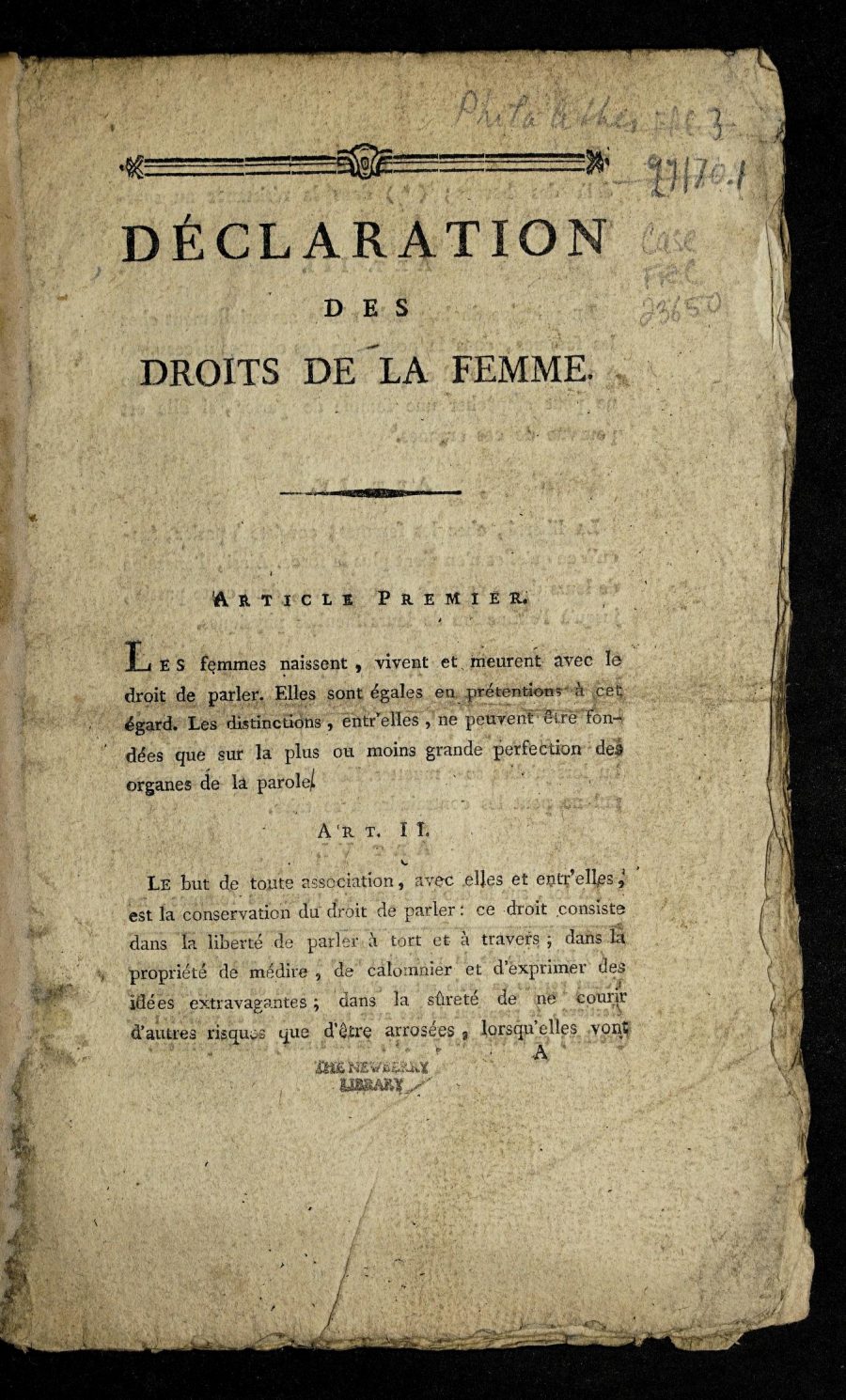
Just above, see a pamphlet titled “The Declaration of the Rights of Women,” penned in 1792 by an anonymous collective of female French citizens writing under the pseudonym Philaletes (Greek for “lover of truth”). The pamphlet consists of seventeen articles enumerating the rights of free speech for French women. “Women are born, live, and die with the right to speak,” states the first article. “They are equal in their ambition in this regard.” The document ends with a “Dedication Epistle to Female Citizens,” which begins, “for too long the Assemblée Nationale has made you wait for the declaration of your rights; it is essential and urgent that they be proclaimed.”
These fascinating documents represent just a tiny sampling of the thousands of pamphlets available, though most of them remain to be translated into English. You can volunteer to help with the translation initiative here. And enter the enormous archive of nearly 40,000 pamphlets, organized by year, subject, creator, collection, and language, here.
Related Content:
14,000 Free Images from the French Revolution Now Available Online
Josh Jones is a writer and musician based in Durham, NC. Follow him at @jdmagness
Read More...The Causes & Prevalence of Suicide Explained by Two Videos from Alain de Botton’s School of Life
“Suicide,” writes Albert Camus in “The Myth of Sisyphus,” has never been dealt with except as a social phenomenon.” And yet, as Alain de Botton argues in his School of Life video above, at least when it comes to media and government priorities, contemporary societies prefer to hardly deal with the problem at all, even though it claims the lives of some 800,000 people every year. “It remains entirely strange,” says De Botton, “that through the media we should hear so much about killers and so little about those who take their own lives.”
Given that so much mass media seems to specialize in producing a fear of others, perhaps this is not so strange after all. However, when it comes to the allocation of government resources, most “in the wealthy nations tend overwhelmingly to direct their efforts to dealing with poverty, illness, and aging,” and devote little to the problem of suicide. This may be due to social stigma. “Suicide is the supreme reminder of our intense psychological vulnerability,” and in highly religious societies, like the United States, it carries an added stigmatization as a “sin.”
Nonetheless, “given that more people die by suicide than are collectively murdered, die in traffic accidents, or are killed by animals,” it should stand to reason that we would expend more effort on finding out why. Perhaps over and above philosophy and the social sciences, De Botton argues that literature alerts us to the importance of several qualities that make our lives matter, including “love, self acceptance, meaning, hope, status, pride, forgiveness.” Such intangibles have no price or value in the competitive marketplaces that increasingly dominate our lives.
The trivialization of psychological needs leads to another common feature of suicide—the “element of surprise.” The suicide of those we know, or thought we knew, nearly always comes as a shock, which De Botton takes as “evidence of an unwitting neglect of one another (and of ourselves).” It does not serve us at all to live in denial of suffering or push despair to the margins of thought. “We should always be mindful,” Arthur Schopenhauer wrote in 1818, “of the fact that no man is ever very far from the state in which he would readily want to seize a sword or poison in order to bring his existence to an end.”
Schopenhauer’s grim universalizing statement, however, does not accord with the vast differences in suicide rates across societies. Certain countries, like Kuwait, have rates close to zero, or 0.1 in 100,000. By contrast, China has the highest rate of all, at 25.6 in 100,000. One significant difference, De Botton argues, has to do with the “interpretation and acceptance of difficulty,” including “a greater acceptance of failure, a higher role for forgiveness,” and “a status system that honors intrinsic value over achievement.”
The difference in suicide rates between nations does not have anything to do, however, with wealth. “One of the most surprising aspects of suicide,” De Botton observes in the video above, is that rates tend to rise “markedly the richer and more developed a society becomes,” a phenomenon that might appear to “negate the whole purpose of economic growth”—that is, if we assume the purpose is the maximization of human well-being. The suicide rate of an “undeveloped country like the Democratic Republic of the Congo,” he notes, “is a fraction of the rate of a developed country like South Korea.”
De Botton does not address the problem of inequality within wealthy societies. The United States, for example, the wealthiest country in recorded history, also has the greatest degree of economic inequality in history. Here, suicide rates have risen an astonishing 25% overall and over 30% in half of the states since 1999. De Botton’s cultural explanation for widely varying suicide rates between different kinds of societies may help us understand that alarming increase.
Paraphrasing the work of sociologist Emile Durkheim, he tells us that “the crucial factor behind people’s decision to end their lives is not really wealth or poverty…. It’s the extent to which the surrounding culture ascribes responsibility for failure to individuals” rather than to external factors beyond our control. Ideologies of individualism and meritocracy create grossly exaggerated beliefs about our ability to influence events in our favor, and grossly exaggerate the shame and stigma heaped upon us when we cannot do so.
This makes high-profile celebrity suicides seem to us the ultimate conundrum, since such people appear, at least superficially, to have it “all”: wealth, power, talent, status, and acclaim. But the celebrity culture that elevates some people beyond the reach of ordinary mortals can also be profoundly isolating, creating illusions of happiness rather than genuine fulfillment. We can never truly know what private griefs and personal feelings of failure and sorrow other people live with. Tending to our emotional needs, in spite of societal pressures and narratives, is critical for suicide prevention and can greatly deepen our care and compassion for ourselves and those around us.
Suicide is one of the top 10 causes of death in the U.S. right now. Call 1–800-273-TALK (8255) for help and support.
Related Content:
Stephen Fry on Coping with Depression: It’s Raining, But the Sun Will Come Out Again
Josh Jones is a writer and musician based in Durham, NC. Follow him at @jdmagness
Read More...Optical Scanning Technology Lets Researchers Recover Lost Indigenous Languages from Old Wax Cylinder Recordings
In an 1878 North American Review description of his new invention, the phonograph, which transcribed sound on wax-covered metal cylinders, Thomas Edison suggested a number of possible uses: “Letter writing and all kinds of dictation without the aid of a stenographer,” “Phonographic books” for the blind, “the teaching of elocution,” and, of course, “Reproduction of music.” He did not, visionary though he was, conceive of one extraordinary use to which wax cylinders might be put—the recovery or reconstruction of extinct and endangered indigenous languages and cultures in California.
And yet, 140 years after Edison’s invention, this may be the most culturally significant use of the wax cylinder to date. “Among the thousands of wax cylinders” at UC Berkeley’s Phoebe A. Hearst Museum of Anthropology, writes Hyperallergic’s Allison Meier, “are songs and spoken-word recordings in 78 indigenous languages of California. Some of these languages, recorded between 1900 and 1938, no longer have living speakers.”
Such is the case with Yahi, a language spoken by a man called “Ishi,” who was supposedly the last surviving member of his culture when anthropologist Alfred Kroeber met him in 1911. Kroeber recorded nearly 6 hours of Ishi’s speech on 148 wax cylinders, many of which are now badly degraded.
“The existing versions” of these artifacts “sound terrible,” says Berkeley linguist Andrew Garrett in the National Science Foundation video at the top, but through digital reconstruction much of this rare audio can be restored. Garrett describes the project—supported jointly by the NSF and NEH—as a “digital repatriation of cultural heritage.” Using an optical scanning technique, scientists can recover data from these fragile materials without further damaging them. You can see audio preservationist Carl Haber describe the advanced methods above.
The project represents a scientific breakthrough and also a stark reminder of the genocide and humiliation of indigenous people in the American west. When he was found, “starving, disoriented and separated from his tribe,” writes Jessica Jimenez at The Daily Californian, Ishi was “believed to be the last Yahi man in existence because of the Three Knolls Massacre in 1866, in which the entire Yahi tribe was thought to have been slaughtered.” (According to another Berkeley scholar his story may be more complicated.) He was “put on display at the museum, where outsiders could watch him make arrows and describe aspects of Yahi culture.” He never revealed his name (“Ishi” means “man”) and died of tuberculosis in 1916.
The wax cylinders will allow scholars to recover other languages, stories, and songs from peoples destroyed or decimated by the 19th century “Indian Wars.” Between 1900 and 1940, Kroeber and his colleagues recorded “Native Californians from many regions and cultures,” the Berkeley project page explains, “speaking and singing; reciting histories, narratives and prayers, listing names for places and objects among many other things, all in a wide variety of languages. Many of the languages recorded on the cylinders have transformed, fallen out of use, or are no longer spoken at all, making this collection a unique and invaluable resource for linguists and contemporary community members hoping to learn about or revitalize languages, or retrieve important piece of cultural heritage.”
Related Content:
Josh Jones is a writer and musician based in Durham, NC. Follow him at @jdmagness
Read More...Visualizing Dante’s Hell: See Maps & Drawings of Dante’s Inferno from the Renaissance Through Today

The light was departing. The brown air drew down
all the earth’s creatures, calling them to rest
from their day-roving, as I, one man alone,prepared myself to face the double war
of the journey and the pity, which memory
shall here set down, nor hesitate, nor err.
Reading Dante’s Inferno, and Divine Comedy generally, can seem a daunting task, what with the book’s wealth of allusion to 14th century Florentine politics and medieval Catholic theology. Much depends upon a good translation. Maybe it’s fitting that the proverb about translators as traitors comes from Italian. The first Dante that came my way—the unabridged Carlyle-Okey-Wicksteed English translation—renders the poet’s terza rima in leaden prose, which may well be a literary betrayal.
Gone is the rhyme scheme, self-contained stanzas, and poetic compression, replaced by wordiness, antiquated diction, and needless density. I labored through the text and did not much enjoy it. I’m far from an expert by any stretch, but was much relieved to later discover John Ciardi’s more faithful English rendering, which immediately impresses upon the senses and the memory, as in the description above in the first stanzas of Canto II.
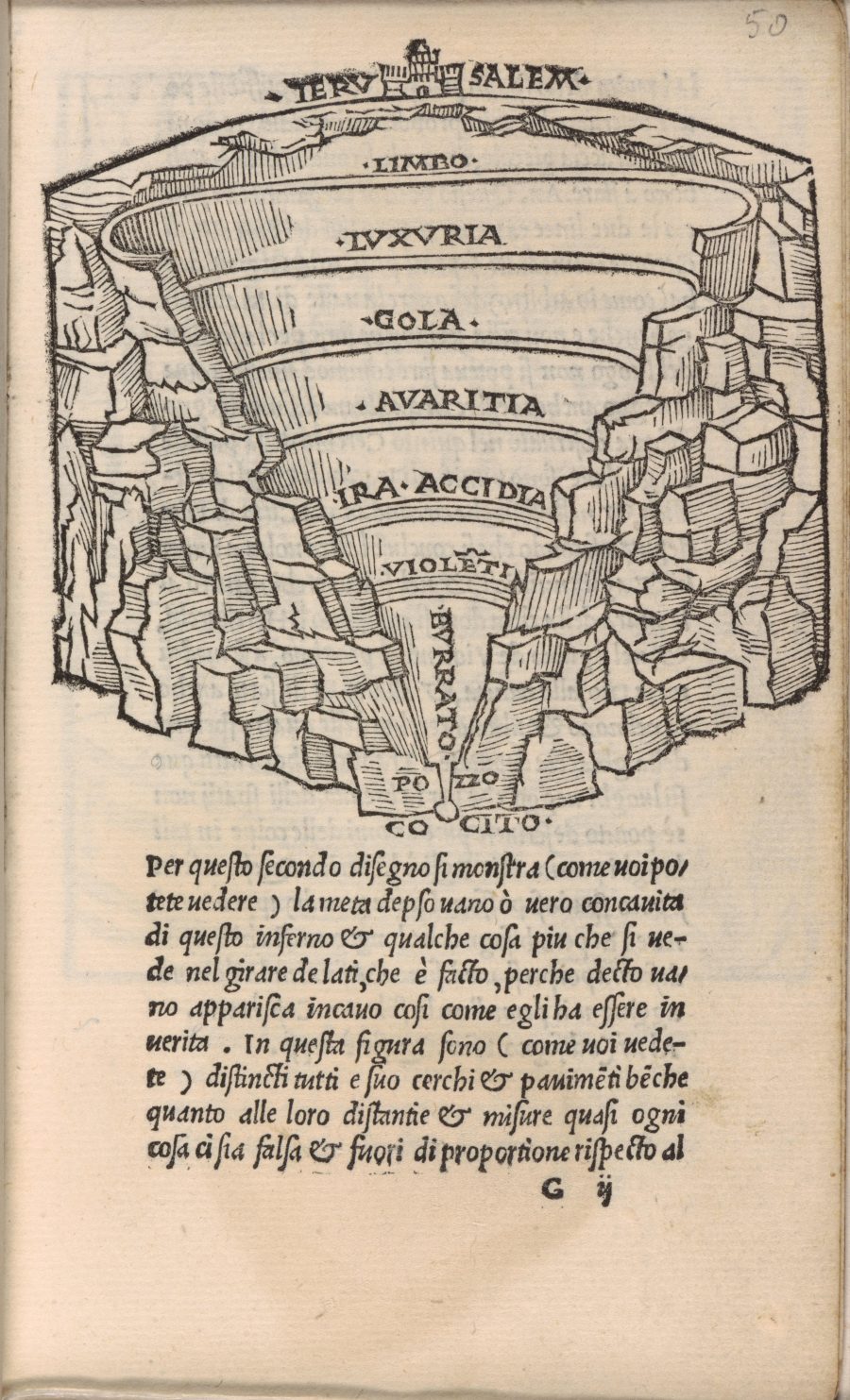
The sole advantage, perhaps, of the translation I first encountered lies in its use of illustrations, maps, and diagrams. While readers can follow the poem’s vivid action without visual aids, these lend to the text a kind of imaginative materiality: saying yes, of course, this is a real place—see, it’s right here! We can suspend our disbelief, perhaps, in Catholic doctrine and, doubly, in Dante’s weirdly officious, comically bureaucratic, scheme of hell.
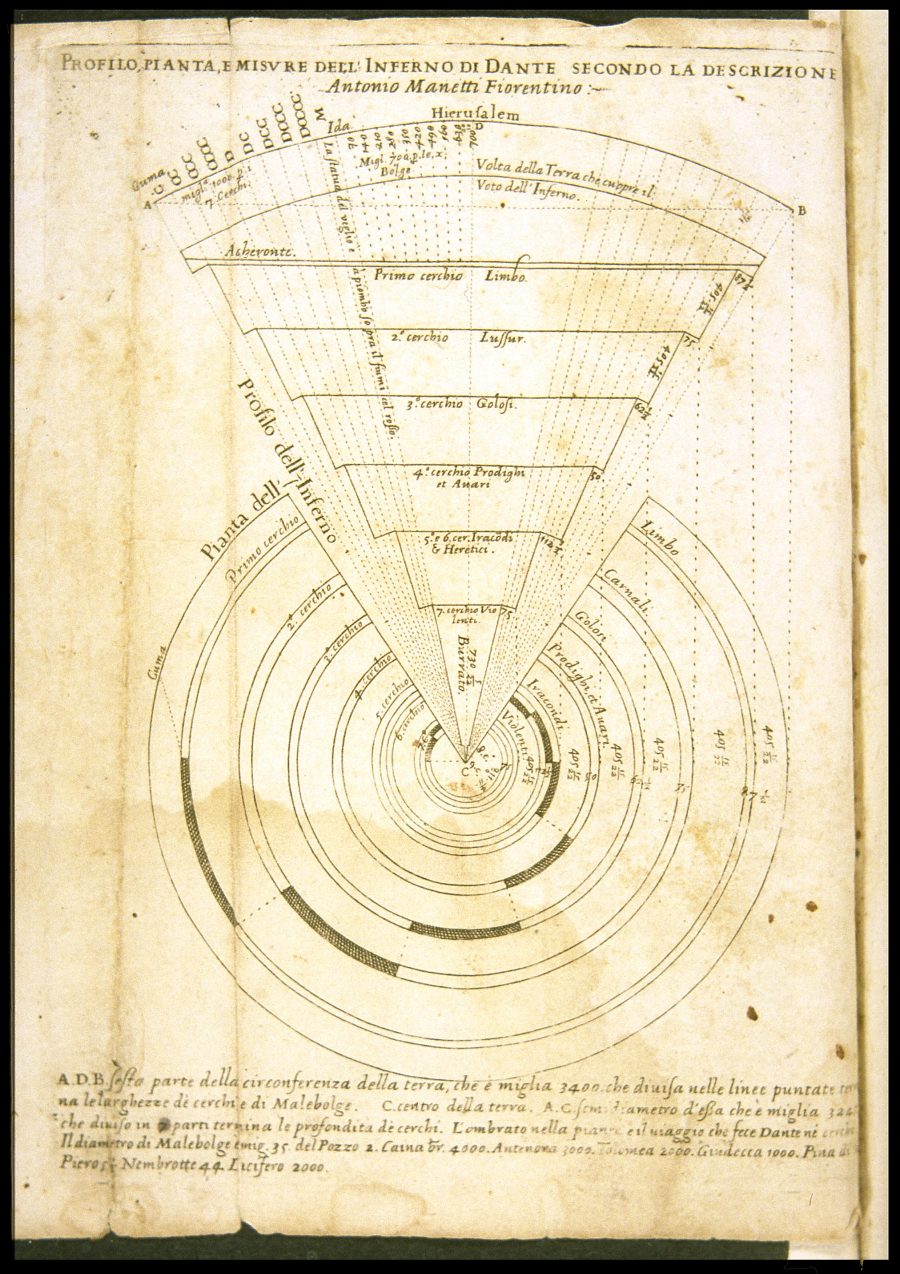
Indeed, readers of Dante have been inspired to map his Inferno for almost as long as they have been inspired to translate it into other languages—and we might consider these maps more-or-less-faithful visual translations of the Inferno’s descriptions. One of the first maps of Dante’s hell (top) appeared in Sandro Botticelli’s series of ninety illustrations, which the Renaissance great and fellow Florentine made on commission for Lorenzo de’Medici in the 1480s and 90s.
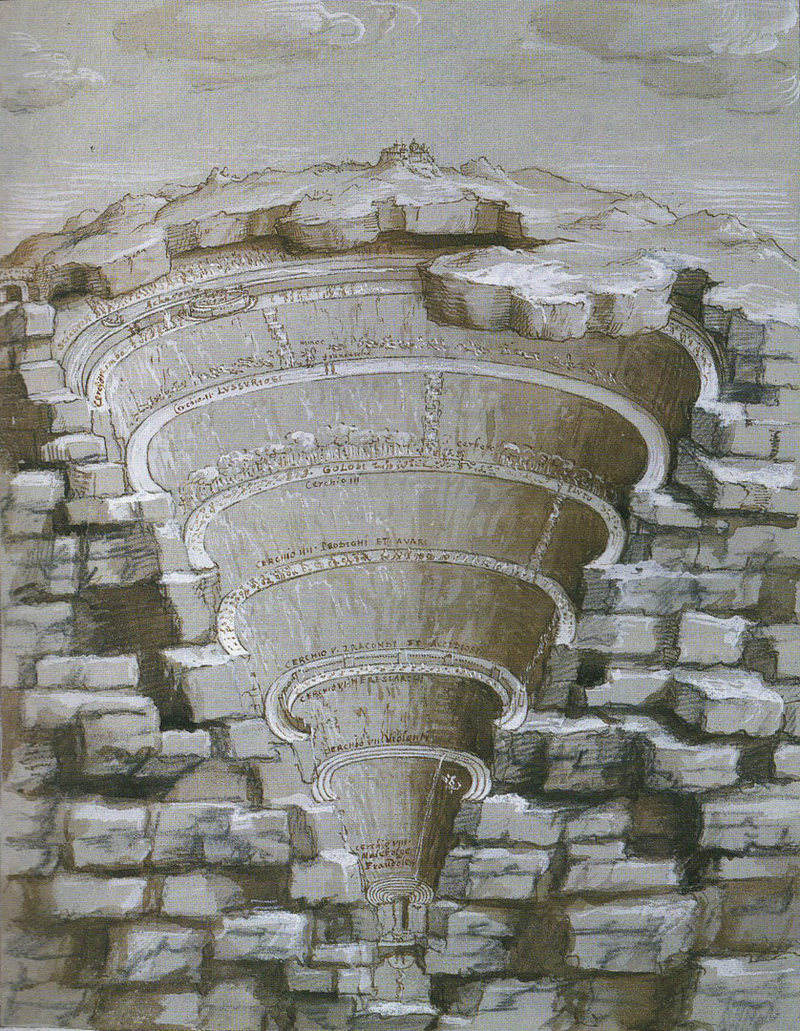
Botticelli’s “Chart of Hell,” writes Deborah Parker, “has long been lauded as one of the most compelling visual representations… a panoptic display of the descent made by Dante and Virgil through the ‘abysmal valley of pain.’” Below it, we see one of Antonio Manetti’s 1506 woodcut illustrations, a series of cross-sections and detailed views. Maps continued to proliferate: see printmaker Antonio Maretti’s 1529 diagram further up, Joannes Stradanus’ 1587 version, above, and, below, a 1612 illustration below by Jacques Callot.
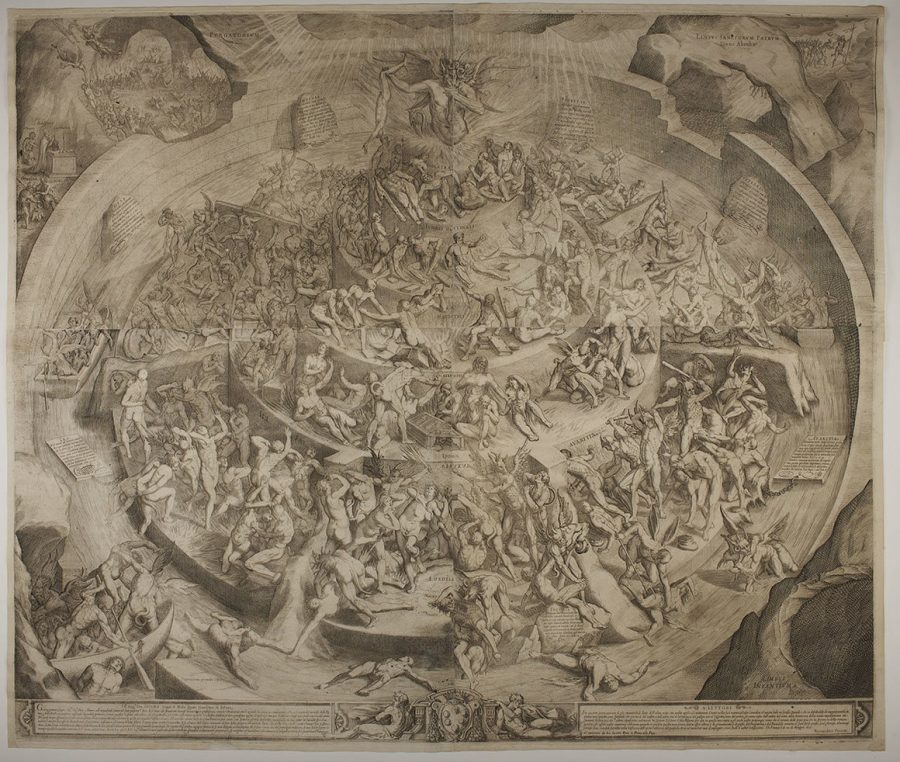
Dante’s hell lends itself to any number of visual treatments, from the purely schematic to the broadly imaginative and interpretive. Michelangelo Caetani’s 1855 cross-section chart, below, lacks the illustrative detail of other maps, but its use of color and highly organized labeling system makes it far more legible that Callot’s beautiful but busy drawing above.
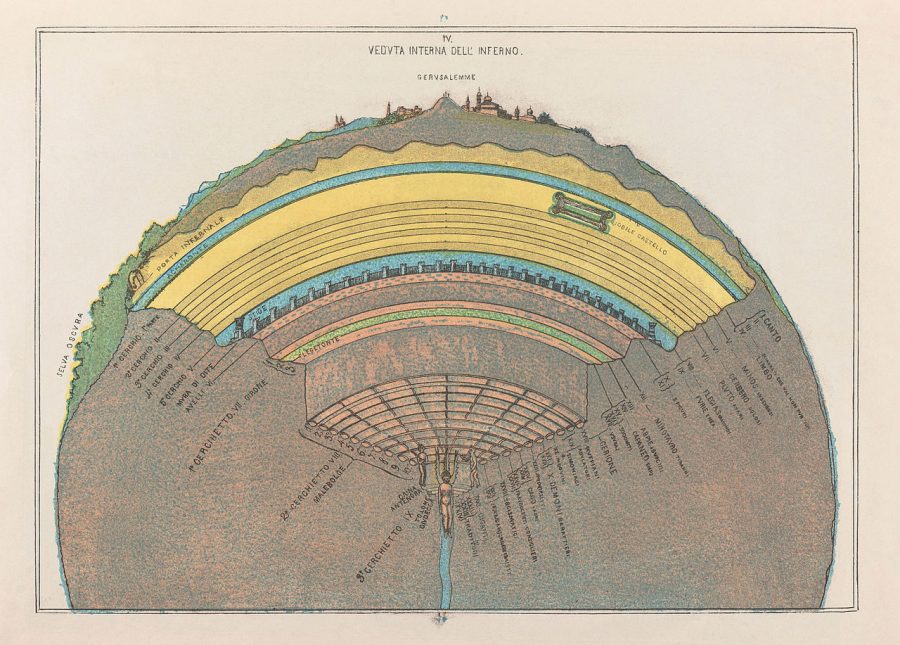
Though we are within our rights as readers to see Dante’s hell as purely metaphorical, there are historical reasons beyond religious belief for why more literal maps became popular in the 15th century, “including,” writes Atlas Obscura, “the general popularity of cartography at the time and the Renaissance obsession with proportions and measurement.”
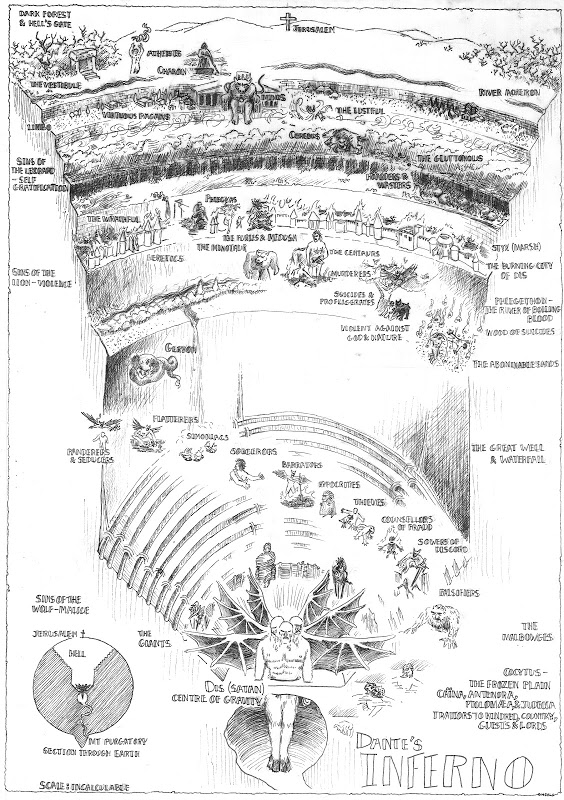
Even after hundreds of years of cultural shifts and upheavals, the Inferno and its humorous and horrific scenes of torture still retain a fascination for modern readers and for illustrators like Daniel Heald, whose 1994 map, above, while lacking Botticelli’s gilded brilliance, presents us with a clear visual guide through that perplexing valley of pain, which remains—in the right translation or, doubtless, in its original language—a pleasure for readers who are willing to descend into its circular depths. Or, short of that, we can take a digital train and escalators into an 8‑bit video game version.
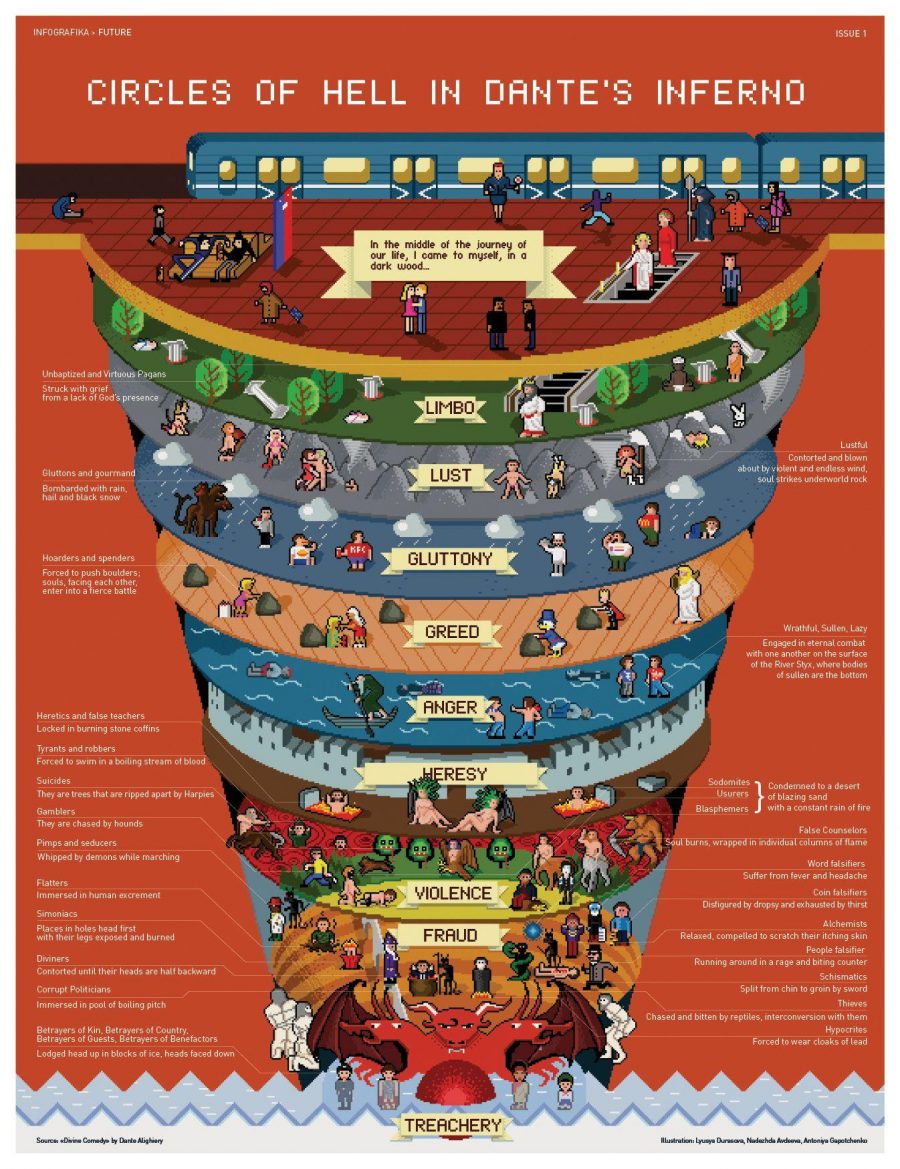
See more maps of Dante’s Inferno here, here, and here.
via Atlas Obscura
Related Content:
A Free Course on Dante’s Divine Comedy from Yale University
Hear Dante’s Inferno Read Aloud by Influential Poet & Translator John Ciardi (1954)
Robert Rauschenberg’s 34 Illustrations of Dante’s Inferno (1958–60)
Josh Jones is a writer and musician based in Durham, NC. Follow him at @jdmagness
Read More...James Hill Plays Michael Jackson’s “Billie Jean” on the Ukulele: Watch One Musician Become a Complete Band
James Hill, an award-winning ukulele player and songwriter from Canada, has been called a “ukulele wunderkind,” and an artist who “gives the ukulele its dignity back without ever taking himself too seriously.” The video above puts Hill’s lighter side and wunderkind talents on full display.
Performing live for a crowd in California, Hill and his “imaginary band” perform an enchanting version of Michael Jackson’s “Billie Jean.” With just a uke, Hill plays the bass line, percussion, and piano parts. Put it all together, and you have a fascinating one-man ukulele performance. But wait until you see what he can do with a uke, chopsticks and comb…
If you would like to support the mission of Open Culture, consider making a donation to our site. It’s hard to rely 100% on ads, and your contributions will help us continue providing the best free cultural and educational materials to learners everywhere. You can contribute through PayPal, Patreon, and Venmo (@openculture). Thanks!
Related Content:
George Harrison Explains Why Everyone Should Play the Ukulele
19-Year-Old Russian Guitarist Plays an Ingenious Cover of Michael Jackson’s “Billie Jean”
Read More...“Back in Black,” “Stairway to Heaven,” “Welcome to the Jungle,” and Other Classic Rock Songs Played on Traditional Japanese Instruments
Name any classic rock band — or maybe any band, period — and you can rest assured that their biggest, most obsessive fan lives in Japan. Though it possesses a native musical culture of its own, with a rich history and a distinctive set of aesthetic sensibilities, that country has also cultivated great enthusiasm for the music of other lands. Just as 21st-century Japan continues to produce masters of such traditional instruments as the stringed koto, the bamboo shakuhachi flute, and the taiko drum, it also continues to produce increasingly all-knowing, all-collecting followers of bands like AC/DC, Guns N’ Roses, and Led Zeppelin.
Seldom have those currents of Japan’s music world had a venue to reliably meet — or at least it hadn’t before the advent of NHK Blends. Produced by NHK World, the international channel of Japanese national broadcaster NHK, the show offers performances of well-known Western songs, usually rock and pop hits, interpreted with traditional Japanese instruments played in traditional settings by musicians in traditional dress.
Here we’ve embedded NHK Blends’ renditions of “Back in Black,” “Stairway to Heaven,” and “Welcome to the Jungle,” and on their videos page you can find many more: Michael Jackson’s “Smooth Criminal” and “Beat It,” Toto’s “Africa,” and the Beatles’ “Let It Be.”
Those all rank among NHK Blends’ most popular videos, having racked up hundreds of thousands and even millions of views. This suggests that, no matter how many countless times we hear these songs on the car radio, at the gym, or while grocery-shopping, a sufficiently radical re-interpretation can still breathe new life into them. Some performances pull off extra dimensions of cultural transposition: the NHK Blends version of “Misirlou,” for instance, takes a traditional piece of music from the Eastern Mediterranean and interprets it for the kokyo, a stringed instrument that originally came to Japan from China. Or rather, it interprets French guitarist Jean-Pierre Danel’s interpretation of “surf guitar” king Dick Dale’s famous version from 1961. Close your eyes and you can very nearly imagine the samurai picture Quentin Tarantino somehow hasn’t yet made.
See the full list of songs here.
Related Content:
Watch Jimi Hendrix’s ‘Voodoo Chile’ Performed on a Gayageum, a Traditional Korean Instrument
Based in Seoul, Colin Marshall writes and broadcasts on cities and culture. His projects include the book The Stateless City: a Walk through 21st-Century Los Angeles and the video series The City in Cinema. Follow him on Twitter at @colinmarshall or on Facebook.
Read More...Support Us
We're hoping to rely on loyal readers, rather than erratic ads. Please click the Donate button and support Open Culture. You can use Paypal, Venmo, Patreon, even Crypto! We thank you!

About Us

Open Culture scours the web for the best educational media. We find the free courses and audio books you need, the language lessons & educational videos you want, and plenty of enlightenment in between.
Advertise With Us

FREE UPDATES!
GET OUR DAILY EMAIL
Get the best cultural and educational resources on the web curated for you in a daily email. We never spam. Unsubscribe at any time.
FOLLOW ON SOCIAL MEDIA

Open Culture editor Dan Colman scours the web for the best educational media. He finds the free courses and audio books you need, the language lessons & movies you want, and plenty of enlightenment in between.
Advertise With Us

