Behold the Masterpiece by Japan’s Last Great Woodblock Artist: View Online Tsukioka Yoshitoshi’s One Hundred Aspects of the Moon (1885)
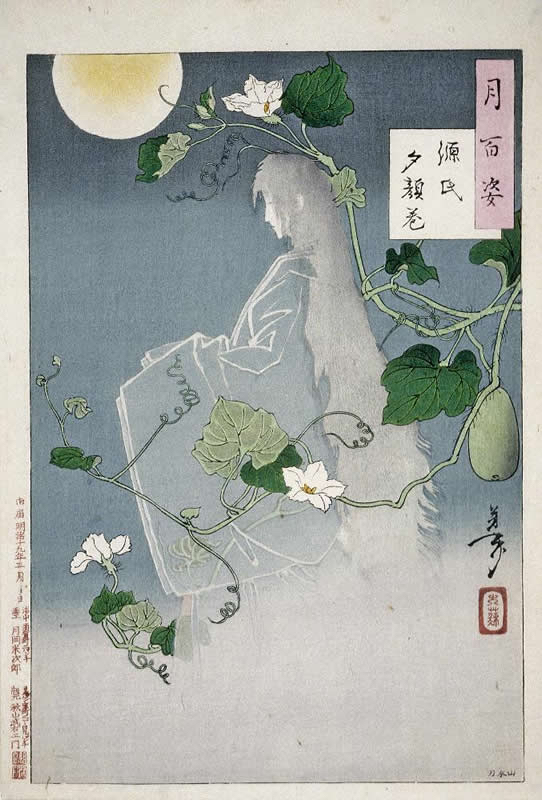
Uruguayan-French poet Jules Laforgue, one of the young T.S. Eliot’s favorites, published his major work, The Imitation of Our Lady the Moon, in 1886, two years before his untimely death at 27 from tuberculosis. It is “a book of poems,” notes Wuthering Expectations, “about clowns who live on the moon… wear black silk skullcaps and use dandelions as boutonieres.” The Pierrots in his poems, Laforgue once wrote in a letter, “seem to me to have arrived at true wisdom” as they contemplate themselves and their conflicts in the light of the moon’s many faces.
I cannot help but think of Laforgue when I think of another artist who, around the same time, began on the other side of the world what is often considered the greatest work of his career. The artist, Japanese printmaker Tsukioka Yoshitoshi, also stood astride an old world and a rapidly modernizing new one. And his visual ruminations, though lacking Laforgue’s arch comedy, beautifully illustrate the same kind of dreamy contemplation, loneliness, melancholy, and weary resignation. The moon, as Laforgue wrote—a “Cat’s‑eye of bright / Redeeming light”—both comforts and taunts us: “It comes with the force of a body blow / That the Moon is a place one cannot go.”
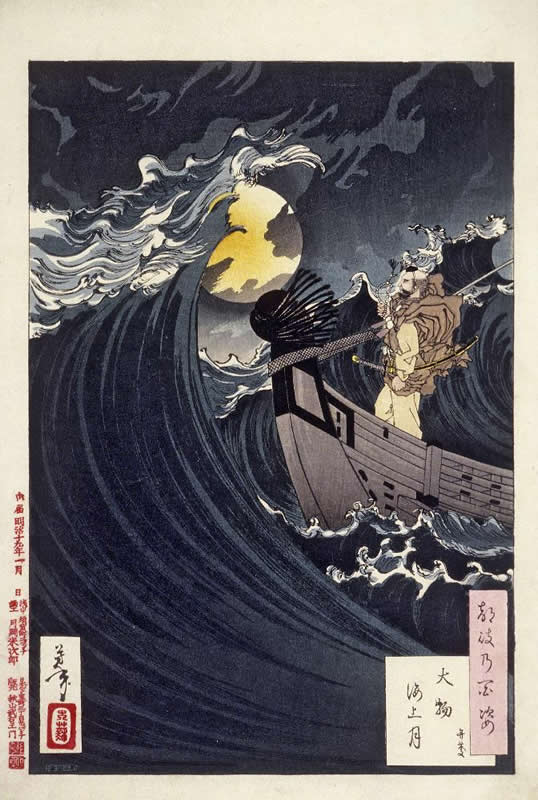
Yoshitoshi’s prints feature a fixation on the moon’s mysteries, and a theatrical device to aid in the contemplation of its meanings: characters from Chinese and Japanese folklore and heroes from novels and plays, all of them staged just after key moments in their stories, in static postures and in silent dialogue with the night. Heavily invested with literary allusions and deeply laden with symbolism, the 100 prints, writes the Fitzwilliam Museum, “conjure a refined poetry to give a new twist to traditional subjects.”
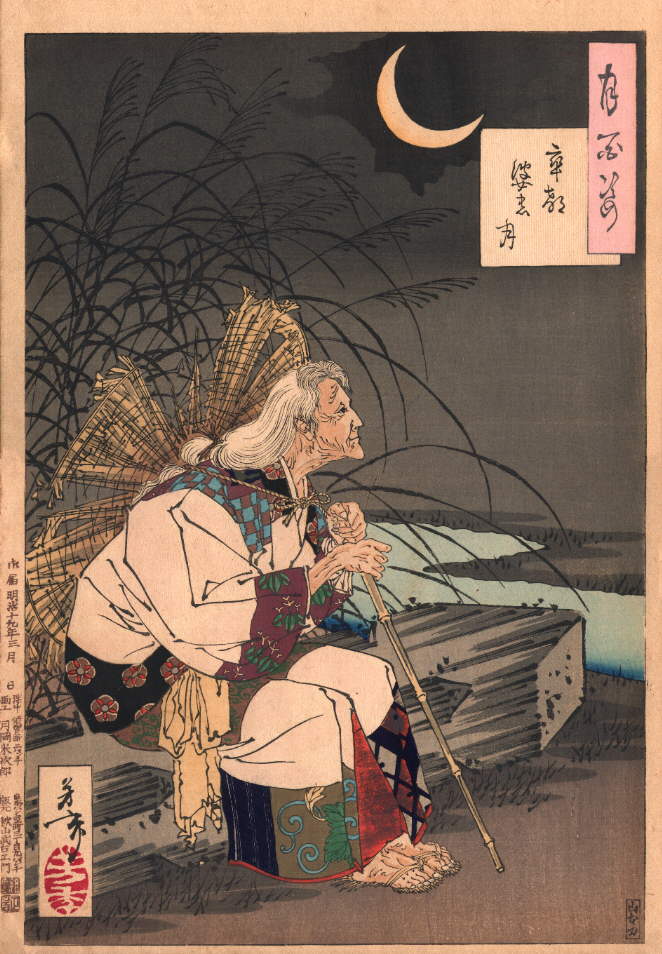
The portraits, mostly solitary, wistful, and brooding, “penetrated deeper into the psychology of his subjects” than previous work in Yoshitoshi’s Ukiyo‑e style, one soon to be altered permanently by Western influences flooding in between the Edo and Meiji periods. Yoshitoshi both incorporated and resisted this influence, using figures from Kabuki and Noh theater to represent traditional Japanese arts, yet introducing techniques “never seen before in Japanese woodblock prints,” writes J. Noel Chiappa, breaking convention by “show[ing] people freely, from all angles,” rather than only in three-quarter view, and by using increased realism and Western perspectives.
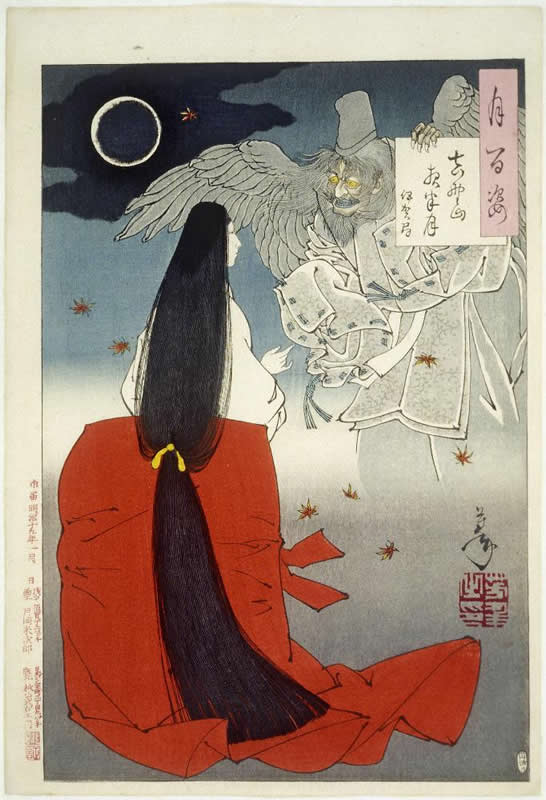
Yoshitoshi began publishing these prints in 1885, and they proved hugely popular. People lined up for new additions to the series, which ran until 1892, when the artist died after a long struggle with mental illness. In these last years, he produced his greatest work, which also includes a kabuki-style series based on Japanese and Chinese ghost stories, New Forms of 36 Ghost Stories. “In a Japan that was turning away from its own past,” Chiappa writes, Yoshitoshi, “almost single-handedly managed to push the traditional Japanese woodblock print to a new level, before it effectively died with him.
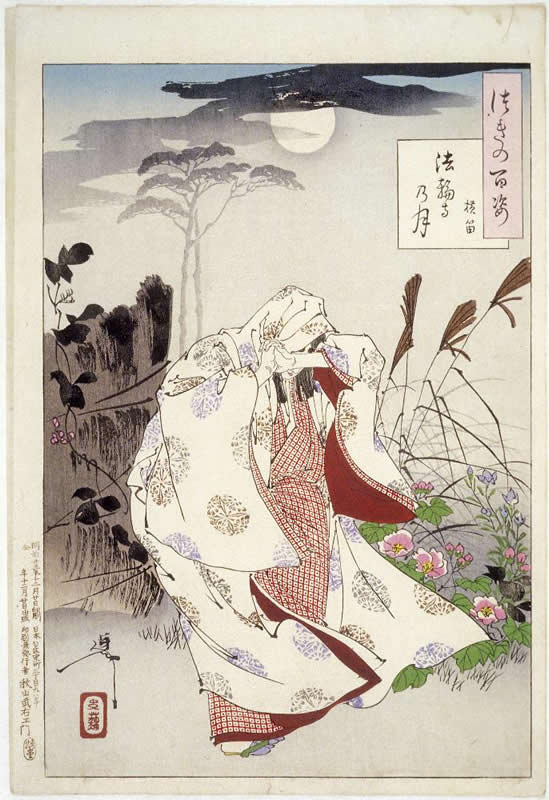
His tumultuous career, after very successful beginnings, had fallen into disrepair and he had been publishing illustrations for sensationalist newspapers, an erotic portrait series of famous courtesans, and macabre prints of violence and cruelty. These preoccupations become completely stylized and psychologized in his final works, especially in One Hundred Aspects of the Moon, an extraordinary series of prints. View them all, with short descriptions of each subject, here, or at the Ronin Gallery, who provide information on the size and condition of each of its prints and allow viewers to zoom in on every detail. The images have also been publishished in a 2003 book, One Hundred Aspects of the Moon: Japanese Woodblock Prints by Yoshitoshi.
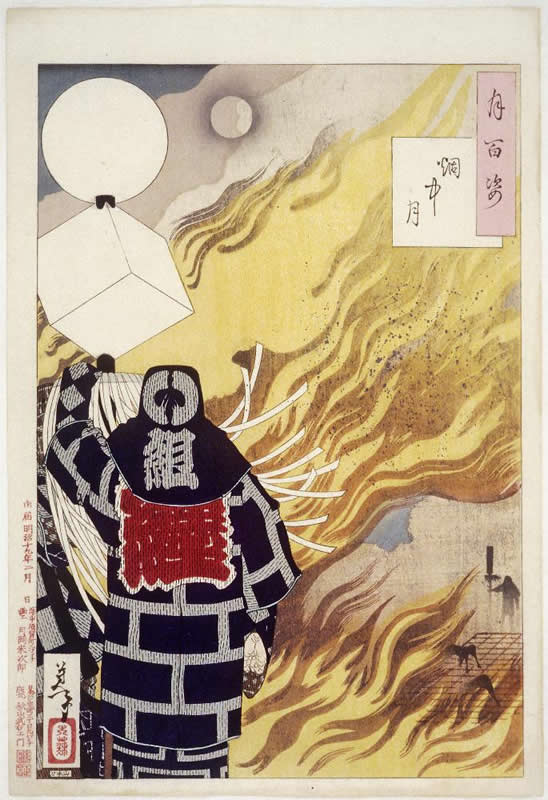
While it certainly helps to understand the literary and cultural context of each print in the series, it is not necessary for an appreciation of their exquisite visual poetry. Perhaps the artist’s memorial poem after his death at age 53 provides us with a master key for viewing his One Hundred Aspects of the Moon.
holding back the night
with increasing brilliance
the summer moon
Related Content:
Download Hundreds of 19th-Century Japanese Woodblock Prints by Masters of the Tradition
Josh Jones is a writer and musician based in Durham, NC. Follow him at @jdmagness
Read More...Take a 16-Week Crash Course on the History of Movies: From the First Moving Pictures to the Rise of Multiplexes & Netflix
Almost all movies tell stories, even the ones that don’t intend to. Put every movie ever made together, and they collectively tell another story: the story of cinema. Of course, not just one “story of cinema” exists to tell: critic Mark Cousins told one to great acclaim a few years ago in the form of his book and documentary series The Story of Film, as Jean-Luc Godard had done earlier in his Histoire(s) du cinéma, whose very title acknowledges the multiplicity of possible narratives in the history of the moving image. Now, with a lighter but no doubt equally strong perspective, comes the latest multipart video journey through it: Crash Course Film History.
“Movies haven’t always looked like they do now,” says host Craig Benzine (better known as the Youtuber WheezyWaiter) in the trailer above. “There was a real long process to figure out what they… were. Were they spectacles? Documentaries? Short films? If so, how short? Long films?
If so, how long? Is black and white better than color? Should sound be the industry standard? And where should we make them?” And even though we’ve now seen over a century of development in cinema, those issues still seem up for grabs — some of them more than ever.
In the first episode, Benzine dives right into his search for the source of the power of movies, “one of the most influential forms of mass communication the world has ever known,” a “universal language that lets us tell stories about our collective hopes and fears, to make sense of the world around us and the people around us.” To do so, he must begin with the invention of film — the actual image-capturing celluloid substance that made cinema possible — and then goes even farther back in time to the very first moving images, “illusions” in their day, and the surprising qualities of human visual perception they exploited.
All this might seem a far cry from the spectacles you’d see at the multiplex today, but Crash Course Film History (which comes from the same folks who gave us A Crash Course in English Literature and A Crash Course in World History) assures us that both of them exist on the same spectrum — the ride along that spectrum being the story of movies. It will last sixteen weeks, after which Crash Course and PBS Digital Studios will continue their collaborative exploration of film with a course on production followed by a course on criticism. Take all three and you’ll no doubt come out impressed not just by the size of the creative space into which film has expanded, but also by how much it has yet to touch.
As new installments of Crash Course Film History come out, they will be added to this playlist. Check back for updates.
Related Content:
Hollywood, Epic Documentary Chronicles the Early History of Cinema
World Cinema: Joel and Ethan Coen’s Playful Homage to Cinema History
A Crash Course in English Literature: A New Video Series by Best-Selling Author John Green
A Crash Course in World History
Cinema History by Titles & Numbers
Based in Seoul, Colin Marshall writes and broadcasts on cities and culture. He’s at work on a book about Los Angeles, A Los Angeles Primer, the video series The City in Cinema, the crowdfunded journalism project Where Is the City of the Future?, and the Los Angeles Review of Books’ Korea Blog. Follow him on Twitter at @colinmarshall or on Facebook.
Read More...Patti Smith, Umberto Eco & Richard Ford Give Advice to Young Artists in a Rollicking Short Animation
Note: There are a couple brief not-safe-for-work moments in this film.
Patronizing, ponderous, well-meaning, self-aggrandizing, incoherent… young artists are subjected to a lot of unsolicited advice, and not just from their parents.
But what happens when a young artist actively seeks it out?
Daniella Shuhman turned to the Louisiana Channel’s series, “Advice to the Young,” feasting on the collected wisdom of such heavy hitters as performance artist Marina Abramovic, author Umberto Eco, artist Olafur Eliasson, and the multitalented Godmother of Punk, Patti Smith in preparation for her final project at Jerusalem’s Bezalel Academy of Arts and Design.
Her resultant short film, above, appears to be the work of a deliriously aggro inner child, one with a keen bullshit meter and an anarchic sense of humor.
“The most important advice I have is to have fun,” counsels novelist Jonathan Franzen—a man who allegedly wrote The Corrections while wearing earplugs, earmuffs, and a blindfold, then busted on Oprah Winfrey when she chose it for for her Book Club.
Cue great spurts of animated arterial blood.
At least Franzen bothers to sound encouraging… much more so than Abramovic, or fellow novelist Richard “Talk Yourself Out of It If You Possibly Can Because You’re Probably Not Going to Be Very Good At It” Ford.
(Parents struggling to come up with tuition may be relieved to learn that Ford’s on leave from Columbia University this term.)
Meanwhile, Shuhman breaks for NSFW territory to visualize artist Eliasson’s advice, a move that would surely please another Louisiana Channel personality, cartoonist David Shrigley. Perhaps it can be his consolation prize for not making the cut.
The pulsating reproductive organs aren’t entirely inappropriate. Listen to Eliasson’s full interview to hear him equate making art with making the world. Now that’s the sort of advice that will put a young artist to work!
Some of the more generous advice:
Build a good name, keep your name clean, don’t make compromises, don’t worry about making a bunch of money or being successful.
Don’t be embarrassed about what excites you.
If you are doing something weird that everybody hates, that might be something worth looking into and worth investigating.
Make your own way in the world. Wrap up warm. Eat properly, sensibly. Don’t smoke and phone your mom.
We love imagining the sort of unfettered advice Shuhman will one day be in a position to dispense.
You can see some of her post graduation illustration work on her Flickr page.
Related Content:
Ayun Halliday is an author, illustrator, theater maker and Chief Primatologist of the East Village Inky zine. Follow her @AyunHalliday.
Read More...Watch Frank Sinatra Record “It Was a Very Good Year” in the Studio in 1965, and You’ll Know Why They Called Him “The Voice”
I’ll be honest, for a long time when I thought of Frank Sinatra, I thought of Marilyn Monroe, ratpack films, and the Olive Garden. That is, until I lived for a short time near The Bronx’s Arthur Avenue, the best Little Italy in New York. Sinatra poured from the speakers of Italian eateries and cigar and pastry shops. It dramatically increased the quality of my pleasant associations with his music. Still, I rarely listened very closely. I can’t entirely blame pop culture for turning him into background music—it happens to nearly every major star. But overuse of his voice as accompaniment to olive oil, cigars, and martinis has perhaps made us tune him out too often.
Treating Sinatra as mood music would not have sat well with some of the singers many of us grew up idolizing from a young age, like Paul McCartney and David Bowie, who both found his work formative. McCartney thought so highly of it, he sent Sinatra one of his earliest compositions, an off-kilter lounge crooner called “Suicide” that he wrote at the age of 14. (Hear an unreleased recording below.)
“I thought it was quite a good one,” he remembered, “but apparently [Sinatra] thought I was taking the mickey out of him and he rejected it.”
Bowie, in 1977, wrote what he expressly intended as a parody of Sinatra—“Life on Mars.” But the story is even stranger than that. He specifically tried to “take the mickey” out of Sinatra’s “My Way,” a song credited to Paul Anka that just happens to have first been written, with different lyrics, by Bowie, as “Even a Fool Learns to Love” in 1968 (hear Bowie sing it above). “Life on Mars,” one of the most beautifully melodic songs in all of pop music, with one of Bowie’s best vocal performances, shows how much the Thin White Duke owed to Ole Blue Eyes.
These are just two of hundreds of male singers whose melodies have taken up immortal residence in our brains and who owe a tremendous debt to Frank Sinatra. In addition to his keen melodic sensibility, Sinatra also set a high bar with his technique. In the video at the top of the post from 1965, we see the consummate artist record “It Was a Very Good Year” in the studio, while smoking a cigarette and casually sipping what may be coffee from a paper cup in his other hand.
At one point, he stops and banters with the engineer, asking him to stop for any “P popping,” the explosive sound resulting from singers putting too much force into their “p” sounds and distorting the microphone. Nowadays everyone uses what’s called a “pop filter” to catch these bursts of air, but Sinatra doesn’t have one, or seem to need one. “I don’t thump,” he tells the recording engineer, “I’m a sneaky P popper.” Indeed. One commenter on YouTube pointed out Sinatra’s graceful mic technique:
Notice how he turned his head when he sang “it poured sweet and clear” to avoid the spike on the P. In fact, he backed away from the mic just a bit for that whole last verse because he was singing much stronger for the last statement of the song. Think about it… this was a live studio recording. One take. No overdubs, No added tracks. Just pure talent. The only thing the sound engineers had to do was adjust the eq levels a bit and that’s it. This is what you hear on the album. You’d be hard pressed to find ANYONE who could do that today.
Most vocal performances get recorded in booths, and certainly not in big open rooms with an orchestra and no headphones. Some singers learn to handle a microphone well. Many do not. Audio compression supplies the dynamics, performances get processed digitally and edited together from several takes. Young producers often wonder how people made great sounding records before improvements like pop filters, isolating monitoring systems, or software that allow a nearly infinite number of corrective techniques. The answer: perhaps many of these things aren’t always improvements, but props. As Sinatra shows us in this footage, great sound in the studio came from the professionalism and attentive technique of artists and engineers who got it right at the source.
Watch Suddenly: Frank Sinatra Stars in a 1954 Noir Film
Bob Dylan Releases a New Cover of Frank Sinatra’s “Full Moon and Empty Arms”
Josh Jones is a writer and musician based in Durham, NC. Follow him at @jdmagness
Read More...Live Stream the Concerts at Coachella This Weekend: Radiohead, Lady Gaga, Lorde, New Order & Much More
This weekend, YouTube is live streaming Coachella 2017, which will feature performances by Lady Gaga, Kendrick Lamar, Radiohead, Lorde, Bon Iver, New Order and more.
To watch the shows, you can tune into three channels throughout the weekend, plus a Live 360 channel for select performances. The channels all appear below. And further down the page, you can find the schedule for the entire weekend. Enjoy!
Channel 1
Chanel 2
Chanel 3
Live 360
The Line Up:
Friday, April 14
Channel 1
- 3:35 – Tennis
- 4:10 – King Gizzard & The Lizard Wizard
- 5:00 – Bonobo
- 5:50 – Mac DeMarco
- 6:55 – Glass Animals
- 7:45 – Father John Misty
- 8:45 – Phantogram
- 9:35 – The xx
- 10:40 – Radiohead
Channel 2
- 3:35 – Preservation Hall Jazz Band
- 4:25 – SOHN
- 5:10 – Sampha
- 6:00 – Francis and the Lights
- 6:50 – Oh Wonder
- 7:40 – BANKS
- 8:30 – Richie Hawtin
- 9:30 – Jagwar Ma
- 10:20 – DJ Shadow
- 11:20 – Travis Scott
- 12:15 – Capital Cities
Channel 3
- 3:35 – Klangstof
- 4:05 – Joseph
- 5:00 – The Lemon Twigs
- 5:45 – Stormzy
- 6:30 – Broods
- 7:20 – Big Gigantic
- 8:20 – Crystal Castles
- 9:10 – Mac Miller
- 10:00 – Steve Angello
- 11:00 – Empire of the Sun
- 11:55 – Dillon Francis
Saturday, April 15
Channel 1
- 3:35 – Local Natives
- 4:30 – Chicano Batman
- 5:15 – The Head and the Heart
- 6:10 – Bastille
- 7:20 – Two Door Cinema Club
- 8:20 – Future
- 9:15 – ScHoolboy Q
- 10:15 – Bon Iver
- 11:25 – Lady Gaga
Channel 2
- 3:35 – Arkells
- 3:55 – Kaleo
- 4:45 – Car Seat Headrest
- 5:40 – The Atomics
- 6:25 – Roisin Murphy
- 7:15 – DREAMCAR
- 8:05 – Moderat
- 9:05 – Warpaint
- 9:55 – NAV
- 10:45 – DJ Snake
- 12:00 – Gucci Mane
Channel 3
- 3:35 – Blossoms
- 4:20 – Shura
- 5:00 – Banks & Steelz
- 5:45 – Autograf
- 6:35 – Little Dragon
- 7:25 – Mura Masa
- 8:15 – Gryffin
- 9:10 – Tory Lanez
- 10:00 – Röyksopp
- 10:55 – Martin Garrix
- 12:05 – Classix
Sunday, April 16
Channel 1
- 3:35 – Ezra Furman
- 4:25 – Whitney
- 5:15 – Toots & The Maytals
- 6:10 – Grouplove
- 7:20 – Future Islands
- 7:55 – Tove Lo
- 8:15 – Porter Robinson & Madeon
- 9:20 – Lorde
- 10:25 – Kendrick Lamar
Channel 2
- 3:35 – Grace Mitchell
- 4:25 – Preoccupations
- 5:15 – Goldlink
- 6:10 – Jack Garratt
- 7:00 – Kiiara
- 7:45 – Tycho
- 8:40 – Hans Zimmer
- 9:45 – Hehlani
- 10:30 – New Order
Channel 3
- 4:15 – Anna Lunoe
- 5:15 – NAO
- 6:55 – Kaytranada
- 8:10 – DJ Khaled
- 9:20 – Lorde
- 9:00 – Galantis
- 9:55 – Marshmello
- 10:50 – Justice
Discover the “Lost” Final Scene of The Shining, Which Kubrick Personally Had Recalled and Destroyed
When we think of Stanley Kubrick, we can’t help but think of perfectionism, a quality he brought even to the making of what he called a “ghost film” — a genre for which he seemed to have little respect — with 1980’s The Shining. So much did he want to get his adaptation (or rather, near-total reimagination) of Stephen King’s novel of the haunted Overlook Hotel just right that he actually had the first set of released prints recalled and destroyed because he didn’t think he’d quite nailed the ending: specifically, he wanted to remove just one short scene from it, one which came immediately before the haunting final photograph of the Overlook’s 1921 Fourth of July Ball.
“There was a big length problem with Warner Bros,” said screenwriter Diane Johnson in an interview with Entertainment Weekly’s James Hibberd. “The film was too long and people said it had to be shortened.” The two minutes Kubrick cut from the ending constituted what Hibberd describes as a hospital scene in which “the hotel manager, Ullman (Barry Nelson), visits Wendy and Danny after their ordeal and explains that no supernatural evidence was found to support their claims of what transpired,” not even the frozen body of Jack Nicholson’s crazed Jack Torrance. “Just when the audience begins to question everything they’ve seen, Ullman ominously gives Danny the same ball that was rolled to him from an unseen force outside Room 237.”
“In other words,” said Johnson in an explanation of the scene’s point, “all of this really happened, and the magic events were actual. It was just a little twist. It was easy to jettison.” Roger Ebert, in a 2006 essay on the film, also thought “Kubrick was wise to remove that epilogue,” though for a different reason: “It pulled one rug too many out from under the story. At some level, it is necessary for us to believe the three members of the Torrance family are actually residents in the hotel during that winter, whatever happens or whatever they think happens.” Whether or not you think it should have been left in, we can surely all agree that Kubrick did well to depart from King’s original ending, which had the Overlook explode in a ball of flame, taking Jack with it, as the rest of the family escaped to safety. Sometimes what works on the page just doesn’t work on the screen.
The video above features the screenplay for the deleted original ending of The Shining.
via Kottke
Related Content:
The Making of Stanley Kubrick’s The Shining (As Told by Those Who Helped Him Make It)
Go Inside the First 30 Minutes of Kubrick’s The Shining with This 360º Virtual Reality Video
Based in Seoul, Colin Marshall writes and broadcasts on cities and culture. He’s at work on a book about Los Angeles, A Los Angeles Primer, the video series The City in Cinema, the crowdfunded journalism project Where Is the City of the Future?, and the Los Angeles Review of Books’ Korea Blog. Follow him on Twitter at @colinmarshall or on Facebook.
Read More...“Primitive Potter” Travels into the Backcountry for 10 Days with Only a Knife & Buckskin and Makes Anasazi Pottery
From filmmaker Steve Olpin comes a short documentary (a “documentary poem”) called Earth and Fire, about artist and primitive potter Kelly Magleby. The film follows Kelly as she travels into “the backcountry of Southern Utah with a knife and a buckskin for 10 days to try to learn about Anasazi pottery by doing it the way the Anasazi did it.” On her website, Kelly writes “My desire to make Anasazi pottery started with my interest in primitive and survival skills. I love the fact that you can go into the wild with nothing and get all you need to survive and even flourish from the earth. The idea that you can go out and dig up some ‘dirt’, shape it, paint it and fire it all using only materials found in nature is amazing to me.” On her site, she details her method for making the pottery. Find more info about the Anasazi and their pottery here and here.
If you would like to support the mission of Open Culture, consider making a donation to our site. It’s hard to rely 100% on ads, and your contributions will help us continue providing the best free cultural and educational materials to learners everywhere. You can contribute through PayPal, Patreon, and Venmo (@openculture). Thanks!
Read More...How Quentin Tarantino Creates Suspense in His Favorite Scene, the Tension-Filled Opening Moments of Inglourious Basterds
We all have a favorite Quentin Tarantino scene, but the director of Pulp Fiction, Kill Bill, The Hateful Eight, and other movies that can seem made out of nothing but memorable scenes also has one of his own. “My favorite thing I think I’ve ever written is the scene at the French farmhouse at the beginning of Inglourious Basterds,” Business Insider quotes him as saying in a panel at San Diego Comic-Con. “The scene Tarantino refers to is the very first one of his brutal World War II epic” wherein “SS Colonel Hans Landa (Christoph Waltz) arrives at a remote dairy farm in France that is suspected of hiding Jewish people. Landa sits down with the farmer (Denis Menochet) and questions him about the whereabouts of the Dreyfus family.” A “tense and sneaky psychological mind game” ensues.
You can learn exactly what makes those opening twenty minutes such a miniature masterpiece in the Lessons from the Screenplay video above. Drawing from psychological research on the nature of tension and suspense, series creator Michael Tucker highlights certain “key components of tension experiences,” including uncertainty, instability, and a lack of control, and shows how Tarantino uses them to heighten the tension as much as possible throughout these seventeen minutes.
“It’s like the suspense is a rubber band,” Tarantino says in a Charlie Rose interview clip included in the video, “and I’m just stretching it and stretching it and stretching it to see how far it can stretch.”
Tarantino also uses a suite of techniques that moviegoers have come to associate specifically with him, such as long stretches of dialogue that go off on extended tangents (“Part of my plan,” he says in another interview clip, “is to bury it in so much minutia about nothing that you don’t realize you’re being told an important plot point until it becomes important”), the charged consumption of food and drink, and the potential for carnage at any moment. “The fact that the audience is aware they’re watching a Tarantino film adds to the suspense,” says Tucker. “We know there will be consequences, and that Tarantino has no qualms about showing violence.” And after the tour de force of its opening, the movie still has well over two hours of pure Tarantinian cinema to go.
Related Content:
The Power of Food in Quentin Tarantino’s Films
Based in Seoul, Colin Marshall writes and broadcasts on cities and culture. He’s at work on a book about Los Angeles, A Los Angeles Primer, the video series The City in Cinema, the crowdfunded journalism project Where Is the City of the Future?, and the Los Angeles Review of Books’ Korea Blog. Follow him on Twitter at @colinmarshall or on Facebook.
Read More...Hamilton’s Lin-Manuel Miranda Creates a 19-Song Playlist to Help You Get Over Writer’s Block

Photo by Steve Jurvetson, via Flickr Commons
Last year we alerted you to a short doc about authors and their relationship with writer’s block. Many were philosophical. Others like Philipp Meyer dismissed it: ““I don’t think writer’s block actually exists,” he said. “It’s basically insecurity.”
How seriously you take it or how terribly it affects you, we have a Spotify playlist created by Lin-Manuel Miranda of Hamilton fame called “Write Your Way Out.”
He revealed the playlist on his Twitter feed on March 20 with an apology that the mix took longer to make than expected. It is a mix, he said, “about writing, songs that feature great writing, and everything in between.” Like his other mixes, he’s thinking about us, that kindly Mr. Miranda.
The eclectic mix begins with “Happy Birthday Darling” from Bright Lights Big City (“Now when you write my son, make the choice, find your voice, look down deep in your heart”), then features English-language hip hop from the Hamilton Mixtape (Nas’ “Wrote My Way Out”) and Spanish-language hip hop from Calle 13 (“Adentro”), folk classics (Joni Mitchell’s “Chelsea Morning”, Bob Dylan’s “My Back Pages”), even some jaunty pop from Vampire Weekend (“Oxford Comma”) and Sara Bareilles (“Love Song”). He ends with Raúl Esparza’s ballad “Why” from the musical Tick, Tick, BOOM!, which closes the mix with a paean to the healthy addiction of creativity. (“I make a vow, right here and now / I’m gonna spend my time this way,” he sings.)
And don’t worry if you don’t have Spotify (which you can download here). He’s listed the tracks on his Twitter post too.
It’s nice to know that Miranda fussed over this selection like one used to do back in the days of cassette tapes. Does that mean he has a crush on all of us?
Related Content:
How Famous Writers Deal With Writer’s Block: Their Tips & Tricks
Ray Bradbury Gives 12 Pieces of Writing Advice to Young Authors (2001)
Ted Mills is a freelance writer on the arts who currently hosts the artist interview-based FunkZone Podcast and is the producer of KCRW’s Curious Coast. You can also follow him on Twitter at @tedmills, read his other arts writing at tedmills.com and/or watch his films here.
Read More...John Coltrane Draws a Picture Illustrating the Mathematics of Music
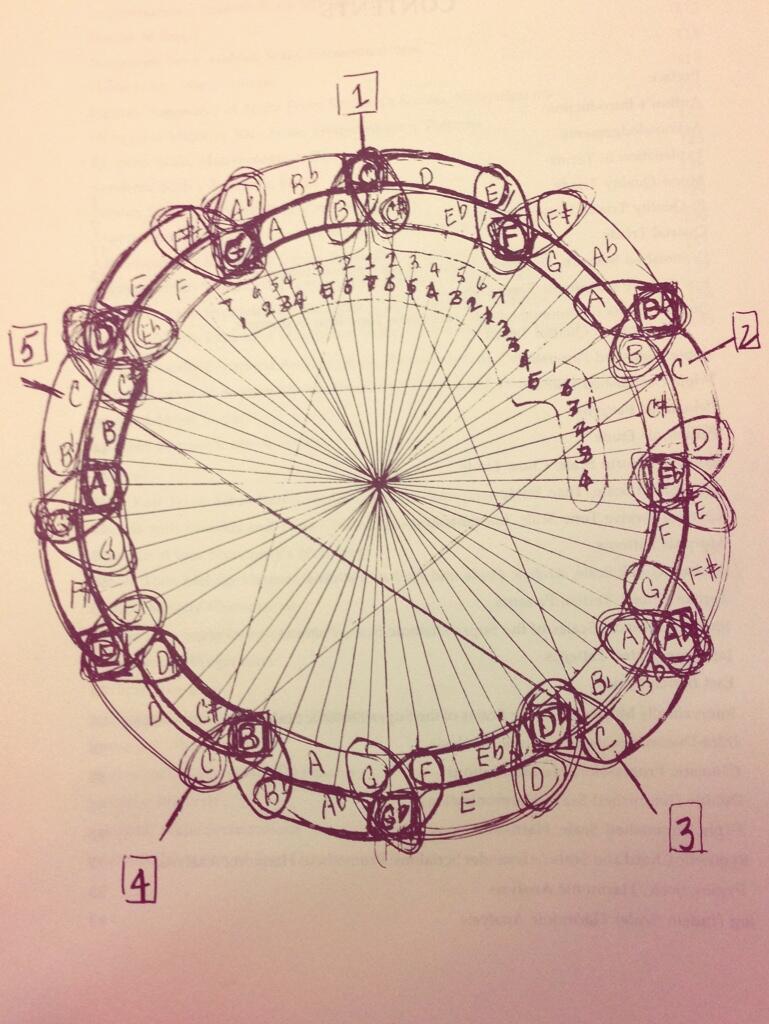
Physicist and saxophonist Stephon Alexander has argued in his many public lectures and his book The Jazz of Physics that Albert Einstein and John Coltrane had quite a lot in common. Alexander in particular draws our attention to the so-called “Coltrane circle,” which resembles what any musician will recognize as the “Circle of Fifths,” but incorporates Coltrane’s own innovations. Coltrane gave the drawing to saxophonist and professor Yusef Lateef in 1967, who included it in his seminal text, Repository of Scales and Melodic Patterns. Where Lateef, as he writes in his autobiography, sees Coltrane’s music as a “spiritual journey” that “embraced the concerns of a rich tradition of autophysiopsychic music,” Alexander sees “the same geometric principle that motivated Einstein’s” quantum theory.
Neither description seems out of place. Musician and blogger Roel Hollander notes, “Thelonious Monk once said ‘All musicans are subconsciously mathematicians.’ Musicians like John Coltrane though have been very much aware of the mathematics of music and consciously applied it to his works.”
Coltrane was also very much aware of Einstein’s work and liked to talk about it frequently. Musican David Amram remembers the Giant Steps genius telling him he “was trying to do something like that in music.”
Hollander carefully dissects Coltrane’s mathematics in two theory-heavy essays, one generally on Coltrane’s “Music & Geometry” and one specifically on his “Tone Circle.” Coltrane himself had little to say publically about the intensive theoretical work behind his most famous compositions, probably because he’d rather they speak for themselves. He preferred to express himself philosophically and mystically, drawing equally on his fascination with science and with spiritual traditions of all kinds. Coltrane’s poetic way of speaking has left his musical interpreters with a wide variety of ways to look at his Circle, as jazz musician Corey Mwamba discovered when he informally polled several other players on Facebook. Clarinetist Arun Ghosh, for example, saw in Coltrane’s “mathematical principles” a “musical system that connected with The Divine.” It’s a system, he opined, that “feels quite Islamic to me.”

Lateef agreed, and there may be few who understood Coltrane’s method better than he did. He studied closely with Coltrane for years, and has been remembered since his death in 2013 as a peer and even a mentor, especially in his ecumenical embrace of theory and music from around the world. Lateef even argued that Coltrane’s late-in-life masterpiece A Love Supreme might have been titled “Allah Supreme” were it not for fear of “political backlash.” Some may find the claim tendentious, but what we see in the wide range of responses to Coltrane’s musical theory, so well encapsulated in the drawing above, is that his recognition, as Lateef writes, of the “structures of music” was as much for him about scientific discovery as it was religious experience. Both for him were intuitive processes that “came into existence,” writes Lateef, “in the mind of the musican through abstraction from experience.”
If you would like to support the mission of Open Culture, consider making a donation to our site. It’s hard to rely 100% on ads, and your contributions will help us continue providing the best free cultural and educational materials to learners everywhere. You can contribute through PayPal, Patreon, and Venmo (@openculture). Thanks!
Related Content:
John Coltrane’s Handwritten Outline for His Masterpiece A Love Supreme
John Coltrane’s ‘Giant Steps’ Animated
Josh Jones is a writer and musician based in Durham, NC. Follow him at @jdmagness
Read More...Support Us
We're hoping to rely on loyal readers, rather than erratic ads. Please click the Donate button and support Open Culture. You can use Paypal, Venmo, Patreon, even Crypto! We thank you!

About Us

Open Culture scours the web for the best educational media. We find the free courses and audio books you need, the language lessons & educational videos you want, and plenty of enlightenment in between.
Advertise With Us

FREE UPDATES!
GET OUR DAILY EMAIL
Get the best cultural and educational resources on the web curated for you in a daily email. We never spam. Unsubscribe at any time.
FOLLOW ON SOCIAL MEDIA

Open Culture editor Dan Colman scours the web for the best educational media. He finds the free courses and audio books you need, the language lessons & movies you want, and plenty of enlightenment in between.
Advertise With Us

