How the World’s Oldest Computer Worked: Reconstructing the 2,200-Year-Old Antikythera Mechanism
In 1900, Greek sponge divers discovered a shipwreck off the Greek island of Antikythera. The artifacts they came back up with included money, statues, pottery, and various other works of art and craft, as well as a curious lump of bronze and wood that turned out to be by far the most important item onboard. When an archaeologist named Valerios Stais took a look at it two years later, he noticed that the lump had a gear in it. Almost a half-century later, the science historian Derek J. de Solla Price thought this apparently mechanical object might merit further examination, and almost a quarter-century after that, he and the nuclear physicist Charalambos Karakalos published their discovery–made by using X‑ray and gamma-ray images of the interior–that those divers had found a kind of ancient computer.
“Understanding how the pieces fit together confirmed that the Antikythera mechanism was capable of predicting the positions of the planets with which the Greeks were familiar — Mercury, Venus, Mars, Jupiter and Saturn — as well as the sun and moon, and eclipses,” writes Big Think’s Robby Berman. “It even has a black and white stone that turns to show the phases of the moon.”
Determining how it really worked has required the building of various different models of various different kinds, one of which you can see assembled, operated, and disassembled before your very eyes in the CGI rendering at the top of the post. Its design comes from the work of historian of mechanism Michael T. Wright, who also put together the physical recreation of the Antikythera mechanism you can see him explain just above.
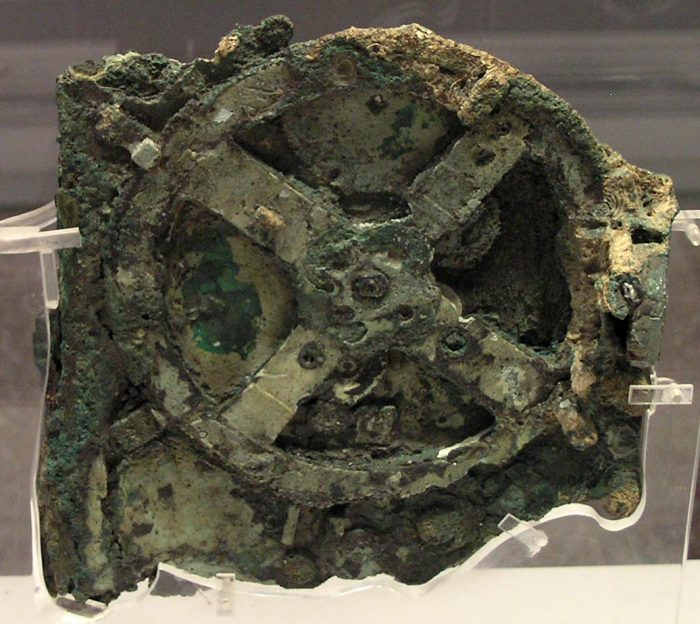
Image via Wikimedia Commons
By its very nature, an artifact as fascinating and as incomplete as this draws all sorts of theories about the specifics of its design, purpose, and even its age. (It dates back to somewhere between 205 and 100 BC.) In 2012, Tony Freeth and Alexander Jones published their own model, different from Wright’s, of this “machine designed to predict celestial phenomena according to the sophisticated astronomical theories current in its day, the sole witness to a lost history of brilliant engineering, a conception of pure genius, one of the great wonders of the ancient world,” — but one which “didn’t really work very well.” Some of the problems has to do with the limitations of ancient Greek astronomical theory, and some with the unreliability of its layers of handmade gears.
More recent research, adds Berman, has discovered that “the device was built by more than one person on the island of Rhodes, and that it probably wasn’t the only one of its kind,” indicating that the ancient Greeks, despite the apparent deficiencies of the Antikythera mechanism itself, “were apparently even further ahead in their astronomical understanding and mechanical know-how than we’d imagined.” Now watch the video just above, in which the Apple engineer makes his own Antikythera mechanism with an entirely more modern set of components, and just imagine what the ancient Greeks could have accomplished had they developed Lego.
Related Content:
Introduction to Ancient Greek History: A Free Online Course from Yale
How the Ancient Greeks Shaped Modern Mathematics: A Short, Animated Introduction
How Ancient Greek Statues Really Looked: Research Reveals their Bold, Bright Colors and Patterns
Modern Artists Show How the Ancient Greeks & Romans Made Coins, Vases & Artisanal Glass
Based in Seoul, Colin Marshall writes and broadcasts on cities and culture. He’s at work on a book about Los Angeles, A Los Angeles Primer, the video series The City in Cinema, the crowdfunded journalism project Where Is the City of the Future?, and the Los Angeles Review of Books’ Korea Blog. Follow him on Twitter at @colinmarshall or on Facebook.
Read More...Watch 100 Randomly Ticking Metronomes Miraculously Achieve Synchronicity
It’s always satisfying to impose order on chaos, especially if it doesn’t involve bellowing at a roomful of jacked up teenagers.
Witness the experiment above.
Members of Ikeguchi Laboratory, a Japanese organization dedicated to the analysis and prediction of nonlinear phenomena, placed 100 randomly ticking metronomes on a hanging platform, curious as to how long it would take them to synchronize.
(SPOILER ALERT! They start synching up around the 1 minute, 20 second mark.)
How? Why? Is this some mystical, musical variant of menstrual synchrony?
Nope. Physics is doing the heavy lifting here.
The key is that the platform holding the metronomes is not fixed. It affects their movement by moving in response to theirs.
To put it another way, KE = 0.5 • m • v2. Which is to say Kinetic Energy = 0.5 • mass of object • (speed of object)2.
If you’re looking for another scientific explanation, here’s how Gizmodo puts it: “the metronomes are transferring energy to the platform they’re on, which then transfers that energy back to the metronomes—until they all sync up and start hitting the beat in one glorious wavelength.”
By the two and a half minute mark, some viewers will be raring to delve into further study of energy transference.
Others, their brains imploding, may elect to downshift into a purely auditory experience.
Close your eyes and listen as the last hold outs fall into rhythmic step with the rest of the herd. A pleasantly harmonious sound, not unlike that moment when a roomful of jacked up teens simmers down, achieving the sort of blissful hive mind that’s a balm to teacher’s frazzled soul.
Craving more? Ikeguchi Laboratory also filmed their metronomes in triangular, circular and X‑shaped formations, available for your viewing pleasure on the lab’s YouTube channel.
Related Content:
The Remarkable Physics of Ants: Watch Them Turn into Fluids and Solids at Will
The Mysterious Physics Behind How Bikes Ride by Themselves
Ayun Halliday is an author, illustrator, theater maker and Chief Primatologist of the East Village Inky zine. Her play Zamboni Godot is opening in New York City in March 2017. Follow her @AyunHalliday
Read More...Mesmerizing GIFs Illustrate the Art of Traditional Japanese Wood Joinery — All Done Without Screws, Nails, or Glue
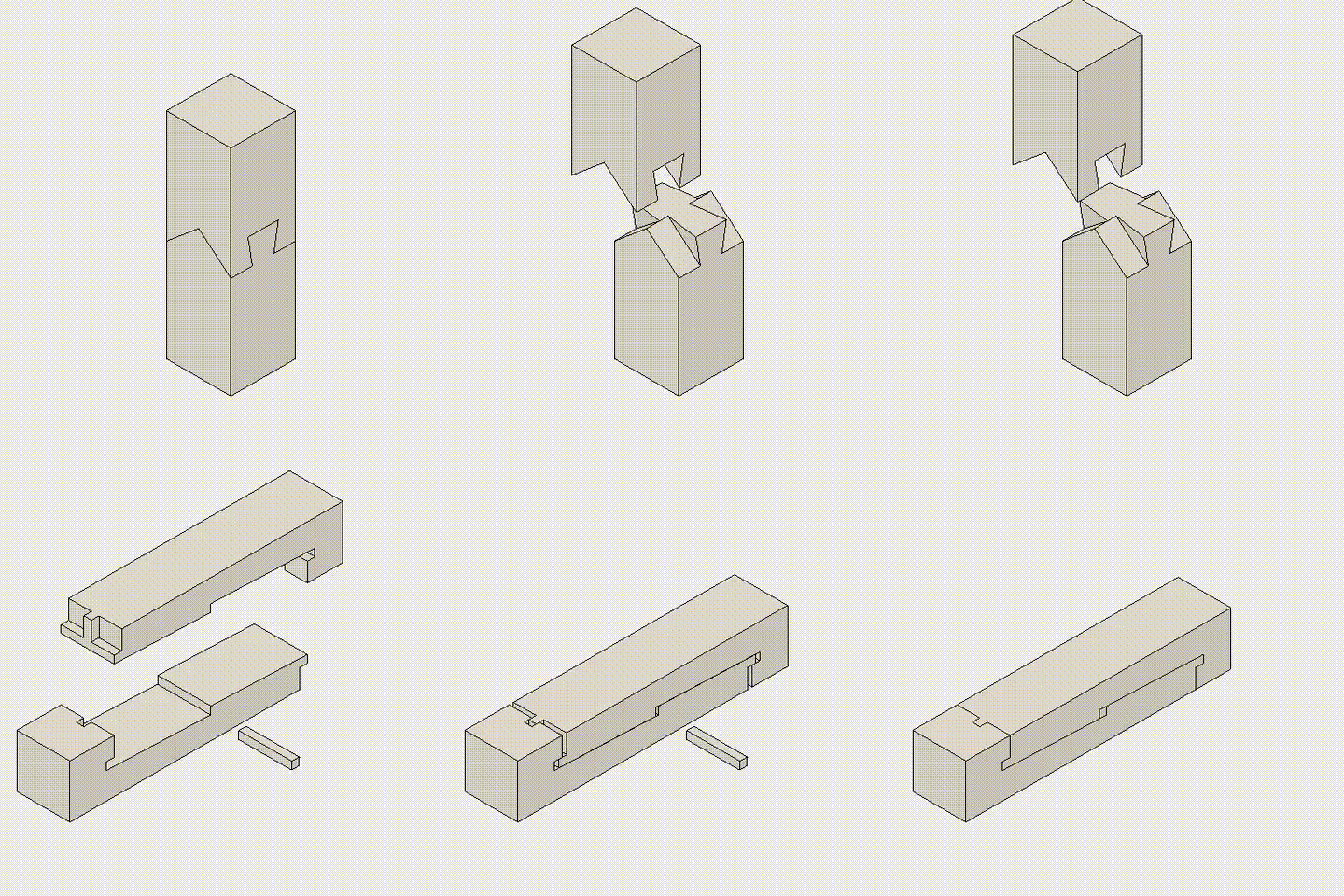
Traditional Japanese carpentry, whether used to build a dinner table or the entire house containing it, doesn’t use screws, nails, adhesives, or any other kind of non-wooden fastener. So how do its constructions hold together? How have all those thousands of wooden houses, tables, and countless other objects and structures stood up for dozens and even hundreds of years, and so solidly at that? The secret lies in the art of joinery and its elaborate cutting techniques refined, since its origin in the seventh century, through generations and generations of steadily increasing mastery — albeit by a steadily dwindling number of masters.
河合継手 Kawai-tsugite pic.twitter.com/WQwxeZ7t4M
— The Joinery (@TheJoinery_jp) May 17, 2016
“Even until recent times when carpentry books began to be published, mastery of these woodworking techniques remained the fiercely guarded secret of family carpentry guilds,” writes Spoon & Tamago’s Johnny Strategy. If you find it difficult to grasp how simply cutting two pieces of wood in a certain way could unite them as if they’d grown together in the first place, have a look at a Twitter feed called The Joinery, run by a young enthusiast who has collected a great many of these carpentry books. He’s used them, in combination with mechanical design software skills presumably honed in his career in the auto industry, to create elegantly animated visual explanations of Japanese carpentry’s tried-and-true joinery methods.
三方組仕口 Sampo-gumi-shikuchi pic.twitter.com/OdgpaTBvcs
— The Joinery (@TheJoinery_jp) May 3, 2016
Archdaily points to the work of architect Shigeru Ban as one example of how this “uniquely Japanese wood aesthetic” has survived into the modern day, but the man behind The Joinery imagines even more ambitious possibilities: “3D printing and woodworking machinery has enabled us to create complicated forms fairly easily,” he tells Spoon & Tamago. “I want to organize all the joinery techniques and create a catalog of them all,” so that anyone with the tools might potentially make use of their beauty and sturdiness in hitherto unimagined new contexts. And so another traditional Japanese craft that has looked doomed to outmoded oblivion, what with all the more advanced and efficient fabrication and construction techniques developed over the past 1400 years, may well thrive in the future. To learn more about the art of joinery, you’ll want to explore this 1995 book, The Complete Japanese Joinery.
梨くずしの逆組み継ぎ Nashi-kuzushi-no-gyaku-kumitsugi pic.twitter.com/5T2EG0VGHm
— The Joinery (@TheJoinery_jp) January 4, 2017
Related Content:
20 Mesmerizing Videos of Japanese Artisans Creating Traditional Handicrafts
The Making of Japanese Handmade Paper: A Short Film Documents an 800-Year-Old Tradition
Watch a Japanese Craftsman Lovingly Bring a Tattered Old Book Back to Near Mint Condition
Japanese Craftsman Spends His Life Trying to Recreate a Thousand-Year-Old Sword
Based in Seoul, Colin Marshall writes and broadcasts on cities and culture. He’s at work on a book about Los Angeles, A Los Angeles Primer, the video series The City in Cinema, the crowdfunded journalism project Where Is the City of the Future?, and the Los Angeles Review of Books’ Korea Blog. Follow him on Twitter at @colinmarshall or on Facebook.
Read More...An Introduction to Confucius’ Life & Thought Through Two Animated Videos
Though it isn’t widely acknowledged, there’s been a longstanding and robust debate at least since the nineteenth century over whether or not a historical Jesus existed. The majority of Christians dismiss the evidence, or lack thereof, for reasons of belief, but on a wider view it’s not at all unique that the historical founder of a religion or school might be an invention, or might have been nothing at all like the tradition suggests. Such questions have arisen about the reality of the Buddha, for example, or the authorship of Lao Tzu, writer of the Tao Te Ching, or the historical existence of his supposed contemporary Confucius, founder of the system of philosophy and ethics simply known as Confucianism.
What do we know about Confucius? “Very little for certain,” says Alain de Botton in his School of Life introductory video above. “He’s said to have been born in 551 BC in China,” and he may have been a student of Lao Tzu. Confucius supposedly served as minister of crime under the ruler of the state of Lu. Many mundane stories about the Chinese thinker make his existence seem quite plausible, though his legend picked up miraculous features over time. But the sayings supposedly by and about Confucius, historical or otherwise—like those of Jesus and the Buddha—were only written down many years after his death, collected in the famous Analects (Lunyu, or “edited conversations”).
These sayings became enormously popular during the European Enlightenment and the 20th century, writes Charlotte Allen at The Atlantic, in part because Confucius remained “agnostic on whether a supernatural world actually exists.” Though he encouraged participation in religious rituals, “The Master,” one of the analects remarks, “never talked of: miracles; violence; disorders; spirits.” What he did talk about what was “the Golden Mean: all things in moderation, even moderation itself.” Confucius was a conservative thinker—in the sense that word once had of holding fast to tradition, encouraging adherence to “ritual propriety” and family observances, and respecting the rule of law.
His sayings include a version of the Golden Rule, and he “is said to have taught his disciples the cultivation of personal virtue.… veneration of one’s parents, love of learning, loyalty to one’s superiors, kindness to one’s subordinates, and a high regard for all of the customs, institutions, and rituals that make for civility.” One can see his appeal to many liberal Western philosophers, who have often advanced radical theses alongside the conservative values Max Weber characterized as the Protestant ethic. Thomas Paine, writes Allen, “listed Confucius with Jesus and the Greek philosophers as the world’s great moral teachers” in the Age of Reason, and Ezra Pound had a particularly high regard for the Chinese thinker.
This kind of veneration has meant that “to many educated Westerners, Confucius is the very emblem of Chinese civilization and religious belief.” Or as the TED-Ed video above puts it, “most people recognize his name and know that he is famous for having said… something.” In this video introduction to Confucius, the philosopher’s biography plays a very prominent role, and it does make for an engaging story. But we should be aware that the details of his life are highly contested by scholars in the East and West. The only sources date from “well after his death,” notes the Stanford Encyclopedia of Philosophy, and “taken together paint contradictory pictures of his personality and the events in his life.” Some scholars even claim he was an invention of the Jesuits, who may have created the Confucius character to accord with their Western desire for a personal founder.
But we need not believe biographical details or decide between scholarly controversies to appreciate Confucian thought. As de Botton makes clear, Confucius’ respect for tradition—though certainly patriarchal and hierarchical—also gives us a lot of insight into how and why we should heed people with expertise and superior knowledge, why we should value education and difficult study, and why personal integrity matters in civic life. Though we cannot verify his life story, we can see it as a popular narrative allegory for his ideas. Confucius exhorted his disciples to obey their leaders, yet he also insisted that those leaders be benevolent and honorable.
It is said that Confucius left Lu, where he had served faithfully as a minister, when the Duke received a gift of courtesans and horses from a neighboring ruler, and began to spend all his time cavorting, and misusing the state’s resources. Thus, according to the tradition, began a period of wandering as the philosopher pondered the cultivation of character. You can read the Analects for yourself in a number of translations—including this free online version from Robert Eno. And if you wish to immerse yourself more fully in the study of Confucianism and Chinese philosophy and culture more generally, you can do so for free through Harvard’s edX course on China or, through Coursera’s “Classics of Chinese Humanities: Guided Readings,” taught by Ou Fan Leo Lee, Professor of Chinese Culture at The Chinese University of Hong Kong.
Related Content:
Free Online Philosophy Courses
Eastern Philosophy Explained with Three Animated Videos by Alain de Botton’s School of Life
Josh Jones is a writer and musician based in Durham, NC. Follow him at @jdmagness
Read More...The Triumphant Night When a Teacher Saved His Students from a Motorcycle Gang: A True, Hand-Animated Story
“Survival of the fittest, this still exists even today. If you’re weak, people pick on you, they take advantage. And if you don’t respond to what they do, they will continually pick on you. You have to frighten them and attack first.”
Those strong words come from Ralph Whims, a teacher who, one night back in 1973, agreed to chaperone a school dance in a church basement. It was a pretty ordinary affair, until a 20-member biker gang barged in, uninvited, and started harassing the kids. What to do? Retreat? Or step forward and restore order? That’s the story, apparently all true, told by the short animation, The Chaperone, created by Fraser Munden. (His own father once had Ralph Whims as an elementary school teacher in Montreal.) This empowering short film has been screened at 70 film festivals and won 25 awards. You can get more backstory on the film by reading an interview with the director here.
The Chaperone will be added to the Animation section of our collection, 4,000+ Free Movies Online: Great Classics, Indies, Noir, Westerns, Documentaries & More.
If you would like to support the mission of Open Culture, consider making a donation to our site. It’s hard to rely 100% on ads, and your contributions will help us continue providing the best free cultural and educational materials to learners everywhere. You can contribute through PayPal, Patreon, and Venmo (@openculture). Thanks!
Related Content:
10 Rules for Students and Teachers Popularized by John Cage
Hunter S. Thompson Gets Confronted by The Hell’s Angels: Where’s Our Two Kegs of Beer? (1967)
Read More...Albert Einstein Explains How Slavery Has Crippled Everyone’s Ability to Think Clearly About Racism
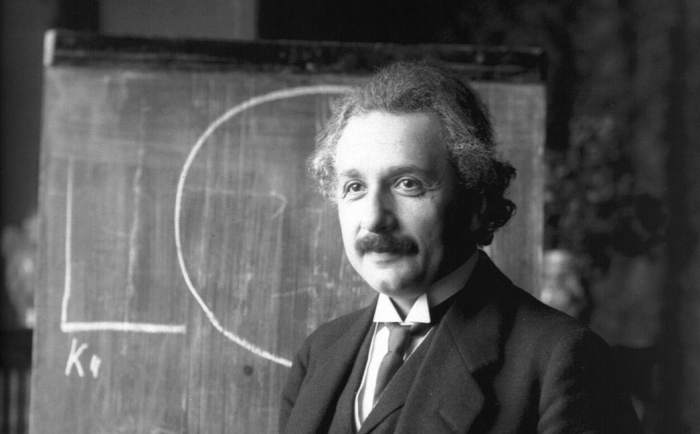
Image by Ferdinand Schmutzer, via Wikimedia Commons
“Should we allow celebrities to discuss politics?” goes one variation on an evergreen headline and supposedly legitimate public debate. No amount of public disapproval could have stopped some of the most outspoken public figures, and we’d be the worse off for it in many cases. Muhammad Ali, John Lennon, Nina Simone, George Carlin, Roger Waters, Margaret Cho, and, yes, Meryl Streep—millions of people have been very grateful (and many not) for these artists’ political commentary. When it comes to scientists, however, we tend to see more baseless accusations of political speech than overwhelming evidence of it.
But there have been those few scientists and philosophers who were also celebrities, and who made their political views well-known without reservation. Bertrand Russell was such a person, as was Albert Einstein, who took up the causes of world peace and of racial justice in the post-war years. As we’ve previously noted, Einstein’s commitments were both philanthropic and activist, and he formed close friendships with Paul Robeson, W.E.B. Du Bois, Marian Anderson, and other prominent black leaders.
Einstein also co-chaired an anti-lynching campaign and issued a scathing condemnation of racism during a speech he gave in 1946 at the alma mater of Langston Hughes and Thurgood Marshall in which he called racism “a disease of white people.” That same year, notes On Being’s executive editor Trent Gilliss, Einstein “penned one of his most articulate and eloquent essays advocating for the civil rights of black people in America.” Titled “The Negro Question” and published in the January 1946 edition of Pageant magazine, the essay, writes Gilliss, “was intended to address a primarily white readership.”
Einstein begins by answering the inevitable objection, “What right has he to speak about things which concern us alone, and which no newcomer should touch?” To this, the famed physicist answers, “I do not think such a standpoint is justified.” Einstein believed he had a unique perspective: “One who has grown up in an environment takes much for granted. On the other hand, one who has come to this country as a mature person may have a keen eye for everything peculiar and characteristic.” Speaking freely about his observations, Einstein felt “he may perhaps prove himself useful.”
Then, after praising the country’s “democratic trait” and its citizens’ “healthy self-confidence and natural respect for the dignity of one’s fellow-man,” he plainly observes that this “sense of equality and human dignity is mainly limited to men of white skins.” Anticipating a casually racist defense of “natural” differences, Einstein replies:
I am firmly convinced that whoever believes this suffers from a fatal misconception. Your ancestors dragged these black people from their homes by force; and in the white man’s quest for wealth and an easy life they have been ruthlessly suppressed and exploited, degraded into slavery. The modern prejudice against Negroes is the result of the desire to maintain this unworthy condition.
The ancient Greeks also had slaves. They were not Negroes but white men who had been taken captive in war. There could be no talk of racial differences. And yet Aristotle, one of the great Greek philosophers, declared slaves inferior beings who were justly subdued and deprived of their liberty. It is clear that he was enmeshed in a traditional prejudice from which, despite his extraordinary intellect, he could not free himself.
Like the ancient Greeks, Americans’ prejudices are “conditioned by opinions and emotions which we unconsciously absorb as children from our environment.” And racist attitudes are both causes and effects of economic exploitation, learned behaviors that emerge from historical circumstances, yet we “rarely reflect” how powerful the influence of tradition is “upon our conduct and convictions.” The situation can be remedied, Einstein believed, though not “quickly healed.” The “man of good will,” he wrote, “must have the courage to set an example by word and deed, and must watch lest his children become influenced by this racial bias.”
Read the full essay at On Being, and learn more about Einstein’s committed anti-racist activism from Fred Jerome and Rodger Taylor’s 2006 book Einstein on Race and Racism.
Related Content:
Listen as Albert Einstein Calls for Peace and Social Justice in 1945
Albert Einstein Expresses His Admiration for Mahatma Gandhi, in Letter and Audio
Josh Jones is a writer and musician based in Durham, NC. Follow him at @jdmagness
Read More...How the French New Wave Changed Cinema: A Video Introduction to the Films of Godard, Truffaut & Their Fellow Rule-Breakers
You could describe every act of filmmaking as an act of film criticism, and for no group of directors has that held truer than those of the French New Wave. In one of the most exciting chapters of cinema history thus far, the late 1950s and 1960s saw such newly emergent auteurs as Jean-Luc Godard, François Truffaut, Agnès Varda, Jacques Demy, Claude Chabrol, Éric Rohmer, Jacques Rivette, and André Bazin turn away from the established practices of filmmaking and, by a mixture of inclination and necessity, start a few of their own.
They followed these new rules to come up with pictures like Le Beau Serge, Breathless, The 400 Blows, Last Year at Marienbad, Cléo from 5 to 7, and La Jetée. Those and the other movies of the Nouvelle Vague startled viewers with their boldness of form and content, but what of importance do they have to say in film culture today? Lewis Bond of Channel Criswell, source of video essays previously featured here about filmmakers like Andrei Tarkovsky and Akira Kurosawa, looks at the lasting achievements of the movement in “Breaking the Rules.”
The members of the French New Wave told personal stories that reflected personal philosophies, shooting documentary-style with handheld cameras, cutting those shots together with previously unheard of conspicuousness, and using a variety of other visual and narrative techniques to establish a new relationship between films and their viewers. “If you’re still skeptical as to whether the nouvelle vague intentionally toyed with the audience’s expectations,” says Bond over a selection of fourth-wall-breaking shots, “just look at how many times their movies directly acknowledge them. The nouvelle vague wanted to have the audience tested as to what could be a movie and how they could push the boundaries of storytelling, not just with their techniques but with their content too.”
And what do we jaded 21st-century viewers and filmmakers still have to learn from all this? “Just watch the films. They’re so ahead of their time, it’s not difficult to see” the influence of their editing on the Scorseses of the world, their concept of the auteur on the Tarantinos, and their camera movement on the Luzbekis of today. “The thing that the filmmakers of la nouvelle vague did was utilize one of the most important processes I think there is for an artist: look at what works in your medium and think, ‘How can it be done differently?’ Because if you don’t have anything new to say, what’s the point of saying anything?” And, now as in the mid-2oth-century as in the centuries before cinema itself, if you do have something new to say, you can’t say it by following the old rules.
If you would like to support the mission of Open Culture, consider making a donation to our site. It’s hard to rely 100% on ads, and your contributions will help us continue providing the best free cultural and educational materials to learners everywhere. You can contribute through PayPal, Patreon, and Venmo (@openculture). Thanks!
Related Content:
An Introduction to Jean-Luc Godard’s Innovative Filmmaking Through Five Video Essays
How Truffaut Became Truffaut: From Petty Thief to Great Auteur
How Akira Kurosawa’s Seven Samurai Perfected the Cinematic Action Scene: A New Video Essay
Based in Seoul, Colin Marshall writes and broadcasts on cities and culture. He’s at work on a book about Los Angeles, A Los Angeles Primer, the video series The City in Cinema, the crowdfunded journalism project Where Is the City of the Future?, and the Los Angeles Review of Books’ Korea Blog. Follow him on Twitter at @colinmarshall or on Facebook.
Read More...The American Novel Since 1945: A Free Yale Course on Novels by Nabokov, Kerouac, Morrison, Pynchon & More
Taught by professor Amy Hungerford, The American Novel Since 1945 offers an introduction to the fertile literary period that followed World War II. The course description reads:
In “The American Novel Since 1945” students will study a wide range of works from 1945 to the present. The course traces the formal and thematic developments of the novel in this period, focusing on the relationship between writers and readers, the conditions of publishing, innovations in the novel’s form, fiction’s engagement with history, and the changing place of literature in American culture. The reading list includes works by Richard Wright, Flannery O’Connor, Vladimir Nabokov, Jack Kerouac, J. D. Salinger, Thomas Pynchon, John Barth, Maxine Hong Kingston, Toni Morrison, Marilynne Robinson, Cormac McCarthy, Philip Roth and Edward P. Jones. The course concludes with a contemporary novel chosen by the students in the class.
You can watch the 26 lectures from the course above, or find them on YouTube and iTunes (video — audio). To get more information about the course, including the syllabus, visit this Yale website.
The main texts used in this course include:
- Richard Wright, Black Boy (1945)
- Flannery O’Connor, Wise Blood (1949)
- Vladimir Nabokov, Lolita (1955)
- Jack Kerouac, On the Road (1957)
- J.D. Salinger, Franny and Zooey (1961)
- John Barth, Lost in the Funhouse (1963–68)
- Thomas Pynchon, The Crying of Lot 49 (1967)
- Toni Morrison, The Bluest Eye (1970)
- Maxine Hong Kingston, The Woman Warrior (1976)
- Marilynne Robinson, Housekeeping (1980)
- Cormac McCarthy, Blood Meridian (1985)
- Philip Roth, The Human Stain (2000)
- Edward P. Jones, The Known World (2003)
- Jonathan Safran Foer, Everything is Illuminated (2002)
The American Novel Since 1945 will be added to our collection, 1,700 Free Online Courses from Top Universities. There you can find a specialized list of Free Online Literature Courses.
Related Content:
Vladimir Nabokov Names the Greatest (and Most Overrated) Novels of the 20th Century
Flannery O’Connor Reads ‘A Good Man is Hard to Find’ in Rare 1959 Audio
Cormac McCarthy’s Three Punctuation Rules, and How They All Go Back to James Joyce
Read More...Hear Metallica’s “Nothing Else Matters” Covered in Unexpected Styles: Gregorian Choir, Cello Ensemble, Finnish Bluegrass, Jazz Vocal & More
They may have arrived on the scene in the 80s as one of the four horsemen of thrash metal—kin to such cuddly acts as Anthrax, Megadeth, and Slayer—but believe or not, Metallica had some serious crossover appeal from the start. Granted, that appeal was limited to a small subset of punks and skaters who came to appreciate metal thanks to Metallica’s covers of horror-punks The Misfits on their 1987 Garage Days Revisited EP. Nonetheless, it showed that the band always had a sense of humor and an appreciation for other—albeit very closely-related—genres.
Since then, Metallica has grown up, sometimes awkwardly. We watched them do it with the help of a therapist in the 2003 documentary Some Kind of Monster. We listened to their grown-up angst on that bummer of an album, St. Anger. That year, they also took on a fourth member, bassist Robert Trujillo, whose extra-genre affinities are broad and deep—from his love for Motown, funk, and the athletic fusion of Jaco Pastorius to his dabbling in flamenco. The band may have returned to their thrash roots with 2008’s Death Magnetic and this year’s Hardwired… to Self-Destruct, but they’ll likely take a few more weird excursions (like their puzzling 2011 collaboration with Lou Reed) in coming years.
And yes, they gained a reputation as being stingy with their catalog during that whole Napster dust-up. But as you can hear James Hetfield and Kirk Hammett discuss in a recent Nerdist podcast (stream it at the bottom of this post), their “creative restlessness” has made them very appreciative of what other artists have done with their music, stretching it into alien genres and unexpected instrumentation and arrangements.
In his self-deprecating way, Hetfield confesses, “there’s a lot of better versions of ‘Nothing Else Matters’ than ours.” Hammett agrees, and here you’ll find most of those they mention—from Scott D. Davis on solo piano at the top of the post, to a choir at Santiago de Compostela with their Gregorian Chant version below it, and, just above, Finnish cello ensemble Apocalyptica.
It may not be many people’s favorite Metallica song, but I think the vast range of worthy interpretations speaks to the strengths of its composition. “Nothing Else Matters” has even translated to bluegrass, thanks to Finnish pickers Steve ‘N’ Seagulls, who specialize in such tongue-in-cheek country metal covers. And Hetfield and Hammett both mention with awe Macy Gray’s smoky lounge-jazz cover, below. “That’s an honor,” says Hetfield, “that is a huge compliment, when someone takes your song and legitimately does it their style.… It’s really cool to think that the song is that good it can work in any different genre.”
Indeed. Have a listen to SHEL’s haunting cover of another Metallica dirge, “Enter Sandman” or Stary Olsa’s riff on the mostly dirge-like “One.” And it doesn’t only work with the slow tunes either. Just check out this killer banjo version of “Master of Puppets.”
Hear Metallica talk cover versions (around 50:00), the joys and woes of still touring after all these years, and more at the Nerdist podcast just above.
Related Content:
Metallica Playing “Enter Sandman” on Classroom Toy Instruments
Finnish Musicians Play Bluegrass Versions of AC/DC, Iron Maiden & Ronnie James Dio
Josh Jones is a writer and musician based in Durham, NC. Follow him at @jdmagness
Read More...David Bowie Offers Advice for Aspiring Artists: “Go a Little Out of Your Depth,” “Never Fulfill Other People’s Expectations”
January 10th, 2017–David Bowie died one year ago today. Revisiting my own memories of him, it so often seemed impossible that he could grow old, much less pass away, even as we all watched him age over the decades. He did it much better than most, that’s for sure, and grew into the role of elder statesman with incredible poise and grace, though he also didn’t let that role be his last one.
What else should we have expected from the artist who wrote “Changes”—the definitive creative statement on facing time and mortality—at the age of 24, before he’d even achieved the international superstardom that Ziggy Stardust brought him? Bowie was always an old soul. “It’s not age itself,” he told the BBC in 2002. “Age doesn’t bother me. So many of my heroes were older guys.… I embrace that aspect of it.” And so, in his later years, he became an older guy hero to millions.
In 1997, after his drum and bass-inspired Earthling, Bowie gave an interview in which he offered the timeless wisdom to younger artists in the clip above:
Never play to the gallery.… Never work for other people in what you do. Always remember that the reason that you initially started working was that there was something inside yourself that you felt that if you could manifest in some way, you would understand more about yourself and how you co-exist with the rest of society.… I think it’s terribly dangerous for an artist to fulfill other people’s expectations.
It’s advice we’ve likely heard some version of before—perhaps even from one of Bowie’s own older-guy heroes, William S. Burroughs (here by way of Patti Smith). But I’ve never heard it stated so succinctly and with so much conviction and feeling. We naturally associate David Bowie with artful inauthenticity, with a succession of masks. He encouraged that impression at every turn, even telling a graduating Berklee College of Music class in 1999, “it seemed that authenticity and the natural form of expression wasn’t going to be my forte.”
But in hindsight, and especially in the rapt, posthumous attention paid to Bowie’s final work, Blackstar, it can seem that his embrace of poses was often itself a pose. Bowie has always been candid, in various moments of self-reflection, about his missteps and excesses. But not to have taken the risks he did, not to have placed himself in uncomfortable situations, would have meant impoverishing his work. “The other thing I would say,” he goes on, “is that if you feel safe in the area you’re working in, you’re not working in the right area. Always go a little further into the water than you feel you are capable of being in. Go a little bit out of your depth. When you don’t feel that your feet are quite touching the bottom, you’re just about in the right place to do something exciting.”
If you would like to support the mission of Open Culture, consider making a donation to our site. It’s hard to rely 100% on ads, and your contributions will help us continue providing the best free cultural and educational materials to learners everywhere. You can contribute through PayPal, Patreon, and Venmo (@openculture). Thanks!
Related Content:
The Story of Ziggy Stardust: How David Bowie Created the Character that Made Him Famous
Patti Smith Shares William S. Burroughs’ Advice for Writers and Artists
Josh Jones is a writer and musician based in Durham, NC. Follow him at @jdmagness
Read More...Support Us
We're hoping to rely on loyal readers, rather than erratic ads. Please click the Donate button and support Open Culture. You can use Paypal, Venmo, Patreon, even Crypto! We thank you!

About Us

Open Culture scours the web for the best educational media. We find the free courses and audio books you need, the language lessons & educational videos you want, and plenty of enlightenment in between.
Advertise With Us

FREE UPDATES!
GET OUR DAILY EMAIL
Get the best cultural and educational resources on the web curated for you in a daily email. We never spam. Unsubscribe at any time.
FOLLOW ON SOCIAL MEDIA

Open Culture editor Dan Colman scours the web for the best educational media. He finds the free courses and audio books you need, the language lessons & movies you want, and plenty of enlightenment in between.
Advertise With Us


