Hear a 9,000 Year Old Flute—the World’s Oldest Playable Instrument—Get Played Again
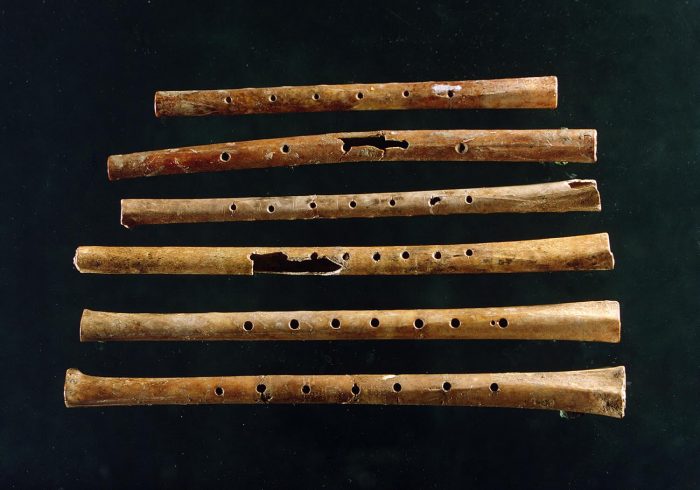
Classical music enthusiasts seem to agree that the renewal of interest in period instruments made for a noticeable change in the sound of most, if not all, orchestral performances. But doesn’t the replication and use of viols, ophicleides, and fortepianos from the times of Bach, Beethoven, and Mozart raise a curiosity about what people used to make music generations before them, and generations before that? How early can we get into early music and still find tools to use in the 21st century? Since the end of the 20th, we’ve had the same answer: about nine millennia.
“Chinese archeologists have unearthed what is believed to be the oldest known playable musical instrument,” wrote Henry Fountain in a 1999 New York Times article on the discovery of “a seven-holed flute fashioned 9,000 years ago from the hollow wing bone of a large bird.”
Those holes “produced a rough scale covering a modern octave, beginning close to the second A above middle C,” and the fact of this “carefully selected tone scale indicates that the Neolithic musicians may have been able to play more than single notes, but actual music.”
You can hear the haunting sounds of this oldest playable musical instrument known to man in the clip above. When would those prehistoric humans have heard it themselves? Fountain quotes ethnomusicologist Frederick Lau as saying that these flutes “almost certainly were used in rituals,” perhaps “at temple fairs, burials and other ritualistic events,” and possibly even for “for personal entertainment.” 9,000 years ago, one surely took one’s entertainment where one could find it.
If this listening experience has given you a taste for the real oldies — not just the AM-radio but the history-of-mankind sense — you can also hear in our archive the 43,000-year-old “Neanderthal flute” (found only in fragments, but reconstructed) as well as such ancient songs as 100 BC’s “Seikilos Epitaph,” a composition by Euripides from a century before that, and a 3,400-year-old Sumerian hymn known as the oldest song in the world, all of which raises an important question: what will the people of the year 11000 think when they unearth our DJ rigs, those artifacts of so many of our own ritualistic events, and give them a spin?
You can get more information on this ancient flute here.
Related Content:
What Ancient Greek Music Sounded Like: Hear a Reconstruction That is ‘100% Accurate’
Listen to the Oldest Song in the World: A Sumerian Hymn Written 3,400 Years Ago
Hear the World’s Oldest Instrument, the “Neanderthal Flute,” Dating Back Over 43,000 Years
Based in Seoul, Colin Marshall writes and broadcasts on cities and culture. He’s at work on a book about Los Angeles, A Los Angeles Primer, the video series The City in Cinema, the crowdfunded journalism project Where Is the City of the Future?, and the Los Angeles Review of Books’ Korea Blog. Follow him on Twitter at @colinmarshall or on Facebook.
Read More...How The Beatles’ Sgt. Pepper’s Lonely Hearts Club Band Changed Album Cover Design Forever
I am older than Evan Puschak, The Nerdwriter, one of a handful who have mastered the online video essay. But I still find myself agreeing with his take on the music video as mostly unnecessary and distracting. At least at first. Then I get nostalgic and remember some of the videos of my youth, like, say The Cure’s “Pictures of You” or Boyz II Men’s “It’s So Hard to Say Goodbye to Yesterday”—both bittersweet tracks about nostalgia—and I feel differently. The video can have a powerful emotional pull on us. But its power to sell music has perhaps never matched that of the album cover, even after the death of the record store. Puschak makes the case that The Beatles forever changed the form, making it into the “almost limitless” art we know today.
Another critic besides Puschak—one who remembers buying a first pressing of Sgt. Pepper’s Lonely Hearts Club Band—might be alleged to have fallen victim to a reverie. But there is nostalgia and there are qualitative historical arguments, and Puschak, a consummately careful, if exceedingly concise, essayist, makes the latter. In times past, he informs us, during the first few decades of the industry, record covers were more or less utilitarian brown paper bags, with some exceptions. Then came Columbia Records designer Alexander Steinweiss in 1938 to revolutionize album art, initiating a “huge boom in sales.” The market followed suit and record shops bloomed with color as album covers became little billboards for their contents.
“Since music has no spatial dimension,” and we can’t hold it in our hands, “the album cover emerged as the stand-in for the commodity to be purchased. This explains the so-called “personality cover” featuring prominent band photos that look like portraits of actors’ troupes. It’s a convention The Beatles dutifully observed on their first few sleeves in the early sixties. As their stature increased, however, the band “seemed to become darkly aware of their status as commodities.” (Thus the glum looks on the cover of their unsubtly titled 1964 Beatles for Sale.)
Their evolution from the teenpop “personality cover” to the broody and surreal is self-evident, from Rubber Soul’s groovy band shot and psychedelic lettering to Revolver’s take on Aubrey Beardsley, courtesy of Klaus Vormann, “The Beatles were leaders in expanding an album cover’s function from a marketing tool to a work of art in its own right.” Then we come to Sgt. Pepper’s, and the shift is cemented. The album cover’s designer, Peter Blake, explicitly thought of the cover as “a piece of art rather than an album cover. It was almost a piece of theater design.” And the band themselves had a direct hand in its creation. “We all chose our own colours and our own materials,” noted McCartney.
They also chose most of the people on the cover (out of many who turned them down or didn’t make the final cut). By “juxtaposing highbrow artists and thinkers with pop icons,” says Puschak, “The Beatles signal the breakdown and mixing of high and low culture that they themselves exemplified.” What’s brilliant about the cover is that it taps into the band and the record buyer’s nostalgia with an open acknowledgement of the music as commerce. “We liked the idea of reaching out to the record-buyer,” McCartney recalled, “because our memories of spending our own hard-earned cash and really loving anyone who gave us value for money.”
But, as Puschak points out, the Sgt. Pepper’s cover also serves as its own critique. “By staging the scene as a performance and an audience,” he says, “the band challenges us to deal with the function of both.” That this message coincides with their decision to stop touring suggests that the band was using the album cover as they were using their music to draw the audience closer and give them the private emotional and aesthetic experiences so many inviting album covers now routinely promise. Designer Blake and the band encouraged listeners to have an intellectual relationship with the record from the very start, with the cryptic who’s‑who puzzle photomontage of famous people and the lyrics printed directly on the back. In so doing, they announced that although recorded music was inescapably a commodity, it was also, inseparably, a modern art.
Related Content:
Andy Warhol Creates Album Covers for Jazz Legends Thelonious Monk, Count Basie & Kenny Burrell
Classic Jazz Album Covers Animated, or the Re-Birth of Cool
Josh Jones is a writer and musician based in Durham, NC. Follow him at @jdmagness
Read More...The Corkscrew: The 700-Pound Mechanical Sculpture That Opens a Wine Bottle & Pours the Wine
We’ve shown you a very simple way to open a bottle of wine, with nothing but a wall and a shoe. (Try it at your own risk.) Now comes the most artfully complex.
Above, watch Rob Higgs demo his mechanical sculpture, “The Corkscrew.” Created with found objects from scrapyards and farmsteads, the sculpture has 382 moving parts and weighs 700+ pounds, reports the BBC. Designed to pull a cork from a bottle and pour the wine, the steampunk sculpture is not just beautiful. It actually works.
According to the Daily Mail, you could buy “The Corkscrew” for somewhere bewteen $90,000 and $120,000.
Related Content:
How to Open a Wine Bottle with Your Shoe
How to Clean Your Vinyl Records with Wood Glue
Vintage Wine in our Collection of 1100 Free Online Courses
Read More...George Michael Gives a Stunning Performance of “Somebody to Love” with Queen, As David Bowie Nods Along in the Wings
It’s been a year tomorrow since David Bowie left the planet, just two days after his 69th birthday and the release of his phenomenal and difficult final album. His death began a year of shocking losses, ending with two in quick succession that grieved not only their lifelong fans, but also people who knew their work primarily from samples, remixes, and reboots: the immortally funny Carrie Fisher and, of course, on Christmas Day, the uncanny pop music force-of-nature, George Michael. As cosmic justice would have it, these were two of the most outspoken characters in popular culture—two people who refused to be shamed into silence or apologize for their lives.
George Michael weathered what is hard to believe was a genuine scandal at the time: his 1998 Beverly Hills arrest, subsequent vicious outing by the press, and the sordid poring over of his private life. He responded to every provocation with defiance and, writes Christo Foufas, “went on the offensive.”
In his controversial video for the single “Outside,” for example, his turn as a wickedly satirical disco cop so effectively piqued the police that his arresting officer sued him for slander, and lost. The publicity surrounding Michael at the height of his post-Wham! fame seemed to liberate him to become more and more himself in the public eye, but it never obscured what made him a star in the first place—his soaring, confident voice and impeccable musical instincts.
It is these qualities—Michael’s bravado and true skill as a vocalist and performer—that also made him an absolute perfect choice to cover an earlier gay icon gone before his time, Freddie Mercury. In his rendition of “Somebody to Love” with Queen at Mercury’s 1992 tribute concert Michael delivered a stunning performance; while he lacked Mercury’s range, he nearly matched the former Queen singer in power and charisma. And while we see can this feat on display in the official concert video, above, it’s just as evident in rehearsal footage, which you can see at the top of the post.
Immediately after Michael’s death, this rehearsal video began making the rounds on social media, and people highlighted not only his mastery of a very challenging vocal melody, but the appreciation of fellow Mercury tribute performer David Bowie, whom we see nodding along in the wings at around 3:00. It’s a very poignant moment, in hindsight, that underlines some of the significant similarities between the two stars. Not only were they both sexually adventurous chameleons and riveting performers, but—as we learned in story after story shared in their many posthumous tributes—both men used their status to help others, often anonymously.
The Mercury tribute concert, an AIDS benefit, took place five years before Michael’s arrest and public full disclosure of his sexuality. But even before he felt comfortable discussing his personal life, he involved himself in the lives of others who struggled with similar issues, including depression. From the earliest Wham! days of “Choose Life” t‑shirts and “cheeky critiques of heteronormative life” to Michael’s barnburning performance with Elton John at Live Aid in 1985 and beyond, he was “a father figure for political pop,” writes Barry Walters at NPR, and a role model for a generation of young gay men and women. And “it didn’t hurt that he could write and sing soul music with effortless power and grace,” even recording a duet “with Aretha Franklin without making a fool of himself,” and filling the shoes, for one night at least, of the legendary Freddie Mercury.
Related Content:
The Making of Queen and David Bowie’s 1981 Hit “Under Pressure”: Demos, Studio Sessions & More
Josh Jones is a writer and musician based in Durham, NC. Follow him at @jdmagness
Read More...An Animated Introduction to the Feminist Philosophy of Simone de Beauvoir
How influential are the writings of Simone de Beauvoir? So influential that even the rushed, by all accounts shoddy first English translation (executed by a zoologist not especially acquainted with philosophy, and only somewhat more so with the French language) of her book Le deuxième sexe became, in 1953, The Second Sex. Though not properly translated until 2009, it nevertheless provided the foundation for modern feminist thought in the West. But what, if we can ask this question surely at least a couple of “waves” of feminism later, did de Beauvoir, born 109 years ago today, actually think?
She thought, as the Harry Shearer-narrated History of Ideas animation from the BBC and Open University above puts it, that “a woman isn’t born a woman, rather she becomes one,” meaning that “there is no way women have to be, no given femininity, no ideal to which all women should conform.”
The basic biological facts aside, “what it is to be a woman is socially constructed, and largely by males at that. It is through other people’s expectations and assumptions that a woman becomes ‘feminine,’ ” struggling to meet male-defined standards of beauty, acting like nothing more than “passive objects” in society, and in the feminist view, often wasting their lives in so doing.
A bold declaration, especially at the time. But de Beauvoir’s belief “that women are fundamentally free to reject male stereotypes of beauty and attractiveness, and to become more equal as a result” basically aligned with the existentialist movement then rising up through the zeitgeist. (Demonstrating that the philosophical extends to the personal, she spent much of her life in an open relationship with her fellow existentialist icon Jean-Paul Sartre.) Yet it hasn’t really gone stale, and has indeed proven adaptable to various different interpretations, eras, and contexts — including, as we can see in the 8‑Bit Philosophy video above, video games.
“This is Samus, defender of the galaxy,” says its narrator, introducing the space-suited protagonist of the classic Nintendo game Metroid. “For those of you that don’t know, Samus is a woman.” This fact, revealed only after the defeat of the final boss, jolted the gamers of the day. Metroid came out in 1986, just months after de Beauvoir’s death, and it came out onto a video-gaming landscape where player characters’ maleness went without saying, where “man is a savior and the feminine is a damsel in distress. Man is a subject whereas woman is the object of possession.” But to de Beauvoir’s mind, “a fundamental ambiguity marks the feminine being,” leaving women — of any country, of any time, or of actual or digital reality — much greater freedom to define themselves than they may know.
Related Content:
Simone de Beauvoir & Jean-Paul Sartre Shooting a Gun in Their First Photo Together (1929)
Photos of Jean-Paul Sartre & Simone de Beauvoir Hanging with Che Guevara in Cuba (1960)
Edward Said Recalls His Depressing Meeting With Sartre, de Beauvoir & Foucault (1979)
The Feminist Theory of Simone de Beauvoir Explained with 8‑Bit Video Games (and More)
Based in Seoul, Colin Marshall writes and broadcasts on cities and culture. He’s at work on a book about Los Angeles, A Los Angeles Primer, the video series The City in Cinema, the crowdfunded journalism project Where Is the City of the Future?, and the Los Angeles Review of Books’ Korea Blog. Follow him on Twitter at @colinmarshall or on Facebook.
Read More...A Joan Miró-Inspired Animation of Federico García Lorca’s Poem, “Romance Sonámbulo”
What toddler is transfixed by a poem of tragically thwarted desire?
Thousands of them, thanks to “The Sleepwalker,” animator Theodore Ushev’s creative interpretation of Federico García Lorca’s poem, “Romance Sonámbulo.”
Ushev starts by scrapping the words, in favor of a purely visual language that draws heavily on the work of Lorca’s contemporary, surrealist painter Joan Miró.
Would Lorca have approved?
Possibly. He had great admiration for Miró, whose paintings he declared “the purest of all images” in a public lecture on modern art at Grenada’s Athenaeum:
They come from dream, from the center of the soul, there where love is made flesh and incredible breezes of distant sounds blow.
Animator Ushev is another who’s put a lot of stock in dreams:
I wanted to create a joyful film, that makes the public happy – inexplicably happy. The surrealist movement was a play, a game itself. I often start my masterclasses with the quotation, “The life is a dream (and everything is a game).” It is a modified version of the romantic belief of another Spanish writer – Pedro Calderón de la Barca. This little film can be seen as such – an allegory over the joy and mystery of life.
His take may confuse those who’ve been debating the original poem’s far-from-joyful meaning.
There are recognizable forms … Lorca’s “gypsy girl,” for instance.
What’s going on?
Ask a toddler what’s he or she sees.
A wounded contraband runner dragging himself back to his forbidden lady love?
A grief-stricken Juliet throwing herself in a cistern?
More likely, dancing, and lots of it, thanks to the irresistible score — Bulgarian musician Kottarashky’s “Opa Hey.”
(Ushev made a conscious decision to expand the gypsy theme beyond Lorca’s native Andalucía to the Balkan region.)
“Romance Sonámbulo”
Green, how I want you green.
Green wind. Green branches.
The ship out on the sea
and the horse on the mountain.
With the shade around her waist
she dreams on her balcony,
green flesh, her hair green,
with eyes of cold silver.
Green, how I want you green.
Under the gypsy moon,
all things are watching her
and she cannot see them.
Green, how I want you green.
Big hoarfrost stars
come with the fish of shadow
that opens the road of dawn.
The fig tree rubs its wind
with the sandpaper of its branches,
and the forest, cunning cat,
bristles its brittle fibers.
But who will come? And from where?
She is still on her balcony
green flesh, her hair green,
dreaming in the bitter sea.
—My friend, I want to trade
my horse for her house,
my saddle for her mirror,
my knife for her blanket.
My friend, I come bleeding
from the gates of Cabra.
—If it were possible, my boy,
I’d help you fix that trade.
But now I am not I,
nor is my house now my house.
—My friend, I want to die
decently in my bed.
Of iron, if that’s possible,
with blankets of fine chambray.
Don’t you see the wound I have
from my chest up to my throat?
—Your white shirt has grown
thirsty dark brown roses.
Your blood oozes and flees a
round the corners of your sash.
But now I am not I,
nor is my house now my house.
—Let me climb up, at least,
up to the high balconies;
Let me climb up! Let me,
up to the green balconies.
Railings of the moon
through which the water rumbles.
Now the two friends climb up,
up to the high balconies.
Leaving a trail of blood.
Leaving a trail of teardrops.
Tin bell vines
were trembling on the roofs.
A thousand crystal tambourines
struck at the dawn light.
Green, how I want you green,
green wind, green branches.
The two friends climbed up.
The stiff wind left
in their mouths, a strange taste
of bile, of mint, and of basil
My friend, where is she—tell me—
where is your bitter girl?
How many times she waited for you!
How many times would she wait for you,
cool face, black hair,
on this green balcony!
Over the mouth of the cistern
the gypsy girl was swinging,
green flesh, her hair green,
with eyes of cold silver.
An icicle of moon
holds her up above the water.
The night became intimate
like a little plaza.
Drunken “Guardias Civiles”
were pounding on the door.
Green, how I want you green.
Green wind. Green branches.
The ship out on the sea.
And the horse on the mountain.
Read “Romance Sonámbulo” in the original Spanish here
Read an interview with animator Ushev here.
Related Content:
Patti Smith Reads Federico Garcia Lorca’s “Little Viennese Waltz” in New York City
Hear Jorge Luis Borges Read 30 of His Poems (in the Original Spanish)
Ayun Halliday is an author, illustrator, theater maker and Chief Primatologist of the East Village Inky zine. Her play Zamboni Godot is opening in New York City in March 2017. Follow her @AyunHalliday.
Read More...Stream David Bowie’s New EP No Plan and Hear His Final Four Recordings
Today marks what would have been David Bowie’s 70th birthday. And you can commemorate that bittersweet occasion by streaming his brand new EP called No Plan. It features four tracks–the last four songs Bowie ever recorded.
Listeners might be familiar with the first track, “Lazarus.” But not so much with the remaining three–“No Plan,” “Killing a Little Time” and “When I Met You.” You can stream the EP for free on Spotify below. (If you need their software, download a copy here.) You can also purchase copies of No Plan on Amazon and iTunes. Watch the video for “No Plan” above.
If you would like to support the mission of Open Culture, consider making a donation to our site. It’s hard to rely 100% on ads, and your contributions will help us continue providing the best free cultural and educational materials to learners everywhere. You can contribute through PayPal, Patreon, and Venmo (@openculture). Thanks!
Related Content:
David Bowie Lists His 25 Favorite LPs in His Record Collection: Stream Most of Them Free Online
Read More...Inside the Creepy, “Abandoned” Wizard of Oz Theme Park: Scenes of Beautiful Decay
The romantic allure of the ghostly, abandoned theme park is difficult to resist. Case in point: The Land of Oz, above, a not-entirely-defunct attraction nestled atop North Carolina’s Beech Mountain.
Debbie Reynolds, accompanied by her 13-year-old daughter, Carrie Fisher, cut the ribbon on the park’s opening day in 1970.
Its road was far from smooth, even before urban explorers began filching its 44,000 custom-glazed yellow bricks, eventually forcing management to repave with painted stand issue models.
One of its two founders died of cancer six months before opening, and later a fire destroyed the Emerald City and a collection of memorabilia from the 1939 MGM film.
Crippled by the gas crisis and insurmountable competition from Disney World and its ilk, the Land of Oz closed in 1980, thus sparing it the indignities of Yelp reviews and discerning child visitors whose expectations have been formed by CGI.
Its shuttering attracted another kind of tourist: the camera-toting, fence hopping connoisseurs of what is now known as “ruin porn.”
An isolated, abandoned theme park based on the Wizard of Oz? Could there be a holier grail?
Only trouble is…the Land of Oz didn’t stay shuttered. Local real estate developers cleaned it up a bit, luring overnight visitors with rentals of Dorothy’s house. They started a tradition of reopening the whole park for one weekend every October, and demand was such that June is now Land of Oz Family Fun Month. The International Wizard of Oz Club held its annual convention there in 2011. How abandoned can it be?
And yet, unofficial visitors, sneaking onto the grounds off-season, insist that it is. I get it. The quest of adventure, the desire for beautiful decay, the bragging rights… After photographing the invariably leaf strewn Yellow Brick Road, they turn their lenses to the lumpy-faced trees of the Enchanted Forest.
Yes, they’re creepy, but it’s less from “abandonment” than a low-budget approximation by the hands of artists less expert than those of the original.
It’s safe to presume that any leaves and weeds littering the premises are merely evidence of changing seasons, rather than total neglect.
What I want to know is, where’s the sex, drugs & rock’n’roll evidence of local teens’ off-season blowouts—no spray painted f‑bombs? No dead soldiers? Security must be pretty tight.
If creepy’s what the perpetuators of the abandonment myth crave, they could content themselves with the amateur footage above, shot by a visiting dad in 1970.
Those costumes! The scarecrow and the tin man in particular… Buzzfeed would love ’em, but it’s hard to imagine a millennial tot going for that mess. Their Halloween costumes were 1000 times more accurate.
(In interviews, the one generation who can remember the Land of Oz in its prime is a loyal bunch, recalling only their long ago sense of wonder and excitement. Ah, life before Betamax…)
The documentary video below should settle the abandonment myth once and for all. It opens not in Kansas, but New York City, as a carload of young performers heads off for their annual gig at the Land of Oz. They’re conversant in jazz hands and certain Friends of Dorothy tropes, surely more so than the local players who originally staffed the park. Clearly, these ringers were hired to turn in credible impersonations of the characters immortalized by Ray Bolger, Burt Lahr, and Judy Garland. Presumably, their updated costumes also passed muster with Autumn at Oz’s savvy child attendees.
Still craving that ruin porn? Business Insider published Seph Lawless’ photos of “the crumbling park” here.
If you’d prefer to rubberneck at a truly abandoned theme park, check out the Carpetbagger’s video tour of Cave City, Kentucky’s Funtown Mountain. (Though be forewarned. It was sold at auction in April 2016 and plans are afoot to reengineer it as as “an epic playground of wonder, imagination, and dreams.”)
Related Content:
Disneyland 1957: A Little Stroll Down Memory Lane
Jurassic Park Tells You Everything You Need to Know About the Dangers of Global Capitalism
Ayun Halliday is an author, illustrator, theater maker and Chief Primatologist of the East Village Inky zine. Her play Zamboni Godot is opening in New York City in March 2017. Follow her @AyunHalliday.
Read More...Trainwreck: The Teach to One Math Experiment in Mountain View, CA Is a Cautionary Tale About the Perils of Digital Math Education

Image via Wikimedia Commons
I live in Silicon Valley, which operates on the assumption that there’s no problem that technology can’t solve. It suffuses our culture here, and sometimes we pay the price for this technocratic utopianism. Case in point: Right now, I’m sending my kid to a public school in Mountain View, CA–the home of Google–where the administrators have upended the entire sixth grade math program. Last August, they abolished the traditional math program–you know, where students get to sit in a classroom and learn from a trained and qualified math teacher. And instead the administrators asked students to learn math mainly from a computer program called Teach to One. Run by a venture called New Classrooms, Teach to One promises to let each student engage in “personalized learning,” where a computer program gauges each student’s knowledge of math, then continually customizes the math education that students receive. It all sounds like a great concept. Bill Gates has supposedly called it the “Future of Math Education.” But the rub is this: Teach to One doesn’t seem ready for the present. And our kids are paying the price.
A new article featured in our local paper, The Mountain View Voice, outlines well the problems that students and parents have experienced with the Teach to One program. I would encourage any parent or educator interested in the pitfalls of these “innovative” math programs to give the article a good look. (Update: The Mountain View Voice has done a series of excellent articles on the Teach to One experiment in Mountain View and all that went wrong. They’re all listed below.)
If you read the article, here’s what you will learn. The Mountain View school district apparently budgeted $521,000 to implement and operate this new-fangled math program in two local schools (Graham and Crittenden Middle Schools). Had they adequately beta tested the program beforehand, the school district might have discovered that Teach to One teaches math–we have observed–in a disjointed, non-linear and often erratic fashion that leaves many students baffled and disenchanted with math. The program contains errors in the math it teaches. Parents end up having to teach kids math at home and make up for the program’s deficiencies. And all the while, the math teachers get essentially relegated to “managing the [Teach to One] program rather than to providing direct instruction” themselves.
By October, many parents started to register individual complaints with the school district. By December, 180 parents signed a letter meticulously outlining the many problems they found with the Teach to One program. (You can read that letter here.) When the school later conducted a survey on Teach to One (review it here), 61% of the parents “said they do not believe the program matches the needs of their children,” and test scores show that this crop of sixth graders has mastered math concepts less well than last year’s. (Note: there was a big decrease in the number of kids who say they love math, and conversely a 413% increase in the number of kids who say they hate math.) Given the mediocre evaluation, the parents have asked for one simple thing–the option to let their kids learn math in a traditional setting for the remainder of the year, until it can be demonstrated that Teach to One can deliver better results. (Teach to One would ideally continue as a smaller pilot, where the kinks would get worked out.) So far the school district, headed by Ayindé Rudolph, has continued to champion the Teach to One program in finely-spun bureaucratic letters that effectively disregard parental concerns and actual data points. But the schools have now agreed to let students spend 5o% of their time learning math with Teach to One, and the other 50% learning math from a qualified teacher. Why the impractical half measure? I can only speculate.
I posted this so that interested parents and educators, wherever you live, can be prudent and thoughtful when it comes to adopting computer-driven math programs. Perhaps you can learn something from our cautionary tale. Do your research, run a controlled pilot, and make sure the product is actually a good fit for your school. Again, I would encourage you to read the fine article in The Mountain View Voice, the parents’ letter outlining the observed deficiencies in the Teach to One program, and the eye-opening survey results on Teach to One.
Update: It was announced on January 12 that the Mountain View will discontinue the Teach to One math pilot effective immediately. Patronizingly, New Classrooms has attributed the scrapping of the pilot to a communication problem. “There was a subset of parents of higher-achieving students who didn’t fully understand how Teach to One operated and how much it benefited their children,” Joel Rose is quoted as saying in The Wall Street Journal. Once again, I’d refer you back to the actual data collected by our schools. It speaks for itself.
Great Articles by The Mountain View Voice: Mountain View’s local paper has done some excellent reporting on this fiasco. I would encourage you to read them all.
- Parents up in arms over digital math program
- District abruptly drops digital math program
- Stuck with a half-million-dollar bill
- Math program’s flaws hidden from school board, public
This story has also received coverage from The Wall Street Journal and Edsurge.
Update 2019: It sounds like another Teach-to-One pilot in Elizabeth, NJ has its own issues. Read here and here.
Read More...Famed Art Critic Robert Hughes Hosts the Premiere of 20/20, Where Tabloid TV News Began (1978)
A few years ago we featured The Shock of the New, respected critic Robert Hughes’ eight-part documentary series on modern art, which since its first broadcast in 1980 has stood as a signal achievement in intelligent television. But Hughes also had a hand in the development of, shall we say, unintelligent television, having two years earlier co-hosted the premier of ABC’s still-running newsmagazine show 20/20. His newly (and posthumously) published volume of essays and autobiographical writings The Spectacle of Skill devotes an entire chapter to the story of this televisual event, much ballyhooed in promos like the one just above.
“I was hired in some fit of aberration,” Hughes wrote in a 1995 New York Review of Books piece that would become the chapter’s basis. “My fellow anchor was the now, alas, late Harold Hayes, who had been a brilliant editor of Esquire but, like me, proved to have little talent for sitting in front of a TV camera with makeup all over his face and reciting lines that had been written for him by other people.” Their producer made it clear that “neither Hayes nor I was to have any say in what we would say,” that “the stories had to have an ‘interesting’ angle; mere news value would not do,” and that “the audience out there could be assumed to have the attention span of caddis flies.”
Viewers who tuned in to the very first 20/20 on the evening of June 6th, 1978 were treated to cultural announcements such as that of Saturday Night Fever’s position at the top of the record charts; an interview with Flip Wilson offering “a long stretch of pushy bathos” about the comedian’s family troubles; jokes about Pet Rocks; a young Geraldo Rivera, “fired up with sympathy,” exposing the use of live rabbits to train racing greyhounds (the unmoved Hughes remembers his childhood in Australia, where “the rabbit is just an agricultural pest, a little higher on the ladder of existence than a cane toad or a cockroach”); a vocabulary-building “absurdity” after each commercial break; and, bizarrely, a clay-animation Jimmy Carter singing “Georgia on My Mind.”
“All across America the next morning there was a collective exhalation of rage from TV critics about the trivialization of news,” recalls Hughes. “In addition to being pointless, the new ABC news magazine is dizzyingly absurd,” wrote the New York Times’ John J. O’Connor. The Washington Post’s Tom Shales likened it to “being trapped for an hour at the supermarket checkout counter and having to read the front pages of blabby tabloids over and over again,” though he did praise its “slightly more respectable” examination of the then- and current California governor Jerry Brown’s bid for the White House. Carl Sagan, who in 1980 would make his own monumental contribution to intelligent television with Cosmos, also showed up as a promising presence on the correspondent roster.
Anyone watching today will, at least, appreciate the relative brevity and infrequency of the advertisements. They, along with much else seen and everything derided in 20/20’s premiere, would grow enormously more bothersome as the decades wore on, a fact that ultimately made Hughes realize that he had, “however briefly and ineptly, been part of the avant-garde of network television. The first issue of 20/20 was unquestionably one of the worst turkeys ever seen on an American network, and yet it was curiously prophetic, and critics like Tom Shales who saw in it an omen of the future of the TV news-magazine program were not wrong.”
Soon all of America, and much of the rest of the world, would find itself settling for the caliber of viewing material set by the first 20/20, with “its sentimentality, its farcical chumminess, its dismal fixation on celebrity, its kitschy mock humanism, its voyeurism, and above all its belief that reality must always take the backseat to entertainment.” Hughes, in the NYRB essay and in the new book, sums up this regrettable de-evolution with the words of Ovid. Video meliora proboque: deteriora sequor: “I see better things and approve them: I go for the worse.”
Related Content:
Art Critic Robert Hughes Demystifies Modern Art in The Shock of the New
Remembering Robert Hughes, the Art Critic Who Took No Prisoners
1978 News Report on the Rocky Horror Craze Captures a Teenage Michael Stipe in Drag
How ABC Television Introduced Rap Music to America in 1981: It’s Painfully Awkward
Based in Seoul, Colin Marshall writes and broadcasts on cities and culture. He’s at work on a book about Los Angeles, A Los Angeles Primer, the video series The City in Cinema, the crowdfunded journalism project Where Is the City of the Future?, and the Los Angeles Review of Books’ Korea Blog. Follow him on Twitter at @colinmarshall or on Facebook.
Read More...Support Us
We're hoping to rely on loyal readers, rather than erratic ads. Please click the Donate button and support Open Culture. You can use Paypal, Venmo, Patreon, even Crypto! We thank you!

About Us

Open Culture scours the web for the best educational media. We find the free courses and audio books you need, the language lessons & educational videos you want, and plenty of enlightenment in between.
Advertise With Us

FREE UPDATES!
GET OUR DAILY EMAIL
Get the best cultural and educational resources on the web curated for you in a daily email. We never spam. Unsubscribe at any time.
FOLLOW ON SOCIAL MEDIA

Open Culture editor Dan Colman scours the web for the best educational media. He finds the free courses and audio books you need, the language lessons & movies you want, and plenty of enlightenment in between.
Advertise With Us


