An Animated Introduction to Theodor Adorno & His Critique of Modern Capitalism
The German philosopher and sociologist Theodor Adorno had much to say about what was wrong with society, and even now, nearly fifty years after his death, his adherents would argue that his diagnoses have lost none of their relevance. But what, exactly, did he think ailed us? This animated introduction from Alain de Botton’s School of Life on the “the beguiling and calmly furious work” of the author of books like Dialectic of Enlightenment, Minima Moralia, Negative Dialectics, and The Authoritarian Personality offers a brief primer on the critical theory that constituted Adorno’s entire life’s work.
Well, almost his entire life’s work: “Until his twenties, Adorno planned for a career as a composer, but eventually focused on philosophy.” He then became an exile from his homeland in 1934, eventually landing in Los Angeles, where he found himself “both fascinated and repelled by Californian consumer culture, and thought with unusual depth about suntans and drive-ins.”
This eventually brought him to define “three significant ways in which capitalism corrupts and degrades us,” the first being that “leisure time becomes toxic” (due in large part to the “omnipresent and deeply malevolent entertainment machine which he called the Culture Industry”), the second that “capitalism doesn’t sell us the things we really need,” and the third that “proto-fascists are everywhere.”
Even if you don’t buy all the dangers Adorno ascribes to capitalism itself, his core observation still holds up: “Psychology comes ahead of politics. Long before someone is racist, homophobic, or authoritarian, they are, Adorno skillfully suggested, likely to be suffering from psychological frailties and immaturities, which is the task of a good society to get better at spotting and responding to.” In order to address this, “we should learn to understand the psychology of everyday insanity from the earliest moments.” What would Adorno, who “recognized that the primary obstacles to social progress are cultural and psychological rather than narrowly political or economic,” make of our 21st-century social media age? Maybe it would surprise him — and maybe it wouldn’t surprise him at all.
On a related note, you might want to read Alex Ross’ piece in The New Yorker, “The Frankfurt School Knew Trump Was Coming.”
Related Content:
Theodor Adorno’s Critical Theory Text Minima Moralia Sung as Hardcore Punk Songs
Hear Theodor Adorno’s Avant-Garde Musical Compositions
Theodor Adorno’s Philosophy of Punctuation
Based in Seoul, Colin Marshall writes and broadcasts on cities and culture. He’s at work on a book about Los Angeles, A Los Angeles Primer, the video series The City in Cinema, the crowdfunded journalism project Where Is the City of the Future?, and the Los Angeles Review of Books’ Korea Blog. Follow him on Twitter at @colinmarshall or on Facebook.
Read More...Watch Priceless 17-Century Stradivarius and Amati Violins Get Taken for a Test Drive by Professional Violinists
Materials like carbon fiber and Lucite have been making their way into classical stringed instrument design for many years, and we’ve recently seen the 3‑D printed electric violin come into being. It’s an impressive-sounding instrument, one must admit. But trained classical violinists, luthiers, music historians, and collectors all agree: the violin has never really been improved upon since around the turn of the 18th century, when two its finest makers—the Amati and Stradivari families—were at their peak. A few studies have tried to poke holes in the argument that such violins are superior in sound to modern makes. There are many reasons to view these claims with skepticism.
By the time the most expert Italian luthiers began making violins, the instrument had already more or less assumed its final shape, after the long evolution of its f‑holes into the perfect sonic conduit. However, Amati and Stradivari not only refined the violin’s curves, edges, and neck design, they also introduced new chemical processes meant to protect the wood from worms and insects.
One biochemistry professor discovered that these chemicals “had the unintended result of producing the unique sounds that have been almost impossible to duplicate in the past 400 years.”
Knowing they had hit upon a winning formula, the top makers passed their techniques down for several generations, making hundreds of violins and other instruments. A great many of these instruments survive, though a market for fakes thrives alongside them. The instruments you see in the videos here are the real thing, four of the world’s oldest and most priceless violins, all of them residing at The Metropolitan Museum of Art. These date from the late 1600s to early 1700s, and were all made in Cremona, the Northern Italian home of the great masters. At the top of the post, you can see Sean Avram Carpenter play Bach’s Sonata No. 1 in G minor on a 1669 violin made by Nicolò Amati.
The next three videos are of violins made by Antonio Stradivari, perhaps once an apprentice of Amati. Each instrument has its own nickname: “The Gould” dates from 1693 and is, writes the Met, “the only [Stradivari] in existence that has been restored to its original Baroque form.” We can see Carpenter play Bach’s Sonata in C major on this instrument further up. Both “The Gould” and the Amati violin were made before modifications to the angle of the neck created “a louder, more brilliant tone.” Above you can hear “The Francesca,” from 1694. Carpenter plays from “Liebesleid” by Fritz Kreisler with the pianist Gabriela Martinez. See if you can tell the difference in tone between this instrument and the first two, less modern designs.
The last violin featured here, “The Antonius,” made by Stradivari in 1717, gets a demonstration in front of a live audience by Eric Grossman, who plays the chaconne from Bach’s Partita No. 2 in D minor. This instrument comes from what is called Stradivari’s “Golden Period,” the years between 1700 and 1720. Some of the most highly valued of Stradivarii in private hands date from around this time. And some of these instruments have histories that may justify their staggering price tags. The Molitor Stradivarius, for example, was supposedly owned by Napoleon. But no matter the previous owner or number of millions paid, every violin created by one of these makers carries with it tremendous prestige. Is it deserved? Hearing them might make you a believer. Joseph Nagyvary, the Texas A&M professor emeritus who is discovering their secrets, tells us, “the great violin masters were making violins with more humanlike voices than any others of the time.” Or any since, most experts would agree.
Related Content:
What Does a $45 Million Viola Sound Like? Violist David Aaron Carpenter Gives You a Preview
The Art and Science of Violin Making
Why Violins Have F‑Holes: The Science & History of a Remarkable Renaissance Design
Behold the “3Dvarius,” the World’s First 3‑D Printed Violin
Josh Jones is a writer and musician based in Durham, NC. Follow him at @jdmagness
Read More...Watch The Danish Poet, the Oscar-Winning Animated Film Narrated by Ingmar Bergman’s Muse Liv Ullmann
“Liv, you are my Stradivarius,” Ingmar Bergman once told his muse, Liv Ullmann, the actress who starred in 12 of the director’s films, including Persona (1966), The Passion of Anna (1969), Cries and Whispers (1972) and Autumn Sonata (1978).
Ullmann and Bergman’s cinematic legacies are inextricably linked. When you think of one, you think of the other. And yet Ullmann had an acting career before and after Bergman. Above, you can watch The Danish Poet, narrated by Ullmann herself. Winner of the 2007 Oscar for Best Animated Short Film, The Danish Poet follows “Kasper, a poet whose creative well has run dry, on a holiday to Norway to meet the famous writer, Sigrid Undset. As Kasper’s quest for inspiration unfolds, it appears that a spell of bad weather, an angry dog, slippery barn planks, a careless postman, hungry goats and other seemingly unrelated factors might play important roles in the big scheme of things after all.”
If you would like to support the mission of Open Culture, consider making a donation to our site. It’s hard to rely 100% on ads, and your contributions will help us continue providing the best free cultural and educational materials to learners everywhere. You can contribute through PayPal, Patreon, and Venmo (@openculture). Thanks!
Related Content:
Ingmar Bergman Names the 11 Films He Liked Above All Others (1994)
The Mirrors of Ingmar Bergman, Narrated with the Poetry of Sylvia Plath
Read More...David Lynch Explains How Meditation Boosts Our Creativity (Plus Free Resources to Help You Start Meditating)
David Lynch meditates, and he meditates hard. Beginning his practice in earnest after it helped him solve a creative problem during the production of his breakout 1977 film Eraserhead, he has continued meditating assiduously ever since, going so far as to found the David Lynch Foundation for Consciousness-Based Education and Peace and publish a pro-meditation book called Catching the Big Fish.
It might seem nonsensical to hear an artist of the grotesque like Lynch speak rapturously about voyaging into his own consciousness, let alone in his fractured all-American, askew-Jimmy-Stewart manner, but he does meditate for a practical reason: it gives him ideas.
Only by meditating, he says, can he dive down and catch the “big fish” he uses as ingredients in his inimitable film, music, and visual art. You can hear more of his thoughts on meditation, consciousness, and creativity in his nine-minute speech above.
If you’d like to hear more, the video just above offers a nearly two-hour presentation at UC Berkeley with Lynch as its star. You’ll also hear from outspoken quantum physicist John Hagelin and Fred Travis, director of the Center for Brain, Consciousness and Cognition Maharishi University of Management. Some of what they say might make good sense to you: after all, we could all use a method to clear our minds so we can create what we need to create. Some of what they say might strike you as total nonsense. But if you feel tempted to dismiss all as too bizarre for serious consideration, you might meditate, as it were, on other things Lynchian: backwards-talking dwarves, severed ears on suburban lawns, alien babies, women living in radiators, sitcom families in rabbit suits. He’s certainly pitched us weirder concepts than meditation.
For some secular introductions to meditation, you may wish to try out some of these resources.
–UCLA’s Free Guided Meditation Sessions
–Insight Meditation Center’s Free 6‑Part Intro to Mindfulness Meditation
–Stream 18 Hours of Free Guided Meditations
–Meditation 101: A Short, Animated Beginner’s Guide
–Philosopher Sam Harris Leads You Through a 26-Minute Guided Meditation
This post originally appeared on our site in April, 2013.
Related content:
David Lynch Talks Meditation with Paul McCartney
Daily Meditation Boosts & Revitalizes the Brain and Reduces Stress, Harvard Study Finds
Allen Ginsberg Teaches You How to Meditate with a Rock Song Featuring Bob Dylan on Bass
Colin Marshall hosts and produces Notebook on Cities and Culture and writes essays on literature, film, cities, Asia, and aesthetics. He’s at work on a book about Los Angeles, A Los Angeles Primer. Follow him on Twitter at @colinmarshall.
Read More...Bauhaus Artist László Moholy-Nagy Designs an Avant-Garde Map to Help People Get Over the Fear of Flying (1936)

Though he’s hardly a household name like Kandinsky or Klee, Hungarian painter and photographer László Moholy-Nagy was just as influential as those members of Walter Gropius’ Bauhaus during the 1920s. As a teacher and one of the collective’s “leading figures,” Fiona MacCarthy argues, he may have indeed been, “the most inventive and engaging of all the Bauhaus artists.” Where all of the school’s members embraced, and sometimes critiqued, emerging technologies, materials, and modes of production, perhaps none did so with such conviction as Moholy-Nagy.
“Everyone is equal before the machine,” he once wrote, “I can use it; so can you. It can crush me; the same can happen to you.” His cool “grasp of new technologies,” writes MacCarthy, “was prophetic.… Entranced by the mechanized production of artworks,” he ridiculed “the artists’ traditional stance as individual creator.” Many modern artists shunned advertising work, but in Moholy-Nagy’s case, the transition seems perfectly natural and consistent with his theory. He also needed the money. Having fled the Nazis and settled in London in 1935, the artist found himself, notes Hyperallergic, “looking to pick up some work to support his displaced life.”
He found it in 1936 through the UK’s Imperial Airways, who commissioned him to apply “his constructivist style” to a map (view it in a larger format here) intended to reassure nervous potential customers of the safety of air travel, a still new and frightening prospect for most travelers. He did so in a way that “makes air travel seem as approachable as stepping on the subway,” with his officiously color-coded “Map of Empire & European Air Routes.” The map, according to Rumsey, “draws on the pioneering information design work of Harry Beck and his London subway maps,” made in 1933 and “originally considered too radical.”
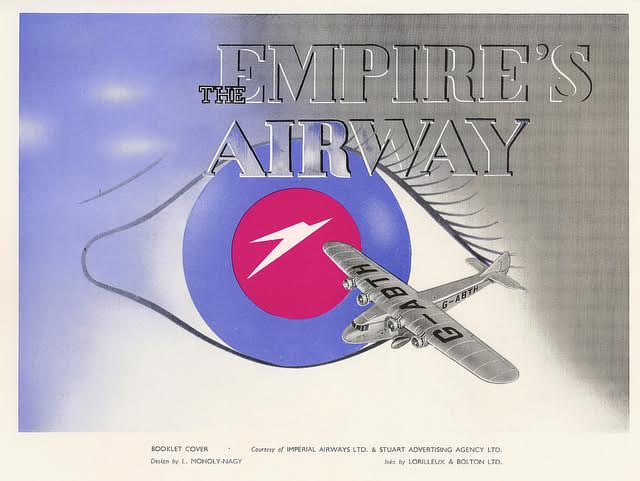
In addition to this businesslike presentation of orderly and predictable flight patterns, Moholy-Nagy created a brochure for the British airline (see the cover above and more pages here). Incorporating the so-called “Speedbird symbol,” these designs, writes Paul Jarvis, made “the point that Imperial spanned the empire and in time would span the world.” Not everyone was impressed. British transit executive Frank Pick, who presided over the visual identity of the London Underground, called Mohagy-Nagy “a gentleman with a modernistic tendency… of a surrealistic type, and I am not at all clear why we should fall for this.” His comments underscore MacCarthy’s argument that the Hungarian artist’s reputation suffered in England because of nationalist hostilities.
Mohagy-Nagy’s art “is international,” said Pick, “or at least continental. Let us leave the continent to pursue their own tricks.” The statement now seems a bit uncanny, though of course Pick could have had nothing like Brexit in mind. As far as Imperial Airlines was concerned, Mohagy-Nagy’s “continental” avant-gardism was exactly what the company needed to entice wary, yet adventurous passengers. You can download free high resolution scans of the map, or buy a print, at the David Rumsey Map Collection (an original vintage poster will cost you between four and six thousand dollars). And see some of Mohagy-Nagy’s less commercial work at this downloadable collection of Bauhaus books and journals.
Related Content:
Designer Massimo Vignelli Revisits and Defends His Iconic 1972 New York City Subway Map
Josh Jones is a writer and musician based in Durham, NC. Follow him at @jdmagness
Read More...The Scores That Electronic Music Pioneer Wendy Carlos Composed for Stanley Kubrick’s A Clockwork Orange and The Shining
Back in September, we featured Every Frame a Painting’s video essay on how bland and unoriginal so much film music has become. As the essay makes clear—and as the Coen brothers and Carter Burwell revealed in a recent roundtable—part of the problem is the ubiquity of “temp music”—the music directors and editors use as temporary scores in rough cuts. Some kind of inertia has trapped Hollywood composers into copying classical works, and each other, in ways that often verge on plagiarism.
In contrast to this tendency, some directors simply find that their temp music is so compelling that they are compelled to keep it. In perhaps the best example of this, Stanley Kubrick tossed out Alex North’s score for the final cut of 2001: A Space Odyssey and kept the music of Richard Strauss and Johann Strauss, of Ligeti, Khachaturian, and others. North famously didn’t find out until the film’s premiere. Comparing North’s mild score with, for example, Thus Spake Zarathustra, we can hardly fault the director’s choice, but he could have communicated it better.
This episode might have deterred another Kubrick composer, Wendy Carlos, who ended up providing music for two of his best-known later films. Fans of both Kubrick and Carlos will be grateful that it didn’t, though the experience became a frustrating one for Carlos, who often found her music nudged out as well. Nonetheless, her contributions to A Clockwork Orange and The Shining are indispensable in creating the dread and horror that carry through these cinematic masterpieces. As you can hear in the opening title music for both films, at the top and below, Carlos’ synth scores set up the near-unbearable tensions in Kubrick’s worlds.
In fact, Carlos came to prominence by doing what many a film composer does, interpreting the work of classical composers. But her reworkings of Beethoven, Bach, and Mozart are unique, made on early Moog synthesizers, which she had a hand in designing while a student at Columbia University’s Electronic Music Center in the sixties. Her album Switched on Bach, released the same year as 2001, won the composer three Grammy Awards, put Baroque music on the pop charts, garnered the highest praise from no less a keyboard authority than Glenn Gould, and “made electronic music mainstream.”
The album also put Carlos on Kubrick’s radar and he hired her and producer Rachel Elkind to compose the score for 1972’s A Clockwork Orange. Much of the music Carlos wrote or interpreted for the film wound up being cut, but what remained—the haunting arrangement of Henry Purcell in the film’s opening title, for example—has become inseparable from the classical and futuristic elements commingled in Kubrick’s adaptation of Anthony Burgess. Carlos’ complete original score has since been released as a CD, which you can purchase. The first track, “Timesteps,” as the album’s liner notes inform us, was both the only original composition that made it into the film and the first recording Carlos sent to Kubrick.
As Carlos herself writes on her website, she found the abridgement of her music “frustrating… as these were among the best things we’d done for the project.” Eight years later, during her work on The Shining, she would almost suffer the same fate as Alex North when she and Elkind wrote a complete score for the film and Kubrick—writes site The Overlook Hotel—“ended up using only two of their complete tracks, ‘The Shining’ (Main Title), and ‘Rocky Mountains.’” As with 2001, the perfectionistic director instead decided on several classical compositions—from Ligeti, Penderecki, Bartok and others.
And who can fault his choice? As The Cinemologists observe, his use of music has ended up informing horror film scores ever since, as Bernard Hermann’s Psycho score had twenty years earlier. But Carlos was soured on the relationship and vowed never again to work with Kubrick on another project. Yet again, we can be grateful for the collaboration. Her music for the title sequence (with Elkind’s distorted voice)—so weirdly, dissonantly ominous—provides the perfect accompaniment to one of the most complex opening sequences in film history.
In this case also, we can hear what Carlos intended, with the release of two volumes of Carlos’ “lost scores” that include her Shining compositions along with those from A Clockwork Orange and Tron. You can purchase those compilations here and here and read liner notes here and here. Carlos has worked hard to safeguard her privacy, and you’ll find little of her music online. Yet her strangely compelling soundtracks are well worth tracking down in any form you can find them.
Related Content:
The Classical Music in Stanley Kubrick’s Films: Listen to a Free, 4 Hour Playlist
Josh Jones is a writer and musician based in Durham, NC. Follow him at @jdmagness
Read More...The Grateful Dead Pays Tribute to Edgar Allan Poe’s “The Raven” in a 1982 Concert: Hear “Raven Space”
Over the years, we’ve featured numerous readings of Edgar Allan Poe’s famous narrative poem, “The Raven” (1845). Narrations by Christopher Walken, Vincent Price, Christopher Lee, Neil Gaiman, Stan Lee and John Astin (think The Addams Family)–they’ve all gotten some airtime here on Open Culture. Now you can add The Grateful Dead to the list. Kind of.
In April 19, 1982, the Dead played their final show of an East Coast tour in Baltimore, the town where Poe lived and eventually died (under mysterious circumstances, I might add). About 15 songs into their set, the band wheeled two giants tanks of nitrous oxide onstage and launched into their long improvs “Drums” and “Space.” In what’s since been dubbed “Raven Space” (listen above), an eerie soundscape unfolds. Then bassist Phil Lesh, says grimly “Quoth the Raven ‘Nevermore,’ ” letting you know what idea they’re riffing on. No complete narration of “The Raven” follows. The homage to Poe is more conceptual than literal, just as you might expect from the Dead.
You can listen to the Dead’s complete Baltimore show here.
If you would like to support the mission of Open Culture, consider making a donation to our site. It’s hard to rely 100% on ads, and your contributions will help us continue providing the best free cultural and educational materials to learners everywhere. You can contribute through PayPal, Patreon, and Venmo (@openculture). Thanks!
Related Content:
Edgar Allan Poe’s “The Raven,” Read by Christopher Walken, Vincent Price & Christopher Lee
The Great Stan Lee Reads Edgar Allan Poe’s “The Raven”
Read More...Learn Digital Photography with Harvard University’s Free Online Course
Since the taking of the very first photograph in 1826, photography has developed, as it were, in ways hardly imaginable to its first few generations of practitioners. The most thorough transformation so far has, of course, come in the form of the digital revolution (and especially its latest fruit, the camera phone), which has in many real ways delivered on its promise of making “everyone a photographer.” But the ability to take a picture is one thing, and the ability to take a picture worth looking at — let alone looking at more than once — quite another.
Fortunately, high technology has democratized not only the means of production, but also the means of learning with online courses like this free one on digital photography sourced from no less an institution than Harvard University.

Its materials come from Dan Armendariz’s Harvard course DGMD E‑10: Exposing Digital Photography, and its twelve modules “will take an average student about 10 to 15 hours to complete, and they teach a wide range of topics in digital photography, including exposure settings, reading histograms, learning about light, how sensors and lenses work, and how to post-process photos.” You can watch the lectures above, or find them on YouTube and iTunes, and find related materials on this course website.
Even a basic understanding of all those topics will put you far ahead of the average social-media snapper, but as with any pursuit, gaining some knowledge creates the desire for more. You thus might also consider taking the digital photography course from Stanford professor and Google researcher Marc Levoy we featured last year. (Also see this free massive open online course, Seeing Through Photographs. It’s from the MoMA, and it starts again on January 23.) It would take a lifetime to master all the gear and attain all the know-how out there, even if photography stopped changing today, but don’t let that intimidate you. Just bear in mind the wise words of Hunter S. Thompson: “Any man who can see what he wants to get on film will usually find some way to get it; and a man who thinks his equipment is going to see for him is not going to get much of anything.”
Harvard’s free digital photography course will be added to our collection, 1,700 Free Online Courses from Top Universities.
If you would like to support the mission of Open Culture, consider making a donation to our site. It’s hard to rely 100% on ads, and your contributions will help us continue providing the best free cultural and educational materials to learners everywhere. You can contribute through PayPal, Patreon, and Venmo (@openculture). Thanks!
Related Content:
Annie Leibovitz Teaches Photography in Her First Online Course
Museum of Modern Art (MoMA) Launches Free Course on Looking at Photographs as Art
The History of Photography in Five Animated Minutes: From Camera Obscura to Camera Phone
How to Take Photographs Like Ansel Adams: The Master Explains The Art of “Visualization”
Henri Cartier-Bresson and the Decisive Moment
Alfred Stieglitz: The Eloquent Eye, a Revealing Look at “The Father of Modern Photography”
Hunter S. Thompson’s Advice for Aspiring Photographers: Skip the Fancy Equipment & Just Shoot
ALISON — A Trove of 750 Free Online Job Training Courses
Based in Seoul, Colin Marshall writes and broadcasts on cities and culture. He’s at work on a book about Los Angeles, A Los Angeles Primer, the video series The City in Cinema, the crowdfunded journalism project Where Is the City of the Future?, and the Los Angeles Review of Books’ Korea Blog. Follow him on Twitter at @colinmarshall or on Facebook.
Read More...Alan Turing Gets Channeled in a New Opera: Hear Audio from The Life And Death(S) Of Alan Turing
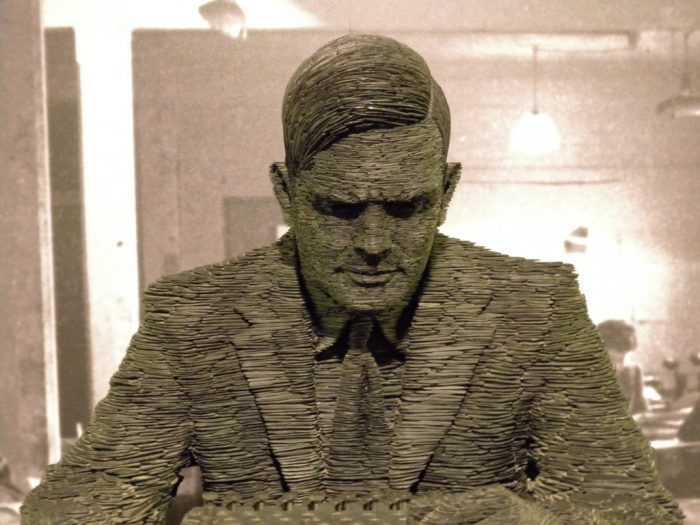
Creative Commons image by Steve Parker
It can seem like a cruel irony that some of the most celebrated people of our day didn’t receive the same acclaim during their sometimes troubled lives. Van Gogh may have been on the cusp of fame when he died despairing and broke, but few could have imagined then that he would be the universally beloved and admired artist he became in the following decades. (A recent Doctor Who episode poignantly imagined Van Gogh traveling to our time to witness his legacy.) In a more recent example in the sciences, the book—now film—Hidden Figures celebrates three previously unsung African-American women: mathematicians, or “human computers,” whose calculations were instrumental to NASA’s success but whose accomplishments were obscured by prejudice.
The same could not quite be said for Alan Turing, another genius recently celebrated in a multiple-award-winning Hollywood film, award-winning documentary, and spate of articles, essays, and books. Turing was viciously persecuted for his homosexuality by the state, and he has often been unfairly characterized in many portrayals since.
In 1952, he was convicted of “gross indecency” for a relationship with another man and given the choice between prison and chemical castration. The brilliant English mathematician, codebreaker, and father of modern computing and artificial intelligence chose the latter, and the physical and psychological effects were so demoralizing that he took his own life two years later—perhaps grimly inspiring the Apple logo as he enacted his favorite scene from Snow White (a matter in some dispute, it should be noted).
Turing “left behind a lasting legacy,” note the makers of the docu-drama Codebreakers, “and lingering questions about what else he might have accomplished if society had embraced his unique genius instead of rejecting it.” It’s not fair to say that society rejected his genius—perhaps even more tragically, it rejected his full humanity. Turing’s genius, though cut short at 41, received its due, inspiring, since 1966, the highest award in computer science. His famed “Turing test” became the standard by which nearly all attempts at artificial intelligence have been measured. In addition to those films, books, and essays, Turing has been much lauded in musical productions, namely the Pet Shop Boys “orchestral pop biography” A Man From the Future and a 30-minute oratorio by Adam Gopnik and composer Nico Muhly called Sentences.
And now, a new two-act opera, The Life and Death(s) of Alan Turing, was presented to the public for the first time, in its entirety, on January 12th at New York’s American Lyric Theater (ALT). Commissioned in 2012, and written by composer Justine Chen with a libretto by David Simpatico, the opera is “a historic-fantasia on Turing’s life” that does not obscure the man as it acknowledges his genius. Many critics felt that 2014’s The Imitation Game “obfuscated his sexuality and desexualized him in an attempt to make the story more mainstream,” remarks Shawn Milnes at The Daily Beast. “He was not a sexual creature in this movie,” agrees Simpatico. “He was in the closet.” That impression of Turing’s personal life has almost become commonplace. And yet the truth “couldn’t be more opposite,” Simpatico argues.
He was completely out. He was out upon meeting people. He would say, ‘How are you doing? I’m a homosexual. Will you have a problem with that? No.’ He was out to everybody. The movie makes it feel like he had something to hide.
Fully acknowledging all of the dimensions of Turing’s life allows the opera–The Life and Death(s) of Alan Turing– to draw deeply moving arias from his biography like “Cave of Wonders,” above, in which Turing expresses “his grief over the loss of his first love,” Christopher Morcom, a fellow grade school student who died young in 1930. Turing was “openly devastated” by the event, writes L.V. Anderson at Slate, “and he subsequently developed a relationship with Morcom’s family, going on vacations with them and maintaining a correspondence with Morcom’s mother for years. In The Imitation Game, by contrast, he “denies having known Christopher very well” in a flashback scene.
The music of the opera’s Prologue, above, owes a debt to composers like Steve Reich and John Adams, with its pulsing piano and cacophony of voices, simulating, perhaps, the rush of thought in Turing’s brilliant mind. At the ALT site, you can hear a further excerpt from the opera, “The Social Contract,” which dramatizes the pressure Turing’s mother put on him to marry, and his subsequent consideration of a marriage of convenience to his colleague in cryptoanalysis, Joan Clarke. In the opera, writes Milnes, Simpatico had the idea of “fusing sex and intellect on stage” in order to balance Turing’s portrayal and “see who the person was,” as he puts it. As Simpatico says, the tragically persecuted genius “had no division between his sexual, sensual, physical carnal self and his intellectual, cerebral, interior self.” Only people who couldn’t take them both together seemed to have found it necessary to separate the two, and thus do terrible damage to the man as a whole.
Related Content:
The Books on Young Alan Turing’s Reading List: From Lewis Carroll to Modern Chromatics
Josh Jones is a writer and musician based in Durham, NC. Follow him at @jdmagness
Read More...How the World’s Oldest Computer Worked: Reconstructing the 2,200-Year-Old Antikythera Mechanism
In 1900, Greek sponge divers discovered a shipwreck off the Greek island of Antikythera. The artifacts they came back up with included money, statues, pottery, and various other works of art and craft, as well as a curious lump of bronze and wood that turned out to be by far the most important item onboard. When an archaeologist named Valerios Stais took a look at it two years later, he noticed that the lump had a gear in it. Almost a half-century later, the science historian Derek J. de Solla Price thought this apparently mechanical object might merit further examination, and almost a quarter-century after that, he and the nuclear physicist Charalambos Karakalos published their discovery–made by using X‑ray and gamma-ray images of the interior–that those divers had found a kind of ancient computer.
“Understanding how the pieces fit together confirmed that the Antikythera mechanism was capable of predicting the positions of the planets with which the Greeks were familiar — Mercury, Venus, Mars, Jupiter and Saturn — as well as the sun and moon, and eclipses,” writes Big Think’s Robby Berman. “It even has a black and white stone that turns to show the phases of the moon.”
Determining how it really worked has required the building of various different models of various different kinds, one of which you can see assembled, operated, and disassembled before your very eyes in the CGI rendering at the top of the post. Its design comes from the work of historian of mechanism Michael T. Wright, who also put together the physical recreation of the Antikythera mechanism you can see him explain just above.

Image via Wikimedia Commons
By its very nature, an artifact as fascinating and as incomplete as this draws all sorts of theories about the specifics of its design, purpose, and even its age. (It dates back to somewhere between 205 and 100 BC.) In 2012, Tony Freeth and Alexander Jones published their own model, different from Wright’s, of this “machine designed to predict celestial phenomena according to the sophisticated astronomical theories current in its day, the sole witness to a lost history of brilliant engineering, a conception of pure genius, one of the great wonders of the ancient world,” — but one which “didn’t really work very well.” Some of the problems has to do with the limitations of ancient Greek astronomical theory, and some with the unreliability of its layers of handmade gears.
More recent research, adds Berman, has discovered that “the device was built by more than one person on the island of Rhodes, and that it probably wasn’t the only one of its kind,” indicating that the ancient Greeks, despite the apparent deficiencies of the Antikythera mechanism itself, “were apparently even further ahead in their astronomical understanding and mechanical know-how than we’d imagined.” Now watch the video just above, in which the Apple engineer makes his own Antikythera mechanism with an entirely more modern set of components, and just imagine what the ancient Greeks could have accomplished had they developed Lego.
Related Content:
Introduction to Ancient Greek History: A Free Online Course from Yale
How the Ancient Greeks Shaped Modern Mathematics: A Short, Animated Introduction
How Ancient Greek Statues Really Looked: Research Reveals their Bold, Bright Colors and Patterns
Modern Artists Show How the Ancient Greeks & Romans Made Coins, Vases & Artisanal Glass
Based in Seoul, Colin Marshall writes and broadcasts on cities and culture. He’s at work on a book about Los Angeles, A Los Angeles Primer, the video series The City in Cinema, the crowdfunded journalism project Where Is the City of the Future?, and the Los Angeles Review of Books’ Korea Blog. Follow him on Twitter at @colinmarshall or on Facebook.
Read More...Support Us
We're hoping to rely on loyal readers, rather than erratic ads. Please click the Donate button and support Open Culture. You can use Paypal, Venmo, Patreon, even Crypto! We thank you!

About Us

Open Culture scours the web for the best educational media. We find the free courses and audio books you need, the language lessons & educational videos you want, and plenty of enlightenment in between.
Advertise With Us

FREE UPDATES!
GET OUR DAILY EMAIL
Get the best cultural and educational resources on the web curated for you in a daily email. We never spam. Unsubscribe at any time.
FOLLOW ON SOCIAL MEDIA

Open Culture editor Dan Colman scours the web for the best educational media. He finds the free courses and audio books you need, the language lessons & movies you want, and plenty of enlightenment in between.
Advertise With Us


