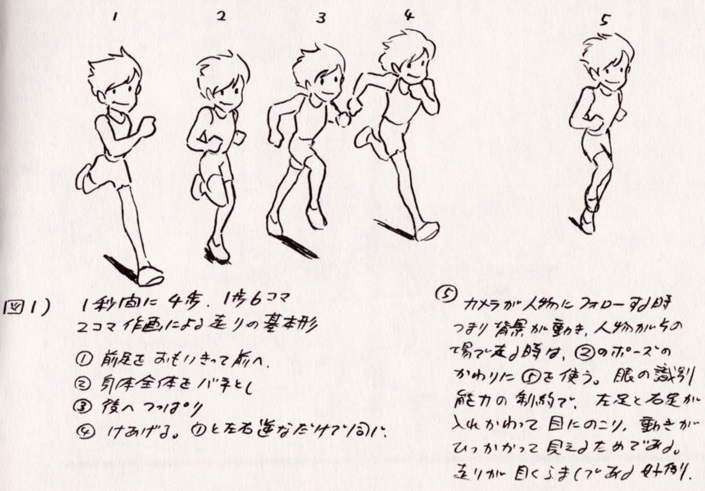
Hayao Miyazaki’s Sketches Showing How to Draw Characters Running: From 1980 Edition of Animation Magazine
Earlier this week, we let you know about the animation software used by Hayao Miyazaki’s Studio Ghibli coming out in an open source version free to download. While this makes available to you a piece of the technology used in the service of such masterpieces as Princess Mononoke, Spirited Away, and The Tale of Princess Kaguya, it won’t, alas, get you any closer to possessing the artistic skills of the Ghibli team. To attain those, you’ve just got to engage in the same long, cyclical process of observation, replication, and refinement that you would when mastering anything.
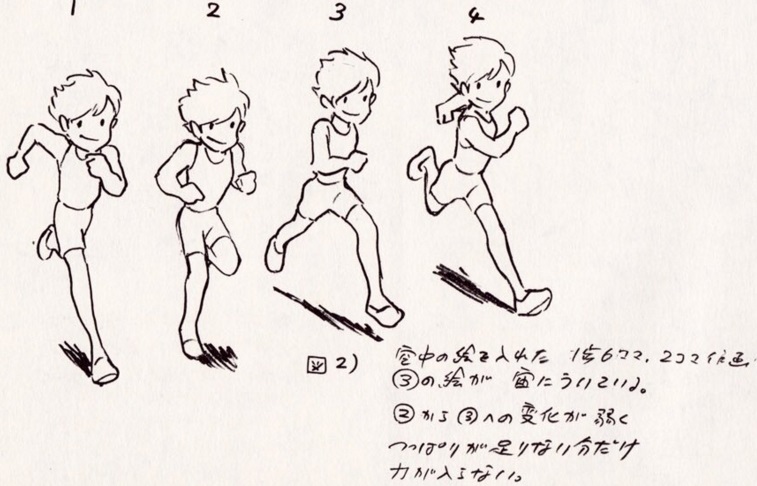
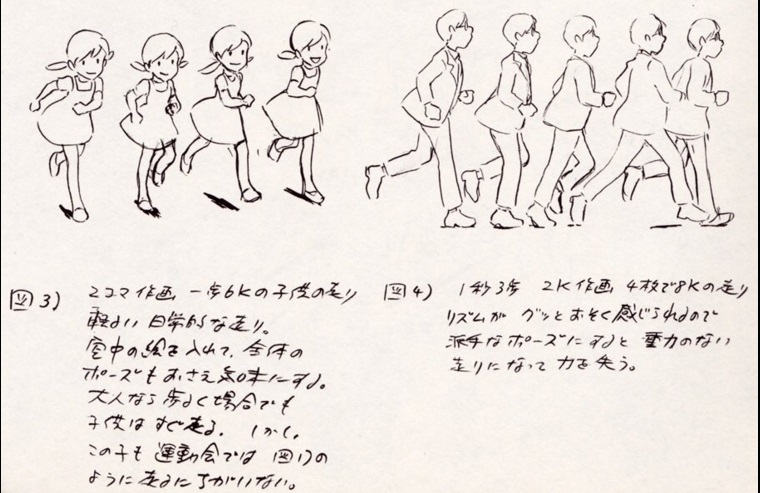
Luckily, Miyazaki has provided plenty of examples to work with, and even, now and again in his long career, broken down his techniques for all to understand. Here we have four of his sketches, originally published in a 1980 issue of Animation Magazine (月刊アニメーション), which provide visual explanations of how to animate a character running — not an uncommon task, one imagines, for the Ghibli animators in charge of what the Creators Project calls “the constant running Miyazaki’s films are known for.” If you’ve ever tried to animate running yourself, you’ll know that what might at first seem like a simple, everyday physical action requires a great deal of subtlety to get right.
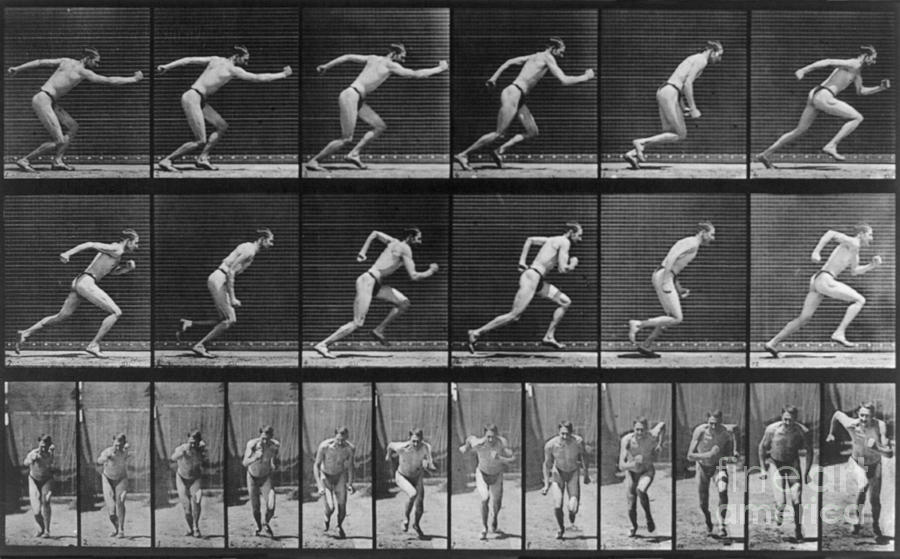
The early motion photographer Eadweard Muybridge gave the world a sense of this when he captured the mechanics of both men and horses running back in the 1880s, but to take those real-world observations and render them convincingly in animation — much less with the characteristic Ghibli smoothness — takes things to another level altogether. “Only Miyazaki man,” said animator LeSean Thomas when he tweeted these images. “Such effortless lines and silhouettes. Years of hard work & learning on display in these sketches!”
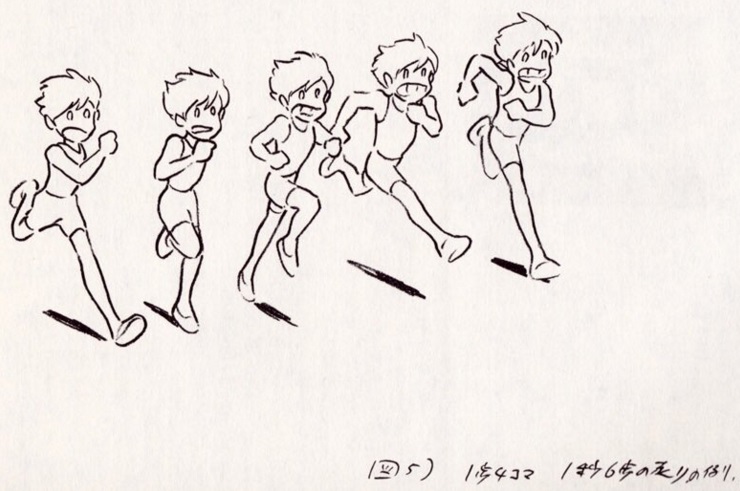
To those who wish to follow Miyazaki’s method of animating running in order to go on to making the kind of lavish cinematic stories he and his collaborators have, best of luck; to those who’d rather not put in the decades, well, you can still learn his method of making instant ramen.
via LeSean Thomas
Related Content:
Software Used by Hayao Miyazaki’s Animation Studio Becomes Open Source & Free to Download
Watch Hayao Miyazaki Animate the Final Shot of His Final Feature Film, The Wind Rises
How to Make Instant Ramen Compliments of Japanese Animation Director Hayao Miyazaki
Early Japanese Animations: The Origins of Anime (1917–1931)
Based in Seoul, Colin Marshall writes and broadcasts on cities, language, and style. He’s at work on a book about Los Angeles, A Los Angeles Primer, the video series The City in Cinema, the crowdfunded journalism project Where Is the City of the Future?, and the Los Angeles Review of Books’ Korea Blog. Follow him on Twitter at @colinmarshall or on Facebook.
Read More...Quentin Tarantino Picks the 12 Best Films of All Time; Watch Two of His Favorites Free Online
Every decade, when the British Film Institute (BFI) announces the outcome of its Sight & Sound Poll of the Greatest Films of All Time, cinephiles listen; no less a serious movie person than Roger Ebert called it, among the countless polls of great movies, “the only one most serious movie people take seriously.” When the BFI conducts the poll, it divides those polled into two groups: one for critics like Ebert, and one for directors like, say, Quentin Tarantino, whose thorough knowledge of cinema and absolute seriousness as a movie person almost makes him a critic as well, albeit one who does his criticism in the form of movies.
In the 2002 poll, Tarantino named these as the greatest films of all time:
- The Good, the Bad and the Ugly (Sergio Leone, 1966)
- Rio Bravo (Howard Hawks, 1959)
- Taxi Driver (Martin Scorsese, 1976)
- His Girl Friday (Howard Hawks, 1940)
- Rolling Thunder (John Flynn, 1977)
- They All Laughed (Peter Bogdanovich, 1981)
- The Great Escape (John Sturges, 1963)
- Carrie (Brian De Palma, 1976)
- Coffy (Jack Hill, 1973)
- Dazed and Confused (Richard Linklater, 1993)
- Five Fingers of Death (Chang-hwa Jeong, 1972)
- Hi Diddle Diddle (Andrew W. Stone, 1943)
You can watch two of Tarantino’s 2002 picks, the formally experimental caper comedy Hi Diddle Diddle as well as His Girl Friday, the capstone of the screwball comedy subgenre, for free online. Once you’ve enjoyed the both of them, why not have a look at Tarantino’s selections a decade on, for the 2012 Sight & Sound directors poll, to compare and contrast, with the new titles bolded:
- Apocalypse Now (Francis Ford Coppola, 1979)
- The Bad News Bears (Michael Ritchie, 1976)
- Carrie (Brian de Palma, 1976)
- Dazed and Confused (Richard Linklater, 1993)
- The Good, the Bad and the Ugly (Sergio Leone, 1966)
- The Great Escape (John Sturges, 1963)
- His Girl Friday (Howard Hawks, 1939)
- Jaws (Steven Spielberg, 1975)
- Pretty Maids All in a Row (Roger Vadim, 1971)
- Rolling Thunder (John Flynn, 1997)
- Sorcerer (William Friedkin. 1977)
- Taxi Driver (Martin Scorsese, 1976)
Tarantino’s 2012 selections reveal a clear increase in appreciation, or at least willingness to vote his appreciation, for high-profile pictures of the 1970s — Apocalypse Now, Jaws, Taxi Driver, The Bad News Bears — a decade whose cinema to which the director has made no lack of homage. We’ll have to wait six more years, until the 2022 poll, to get a full sense of how Tarantino’s idea of the canon has changed. Will the grim, satirical, and lurid films of the 70s consume most of his list by then? Will he favor a different era of film history entirely? I’d only put money on one thing for sure about the preference of this filmmaker who loves dialogue even more than violence: His Girl Friday isn’t going anywhere.
You can find His Girl Friday and Hi Diddle Diddle on our list, 4,000+ Free Movies Online: Great Classics, Indies, Noir, Westerns, Documentaries & More.
Related Content:
Quentin Tarantino’s 10 Favorite Films of 2013
Quentin Tarantino’s Handwritten List of the 11 “Greatest Movies”
Quentin Tarantino Lists His Favorite Films Since 1992
Watch His Girl Friday, Howard Hawks’ Classic Screwball Comedy Starring Cary Grant, Free Online
Based in Seoul, Colin Marshall writes and broadcasts on cities, language, and style. He’s at work on a book about Los Angeles, A Los Angeles Primer, the video series The City in Cinema, the crowdfunded journalism project Where Is the City of the Future?, and the Los Angeles Review of Books’ Korea Blog. Follow him on Twitter at @colinmarshall or on Facebook.
Read More...A Hulking 1959 Chevy Bel Air Gets Obliterated by a Mid-Size 2009 Chevy Malibu in a Crash Test
The auto industry continues to take steps forward, sometimes big, sometimes small. They’re tinkering with electric and driverless cars, and they’re finding ways to improve the safety of everyday vehicles already on the road. How much incremental progress have we made? Just watch the video produced by the Insurance Institute for Highway Safety. A 2009 Chevy Malibu crashes into a colossal 1959 Chevy Bel Air at 40 miles per hour. And despite its “Safety-Girder” cruciform frame (a safety innovation Chevy developed during the 1950s) the bigger Bel Air didn’t fare well at all. The same applies to the dummy inside.
Here’s how the Institute described what happened to the Bel Air to The New York Times:
This car had no seat belts or air bags. Dummy movement wasn’t well controlled, and there was far too much upward and rearward movement of the steering wheel. The dummy’s head struck the steering wheel rim and hub and then the roof and unpadded metal instrument panel to the left of the steering wheel.
During rebound, the dummy’s head remained in contact with the roof and slid rearward and somewhat inward. The windshield was completely dislodged from the car and the driver door opened during the crash, both presenting a risk of ejection. In addition, the front bench seat was torn away from the floor on the driver side.
The Bel Air got a “Poor” rating in every safety category; the Malibu a “Good.”
Although a lot of America seems stuck in reverse, car design is one area where we’re moving forward, hopefully with even better days to come.
Related Content:
178,000 Images Documenting the History of the Car Now Available on a New Stanford Web Site
Jack Nicholson Puts His Star Power Behind “Green” Cars, 1978
Young Robert De Niro Appears in 1969 AMC Car Commercial
Read More...Virginia Woolf Offers Gentle Advice on “How One Should Read a Book”
I am privileged to have grown up in a house filled with books. I don’t remember learning to read; I simply recall books—those that felt beneath me, those that seemed forever beyond comprehension. No one taught me how to read—by which I mean no one told me what to attend to in books, what to ignore; what to love, what to scorn. The shelves in my home, school, and local library were a wilderness, and I was left to carve my own paths through their thickets.
That all changed when I got to college, then graduate school, where I found various critical movements, literary theories, and philosophical schools, and was compelled to choose between their methods, politics, and prohibitions. Reading became a strenuous activity, a heavy intellectual exercise in which I felt those critics and theorists always looking over my shoulder. Those who have done intensive study in the humanities may sympathize: Afterward, I had to relearn how to read without an agenda.
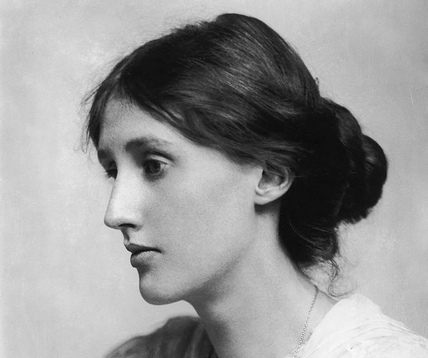
Such is the kind of unfettered reading Virginia Woolf recommends in an essay titled “How Should One Read a Book?”, published in a series called The Common Reader—a title, in fact, of two collections, the first published in 1925, the second in 1932. Woolf wrote these essays for lay readers, not scholars, and many were previously published in venues like The Nation, Vogue, and The Yale Review. In them, Woolf’s informal investigations of writers like Jonathan Swift, Daniel Defoe, Christina Rossetti, and Thomas Hardy—writes a 1925 New York Times review—do not “put the author in the attitude of a defender or an expositor of certain trends in literature.”
“How Should One Read a Book?” appears at the end of the second series of The Common Reader. The essay “cautions,” writes Maria Popova, “against bringing baggage and pre-conceived notions to your reading” and abjures a formal, critical approach:
After all, what laws can be laid down about books? The battle of Waterloo was certainly fought on a certain day; but is Hamlet a better play than Lear? Nobody can say. Each must decide that question for himself. To admit authorities, however heavily furred and gowned, into our libraries and let them tell us how to read, what to read, what value to place upon what we read, is to destroy the spirit of freedom which is the breath of those sanctuaries. Everywhere else we may be bound by laws and conventions — there we have none.
Though herself a more than able scholar and critic, Woolf does not recommend that her readers become so. “The only advice,” she writes, “that one person can give another about reading is to take no advice, to follow your instincts, to use your own reason, to come to your own conclusions.” That said, however, she feels “at liberty to put forward a few ideas and suggestions” that we are free to take or leave. She offers her guidelines to aid enjoyment, not stifle it, and to help us sort and sift the “multitudinous chaos” we encounter when confronted with genres, periods, and styles of every type.
“Where,” Woolf asks, “are we to begin?” Below, in brief, find a few of her “ideas and suggestions,” offered with all of the careful caveats above:
- “Since books have classes—fiction, biography, poetry—we should separate them and take from each what it is right that each should give us.”
Most commonly we come to books with blurred and divided minds, asking of fiction that it shall be true, of poetry that it shall be false, of biography that it shall be flattering, of history that it shall enforce our own prejudices. If we could banish all such preconceptions when we read, that would be an admirable beginning. Do not dictate to your author; try to become him. Be his fellow-worker and accomplice. If you hang back, and reserve and criticise at first, you are preventing yourself from getting the fullest possible value from what you read.
- “Perhaps the quickest way to understand the elements of what a novelist is doing is not to read, but to write; to make your own experiment with the dangers and difficulties of words.”
Recall, then, some event that has left a distinct impression on you — how at the corner of the street, perhaps, you passed two people talking. A tree shook; an electric light danced; the tone of the talk was comic, but also tragic; a whole vision, an entire conception, seemed contained in that moment…. When you attempt to reconstruct it in words, you will find that it breaks into a thousand conflicting impressions…. Then turn from your blurred and littered pages to the opening pages of some great novelist — Defoe, Jane Austen, Hardy. Now you will be better able to appreciate their mastery.
- “We can read [biographies and memoirs] with another aim, not to throw light on literature, not to become familiar with famous people, but to refresh and exercise our own creative powers.”
The greater part of any library is nothing but the record of… fleeting moments in the lives of men, women, and donkeys. Every literature, as it grows old, has its rubbish-heap, its record of vanished moments and forgotten lives told in faltering and feeble accents that have perished. But if you give yourself up to the delight of rubbish-reading you will be surprised, indeed you will be overcome, by the relics of human life that have been cast out to moulder. It may be one letter — but what a vision it gives! It may be a few sentences — but what vistas they suggest!
Read the entirety of Woolf’s essay here to learn her nuanced view of reading. She concludes her essay with another gentle swipe at literary criticism and recommends humility in the company of literature:
If to read a book as it should be read calls for the rarest qualities of imagination, insight, and judgment, you may perhaps conclude that literature is a very complex art and that it is unlikely that we shall be able, even after a lifetime of reading, to make any valuable contribution to its criticism. We must remain readers.
Clearly Woolf did not think of reading as a passive activity, but rather one in which we engage our own imaginations and literary abilities, such as they are. But if we are not to criticize, not draw firm conclusions, morals, life lessons, or philosophies from the books we read, of what use is reading to us?
Woolf answers the question with some questions of her own: “Are there not some pursuits that we practice because they are good in themselves, and some pleasures that are final? And is not this among them?”
Related Content:
Take Vladimir Nabokov’s Quiz to See If You’re a Good Reader–The Same One He Gave to His Students
An Animated Introduction to Virginia Woolf
Josh Jones is a writer and musician based in Durham, NC. Follow him at @jdmagness
Read More...Free M.I.T. Course Teaches You How to Become Bill Nye & Make Great Science Videos for YouTube
If I had my way, more academics would care about teaching beyond the walls of the academy. They’d teach to a broader public and consider ways to make their material more engaging, if not inspiring, to new audiences. You can find examples out there of teachers who are doing it right. The heirs of Carl Sagan–Brian Greene, Neil deGrasse Tyson, and Bill Nye–know how to light a spark and make their material come alive on TV and YouTube. How they do this is not exactly a mystery, not after M.I.T. posted online a course called “Becoming the Next Bill Nye: Writing and Hosting the Educational Show.”
Taught at M.I.T. over a month-long period, Becoming the Next Bill Nye was designed to teach students video production techniques that would help them “to engagingly convey [their] passions for science, technology, engineering, and/or math.” By the end of the course, they’d know how to script and host a 5‑minute YouTube show.
You can now find the syllabus and all materials for that course online at MIT’s OpenCourseWare site. This includes all video lectures and class assignments. Or, if you prefer, you can get the video lectures straight from this YouTube playlist.
Becoming the Next Bill Nye will be added to our meta collection, 1,700 Free Online Courses from Top Universities.
Related Content:
Carl Sagan Presents Six Lectures on Earth, Mars & Our Solar System … For Kids (1977)
Neil deGrasse Tyson Lists 8 (Free) Books Every Intelligent Person Should Read
Read More...Actors from The Wire Star in a Short Film Adaptation of Zora Neale Hurston’s “The Gilded Six-Bits” (2001)
After the cult success of HBO’s gritty Baltimore crime drama, The Wire, the obsessiveness of the show’s fanbase became a running joke. Devoted Wire-lovers browbeat friends, family, and coworkers with the show’s many virtues. Wire fans became emotionally attached not only to the show’s characters, but also to the actors who played them. Though I managed to shun Wire evangelists for a time, I too finally became a convert after its six-year run ended in 2008. Like many a fan I was thrilled to see actors Michael K. Williams and Michael B. Jordan land juicy post-Wire roles (and saddened to see some of the show’s other fine actors seem to disappear from view).
And, like many a fan, I also wanted to know these actors’ backstories. What had they been up to before The Wire? We get one answer to that question above, in the adaptation of Zora Neale Hurston’s 1933 short story “The Gilded Six-Bits.” In the starring role, you’ll recognize The Wire’s (eventually) reformed ex-con Dennis “Cutty” Wise, or Chad Coleman, in his first starring role. Playing opposite him you’ll be happy to see your favorite wiseass, philandering, cigar-chomping detective, Bunk Moreland, or Wendell Pierce, who has landed many juicy roles of his own, both pre- and post-Wire. (Here, playing a wiseass, cigar-chomping womanizer.) Adapted and directed by author and filmmaker Booker T. Mattison, the short film debuted on Showtime in 2001.
The story is an early example of Hurston’s genius, written four years before the publication of her breakout novel Their Eyes Were Watching God and two years before her groundbreaking study of African-American folklore, Mules and Men. Published in the influential literary magazine Story—which also served as an important venue for writers like J.D. Salinger and Richard Wright—“The Gilded Six-Bits” so impressed the magazine’s editor that he asked Hurston if she had a novel in progress. She didn’t, but told him she did, and immediately began work on Jonah’s Gourd Vine, published the following year. A story of infidelity and reconciliation, “The Gilded Six-Bits” features characters and a setting familiar to Hurston readers—ordinary African-Americans caught up in the travails of rural life in the Jim Crow South. But as in all of her work, the seeming simplicity of her characters and language slowly reveal complicated truths about the nature of language, marriage, sexuality, and money. And few could bring her characters to life better than your favorite Wire actors.
Find more films in our collection, 4,000+ Free Movies Online: Great Classics, Indies, Noir, Westerns, Documentaries & More.
via Biblioklept
Related Content:
Hear Zora Neale Hurston Sing the Bawdy Prison Blues Song “Uncle Bud” (1940)
Hear Zora Neale Hurston Sing Traditional American Folk Song “Mule on the Mount” (1939)
Josh Jones is a writer and musician based in Durham, NC. Follow him at @jdmagness
Read More...Software Used by Hayao Miyazaki’s Animation Studio Becomes Open Source & Free to Download

By now we all know the name of Studio Ghibli, the operation responsible for such animated-feature-film-redefining productions as Grave of the Fireflies and Hayao Miyazaki’s My Neighbor Totoro, Princess Mononoke, and Spirited Away. But unless we’ve paid a visit to the Ghibli Museum, seen the documentary The Kingdom of Dreams and Madness, or taken part in the close scrutiny to which Ghibli fans subject the studio’s every public move, we won’t know much about their methods for crafting such visually and emotionally captivating stories. Soon, though, we’ll be able to use their tools ourselves. On March 26, you will be able to download OpenToonz, an open source version of the Toonz software used by Studio Ghibli.
“Included in the OpenToonz are many of Ghibli’s custom tools, specially designed to capture trees waving in the breeze, food that looks too delicious to eat, and the constant running Miyazaki’s films are known for,” writes The Creators Project’s Beckett , who quotes Ghibli’s Executive Imaging Director Atsushi Okui on why they started using the Italian-developed package in the first place: “We needed a software enabling us to create a certain section of the animation digitally. Our requirement was that in order to continue producing theatre-quality animation without additional stress, the software must have the ability to combine the hand-drawn animation with the digitally painted ones seamlessly.” Toonz, evidently, could pull it off.
Ghibli began using the software in 1995, during the production of Princess Mononoke, and has kept using it since. In fact, reports Amid Amidi at Cartoon Brew, “the new OpenToonz is dubbed ‘Toonz Ghibli Edition’ because of all the custom-features that Toonz has developed over the years for the legendary Japanese studio.” With Miyazaki retired, at least from feature-film animation, and nobody quite sure whether 2014’s When Marnie Was There will be the studio’s last picture, as good a time as any has come for successors to the Ghibli tradition. If you’d like to throw your own hat into that enormous ring, you can download OpenToonz for free on March 26, 2016 (or, for a price, buy Toonz Premium) from the official Toonz web site.
Related Content:
Watch Hayao Miyazaki Animate the Final Shot of His Final Feature Film, The Wind Rises
Hayao Miyazaki’s Universe Recreated in a Wonderful CGI Tribute
Hayao Miyazaki’s Masterpieces Spirited Away and Princess Mononoke Imagined as 8‑Bit Video Games
Based in Seoul, Colin Marshall writes and broadcasts on cities, language, and style. He’s at work on a book about Los Angeles, A Los Angeles Primer, the video series The City in Cinema, the crowdfunded journalism project Where Is the City of the Future?, and the Los Angeles Review of Books’ Korea Blog. Follow him on Twitter at @colinmarshall or on Facebook.
Read More...Watch Édith Piaf Sing Her Most Famous Songs: “La Vie en Rose,” “Non, Je Regrette Rien” & More
On the 100th anniversary of Édith Piaf’s birth last December, writes Jeremy Allen at The Guardian, “celebrations… were low key…. Piaf is a little out of fashion with today’s jeunesse dorée.” That’s a little hard to believe, but if Piaf has fallen out of favor with wealthy French youth, her star has continued to shine, year after year, for much of the music- and film-loving world.
Her story has been told in numerous documentaries and biopics, including the multiple-award-winning La Vie en rose in 2007, whose lead actress, Marion Cotillard, received the first Oscar given for a French-speaking role.
Celebrated in song, in print, in photographs, and in many a stage tribute—such as Lady Gaga’s performance of her signature song, “La Vie en rose,” at last year’s Grammy awards—Piaf has “influenced everyone from Marianne Faithfull to Anna Calvi, and Elton John,” not all of whom are themselves in fashion these days.
And yet, writes Allen, “to paraphrase an old footballing cliché, fashion is temporary, class is permanent.” If there’s anything Piaf’s voice and presence have exemplified over many decades, it is that indefinable quality of “class,” which transcends economic divisions and the ramblings of tacky would-be politicians and encompasses rather a mix of graceful self-possession, artistic integrity, and timeless elegance.
She certainly would not have been mistaken, in her youth, for one of those fashionable jeunesse dorée. The daughter of a street singer who abandoned her, Piaf learned her craft by also singing on the streets, “in a Bellevilloise argot apparently not dissimilar to a Parisian version of old cockney,” Allen writes. The dramatic circumstances of her life were “a punk opera decades before the genre exploded….. From growing up in a bordello, to spending four years blinded by keratitis in her infancy, to joining her acrobat father on the road in her teens, to shooting up morphine, cortisone and falling into alcoholism to alleviate a dodgy back sustained in a car crash as an adult (precipitating what she described as her ‘years of hell’).”
Through it all, writes Open Culture’s Mike Springer, “Piaf managed to hold onto a basically optimistic view of life.” Such a view, always tinged with rueful sadness, comes through in her performances of, for example, “La Vie en rose” (which roughly translates to “life through rose-colored glasses”). See her perform the song at the top of the post on French TV in 1954. “She was 38 years old,” writes Springer, “but looked much older” due to her alcoholism and various treatments for her drinking and arthritis. Below this video, in a filmed performance of “Non, je regrette rien” (“I regret nothing”), Piaf’s hard life seems etched on her expressively sorrowful face, but her voice did not suffer for it, nor her willingness to perform until the end of her short life (she died in 1963 at age 47).
Piaf dedicated “Non, je regrette rien”—composed for her in 1956 by Charles Dumont and Michel Vaucaire—to the French Foreign Legion, who adopted it as their anthem. Its title becomes particularly poignant in light of Piaf’s storied life, especially given the accusations after the Nazi occupation that she had collaborated with the Germans. Instead, it was revealed, writes a New York Times profile, that while she performed for German troops, she “was instrumental in helping a number of prisoners escape,” rendering “aid that later saved her from any charges of collaboration.” Piaf became an emblem of Parisian culture, and appeared in several films, such as 1951’s Paris Chante Toujours (“Paris still sings,” above—she sings “Hymne à l’amour.”)
She also became—after surviving a first, disastrous 1947 appearance in New York—a star in the U.S. in the 50s. In 1959, she appeared on The Ed Sullivan Show and sang “Milord” (above), partly in English, a song that briefly reached the Billboard top 100. Piaf would appear a few times on Sullivan’s program throughout the decade. In 1952, she held her own with American audiences in a lineup that included the hugely popular Bobby Darin and the fiery Ike and Tina Turner. Despite her diminutive stature (she stood just 4′8″) and often frail physical condition, Piaf’s world-weary demeanor and smoldering voice stood out in any company. She was a true original and there has never been another performer quite like her.
Related Content:
Édith Piaf’s Moving Performance of ‘La Vie en Rose’ on French TV, 1954
Watch Classic Performances from Maria Callas’ Wondrous and Tragically-Short Opera Career
Bertolt Brecht Sings ‘Mack the Knife’ From The Threepenny Opera, 1929
Josh Jones is a writer and musician based in Durham, NC. Follow him at @jdmagness
Read More...You Can Find the Proof of Evolution in Our Own Spare Body Parts: From Third Molars to Vestigial Tails
Looking for proof of evolution? Perhaps you don’t need to look much beyond your own body. Created by Vox, the video above highlights the vestigial body parts and traits we’ve retained from earlier points in our evolutionary history. Writes Vox’s Joss Fong:
Vestigial structures are evolution’s leftovers — body parts that, through inheritance, have outlived the context in which they arose. Some of the most delightful reminders of the common ancestry we share with other animals, they show that the building blocks of the human body predate our species by hundreds of millions of years.
For a closer look at the mechanics of evolution, you can spend time with Yale’s open course, Principles of Evolution, Ecology and Behavior, which is part of our collection of Free Online Biology Courses. But if you don’t want to dig terribly deep, then start with Carl Sagan’s eight minute animated primer. It’s petty hard to beat.
If you would like to support the mission of Open Culture, consider making a donation to our site. It’s hard to rely 100% on ads, and your contributions will help us continue providing the best free cultural and educational materials to learners everywhere. You can contribute through PayPal, Patreon, and Venmo (@openculture). Thanks!
Related Content:
Richard Dawkins Explains Why There Was Never a First Human Being
10 Million Years of Evolution Visualized in an Elegant, 5‑Foot Long Infographic from 1931
Watch 570 Million Years of Evolution on Earth in 60 Seconds
Carl Sagan Explains Evolution in an Eight-Minute Animation
Read More...How to Sound Smart in a TED Talk: A Funny Primer by Saturday Night Live’s Will Stephen
Is there any subject that can’t be covered in a TED Talk?
Apparently not. You can make a TED Talk about anything, even nothing, as veteran improviser and rookie Saturday Night Live writer, Will Stephen, demonstrated at a recent TEDx event in New York City.
What you shouldn’t do is deviate from TED’s established presentation tropes. Stephen may be punking us with his How to Sound Smart in Your TEDx Talk, above, but aspirant TED speakers should take notes. One can’t practice observational humor without being a keen observer. Stephen’s insights are as good a playbook as any for that unmistakeable TED-style delivery:
Use your hands.
Engage the audience by asking them a question that will result in a show of hands…
By show of hands, how many of you have been asked a question before?
Hit ‘em with an endearing, personal anecdote.
Projections will enhance your credibility.
Replay the clip with the sound down, as Stephen suggests, and it’s still obvious what he’s doing — giving a TED Talk. (The familiar camera work and editing don’t hurt either.)
Even if you’re not planning on nominating yourself to become a TED speaker in the near future, Stephen’s lesson should prove handy next time you’re called upon to do some public speaking, whether running for President or delivering the toast at your best friend’s wedding.
And nothing is certainly not the only topic of substance upon which Stephen can discourse. Witness his Tinder Strategy Powerpoint.
Hmm, maybe there are some TED-proof subjects after all…
Related Content:
1756 TED Talks Listed in a Neat Spreadsheet
Ayun Halliday is an author, illustrator, and Chief Primatologist of the East Village Inky zine. Follow her @AyunHalliday
Read More...Support Us
We're hoping to rely on loyal readers, rather than erratic ads. Please click the Donate button and support Open Culture. You can use Paypal, Venmo, Patreon, even Crypto! We thank you!

About Us

Open Culture scours the web for the best educational media. We find the free courses and audio books you need, the language lessons & educational videos you want, and plenty of enlightenment in between.
Advertise With Us

FREE UPDATES!
GET OUR DAILY EMAIL
Get the best cultural and educational resources on the web curated for you in a daily email. We never spam. Unsubscribe at any time.
FOLLOW ON SOCIAL MEDIA

Open Culture editor Dan Colman scours the web for the best educational media. He finds the free courses and audio books you need, the language lessons & movies you want, and plenty of enlightenment in between.
Advertise With Us