Stephen Hawking’s Uplifting Message: You Can Get Yourself Out of Any Hole, No Matter What Their Size
Several weeks back, you might recall, Stephen Hawking delivered two Reith lectures over the radio airwaves of the BBC –one called “Do Black Holes Have No Hair?,” the other “Black Holes Ain’t as Black as They Are Painted.” Both were featured here, accompanied by some lively chalkboard animations.
Above you can watch an outtake from the second lecture, this time animated in a different aesthetic. It’s trippy, hypnotic, and unless you’re grounded in the material, the talk will leave you a little baffled–at least until the end, when Hawking leaves us with a life-affirming message anyone can relate to. “If you feel like you’re in a black hole, don’t give up. There’s a way out.” At once, he’s talking literally about black holes that are no longer thought to consume everything they encounter, and the metaphorical ones we all run into, somewhere along the way, in life.
On that uplifting note, another week begins…
If you would like to support the mission of Open Culture, consider making a donation to our site. It’s hard to rely 100% on ads, and your contributions will help us continue providing the best free cultural and educational materials to learners everywhere. You can contribute through PayPal, Patreon, and Venmo (@openculture). Thanks!
Related Content
Stephen Hawking’s Lectures on Black Holes Now Fully Animated with Chalkboard Illustrations
Psychedelic Animation Takes You Inside the Mind of Stephen Hawking
The Big Ideas of Stephen Hawking Explained with Simple Animation
Watch A Brief History of Time, Errol Morris’ Film About the Life & Work of Stephen Hawking
Read More...Umberto Eco Dies at 84; Leaves Behind Advice to Aspiring Writers
Umberto Eco, the Italian semiotician, philosopher, literary critic, and novelist — and, of course, author of Foucault’s Pendulum — has died at his home in Milan. He was 84.
Eco’s passing adds some poignancy to a video he recorded just last year, on behalf of The Louisiana Channel, a media outlet based, of all places, in Denmark. In the clip above, Eco gives some counsel to aspiring writers: Keep your ego in check, and your ambitions, realistic. Put in the time and the hard work, and don’t shoot for the Nobel Prize in Literature straight out of the gate. That, Eco says, kills every literary career. And remember that writing is “10% inspiration and 90% perspiration.” They’re truisms–you discover after spending decades as a writer–that turn out to be true. That confirmation is one of the gifts he leaves behind.
Related Content:
Read More...Download 14 Free Posters from NASA That Depict the Future of Space Travel in a Captivatingly Retro Style

If I could send a message back in time, I might send it to the wide-eyed and skyward-looking children of 1960s America, apologizing that we never did build those jetpacks, flying cars, and moon colonies, but also letting them know that at least we, the citizens of the 21st century, have developed such technologies as smartphones and a myriad of ways for snack foods to taste both sweet and salty at once.
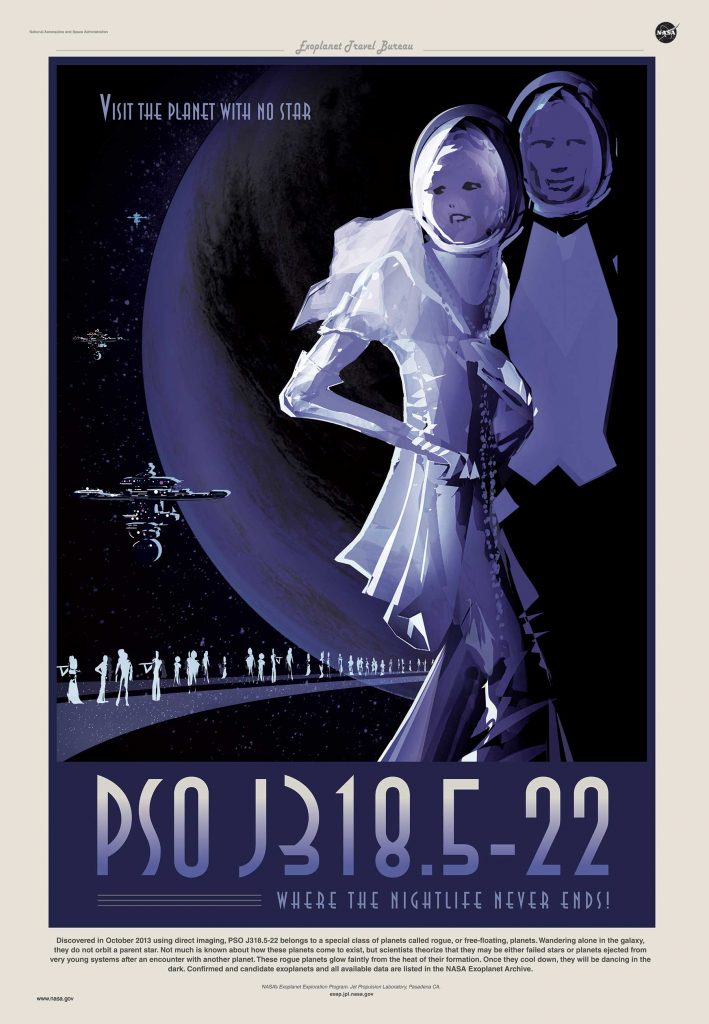
I probably wouldn’t tell them how many of us long for the spirit of their own time, which American history has labeled “the Space Age” for good reason. It had its share of awfulness, starting with the apocalyptic tensions of the Cold War, but that competition between societies did spur mankind to voyage boldly and unhesitatingly out into the great beyond, at least for a while there.

“Back in the 1930s and ’40s, during the height of the Great Depression,” writes Hyperallergic’s Allison Meier, “artists designed posters for the Works Projects Administration (WPA) to encourage travel to national parks and other tourist sites in the United States. NASA’s Jet Propulsion Laboratory (JPL) design studio is taking a similar approach to promote a future of travel to other planets at a time when its funding is up against budget constraints and even a journey to our galactic neighbor Mars may seem almost impossible.” And so we have this brand new series of fourteen Visions of the Future, free to download, print, and hang above your desk to fuel your own outer-space daydreaming.

You’ll notice that all the artists commissioned have designed their space-travel posters—whether they promote the high gravity of the “super Earth” exoplanet HD 40307g, the one-day “Historic Sites of Mars,” or the “Grand Tour” of the Solar System—in a richly retro style reminiscent of 1930s air travel advertisements. This makes them artistically captivating, but also emphasizes the continuity between our present, the century behind us, and the centuries ahead. “As you look through these images of imaginative travel destinations,” says NASA/JPL’s site, “remember that you can be an architect of the future” — and every future worthy of the name comes built solidly upon a past.
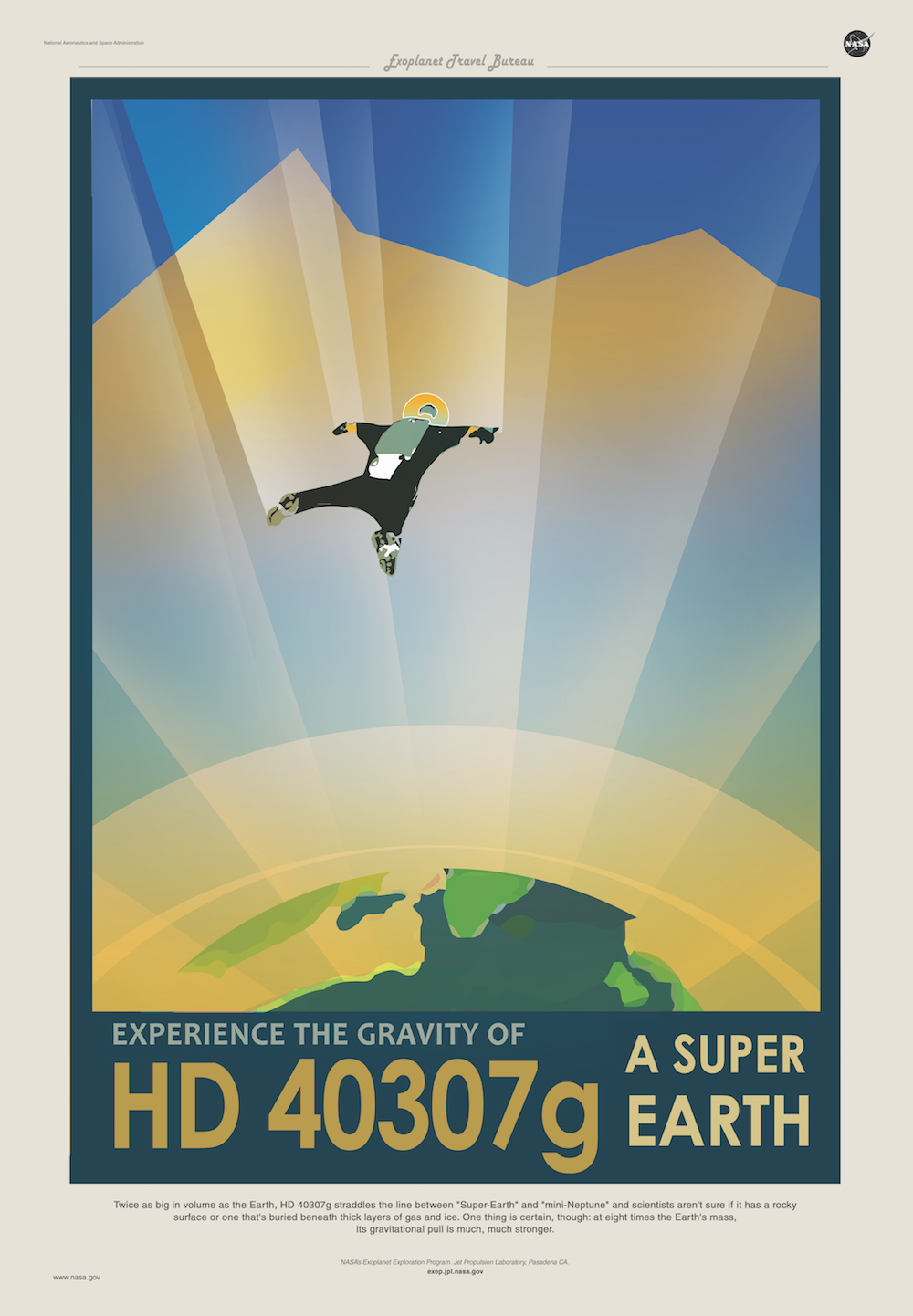
You can download the full collection of posters right here.
Related content:
How the Iconic 1968 “Earthrise” Photo Was Made: An Engrossing Visualization by NASA
NASA Archive Collects Great Time-Lapse Videos of our Planet
Ray Bradbury Reads Moving Poem on the Eve of NASA’s 1971 Mars Mission
NASA Presents “The Earth as Art” in a Free eBook and Free iPad App
NASA Sends Image of the Mona Lisa to the Moon and Back
Leonard Nimoy Narrates Short Film About NASA’s Dawn: A Voyage to the Origins of the Solar System
The Best of NASA Space Shuttle Videos (1981–2010)
Wonderfully Kitschy Propaganda Posters Champion the Chinese Space Program (1962–2003)
Based in Seoul, Colin Marshall writes and broadcasts on cities, language, and style. He’s at work on a book about Los Angeles, A Los Angeles Primer, the video series The City in Cinema, the crowdfunded journalism project Where Is the City of the Future?, and the Los Angeles Review of Books’ Korea Blog. Follow him on Twitter at @colinmarshall or on Facebook.
Read More...Paul Giamatti Plays Honoré de Balzac, Hopped Up on 50 Coffees Per Day
It’s the stuff of legend. Honoré de Balzac cranked out 50+ novels in 20 years and died at 51. The cause? Too much work and caffeine. How much coffee? Up to 50 cups per day, they say.
Whether true or not, it’s fun to imagine what that scene might have looked like. Enter Paul Giamatti, known for his roles in Sideways, American Splendor and John Adams, who gives us his comic take. This new short film comes from The New Yorker, which has just released the first season of The New Yorker Presents on Amazon.
For more on Balzac’s coffee habit, see the first two items in the Relateds below.
Related Content:
The Coffee Pot That Fueled Honoré de Balzac’s Coffee Addiction
Philosophers Drinking Coffee: The Excessive Habits of Kant, Voltaire & Kierkegaard
Read More...Summertime: Willie Nelson Sings Gershwin Is Now Streaming Free for a Limited Time
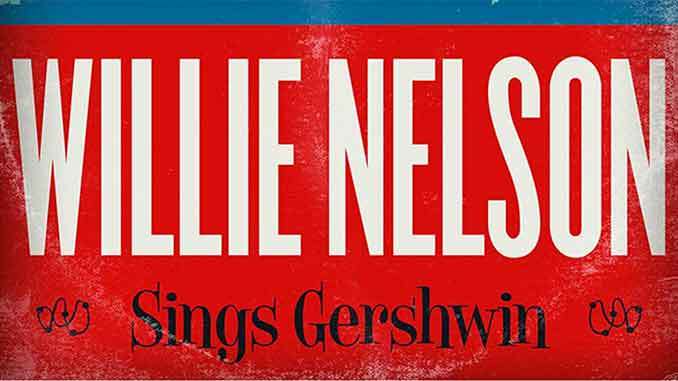
A quick fyi: You now stream for a limited time Summertime: Willie Nelson Sings Gershwin. The new album features Nelson covering 11 classic songs written by George and Ira Gershwin. And it includes duets with Cyndi Lauper and Sheryl Crow. You can stream the album (due to be officially released on February 26th) right below, or hear it over on NPR’s First Listen site. Enjoy.
If you would like to support the mission of Open Culture, consider making a donation to our site. It’s hard to rely 100% on ads, and your contributions will help us continue providing the best free cultural and educational materials to learners everywhere. You can contribute through PayPal, Patreon, and Venmo (@openculture). Thanks!
Related Content:
Willie Nelson Shows You a Delightful Card Trick
Ella Fitzgerald Sings ‘Summertime’ by George Gershwin, Berlin 1968
Bob Dylan & The Grateful Dead Rehearse Together in Summer 1987: Hear 74 Tracks
Read More...Existentialist Psychiatrist, Auschwitz Survivor Viktor Frankl Explains How to Find Meaning in Life, No Matter What Challenges You Face
Free will often seems like nothing more than a cruel illusion. We don’t get to choose the times, places, and circumstances of our birth, nor do we have much control over the state of our states, regions, or nations. Even the few who can design conditions such that they are always secure and comfortable find themselves unavoidably subject to what Buddhists call the “divine messengers” of sickness, aging, and death. Biology may not be destiny, but it is a force more powerful than many of our best intentions. And though most of us in the West have the privilege of living far away from war zones, millions across the world face extremities we can only imagine, and to which we are not immune by any stretch.
Among all of the psychiatrists, philosophers, and religious figures who have wrestled with these universal truths about the human condition, perhaps none has been put to the test quite like neurologist and psychotherapist Viktor Frankl, who survived Auschwitz, but lost his mother, father, brother, and first wife to the camps.
While imprisoned, he faced what he described as “an unrelenting struggle for daily bread and for life itself.” After his camp was liberated in 1945, Frankl published an extraordinary book about his experiences: Man’s Search for Meaning, “a strangely hopeful book,” writes Matthew Scully at First Things, “still a staple on the self-help shelves” though it is “inescapably a book about death.” The book has seen dozens of editions in dozens of languages and ranks 9th on a list of most influential books.
Frankl’s thesis echoes those of many sages, from Buddhists to Stoics to his 20th century Existentialist contemporaries: “Everything can be taken from a man but one thing: the last of the human freedoms—to choose one’s attitude in any given set of circumstances, to choose one’s own way.” Not only did he find hope and meaning in the midst of terrible suffering, but after his unimaginable loss, he “remarried, wrote another twenty-five books, founded a school of psychotherapy, built an institute bearing his name in Vienna,” and generally lived a long, happy life. How? The interview above will give you some idea. Frankl maintains that we always have some freedom of choice, “in spite of the worst conditions,” and therefore always have the ability to seek for meaning. “People are free,” says Frankl, no matter their level of oppression, and are responsible “for making someone or something out of themselves.”
Frankl’s primary achievement as a psychotherapist was to found the school of “logotherapy,” a successor to Freudian psychoanalysis and Adlerian individual psychology. Drawing on Existentialist philosophy (Frankl’s book was published in Germany with the alternate title From Concentration Camp to Existentialism)—but turning away from an obsession with the Absurd—his approach, writes his institute, “is based on three philosophical and psychological concepts… Freedom of Will, Will to Meaning, and Meaning in Life.”
You can hear how Frankl works these principles into his philosophy in the fascinating interview, as well as in the short clip above from an earlier lecture, in which he rails against a crude and ultimately unfulfilling form of meaning-making: the pursuit of wealth. Even us materialistic Americans, renowned for our greed, Frankl notes with good humor, respond to surveys in overwhelming numbers saying our greatest desire is to find meaning and purpose in life. Like no other secular voice, Frankl was confident that we could do so, in spite of life’s seeming chaos, through—as he explains above—a kind of idealism that brings us closer to reality.
Note: You can download Frankl’s major book, “Man’s Search for Meaning,” as a free audio book if you join Audible’s 30-Day Free Trial program. Find details on that here.
Related Content:
Josh Jones is a writer and musician based in Durham, NC. Follow him at @jdmagness
Read More...27 Movies References in The Simpsons Put Side-by-Side with the Movie Scenes They Paid Tribute To
If an entire generation of American adults suffers from Cinematic Chicken Vs. Egg Syndrome, it’s The Simpsons’ fault.
Editor Celia Gómez’ side-by-side shot comparison above makes plain how a 30-year-old Citizen Kane virgin could experience a sense of deja vu on his or her inaugural viewing. The Simpsons pulled from it for “Two Cars in Every Garage and Three Eyes on Every Fish” when said viewer was but a little tot. Three years later, they did it again wit 1993’s “Rosebud.”
Parents who would never have allowed their sensitive little darlings in the room while screening Full Metal Jacket or Requiem for a Dream relaxed their vigilance where the family from Springfield was concerned.
When The Simpsons’ kilted Groundskeeper Willie chastely recrosses his legs in an interrogation room, no kid is going to fixate on what lies beneath. (FYI, it’s a notoriously commando Sharon Stone in 1992’s NSFW thriller, Basic Instinct.)
What makes these homages so great is the attention to detail. Be it Itchy and Scratchy or Michael Madsen and Kirk Baltz as his cop victim in Reservoir Dogs, count on the camera to drift to an empty doorway when the action gets too intense.
Spoilers abound. Those who’ve not yet seen Thelma and Louise, Psycho, or One Flew Over the Cuckoo’s Nest can consider themselves forewarned.
Want a crash course in The Godfather? Watch the Simpsons.
No offense to the human actors who originated the roles, but it’s incredible how the animators can imbue their characters with all the relevant emotions. Their eyes are little more than dots on pingpong balls! (Check out Homer’s dead expression on 1994’s Terminator 2 parody, “Homer Loves Flanders.”)
The complete list of films featured above:
Bram Stoker’s Dracula (1992)
A Clockwork Orange (1971)
Pulp Fiction (1994)
Requiem for a dream (2000)
The Gold Rush (1925)
Full Metal Jacket (1987)
The Fugitive (1993)
Terminator 2 (1991)
Reservoir Dogs (1992)
The Birds (1963)
Risky Business (1983)
Citizen Kane (1941)
Psycho (1960)
The silence of the lambs (1991)
Raiders of the Lost Ark (1981)
Basic Instinct (1992)
Official and Gentleman (1982)
One flew over the cuckoo’s nest (1975)
2001: A space Odissey (1968)
Trainspotting (1996)
Thelma and Louise (1991)
The Godfather (1972)
Taxi Driver (1976)
The Shining (1980)
Spiderman (2002)
ET the Extra-Terrestrial (1982)
Dr. Strange Love (1964)
Related Content:
The Simpsons Pay Wonderful Tribute to the Anime of Hayao Miyazaki
Ayun Halliday is an author, illustrator, and Chief Primatologist of the East Village Inky zine. Follow her @AyunHalliday
Read More...Crash Course Philosophy: Hank Green’s Fast-Paced Introduction to Philosophy Gets Underway on YouTube
Vlogbrothers and “Nerdfighter” online personalities Hank and John Green set about conquering the world of educational media a few years ago—while also writing bestselling novels, recording popular albums, and creating startups and charitable organizations on the side. They’ve almost succeeded, with their “Crash Course” video series steamrolling its way through U.S. History, World History, and the History of Everything Else, as well as Psychology, Literature, the Sciences, and, now, Philosophy, just above, with Hank taking on the professorial duties. “It’s gonna be hard,” he says in the intro video above, “and enlightening, and frustrating, and if I do my job properly it’s going to stick with you long after you and I have parted ways.”
Hank begins where we generally do, in ancient Greece, and introduces the three main branches of philosophy: metaphysics, epistemology, and ethics. Next up, in episode two above, he dives into logic and argumentation, subjects dear to the heart of an internet-based educator, whose audience is quite familiar with the contentious online commentariat. Hank’s style, like his brother’s, is hip, fast-paced, and full of witty editorial asides, enhanced by clever editing, pop-culture references, and animated visual aids. In short, he’s exactly what you wish your college professors were like in the classroom.
Is taking one of the Green’s “crash courses” the equivalent of a college intro course? I guess it would depend on the college, the class, and the instructor. Your mileage may vary with any educational experience, and everyone has their own way of learning. If you’re comfortable having information delivered at the speed of advertising—which I do not mean as an insult, but as an accurate description of their pacing—then you may find that the Green’s methods work perfectly well. If you need to mull things over, take careful notes, hear in-depth explanations, etc., you may consider these videos as fun ways to get your feet wet. Then when you’re ready to dive in, consider taking one of the many free online philosophy courses we feature on the site, and supplementing with podcasts, free eBooks, and other resources.
If you follow this playlist, you can find more Crash Course Philosophy videos as they become available.
Related Content:
Download 100 Free Online Philosophy Courses & Start Living the Examined Life
Learn The History of Philosophy in 197 Podcasts (With More to Come)
Josh Jones is a writer and musician based in Durham, NC. Follow him at @jdmagness
Read More...New Digital Archive, “Richard Pryor’s Peoria,” Takes You Inside the Dark, Lively World That Shaped the Pioneering Comedian
By Scott Saul:
Richard Pryor is a legendary comic, and for good reason. He had extraordinary gifts as a mimic, storyteller, physical comedian, satirist, and improvising actor — gifts he brought together in an act that had the dangerous electricity of an uninsulated wire. Meanwhile he established a feedback loop between his act and his personal life, making use of all those stage chops to draw comedy out of a life that was painfully full of self-sabotage, mayhem, and various forms of abuse.
It was my task, as Pryor’s biographer, to probe the legends of his life, starting with the vivid stories he told of his formative years in the red-light district of Peoria, Illinois. In his stage act and reminiscences, Pryor related how he’d been raised in a brothel by a grandmother and father who worked, respectively, as madam and pimp, and how he had both suffered at their hands and learned from them. He told, too, how he’d made his way in a larger world that, while brutal, was also touched with grace — that grace he felt when he ventured onstage, at school or in a club, and started to find himself as a performer.

Earlier biographers had wondered how much Pryor had embellished his past in building his act around his life story. In my research I discovered a motherlode of material — family photos, court records, newspaper articles, and more — that not only corroborated the outlines of Pryor’s story but also filled in the picture and gave it a historical depth. I could see, for instance, how Pryor’s taboo-busting comedy was rooted in his childhood environment, a black working-class underground where taboos were busted on a regular basis, and hypocrisies called to account. You can watch a short, four-minute film above that sets the story of the young Richard and his family against the backdrop of “Roarin’ Peoria.”
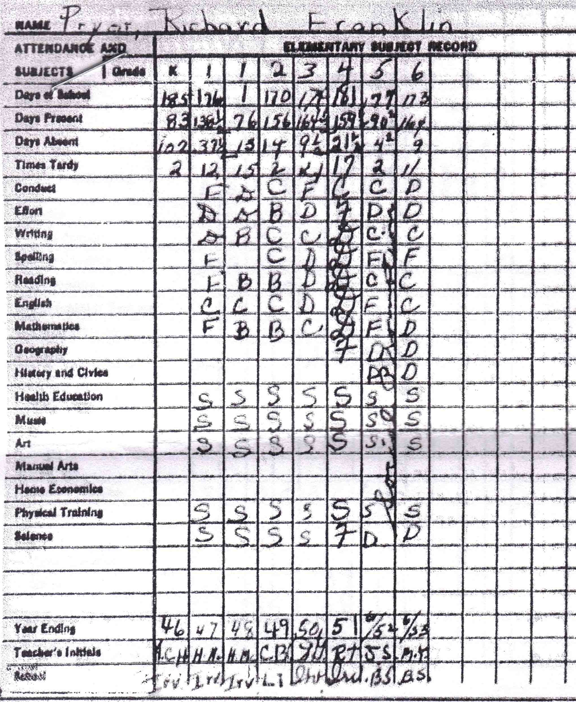
Ultimately, I discovered so much in my research into Pryor’s formative years that I felt it couldn’t be contained in the book I was writing (in which Pryor’s first two decades in Peoria make up only one of five sections). So I built a digital companion where you can explore over 200 documents from “Richard Pryor’s Peoria”. Here you can see, through the young Richard’s report card, how he struggled in the confines of Peoria schools. You can see, through the divorce case of his parents, how his mother (contrary to reports that she abandoned him) tried, unsuccessfully, to steal Richard away from his grandmother and father, and from the red-light district itself. You can see, through the paper trail of Richard’s formidable grandmother Marie, how she fought — with wiliness and blunt force — against her abusive husband and against the system of Jim Crow. And you can visit the various scenes of Richard’s youth, from his family’s tavern and the community center where he first took the stage to the sometimes raucous, sometimes stylish clubs where he got his start as an entertainer.
Richard Pryor was an exceptional human being — a genius who changed the rules of comedy in America — and the website aims to show how the seeds of that genius were planted. At the same time, it suggests how Pryor’s life story makes richer sense when set against larger historical backdrops: the story of how the Midwest’s premier “Sin City” became, during the Cold War, a leading “All-American City”; the story of how black neighborhoods were demolished in “urban renewal” efforts (Pryor’s childhood home was itself targeted by a wrecking ball so that Peoria might be linked to an interstate highway); and, most of all, the story of how black Americans, while locked into segregation in the Midwest, defied that system in inventive and forceful ways.
This post is by Scott Saul, the author of Becoming Richard Pryor (HarperCollins), now out in paperback. He teaches American history and literature at UC-Berkeley, and also is the host of the Chapter & Verse podcast. Follow him on Twitter @scottsaul4.
Read More...In Japanese Schools, Lunch Is As Much About Learning As It’s About Eating
I grew up in the United States, and we Americans don’t, in the main, look back on our school days with particularly fond memories of lunch. Some schools do a superb job of serving up delicious and nutritious meals. Others can barely get their act together to reheat yesterday’s chicken fingers, and, as with much else in America, it all averages out to a frustrating mediocrity. These days, the culinary standards of American school lunches often come in for punishing comparisons in the media to those of other societies, especially France, which has long held up eating well as one of its highest priorities, and Japan, known for its attention to detail as well as the health of its people.
Just have a look at the nine-minute documentary above on one lunch period at an elementary school in Saitama (about fifteen miles outside Tokyo) and you’ll have a vivid sense of the difference — a difference that goes well beyond what gets eaten. At 12:25 in the afternoon, the kids all bow and thank their teacher for the first half of the day’s instruction. Then they put on their caps and smocks and lay their placemats and chopsticks on their desks. A rotating team of students goes to collect everyone’s meals from the kitchen (thanking the lunchladies before wheeling their carts away) while the rest arrange the furniture into the standard lunch formation. Back in the classroom, the students serve each other the day’s fried fish with pear sauce, five-vegetable soup, and mashed potatoes grown on the school’s own farm by students.
But wait, there’s more: the kids all brush their teeth after lunch, then break down their milk cartons, wash them, and set them aside to dry before placing them in the next day’s recycling. The video then shows how, after lunch, they all clean their classroom together. Lunch becomes an opportunity not just to eat healthy food, but to teach students a number of valuable life lessons–good manners, ethics, teamwork and more.
I couldn’t have imagined any of this happening in my own fifth-grade classroom, and if you couldn’t have either, you can read more about how the phenomenon of the Japanese school lunch came to be at Japanese School Lunch, the site of Japan scholar Alexis Agliano Sanborn. She delves into the history, the goals, the mechanics (right down to seasonal menu planning), and the successes of Japan’s school lunch system. “Perhaps no other country in the world can offer school lunch cookbooks, school lunch-themed restaurants or even school lunch-themed paraphernalia,” she writes. Certainly not the one I came from!
(via Twisted Sifter)
Related Comment:
Discover Japan’s Earthquake Proof Underground Bike Storage System: The Future is Now
Cookpad, the Largest Recipe Site in Japan, Launches New Site in English
What Prisoners Ate at Alcatraz in 1946: A Vintage Prison Menu
Based in Seoul, Colin Marshall writes and broadcasts on cities, language, and style. He’s at work on a book about Los Angeles, A Los Angeles Primer, the video series The City in Cinema, the crowdfunded journalism project Where Is the City of the Future?, and the Los Angeles Review of Books’ Korea Blog. Follow him on Twitter at @colinmarshall or on Facebook.
Read More...Support Us
We're hoping to rely on loyal readers, rather than erratic ads. Please click the Donate button and support Open Culture. You can use Paypal, Venmo, Patreon, even Crypto! We thank you!

About Us

Open Culture scours the web for the best educational media. We find the free courses and audio books you need, the language lessons & educational videos you want, and plenty of enlightenment in between.
Advertise With Us

FREE UPDATES!
GET OUR DAILY EMAIL
Get the best cultural and educational resources on the web curated for you in a daily email. We never spam. Unsubscribe at any time.
FOLLOW ON SOCIAL MEDIA

Open Culture editor Dan Colman scours the web for the best educational media. He finds the free courses and audio books you need, the language lessons & movies you want, and plenty of enlightenment in between.
Advertise With Us

