Download Hundreds of 19th-Century Japanese Woodblock Prints by Masters of the Tradition
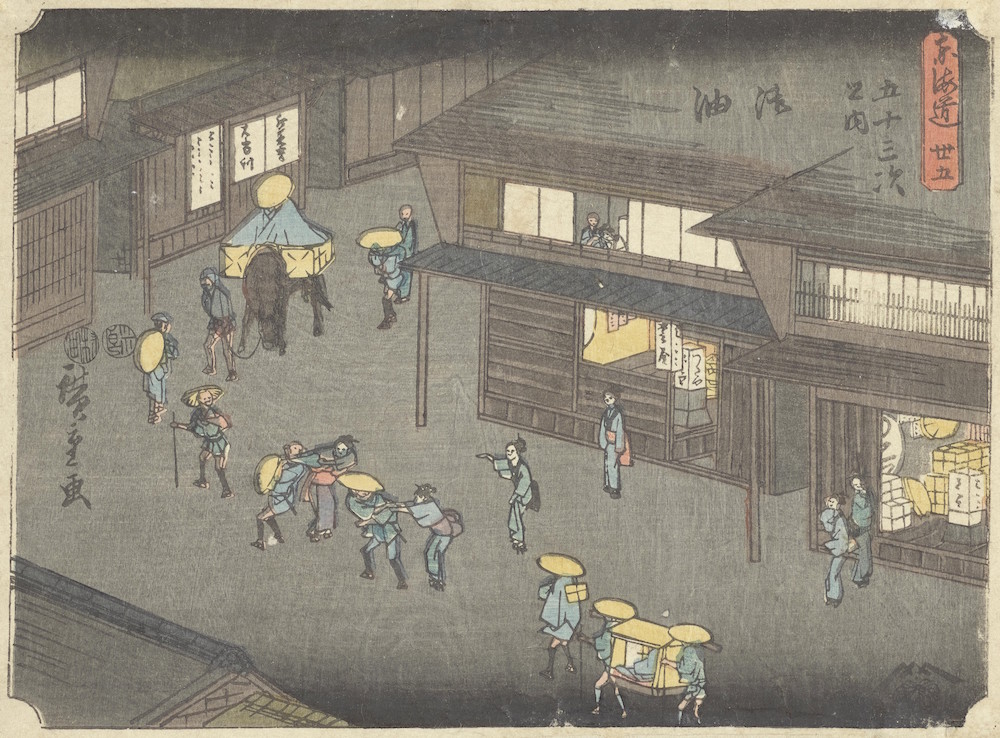
We recently featured hundreds of Van Gogh’s paintings, sketches, and letters downloadable from Amsterdam’s Van Gogh Museum. But despite its name, that respected institution hasn’t devoted itself entirely to the work of the 19th-century post-impressionist painter; they’ve also got a serious stock of art from roughly the same period but the other side of the world in the form of Japanese woodblock prints. And like their Van Gogh materials, they’ve made them available to all of us in high resolution files, free for the downloading in their online collections.
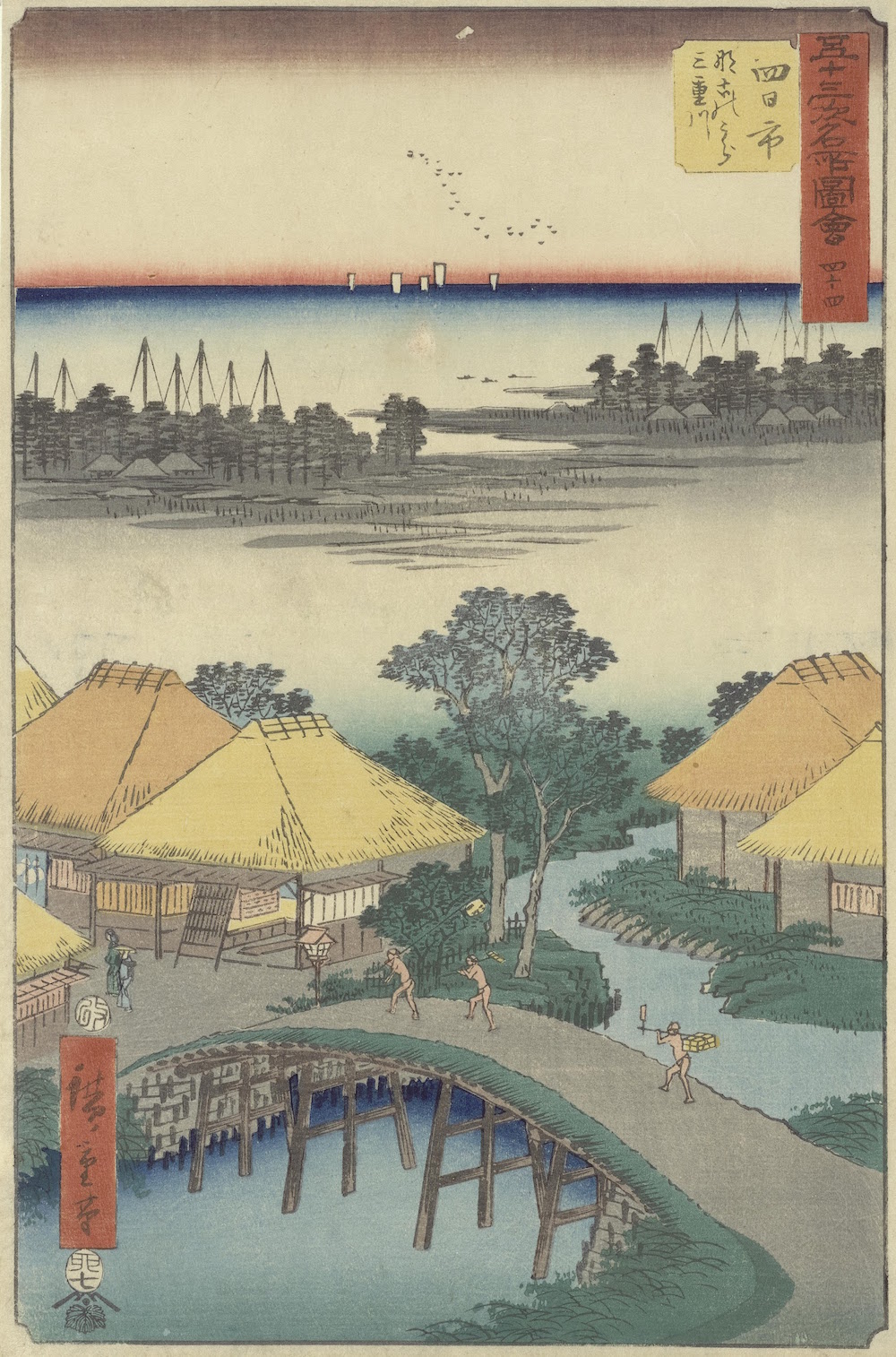
All of us will recognize this style of Japanese art, but not all of us will know its Japanese name: ukiyo‑e, or “pictures of the floating world” — that is, the world of scenic travels through striking landscapes as well as urban beauties, sportsmen, actors, and ladies of the night that bloomed from the 17th to the 19th centuries.
Not only did that heady period of Japanese history provide these woodblock prints their subjects, it also provided the technology used to produce them with increasing color and complexity as well as a merchant-class audience to purchase them as home decor.
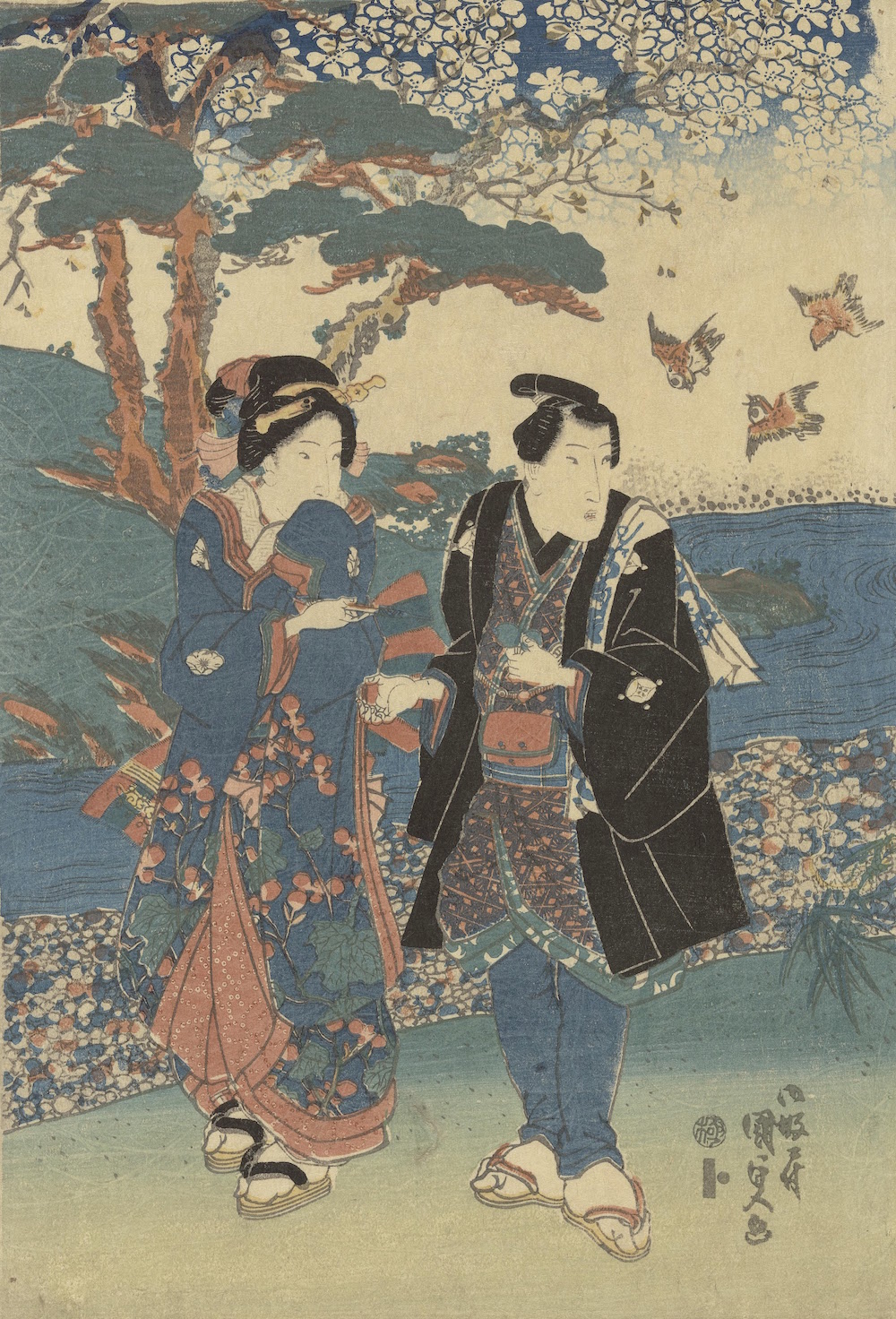
The Van Gogh Museum’s selections come from a time of dominance by a few still-acknowledged ukiyo‑e masters whose names you’ll know, like Katsushika Hokusai and Utagawa (also known as Ando) Hiroshige, the latter of whose work the online collection has 83 pieces currently downloadable. One of them, Goyu from one series of illustrations of notable places and Yokkaichi: The Miegawa River and Nago Bay from another, appear at the top and second from the top. But the Van Gogh Museum has amassed even more work by Utagawa Kunisada, the most prolific and bestselling ukiyo‑e artist of the day, whose On the Riverbank, one sheet of a triptych, we have just above.
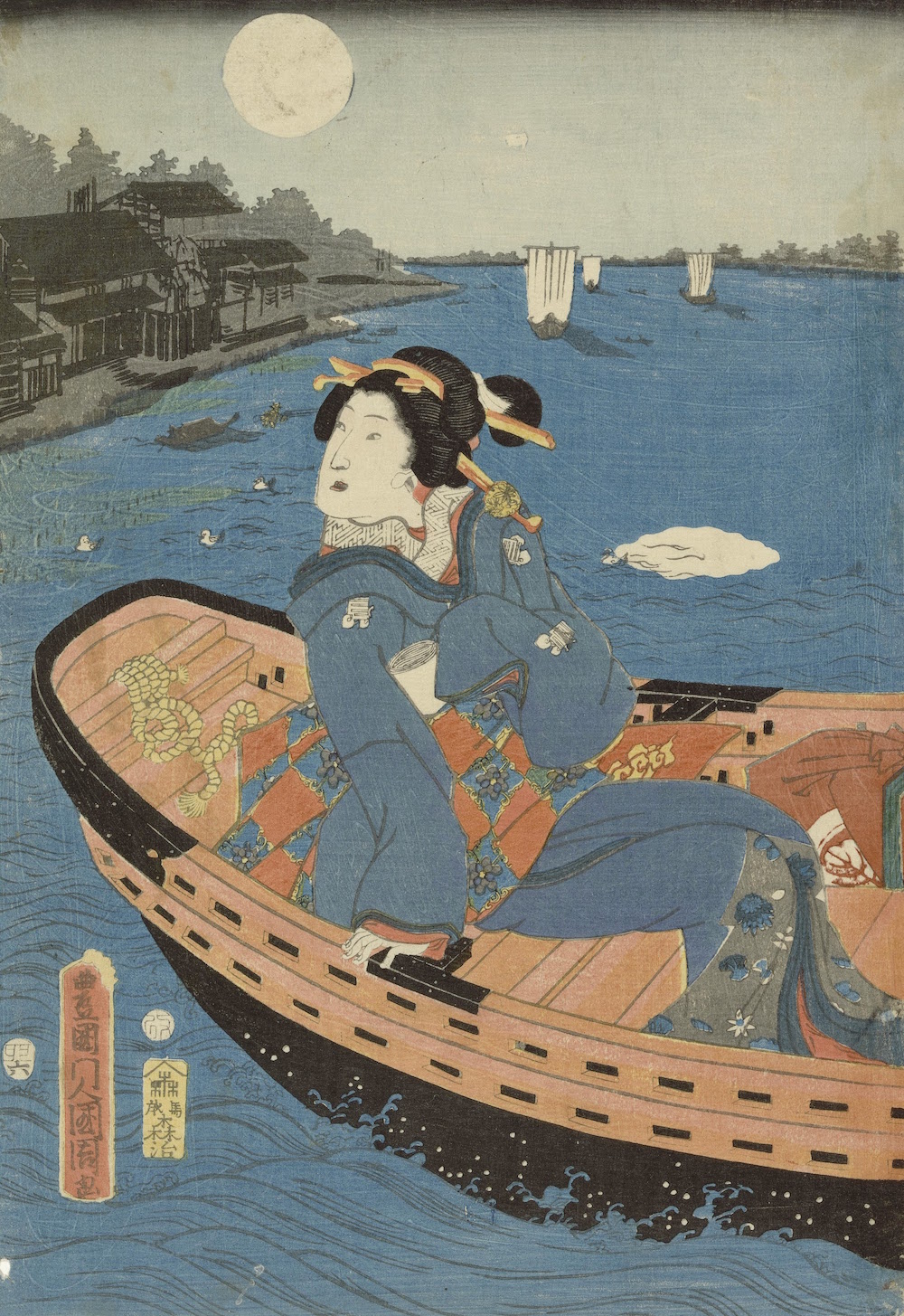
You can download any of the more than 500 pieces in the online collection by these and dozens of other ukiyo‑e artists (such as Toyohara Kunichika, whose Illustration of Crossing the Sumida River in the Evening appears just above) by clicking on the down arrow that appears in the lower right when you view an individual image. Having just returned from a trip to Japan a couple weeks ago, I can report that the country has changed dramatically and in many ways from the one Hokusai, Hiroshige, Kunisada and their colleagues captured, but still, some durable part of their aesthetic essence remains. Besides, these prints must even at the time have had something of the elegiac about them, itself an enduring quality of Japanese art. “Even in Kyoto,” as the poet Matsuo Masho wrote two centuries before that, “I long for Kyoto.”
Related Content:
Hayao Miyazaki’s Beloved Characters Reimagined in the Style of 19th-Century Woodblock Prints
Download Hundreds of Van Gogh Paintings, Sketches & Letters in High Resolution
Based in Seoul, Colin Marshall writes and broadcasts on cities, language, and style. He’s at work on a book about Los Angeles, A Los Angeles Primer, the video series The City in Cinema, the crowdfunded journalism project Where Is the City of the Future?, and the Los Angeles Review of Books’ Korea Blog. Follow him on Twitter at @colinmarshall or on Facebook.
Read More...The 120 Minutes Archive Compiles Clips & Playlists from 956 Episodes of MTV’s Alternative Music Show (1986–2013)
In the first couple years after MTV’s 1981 debut, the fledgling cable network more or less reproduced the 70’s album-oriented rock radio format with video accompaniment, to the exclusion of a number of emerging popular artists (a fact David Bowie bemoaned in ’83). In the mid-80s, the network diversified: Michael Jackson’s “Billie Jean” broke the color barrier in 1984, and in the following years, the network moved toward edgier music with shows like Headbanger’s Ball in ’85 (originally Heavy Metal Mania) and, a few years later, Yo! MTV Raps.
In 1986, another show appeared that solidified MTV’s status—for a few years at least—as a genuine source for new, “alternative” music, before that term became an empty marketing word. Tucked away in a midnight to 2 A.M. slot, 120 Minutes initially “guided viewers through the late ‘80s college rock landscape, which was largely inspired by trends happening in the UK at the time.”
So writes Tyler at Tylerc.com, who hosts the hugely impressive 120 Minutes Archive, a recreation of the 27-year run of the two-hour music video, news, and interview show that broke many an “alternative” artist in the U.S. and gave many more a platform to promote their music, causes, and personalities. Enter the archive here.
I well remember staying up late, the volume turned down as low as possible so as not to wake the family, and catching videos for the Pixies’ “Here Comes Your Man” (above) and R.E.M.’s “It’s the End of the World (As We Know It),” among so many other bands art-pop, new wave, post-punk, industrial, etc. The show was like a video analogue to Trouser Press—and browsing the online database of that “’bible’ of alternative rock” will give you a good sense of 120 Minutes’ breadth. Though it featured a very healthy mix of hardcore, electronic, and new wave music from both sides of the pond, the show often seemed to be dominated by British bands like the Cure (whose Robert Smith once guest hosted), Depeche Mode, the Psychedelic Furs, and (second from top) Big Audio Dynamite, Mick Jones’ post-Clash project, which Lou Reed discusses briefly in the clip at the top from his 1986 stint as a guest host. (See several more clips of his hosting here.)
In the 90s, 120 Minutes became a showcase for much more homegrown product as the “blender of post-punk, goth, industrial, and jangle-rock gave way… to a coalesced grunge movement” after the seismic debut of Nirvana’s “Smells Like Teen Spirit” in 1991, with the likes of Mudhoney, Soundgarden, the Dandy Warhols, and the Smashing Pumpkins taking over for much of the British new wave. Those who came of age in the 90s will remember the show’s host Matt Pinfield’s obsessive, rock critic’s approach to “the rise and fall of alternative rock.” Soon, the show became a heavily eclectic mix: Brit pop arrived (along with the baggy Madchester of the Happy Mondays, Stone Roses, etc.), and “post-grunge bands, left of center singer-songwriters, west coast ska-inspired bands, and alternative hip hop acts” joined the playlist.
The mid-nineties seem like golden years in retrospect. Flush with cash, record companies threw money at anything vaguely Nirvana-shaped, which enabled a number of excellent bands and artists to break out of their local scenes and into larger studios and stages like the traveling circus of Lollapalooza. (The situation also produced a drag of derivative, dumbed-down awfulness.) Scroll through the playlists Tyler C has compiled for 1994, for example, a year I fondly, mostly, remember, to get a sense of the range of artists and genres the show embraced by this time—from the hammering industrial-metal of Ministry (above) to the hazy, ethereal psych-folk of Mazzy Star (below). Post-Nirvana “alternative rock” went so mainstream that the network eventually ran a companion show every weeknight called Alternative Nation, so named despite the fact that “alternative” came to mean precisely the opposite of the outsider status it had once described.
The boom times couldn’t last. As the millennium waned, so did the heyday of alt-rock music videos. Reality TV and bubblegum pop took over. “In the era of TRL,” writes Tyler C, “the future of 120 Minutes on MTV was uncertain.” As MTV relegated music videos—once its raison d’etre—to the margins, 120 Minutes became MTV’s “de facto rock show,” then moved to MTV 2, then off the air altogether in 2003 after a 17-year run. Then, as indie rock ascended to popularity, the show was revived for a 2003–2011 run as Subterranean and again as 120 Minutes until 2013.
Though Tyler C’s exhaustive archive contains few actual clips from the show, it does document 120 Minutes’ entire history, from its underground late 80s inception, through the mainstream 90s, and into the subdued 2000’s, with playlists from each episode and, writes Buzzfeed, “histories of what bands played, descriptions of tours the show appeared on, and anecdotes where possible.” You can watch full episodes of the show’s last couple years with Matt Pinfield on MTV Hive (Many, like this one, broadcast from New York’s Cake Shop).
The archive, Tyler told Buzzfeed, resonates with Gen X’ers because “it’s all about nostalgia”—and I can certainly testify to that effect—and appeals to younger people “because that era of music in the ’90s was so important. It was the age of EVERYTHING alternative.” For those of us who lived through the decade, and who aged out of MTV’s demographic around the time that Tyler aged in, it’s also an opportunity to catch up with later seasons of the show we probably missed. They may be as essential someday—in their own way—as the ones we so wistfully recall.
Related Content:
The First Live Performance of Nirvana’s “Smells Like Teen Spirit” (1991)
Jim Jarmusch’s Anti-MTV Music Videos for Talking Heads, Neil Young, Tom Waits & Big Audio Dynamite
The First 10 Videos Played on MTV: Rewind the Videotape to August 1, 1981
Josh Jones is a writer and musician based in Durham, NC. Follow him at @jdmagness
Read More...Download Two Harry Potter Audio Books for Free (and Get the Rest of the Series for Cheap)
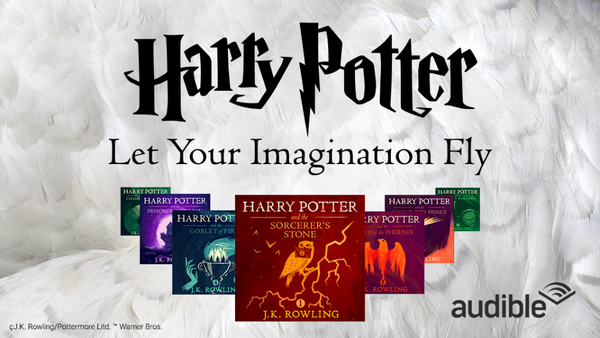
FYI: If you’re looking to download the Harry Potter series as audio books, here’s a way to get two books in the series for free, and the rest at a steep discount.
In recent months, Audible (the audio books company owned by Amazon) began making Harry Potter books available for download. Now here’s what you need to know: If you sign up for Audible’s 30-Day Free Trial Program, you can download two audio books for free, including two books from the Harry Potter series. Then, once the free trial is over, you can decide whether you want to become an ongoing Audible subscriber or not. Regardless of what decision you make, you can keep the two free audio books.
If you remain an Audible subscriber (like I have), you can download additional books at a rate of $14.95 each. That means you can get the remaining 5 books in the Harry Potter series for $74.75 in total—which is significantly cheaper than paying $242.94, the price that Pottermore currently charges for the set.
To get started, you can go to this page, sign up for Audible’s 30-Day Free Trial Program, and then download your first two Harry Potter books for free.
NB: Audible is an Amazon.com subsidiary, and we’re a member of their affiliate program.
Related Content:
1,000 Free Audio Books: Download Great Books for Free
Download a Free Course from “The Great Courses” Through Audible.com’s Free Trial Program
How J.K. Rowling Plotted Harry Potter with a Hand-Drawn Spreadsheet
J.K. Rowling Tells Harvard Grads Why Success Begins with Failure
Twilight Series: How to Get Free Audio Books
Free Audio: Download the Complete Chronicles of Narnia by C.S. Lewis
Read More...What Gravitational Waves Sound Like: New Audio of Black Holes Colliding Confirms Predictions Einstein Made 100 Years Ago
On Thursday, scientists announced that they had recorded the sound of two black holes colliding a billion light years away, providing the first real proof that gravitational waves actually exist–something Albert Einstein predicted 100 years ago in his famous paper on general relativity. If you would like an introduction to the whole concept of gravitational waves, I’d recommend watching the animation below, created by PhD Comics–the same folks who created a handy animation explaining the Higgs Boson when it was confirmed back in 2012.
But, for the moment, I’d really like you to listen to the “Gravitational Wave Chirp,” the audio recording unveiled by scientists this week. (Hear it up top.) As The New York Times describes it, the chirp rises to “the note of middle C before abruptly stopping,” And it’s likely to “take its place among the great sound bites of science,” ranking up there with Alexander Graham Bell’s “Mr. Watson — come here” and Sputnik’s first beeps from orbit.” Decades from now, you can tell your grandkids you heard it here first.
Related Content:
The Higgs Boson, AKA the God Particle, Explained with Animation
Free Online Physics Courses, part of our larger collection, 1,700 Free Online Courses from Top Universities
Gravity Visualized by High School Teacher in an Amazingly Elegant & Simple Way
Read More...Music in the Brain: Scientists Finally Reveal the Parts of Our Brain That Are Dedicated to Music
The late neurologist and writer Oliver Sacks had a big hit back in 2007 with his book Musicophilia: Tales of Music and the Brain, addressing as it did from Sacks’ unquenchably brain- and music-curious perspective a connection almost all of us feel instinctively. We know we love music, and we know that love must have something to do with how our brains work, but for most of human history we haven’t had many credible explanations for what’s going on. But science has discovered more about the relationship between music and the brain, and we’ve posted about some of those fascinating discoveries as they come out. (Have a look at all the related posts below.)
But now, a study from MIT’s McGovern Institute for Brain Research has revealed exactly which parts of our brains respond specifically to music. They’ve put out a brief video of this research, which you can watch above, explaining their process, which involved putting subjects into an MRI and playing them various sounds, then studying how their brains responded differently to music than to, say, the spoken word or a flushing toilet. Not looking to test any hypothesis in particular, the research team found “striking selectivity” in which regions of the brain lit up, in their specially designed analytical model, in response to music.
“Why do we have music?” asks the McGovern Institute’s Dr. Nancy Kanwisher in a New York Times article on the research by Natalie Angier. “Why do we enjoy it so much and want to dance when we hear it? How early in development can we see this sensitivity to music, and is it tunable with experience? These are the really cool first-order questions we can begin to address.” The piece also quotes Josef Rauschecker, director of the Laboratory of Integrative Neuroscience and Cognition at Georgetown University, citing “theories that music is older than speech or language,” and that “some even argue that speech evolved from music,” which “works as a group cohesive. Music-making with other people in your tribe is a very ancient, human thing to do.” Which all, of course, goes to support the bold hypothesis put forth by the late Tower Records: No Music, No Life.
Related Content:
The Neuroscience of Bass: New Study Explains Why Bass Instruments Are Fundamental to Music
The Neuroscience of Drumming: Researchers Discover the Secrets of Drumming & The Human Brain
Playing an Instrument Is a Great Workout For Your Brain: New Animation Explains Why
New Research Shows How Music Lessons During Childhood Benefit the Brain for a Lifetime
Why We Love Repetition in Music: Explained in a New TED-Ed Animation
This is Your Brain on Jazz Improvisation: The Neuroscience of Creativity
Free Online Psychology & Neuroscience Courses
Based in Seoul, Colin Marshall writes and broadcasts on cities, language, and style. He’s at work on a book about Los Angeles, A Los Angeles Primer, the video series The City in Cinema, the crowdfunded journalism project Where Is the City of the Future?, and the Los Angeles Review of Books’ Korea Blog. Follow him on Twitter at @colinmarshall or on Facebook.
Read More...LIFE Magazine’s Guide to Kissing, Circa 1942
Life Magazine’s Guide to Kissing, ca. 1942. pic.twitter.com/II5ruDEFbe
— History in Moments (@historyinmoment) November 11, 2015
Once upon a time, in the middle of World War II, there was a right way to do it. And a wrong way to do it. Are there rules in 2016? And what would they look like? That’s your homework assignment for this Valentine’s Day weekend.
Related Content:
Brokeback Before Brokeback: The First Same-Sex Kiss in Cinema (1927)
The Story Behind Rodin’s ‘The Kiss’
Three “Anti-Films” by Andy Warhol: Sleep, Eat & Kiss
Read More...Celebrate Valentine’s Day with a Charming Stop Motion Animation of an E.E. Cummings’ Love Poem
Valentine’s Day draws nigh, and we can only assume our readers are desperately wondering how to declaim love poetry without looking like a total prat.
Set it to music?
Go for it, but let’s not forget the fate of that soulful young fellow on the stairs of Animal House when his sweet airs fell upon the ears of John Belushi.
Sarah Huff, a young and relentlessly crafty blogger, hit upon a much better solution when animating E.E. Cummings’ 1952 poem [i carry your heart with me(i carry it in] for an American Literature class’ final project at Sinclair Community College.
Her construction paper cutouts are charming, but what really makes her rendering sing is the way she takes the pressure off by setting it to an entirely different love song. (Echoes of Cummings’ goat-footed balloon man in Terra Schneider’s Balloon (a.k.a. The Beginning)?)
Released from the potential perils of a too sonorous interpretation, the poet’s lines gambol playfully throughout the proceedings, spelled out in utilitarian alphabet stickers.
It’s pretty puddle-wonderful.
Watch it with your Valentine, and leave the read aloud to the punctuation-averse Cummings, below.
[i carry your heart with me(i carry it in]
i carry your heart with me(i carry it in
my heart)i am never without it(anywhere
i go you go,my dear;and whatever is done
by only me is your doing,my darling)
i fear
no fate(for you are my fate,my sweet)i want
no world(for beautiful you are my world,my true)
and it’s you are whatever a moon has always meant
and whatever a sun will always sing is you
here is the deepest secret nobody knows
(here is the root of the root and the bud of the bud
and the sky of the sky of a tree called life;which grows
higher than soul can hope or mind can hide)
and this is the wonder that’s keeping the stars apart
i carry your heart(i carry it in my heart
Related Content:
E.E. Cummings Recites ‘Anyone Lived in a Pretty How Town,’ 1953
The Mystical Poetry of Rumi Read By Tilda Swinton, Madonna, Robert Bly & Coleman Barks
Read More...This is Your Brain in Love: The Stanford Love Competition Shows What Love Looks Like on an MRI
We hear it so often it’s almost a cliché, one I’m sure I’ve repeated without giving it much thought: You can’t measure love in a laboratory. But we probably can, in fact. Or at least neuroscientists can. Last year, one joint Chinese and American team of neuroscientists did just that, defining the feeling we call love as “a motivational state associated with a desire to enter or maintain a close relationship with a specific other person.” This doesn’t cover the love of pets, food, or sunsets, but it gets at what we celebrate with candy and red tchotchkes every year around this time, as well as the love we have for friends or family.
Using fMRI scans of three groups of 100 men and women, the researchers found that an “in-love group had more increased activity across several brain regions involved in reward, motivation, emotion, and social functioning,” reports Medical Daily. The longer people had been “in love,” the greater the brain activity in these regions. Whether the brain states cause the emotion, or the emotion causes the brain states, or they are one in the same, I can’t say, but the fact remains: love can be quantifiably measured.
Meanwhile, Brent Hoff separately decided to exploit this fact for what he calls a “Love Competition.” With the help of Stanford’s Center for Cognitive Neurobiological Imaging (CNI), Hoff enlisted seven contestants of varying ages—from 10 to 75—and genders to enter an fMRI machine and “love someone as hard as they can” for five minutes. Whoever generates the most activity in regions “producing the neurochemical experience of love” wins. Gives you the warm fuzzies, right?
While “the idea that love can be measured may seem deeply unromantic,” writes Aeon magazine, “the results were anything but.” The contestants were not restricted to romantic love. Ten-year-old Milo gives his love to a new baby cousin, because “she’s very cute.” Dr. Bob Dougherty of CNI predicts early on that an “older guy” like himself might win because experience would better help him control the emotion. But at the beginning, it’s anyone’s game. Watch the competition above and find out who wins.
Given that this is billed as the “1st Annual Love Competition,” might we expect another this year?
Related Content:
What is Love? BBC Philosophy Animations Feature Sartre, Freud, Aristophanes, Dawkins & More
This Is Your Brain on Jane Austen: The Neuroscience of Reading Great Literature
Steven Pinker Explains the Neuroscience of Swearing (NSFW)
Josh Jones is a writer and musician based in Durham, NC. Follow him at @jdmagness
Read More...Hear Gabriel García Márquez’s Extraordinary Nobel Prize Acceptance Speech, “The Solitude Of Latin America,” in English & Spanish (1982)
From the very beginning of Europe’s incursions into the so-called New World, the ecology, the people, and the civilizations of the Americas became transmuted into legend and fantasy. Early explorers imagined the landscape they encountered as filled with marvels—creatures that arose from their own unconscious and from a literary history of exotic myths dating back to antiquity. And as the native people assumed the character of giants and monsters, savages and demons in travel accounts, their cities became repositories of unimaginable wealth, ripe for the taking.
Foremost among these legends was the city of El Dorado. Sought by the Spanish, Italians, and Portuguese throughout the 15th and 16th centuries and by Walter Raleigh in the 17th, “El Dorado,” says folklorist Jim Griffith, “shifted geographical locations until finally it simply meant a source of untold riches somewhere in the Americas.” A couple hundred years after Raleigh’s last ill-fated expedition, Edgar Allan Poe suggested the location of this city: “Over the Mountains of the Moon, down the Valley of the Shadow, ride, boldly ride… if you seek for El Dorado.”
These colonial encounters, and the feverish accounts they produced, “contained the seeds,” says Gabriel García Márquez in his 1982 Nobel Prize acceptance speech, “of our present-day novels.” El Dorado, “our so avidly sought and illusory land,” remained on imaginary maps of explorers well past the age of exploration: “As late as the last century, a German mission appointed to study the construction of an interoceanic railroad… concluded that the project was feasible” only if the rails were made of gold.
As Márquez’s work has often recounted, especially his epic One Hundred Years of Solitude, other commodities sufficed when the gold didn’t materialize, and the struggle between conquerors, adventurers, mercenaries, dictators, and opportunists on the one hand, and people fiercely determined to survive on the other has made “Latin America… a boundless realm of haunted men and historic women, whose unending obstinacy blurs into legend. We have not had a moment’s rest.”
Márquez’s speech, “The Solitude of Latin America,” weaves together the region’s founding history, its literature, and its bloody civil wars, military coups, and “the first Latin American ethnocide of our time” into an accumulating account of “immeasurable violence and pain,” the result of “age-old inequities and untold bitterness… oppression, plundering and abandonment.” To this catalogue, “we respond with life,” says Márquez, while “the most prosperous countries have succeeded in accumulating powers of destruction such as to annihilate, a hundred times over… the totality of all living beings that have ever drawn breath on this planet of misfortune.”
From the utopian dream of cities of gold and endless wealth, we arrive at a dystopian world bent on destroying itself. And yet,“faced with this awesome reality,” Márquez refuses to despair. He quotes from his literary hero William Faulkner’s Nobel speech—“I decline to accept the end of man”—then articulates another vision:
We, the inventors of tales, who will believe anything, feel entitled to believe that it is not yet too late to engage in the creation of the opposite utopia. A new and sweeping utopia of life, where no one will be able to decide for others how they die, where love will prove true and happiness be possible, and where the races condemned to one hundred years of solitude will have, at last and forever, a second opportunity on earth.
You can hear all of Márquez’s extraordinary speech read in English at the top of the post, and in Spanish by Márquez himself below that. The latter was made available by Maria Popova, and you can read a full transcript of the speech in English at Brain Pickings.
via Brain Pickings
Related Content:
Read 10 Short Stories by Gabriel García Márquez Free Online (Plus More Essays & Interviews)
William Faulkner Reads His Nobel Prize Speech
Josh Jones is a writer and musician based in Durham, NC. Follow him at @jdmagness
Read More...Neil Gaiman Presents “How Stories Last,” an Insightful Lecture on How Stories Change, Evolve & Endure Through the Centuries
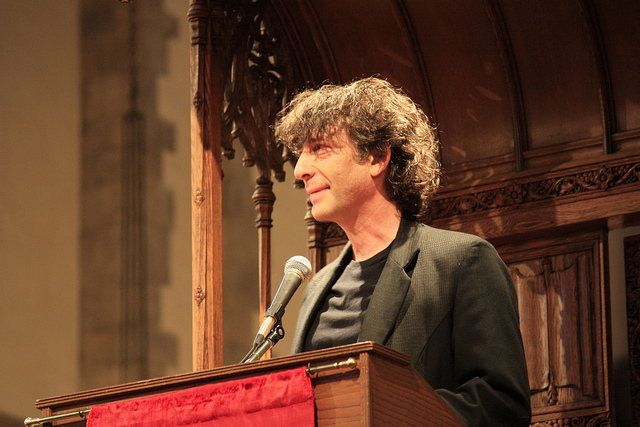
Image by Thierry Ehrmann, via Flickr Commons
Everybody knows Neil Gaiman, but they all know him best for different work: writing comic books like Sandman, novels like American Gods, television series like Neverwhere, movies like MirrorMask, an early biography of Duran Duran. What does all that — and everything else in the man’s prolific career — have in common? Stories. Every piece of work Gaiman does involves him telling a story of one kind or another, and so his profile in the culture has risen to great heights as, simply, a storyteller. That made him just the right man for the job when the Long Now Foundation, with its mission of thinking far back into the past and far forward into the future, needed someone to talk about how certain stories survive through both those time frames and beyond.
“Do stories grow?” Gaiman asks his years-in-the-making Long Now lecture, listenable on Soundcloud right below or viewable as a video here. “Pretty obviously — anybody who has ever heard a joke being passed on from one person to another knows that they can grow, they can change. Can stories reproduce? Well, yes. Not spontaneously, obviously — they tend to need people as vectors. We are the media in which they reproduce; we are their petri dishes.” He goes on to bring out examples from cave paintings, to secret retellings of Gone with the Wind in a Nazi concentration camp, to a warning to future generations not to dig into nuclear waste sites — designed for passage into the minds of posterity as a robustly crafted story.
Stories, writes the Long Now Foundation founder Stewart Brand, “outcompete other stories by hanging over time. They make it from medium to medium — from oral to written to film and beyond. They lose uninteresting elements but hold on to the most compelling bits or even add some.” He knows that, Gaiman knows that, and I think that all of us who have told stories sense its truth on an instinctive level: “The most popular version of the Cinderella story (which may have originated long ago in China) has kept the gloriously unlikely glass slipper introduced by a careless French telling.”
Another beloved British teller of tales, Douglas Adams, also had thoughts on the almost biological nature of literature. “We were talking about The Hitchhiker’s Guide to the Galaxy,” Gaiman recalled elsewhere, “which was something which resembled an iPad, long before it appeared. And I said when something like that happens, it’s going to be the death of the book. Douglas said no. Books are sharks.” And what did he mean by that? “Sharks have been around for a very long time. There were sharks before there were dinosaurs, and the reason sharks are still in the ocean is that nothing is better at being a shark than a shark.” So not only do the best stories evolve to last the longest, so do the forms they take.
You can find 18 stories by Neil Gaiman (all free) in this collection.
Related Content:
George Saunders Demystifies the Art of Storytelling in a Short Animated Documentary
48 Hours of Joseph Campbell Lectures Free Online: The Power of Myth & Storytelling
Neil Gaiman Reads “The Man Who Forgot Ray Bradbury”
Where Do Great Ideas Come From? Neil Gaiman Explains
Amanda Palmer Animates & Narrates Husband Neil Gaiman’s Unconscious Musings
Based in Seoul, Colin Marshall writes and broadcasts on cities and culture. He’s at work on a book about Los Angeles, A Los Angeles Primer, the video series The City in Cinema, the crowdfunded journalism project Where Is the City of the Future?, and the Los Angeles Review of Books’ Korea Blog. Follow him on Twitter at @colinmarshall or on Facebook.
Read More...Support Us
We're hoping to rely on loyal readers, rather than erratic ads. Please click the Donate button and support Open Culture. You can use Paypal, Venmo, Patreon, even Crypto! We thank you!

About Us

Open Culture scours the web for the best educational media. We find the free courses and audio books you need, the language lessons & educational videos you want, and plenty of enlightenment in between.
Advertise With Us

FREE UPDATES!
GET OUR DAILY EMAIL
Get the best cultural and educational resources on the web curated for you in a daily email. We never spam. Unsubscribe at any time.
FOLLOW ON SOCIAL MEDIA

Open Culture editor Dan Colman scours the web for the best educational media. He finds the free courses and audio books you need, the language lessons & movies you want, and plenty of enlightenment in between.
Advertise With Us

