Jules Verne Accurately Predicts What the 20th Century Will Look Like in His Lost Novel, Paris in the Twentieth Century (1863)
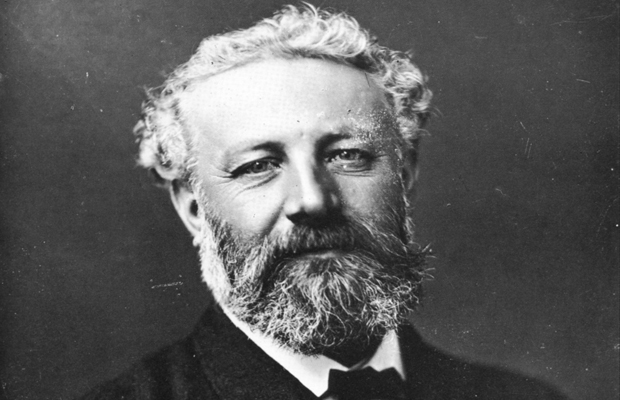
Science fiction, they say, doesn’t really deal with the future; it uses the setting of the future as a way to deal with the present. That would explain all the standard preposterous tropes you regularly see in the genre’s less gracefully aging novels and films: jetpacks, flying cars, holo-phones, that sort of thing. So when you look into sci-fi’s back pages and do come across the occasional accurate or even semi-accurate prediction of the future — that is, an accurate prediction of our present — it really jumps out at you. Many such predictions have jumped out at readers from the pages of Jules Verne’s lost second novel, Paris in the Twentieth Century.
Originally written in 1863 but not published until found at the bottom of a vault in 1994, the book’s scorecard of seemingly bang-on elements of the then-future include the explosion of suburban living and shopping and large-scale higher education; career women; synthesizer-driven electronic music and a recording industry to sell it; ever more advanced forms of ever cruder entertainment; cities of elevator-equipped, automatically surveilled skyscrapers electrically illuminated all night long; gas-powered cars, the roads they drive on, and the stations where they fill up; subways, magnetically-propelled trains, and other forms of rapid transit; fax machines as well as a very basic internet-like communication system; the electric chair; and weapons of war too dangerous to use.
You may sense that the young Verne did not see the future, which takes its form in the novel of Paris in 1960, as a utopia. In fact, he went a little too far in using the setting and its story of an artistic soul adrift in a culturally dead, progress-worshiping technocracy to express his own anxieties about the 19th century and its rise of conglomeration, automation, and mechanization — or so thought his publisher, who believed the book’s bleak predictions, even if accurate, would fail to win over the common reader. “My dear Verne,” he wrote in his rejection letter to the author, “even if you were a prophet, no one today would believe this prophecy… they simply would not be interested in it.”
But over 150 years later, the predictions of Paris in the Twentieth Century do interest us, or at least those of us who wonder whether we’ve handed too much of our humanity over to the realms of technology, finance, and entertainment. Even if Richard Bernstein, reviewing the novel in The New York Times when it finally saw publication, found its satire “weak, innocent and adolescent in light of what actually happened in the 20th century,” it has given us more than ever to talk about today. To get in on the conversation, have a listen to the episode of the Futility Closet podcast on the book just above. Do you think Verne accurately foresaw our current condition — or does his dystopia still lie in wait?
Related Content:
How French Artists in 1899 Envisioned Life in the Year 2000: Drawing the Future
Isaac Asimov Predicts in 1964 What the World Will Look Like Today
In 1964, Arthur C. Clarke Predicts the Internet, 3D Printers and Trained Monkey Servants
Walter Cronkite Imagines the Home of the 21st Century … Back in 1967
The Internet Imagined in 1969
In 1900, Ladies’ Home Journal Publishes 28 Predictions for the Year 2000
Future Shock: Orson Welles Narrates a 1972 Film About the Perils of Technological Change
Based in Seoul, Colin Marshall writes and broadcasts on cities and culture. He’s at work on a book about Los Angeles, A Los Angeles Primer, the video series The City in Cinema, the crowdfunded journalism project Where Is the City of the Future?, and the Los Angeles Review of Books’ Korea Blog. Follow him on Twitter at @colinmarshall or on Facebook.
Read More...Kate Bush’s First Ever Television Appearance, Performing “Kite” & “Wuthering Heights” on German TV (1978)
There are few things in life that I can enjoy uncritically—totally surrender to—and yet also appreciate as intellectually complex, finely-wrought works of art. The music of Kate Bush is one of those things. Her preternatural voice, sublimely ridiculous costumes, dance, and gesture, and haunting, literary lyricism immediately captivate the ear and eye—and work their magic on the mind not long after. It’s an unusual—I’d say extremely rare—set of qualities that set her apart from every pop star in the era of her prime and in our own. At the risk of drawing a perhaps too-easy comparison, but I think an apt one: as a solo artist she rivals maybe only David Bowie in her ability to own the spotlight and remain in total control of her sound and image. (Both of them, in fact, trained with the same dance teacher, Lindsay Kemp.)
But while Bowie made it look easy, and found ways to stay nearly-ever-present in every decade since the 70s, for Bush that control was hard won, and meant withdrawals from the public, including a 12-year break that, writes The Guardian, reminded some of “the mythological resonance of Bob Dylan’s Basement Tapes hiatus.” She has toured only twice: once at the very beginning of her career in 1979 and again, 35 years later, in 2014. Critics and die-hard fans have long speculated about the reasons for Bush’s withdrawal from performance and her general public reticence, but statements from the artist herself have made it clear that part of her struggle with stardom had to do with feeling exploited in the way so many women are by the music industry.
By the end of her lavish, 28-night 1979 extravaganza, she recalled, “I felt a terrific need to retreat as a person, because I felt that my sexuality, which in a way I hadn’t really had a chance to explore myself, was being given to the world in a way which I found impersonal.” “Bush,” The Guardian writes, “did everything she could to prevent herself being exposed in that way again.”
The move was both a loss and a gain for her fans. While her live shows might have become legendary in the way Bowie’s did over the years, her retreat into a private sphere all her own allowed her to continue writing and recording consistently brilliant, challenging music that never became compromised by industry hackwork, as she herself never became someone else’s product.
Her ability to assert herself so early in her career is also a testament to her creative confidence. Bush was only 19 years old when she released her first album, The Kick Inside, an age at which many emerging pop stars allow themselves to be commandeered by overbearing management. But she has remained relevant by remaining her—odd, enigmatic, totally original—self. “Artists shouldn’t be made famous,” she once remarked, “it is a forced importance.”
Before launching that first tour, and deciding it wasn’t for her, Bush made her first television appearance on a German program in 1978—see it at the top of the post. Rather than opening with “Wuthering Heights,” the song that did make her famous, she instead starts with the B‑side, “Kite.” But then we hear that familiar, tinkling piano intro, and she delivers the big single, wearing the flowing red gown she donned in the oft-parodied American video for the song (above). The weird and wonderful dance moves are a little subdued, but like all of her performances—in very rare stage appearances, numerous videos, and ten amazing albums—it’s glorious.
In her first American TV appearance, on Saturday Night Live later that same year, Bush sang “The Man With the Child in His Eyes” in the gold lamé bodysuit she wore in the song’s official video (above). Just one of the many fashion choices that, along with those uninhibited dance moves—“those weird, spastic, fantastic interpretive dance moves,” writes Matthew Zuras in an appreciation—later gave us unforgettable classics like the “Babooshka” video (below). We have this unique, uncompromising body of work both because a more adventurous music industry decided to invest in developing Bush’s talent in the early 70s, and because she refused, after all, to accede to that industry’s usual demands.
Related Content:
300 Kate Bush Impersonators Pay Tribute to Kate Bush’s Iconic “Wuthering Heights” Video
2009 Kate Bush Documentary Dubs Her “Queen of British Pop”
Josh Jones is a writer and musician based in Durham, NC. Follow him at @jdmagness
Read More...The Original Stuffed Animals That Inspired Winnie the Pooh
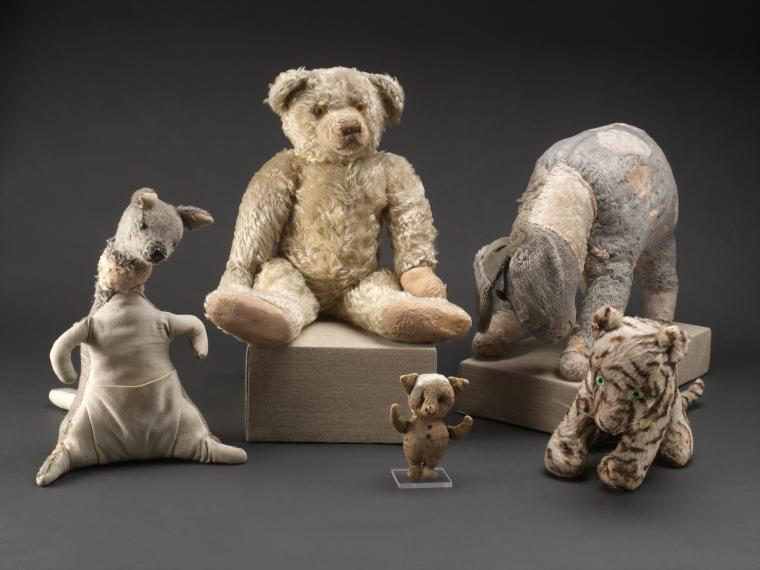
In 1921, Christopher Robin Milne received a stuffed bear for his first birthday. But it wasn’t any old stuffed bear. Bought at Harrods in London, this bear (named “Winnie” after a black bear that resided at the London Zoo) would inspire his father, A.A. Milne, to write the Winnie the Pooh stories in 1926–stories that have captured children’s imaginations ever since.
In the picture above, you can see the original Winnie the Pooh bear, joined by his friends Tigger, Kanga, Eeyore, and Piglet. They all now live at The New York Public Library, where kids and adults can see them on display. It should be noted that Roo isn’t in the picture because he was lost a long time ago. Meanwhile you won’t find Owl or Rabbit, because they weren’t originally based on stuffed animals.
You can find more photos of the stuffed animals over at the NYPL website, and, if you visit this post in our archive, you’ll hear A.A. Milne reading from Winnie the Pooh in a 1929 recording. Enjoy.
If you would like to support the mission of Open Culture, consider making a donation to our site. It’s hard to rely 100% on ads, and your contributions will help us continue providing the best free cultural and educational materials to learners everywhere. You can contribute through PayPal, Patreon, and Venmo (@openculture). Thanks!
Note: Do you want to download Winnie the Pooh as a free audio book? If you start a 30 day free trial with Audible.com, you can download two free audio books of your choice. Get more details on the offer here.
Read More...Hear the Experimental Piano Jazz Album by Comedian H. Jon Benjamin — Who Can’t Play Piano
I wonder: do the fan bases of modern comedy and modern jazz overlap at all? At first, it’s hard to imagine two artistic worlds farther apart, with the comedians seeming like unserious goofballs who consider nothing sacred and the jazz players seeming like serious artists who regard their musical tradition as sacred indeed. But look closer and the difference doesn’t seem as stark as all that: comedy and jazz, both performative pursuits, demand from those who want to succeed in them an almost obsessive commitment to improving their craft. And the best practitioners of both, despite acknowledging the importance of learning and building upon the work of their antecedents, have to know when to break from tradition and experiment.
So perhaps H. Jon Benjamin’s new album Well, I Should Have…, which brings comedy and jazz together but not in the way any of us would have expected, comes as something of an inevitability. Benjamin, a comedian best known for doing voices on such animated shows as Archer, Bob’s Burgers, Dr. Katz: Professional Therapist and Home Movies, has put out not a record of sketches or stand-up material, but of actual jazz music, with him sitting at the piano. The comedic element? The album has a subtitle: … Learned to Play the Piano.
“I don’t play piano at all,” Benjamin deadpans in the trailer for Well, I Should Have… at the top of the post. “And I’m not a huge fan of jazz. I never was. And that’s why I thought it would be funny to make a jazz album.” To compensate for his total lack of skill or experience at his instrument, Benjamin brought three genuine jazz professionals into the studio to fill out the quartet: Scott Kreitzer on saxophone, David Finck on bass, and Jonathan Peretz on drums, all of whom do their best to build legitimate compositions around Benjamin’s near-random poking and slapping of the ivories. Here we see — or rather hear — revealed something else in common between comedians and jazz musicians: both need to improvise.
In the end, you could listen to this as either a conceptual comedy album, a conceptual jazz album, or both. You can hear selections from it (though, given the videos’ geo-restriction, that depends on which country you’re in) in the playlist just above. For most of us, showing up to a recording session completely ignorant of the instrument we have to play constitutes the stuff of nightmares, but Benjamin uses it as an opportunity to play a role he calls “Jazz Daredevil.” Does this count as real comedy? It certainly gets me laughing. I’ll leave the other obvious question to the serious jazz aficionados, who seem to enjoy only one thing almost as much as listening to jazz: arguing over what counts as jazz. If Benjamin has a particular joke to make with all this, it may be on them.
via Metafilter
Related Content:
This is Your Brain on Jazz Improvisation: The Neuroscience of Creativity
10 Great Performances From 10 Legendary Jazz Artists: Django, Miles, Monk, Coltrane & More
Based in Seoul, Colin Marshall writes and broadcasts on cities and culture. He’s at work on a book about Los Angeles, A Los Angeles Primer, the video series The City in Cinema, the crowdfunded journalism project Where Is the City of the Future?, and the Los Angeles Review of Books’ Korea Blog. Follow him on Twitter at @colinmarshall or on Facebook.
Read More...David Bowie Sings Impressions of Bruce Springsteen, Lou Reed, Iggy Pop, Tom Waits & More In Studio Outtakes (1985)
We knew David Bowie could pretty much do it all—glam rock, jazz, funk, Philly soul, cabaret, pop, drum and bass, folk, avant-garde, you name it. In front of the camera, he could stretch himself into the beautiful but wounded alien in The Man Who Fell to Earth, the scary-sexy-cool Goblin King of Labyrinth, the mystical genius Tesla in The Prestige. Nothing he attempted seemed beyond his grasp, including, as you can hear above, off-the-cuff, mostly spot-on impressions of friends and fellow singers like Iggy Pop, Lou Reed, Tom Waits, and Bruce Springsteen.
The audio clip you hear comes from outtakes producer Mark Saunders happened to capture on tape during the 1985 sessions for the Absolute Beginners film soundtrack (“a better soundtrack than it was a movie!” Saunders remarks).
While recording a lead vocal, Saunders writes, Bowie “broke into the impersonations and I realized that these might get erased at some point, so I quickly put a cassette in and hit ‘record.’” You can read his full recollections at The Talkhouse in a short essay he wrote to accompany the audio—introduced by Zach Staggers of indie band the So So Glos, who writes:
Bowie goes through a handful of sung impressions, including but not limited to, Bruce Springsteen, Iggy Pop, Tom Waits, Loud Reed and Anthony Newly, who was such a big influence on the iconic singer that the impersonation almost sounds like Bowie mimicking himself. Between takes you can hear Bowie having fun and going back and forth with the engineers. Jokes.
Bowie also does what sounds like Bob Dylan (or Tom Petty, or Marc Bolan as some have speculated?) in the second take and a passable Neil Young in the last. His Springsteen, Reed, and Pop are excellent (Bowie called the Iggy impression “difficult, he’s somewhere between all of them.”) He closes the impromptu performance with “That’s it, night night.”
Bowie did indeed have jokes, though anyone who followed him over the decades knows of his comedic talents, whether playing straight man to Ricky Gervais’ obnoxious superfan or displaying impeccable timing in his deadpan delivery of “Bowie Secrets” from Late Night With Conan O’Brien in 2002.
Despite the kiss-off he gives Gervais in their comedy bit, those who knew and worked with Bowie all testify that he never took himself too seriously or, as Saunders remembers, threw his weight around by “using a big rock star ‘Hey, I’m David Bowie and I want it done my way.” He may have seemed to many like an alien or a god, but he was apparently in person a pretty humble, and very funny, guy.
Related Content:
David Bowie (RIP) Sings “Changes” in His Last Live Performance, 2006
Josh Jones is a writer and musician based in Durham, NC. Follow him at @jdmagness
Read More...Ursula Le Guin Gives Insightful Writing Advice in Her Free Online Workshop
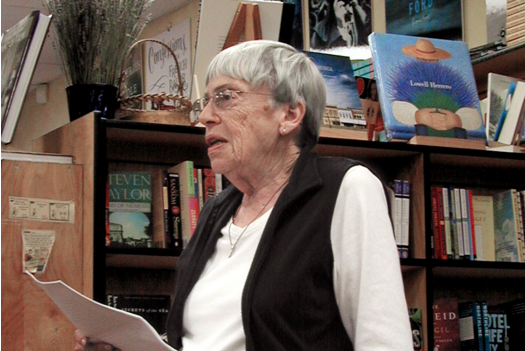
Image by Gorthian, via Wikimedia Commons
Though it’s sometimes regarded as a pretentious-sounding term for genre writers who don’t want to associate with genre, I’ve always liked the phrase “speculative fiction.” J.G. Ballard, Philip K. Dick, Shirley Jackson, Margaret Atwood, Neil Gaiman… A touch of surrealist humor, a highly philosophical bent, and a somewhat tragic sensibility can be found among them all, and also in the work of Ursula K. Le Guin, who does not shy away from the genre labels of science fiction and fantasy, but who approaches these categories in the way of, say, Virginia Woolf in her Orlando: as feminist thought experiments and fables about human ecological failings and inter-cultural potential.
That’s not to say that Le Guin’s writing is driven by political agendas, but that she has a very clear, uncompromising vision, which she has realized over the course of over five decades in novels, short stories, and children’s fiction. LeGuin’s writing takes us away from the familiar to worlds we recognize as alternatives to our own.
Like those in ancient epics, her characters undertake journeys to realms unknown, where they learn as much or more about themselves as about the alien inhabitants. And though we experience in her stories the thrill of discovery and danger common to fantasy and sci-fi, we also enter a world of ideas about who we are as human beings, and how we might be different. For Le Guin, fiction is a vessel that can carry us out of ourselves and return us home changed.
Le Guin stated last year that she no longer has the “vigor and stamina” for writing novels, and having given up teaching as well, said she missed “being in touch with serious prentice writers.” Thus, she decided to start an online writing workshop at the site Book View Café, describing it as “a kind of open consultation or informal ongoing workshop in Fictional Navigation.” In keeping with the metaphor of sea voyaging, she called her workshop “Navigating the Ocean of Story” and declared that she would not take reader questions about publishing or finding an agent: “We won’t be talking about how to sell a ship, but how to sail one.” Reader questions poured in, and Le Guin did her best to answer as many as she could, posting advice every other Monday for all of the summer and much of the fall of 2015.
The first question she received was a doozy—“How do you make something good?”—and her lengthy answer sets the tone for all of her counsel to follow. She is witty and honest, and surprisingly helpful, even when confronted with such a vague, seemingly unanswerable query. The dozens of questions she selected in the following weeks tend to deal with much more manageable issues of style and technique, and in each instance, Le Guin offers the querent a clear set of coordinates to help them navigate the waters of their own fictional journeys. Below are just a few choice excerpts from the many hundreds of words Le Guin generously donated to her reading community.
- The problem of exposition:
In answers to two readers’ questions about providing sufficient backstory, Le Guin refers to an old New Yorker feature called “The Department of Fuller Explanation, where they put truly and grand examples of unnecessary explaining.” Most of us, Le Guin writes, “tend to live in the Department of Fuller Explanation” when writing; “We are telling ourselves backstory and other information, which the reader won’t actually need to know when reading it.”
To avoid the “Expository Lump or the Infodump,” as she calls it, Le Guin advises the writer to “decide—or find out when revising—whether the information is actually necessary. If not, don’t bother. If so, figure out how to work it in as a functional, forward-moving element of the story… giving information indirectly, by hint and suggestion.”
- The problem of description:
When it comes to describing characters’ appearances, Le Guin suggests getting specific:
It’s not just facial features—a way of moving, a voice quality, can ’embody’ a character. Specific features or mannerisms (even absurdly specific ones!) can help fix a minor character in the reader’s mind when they turn up again…. To work on this skill, you might try describing people you see on the bus or in the coffee shop: just do a sentence about them in your head, trying to catch their looks in a few words.
- The problem of setting:
Le Guin answers a reader who confesses to trouble with “world building” by pointing out the central importance of setting:
Event requires location. Where we are affects who we are, what we say and and do, how and why we say and do it. It matters, doesn’t it, whether we’re in Miami or Mumbai — even more whether we’re on Earth or in Made-Up Place? So, I don’t know if it would work to try and build up a world– “all those details” – and tack it onto what you’ve written. If inventing a world isn’t your thing, OK. Stick close to this world, or use readymade, conventional sf and fantasy props and scenery. They’re there for all of us to use.
- The problem of dialogue:
Le Guin offers some very practical advice on how to make speech sound convincing and genuine:
All I can recommend is to read/speak your dialogue aloud. Not whispering, not muttering, OUT LOUD. (Virginia Woolf used to try out her dialogue in the bathtub, which greatly entertained the cook downstairs.) This will help show you what’s fakey, hokey, bookish — it just won’t read right out loud. Fix it till it does. Speaking it may help you to vary the speech mannerisms to suit the character. And probably will cause you to cut a lot. Good! Many contemporary novels are so dialogue-heavy they seem all quotation marks — disembodied voices yaddering on in a void.
- Getting started:
Many readers wrote to ask Le Guin about their difficulty in getting a story started at all. She replied with the caveat that “no answer to this question is going to fit every writer.” While some writers work from “a rough sketch, notes as to where the story is headed and how it might get there, with more extended notes about the world it takes place in,” for others, “a complete outline is absolutely necessary before starting to write.” Whatever the method:
A story is, after all, and before everything else, dynamic: it starts Here, because it’s going There. Its life principle is the same as a river: to keep moving. Fast or slow, straight or erratic, headlong or meandering, but going, till it gets There. The ideas it expresses, the research it embodies, the timeless inspirations it may offer, are all subordinate to and part of that onward movement. The end itself may not be very important; it is the journey that counts. I don’t know much about “flow” states, but I know that the onward flow of a story is what carries a writer from the start to the end of it, along with the whole boatload of characters and ideas and knowledge and meaning — and carries the reader in the same boat.
There are dozens more questions from readers, and dozens more insightful, funny, and very helpful answers from Le Guin. Whether you are a writer of science fiction, fantasy, speculative fiction, or none of the above, much of her advice will apply to any kind of fiction writing you do—or will give you unique insights into the techniques and trials of the fiction writer. Read all of the questions and Le Guin’s answers in her “Navigating the Ocean of Story” posts at Book View Café.
Related Content:
Toni Morrison Dispenses Writing Wisdom in 1993 Paris Review Interview
Hear Inventive Stories from Ursula LeGuin & J.G. Ballard Turned Into CBC Radio Dramas
Josh Jones is a writer and musician based in Durham, NC. Follow him at @jdmagness
Read More...The 20 Most Influential Academic Books of All Time: No Spoilers
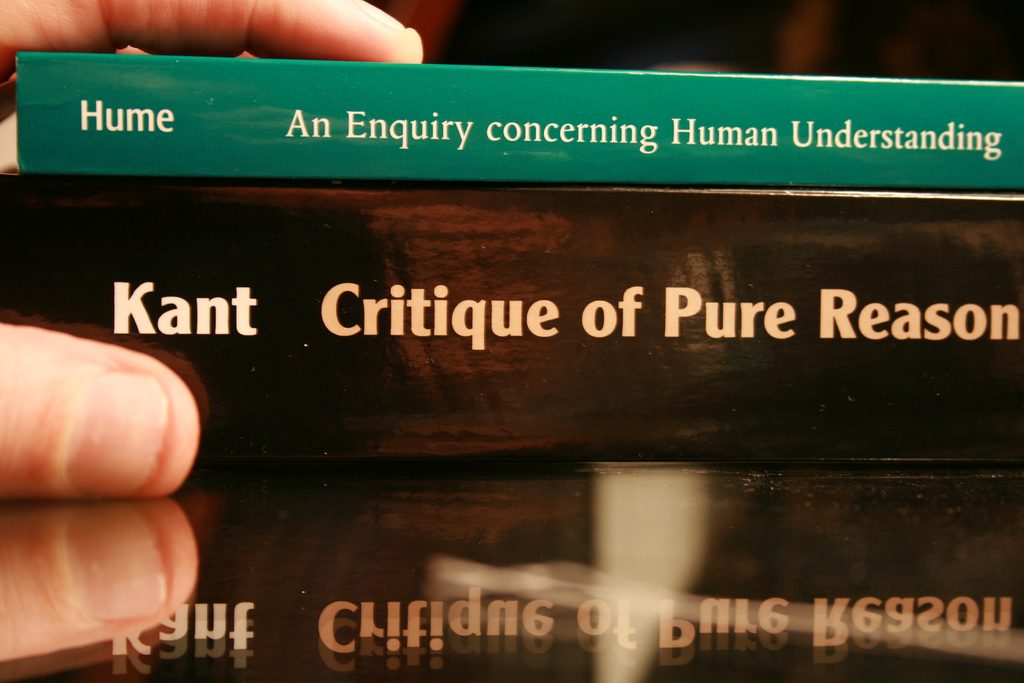
Image by Let Ideas Compete, via Flickr Commons
Sometimes I’ll meet someone who mentions having written a book, and who then adds, “… well, an academic book, anyway,” as if that didn’t really count. True, academic books don’t tend to debut at the heights of the bestseller lists amid all the eating, praying, and loving, but sometimes lightning strikes; sometimes the subject of the author’s research happens to align with what the public believes they need to know. Other times, academic books succeed at a slower burn, and it takes readers generations to come around to the insights contained in them — a less favorable royalty situation for the long-dead writer, but at least they can take some satisfaction in the possibility.
History has shown, in any case, that academic books can become influential. “After a list of the top 20 academic books was pulled together by expert academic booksellers, librarians and publishers to mark the inaugural Academic Book Week,” writes The Guardian’s Alison Flood, “the public was asked to vote on what they believed to be the most influential.” The shortlist of these most important academic books of all time runs as follows (and you can read many of them free by following the links from our meta list of Free eBooks):
- A Brief History of Time by Stephen Hawking
-
A Vindication of the Rights of Woman by Mary Wollstonecraft
-
Nineteen Eighty-Four by George Orwell
-
On the Origin of Species by Charles Darwin
- Orientalism by Edward Said
- Silent Spring by Rachel Carson
- The Communist Manifesto by Karl Marx and Friedrich Engels
- The Complete Works of William Shakespeare
- The Female Eunuch by Germaine Greer
- The Making of the English Working Class by EP Thompson
- The Meaning of Relativity by Albert Einstein
- The Naked Ape by Desmond Morris
- The Prince by Niccolò Machiavelli
- The Republic by Plato
- The Rights of Man by Thomas Paine
- The Second Sex by Simone de Beauvoir
- The Uses of Literacy by Richard Hoggart
- The Wealth of Nations by Adam Smith
- Ways of Seeing by John Berger
The top spot went to Darwin’s On the Origin of Species, which Flood quotes the University of Glasgow’s Andrew Prescott as calling “the supreme demonstration of why academic books matter,” one that “changed the way we think about everything – not only the natural world, but religion, history and society. Every researcher, no matter whether they are writing books, creating digital products or producing artworks, aspires to produce something as significant in the history of thought as Origin of Species.”
Kant’s Critique of Pure Reason placed a still impressive fifth, given its status, in the words of philosopher Roger Scruton, as “one of the most difficult works of philosophy ever written,” — but one which aims to “show the limits of human reasoning, and at the same time to justify the use of our intellectual powers within those limits. The resulting vision, of self-conscious beings enfolded within a one-sided boundary, but always pressing against it, hungry for the inaccessible beyond, has haunted me, as it has haunted many others since Kant first expressed it.”
So you want to write an academic book this influential? You may have a tough time doing it deliberately, but it couldn’t hurt to steep yourself in the materials we’ve previously featured related to the creation of this top twenty, including 16,000 pages of Darwin’s writing on evolution (as well as the man’s personal library), Orwell’s letter revealing why he would write 1984, as well as Marx and Kant’s rigorous work habits — and Kant’s even more rigorous coffee habit, though if there exists any 21st-century academic in need of encouragement to drink more coffee, I have yet to meet them.
Related Content:
800 Free eBooks for iPad, Kindle & Other Devices
Read 700 Free eBooks Made Available by the University of California Press
The 10 Greatest Books Ever, According to 125 Top Authors (Download Them for Free)
28 Important Philosophers List the Books That Influenced Them Most During Their College Days
Life-Changing Books: Your Picks
Darwin: A 1993 Film by Peter Greenaway
Darwin’s Personal Library Goes Digital: 330 Books Online
16,000 Pages of Charles Darwin’s Writing on Evolution Now Digitized and Available Online
George Orwell Explains in a Revealing 1944 Letter Why He’d Write 1984
The Daily Habits of Highly Productive Philosophers: Nietzsche, Marx & Immanuel Kant
Philosophers Drinking Coffee: The Excessive Habits of Kant, Voltaire & Kierkegaard
Based in Seoul, Colin Marshall writes and broadcasts on cities and culture. He’s at work on a book about Los Angeles, A Los Angeles Primer, the video series The City in Cinema, the crowdfunded journalism project Where Is the City of the Future?, and the Los Angeles Review of Books’ Korea Blog. Follow him on Twitter at @colinmarshall or on Facebook.
Read More...Kraftwerk’s First Concert: The Beginning of the Endlessly Influential Band (1970)
“No, I have not shorted out or fallen in love with a cyborg,” insisted Robert Christgau in his review of Kraftwerk’s 1977 album Trans-Europe Express, which he credited with “a simple-minded air of mock-serious fascination with melody and repetition” and textures that “sound like parodies by some cosmic schoolboy of every lush synthesizer surge that’s ever stuck in your gullet — yet also work the way those surges are supposed to work.” To electronic music fans, Kraftwerk now have a status even beyond that of the grand old men of the tradition, but continue to tour the world enthusiastically (with their own detached, biomechanical interpretation of enthusiasm), performing the deliberately technological, sometimes startlingly jagged, sometimes startlingly rhythmic music they invented.
The world got their first taste of it, in an early experimental form, a few short years before successful and relatively mainstream Kraftwerk records like Trans-Europe Express or Autobahn came along. The group debuted onstage in their native Germany (in the town of Soest, to be precise) in the 1970 concert captured on video. Watch the gig above, or find it on YouTube. Together, the footage captures with unexpected clarity the avant-gardism of both Kraftwerk’s performative sensibility and technological setup as well as the reaction of the crowd, on the whole more pleased than bewildered. Now, in an age where performers playing from laptops onstage have become commonplace — even Kraftwerk themselves have joined that rather introverted party — it doesn’t seem as striking as all that.
But the genre of “kraut rock” (which All Music Guide describes as made by “legions of German bands of the early ’70s that expanded the sonic possibilities of art and progressive rock,” going in “mechanical and electronic” directions by “working with early synthesizers and splicing together seemingly unconnected reels of tape”) began in a different reality — in an era when Christgau could still, reviewing a later Kraftwerk album in 1981, write that every time he hears their lyric “ ‘I program my home computer/Bring myself into the future,’ I want to make a tape for all those zealots who claim a word processor will change my life.”
The complete 1970 concert is on YouTube here.
If you would like to support the mission of Open Culture, consider making a donation to our site. It’s hard to rely 100% on ads, and your contributions will help us continue providing the best free cultural and educational materials to learners everywhere. You can contribute through PayPal, Patreon, and Venmo (@openculture). Thanks!
Related Content:
Thomas Dolby Explains How a Synthesizer Works on a Jim Henson Kids Show (1989)
Hear Seven Hours of Women Making Electronic Music (1938–2014)
Based in Seoul, Colin Marshall writes and broadcasts on cities and culture. He’s at work on a book about Los Angeles, A Los Angeles Primer, the video series The City in Cinema, the crowdfunded journalism project Where Is the City of the Future?, and the Los Angeles Review of Books’ Korea Blog. Follow him on Twitter at @colinmarshall or on Facebook.
Read More...Nietzsche Lays Out His Philosophy of Education and a Still-Timely Critique of the Modern University (1872)
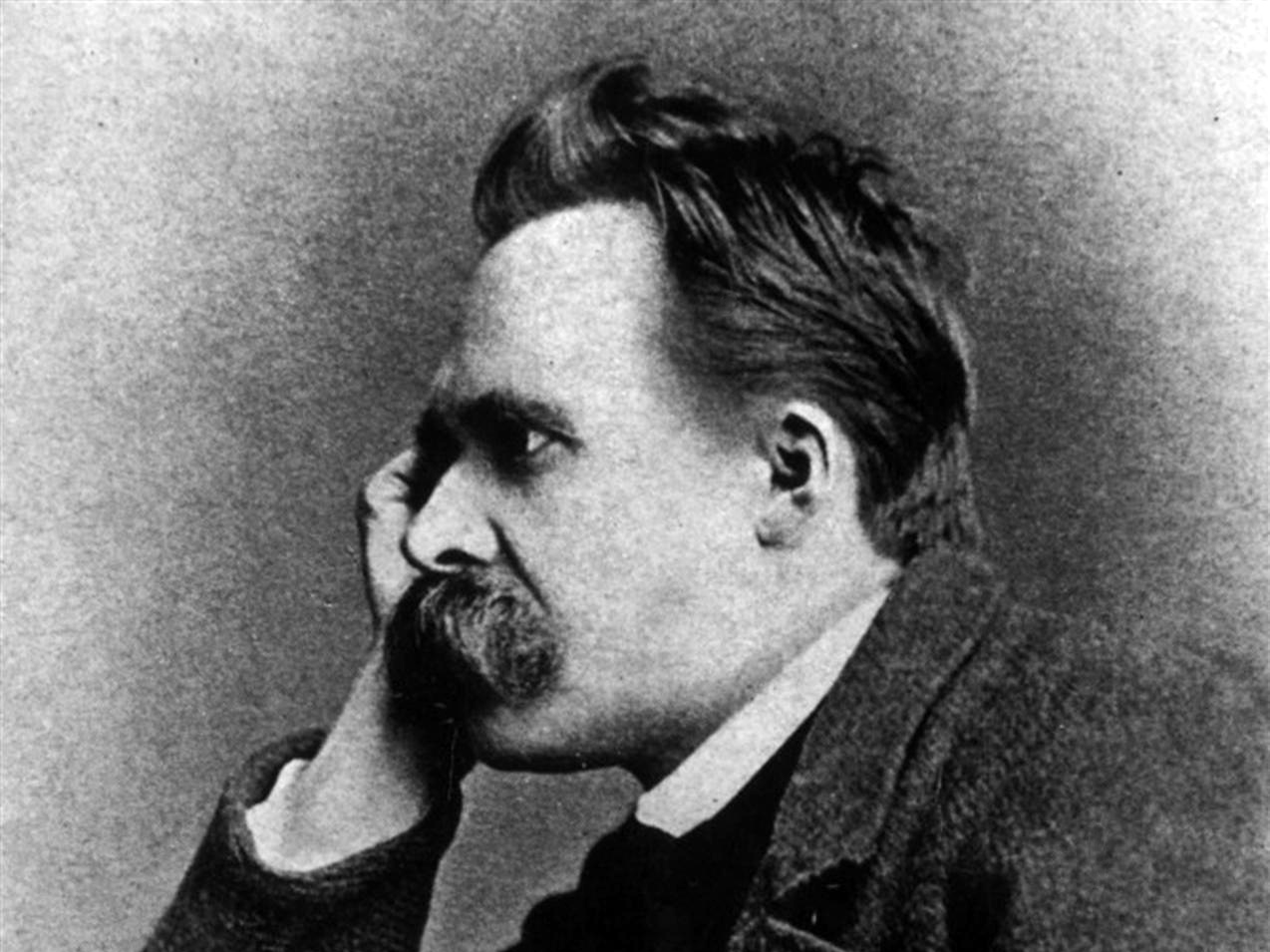
In a recent entry in the New York Times’ philosophy blog “The Stone,” Robert Frodeman and Adam Briggle locate a “momentous turning point” in the history of philosophy: its institutionalization in the research university in the late 19th century. This, they argue, is when philosophy lost its way—when it became subject to the dictates of the academy, placed in competition with the hard sciences, and forced to prove its worth as an instrument of profit and progress. Well over a hundred years after this development, we debate a wider crisis in higher education, as universities (writes Mimi Howard in the Los Angeles Review of Books) “increasingly resemble global corporations with their international campuses and multibillion dollar endowments. Tuition has skyrocketed. Debt is astronomical. The classrooms themselves are more often run on the backs of precarious adjuncts and graduate students than by real professors.”
It’s a cutthroat system I endured for many years as both an adjunct and graduate student, but even before that, in my early undergraduate days, I remember well watching public, then private, colleges succumb to demand for leaner operating budgets, more encroachment by corporate donors and trustees, and less autonomy for educators. Universities have become, in a word, high-priced, high-powered vocational schools where every discipline must prove its value on the open market or risk massive cuts, and where students are treated, and often demand to be treated, like consumers. Expensive private entities like for-profit colleges and corporate educational companies thrive in this environment, often promising much but offering little, and in this environment, philosophy and the liberal arts bear a crushing burden to demonstrate their relevance and profitability.
Howard writes about this situation in the context of her review of Friedrich Nietzsche’s little-known, 1872 series of lectures, On the Future of Our Educational Institutions, published in a new translation by Damion Searls with the pithy title Anti-Education. Nietzsche, an academic prodigy, had become a professor of classical philology at the University of Basel at only 24 years of age. By 27, when he wrote his lectures, he was already disillusioned with teaching and the strictures of professional academia, though he stayed in his appointment until illness forced him to retire in 1878. In the lectures, Nietzsche excoriates a bourgeois higher education system in terms that could come right out of a critical article on the higher ed of our day. In a Paris Review essay, his translator Searls quotes the surly philosopher on what “the state and the masses were apparently clamoring for”:
as much knowledge and education as possible—leading to the greatest possible production and demand—leading to the greatest happiness: that’s the formula. Here we have Utility as the goal and purpose of education, or more precisely Gain: the highest possible income … Culture is tolerated only insofar as it serves the cause of earning money.
Perhaps little has changed but the scale and the appearance of the university. However, Nietzsche did admire the fact that the school system “as we know it today… takes the Greek and Latin languages seriously for years on end.” Students still received a classical education, which Nietzsche approvingly credited with at least teaching them proper discipline. And yet, as the cliché has it, a little knowledge is a dangerous thing; or rather, a little knowledge does not an education make. Though many pursue an education, few people actually achieve it, he believed. “No one would strive for education,” wrote Nietzsche, “if they knew how unbelievably small the number of truly educated people actually was, or ever could be.” For Nietzsche, the university was a scam, tricking “a great mass of people… into going against their nature and pursuing an education” they could never truly achieve or appreciate.
While it’s true that Nietzsche’s critiques are driven in part by his own cultural elitism, it’s also true that he seeks in his lectures to define education in entirely different terms than the utilitarian “state and masses”—terms more in line with classical ideals as well as with the German concept of Bildung, the term for education that also means, writes Searls, “the process of forming the most desirable self, as well as the end point of the process.” It’s a resonance that the English word has lost, though its Latin roots—e ducere, “to lead out of” or away from the common and conventional—still retain some of this sense. Bildung, Searls goes on, “means entering the realm of the fully formed: true culture is the culmination of an education, and true education transmits and creates culture.”
Nietzsche the philologist took the rich valence of Bildung very seriously. In the years after penning his lectures on the educational system, he completed the essays that would become Untimely Meditations (including one of his most famous, “On the Use and Abuse of History for Life”). Among those essays was “Schopenhauer as Educator,” in which Nietzsche calls the gloomy philosopher Arthur Schopenhauer his “true educator.” However, writes Peter Fitzsimons, the “image” of Schopenhauer “is more a metaphor for Nietzsche’s own self-educative process.” For Nietzsche, the process of a true education consists not in rote memorization, or in attaining cultural signifiers consistent with one’s class or ambitions, or in learning a set of practical skills with which to make money. It is, Fitzsimons observes, “rather an exhortation to break free from conventionality, to be responsible for creating our own existence, and to overcome the inertia of tradition and custom”—or what Nietzsche calls the universal condition of “sloth.” In “Schopenhauer as Educator,” Nietzsche defines the role of the educator and explicates the purpose of learning in deliberately Platonic terms:
…for your true nature lies, not concealed deep within you, but immeasurably high above you, or at least above that which you usually take yourself to be. Your true educators and formative teachers reveal to you what the true basic material of your being is, something in itself ineducable and in any case difficult of access, bound and paralysed: your educators can be only your liberators.
As in Plato’s notion of innate knowledge, or anamnesis, Nietzsche believed that education consists mainly of a clearing away of “the weeds and rubbish and vermin” that attack and obscure “the real groundwork and import of thy being.” This kind of education, of course, cannot be formalized within our present institutions, cannot be marketed to a mass audience, and cannot serve the interests of the state and the market. Hence it cannot be obtained by simply progressing through a system of grades and degrees, though one can use such systems to obtain access to the liberatory materials one presumably needs to realize one’s “true nature.”
For Nietzsche, in his example of Schopenhauer, achieving a true education is an enterprise fraught with “three dangers”—those of isolation, of crippling doubt, and of the pain of confronting one’s limitations. These dangers “threaten us all,” but most people, Nietzsche thinks, lack the fortitude and vigor to truly brave and conquer them. Those who acquire Bildung, or culture, those who realize their “true selves,” he concludes “must prove by their own deed that the love of truth has itself awe and power,” though “the dignity of philosophy is trodden in the mire,” and one will likely receive little respite, recompense, or recognition for their labors.
Related Content:
The Digital Nietzsche: Download Nietzsche’s Major Works as Free eBooks
What is the Good Life? Plato, Aristotle, Nietzsche, & Kant’s Ideas in 4 Animated Videos
Download Walter Kaufmann’s Lectures on Nietzsche, Kierkegaard, Sartre & Modern Thought (1960)
Josh Jones is a writer and musician based in Durham, NC. Follow him at @jdmagness
Read More...How Old School Records Were Made, From Start to Finish: A 1937 Video Featuring Duke Ellington
We’re moving back in time, before the mp3 player and the CD. We’re going back to the analog age, a moment when the shellac (and later vinyl) record reigned supreme. The month is June 1937. And the short film you’re watching is “Record Making with Duke Ellington and His Orchestra.” How the film came into being was described in the July 1937 edition of Melody News:
Last month, a crew of cameramen, electricians and technicians from the Paramount film company set up their paraphernalia in the recording studios of Master Records, Inc. for the purpose of gathering ‘location’ scenes for a movie short, now in production, showing how phonograph records are produced and manufactured. Duke Ellington and his orchestra was employed for the studio scenes, with Ivie Anderson doing the vocals.
Narrated by Alois Havrilla, a pioneer radio announcer, the film shows you how records were actually recorded, plated and pressed. It’s a great relic from the shellac/vinyl era, which you will want to couple with this 1956 vinyl tutorial from RCA Victor.
If you would like to support the mission of Open Culture, consider making a donation to our site. It’s hard to rely 100% on ads, and your contributions will help us continue providing the best free cultural and educational materials to learners everywhere. You can contribute through PayPal, Patreon, and Venmo (@openculture). Thanks!
Related Content
How Vinyl Records Are Made: A Primer from 1956
A Celebration of Retro Media: Vinyl, Cassettes, VHS, and Polaroid Too
How to Clean Your Vinyl Records with Wood Glue
How Film Was Made in 1958: A Kodak Nostalgia Moment
Read More...
Support Us
We're hoping to rely on loyal readers, rather than erratic ads. Please click the Donate button and support Open Culture. You can use Paypal, Venmo, Patreon, even Crypto! We thank you!

About Us

Open Culture scours the web for the best educational media. We find the free courses and audio books you need, the language lessons & educational videos you want, and plenty of enlightenment in between.
Advertise With Us

FREE UPDATES!
GET OUR DAILY EMAIL
Get the best cultural and educational resources on the web curated for you in a daily email. We never spam. Unsubscribe at any time.
FOLLOW ON SOCIAL MEDIA

Open Culture editor Dan Colman scours the web for the best educational media. He finds the free courses and audio books you need, the language lessons & movies you want, and plenty of enlightenment in between.
Advertise With Us


