Hear Alec Guinness (The Legend Behind Obi-Wan Kenobi) Read T.S. Eliot’s Four Quartets & The Waste Land
Those who only know T.S. Eliot from such early poems as “The Love Song of J. Alfred Prufrock” and The Waste Land may be surprised to encounter what many critics consider his greatest work, the Four Quartets. The Eliot of the earlier, better-known poems alternates between mocking dissection and tragic lamentation for the supposed cultural decay of the West; in The Waste Land especially, Eliot draws upon his considerable erudition to collapse centuries of poetic and religious text into shards of modernist ingenuity and sharp fragments of despairing irony. The Four Quartets, on the other hand—first published in 1943, though written separately over a period of six years—-attempts to unify traditions, in ways both more earnest and more oblique than readers of Eliot had seen before.
The central theme tying together the four poems—“Burnt Norton,” “East Coker,” “The Dry Salvages,” and “Little Gidding”—is time: as eternity, as emptiness, as a wasteland of words and gestures without meaning or purpose. “If all time is eternally present / All time is unredeemable,” the poet argues in “Burnt Norton,” and he goes on to illustrate ideas drawn from St. Augustine, the Christian mystics, and the Upanishads. Although, as George Orwell wrote in a review, the poems “appear on the surface to be about… certain localities in England and America with which Mr. Eliot has ancestral connexions,” they also serve as a philosophical apologia for his deepening Anglo-Catholicism. Orwell, however, doubted Eliot’s religious sincerity; “there is faith” in the poems, he wrote, “but not much hope, and certainly no enthusiasm.”
Yet much of the appeal of the Four Quartets to those of a mystical bent comes from the poems’ enacting of a meditative faith, however tenuous, held amidst tumults of meaningless activity and a chilling sense of cultural enervation. (One pregnant phrase from “Burnt Norton” inspired the title of a book on Zen and Christian mysticism.) Eliot’s conservatism may prevent him from imagining any sort of worldly human progress, but generations of readers have seen in the Four Quartets the profoundest meditation on a spiritual journey, and it is perhaps in those late poems, written in the poet’s middle age, that Eliot comes closest to his personal literary hero, Dante, who entered the dark wood in the Canto I of The Inferno while “halfway along life’s path.”
In a previous post on the Four Quartets, we featured Eliot himself reading the poems, and Mike Springer offered some helpful context on their settings. Above, we have the rare treat of a reading by Sir Alec Guinness. Recorded in 1971—six years before Guinness donned Obi-Wan Kenobi’s robes—we hear in his reading the gravitas that made his Star Wars Jedi guru seem so wise and weary (though apparently he did not relish that role). As an added bonus, below, hear an audio production of The Waste Land with clips of readings by Guinness, Ted Hughes, Fiona Shaw, Eliot himself, and more.
It’s interesting to hear these audio renditions of the late and early poems side-by-side: Four Quartets held together by the singular soothing voice of Guinness, The Waste Land split apart into the multiple voices of its various characters. (Eliot originally titled the poem “He Do the Police in Different Voices.”) Click here to hear Eliot himself read The Waste Land, his high modernist masterwork of despair and epic ennui.
Related Content:
Read the Entire Comic Book Adaptation of T.S. Eliot’s “The Love Song of J. Alfred Prufrock”
Listen to T.S. Eliot Recite His Late Masterpiece, the Four Quartets
Josh Jones is a writer and musician based in Durham, NC. Follow him at @jdmagness
Read More...See The Empire Strikes Back as a Silent Film — Precisely How George Lucas Imagined the Star Wars Films
The rush to rank the latest Star Wars movie The Force Awakens against its predecessors has got the series’ legions of fans looking back with even more scrutiny than usual at those six chapters of this apparently never-ending cinematic space opera. While Star Wars fans have been known to argue amongst themselves, quite a few of them do agree on certain broader points of assessment: about as many of them call 1980’s The Empire Strikes Back as the best of the bunch as call 1999’s The Phantom Menace the worst. (The worst Star Wars movie, the worst movie, the worst thing — take your pick.)
Much time and energy has gone into the discussion of what makes The Phantom Menace so bad, but what makes The Empire Strikes Back so good? We can get some insight into the matter from the video above, which converts the much-referenced, oft-parodied duel between Luke Skywalker and Darth Vader, complete with the big reveal of parentage and ensuing wail, into a scratchy, twitchy, title card-punctuated, piano-scored (but still faithful to John Williams’ composition) artifact from sometime around 1920. I’ve heard it said that the best songs, however heavily produced in their best-known rendition, work just as well by their very nature when played on nothing but a guitar or piano. The Empire Strikes Back, by the same token, works as a silent film.
This all, if you believe Star Wars creator George Lucas, comes down to music. “Star Wars films are basically silent movies,” he says in the interview clip just above. “The music has a very large role in carrying the story, more than it would in a normal movie. In most movies, the story is carried by the dialogue — in Star Wars films, the music carries the story.” Every installment in the series, from the most beloved to the most execrated, has to hop from world to world quickly while advancing the story, and Lucas sees the music as the “connective tissue” that makes it work: “Without that music there to smooth it out and take you from point A to point B in an elegant way, it becomes very jerky and confused, and the story doesn’t work very well — the film doesn’t work very well.” Does the theory hold for the also Williams-scored The Force Awakens? Let the debate begin.
Related Content:
Fans Reconstruct Authentic Version of Star Wars, As It Was Shown in Theaters in 1977
Star Wars Uncut: The Epic Fan Film
The Empire Strikes Back Uncut: A New Fan-Made, Shot-for-Shot Remake of the 1980 Sci-Fi Classic
The Existential Star Wars: Sartre Meets Darth Vader
Watch a New Star Wars Animation, Drawn in a Classic 80s Japanese Anime Style
Based in Seoul, Colin Marshall writes and broadcasts on cities and culture. He’s at work on a book about Los Angeles, A Los Angeles Primer, the video series The City in Cinema, the crowdfunded journalism project Where Is the City of the Future?, and the Los Angeles Review of Books’ Korea Blog. Follow him on Twitter at @colinmarshall or on Facebook.
Read More...The Science of Willpower: 15 Tips for Making Your New Year’s Resolutions Last from Dr. Kelly McGonigal
At the stroke of midnight on January 1, millions of New Year’s resolutions went into effect, with the most common ones being lose weight, get fit, quit drinking and smoking, save money, and learn something new (we can help you there). Unfortunately, 33% of these resolutions will be abandoned by January’s end. And more than 80% will eventually fall by the wayside. Making resolutions stick is tricky business. But it’s possible, and Stanford psychologist Kelly McGonigal has a few scientifically-proven suggestions for you.
For years, McGonigal has taught a very popular course called The Science of Willpower in Stanford’s Continuing Studies program, where she introduces students to the idea that willpower is not an innate trait. (You can sign up for an online version of her course which starts on January 25. Get details here.) Rather it’s a “complex mind-body response that can be compromised by stress, sleep deprivation and nutrition and that can be strengthened through certain practices.” For those of you who don’t live in the San Francisco Bay Area, you can also find McGonigal’s ideas presented in a recent book, The Willpower Instinct: How Self-Control Works, Why It Matters, and What You Can Do to Get More of It. Below, we have highlighted 15 of Dr. McGonigal’s strategies for increasing your willpower reserves and making your New Year’s resolutions endure.
- Will power is like a muscle. The more you work on developing it, the more you can incorporate it into your life. It helps, McGonigal says in this podcast, to start with small feats of willpower before trying to tackle more difficult feats. Ideally, find the smallest change that’s consistent with your larger goal, and start there.
- Choose a goal or resolution that you really want, not a goal that someone else desires for you, or a goal that you think you should want. Choose a positive goal that truly comes from within and that contributes to something important in life.
- Willpower is contagious. Find a willpower role model — someone who has accomplished what you want to do. Also try to surround yourself with family members, friends or groups who can support you. Change is often not made alone.
- Know that people have more willpower when they wake up, and then willpower steadily declines throughout the day as people fatigue. So try to accomplish what you need to — for example, exercise — earlier in the day. Then watch out for the evenings, when bad habits can return.
- Understand that stress and willpower are incompatible. Any time we’re under stress it’s harder to find our willpower. According to McGonigal, “the fight-or-flight response floods the body with energy to act instinctively and steals it from the areas of the brain needed for wise decision-making. Stress also encourages you to focus on immediate, short-term goals and outcomes, but self-control requires keeping the big picture in mind.” The upshot? “Learning how to better manage your stress is one of the most important things you can do to improve your willpower.” When you get stressed out, go for a walk. Even a five minute walk outside can reduce your stress levels, boost your mood, and help you replenish your willpower reserves.
- Sleep deprivation (less than six hours a night) makes it so that the prefrontal cortex loses control over the regions of the brain that create cravings. Science shows that getting just one more hour of sleep each night (eight hours is ideal) helps recovering drug addicts avoid a relapse. So it can certainly help you resist a doughnut or a cigarette.
- Also remember that nutrition plays a key role. “Eating a more plant-based, less-processed diet makes energy more available to the brain and can improve every aspect of willpower from overcoming procrastination to sticking to a New Year’s resolution,” McGonigal says.
- Don’t think it will be different tomorrow. McGonigal notes that we have a tendency to think that we will have more willpower, energy, time, and motivation tomorrow. The problem is that “if we think we have the opportunity to make a different choice tomorrow, we almost always ‘give in’ to temptation or habit today.”
- Acknowledge and understand your cravings rather than denying them. That will take you further in the end. The video above has more on that.
- Imagine the things that could get in the way of achieving your goal. Understand the tendencies you have that could lead you to break your resolution. Don’t be overly optimistic and assume the road will be easy.
- Know your limits, and plan for them. Says McGonigal, “People who think they have the most self-control are the most likely to fail at their resolutions; they put themselves in tempting situations, don’t get help, give up at setbacks. You need to know how you fail; how you are tempted; how you procrastinate.”
- Pay attention to small choices that add up. “One study found that the average person thinks they make 14 food choices a day; they actually make over 200. When you aren’t aware that you’re making a choice, you’ll almost always default to habit/temptation.” It’s important to figure out when you have opportunities to make a choice consistent with your goals.
- Be specific but flexible. It’s good to know your goal and how you’ll get there. But, she cautions, “you should leave room to revise these steps if they turn out to be unsustainable or don’t lead to the benefits you expected.”
- Give yourself small, healthy rewards along the way. Research shows that the mind responds well to it. (If you’re trying to quite smoking, the reward shouldn’t be a cigarette, by the way.)
- Finally, if you experience a setback, don’t be hard on yourself. Although it seems counter-intuitive, studies show that people who experience shame/guilt are much more likely to break their resolutions than ones who cut themselves some slack. In a nutshell, you should “Give up guilt.”
To put all of these tips into a bigger framework, you can get a copy of Kelly McGonigal’s book, The Willpower Instinct: How Self-Control Works, Why It Matters, and What You Can Do to Get More of It. Or you can get The WillPower Instinct, as a free audio book, if you care to try out Audible.com’s free trial program.
If you live in the SF Bay Area, you can take Kelly’s The Science of Willpower course that begins on January 25. Anyone can enroll.
Finally you might also want to peruse How to Think Like a Psychologist (iTunes Video), a free online course led by Kelly McGonigal. It appears in our collection, 1,700 Free Online Courses from Top Universities.
Note: This post originally appeared on our site in January 2014.
Related Content:
The Power of Empathy: A Quick Animated Lesson That Can Make You a Better Person
Jacques Lacan’s Confrontation with a Young Rebel: Classic Moment, 1972
New Animation Explains Sherry Turkle’s Theories on Why Social Media Makes Us Lonely
Free Online Psychology Courses (Part of our list of 800 Free Online Courses)
Read More...Mark Twain Knocks New Year’s Resolutions: They’re a “Harmless Annual Institution, Of No Particular Use to Anybody”
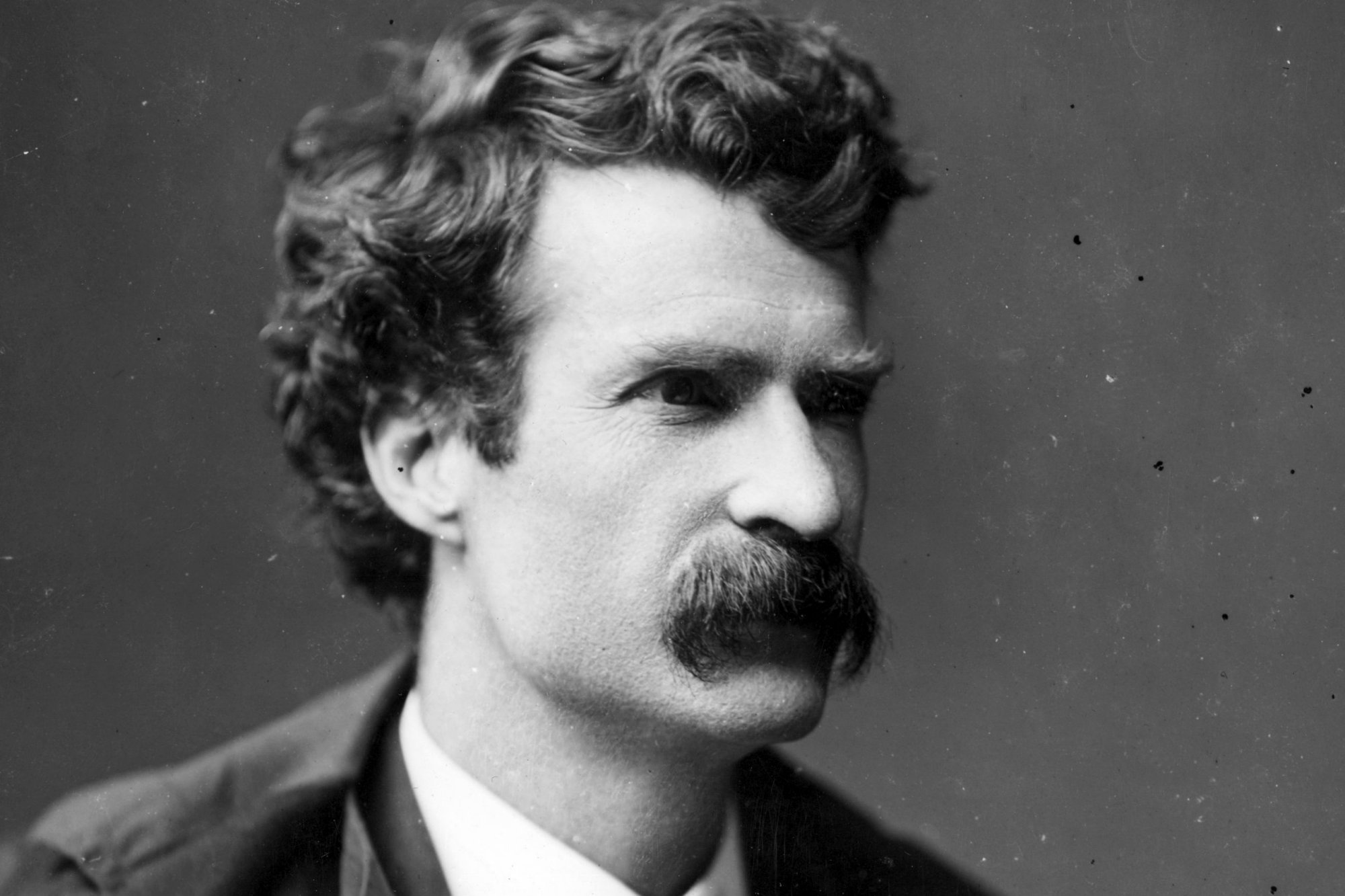
Now that another New Year’s Day has come around, we must once again ask ourselves: do we believe in New Year’s resolutions, or don’t we? As with most institutions, Mark Twain, that most quoted of all American humorists, both believed and didn’t believe in them. Or maybe we could say that his lack of belief transcended run-of-the-mill cynicism to become a kind of devout faith in human folly itself.
Here we have a few words on the subject from the man himself, first published in the January 1, 1863 edition of the Territorial Enterprise, the Virginia City, Nevada newspaper where the young Twain worked for a time:
Now is the accepted time to make your regular annual good resolutions. Next week you can begin paving hell with them as usual. Yesterday, everybody smoked his last cigar, took his last drink, and swore his last oath. To-day, we are a pious and exemplary community. Thirty days from now, we shall have cast our reformation to the winds and gone to cutting our ancient short comings considerably shorter than ever. We shall also reflect pleasantly upon how we did the same old thing last year about this time. However, go in, community. New Year’s is a harmless annual institution, of no particular use to anybody save as a scapegoat for promiscuous drunks, and friendly calls, and humbug resolutions, and we wish you to enjoy it with a looseness suited to the greatness of the occasion.
Twain made a career of skewering the countless pieties of American life, and the culture’s perhaps overzealous spirit of self-improvement provided him a vast and never fully deflatable target. His assessment feels as true today, and makes us laugh just as much today, as it must have 153 years ago. So keep enjoying the friendliness, festivity, and human comedy of the New Year’s holiday as Twain would have. If you do make a resolution, keep it to a manageable level of morality. And don’t forget to revisit the other perspectives on New Year’s we’ve previously featured from such other cultural luminaries as Neil Gaiman, Bob Dylan, Woody Guthrie, and Marilyn Monroe.
Related Content:
A New Year’s Wish from Neil Gaiman
The Top 10 New Year’s Resolutions Read by Bob Dylan
Marilyn Monroe’s Go-Getter List of New Year’s Resolutions (1955)
Based in Seoul, Colin Marshall writes and broadcasts on cities and culture. He’s at work on a book about Los Angeles, A Los Angeles Primer, the video series The City in Cinema, the crowdfunded journalism project Where Is the City of the Future?, and the Los Angeles Review of Books’ Korea Blog. Follow him on Twitter at @colinmarshall or on Facebook.
Read More...Patti Smith Creates a Detailed Packing List for Going on Tour: Haruki Murakami Books, Loquat Tea & More
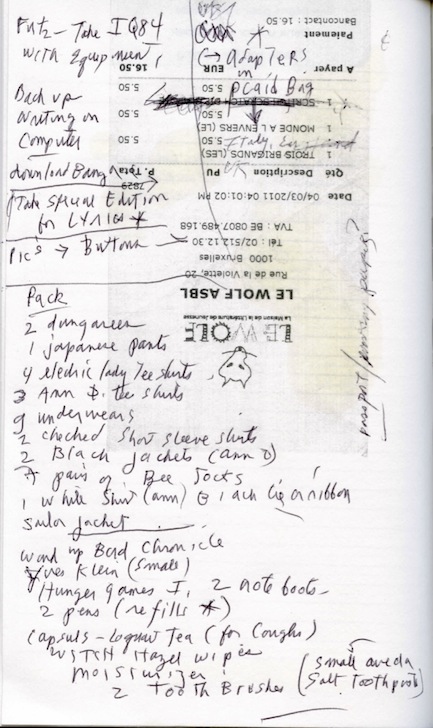
Packing lists are not inherently punk rock.
But the handwritten packing list Godmother of Punk Patti Smith scrawled upside down on a photocopied receipt from a children’s bookstore on the eve of a 40-date European tour comes close. One can kind of imagine her stuffing her adaptors, her Japanese pants, and her “9 underwears” into a shopping bag or a dirty day pack, using it as a pillow in the back of the van…
Behold the reality, below.

Smith’s hard shell case is kitted out with practiced precision, its contents pared to the leanest of luxury-brand necessities to keep her happy and healthy on the road.
It’s not often you find a devotee of Ann Demeulemeester black jackets and $8 toothpaste who’s willing to nightly wring their socks and undies over a hotel room sink, but according to her Banga tour diary, Smith is.
Other essentials in Smith’s tour bag include loquat tea for her throat and plenty of reading material. In addition to the Hunger Games, she elected to take along some old favorites from author Haruki Murakami:
I decide this will be essentially a Haruki Murakami tour. So I will take several of his books including the three volume IQ84 to reread. He is a good writer to reread as he sets your mind to daydreaming while you are reading him. thus i always miss stuff.
Readers, use the comments section to let us know what indispensable items you would pack when embarking on a 40-city tour with Patti Smith.
Related Content:
Patti Smith’s List of Favorite Books: From Rimbaud to Susan Sontag
Ayun Halliday is an author, illustrator, and Chief Primatologist of the East Village Inky zine. Her play, Fawnbook, opens in New York City later this fall. Follow her @AyunHalliday
Read More...Great “Filmumentaries” Take You Inside the Making of Spielberg’s Raiders of the Lost Ark & Jaws
Jamie Benning, an Englishman who edits live television broadcasts of auto races by day, spends all his nights pursuing his appreciation for Hollywood blockbusters of the 1970s and 80s — or at least I assume he does, given how much effort and enthusiasm obviously goes into his signature “filmumentaries,” long-form videos on the making of his favorite movies, packed with all the behind-the-scenes footage, storyboards, alternate takes, interviews, and every other bit and piece of media pertaining to the production on which he can lay his hands. Earlier this year, we featured his filmumentaries on the original Star Wars trilogy; today, we give you his filmumentarization of the work of Steven Spielberg, specifically Jaws and Raiders of the Lost Ark.
Even casual filmgoers will recognize these movies, and they’ll feel, shortly after pressing play on Benning’s Inside Jaws and Raiding the Lost Ark, as if they’ve just settled in to watch them again, though they’ll see them as they never have before. Serious film fans will, as the form of the filmumentary emerges, recognize the basis of the concept. Described as “visual commentaries,” these productions take the concept of the commentary track and step it up considerably, overlaying the original film’s soundtrack with the words of a veritable chorus of those who worked on it — actors (even some not ultimately cast), crew members, designers, producers, hangers-around — sourced and sometimes even recorded by Benning.
The lineup even includes Spielberg himself, who famously doesn’t record commentary tracks, but whose interviews given over the decades Benning credibly repurposes into their form. As we hear all this while watching these movies we know so well, we also see all manner of relevant footage related to their making, just the sort of avenue of cinephilic pleasure I once imagined the DVD player’s “angle” button would open up. The facts also keep flowing, in Raiding the Lost Ark, in the form of onscreen text, just like those older DVD releases that offered a separate subtitle track with pop-up production notes. Sample: “Due to difficult terrain, the donkeys had to be airlifted by helicopter to the shooting location.”
Spielberg has explained his refusal to do commentaries in terms of his reluctance to break the illusion he and his collaborators work so hard to create in their movies — a fair concern, but when I immerse myself in the rich oscillation between and mixture of illusion and reality, fiction and fact, movies and their making, the story and the stories behind pioneered by Benning’s filmumentaries, I feel ready to see a few more illusions so fascinatingly broken.
Related Content:
Spielberg Reacts to the 1975 Oscar Nominations: ‘Commercial Backlash!’
Watch Steven Spielberg’s Rarely Seen 1968 Film, Amblin’
Learn the Elements of Cinema: Spielberg’s Long Takes, Scorsese’s Silence & Michael Bay’s Shots
Based in Seoul, Colin Marshall writes and broadcasts on cities and culture. He’s at work on a book about Los Angeles, A Los Angeles Primer, the video series The City in Cinema, the crowdfunded journalism project Where Is the City of the Future?, and the Los Angeles Review of Books’ Korea Blog. Follow him on Twitter at @colinmarshall or on Facebook.
Read More...The First Adult Coloring Book: See the Subversive Executive Coloring Book From 1961
Since the Harry Potter craze began, we’ve seen young adult fiction gain massive popularity with adults, in ways some critics have lamented as a trend that infantilizes the buying public. (Some say the same about superhero films and adult fans of boy bands). Katie Couric identified the phenomenon as “the rise of so-called Peter Pan activities,” throwing “adult summer camps and Lego leagues” in the mix. Critics of Peter Panism can add another trend to their battery of examples: the rise of the adult coloring book. Business Insider reported in April that “in Britain, four out of the top 10 Amazon bestsellers are coloring (or colouring, as the Brits insist) books for adults.” Currently, Amazon’s top 20 bestsellers for 2015 includes three adult coloring books. Among so many other consumer signs and portents, adult coloring books may indeed herald a coming apocalypse, at least for Russell Brand, who wonders, “What has turned us into terrified divs that want to live in childish stupors?”
Well, whether “childish,” art therapy or “Zen,” adult coloring books meet a need millions of grown-ups have to soothe their jangled nerves, and it seems almost cruel to mock people so anxiety-ridden they’ve returned to kindergarten remedies. Then again, it’s worth noting, as Smithsonian did recently, “the adult coloring concept is not exactly new.”
It dates back to the 1960s, when “bookstores exploded” with coloring books geared exclusively toward adults. The difference between then and now lies in the fact that those books were adult in content as well as form—“satirical and subversive,” offering “a mocking look at American society.” The first of these, The Executive Coloring Book, arrived in 1961, followed by The John Birch Society Coloring Book and many similar titles “satirizing conformism, John F. Kennedy and the Soviet Union,” among other targets. And yet, “Unlike the adult coloring books flying off the shelves today,” Smithsonian writes, “these books were not created with the intention to be colored in.”

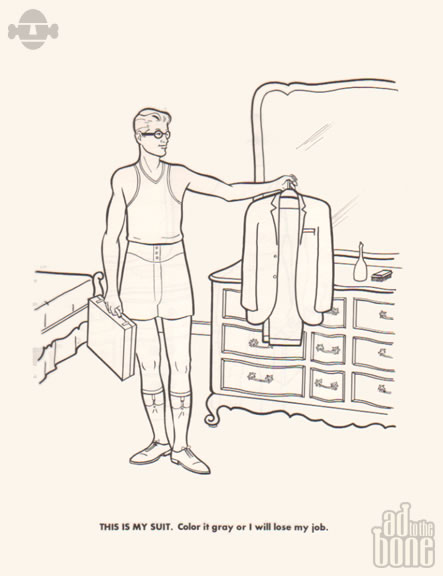
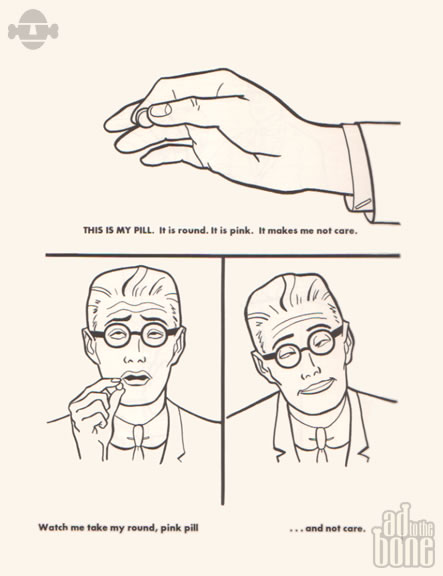
Take the two pages from The Executive Coloring Book above. The first, at the top, shows us our executive preparing for his day with the caption “THIS IS MY SUIT. Color it gray or I will lose my job.” Above, a line of identical executives boards a train. Hammering home the point, we’re told “THIS IS MY TRAIN. It takes me to my office every day. You meet lots of interesting people on the train. Color them all gray.” A notable exception to these dreary instructions, below, tells us “THIS IS MY PILL. It is round. It is pink. It makes me not care. Watch me take my round, pink pill… and not care.” The contents of the pill may have changed, but the medicated worker bee is still very much with us, though the gray flannel suit is a thing of the past.
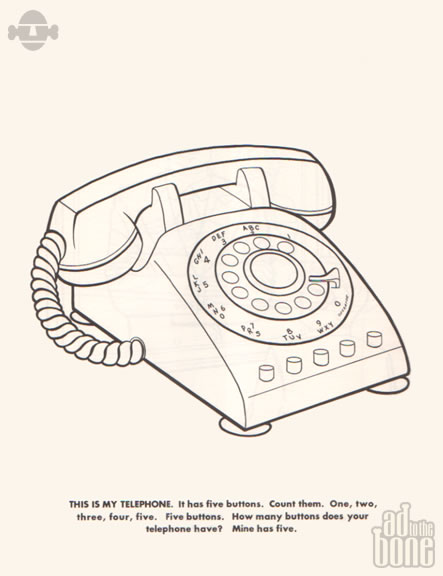
Rather than giving its target audience a chance to become kids again, The Executive Coloring Book pokes fun at the ways in which pampered executives of the Mad Men-era could themselves be shallow manchildren. One page, below, shows the executive’s secretary with the caption “THIS IS MY SECRETARY. I hate her. She is mean. I used to have a soft, round lady. But my wife called her papa.” Another (bottom), reminiscent of the business card scene in American Psycho, shows us the executive’s important phone: “THIS IS MY TELEPHONE. It has five buttons. Count them. One, two, three, four, five. Five buttons. How many buttons does your telephone have? Mine has five.”
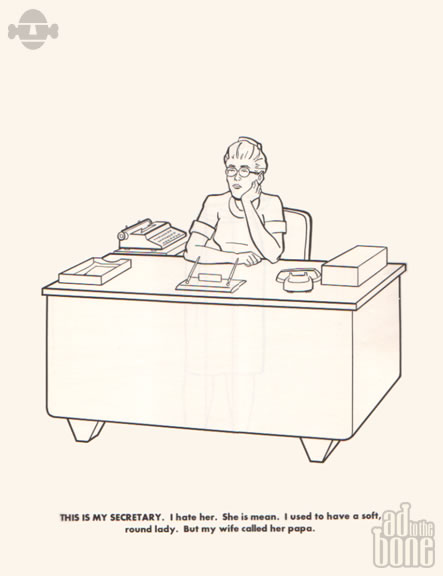
From its faux-leather cover to its final page of business-speak gibberish, the whole thing is a masterfully simple, self-contained piece of conceptual art. The next publication by the same authors, The John Birch Coloring Book, made its intentions a little more obvious. A Sunday Herald review quotes from its introduction: “This book is respectfully dedicated to Dwight D. Eisenhower and many other loyal Americans who have been maligned by extremist groups.” One caption reads “This is our eagle. We cut off his left wing. Now he is an all American eagle. But he flies only in circles.” The “Birchers will have to learn to smile,” writes the reviewer, as the book “spare[s] not their feelings.” Not likely. Rather than selling relaxation, the adult coloring books of the 60s were “engaged,” wrote Milton Bracker in a 1962 New York Times review, “in political warfare.”
via Smithsonian and Ad to the Bone
Related Content:
Download 15,000+ Free Golden Age Comics from the Digital Comic Museum
Dr. Seuss Draws Anti-Japanese Cartoons During WWII, Then Atones with Horton Hears a Who!
Read More...Sartre Writes a Tribute to Camus After His Friend-Turned-Rival Dies in a Tragic Car Crash: “There Is an Unbearable Absurdity in His Death”
The friendship of Jean-Paul Sartre and Albert Camus ended, famously, in 1951. That year, increasingly fractious political tensions between the two philosopher-writers came to a head over the publication of Camus’ The Rebel, a book-length essay that marked a departure from revolutionary thought and a turn toward a more pragmatic individualism (as well as recalling the anarcho-syndicalism Camus had embraced in the 30s). The doctrinaire Sartre and his intellectual coterie took exception, and while Sartre further pursued a Marxist political program, informed by a critique of racism and colonialism, Camus confronted the absurd; he “begins to sound more like Samuel Beckett,” writes Andy Martin at the New York Times’ philosophy blog, “all alone, in the night, between continents, far away from everything.”
The two split not only over ideas, however: after the war, Camus became increasingly disillusioned with Stalin’s totalitarian Soviet rule, while Sartre made what Camus considered weak attempts to defend or excuse the regime’s crimes. At first, writes Volker Hage in Der Spiegel, their disagreements were “limited to a relatively small group of intellectuals.” Then Sartre published Francis Jeanson’s scathing review of The Rebel in the journal Sartre founded in 1945, Les Temps Modernes. (See Jeanson discuss the review in the video interview below, excerpted from the short documentary on Sartre and Camus at the top of the post). Camus, Hage writes, “made the mistake of sending a long rejoinder. What followed was a tragic dissolution of what had once been a friendship.”
Sartre made his final kiss-off very public, printing in Les Temps Modernes a “merciless” response, “insidious and malicious, yet also a magnificent masterpiece of personal polemics.” Almost ten years later, in 1960, Camus was killed in a car accident at the age of 46. Though the two never formally reconciled, Sartre penned a heartfelt tribute to his former friend in The Reporter that contained none of the vitriol of his past condemnations. Instead, he describes their falling out in the terms one might use for a former lover:
He and I had quarreled. A quarrel doesn’t matter — even if those who quarrel never see each other again — just another way of living together without losing sight of one another in the narrow little world that is allotted us. It didn’t keep me from thinking of him, from feeling that his eyes were on the book or newspaper I was reading and wondering: “What does he think of it? What does he think of it at this moment?”
Sartre confesses his uneasiness with Camus’ moody silence, “which according to events and my mood I considered sometimes too cautious and sometimes too painful.” It was a silence that seemingly overtook Camus in his final years as he retreated from public life, and though Camus’ fierce individualism lay at the heart of their falling-out, Sartre wrote in deep appreciation of his friend and antagonist’s solitude and stubborn resoluteness:
He represented in our time the latest example of that long line of moralistes whose works constitute perhaps the most original element in French letters. His obstinate humanism, narrow and pure, austere and sensual, waged an uncertain war against the massive and formless events of the time. But on the other hand through his dogged rejections he reaffirmed, at the heart of our epoch, against the Machiavellians and against the Idol of realism, the existence of the moral issue.
In a way, he was that resolute affirmation. Anyone who read or reflected encountered the human values he held in his fist; he questioned the political act. One had to avoid him or fight him-he was indispensable to that tension which makes intellectual life what it is.
Camus’ “silence,” the theme of Sartre’s tribute, “had something positive about it.” The former harshness of Sartre’s critiques softens as he chides Camus’ refusal “to leave the safe ground of morality and venture on the uncertain paths of practicality.” Camus’ confrontation with the Absurd, writes Sartre, with “the conflicts he kept hidden… both requires and condemns revolt.”
At the bitter end of their friendship, Sartre viciously condemned the contradictions of Camus’ political thought as the product of personal failings, telling him, “You have become the victim of an excessive sullenness that masks your internal problems. Sooner or later, someone would have told you, so it might as well be me.” In his final tribute to Camus, he returns to this idea, in much different language, writing that, at the age of 20, Camus had become “suddenly afflicted with a malady that upset his whole life”; he had “discovered the Absurd—the senseless negation of man.” Rather than succumbing, however—Sartre writes—Camus “became accustomed to it, he thought out his unbearable condition, he came through.”
After the car accident, Sartre acknowledged Camus’ fierce individualism and principle in the face of life’s absurdity as an existential triumph rather than a handicap: “We shall recognize in that work and in the life that is inseparable from it the pure and victorious attempt of one man to snatch every instant of his existence from his future death.”
Read the full tribute essay in a downloadable PDF format here.
Related Content:
Hear Albert Camus Deliver His Nobel Prize Acceptance Speech (1957)
The Absurd Philosophy of Albert Camus Presented in a Short Animated Film by Alain De Botton
Josh Jones is a writer and musician based in Durham, NC. Follow him at @jdmagness
Read More...Discover The Music Vault: A Massive YouTube Archive of 22,000 Live Concert Videos
Last summer, we highlighted an almost unbelievably rich resource for music fans: the Music Vault, a Youtube archive of 22,000 live concert videos from a range of artists, spanning about four decades into the present. In a time of soaring ticket prices, the Music Vault allows us to catch a show at home for free, and to see bands we missed in their heyday perform on stages around the world. Last summer, I wrote, “enjoy revisiting the glory days and rest assured, they aren’t going away anytime soon.” But I spoke too soon, as many Music Vault videos (there were only 13,000 then) began disappearing, along with the nostalgia and hip currency they offered. Well, now they’re back up and running, and let’s hope it’s for good.
Unsurprisingly—given its association with Wolfgang’s Vault, a restoration and archive project that began with the collection of legendary concert promoter Bill Graham—the Music Vault’s storehouse includes perhaps more Grateful Dead material than anything else, like the nearly six hour Winterland concert above from 1978. Check out the intro interview with now Senator, then comedian Al Franken, doing some political humor for radio station KSAN. (And see Franken do another Dead intro skit in 1980 at Radio City Music Hall here.) There’s so much Grateful Dead in fact, they get their own channel. You’ll also find plenty more live classic rock shows from Neil Young, Lynyrd Skynyrd, Van Morrison, the Stones, Joe Cocker, and more. (Check out this rare show from a pre-Van Halen Sammy Hagar in 1978.)
If that’s not what you’re into, there’s also plenty of punk and new wave, like the classic Talking Heads performance of “Life During Wartime” above at the Capitol Theatre from 1980 (see the complete concert here). You can also catch Iggy Pop in ’86, Blondie in ’79, the Ramones in ’78, Prince in ’82, or Green Day in ’94. You don’t get the cred from saying you were there, whatever that’s worth, but you get the thrill of seeing these artists in their prime, (almost) live and direct. Fancy more contemporary fare? Check out the New Music Discovery channel with live performances from current acts, curated by Daytrotter and Paste Magazine. Dig funk, soul, and reggae? They’ve got you covered, with shows from Parliament-Funkadelic, Jimmy Cliff, Curtis Mayfield, and many more. See Bob Marley and the Wailers do a stellar rendition of “No Woman, No Cry” at the Oakland Auditorium in 1979, below.
More of a jazz cat? No worries, Music Vault has an extensive jazz channel featuring everyone from Miles Davis to Herbie Hancock to Tony Bennet, and including newer artists like vocalist Lizz Wright and trio The Bad Plus. (They’ve even got a surprising performance from Orange is the New Black’s Lea DeLaria at the Newport Jazz Festival in 2002.) The Music Vault also hosts classic music documentaries and interviews, like the Rolling Stones 1976 European Tour documentary below. (Other highlights include documentary Last Days at the Fillmore and a 1974 interview with Bill Graham.) Whatever your thing is, you’ll probably find a little bit, or a lot, of it in this enormous database of live concert film and video and other features (though almost no pop, r&b, or hip-hop). If you don’t, check back later. The Music Vault promises to add new “hand-curated” concert videos daily.
Related Content:
The Grateful Dead’s Final Farewell Concerts Now Streaming Online
10,173 Free Grateful Dead Concert Recordings in the Internet Archive
What Was Your First Live Concert? We’ll Show You Ours, Share Yours.
The Clash Live in Tokyo, 1982: Watch the Complete Concert
Josh Jones is a writer and musician based in Durham, NC. Follow him at @jdmagness
Read More...How to Get Started: John Cage’s Approach to Starting the Difficult Creative Process
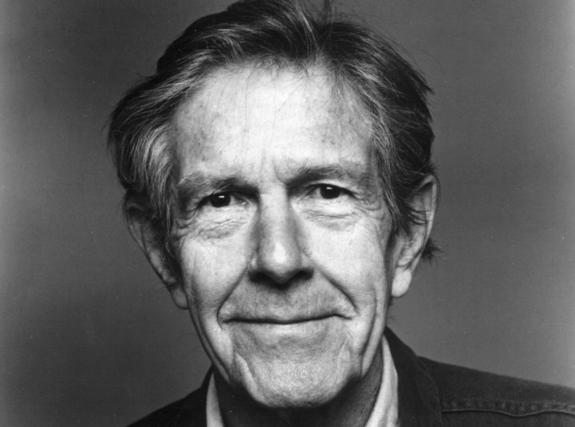
Image by WikiArt, via Wikimedia Commons
You know what they say: eighty percent of the work you do on a project, you do getting the last twenty percent of that project right. But most of that other twenty percent of the work must go toward getting started in the first place; you’ve got to get over a pretty big hill just to get to the point of writing the first sentence, painting the first stroke, shooting the first shot, or playing the first chords. Avant-garde composer John Cage knew well the challenges of just getting started, and his thoughts on the subject motivated him, toward the end of his career, to do the written, performed, and recorded project we feature today, How to Get Started.
Cage himself only put on How to Get Started once, at an international conference on sound design at George Lucas’ Skywalker Ranch on August 31, 1989. It worked like this: he brought with him ten note cards, each of which contained notes for a particular “idea” he wanted to talk about. On went a tape recorder, and he began speaking improvisationally about the first idea. Then he flipped to the next card, and as he talked about its idea, the recording of the first one played in the background. He continued with this procedure until, by the tenth idea on the tenth card, he had his impromptu speeches on all nine previous ideas playing simultaneously behind him. You can get an idea of what his readings sounded like in the three clips (from howtogetstarted.org) embedded here [first, second, third].
The ten ideas Cage jotted down on his notecards come inspired by, and inspired him to discuss further, his own creative experiences. In the first, he describes a new compositional process that came to him in a dream, which involves crumpling a score into a ball and unfolding it again. In the third, he thinks back to his work Roaratorio, an Irish circus on Finnegans Wake, which converted Joyce’s novel into music, and imagines a way forward that would involve turning into music not one book at a time but several. In the fifth, he references Marcel Duchamp’s “The Creative Act,” which brought home for him the notion of how audiences “finish the work by listening,” which led to his creating works of “musical sculpture,” including one particularly memorable example involving “between 150 and 200” Yugoslavian high school students, all playing their instruments in different places.
Cage’s other stories of creative epiphany in How to Get Started involve a trip to an anechoic chamber; finding out what made one dance performance at the University of North Carolina School of the Arts so “tawdry, shabby, miserable”; discovering the artist’s “inner clock” in Leningrad; and how he works around what no less a musical mind than Arnold Schoenberg diagnosed as his absent sense of harmony. You can read a transcript of all of them in a PDF of How to Get Started’s companion booklet. And depending upon how inspired you find yourself (or how close you live to Philadelphia), you might consider making the trip to the Slought Foundation, who have built a room specially designed for the piece. You might not come out of it feeling like you’ve absorbed all the creativity of John Cage, but he himself points us toward the important thing: not the amorphous quality of creativity, but the action of getting started.
Related Content:
The Universal Mind of Bill Evans: Advice on Learning to Play Jazz & The Creative Process
Isaac Asimov Explains the Origins of Good Ideas & Creativity in Never-Before-Published Essay
John Cleese’s Philosophy of Creativity: Creating Oases for Childlike Play
David Lynch Explains How Meditation Enhances Our Creativity
Jump Start Your Creative Process with Brian Eno’s “Oblique Strategies” Deck of Cards (1975)
Based in Seoul, Colin Marshall writes and broadcasts on cities and culture. He’s at work on a book about Los Angeles, A Los Angeles Primer, the video series The City in Cinema, the crowdfunded journalism project Where Is the City of the Future?, and the Los Angeles Review of Books’ Korea Blog. Follow him on Twitter at @colinmarshall or on Facebook.
Read More...Support Us
We're hoping to rely on loyal readers, rather than erratic ads. Please click the Donate button and support Open Culture. You can use Paypal, Venmo, Patreon, even Crypto! We thank you!

About Us

Open Culture scours the web for the best educational media. We find the free courses and audio books you need, the language lessons & educational videos you want, and plenty of enlightenment in between.
Advertise With Us

FREE UPDATES!
GET OUR DAILY EMAIL
Get the best cultural and educational resources on the web curated for you in a daily email. We never spam. Unsubscribe at any time.
FOLLOW ON SOCIAL MEDIA

Open Culture editor Dan Colman scours the web for the best educational media. He finds the free courses and audio books you need, the language lessons & movies you want, and plenty of enlightenment in between.
Advertise With Us


