Gravity Visualized by High School Teacher in an Amazingly Elegant & Simple Way
Just a few miles down the highway from Open Culture’s gleaming headquarters you will find Los Gatos High School, where Dan Burns, an AP Physics Teacher, has figured out a simple but clever way to visualize gravity, as it was explained by Einstein’s 1915 General Theory of Relativity. Get $20 of spandex, some marbles, a couple of weights, and you’re all good to go. Using these readily-available objects, you can demonstrate how matter warps space-time, how objects gravitate towards one another, and why objects orbit in the way they do. My favorite part comes at the 2:15 mark, where Burns demonstrates the answer to a question you’ve maybe pondered before: why do all planets happen to orbit the sun moving in a clockwise (rather than counter-clockwise) fashion? Now you can find out why.
If you would like to support the mission of Open Culture, consider making a donation to our site. It’s hard to rely 100% on ads, and your contributions will help us continue providing the best free cultural and educational materials to learners everywhere. You can contribute through PayPal, Patreon, and Venmo (@openculture). Thanks!
Related Content
Bertrand Russell’s ABC of Relativity: The Classic Introduction to Einstein (Free Audio)
Read More...Hear Arthur Miller Read From Death of a Salesman, His Great American Play (1955)
1949’s Death of a Salesman is one of the most enduring plays in the American canon, a staple of both community and professional theater.
Playwright Arthur Miller recalled that when the curtain fell on the first performance, there were “men in the audience sitting there with handkerchiefs over their faces. It was like a funeral.”
Robert Falls, Artistic Director of Chicago’s Goodman Theater, brings the experience of dozens of productions to bear when he describes it as the only play that “sends men weeping into the Men’s room.”
Small wonder that the titular part has become a grail of sorts for aging leading men eager to be taken seriously. Dustin Hoffman, George C. Scott, and Philip Seymour Hoffman have all had a go at Willy Loman, a role still associated with the towering Lee J. Cobb, who originated it.
(Willy’s wife, Linda, with her famous graveside admonition that “attention must be paid,” is considered no less of a plum part.)
On February 2, 1955, Arthur Miller joined Salesman’s first Mrs. Loman, Mildred Dunnock, to read selections from the script before a live audience at Manhattan’s 92nd Street YMCA. In addition to reading the role of Willy Loman, Miller supplied stage directions and explained his rationale for picking the featured scenes. The Pulitzer Prize winner’s New York accent and brusque manner make him a natural, and of course, who better to understand the nuances, motivations, and historical context of this tragically flawed character?
Miller told The New Yorker that he based Loman on his family friend, Manny Newman:
Manny lived in his own mind all the time. He never got out of it. Everything he said was totally unexpected. People regarded him as a kind of strange, completely untruthful personality. Very charming. I thought of him as a kind of wonderful inventor. For example, at will, he would suddenly say, “That’s a lovely suit you have on.” And for no reason at all, he’d say, “Three hundred dollars.” Now, everybody knew he never paid three hundred dollars for a suit in those days. At a party, he would lie down on his wife’s lap and pretend to be sucking her breast. He’d curl up on her lap—she was an immense woman. It was crazy. At the same time, there was something in him which was terribly moving. It was very moving, because his suffering was right on his skin, you see.
If Miller and Dunnock’s performance leaves you hungry for more, you can see her and Lee J. Cobb reprise their roles on television in a 1966 CBS production. See Act 1 above, and Act 2 here.
Related Content:
Albert Camus Talks About Adapting Dostoyevsky for the Theatre, 1959
Peter Weiss’s Marat/Sade Pushed the Boundaries of Theater, and Still Does
Ayun Halliday is an author, illustrator, and Chief Primatologist of the East Village Inky zine. Her play, Fawnbook, is now playing in New York City . Follow her @AyunHalliday
Read More...Harlan Ellison’s Wonderful Rant on Why Writers Should Always Get Paid
In a perfect world, I could write this post for free. Alas, the rigors of the modern economy demand that I pay regular and sometimes high prices for food, shelter, books, and the other necessities of life. And so if I spend time working on something — and in my case, that usually means writing something — I’d better ask for money in exchange, or I’ll find myself out on the street before long. Nobody understands this better than Harlan Ellison, the hugely prolific author of novels, stories, essays screenplays, comic books, usually in, or dealing with, the genre of science fiction.
Ellison also starred in Dreams with Sharp Teeth, a documentary about his colorful life and all the work he’s written during it, a clip of which you can see at the top of the post. In it, he describes receiving a call just the day before from “a little film company” seeking permission to include an interview clip with him previously shot about the making of Babylon 5, a series on which he worked as creative consultant. “Absolutely,” Ellison said to the company’s representative. “All you’ve got to do is pay me.”
This simple request seemed to take the representative—who went on to insist that “everyone else is just doing it for nothing” and that “it would be good publicity”—quite by surprise. “Do you get a paycheck?” Ellison then asked. “Does your boss get a paycheck? Do you pay the telecine guy? Do you pay the cameraman? Do you pay the cutters? Do you pay the Teamsters when they schlep your stuff on the trucks? Would you go to the gas station and ask them to give you free gas? Would you go to the doctor and have them take out our spleen for nothing?”
This line of questioning has come up again and again since Ellison told this story, as when the journalist Nate Thayer, or more recently Wil Wheaton, spoke out against the expectation that writers would hand out the rights to their work “for exposure.” The pragmatic Ellison frames the matter as follows: “Cross my palm with silver, and you can use my interview.” But do financially-oriented attitudes such as his (“I don’t take a piss without getting paid for it”) taint the art and craft of writing? He doesn’t think so: “I sell my soul,” he admits, “but at the highest rates.”
Related Content:
Stephen King’s Top 20 Rules for Writers
Ray Bradbury on Zen and the Art of Writing (1973)
Colin Marshall writes elsewhere on cities, language, Asia, and men’s style. He’s at work on a book about Los Angeles, A Los Angeles Primer, the video series The City in Cinema, and the crowdfunded journalism project Where Is the City of the Future? Follow him on Twitter at @colinmarshall or on Facebook.
Read More...Horror Legend Christopher Lee Reads Bram Stoker’s Dracula
Did Bram Stoker’s world-famous Dracula character—perhaps the most culturally unkillable of all horror monsters—derive from Irish folklore? Search the Gaelic “Droch-Fhoula” (pronounced droc’ola) and, in addition to the requisite metal bands, you’ll find references to the “Castle of the Blood Visage,” to a blood-drinking chieftain named Abhartach, and to other possible native sources of Irish writer Bram Stoker’s 1897 novel. These Celtic legends, the BBC writes, “may have shaped the story as much as European myths and Gothic literature.”
Despite all this intriguing speculation about Dracula’s Irish origins, the actors playing him have come from a variety of places. One recent incarnation, TV series Dracula, did cast an Irish actor, Jonathan Rhys Meyers, in the role.
Hungarian Bela Lugosi comes closest to the fictional character’s nationality, as well as that of another, perhaps dubious source, Romanian warlord Vlad the Impaler. Protean Brit Gary Oldman played up the character as Slavic aristocrat in Francis Ford Coppola’s somewhat more faithful take. But one too-oft-overlooked portrayal by another English actor, Christopher Lee, deserves much more attention than it receives.
In ten low-budget films made by British exploitation studio Hammer, Lee portrayed the monstrous-yet-seductive blood-sucking nobleman as a very proper Englishman with “a certain lascivious sex appeal”—beginning with 1958’s Horror of Dracula (see a trailer above) and ending with 1973’s The Satanic Rites of Dracula. I find Lee’s Dracula so memorable that I was delighted to hear the audio above of him reading an adaptation of the novel, in ten parts. The video begins with titles and an establishing shot from the Hammer films, then segues to images from a 1966 Dracula graphic novel, the source of the “pretty faithful” adaptation by Otto Binder and Craig Tennis, for which Lee wrote an introduction.
The audio here was also recorded in 1966 by the book’s editor Russ Jones. Comics blogger Steven Thompson remarks that “since Dracula is made up of a series of letters, journal and diary entries, the writers here logically take a more straightforward route of telling the tale while maintaining the episodic feel quite well.” Rather than the voice of Count Dracula, Lee reads as the novel’s epistolary narrator Jonathan Harker, and the Dracula in the artwork, drawn by artist Al McWilliams, “bears more than a passing resemblance here to actor John Carradine,” a notable American actor who played the character in Universal’s House of Frankenstein and House of Dracula. Nonetheless, Lee’s voice is enough to conjure his many exceptional performances as the prototypical vampire, a character and concept that will likely never die.
Scholar and writer Bob Curran, a proponent of the Irish origins of Dracula, argues in his book Vampires that legends of undead, blood-drinking ghouls are found all over the world, which goes a long way toward explaining the enduring popularity of Dracula in particular and vampires in general. We’ll probably see another actor inherit the role of Stoker’s seductively creepy count in the near future. Whoever it is will have to measure himself against not only the performances of Lugosi, Carradine, Oldman, and Meyers, but also against the debonair Christopher Lee. He would do well, wherever he comes from, to study Lee’s Dracula films closely, and listen to him read the story in the adaptation above.
Related Content:
Watch Nosferatu, the Seminal Vampire Film, Free Online (1922)
Hear Edgar Allan Poe’s “The Tell Tale Heart” Read by the Great Bela Lugosi (1946)
800 Free eBooks for iPad, Kindle & Other Devices.
Josh Jones is a writer and musician based in Durham, NC. Follow him at @jdmagness
Read More...Stephen Hawking Wonders Whether Capitalism or Artificial Intelligence Will Doom the Human Race

Creative Commons image via NASA
It shouldn’t be especially controversial to point out that we live in a pivotal time in human history—that the actions we collectively take (or that plutocrats and technocrats take) will determine the future of the human species—or whether we even have a future in the coming centuries. The threats posed by climate change and war are exacerbated and accelerated by rapidly worsening economic inequality. Exponential advances in technology threaten to eclipse our ability to control machines rather than be controlled, or stamped out, by them.
It’s also the case that our most well-regarded scientists and technological innovators have not remained silent in the face of these crises. Physicist Stephen Hawking has issued some dire warnings lately when it comes to humanity’s future. Several years ago, he predicted that “our only chance of long term survival” may be to “spread out into space,” a la Interstellar. In addition to the worsening climate crisis, the rise of artificial intelligence concerns Hawking. Along with Bill Gates and Elon Musk, he has warned of what futurist Ray Kurzweil has called “the singularity,” the point at which machine intelligence surpasses our own.
If you would like to support the mission of Open Culture, consider making a donation to our site. It’s hard to rely 100% on ads, and your contributions will help us continue providing the best free cultural and educational materials to learners everywhere. You can contribute through PayPal, Patreon, and Venmo (@openculture). Thanks!
Where Kurzweil has seen this event through an optimistic, New Age lens, Hawking’s view seems more in line with dystopian sci-fi visions of robot apocalypse. “Success in AI would be the biggest event in human history,” he wrote in The Independent last year, “Unfortunately it might also be the last.” Given the design of autonomous weapons systems and, as he told the BBC, the fact that “Humans, who are limited by slow biological evolution, couldn’t compete and would be superseded,” the prospect looks chilling, but it isn’t inevitable.
Our tech isn’t actively out to get us. “The real risk with AI isn’t malice but competence,” Hawking clarified, in a fascinating Reddit “Ask Me Anything” session last month. Due to the physicist’s physical limitations, readers posted questions and voted on their favorites. From these, Hawking elected the “ones he feels he can give answers to.” In response to a top-rated question about the so-called “Terminator Conversation,” he wrote, “A superintelligent AI will be extremely good at accomplishing its goals, and if those goals aren’t aligned with ours, we’re in trouble.”
This problem of misaligned goals is not of course limited to our relationship with machines. Our precarious economic relationships with each other pose a separate threat, especially in the face of massive job loss due to future automation. We’d like to imagine a future where technology frees us of toil and want, the kind of society Buckminster Fuller sought to create. But the truth is that wealth and income inequality, at their highest levels in the U.S. since at least the Gilded Age, may determine a very different path—one we might think of in terms of “The Elysium Conversation.” Asked in the same AMA Reddit session, “Do you foresee a world where people work less because so much work is automated? Do you think people will always either find work or manufacture more work to be done?,” Hawking elaborated,
If machines produce everything we need, the outcome will depend on how things are distributed. Everyone can enjoy a life of luxurious leisure if the machine-produced wealth is shared, or most people can end up miserably poor if the machine-owners successfully lobby against wealth redistribution. So far, the trend seems to be toward the second option, with technology driving ever-increasing inequality.
For decades after the Cold War, capitalism had the status of an unquestionably sacred doctrine—the end of history and the best of all possible worlds. Now, not only has Hawking identified its excesses as drivers of human decline, but so have other decidedly non-Marxist figures like Bill Gates, who in a recent Atlantic interview described the private sector as “in general inept” and unable to address the climate crisis because of its focus on short-term gains and maximal profits. “There’s no fortune to be made,” he said, from dealing with some of the biggest threats to our survival. But if we don’t deal with them, the losses are incalculable.
Related Content:
187 Big Thinkers Answer the Question: What Do You Think About Machines That Think?
Bertrand Russell & Buckminster Fuller on Why We Should Work Less, and Live & Learn More
Seven Questions for Stephen Hawking: What Would He Ask Albert Einstein & More
Stephen Hawking: Abandon Earth Or Face Extinction
Noam Chomsky Explains Where Artificial Intelligence Went Wrong
Josh Jones is a writer and musician based in Durham, NC. Follow him at @jdmagness
Read More...Citizen Maths: A Free Online Course That Teaches Adults the Math They Missed in High School
Many people still have a major fear of mathematics, having suffered through school and not really having been in the right frame of mind to grasp concepts that we’ve been told will come in handy in our future working lives. When Britons get to the age of 16, many can choose to leave school, escaping the terror of math (or, as they say, maths).
But we shouldn’t live in fear, so along comes Citizen Maths, a UK-based free online course that purports to help adults catch up with Level 2 math (aka what a 16-year-old should know) without getting hit with a ruler or a spit wad. The course is funded by the UFI Charitable Trust, which focuses on providing free education for adults.
The Citizen Maths course currently consists of three units—Proportion, Uncertainty, and Representation. Additional sections on Pattern and Measurements will soon follow. All units come with videos and tests that take about an hour of the viewer’s time. As the narrator says, you can “learn in safety, without fear of being told off or exposed.” The full course takes, on average, about 20 hours.
And the tutorials bring in the real world, not just the abstract. Ratios and odds are experienced through roulette, horse racing, and playing dice. Understanding insurance comes into the tutorial on making decisions. Modeling is explained by trying to understand weather patterns. And proportion is explained through baking recipes and making cocktails.
You will need a Google Account to get started, though, for those without one, there is a simple guide to get you started. The tutorials feature YouTube instruction along with an embedded app called Scratch.
As of this post, three of the five sections are available, with the complete course due up by next year. You can find more advanced Math courses in our collection of Free Online Math Courses.
via BoingBoing
Related Content:
The Unexpected Math Behind Van Gogh’s “Starry Night”
Ted Mills is a freelance writer on the arts who currently hosts the FunkZone Podcast. You can also follow him on Twitter at @tedmills, read his other arts writing at tedmills.com and/or watch his films here.
Read More...Poignant and Unsettling Post-Mortem Family Portraits from the 19th Century

The 19th century witnessed the birth of photography. And, before too long, Victorian society found important applications for the new medium — like memorializing the dead. A recent post on a Dutch version of National Geographic notes that “Photographing deceased family members just before their burial was enormously popular in certain Victorian circles in Europe and the United States. Although adults were also photographed, it was mainly children who were commemorated in this way. In a period plagued by unprecedented levels of infant mortality, post-mortem pictures often provided the only tangible memory of the deceased child.”

Though unusual by modern standards, the pictures played an important role in a family’s grieving process and often became one of its cherished possessions — cherished because it was likely the only photo of the deceased child that families had. During the early days of photography, portraits were expensive, which meant that most families didn’t take pictures during the course of everyday life. It was only death that gave them a prompt.

The practice of taking post mortem pictures peaked in the 19th century, right around the time when “snapshot” photography became more prevalent, allowing families to take portraits at a lower cost, when everyone was in the full swing of life. Hence obviating the need for post-mortem photos. You can learn more about this bygone practice by visiting the Burns Archive or getting the book, Sleeping Beauty: Memorial Photography in America.
via Dutch Nat Geo/ Science Dump
Follow Open Culture on Facebook and Twitter and share intelligent media with your friends. Or better yet, sign up for our daily email and get a daily dose of Open Culture in your inbox. And if you want to make sure that our posts definitely appear in your Facebook newsfeed, just follow these simple steps.
Read More...
Man Ray’s Portraits of Ernest Hemingway, Ezra Pound, Marcel Duchamp & Many Other 1920s Icons
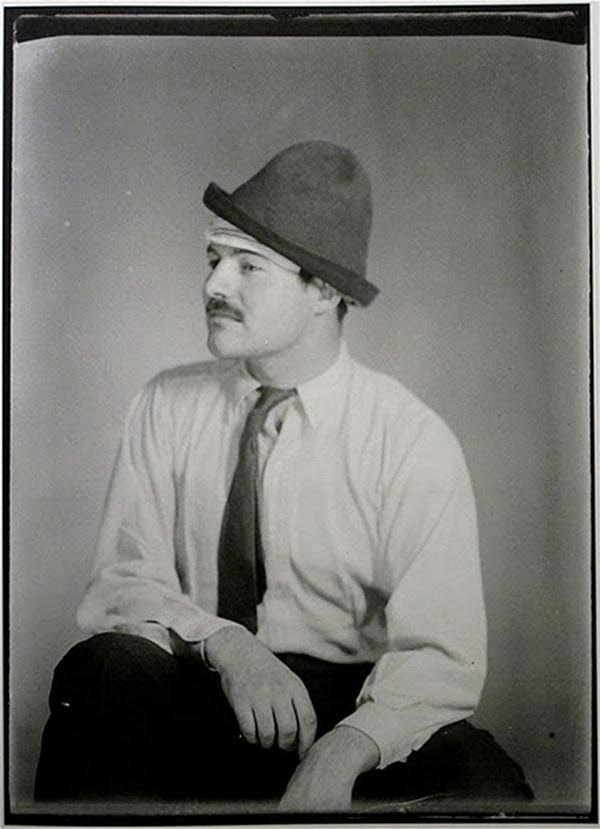
When photographers specialize in portraits of famous people, they often speak of finding a visual way to reveal their oft-photographed subject’s rarely exposed nature; to bring their depths, in other words, to the surface. Man Ray (1890–1976), the Surrealist photographer and artist, had his own way of doing most everything, and he certainly had his own approach to celebrity portraiture. Take, for example, his 1923 shot of Ernest Hemingway above, taken just a couple years after both the writer and photographer joined the moveable feast of Paris, which Man Ray would call home for most of his career.
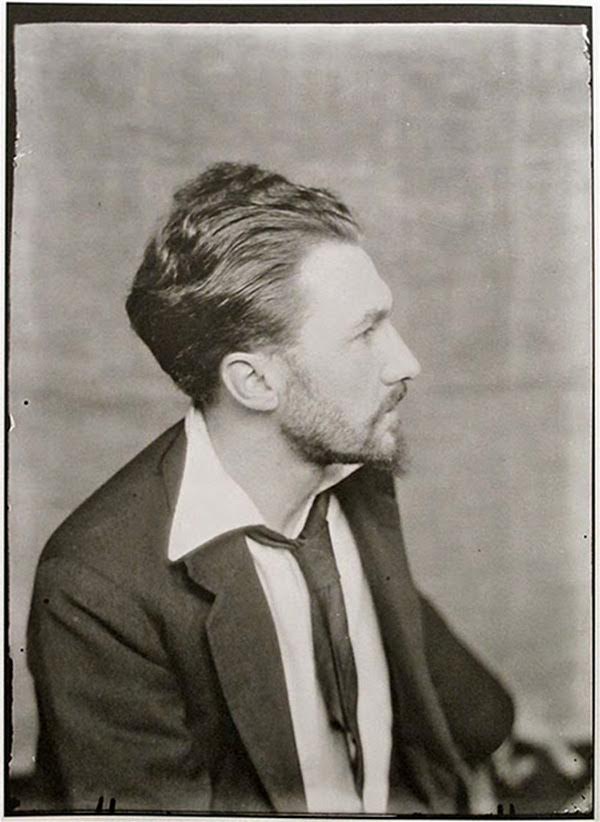
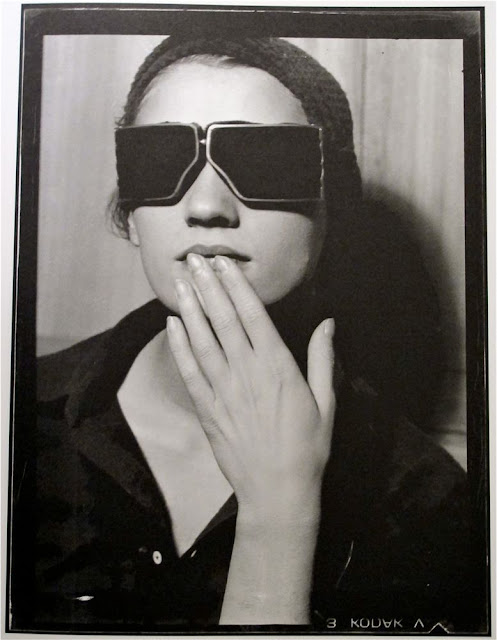
That same year and in that same urban bohemia, Man Ray photographed another famed man of letters, the modernist poet Ezra Pound. You can see the somewhat more conventional-looking result of that encounter just above. Below, we have a far less conventional-looking portrait from 1922, which takes as its subject the dancer Bronislava Nijinska, who perhaps only counts as famous to you if you know the history of 20th-century ballet — but I say anyone willing to appear in a portrait looking that frightening has earned all the fame they can get.

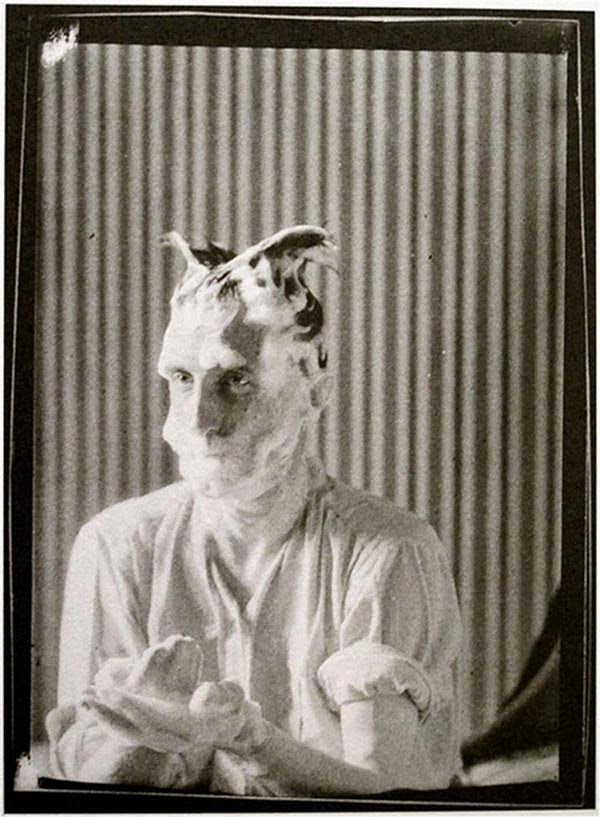
Marcel Duchamp, who appears below, sat for Man Ray in 1921 looking less scary than silly, but as one of the wittiest and most artistically forward-thinking figures of the era, he surely got the joke. These appear in the book Man Ray: Paris — Hollywood — Paris, which collects 500 of the portraits Man Ray left in his archives when he died in 1976, all of “members of Dadaist and Surrealist circles, of artists and painters, of writers and US emigrants of the Lost Generation, of aristocrats, and paragons of the worlds of fashion and theater.”
You can sample more such works, which capture as only Man Ray would the natures of such icons as André Breton, Salvador Dalí, and Lee Miller, at Mondo Blogo. You can also find many more works, in general, by Man Ray on the MoMA’s website.
via Flavorwire
Related Content:
Three Essential Dadaist Films: Groundbreaking Works by Hans Richter, Man Ray & Marcel Duchamp
Philosopher Portraits: Famous Philosophers Painted in the Style of Influential Artists
Coffee Portraits of John Lennon, Albert Einstein, Marilyn Monroe & Other Icons
Colin Marshall writes elsewhere on cities, language, Asia, and men’s style. He’s at work on a book about Los Angeles, A Los Angeles Primer, the video series The City in Cinema, and the crowdfunded journalism project Where Is the City of the Future? Follow him on Twitter at @colinmarshall or on Facebook.
Read More...Read the Entire Comic Book Adaptation of T.S. Eliot’s “The Love Song of J. Alfred Prufrock”
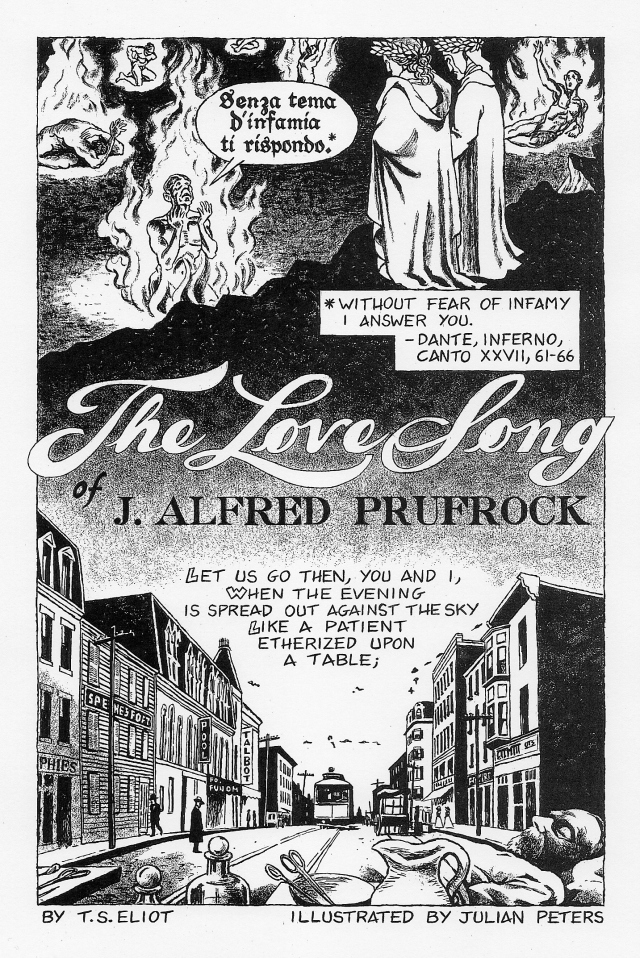
Two years ago, we highlighted for you the beginning of a promising project — Julian Peters’ comic book adaptation of T.S. Eliot’s 1910 poem “The Love Song of J. Alfred Prufrock.” At the time of our post, Peters had only completed the first nine pages of his adaptation. And, about those first pages, our Josh Jones had this to say:
Dante is where “Prufrock” begins, with an epigraph from the Inferno. Peters’ first page illustrates the agonized speaker of Dante’s lines, Guido da Montefeltro, a soul confined to the eighth circle, whom you can see at the top of the title page shown above. Peters’ visual choices place us firmly in the hellish emotional realm of “Prufrock,” a seeming catalogue of the mundane that harbors a darker import. Peters gives us no hint of when we might expect new pages, but I for one am eager to see more.
Happily for Josh … and the rest of us … we can now find out where Peters took the rest of the project. The adaptation is now complete. 24 pages in total. All now on display on Peters’ website here.
If you’re not familiar with “The Love Song of J. Alfred Prufrock,” I’d strongly encourage you to revisit a post in our archive where you can hear “Prufrock” being read by T.S. Eliot himself and also Sir Anthony Hopkins. There you can learn more about Eliot’s modernist masterpiece.
Note: Julian is looking for a publisher to help put his comic book in print. If any publishers want to chat with him, you can find his contact info on his web site.
Follow Open Culture on Facebook and Twitter and share intelligent media with your friends. Or better yet, sign up for our daily email and get a daily dose of Open Culture in your inbox. And if you want to make sure that our posts definitely appear in your Facebook newsfeed, just follow these simple steps.
Related Content:
T.S. Eliot’s Radical Poem “The Love Song of J. Alfred Prufrock,” Read by Anthony Hopkins and Eliot Himself
Listen to T.S. Eliot Recite His Late Masterpiece, the Four Quartets
T.S. Eliot Reads Old Possum’s Book of Practical Cats & Other Classic Poems (75 Minutes, 1955)
Bob Dylan Reads From T.S. Eliot’s Great Modernist Poem The Waste Land
Read More...iTunes Terms & Conditions Adapted into a Graphic Novel: Read It Free Online

In the past, we’ve brought you the creative work of R. Sikoryak. An illustrator who teaches at the Parsons School of Design in NYC, Sikoryak has a penchant for creating comic book adaptations of literary classics. Take for example Dostoyevsky Comics where Batman stars in a comic book version of Crime & Punishment. Or Waiting to Go, which marries Waiting for Godot with Beavis and Butt-Head.
In his latest project, Sikoryak veers sharply away from literature toward language that is much more technical. Now, on his tumblr, you can find iTunes Terms & Conditions: The Graphic Novel.
Adding a new page every day, Sikoryak is creating an illustrated version of the “complete, unabridged legal agreement.” You can currently view the first 49 pages. Click here. Go to the bottom of the page. Then start scrolling up as you read.
Follow Open Culture on Facebook and Twitter and share intelligent media with your friends. Or better yet, sign up for our daily email and get a daily dose of Open Culture in your inbox. And if you want to make sure that our posts definitely appear in your Facebook newsfeed, just follow these simple steps.
Related Content:
Batman Stars in an Unusual Cartoon Adaptation of Dostoyevsky’s Crime and Punishment
Download 15,000+ Free Golden Age Comics from the Digital Comic Museum
Comics Inspired by Waiting For Godot, Featuring Tintin, Roz Chast, and Beavis & Butthead
Read More...Support Us
We're hoping to rely on loyal readers, rather than erratic ads. Please click the Donate button and support Open Culture. You can use Paypal, Venmo, Patreon, even Crypto! We thank you!

About Us

Open Culture scours the web for the best educational media. We find the free courses and audio books you need, the language lessons & educational videos you want, and plenty of enlightenment in between.
Advertise With Us

FREE UPDATES!
GET OUR DAILY EMAIL
Get the best cultural and educational resources on the web curated for you in a daily email. We never spam. Unsubscribe at any time.
FOLLOW ON SOCIAL MEDIA

Open Culture editor Dan Colman scours the web for the best educational media. He finds the free courses and audio books you need, the language lessons & movies you want, and plenty of enlightenment in between.
Advertise With Us